 Скачать презентацию Lumbar Spinal Stenosis Diagnosis and Management A 30
afd7ec0561fbe557f22b879d825e5101.ppt
- Количество слайдов: 20



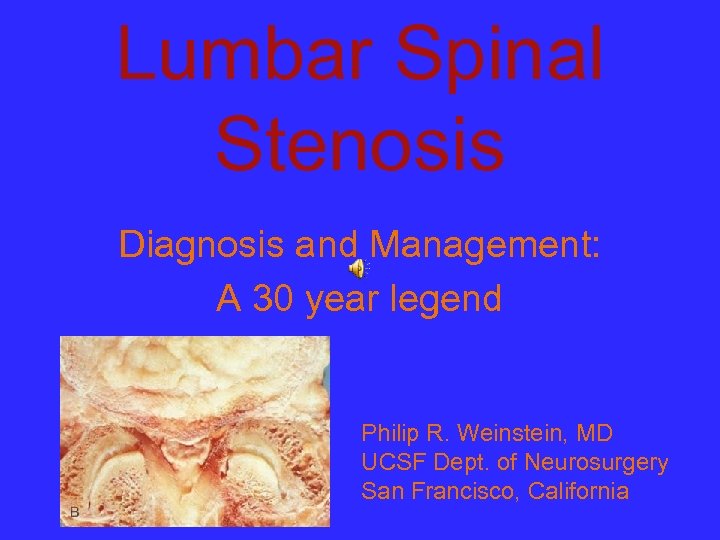
Lumbar Spinal Stenosis Diagnosis and Management: A 30 year legend Philip R. Weinstein, MD UCSF Dept. of Neurosurgery San Francisco, California
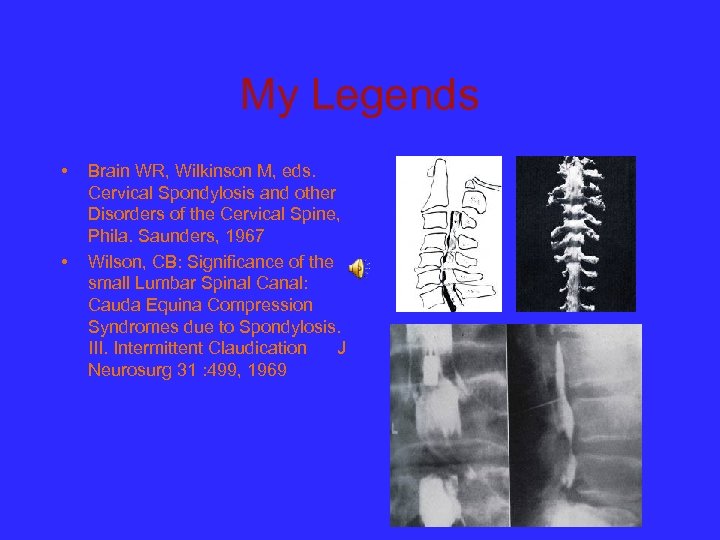
My Legends • • Brain WR, Wilkinson M, eds. Cervical Spondylosis and other Disorders of the Cervical Spine, Phila. Saunders, 1967 Wilson, CB: Significance of the small Lumbar Spinal Canal: Cauda Equina Compression Syndromes due to Spondylosis. III. Intermittent Claudication J Neurosurg 31 : 499, 1969
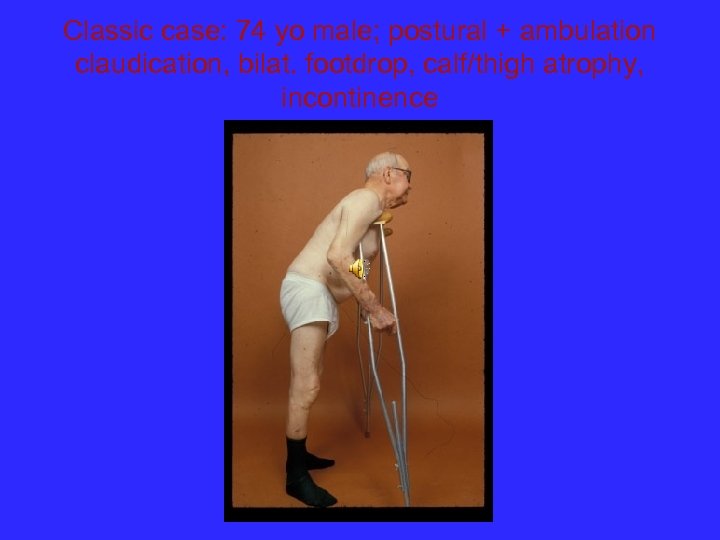
Classic case: 74 yo male; postural + ambulation claudication, bilat. footdrop, calf/thigh atrophy, incontinence
Why so mysterious? • Lumbar spondylostenosis, one of the most common neuro-spinal disorders, was not regularly recognized and treated until 1960. The diagnosis was not considered as an alternative to disc, infection or tumor because: – – – – Stenosis not described/identified Spondylosis not appreciated/visualized Postural radiculopathy not understood Atypical leg pain not interpreted Neurogenic claudication not defined/explained Cauda equina syndrome not diagnosed Role of associated LBP/deformity not appreciated
Why has treatment been unsuccessful (20 -40%)? • • • Clinical history/diagnosis not appreciated Anatomy/imaging misinterpreted Surgical plan incomplete or excessive Surgical decompression inadequate Fusion/fixation omitted/incomplete Post-operative instability; ASD Neuropathic radiculopathy Progressive disc/facet DJD, spondy, scolio Recurrent/progressive stenosis Co-morbidities
Books on Lumbar Stenosis • Neurogenic Intermittent Claudication, Verbiest H, 1976, Elsevier • Lumbar Spondylosis, Weinstein P, et al, 1977, Year Book Medical • Cheirolumbar Dysostosis, Wachenheim A, et al, 1980, Springer • Lumbar Spinal Stenosis, Postacchini F, et al, 1989, Springer • Lumbar Spinal Stenosis, Andersson GBJ, et al, 1992, Mosby-Year Book • Lumbar Spinal Stenosis, Gunzberg R, et al, 2000, Lippincott-Williams&Wilkins
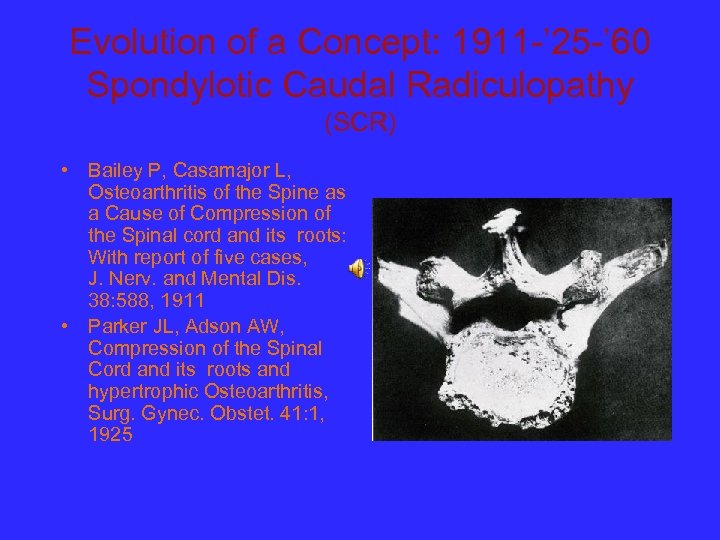
Evolution of a Concept: 1911 -’ 25 -’ 60 Spondylotic Caudal Radiculopathy (SCR) • Bailey P, Casamajor L, Osteoarthritis of the Spine as a Cause of Compression of the Spinal cord and its roots: With report of five cases, J. Nerv. and Mental Dis. 38: 588, 1911 • Parker JL, Adson AW, Compression of the Spinal Cord and its roots and hypertrophic Osteoarthritis, Surg. Gynec. Obstet. 41: 1, 1925
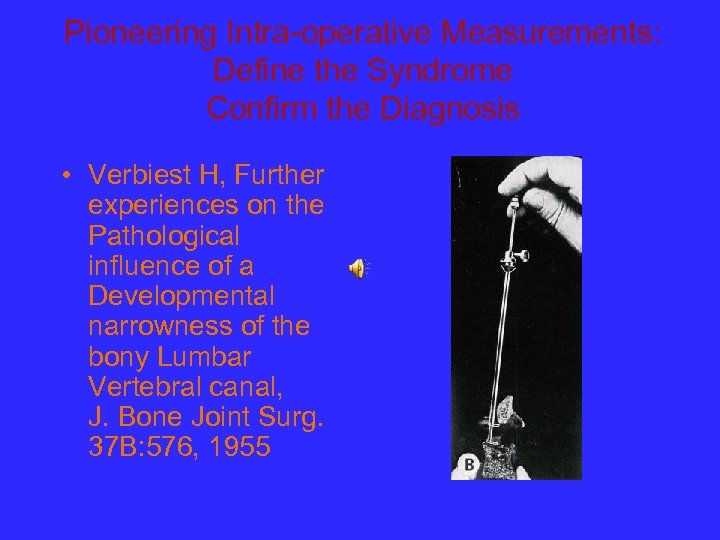
Pioneering Intra-operative Measurements: Define the Syndrome Confirm the Diagnosis • Verbiest H, Further experiences on the Pathological influence of a Developmental narrowness of the bony Lumbar Vertebral canal, J. Bone Joint Surg. 37 B: 576, 1955
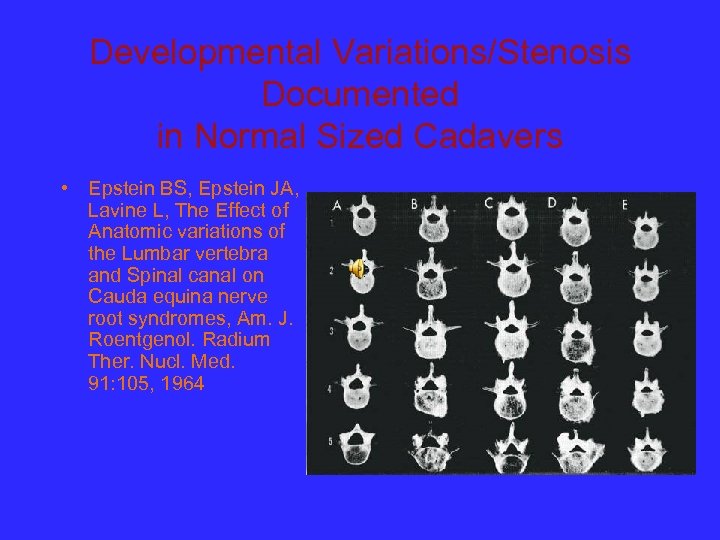
Developmental Variations/Stenosis Documented in Normal Sized Cadavers • Epstein BS, Epstein JA, Lavine L, The Effect of Anatomic variations of the Lumbar vertebra and Spinal canal on Cauda equina nerve root syndromes, Am. J. Roentgenol. Radium Ther. Nucl. Med. 91: 105, 1964
Vertebral Embryology • Unique paired growth centers for neural arch; vertebral body centers unite at 9 weeks • Premature arrest only dorsally in LS; both arch and body in dwarfism • Conus reaches L 2; 22 weeks gestation • Most rapid canal growth; 18 -36 weeks • L 3 -4 canal 80% at birth; 100%-1 year; stops • L 5 canal 50% at birth; 100%-5 years • Canal deficiency: birth age/weight, mater. age • L 5 trefoil canal: 15 -25% Papp T, et al, JBJS 1995, 77 B: 469 -472 Angevine JB, Clin. NS 1973, 20: 95 -113
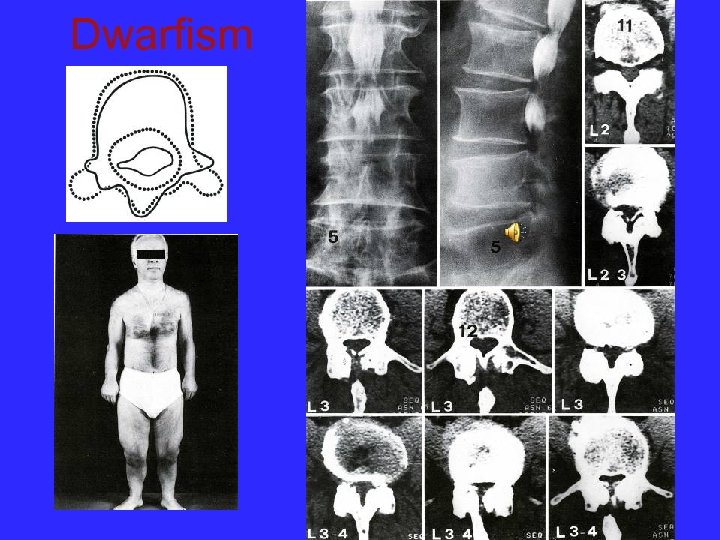
Dwarfism
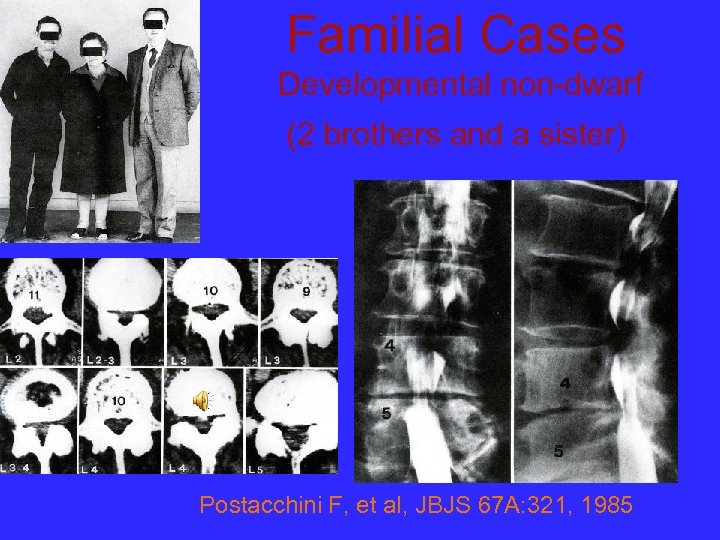
Familial Cases Developmental non-dwarf (2 brothers and a sister) Postacchini F, et al, JBJS 67 A: 321, 1985
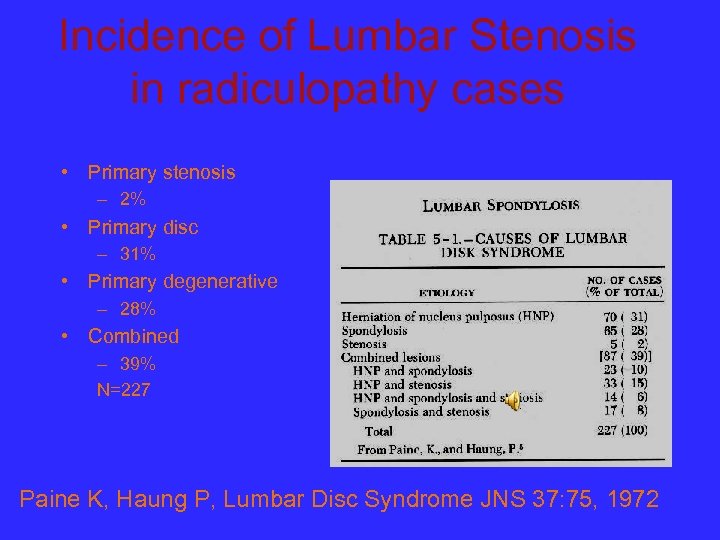
Incidence of Lumbar Stenosis in radiculopathy cases • Primary stenosis – 2% • Primary disc – 31% • Primary degenerative – 28% • Combined – 39% N=227 Paine K, Haung P, Lumbar Disc Syndrome JNS 37: 75, 1972
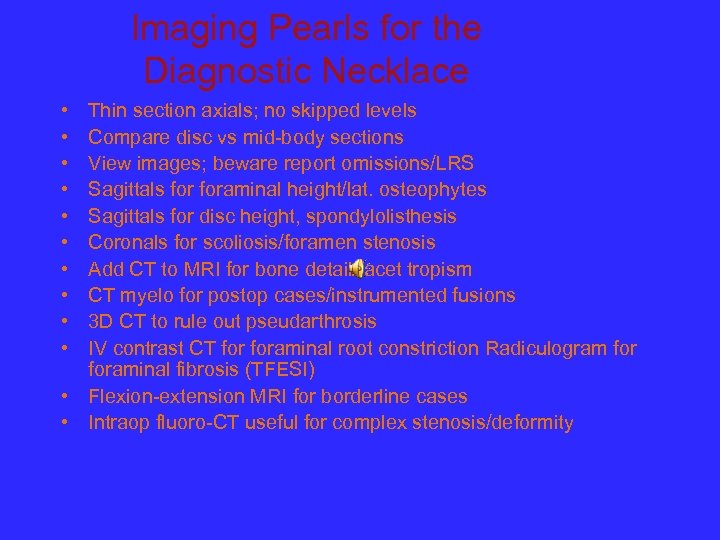
Imaging Pearls for the Diagnostic Necklace • • • Thin section axials; no skipped levels Compare disc vs mid-body sections View images; beware report omissions/LRS Sagittals foraminal height/lat. osteophytes Sagittals for disc height, spondylolisthesis Coronals for scoliosis/foramen stenosis Add CT to MRI for bone detail/facet tropism CT myelo for postop cases/instrumented fusions 3 D CT to rule out pseudarthrosis IV contrast CT foraminal root constriction Radiculogram foraminal fibrosis (TFESI) • Flexion-extension MRI for borderline cases • Intraop fluoro-CT useful for complex stenosis/deformity
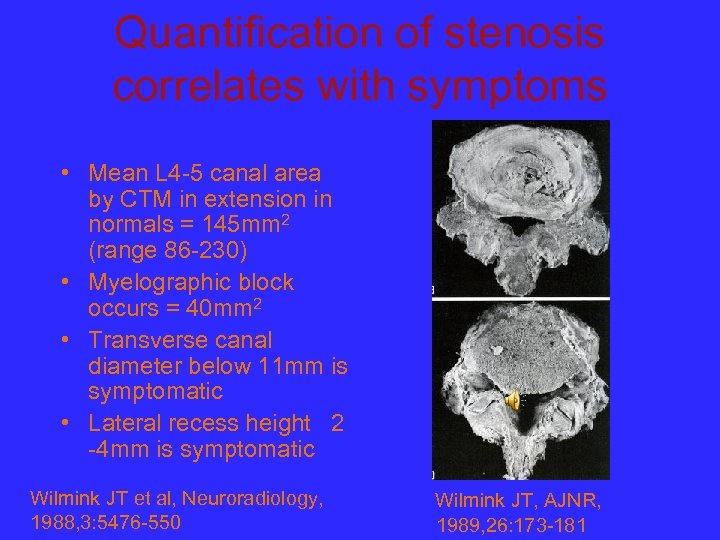
Quantification of stenosis correlates with symptoms • Mean L 4 -5 canal area by CTM in extension in normals = 145 mm 2 (range 86 -230) • Myelographic block occurs = 40 mm 2 • Transverse canal diameter below 11 mm is symptomatic • Lateral recess height 2 -4 mm is symptomatic Wilmink JT et al, Neuroradiology, 1988, 3: 5476 -550 Wilmink JT, AJNR, 1989, 26: 173 -181
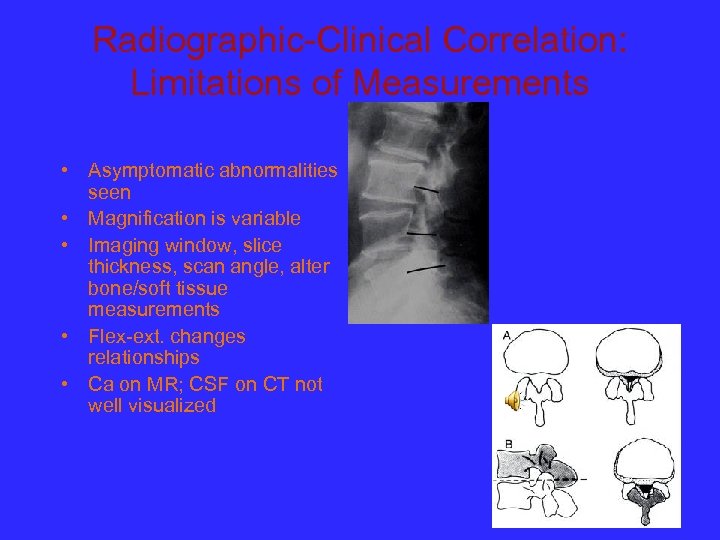
Radiographic-Clinical Correlation: Limitations of Measurements • Asymptomatic abnormalities seen • Magnification is variable • Imaging window, slice thickness, scan angle, alter bone/soft tissue measurements • Flex-ext. changes relationships • Ca on MR; CSF on CT not well visualized
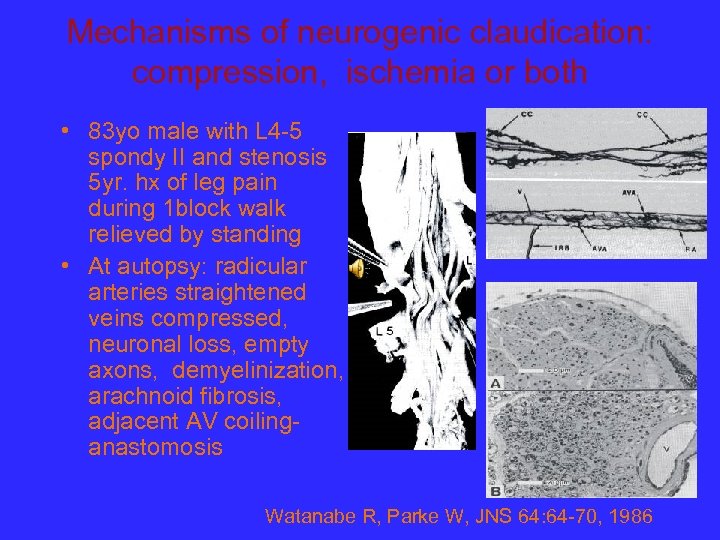
Mechanisms of neurogenic claudication: compression, ischemia or both • 83 yo male with L 4 -5 spondy II and stenosis 5 yr. hx of leg pain during 1 block walk relieved by standing • At autopsy: radicular arteries straightened veins compressed, neuronal loss, empty axons, demyelinization, arachnoid fibrosis, adjacent AV coilinganastomosis Watanabe R, Parke W, JNS 64: 64 -70, 1986
Problems in Patient Selection and Surgical Planning • • • Patient age/co-morbidities Previous surgery Unilateral or bilateral decompression “Asymptomatic” levels MIS vs open Disc “herniation” Disc collapse/foramen stenosis Spondylolisthesis/scoliosis/kyphosis “Back pain” without instability (arthrogenic vs radicular) • Fusion: instrumented/PSF vs interbody fusion
What do Evidence-based Guidelines Tell Us? • Surgery resulted in better improvement in pain and function than non-operative rx for stenosis/deg. spondy @ 2 yrs. 17% crossover to surg. Weinstein JN, (SPORT STUDY) NEJM, 2007; 356(22): 2257 -70 • Surgery better for leg pain and back related function but equal to non-op rx for pt. satisfaction, back pain and primary sx relief @8 -10 yrs. 39% non-ops had surg. 23% reops. Atlas SJ, (MAINE STUDY) Spine, 2005; 30(8): 936 -43
Clinical Trial Results • Unilat Laminotomy for Bilateral Microdecompr: 520 levels/374 pts • 88% improved VAS/Prolo scale 5 yr f/u 0. 8% instability: none reoperated Costa F etal. JNS-Spine 2007; 7(6): 579 -586
Скачать презентацию Lumbar Spinal Stenosis Diagnosis and Management A 30
afd7ec0561fbe557f22b879d825e5101.ppt