 Скачать презентацию Luke-Acts June 2 2007 Liberation through the
e5e15464253cce0bb8d82624c9010f2e.ppt
- Количество слайдов: 15




Luke-Acts June 2, 2007
“Liberation through the Power of the Spirit” ► Two-part structure shows how the emergence of the church is a necessary sequel to the ministry of Jesus. ► Luke 1: 1 -2—”I made the first book…about everything that Jesus began to do and teach until the day when—after giving instruction through the Holy Spirit…he was taken up”
Background/Genre ► Written with specific attention to the conventions of historical writing in late antiquity. ► Written to a cultured readership in the Hellenistic world. § Narrate everything kathexes, “in good order” (1: 1 -4). Entails a well-ordered story that convinces reader of the God’s plan in history (asphaleia). § Significant attention to WOMEN and DELIVERANCE OF POOR (Luke 1: 52 -53; 10: 38 -42; 15: 11 -32 [prefigures response of Jews in Acts? ].
Style/Genre continued ► Septuagintal diction manifests focus on the deep continuity between the OT and the Gospel story presented in Luke. § E. g. , Luke’s birth and infancy narratives. § Not so much a focus on fulfillment of prophetic predictions but on the FULFILLMENT OF GOD’S PROMISES TO ISRAEL (Luke 1: 54 -55). Hence, lack of specific scriptural citations.
Luke’s Christology: “The Spirit of the Lord is upon me” ► Eclectic portrayal of Jesus—Jesus is part of the larger purpose of God to bring salvation to the world. § He is presented as playing a vital role in bringing God’s salvation to the world, but with an equal emphasis on the role of the HOLY SPIRIT as poured out on the Church.
Luke’s Christology: Spiritempowered servant ► Luke 4: 16 -21: Spirit-empowered public announcement of messianic vocation. § SEVERAL IMPORTANT LUKAN THEMES HERE: ►PAIS THEOU—”servant of God”; appeal to Isaiah and prophetic line. ►Messiah—’anointed one’ (3: 21 -22; 4: 1, 14) ►Liberation and justice for poor and oppressed— Isa. 61 and Isa. 58: 6 -7; 9 ►Call of God directed to all!
Luke’s Christology: Prophet like Moses ► More emphasis on Moses as prophetic liberator; LUKE 9: 31 (“his exodus, which he was going to fulfill in Jerusalem. ”) ► Acts 3: 22 -23 (mighty works), 25; 7: 37 ► Moses sent twice—first time in weakness, second time in power. First leads to rejection out of ignorance, but second time, accompanied by signs, leads to rejection by God. § JESUS “MUST” SUFFER IN LINE WITH MOSAIC PATTERN.
Luke’s Christology: Righteous Martyr ► “he has done nothing to deserve death” (3 X)--Luke 23: 4, 13 -15, 22 § 23: 40 -41—”this man has done nothing wrong. ” § 23: 47—dikaios ►Isa. 53: 11 LXX--speaks of a RIGHTEOUS ONE who will take away the sins of many (cf. Wisdom of Solomon 2: 12 -13; 17 -20). ►ACTS 3: 13 -15 --”his servant Jesus…you rejected the Holy and Righteous One” [ton hagion kai dikaion]. ►ACTS 7: 51 -52
The Church in the Power of the Spirit ► Jesus as paradigm for ministry: “everything that Jesus began to do and teach”—church is called to continue in these teachings and deeds. ► Just as Jesus is anointed by Spirit for service, so Pentecost (Acts 1: 8; 2) reflects the empowerment of the church to proclaim the message to all nations. (Luke 24: 46 -49)
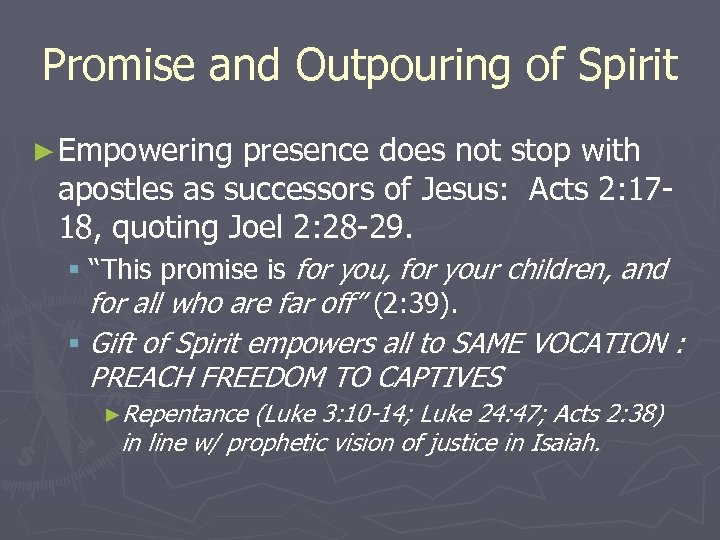
Promise and Outpouring of Spirit ► Empowering presence does not stop with apostles as successors of Jesus: Acts 2: 1718, quoting Joel 2: 28 -29. § “This promise is for you, for your children, and for all who are far off” (2: 39). § Gift of Spirit empowers all to SAME VOCATION : PREACH FREEDOM TO CAPTIVES ►Repentance (Luke 3: 10 -14; Luke 24: 47; Acts 2: 38) in line w/ prophetic vision of justice in Isaiah.
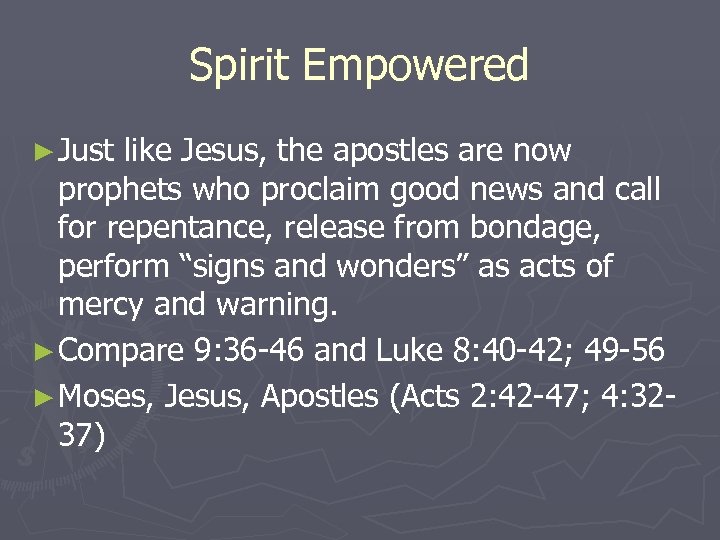
Spirit Empowered ► Just like Jesus, the apostles are now prophets who proclaim good news and call for repentance, release from bondage, perform “signs and wonders” as acts of mercy and warning. ► Compare 9: 36 -46 and Luke 8: 40 -42; 49 -56 ► Moses, Jesus, Apostles (Acts 2: 42 -47; 4: 3237)
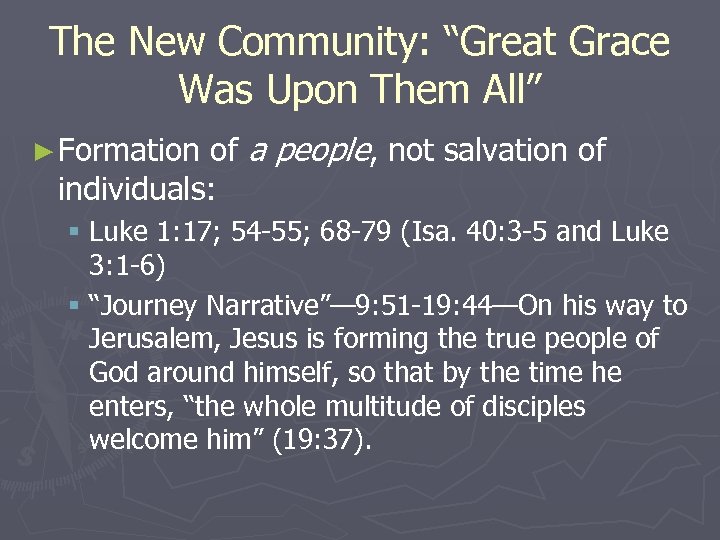
The New Community: “Great Grace Was Upon Them All” of a people, not salvation of individuals: ► Formation § Luke 1: 17; 54 -55; 68 -79 (Isa. 40: 3 -5 and Luke 3: 1 -6) § “Journey Narrative”— 9: 51 -19: 44—On his way to Jerusalem, Jesus is forming the true people of God around himself, so that by the time he enters, “the whole multitude of disciples welcome him” (19: 37).
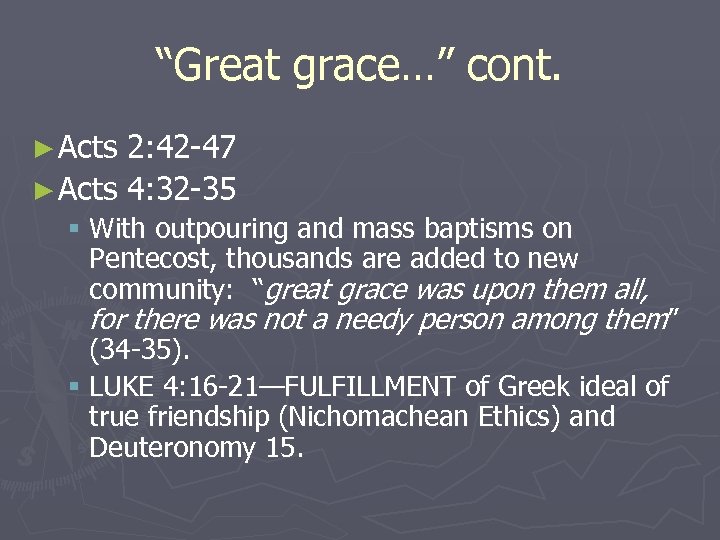
“Great grace…” cont. ► Acts 2: 42 -47 ► Acts 4: 32 -35 § With outpouring and mass baptisms on Pentecost, thousands are added to new community: “great grace was upon them all, for there was not a needy person among them” (34 -35). § LUKE 4: 16 -21—FULFILLMENT of Greek ideal of true friendship (Nichomachean Ethics) and Deuteronomy 15.
“Great grace…” cont. ► The practice of distributing goods to meet needs is in obedience to Jesus’ teaching throughout Luke; some key texts: § Luke 6: 20 -25 § 12: 13 -21; 16: 19 -31 (Deut. 15 and Isa. 58!) § Contrasts: 18 -30 and 19: 1 -10 ►POSSESSIONS AS SYMBOLS OF RESPONSE TO GOD —(ACTS 5: 1 -11): UNCOERCED GENEROSITY OR HESITANT STINGINESS?
Church and Empire: Turning the World Upside Down ► Sharp depiction of how new community relates to kingdoms of the world: Acts 17: 1 -9 § Concern for outcasts; condemnation of wealthy; critique of unjust and oppressive institutions; call for relationships based on humility and service, and opposition to violence=THREAT TO ROMAN (or, any) ORDER. § Many specific rulers and public officials mentioned by name (Luke 2: 1 and 3: 1; Acts 26: 26). § See Acts 4: 19 -30 [psalm 2: 1 -2]; Acts 5: 17 -42 (“…rather than human authority”); Acts 19: 23 -41.
Скачать презентацию Luke-Acts June 2 2007 Liberation through the
e5e15464253cce0bb8d82624c9010f2e.ppt