


 Скачать презентацию LUG Conference 2007 Non-traumatic harm risk factors
2e938d9cbb7a1145ecafe5b3e713dc20.ppt
- Количество слайдов: 35
 LUG Conference 2007 Non-traumatic harm: risk factors & legal issues bu si ne ss se rvi ce s co ns tr uc tio n & pr op er ty in su ra nc e & Alistair Kinley & Vanessa Latham
 overview n n n n Introduction Asbestos compensation – legal & judicial agendas Policy coverage & triggers (Bolton v MMI) Noise-induced hearing loss Asymptomatic conditions & pleural plaques Harassment & discrimination Conclusions
 introduction n n By non-traumatic harm we mean conventional occupational disease risks and also psychiatric injury • why is it topical? • interest for insurers • social issues “ Liability for psychiatric injury … is in general no different in principle from liability for physical injury … It is foreseeable injury flowing from the … breach of duty that gives rise to the liability. ” Scott-Baker LJ, Hartman v South Essex Mental Health [2005]
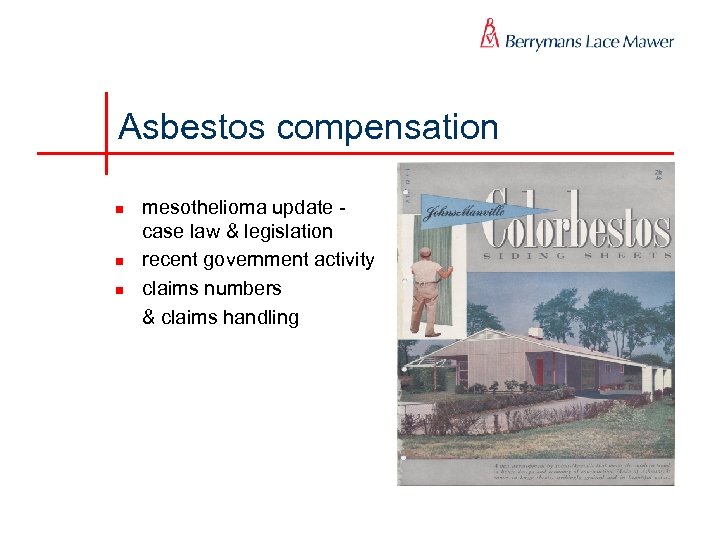 Asbestos compensation n mesothelioma update - case law & legislation recent government activity claims numbers & claims handling
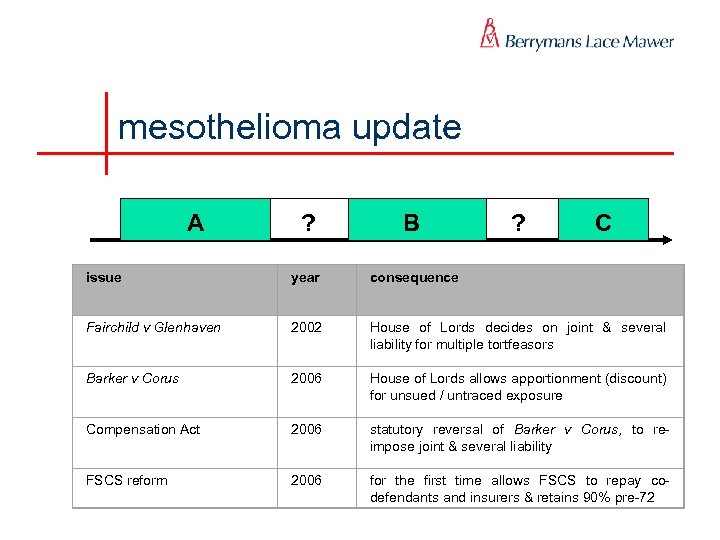 mesothelioma update A issue ? B year ? C consequence Fairchild v Glenhaven 2002 House of Lords decides on joint & several liability for multiple tortfeasors Barker v Corus 2006 House of Lords allows apportionment (discount) for unsued / untraced exposure Compensation Act 2006 statutory reversal of Barker v Corus, to reimpose joint & several liability FSCS reform 2006 for the first time allows FSCS to repay codefendants and insurers & retains 90% pre-72
 recent Government activity
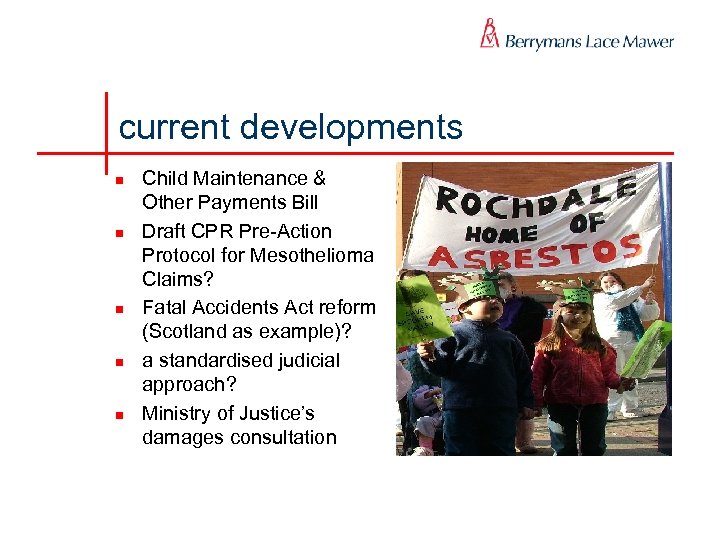 current developments n n n Child Maintenance & Other Payments Bill Draft CPR Pre-Action Protocol for Mesothelioma Claims? Fatal Accidents Act reform (Scotland as example)? a standardised judicial approach? Ministry of Justice’s damages consultation
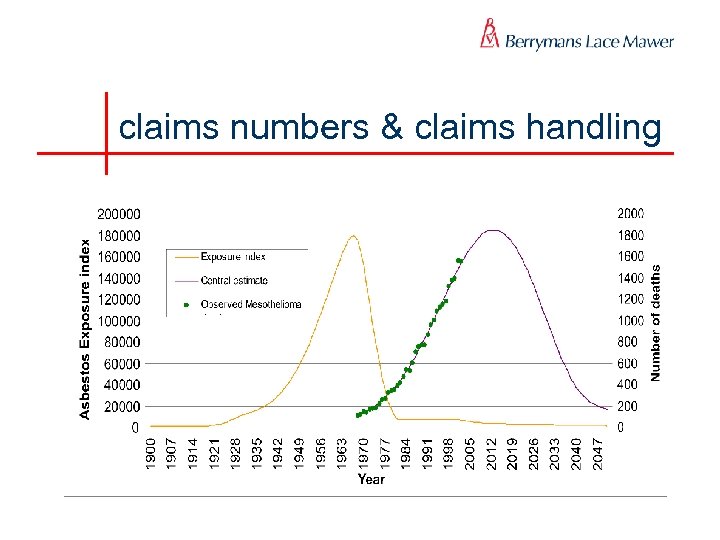 claims numbers & claims handling
 claims numbers & claims handling n quicker handling • n larger interim payments • n DWP reforms & draft CPR protocol more expensive claims • n draft CPR protocol, standardised judicial approach DWP reforms will introduce CRU mechanisms retrospective costs • DWP reforms (CM&OP Bill clause 49(3))
 Policy coverage n Divisible Pleural Thickening Asbestosis Indivisible Mesothelioma Lung Cancer
 Divisible injury n Defendant only pays for the period of their exposure n Insurer pays only for the period on risk n Holtby v Brigham & Cowan (2000)
 Indivisible injury n n “each defendant liable in full for a claimant’s damage, although a defendant can seek a contribution against another employer liable for causing the disease” (Hoffman, Fairchild) Phillips v Syndicate 992 (2003) Insurer liable for full extent of C’s damages even though it only insured for part of C’s employers culpable exposure
 ABI mesothelioma guidelines - EL n n n Time based apportionment Pay and be paid. Apportionment first by employer then by insurer Ignore void periods – no solvent employer and no insurer Gap period paid by solvent employer or if insolvent, by its insurer BUT Phillips
 Policy Triggers n n n Wording of policies differ Long tail claims – cause and effect can be many years apart. Mesothelioma - historically, EL coverage usually when the exposure occurred and PL, when malignancy occurs 10 years prior to symptoms.
 Bolton v MMI and CU (2006) n n PL claim CU 1960 -65 when injury/illness “occurred” MMI 1979 -91 when injury/illness “occurs” Court of Appeal found that injury occurs when the malignancy develops or symptoms identified
 Implication on Policy Trigger n n n PL polices usually worded ‘occurs’ so will be when malignancy occurs/symptoms develop EL policies post 1 January 1972 should state injury or disease “sustained” by employee and “arising” out of their employment so will be when exposure occurred. Pre-1972 policy wording varies – some which use wording ‘occurs’
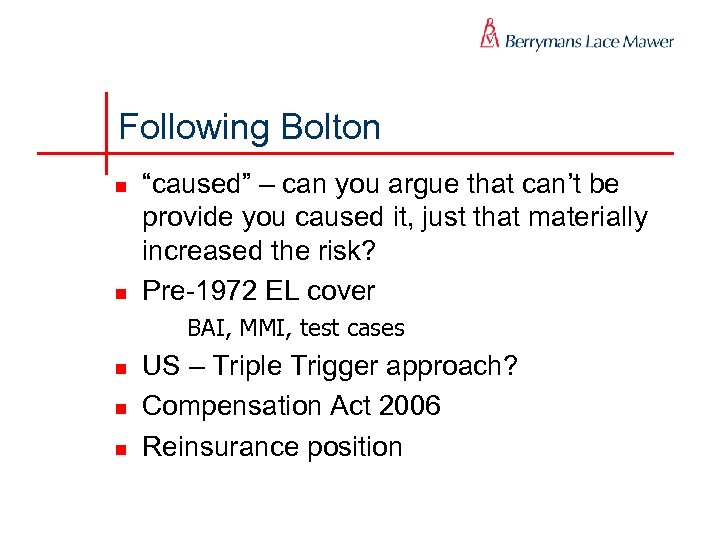 Following Bolton n n “caused” – can you argue that can’t be provide you caused it, just that materially increased the risk? Pre-1972 EL cover BAI, MMI, test cases n n n US – Triple Trigger approach? Compensation Act 2006 Reinsurance position
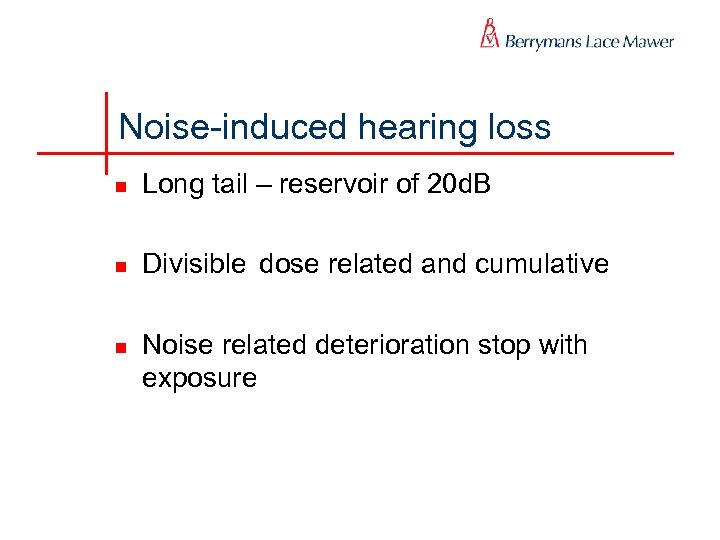 Noise-induced hearing loss n Long tail – reservoir of 20 d. B n Divisible dose related and cumulative n Noise related deterioration stop with exposure
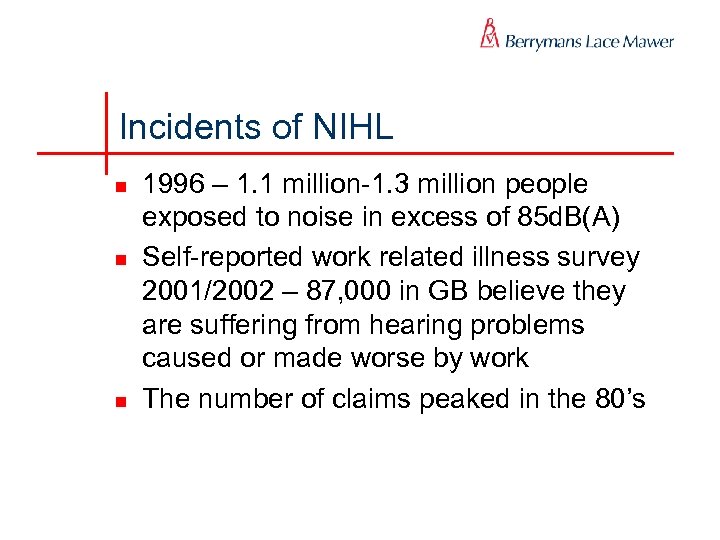 Incidents of NIHL n n n 1996 – 1. 1 million-1. 3 million people exposed to noise in excess of 85 d. B(A) Self-reported work related illness survey 2001/2002 – 87, 000 in GB believe they are suffering from hearing problems caused or made worse by work The number of claims peaked in the 80’s
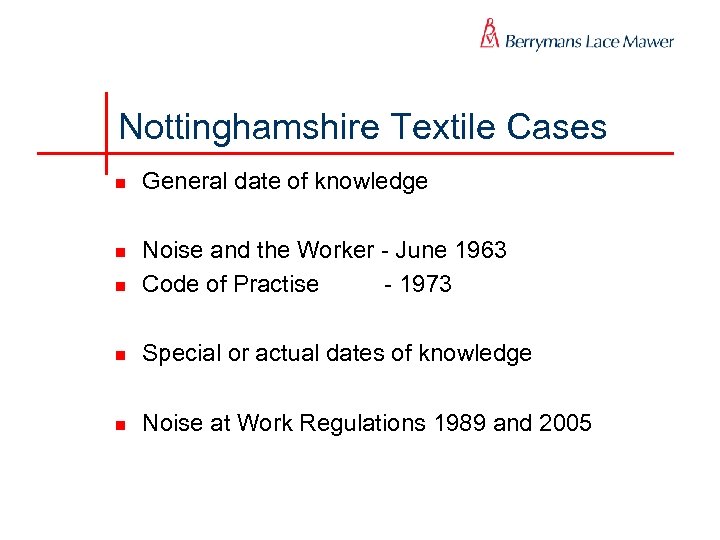 Nottinghamshire Textile Cases n General date of knowledge n Noise and the Worker - June 1963 Code of Practise - 1973 n Special or actual dates of knowledge n Noise at Work Regulations 1989 and 2005 n
 Nottinghamshire Textile Cases n n 7 Test cases Daily exposure 80 -86 b. D (A) Breach - no general liability below 90 d. B(A) Diagnosis - History of exposure PLUS - “notch” on audiogram at 4 k. Hz
 Potential for Future Claims n n Insurers reporting increase New Legislation – Noise at Work Regulations 2005 New Areas of Litigation call centres leisure industry motorcycles Acoustic Shock Syndrome
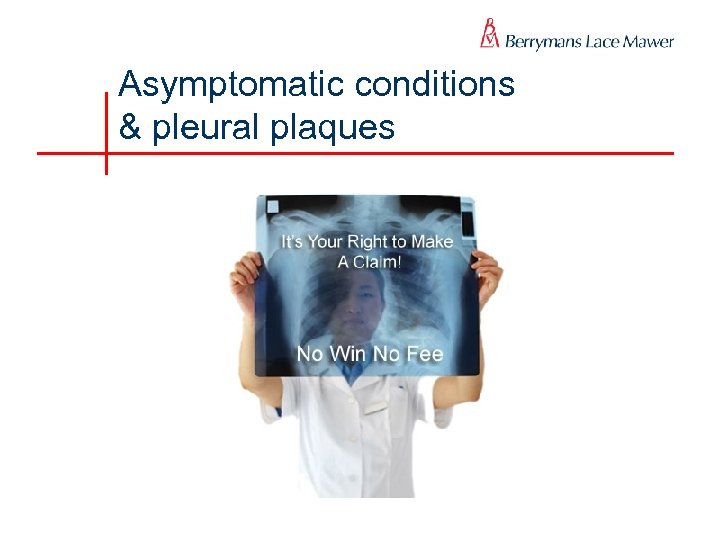 Asymptomatic conditions & pleural plaques
 Pleural plaques n n n Duty, breach, causation, loss Pleural plaques are asymptomatic, so what is the ‘loss’? The basic test case argument is, essentially: • exposure + plaques + anxiety = £ compensation • however, doesn’t 0 + 0 = ? ? House of Lords ruling expected before end of year Prospects of Government intervention thereafter? “There was a lack of evidence of associated disability to justify adding pleural plaques to the list of prescribed diseases. ” - IIAC Annual report 2004/05
 Asymptomatic conditions n n The focus for now is pleural plaques, and there was an unsuccessful amendment to the Compensation Bill “The lodging in the body of a chemical or substance which may cause injury as a consequence of negligence or breach of statutory duty, shall give rise to a cause of action whether or not the lodging has caused symptoms at the time the action is commenced or brought to trial. ” Any other examples?
 Harassment & Discrimination n n Protection from Harassment Act 1997 S 1(1) A person must not pursue a course of conduct which he know or ought to know amount to harassment of another Criminal offence to breach s 1 Damages for any anxiety and financial loss
 Protection from Harassment Act n n n Limitation 6 years Course of Conduct Harassment – criminal liability Foreseeability Quantum – Singh v Bhakar & Bhakar (2006)
 Majrowski v Guys and St Thomas’ n Vicarious liability n “course of employment” n Lister v Hesley Hall n No defence for employer
 Insurance Coverage n n n EL policy Anxiety/distress – is this covered? “Mental Anguish” Intentional Acts PL Policy
 Discrimination n n n Sex Race Disability Sexual Orientation Religion/belief Age
 Key Issues n n n Time limits – 3 or 6 months Conduct must relate to status Foreseeability not required Damages for injured feelings - £ 500 -£ 25, 000 Costs
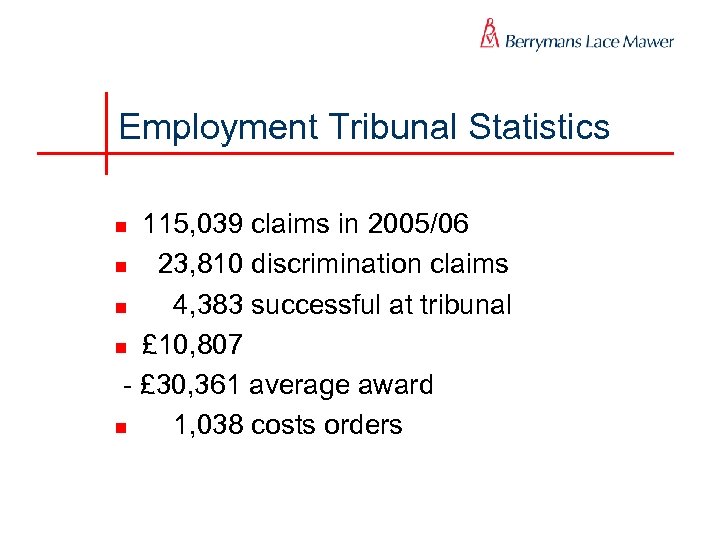 Employment Tribunal Statistics 115, 039 claims in 2005/06 n 23, 810 discrimination claims n 4, 383 successful at tribunal n £ 10, 807 - £ 30, 361 average award n 1, 038 costs orders n
 Insurance Considerations n n n Employment Practises Insurance EL Policy wording Injury to Feelings – is this covered? Intentional Acts Exclusion of ‘claims arising solely out of the contract of employment’ PL Policy – DDA Service Providers
 Conclusions n n n There is a continuing political and judicial focus on UK mesothelioma claims We are entering a period of uncertainty regarding ‘asymptomatic’ conditions Legislation against discrimination and harassment is drawing EL & PL insurers into unforeseen areas
 LUG Conference 2007 Non-traumatic harm: risk factors & legal issues bu si ne ss se rvi ce s co ns tr uc tio n & pr op er ty in su ra nc e & Alistair Kinley & Vanessa Latham