 Скачать презентацию LUDI Play for Children with Disabilities
3b1dfeb52139355ded3fde97ecc282ec.ppt
- Количество слайдов: 31



+ LUDI – Play for Children with Disabilities
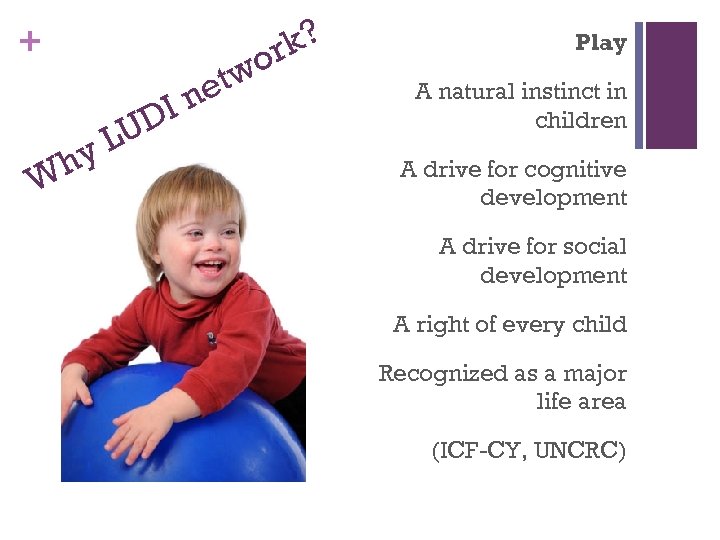
+ In tw e hy W UD L k? or Play A natural instinct in children A drive for cognitive development A drive for social development A right of every child Recognized as a major life area (ICF-CY, UNCRC)
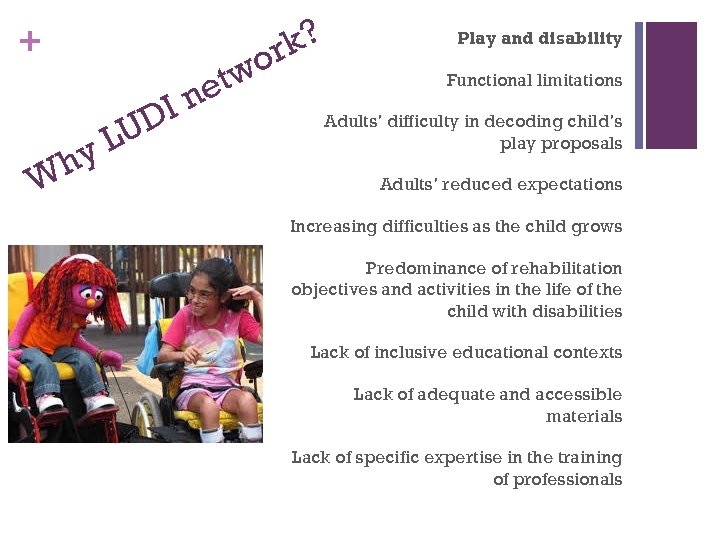
+ tw e k? or In D h W LU y Play and disability Functional limitations Adults’ difficulty in decoding child’s play proposals Adults’ reduced expectations Increasing difficulties as the child grows Predominance of rehabilitation objectives and activities in the life of the child with disabilities Lack of inclusive educational contexts Lack of adequate and accessible materials Lack of specific expertise in the training of professionals
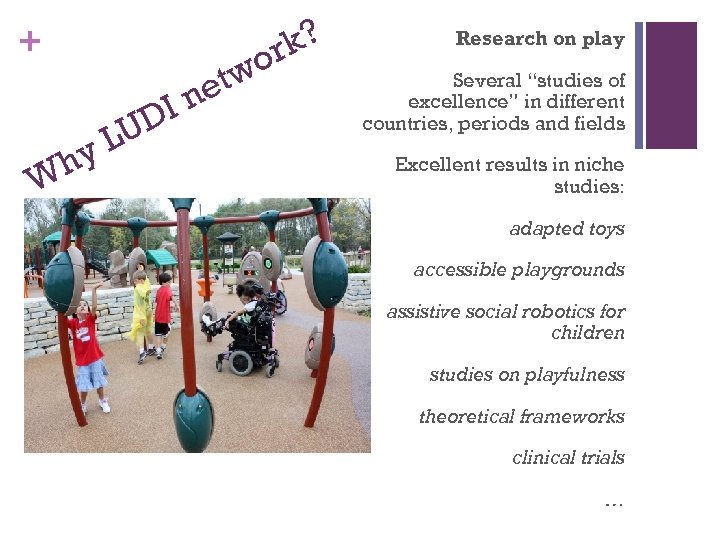
+ tw e k? or In D h W LU y Research on play Several “studies of excellence” in different countries, periods and fields Excellent results in niche studies: adapted toys accessible playgrounds assistive social robotics for children studies on playfulness theoretical frameworks clinical trials …
+ But All these studies are so far scattered among numerous sub-fields and lack of an holistic perspective Consequently the effects of these studies on the quality of life of children with disabilities are occasional and poorly impacting Giving consistency to these studies, connecting them, creating a support network is an urgent need
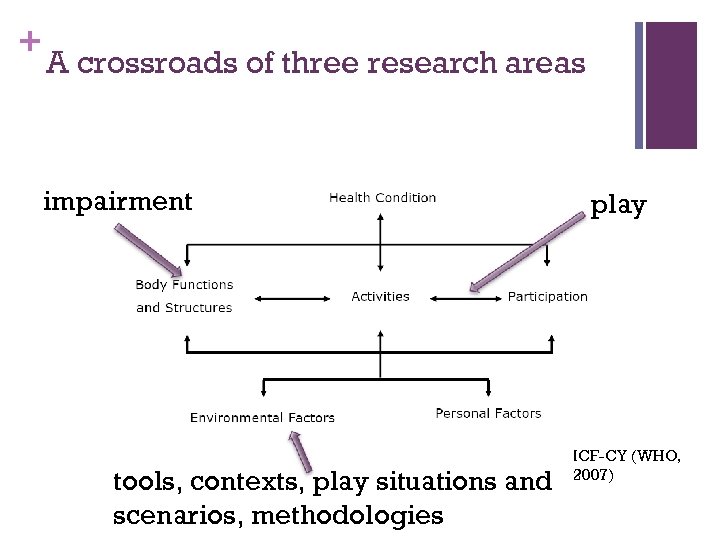
+ A crossroads of three research areas impairment tools, contexts, play situations and scenarios, methodologies play ICF-CY (WHO, 2007)
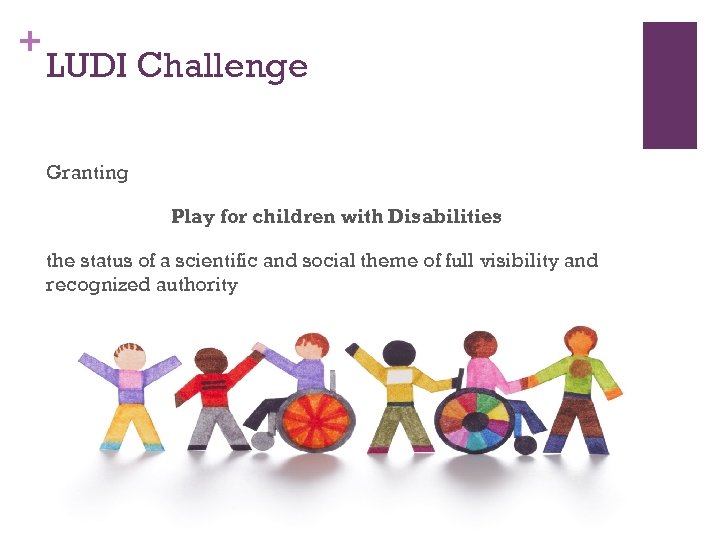
+ LUDI Challenge Granting Play for children with Disabilities the status of a scientific and social theme of full visibility and recognized authority
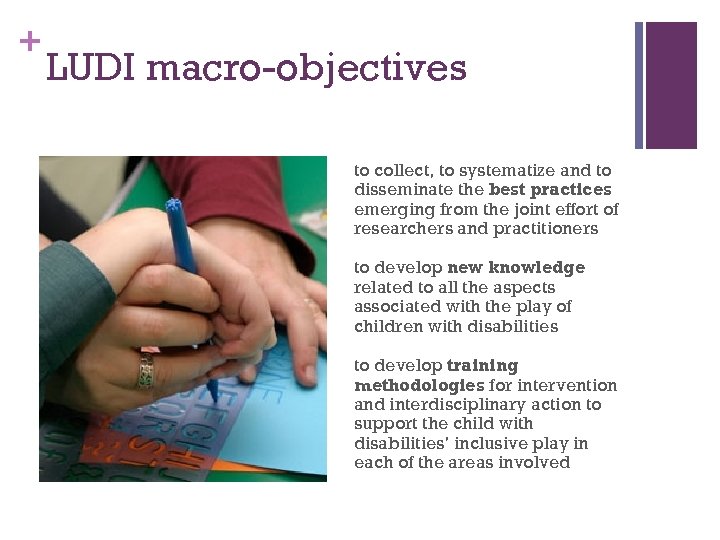
+ LUDI macro-objectives to collect, to systematize and to disseminate the best practices emerging from the joint effort of researchers and practitioners to develop new knowledge related to all the aspects associated with the play of children with disabilities to develop training methodologies for intervention and interdisciplinary action to support the child with disabilities’ inclusive play in each of the areas involved
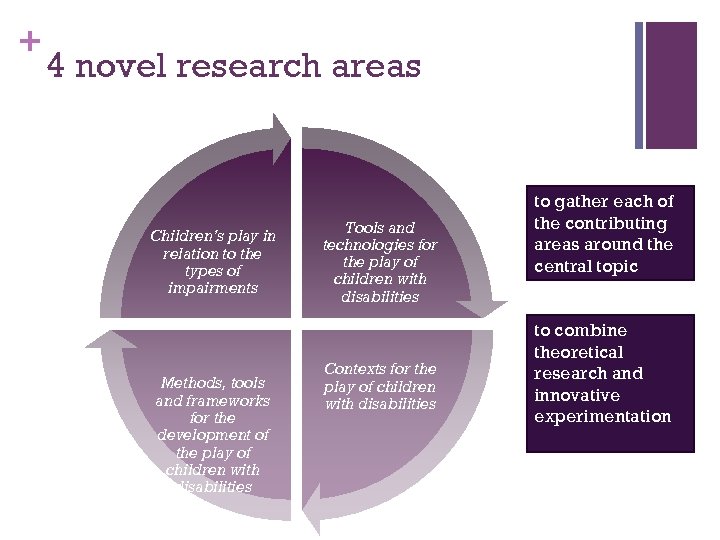
+ 4 novel research areas Children’s play in relation to the types of impairments Methods, tools and frameworks for the development of the play of children with disabilities Tools and technologies for the play of children with disabilities Contexts for the play of children with disabilities to gather each of the contributing areas around the central topic to combine theoretical research and innovative experimentation
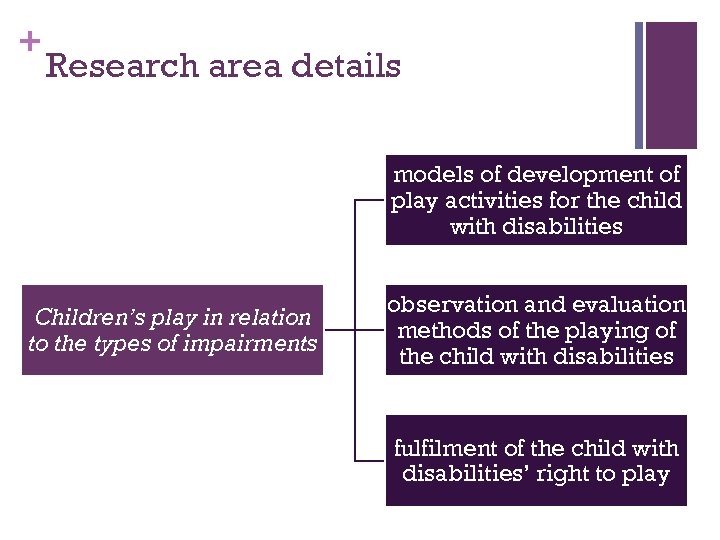
+ Research area details models of development of play activities for the child with disabilities Children’s play in relation to the types of impairments observation and evaluation methods of the playing of the child with disabilities fulfilment of the child with disabilities’ right to play
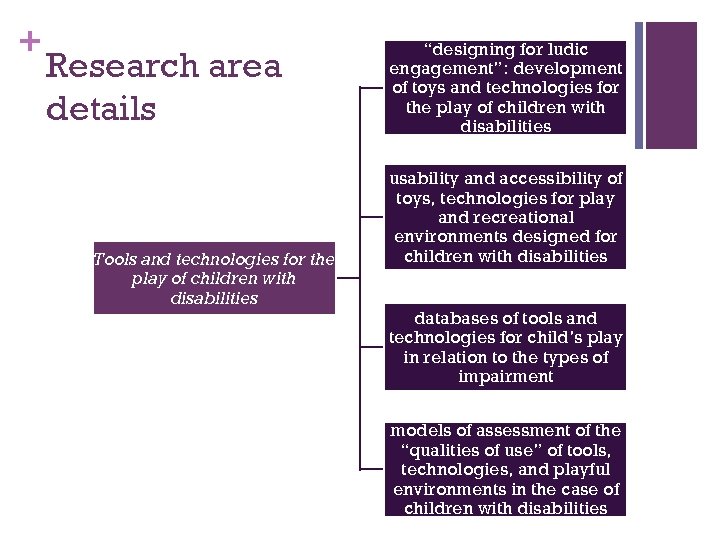
+ Research area details Tools and technologies for the play of children with disabilities “designing for ludic engagement”: development of toys and technologies for the play of children with disabilities usability and accessibility of toys, technologies for play and recreational environments designed for children with disabilities databases of tools and technologies for child’s play in relation to the types of impairment models of assessment of the “qualities of use” of tools, technologies, and playful environments in the case of children with disabilities
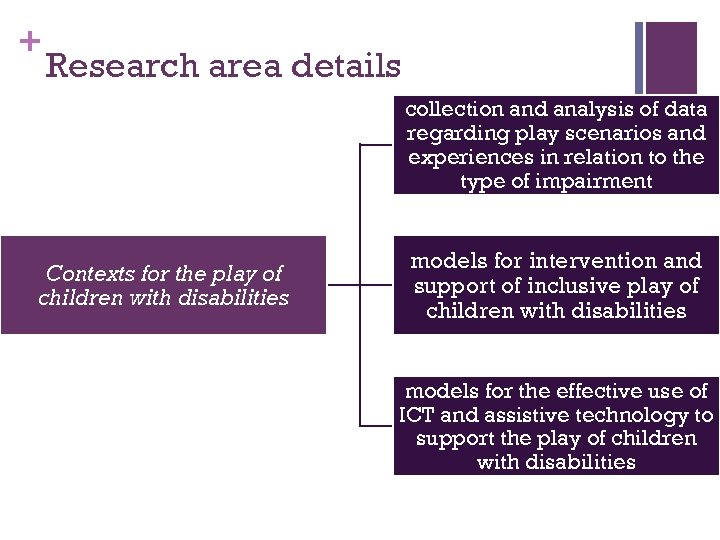
+ Research area details collection and analysis of data regarding play scenarios and experiences in relation to the type of impairment Contexts for the play of children with disabilities models for intervention and support of inclusive play of children with disabilities models for the effective use of ICT and assistive technology to support the play of children with disabilities
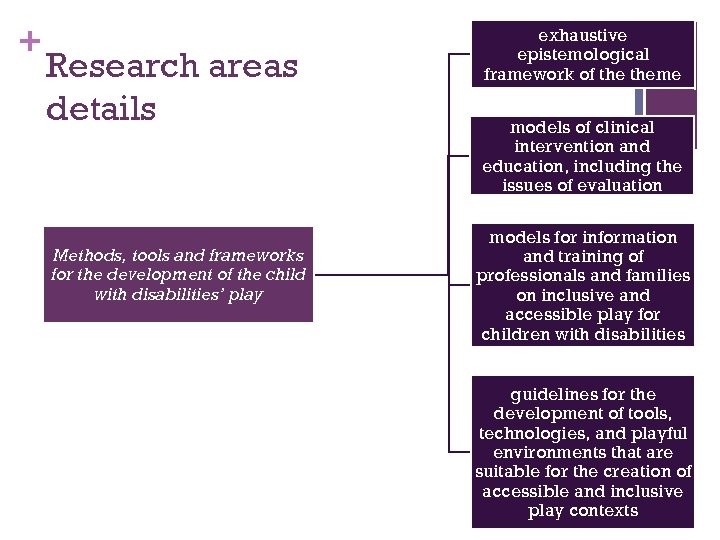
+ Research areas details Methods, tools and frameworks for the development of the child with disabilities’ play exhaustive epistemological framework of theme models of clinical intervention and education, including the issues of evaluation models for information and training of professionals and families on inclusive and accessible play for children with disabilities guidelines for the development of tools, technologies, and playful environments that are suitable for the creation of accessible and inclusive play contexts
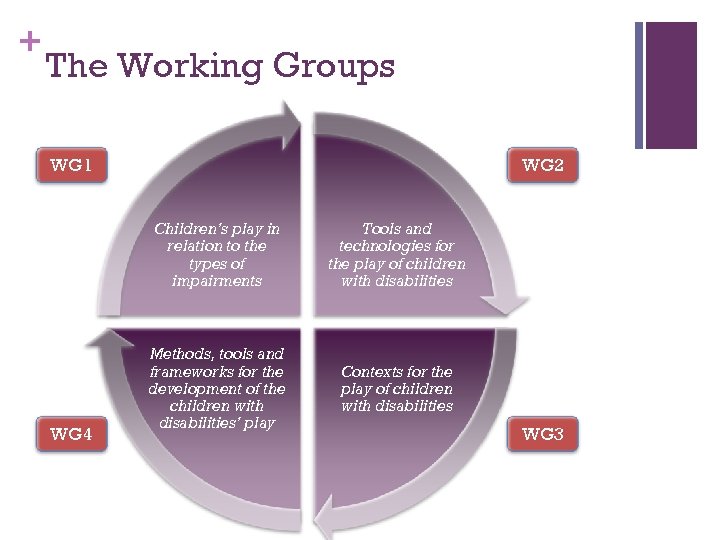
+ The Working Groups WG 1 WG 2 Children’s play in relation to the types of impairments WG 4 Tools and technologies for the play of children with disabilities Methods, tools and frameworks for the development of the children with disabilities’ play Contexts for the play of children with disabilities WG 3
+ Questions and Answers
+ Design elements missing: including more design based institutions How do you envisage to include physical interaction in building design (access for all) as part of the Action? 1
+ Answer n The LUDI network was created by recruiting partners all over Europe (and not only) that are specifically competent in the various areas related to the topic of children with disabilities’ play n The entire WG 2 will be devoted to explore issues related to tools and technologies development and evaluation (including accessibility and usability topics). Design oriented institutions will be the leaders of this WG For example, we cite here the University of Siena, AIJU, Aalborg University They will bring their sound experience and their long-lasting fruitful contacts with other institutions working in this field of interest
+ A lack of information of how outreach (Training School) will be promoted in applied settings. More information about the training school (Countries? Possible number of students? Type of targeted professionals? ) would make the return value clearer. 2
+ Answer n As well as in the case of design specialists, also in this case LUDI collects partners specialized in the fields of education and training n Developed information and training materials will be translated, attuned to the different cultural sensitivities and made available in all the languages of the participant partners n This is one of the main reasons for which the outputs of the WG 1, WG 2 and WG 3 will converge into the WG 4 that collects the materials and disseminate them in all the territories reached by the LUDI network. In this sense every member country and every partner will benefit of the overall results of the project n These materials will be consistent with the adopted training methodology. Moreover, they will be specifically developed taking into account each of the different targeted populations addressed (families, clinical and rehabilitation professionals, teachers, researchers). The partners will state the number of possible students for each population, which will be no less than 50 people
+ Please explain in more detail the reason and advantage of the proposed organisation in WGs 3
+ Answer n WG 1, WG 2, WG 3 have been planned to explore in detail, since the very beginning of the LUDI network, the three main areas (impairments, play, tools and contexts for play) that converge into the general theme n On the contrary, WG 4 will be mainly active whenever the works of the other three WGs will be arrived at an advanced stage n In fact, only in this way LUDI will achieve its main final objectives, that are: gather best practices, create new consistent exhaustive knowledge, disseminate it through authoritative publications and appropriate training
+ Clarify the shortcomings about Milestones and Deliverables and provide additional information on these issues 4
+ Answer n Methodologies and studies produced within D 1 and D 2 will concretely take the form of publications of the critical review of the existing literature in the considered fields (play development of children with disabilities and evaluation of play of children with disabilities) n In the case of D 10, D 11, D 12 there has perhaps been a slight wording misunderstanding. The three Deliverables are connected in a recursive process: D 11 represents the experimental phase for the beta version of the training model (D 10) and it will lead to the release of the final version (D 12)
+ Provide more information whether the Network of Proposers includes all relevant professional sectors (notably from the clinical, educational and industrial sectors). 5
+ Answer n Some partners are already relevant in the mentioned sectors n In addition all the partners play a fundamental role in their expertise domain and are strictly connected to professional subnetworks in their own territories. These subnetworks will constitute external nodes of the LUDI network n Anyway the LUDI network is intended for a continuous expansion and from the outline all relevant professional sectors will be balanced, if needed
+ Explain how you plan to engage in the Action activities other relevant stakeholders, such as policy makers, and other relevant state and private representatives in order that the Action achievements fall on a "fertile ground". 6
+ Answer… n LUDI network will belong both to the virtual network of science and to the factual network of the territories of its partners n This means that in particular, the stakeholders and the policy makers will be directly involved since the very beginning through focus groups, discussion forums and targeted dissemination of results throughout the network lifetime n Constant attention will be dedicated to the hearing and the involvement of the various targeted populations and their representatives, first of all persons with disabilities and their associations
+ Answer… n The users’ experience, opinion and expertise will constantly recalled to allow LUDI network to be Action-Intervention based (not merely theoretical) which is one of its main scopes n The transfer of knowledge from clinical to practice is also mentioned in The Horizon 2020 “Societal challenges”
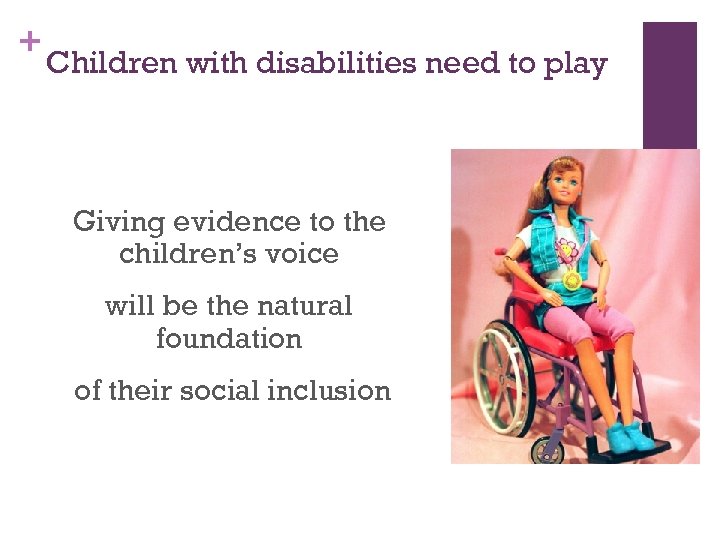
+ Children with disabilities need to play Giving evidence to the children’s voice will be the natural foundation of their social inclusion
+ LUDI: Countries involved n Austria n Bulgaria n Germany n Denmark n Israel n Ireland n Netherlands n Portugal n Sweden n Spain n France n Finland n Russian Federation n United Kingdom n Canada n Italy n Colombia

+
Скачать презентацию LUDI Play for Children with Disabilities
3b1dfeb52139355ded3fde97ecc282ec.ppt