

Lucien Ginsburg Biography Serge Gainsbourg, born Lucien Ginsburg

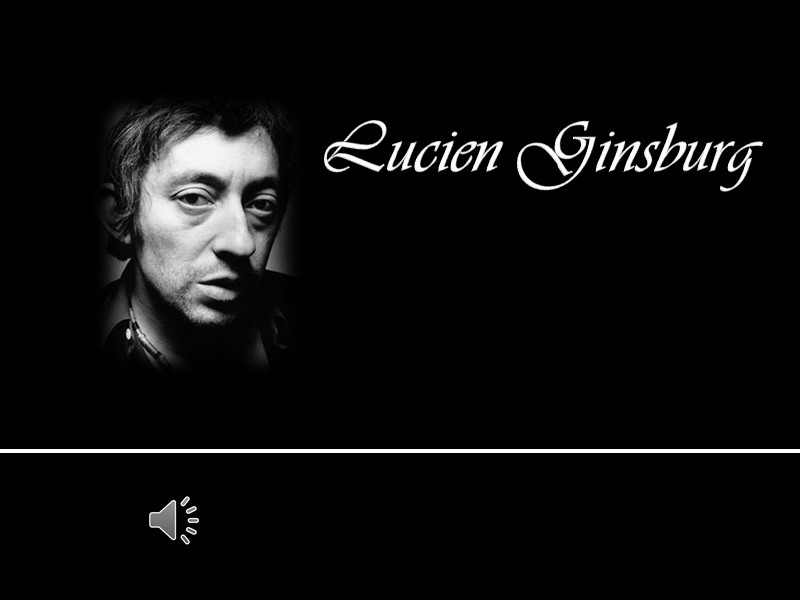
Lucien Ginsburg
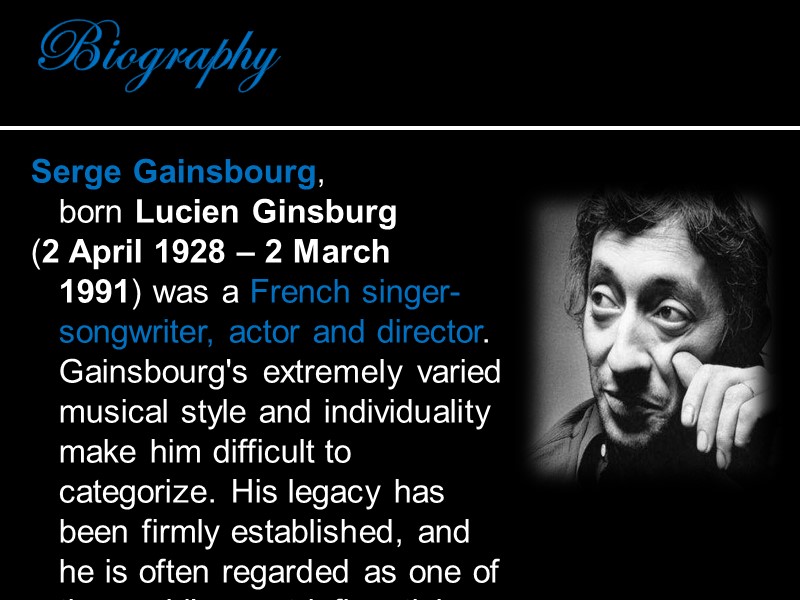
Biography Serge Gainsbourg, born Lucien Ginsburg (2 April 1928 – 2 March 1991) was a French singer-songwriter, actor and director. Gainsbourg's extremely varied musical style and individuality make him difficult to categorize. His legacy has been firmly established, and he is often regarded as one of the world's most influential popular musicians.
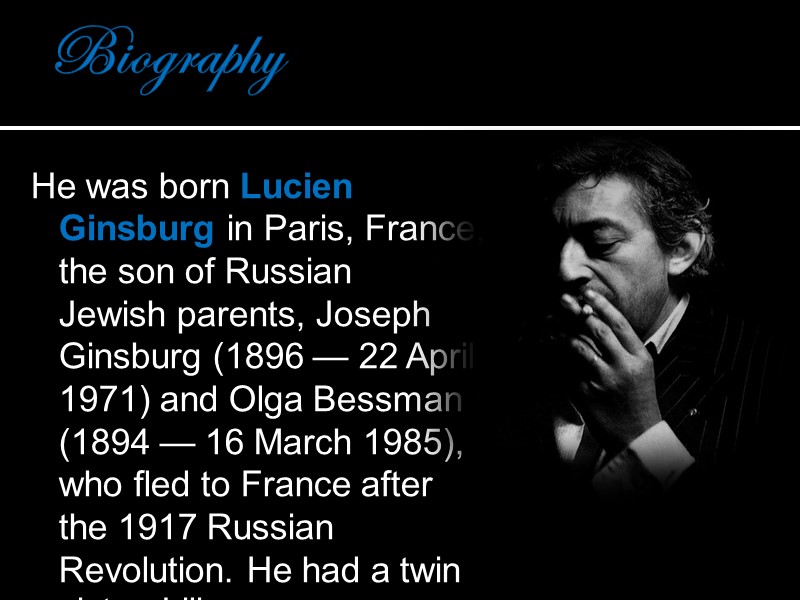
Biography He was born Lucien Ginsburg in Paris, France, the son of Russian Jewish parents, Joseph Ginsburg (1896 — 22 April 1971) and Olga Bessman (1894 — 16 March 1985), who fled to France after the 1917 Russian Revolution. He had a twin sister, Liliane.
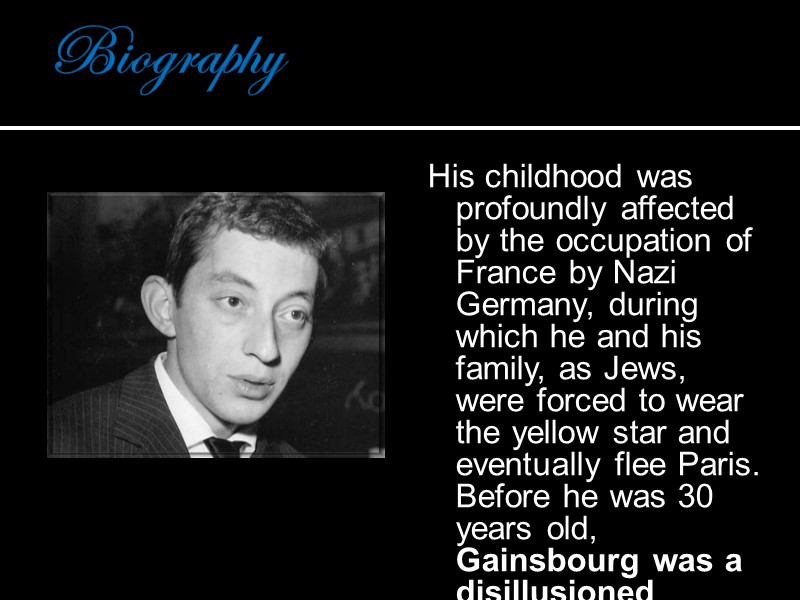
Biography His childhood was profoundly affected by the occupation of France by Nazi Germany, during which he and his family, as Jews, were forced to wear the yellow star and eventually flee Paris. Before he was 30 years old, Gainsbourg was a disillusioned painter, but earned his living as a piano player in bars.
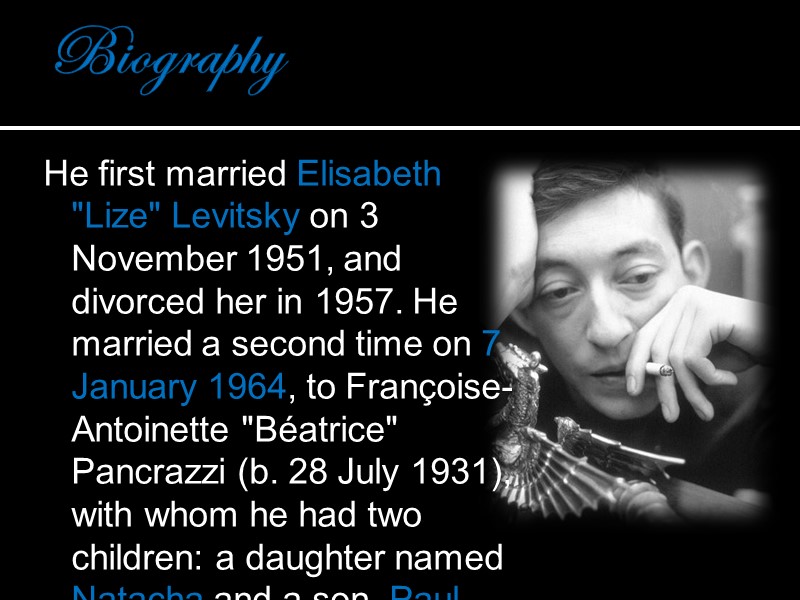
Biography He first married Elisabeth "Lize" Levitsky on 3 November 1951, and divorced her in 1957. He married a second time on 7 January 1964, to Françoise-Antoinette "Béatrice" Pancrazzi (b. 28 July 1931), with whom he had two children: a daughter named Natacha and a son, Paul. They divorced in February 1966.
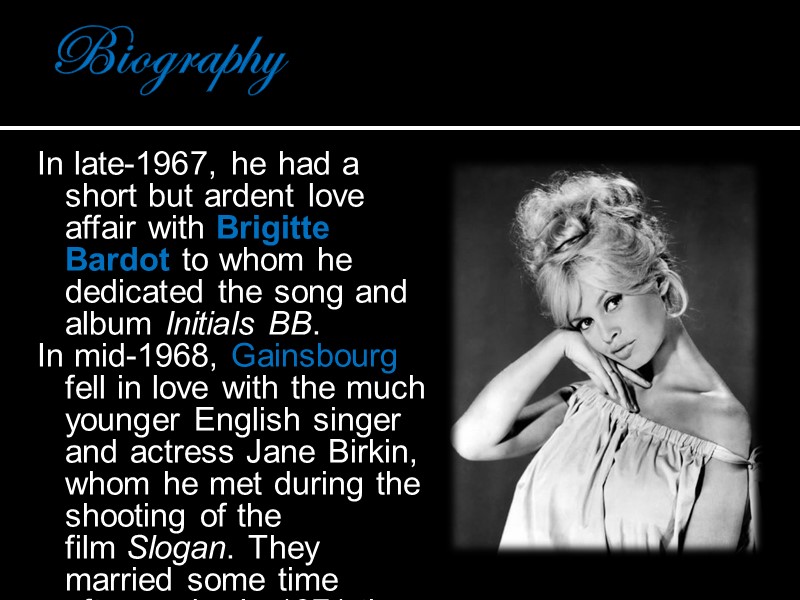
Biography In late-1967, he had a short but ardent love affair with Brigitte Bardot to whom he dedicated the song and album Initials BB. In mid-1968, Gainsbourg fell in love with the much younger English singer and actress Jane Birkin, whom he met during the shooting of the film Slogan. They married some time afterwards. In 1971 they had a daughter, the actress and singer Charlotte. Birkin left him in 1980.
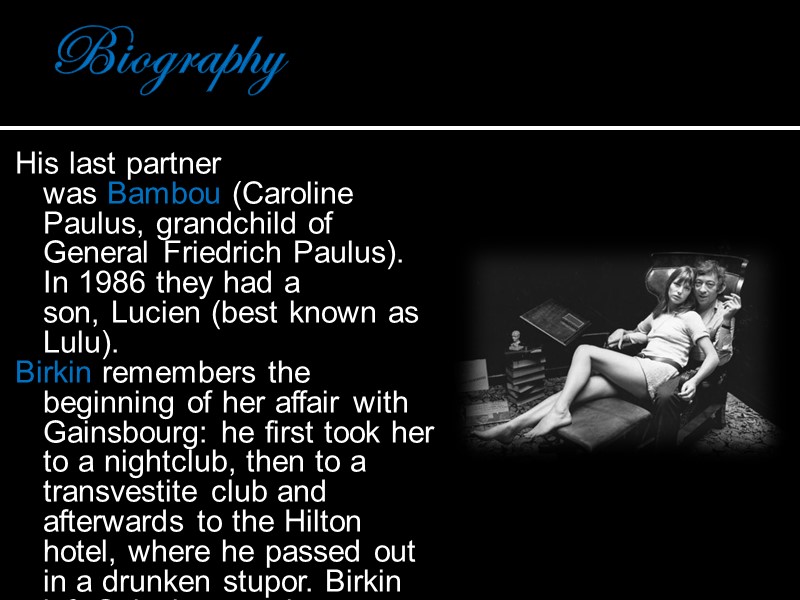
Biography His last partner was Bambou (Caroline Paulus, grandchild of General Friedrich Paulus). In 1986 they had a son, Lucien (best known as Lulu). Birkin remembers the beginning of her affair with Gainsbourg: he first took her to a nightclub, then to a transvestite club and afterwards to the Hilton hotel, where he passed out in a drunken stupor. Birkin left Gainsbourg when pregnant with her third daughter, Lou, by the film director Jacques Doillon, whom she later married.
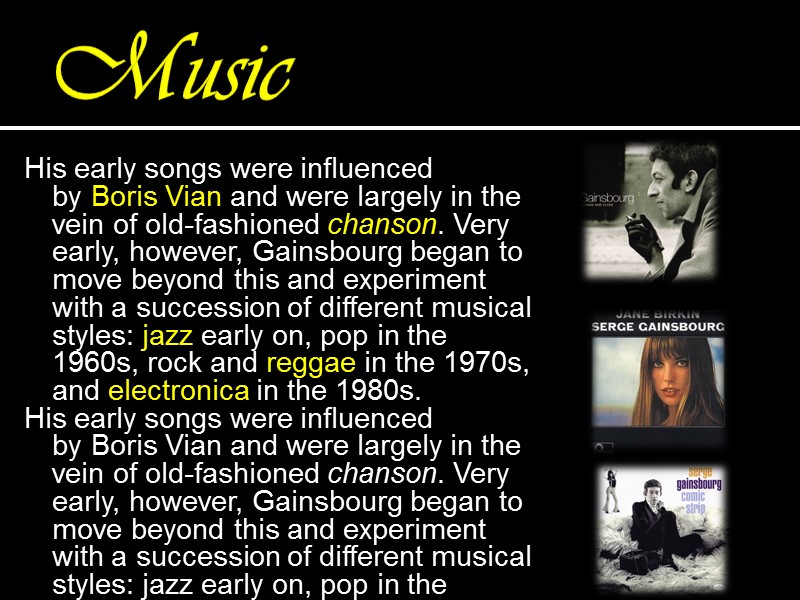
Music His early songs were influenced by Boris Vian and were largely in the vein of old-fashioned chanson. Very early, however, Gainsbourg began to move beyond this and experiment with a succession of different musical styles: jazz early on, pop in the 1960s, rock and reggae in the 1970s, and electronica in the 1980s. His early songs were influenced by Boris Vian and were largely in the vein of old-fashioned chanson. Very early, however, Gainsbourg began to move beyond this and experiment with a succession of different musical styles: jazz early on, pop in the 1960s, rock and reggae in the 1970s, and electronica in the 1980s.
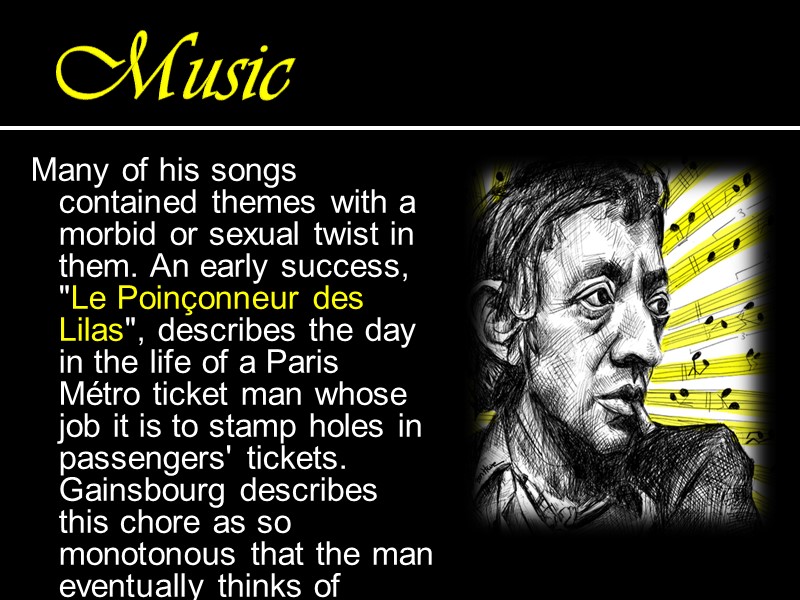
Music Many of his songs contained themes with a morbid or sexual twist in them. An early success, "Le Poinçonneur des Lilas", describes the day in the life of a Paris Métro ticket man whose job it is to stamp holes in passengers' tickets. Gainsbourg describes this chore as so monotonous that the man eventually thinks of putting a hole into his own head and being buried in another.
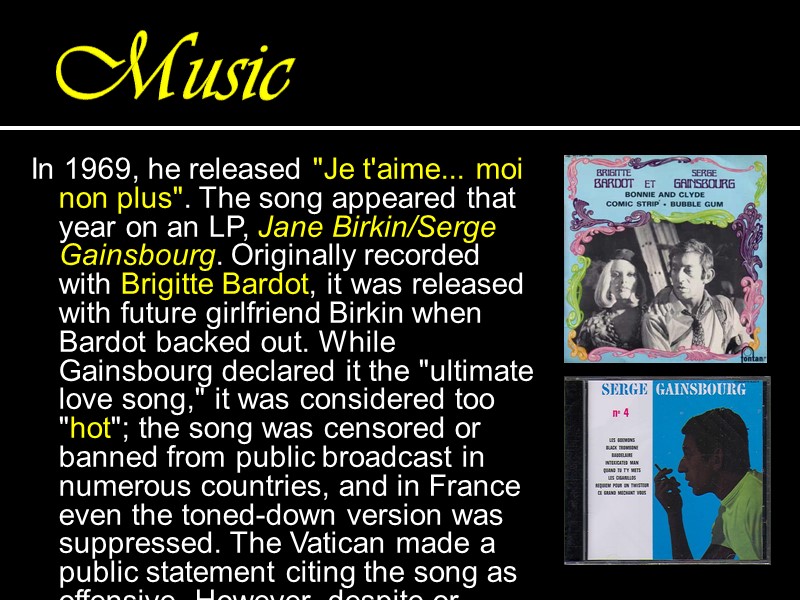
Music In 1969, he released "Je t'aime... moi non plus". The song appeared that year on an LP, Jane Birkin/Serge Gainsbourg. Originally recorded with Brigitte Bardot, it was released with future girlfriend Birkin when Bardot backed out. While Gainsbourg declared it the "ultimate love song," it was considered too "hot"; the song was censored or banned from public broadcast in numerous countries, and in France even the toned-down version was suppressed. The Vatican made a public statement citing the song as offensive. However, despite or perhaps because of all the controversy, it sold well and charted within the top ten in many European countries.
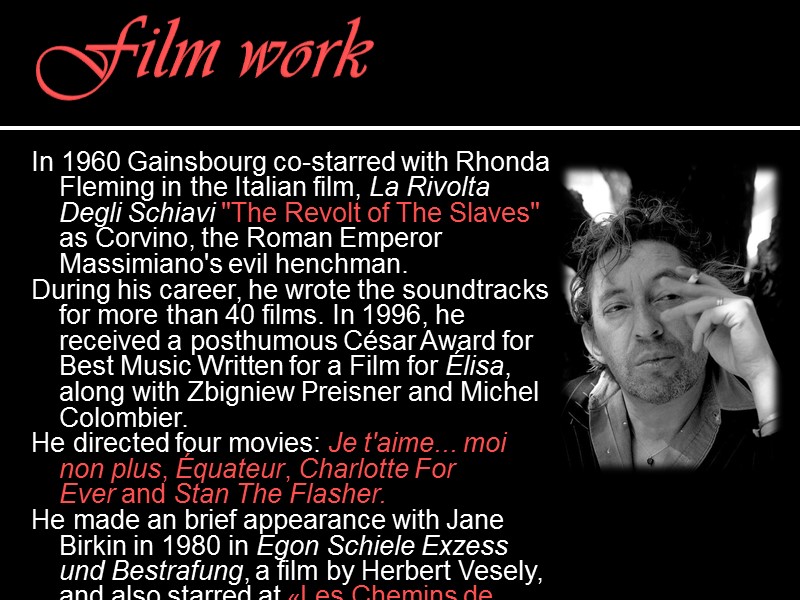
Film work In 1960 Gainsbourg co-starred with Rhonda Fleming in the Italian film, La Rivolta Degli Schiavi "The Revolt of The Slaves" as Corvino, the Roman Emperor Massimiano's evil henchman. During his career, he wrote the soundtracks for more than 40 films. In 1996, he received a posthumous César Award for Best Music Written for a Film for Élisa, along with Zbigniew Preisner and Michel Colombier. He directed four movies: Je t'aime... moi non plus, Équateur, Charlotte For Ever and Stan The Flasher. He made an brief appearance with Jane Birkin in 1980 in Egon Schiele Exzess und Bestrafung, a film by Herbert Vesely, and also starred at «Les Chemins de Katmandou», with Jane Birkin.
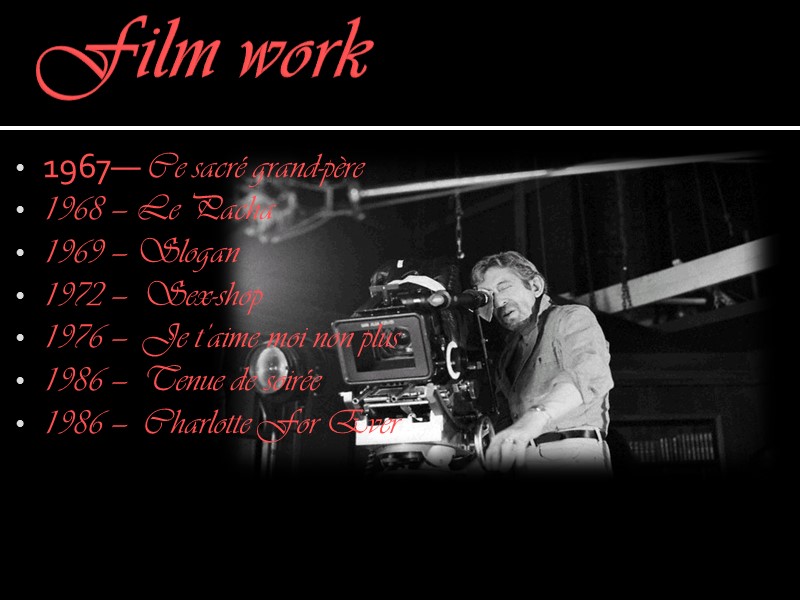
Film work 1967— Ce sacré grand-père 1968 — Le Pacha 1969 — Slogan 1972 — Sex-shop 1976 — Je t’aime moi non plus 1986 — Tenue de soirée 1986 — Charlotte For Ever
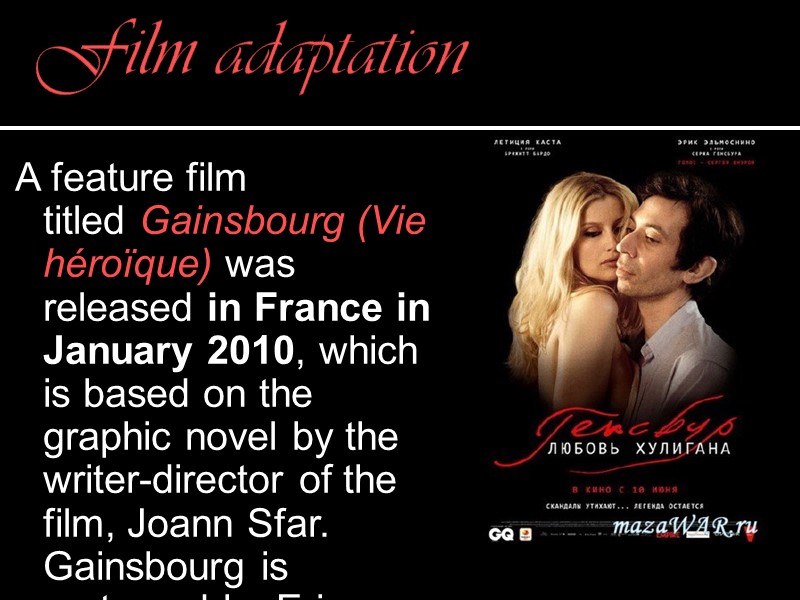
Film adaptation A feature film titled Gainsbourg (Vie héroïque) was released in France in January 2010, which is based on the graphic novel by the writer-director of the film, Joann Sfar. Gainsbourg is portrayed by Eric Elmosnino and Kacey Mottet Klein.
 Скачать презентацию Lucien Ginsburg Biography Serge Gainsbourg, born Lucien Ginsburg
28230-lucien_ginsburg.ppt
- Количество слайдов: 14