


 Скачать презентацию LTD Market Rich Clement GUAA Amelia Island
df4cb542c4bff9933b12b6f80b7e833a.ppt
- Количество слайдов: 30
 LTD Market Rich Clement GUAA – Amelia Island November 14, 2007 GUAA Amelia Island, November 16, 2007 1
 Outline Ø My Perspective on the LTD market Ø LTD manual rate comparisons Ø Underwriting in a slumping economy Ø Keys to success Ø Questions and discussion GUAA Amelia Island, November 16, 2007 2
 Why is LTD Difficult? ØLoss Experience is Volatile -Many time-dependent external influences -Hard to distinguish random from systematic ØLoss Takes a Long Time to Develop -Reserving Issues may cloud risk dynamics ØHigh Product Complexity - Many Plan Options - Contract differences across carriers GUAA Amelia Island, November 16, 2007 3
 Why is LTD Difficult? (Cont) ØHigh level of Underwriter Discretion -May provide subjective underwriter intelligence, but leads to loss of control and poor tracking. ØIrrational Marketplace: Some Companies … - are buying market share - are subject to underwriting cycles - have poor underwriting control - lead with other products (dental, life, etc) - have old and/or invalid rates GUAA Amelia Island, November 16, 2007 4
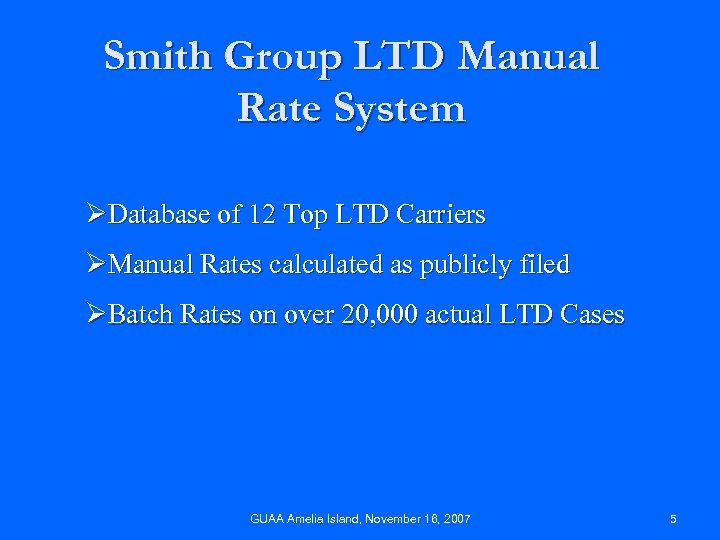 Smith Group LTD Manual Rate System ØDatabase of 12 Top LTD Carriers ØManual Rates calculated as publicly filed ØBatch Rates on over 20, 000 actual LTD Cases GUAA Amelia Island, November 16, 2007 5
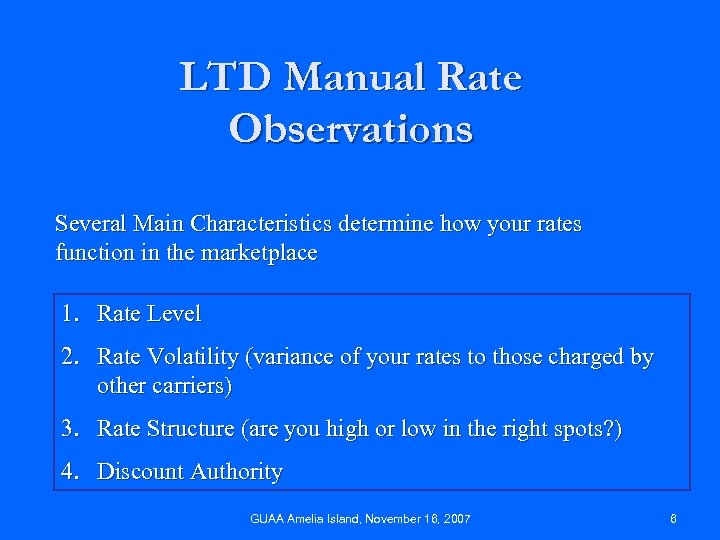 LTD Manual Rate Observations Several Main Characteristics determine how your rates function in the marketplace 1. Rate Level 2. Rate Volatility (variance of your rates to those charged by other carriers) 3. Rate Structure (are you high or low in the right spots? ) 4. Discount Authority GUAA Amelia Island, November 16, 2007 6
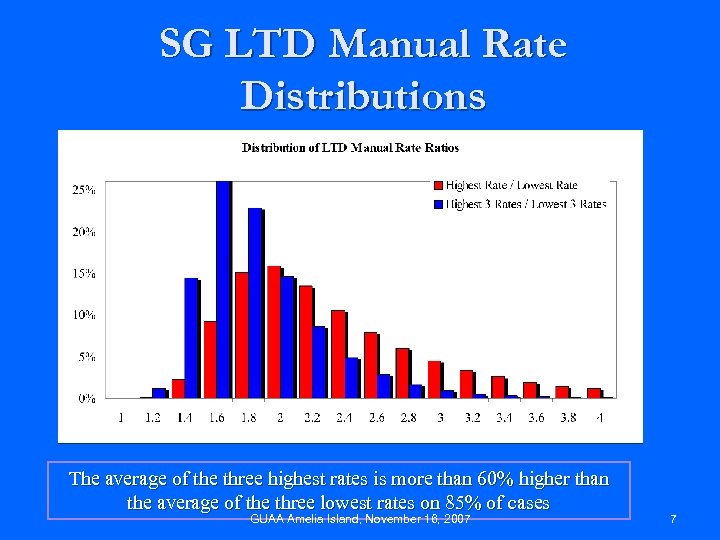 SG LTD Manual Rate Distributions The average of the three highest rates is more than 60% higher than the average of the three lowest rates on 85% of cases GUAA Amelia Island, November 16, 2007 7
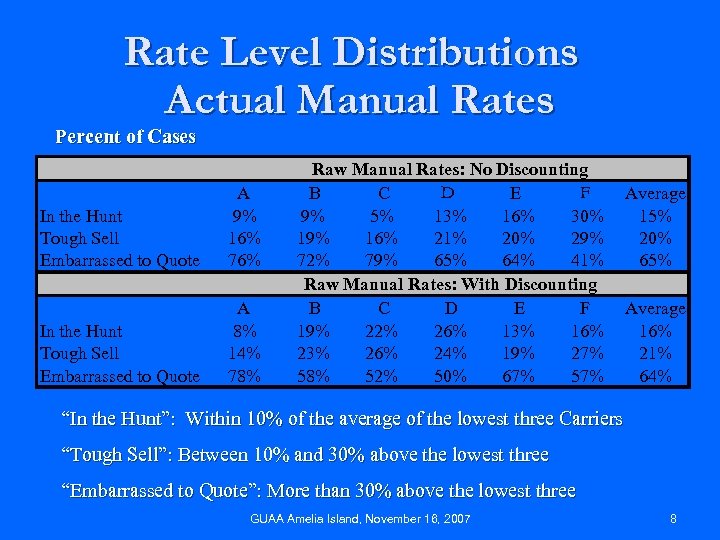 Rate Level Distributions Actual Manual Rates Percent of Cases In the Hunt Tough Sell Embarrassed to Quote A 9% 16% 76% In the Hunt Tough Sell Embarrassed to Quote A 8% 14% 78% Raw Manual Rates: No Discounting D F B C E 9% 5% 13% 16% 30% 19% 16% 21% 20% 29% 72% 79% 65% 64% 41% Raw Manual Rates: With Discounting B C D E F 19% 22% 26% 13% 16% 23% 26% 24% 19% 27% 58% 52% 50% 67% 57% Average 15% 20% 65% Average 16% 21% 64% “In the Hunt”: Within 10% of the average of the lowest three Carriers “Tough Sell”: Between 10% and 30% above the lowest three “Embarrassed to Quote”: More than 30% above the lowest three GUAA Amelia Island, November 16, 2007 8
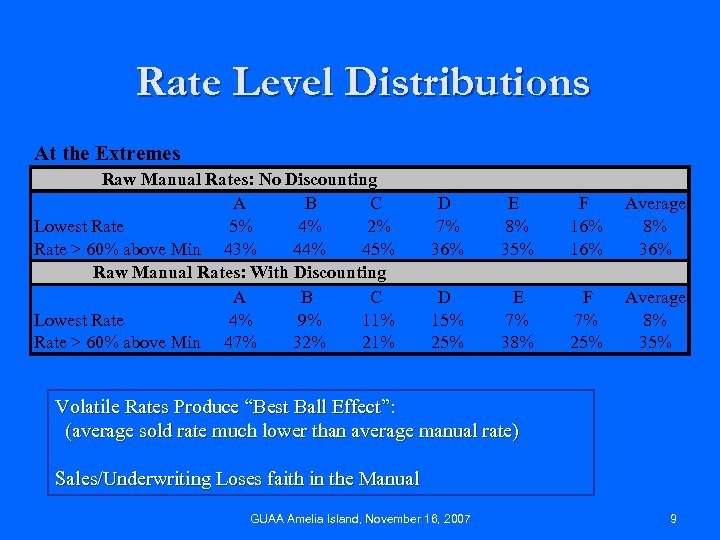 Rate Level Distributions At the Extremes Raw Manual Rates: No Discounting A B C Lowest Rate 5% 4% 2% Rate > 60% above Min 43% 44% 45% Raw Manual Rates: With Discounting A B C Lowest Rate 4% 9% 11% Rate > 60% above Min 47% 32% 21% D 7% 36% E 8% 35% F 16% Average 8% 36% D 15% 25% E 7% 38% F 7% 25% Average 8% 35% Volatile Rates Produce “Best Ball Effect”: (average sold rate much lower than average manual rate) Sales/Underwriting Loses faith in the Manual GUAA Amelia Island, November 16, 2007 9
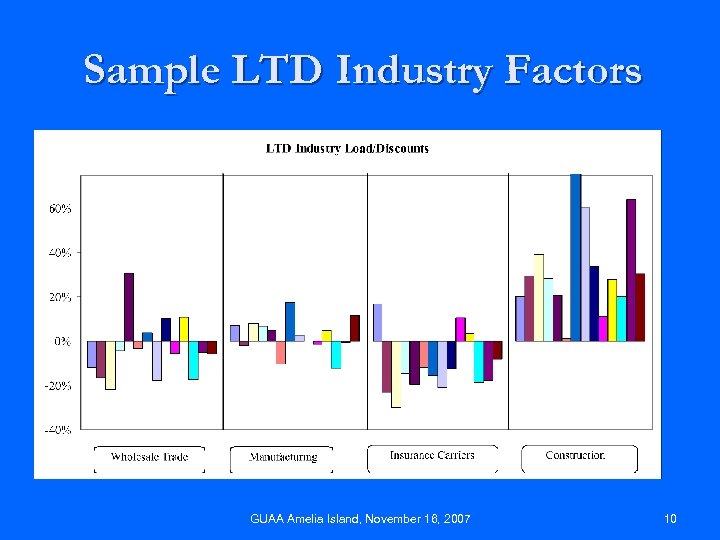 Sample LTD Industry Factors GUAA Amelia Island, November 16, 2007 10
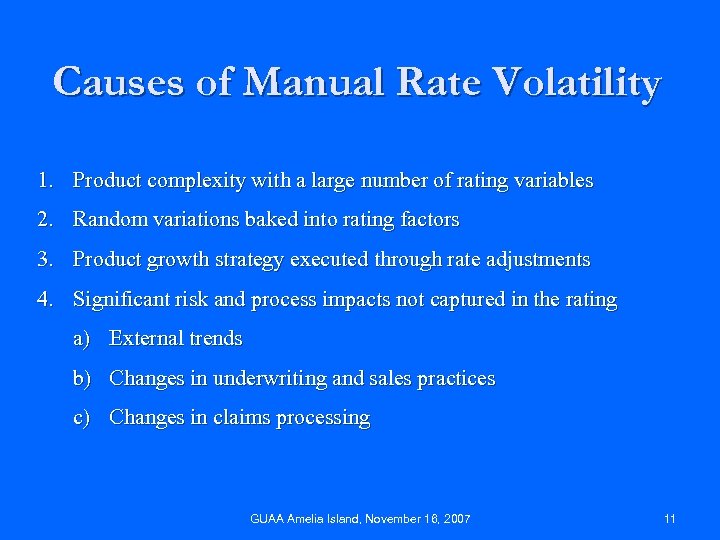 Causes of Manual Rate Volatility 1. Product complexity with a large number of rating variables 2. Random variations baked into rating factors 3. Product growth strategy executed through rate adjustments 4. Significant risk and process impacts not captured in the rating a) External trends b) Changes in underwriting and sales practices c) Changes in claims processing GUAA Amelia Island, November 16, 2007 11
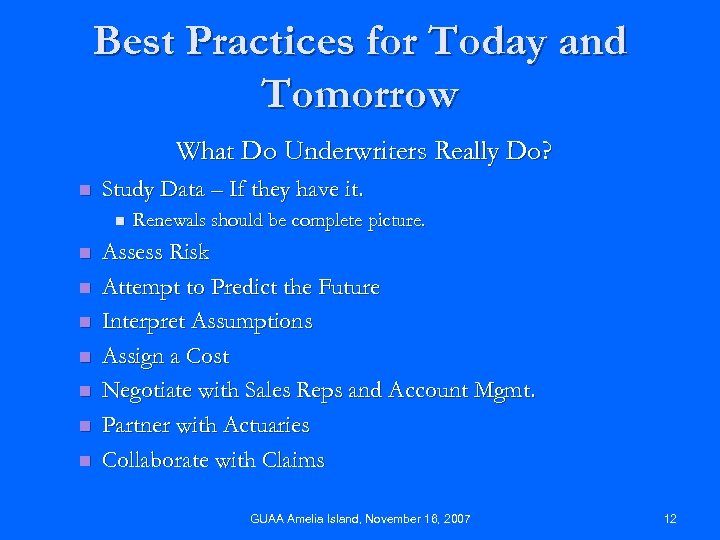 Best Practices for Today and Tomorrow What Do Underwriters Really Do? n Study Data – If they have it. n n n n Renewals should be complete picture. Assess Risk Attempt to Predict the Future Interpret Assumptions Assign a Cost Negotiate with Sales Reps and Account Mgmt. Partner with Actuaries Collaborate with Claims GUAA Amelia Island, November 16, 2007 12
 What if the Economy Turned? Planning and Preparation: Ø Ø Ø Can the past help us understand the future? What has happened in the past? Provides empirical boundaries Ø Within the last 20 years we have had two economic slow downs: Ø ’ 91 -’ 92 impacted white-collar employees Ø Ø Ø ’ 01 -’ 02 impacted financial sector and telecommunications Ø Ø Exacerbated by liberal plan designs Many new claim diagnosis – CFS, Carpal Tunnel Smaller employers Many changes have occurred, i. e. claims practices, contract rewrite GUAA Amelia Island, November 16, 2007 13
 Diversity of Book Ø Ø Pursue Industries that may not follow the traditional economic cycle Ø Municipalities Ø Health-care Ø Education Ø Other industries Plan design Ø Ø Conscious of replacement ratios Avoid liberal salary definitions that depend on large bonuses Ø Ø Real Estate 24 month M&N/Substance Abuse Limitation Ø Subjective condition limit – understand value from claims GUAA Amelia Island, November 16, 2007 14
 Impact on Smaller Employers Ø Smaller groups can be more of a concern Ø Less likely to have surplus – rainy day fund Ø Harder to borrow needed cash – limited collateral Ø Less RTW opportunities and capabilities Ø Trickle down effect ØSmall consulting firms, housing market GUAA Amelia Island, November 16, 2007 15
 Financial Underwriting Pay greater attention to financial underwriting n Look for signs of weak financials n Avoid the mistake n Underwriters should keep up to date on economic outlook n Industry experts to communicate positive and negative outlooks n Evaluate business segments for known concentrations n GUAA Amelia Island, November 16, 2007 16
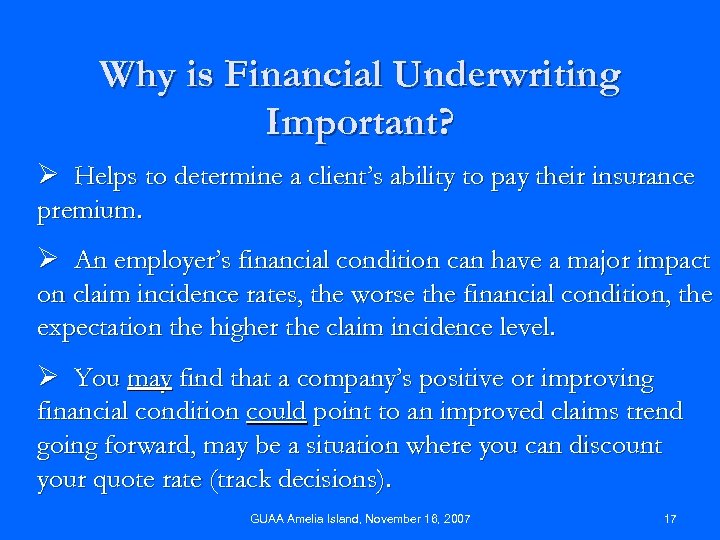 Why is Financial Underwriting Important? Ø Helps to determine a client’s ability to pay their insurance premium. Ø An employer’s financial condition can have a major impact on claim incidence rates, the worse the financial condition, the expectation the higher the claim incidence level. Ø You may find that a company’s positive or improving financial condition could point to an improved claims trend going forward, may be a situation where you can discount your quote rate (track decisions). GUAA Amelia Island, November 16, 2007 17
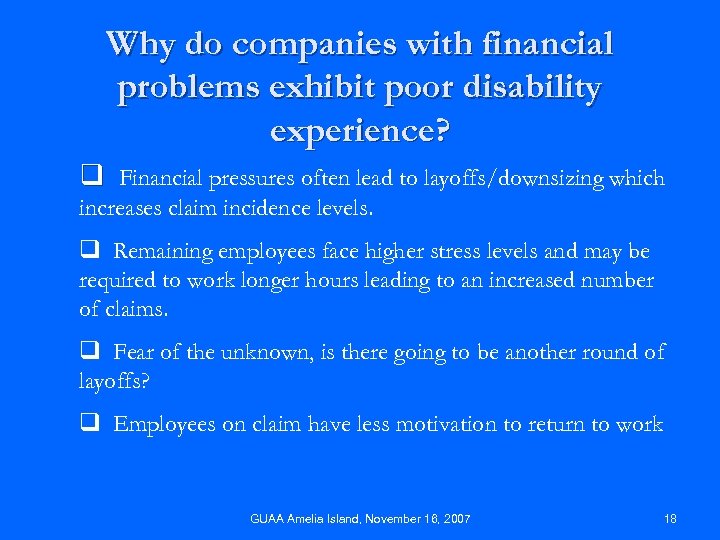 Why do companies with financial problems exhibit poor disability experience? q Financial pressures often lead to layoffs/downsizing which increases claim incidence levels. q Remaining employees face higher stress levels and may be required to work longer hours leading to an increased number of claims. q Fear of the unknown, is there going to be another round of layoffs? q Employees on claim have less motivation to return to work GUAA Amelia Island, November 16, 2007 18
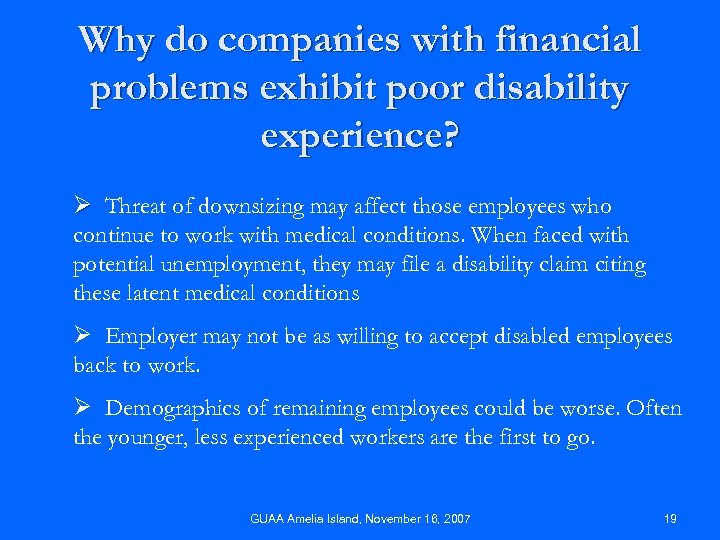 Why do companies with financial problems exhibit poor disability experience? Ø Threat of downsizing may affect those employees who continue to work with medical conditions. When faced with potential unemployment, they may file a disability claim citing these latent medical conditions Ø Employer may not be as willing to accept disabled employees back to work. Ø Demographics of remaining employees could be worse. Often the younger, less experienced workers are the first to go. GUAA Amelia Island, November 16, 2007 19
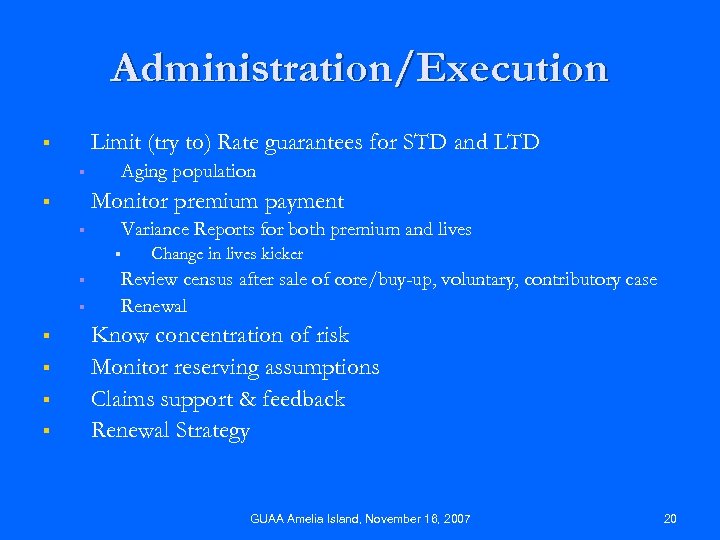 Administration/Execution Limit (try to) Rate guarantees for STD and LTD § Aging population § Monitor premium payment § Variance Reports for both premium and lives § § § § Change in lives kicker Review census after sale of core/buy-up, voluntary, contributory case Renewal Know concentration of risk Monitor reserving assumptions Claims support & feedback Renewal Strategy GUAA Amelia Island, November 16, 2007 20
 Best Practices for Today and Tomorrow Invest in the Right Opportunities Who is the competition? What have they done and what will they do? n What do we need to do to write the case (without leaving money on the table? ) n Are we comfortable with our decision? n Know when to walk away. n Emotionally invested. GUAA Amelia Island, November 16, 2007 21
 Best Practices for Today and Tomorrow Invest in the Right Opportunities Avoid the pitfalls n n Don’t back into your formula rate based on competitive positioning. Do your analysis first Don’t overvalue the inforce and /or competitor rates Trust yourself. GUAA Amelia Island, November 16, 2007 22
 Best Practices for Today and Tomorrow Invest in the Right Opportunities Avoid the pitfalls n Overly aggressive approach to weighing credibility, shock claims: n n n Exercise caution when reviewing recent experience periods. n n Does experience reflect high end exposure? Pooling works two ways. Is data fully revealed? Is standard claim lag appropriate? Are all claims approved? What is likely claim termination rate? We need to honor any rate put on the table. n Be careful of shadow pricing. n No such thing as “illustrative quote. ” GUAA Amelia Island, November 16, 2007 23
 Best Practices for Today and Tomorrow Invest in the Right Opportunities Avoid the pitfalls n Avoid the disaster! n Look for the warning signs: n Financials: n Mergers, Acquisitions, Management Changes, Filings n Experience and Industry Trends n Data Quality n Carrier Hopping GUAA Amelia Island, November 16, 2007 24
 Best Practices for Today and Tomorrow Invest in the Right Opportunities “In today’s economy, there are no experts, no ‘best and brightest’ with all the answers. It’s up to each one of us. The only way to screw up is to nottry anything. Tom Peters GUAA Amelia Island, November 16, 2007 25
 Best Practices for Today and Tomorrow Making the Call It’s Your Investment n Common Sense n Not Based On One Reason Alone n Pure Business Decision n Balance; it works both ways n Communicate n Get It Back Into The Process: Document n GUAA Amelia Island, November 16, 2007 26
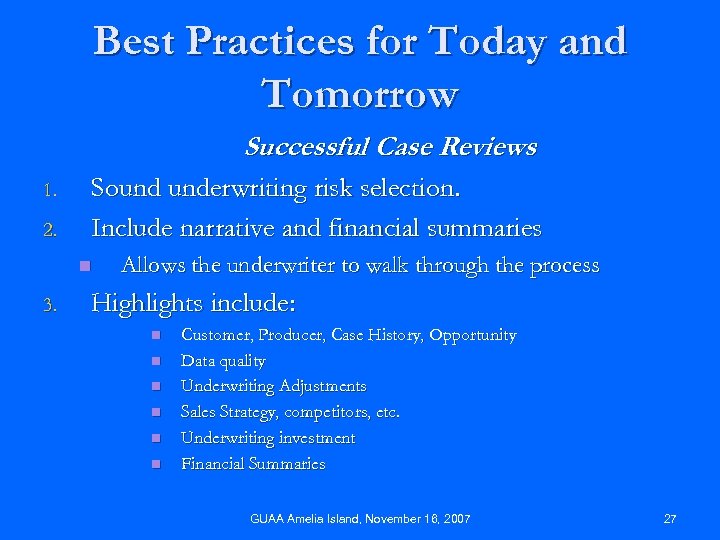 Best Practices for Today and Tomorrow Successful Case Reviews 1. 2. Sound underwriting risk selection. Include narrative and financial summaries n 3. Allows the underwriter to walk through the process Highlights include: n n n Customer, Producer, Case History, Opportunity Data quality Underwriting Adjustments Sales Strategy, competitors, etc. Underwriting investment Financial Summaries GUAA Amelia Island, November 16, 2007 27
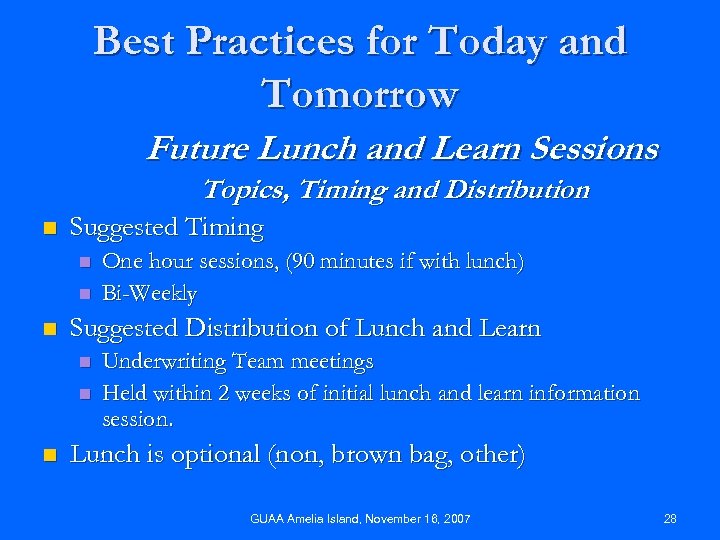 Best Practices for Today and Tomorrow Future Lunch and Learn Sessions Topics, Timing and Distribution n Suggested Timing n n n Suggested Distribution of Lunch and Learn n One hour sessions, (90 minutes if with lunch) Bi-Weekly Underwriting Team meetings Held within 2 weeks of initial lunch and learn information session. Lunch is optional (non, brown bag, other) GUAA Amelia Island, November 16, 2007 28
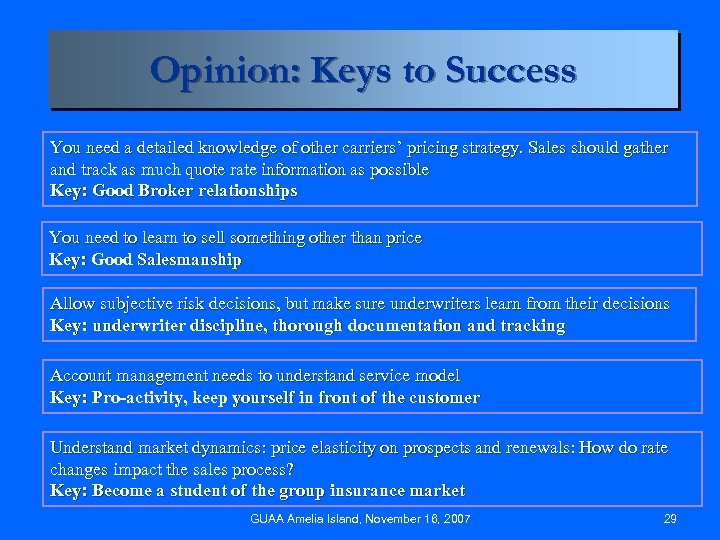 Actual Keys to Rates Opinion: Manual Success You need a detailed knowledge of other carriers’ pricing strategy. Sales should gather and track as much quote rate information as possible Key: Good Broker relationships You need to learn to sell something other than price Key: Good Salesmanship Allow subjective risk decisions, but make sure underwriters learn from their decisions Key: underwriter discipline, thorough documentation and tracking Account management needs to understand service model Key: Pro-activity, keep yourself in front of the customer Understand market dynamics: price elasticity on prospects and renewals: How do rate changes impact the sales process? Key: Become a student of the group insurance market GUAA Amelia Island, November 16, 2007 29
 Questions Thank you for your time. GUAA Amelia Island, November 16, 2007 30