


 Скачать презентацию LSA 352 Summer 2007 Speech Recognition and Synthesis
ef4267f240065c41235cd66d24b6edd9.ppt
- Количество слайдов: 91
 LSA 352: Summer 2007. Speech Recognition and Synthesis Dan Jurafsky Lecture 2: TTS: Brief History, Text Normalization and Part-of -Speech Tagging IP Notice: lots of info, text, and diagrams on these slides comes (thanks!) from Alan Black’s excellent lecture notes and from Richard Sproat’s slides. 1/5/07 LSA 352 2007 1
 Outline I. III. IV. History of Speech Synthesis State of the Art Demos Brief Architectural Overview Text Processing 1) Text Normalization • • 2) 3) Homograph disambiguation Part-of-speech tagging • 1/5/07 Tokenization End of sentence detection • Methodology: decision trees Methodology: Hidden Markov Models LSA 352 2007 2
 Dave Barry on TTS “And computers are getting smarter all the time; scientists tell us that soon they will be able to talk with us. (By "they", I mean computers; I doubt scientists will ever be able to talk to us. ) 1/5/07 LSA 352 2007 3
 History of TTS • Pictures and some text from Hartmut Traunmüller’s web site: • http: //www. ling. su. se/staff/hartmut/kemplne. htm • Von Kempeln 1780 b. Bratislava 1734 d. Vienna 1804 • Leather resonator manipulated by the operator to try and copy vocal tract configuration during sonorants (vowels, glides, nasals) • Bellows provided air stream, counterweight provided inhalation • Vibrating reed produced periodic pressure wave 1/5/07 LSA 352 2007 4
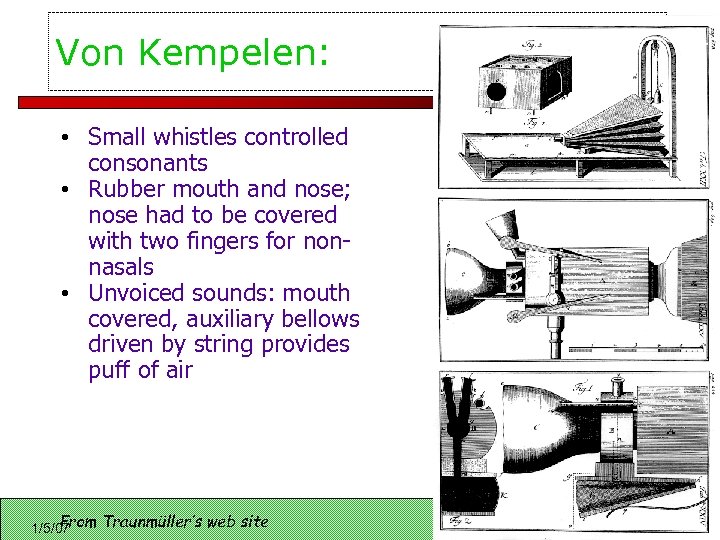 Von Kempelen: • Small whistles controlled consonants • Rubber mouth and nose; nose had to be covered with two fingers for nonnasals • Unvoiced sounds: mouth covered, auxiliary bellows driven by string provides puff of air From Traunmüller’s web site 1/5/07 LSA 352 2007 5
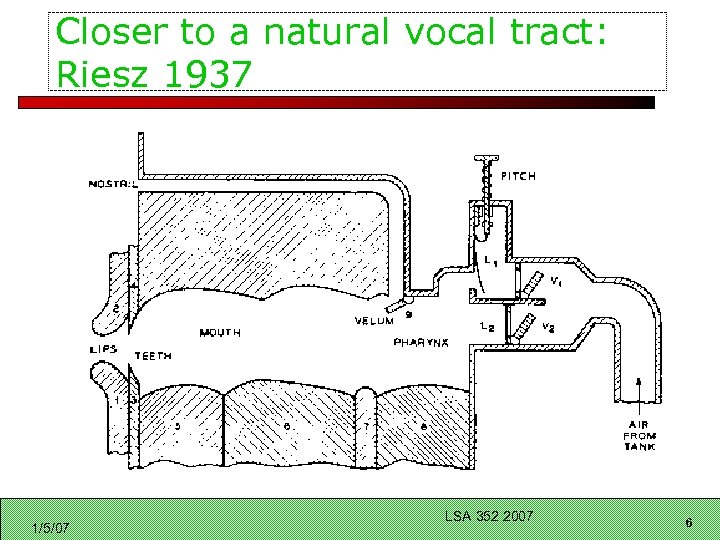 Closer to a natural vocal tract: Riesz 1937 1/5/07 LSA 352 2007 6
 Homer Dudley 1939 VODER Synthesizing speech by electrical means 1939 World’s Fair 1/5/07 LSA 352 2007 7
 Homer Dudley’s VODER • Manually controlled through complex keyboard • Operator training was a problem 1/5/07 LSA 352 2007 8
 An aside on demos That last slide Exhibited Rule 1 of playing a speech synthesis demo: Always have a human say what the words are right before you have the system say them 1/5/07 LSA 352 2007 9
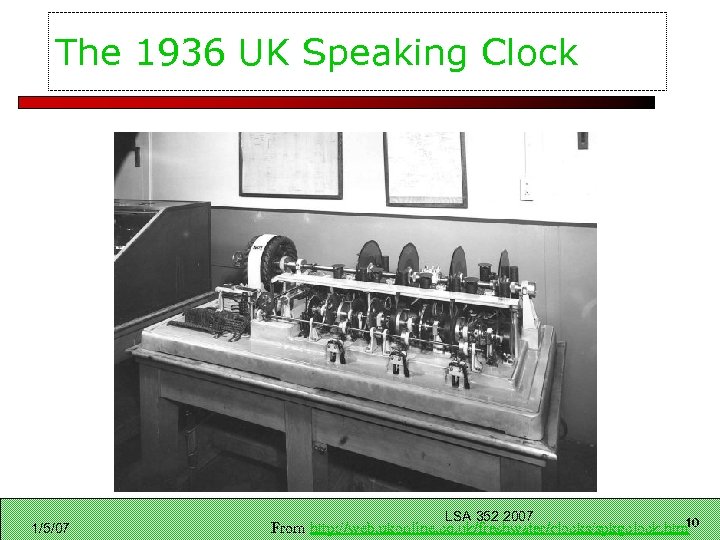 The 1936 UK Speaking Clock 1/5/07 LSA 352 2007 10 From http: //web. ukonline. co. uk/freshwater/clocks/spkgclock. htm
 The UK Speaking Clock July 24, 1936 Photographic storage on 4 glass disks 2 disks for minutes, 1 for hour, one for seconds. Other words in sentence distributed across 4 disks, so all 4 used at once. Voice of “Miss J. Cain” 1/5/07 LSA 352 2007 11
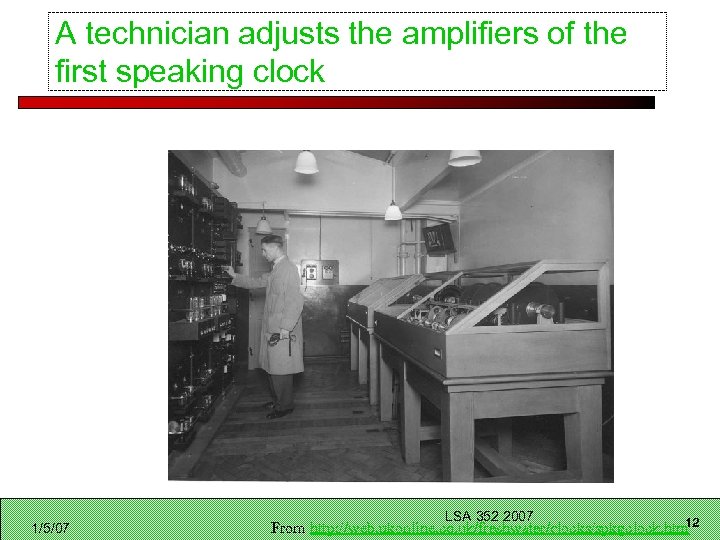 A technician adjusts the amplifiers of the first speaking clock 1/5/07 LSA 352 2007 12 From http: //web. ukonline. co. uk/freshwater/clocks/spkgclock. htm
 Gunnar Fant’s OVE synthesizer Of the Royal Institute of Technology, Stockholm Formant Synthesizer for vowels F 1 and F 2 could be controlled 1/5/07 LSA 352 2007 13 From Traunmüller’s web site
 Cooper’s Pattern Playback Haskins Labs for investigating speech perception Works like an inverse of a spectrograph Light from a lamp goes through a rotating disk then through spectrogram into photovoltaic cells Thus amount of light that gets transmitted at each frequency band corresponds to amount of acoustic energy at that band 1/5/07 LSA 352 2007 14
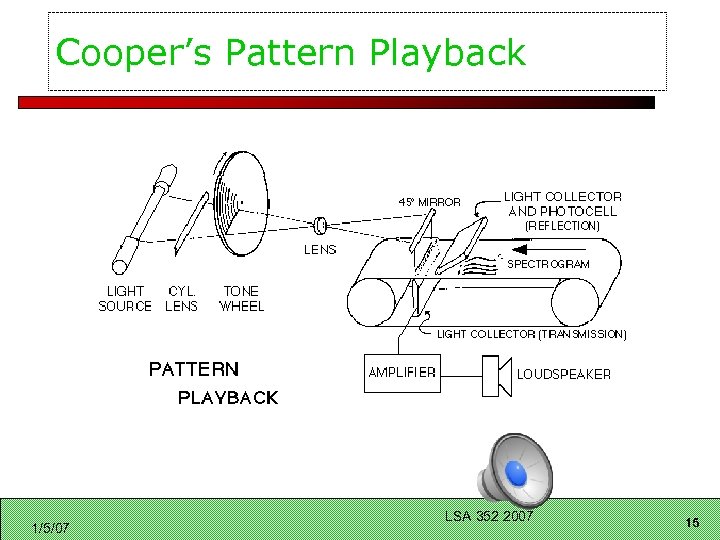 Cooper’s Pattern Playback 1/5/07 LSA 352 2007 15
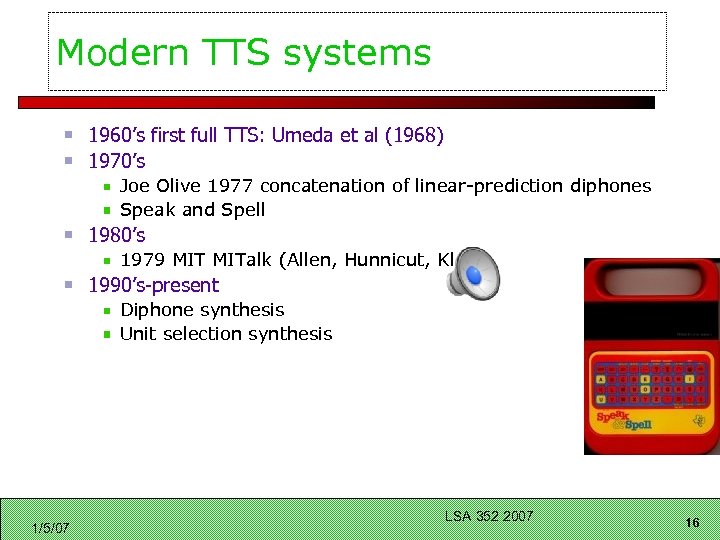 Modern TTS systems 1960’s first full TTS: Umeda et al (1968) 1970’s Joe Olive 1977 concatenation of linear-prediction diphones Speak and Spell 1980’s 1979 MITalk (Allen, Hunnicut, Klatt) 1990’s-present Diphone synthesis Unit selection synthesis 1/5/07 LSA 352 2007 16
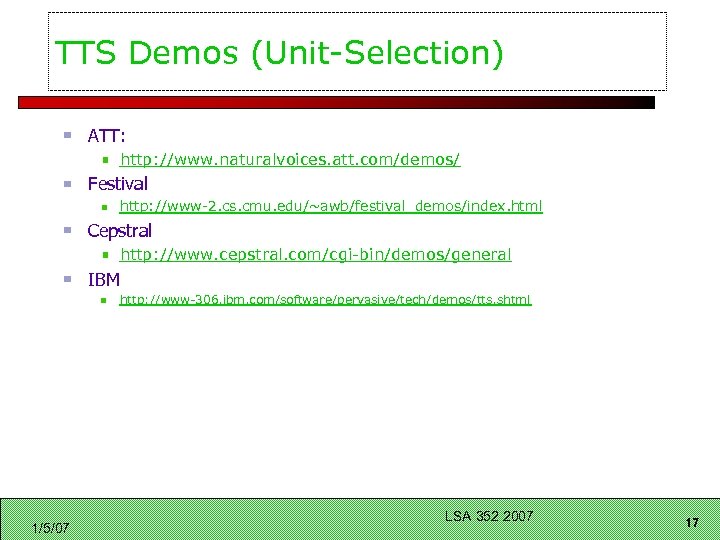 TTS Demos (Unit-Selection) ATT: http: //www. naturalvoices. att. com/demos/ Festival http: //www-2. cs. cmu. edu/~awb/festival_demos/index. html Cepstral http: //www. cepstral. com/cgi-bin/demos/general IBM http: //www-306. ibm. com/software/pervasive/tech/demos/tts. shtml 1/5/07 LSA 352 2007 17
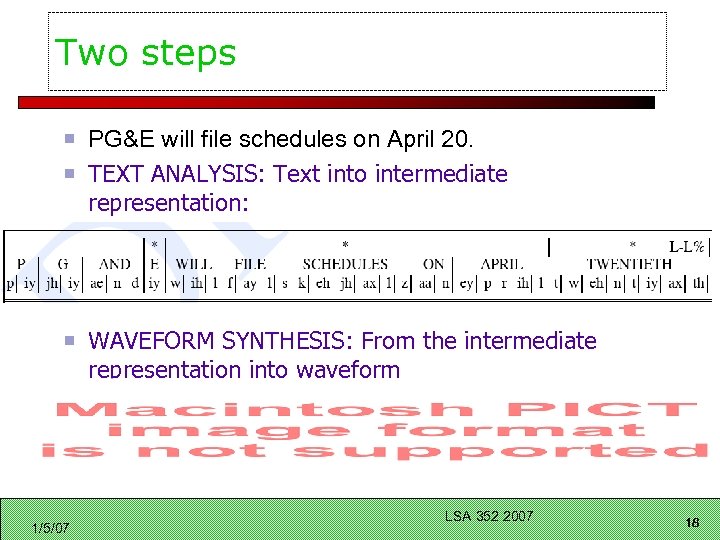 Two steps PG&E will file schedules on April 20. TEXT ANALYSIS: Text into intermediate representation: WAVEFORM SYNTHESIS: From the intermediate representation into waveform 1/5/07 LSA 352 2007 18
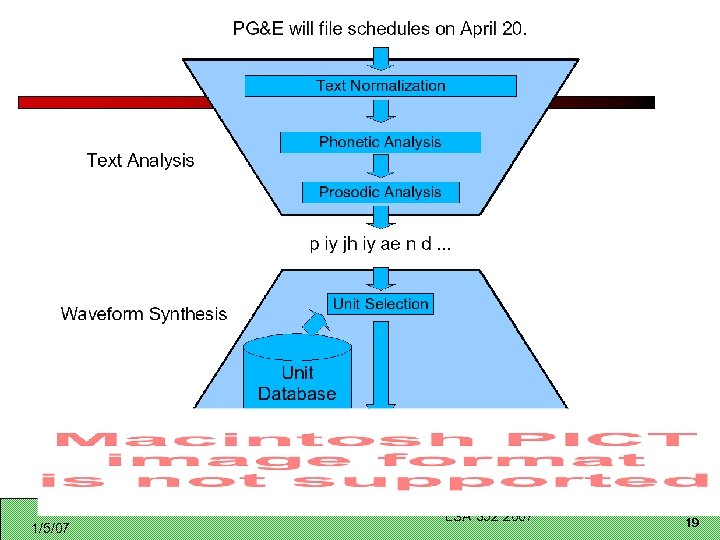 1/5/07 LSA 352 2007 19
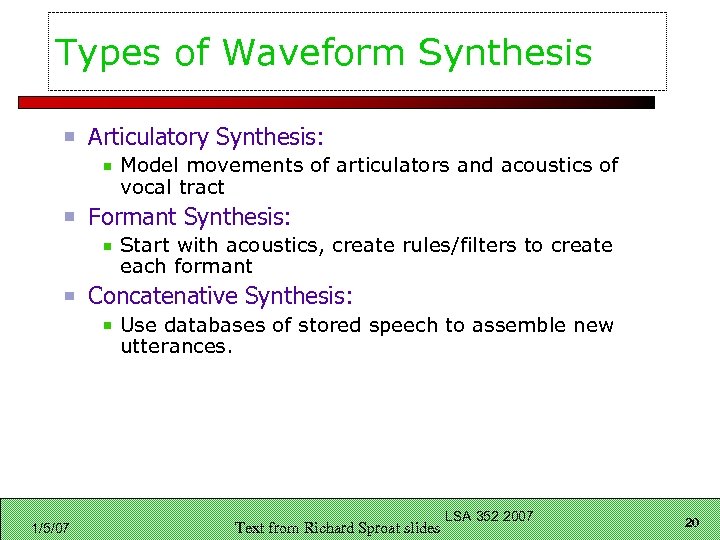 Types of Waveform Synthesis Articulatory Synthesis: Model movements of articulators and acoustics of vocal tract Formant Synthesis: Start with acoustics, create rules/filters to create each formant Concatenative Synthesis: Use databases of stored speech to assemble new utterances. 1/5/07 Text from Richard Sproat slides LSA 352 2007 20
 Formant Synthesis Were the most common commercial systems while (as Sproat says) computers were relatively underpowered. 1979 MITalk (Allen, Hunnicut, Klatt) 1983 DECtalk system The voice of Stephen Hawking 1/5/07 LSA 352 2007 21
 Concatenative Synthesis All current commercial systems. Diphone Synthesis Units are diphones; middle of one phone to middle of next. Why? Middle of phone is steady state. Record 1 speaker saying each diphone Unit Selection Synthesis Larger units Record 10 hours or more, so have multiple copies of each unit Use search to find best sequence of units 1/5/07 LSA 352 2007 22
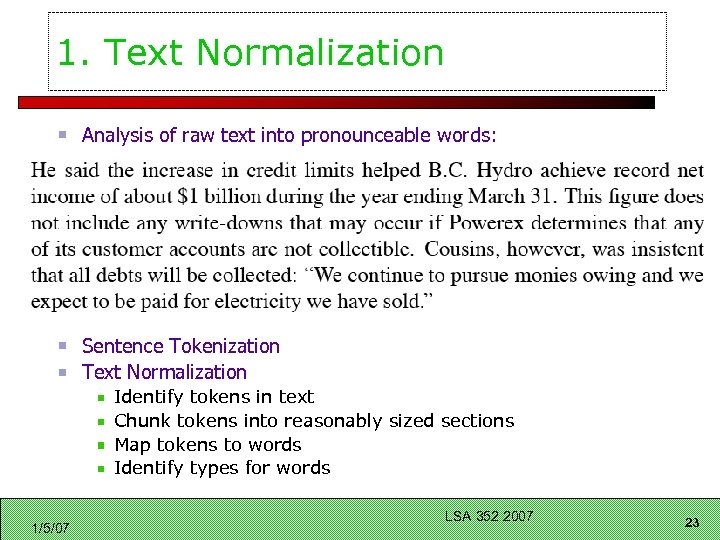 1. Text Normalization Analysis of raw text into pronounceable words: Sentence Tokenization Text Normalization Identify tokens in text Chunk tokens into reasonably sized sections Map tokens to words Identify types for words 1/5/07 LSA 352 2007 23
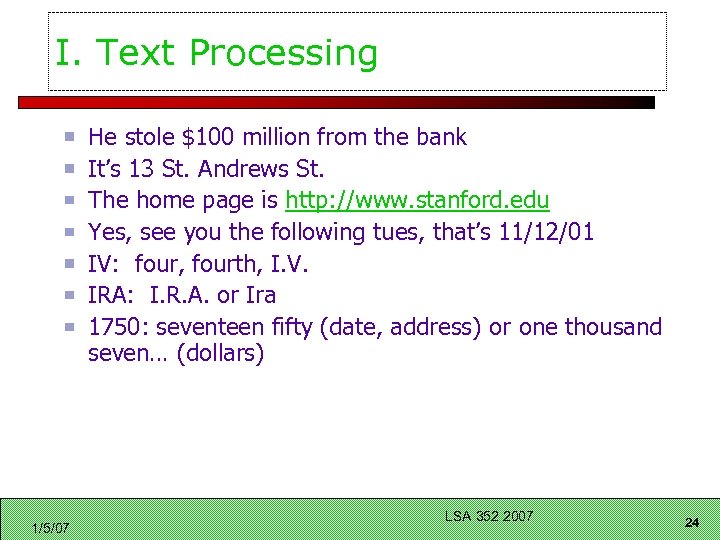 I. Text Processing He stole $100 million from the bank It’s 13 St. Andrews St. The home page is http: //www. stanford. edu Yes, see you the following tues, that’s 11/12/01 IV: four, fourth, I. V. IRA: I. R. A. or Ira 1750: seventeen fifty (date, address) or one thousand seven… (dollars) 1/5/07 LSA 352 2007 24
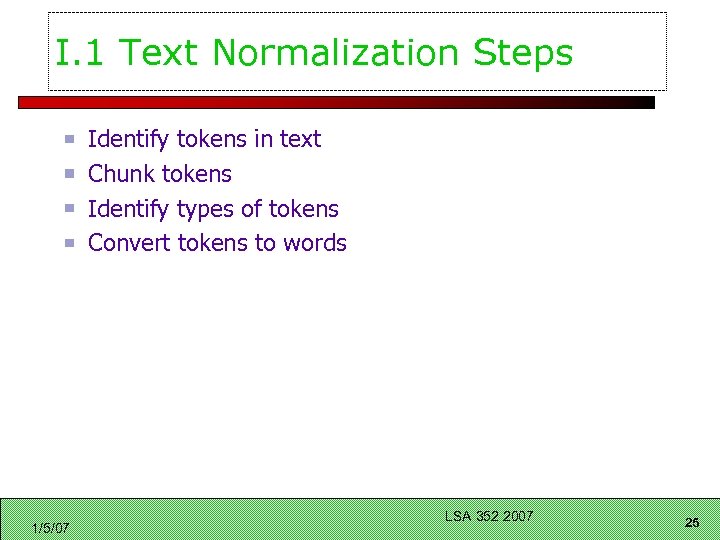 I. 1 Text Normalization Steps Identify tokens in text Chunk tokens Identify types of tokens Convert tokens to words 1/5/07 LSA 352 2007 25
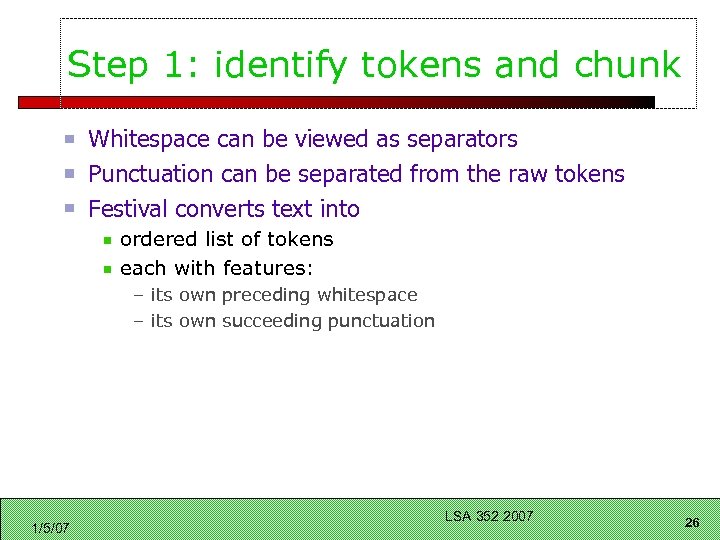 Step 1: identify tokens and chunk Whitespace can be viewed as separators Punctuation can be separated from the raw tokens Festival converts text into ordered list of tokens each with features: – its own preceding whitespace – its own succeeding punctuation 1/5/07 LSA 352 2007 26
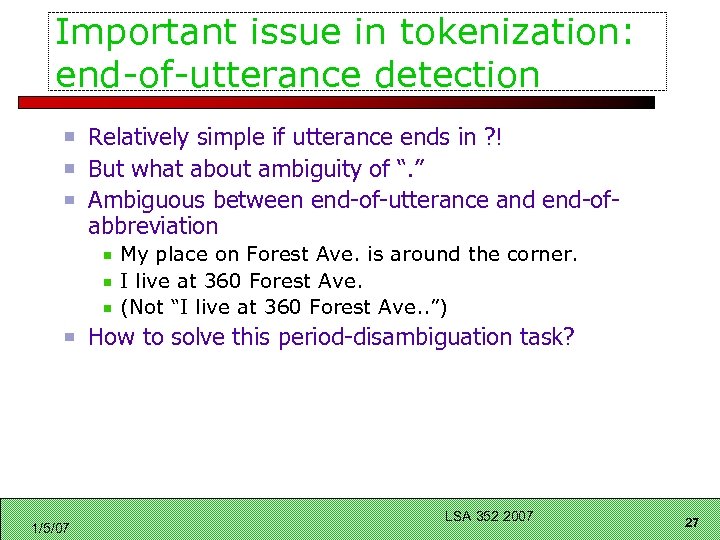 Important issue in tokenization: end-of-utterance detection Relatively simple if utterance ends in ? ! But what about ambiguity of “. ” Ambiguous between end-of-utterance and end-ofabbreviation My place on Forest Ave. is around the corner. I live at 360 Forest Ave. (Not “I live at 360 Forest Ave. . ”) How to solve this period-disambiguation task? 1/5/07 LSA 352 2007 27
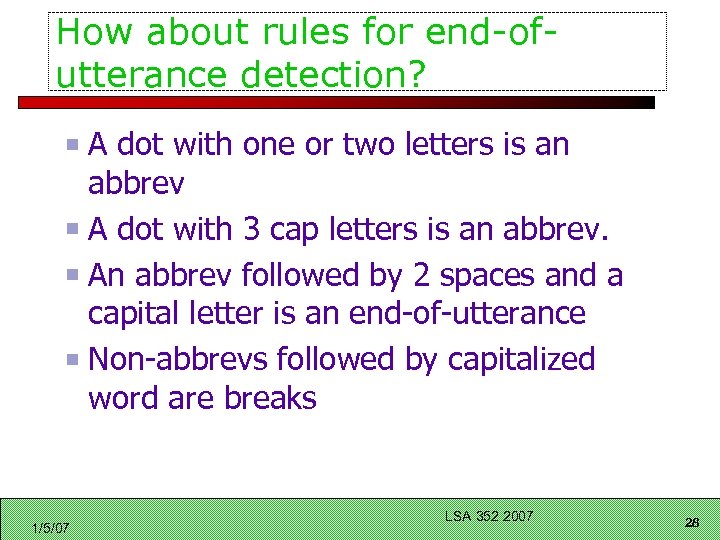 How about rules for end-ofutterance detection? A dot with one or two letters is an abbrev A dot with 3 cap letters is an abbrev. An abbrev followed by 2 spaces and a capital letter is an end-of-utterance Non-abbrevs followed by capitalized word are breaks 1/5/07 LSA 352 2007 28
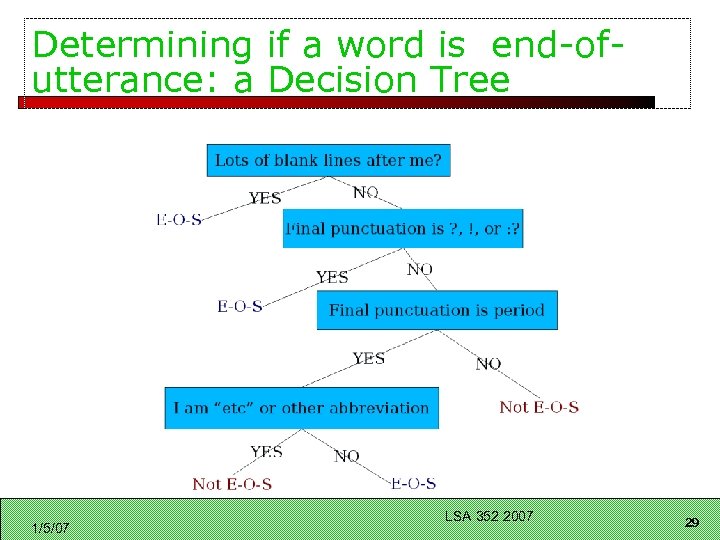 Determining if a word is end-ofutterance: a Decision Tree 1/5/07 LSA 352 2007 29
 CART Breiman, Friedman, Olshen, Stone. 1984. Classification and Regression Trees. Chapman & Hall, New York. Description/Use: Binary tree of decisions, terminal nodes determine prediction (“ 20 questions”) If dependent variable is categorial, “classification tree”, If continuous, “regression tree” 1/5/07 LSAText 2007 Richard Sproat 352 from 30
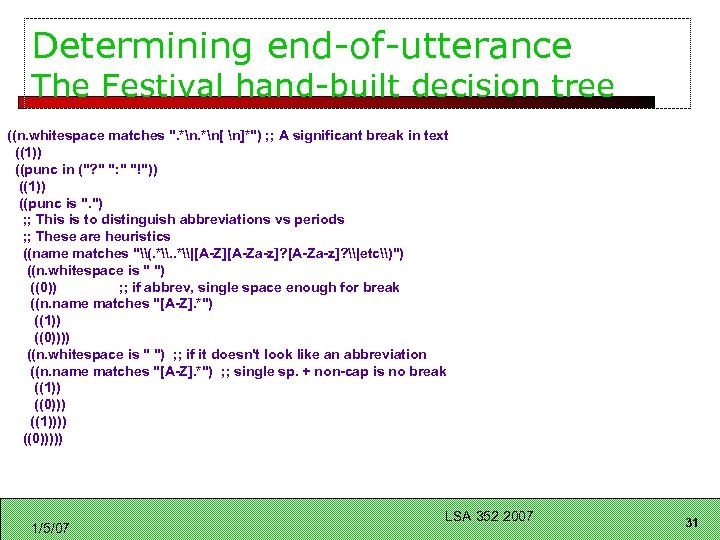 Determining end-of-utterance The Festival hand-built decision tree ((n. whitespace matches ". *n[ n]*") ; ; A significant break in text ((1)) ((punc in ("? " ": " "!")) ((1)) ((punc is ". ") ; ; This is to distinguish abbreviations vs periods ; ; These are heuristics ((name matches "\(. *\|[A-Z][A-Za-z]? \|etc\)") ((n. whitespace is " ") ((0)) ; ; if abbrev, single space enough for break ((n. name matches "[A-Z]. *") ((1)) ((0)))) ((n. whitespace is " ") ; ; if it doesn't look like an abbreviation ((n. name matches "[A-Z]. *") ; ; single sp. + non-cap is no break ((1)) ((0))) ((1)))) ((0))))) 1/5/07 LSA 352 2007 31
 The previous decision tree Fails for Cog. Sci. Newsletter Lots of cases at end of line. Badly spaced/capitalized sentences 1/5/07 LSA 352 2007 32
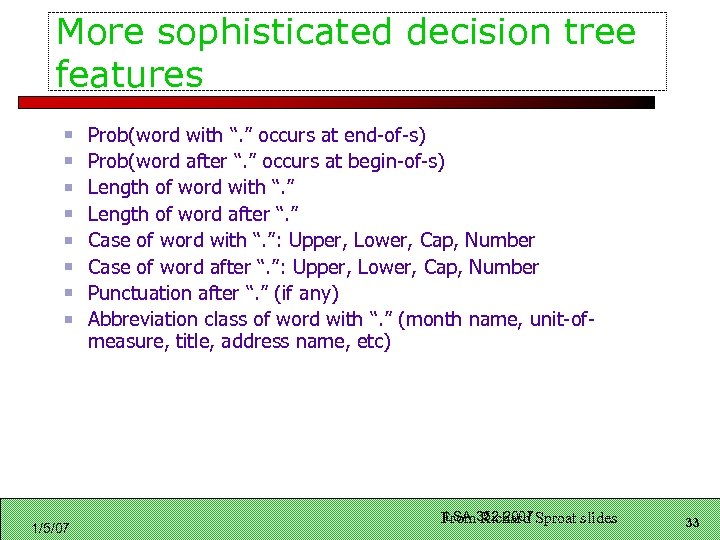 More sophisticated decision tree features Prob(word with “. ” occurs at end-of-s) Prob(word after “. ” occurs at begin-of-s) Length of word with “. ” Length of word after “. ” Case of word with “. ”: Upper, Lower, Cap, Number Case of word after “. ”: Upper, Lower, Cap, Number Punctuation after “. ” (if any) Abbreviation class of word with “. ” (month name, unit-ofmeasure, title, address name, etc) 1/5/07 LSA Richard From 352 2007 Sproat slides 33
 Learning DTs are rarely built by hand Hand-building only possible for very simple features, domains Lots of algorithms for DT induction Covered in detail in Machine Learning or AI classes Russell and Norvig AI text. I’ll give quick intuition here 1/5/07 LSA 352 2007 34
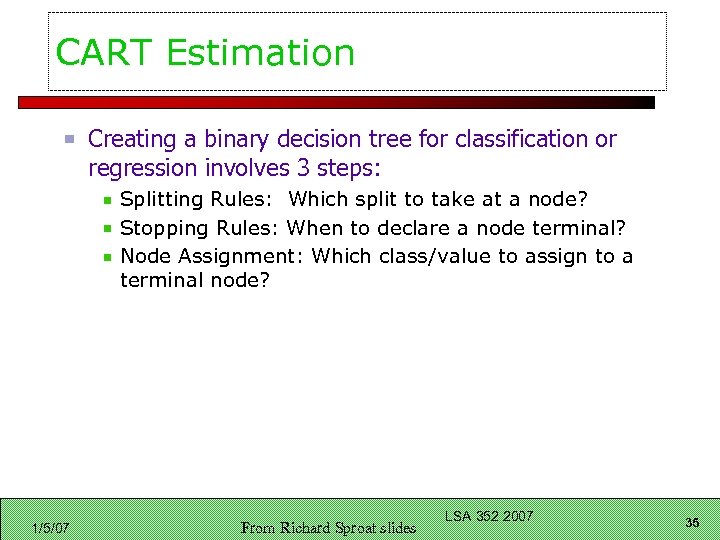 CART Estimation Creating a binary decision tree for classification or regression involves 3 steps: Splitting Rules: Which split to take at a node? Stopping Rules: When to declare a node terminal? Node Assignment: Which class/value to assign to a terminal node? 1/5/07 From Richard Sproat slides LSA 352 2007 35
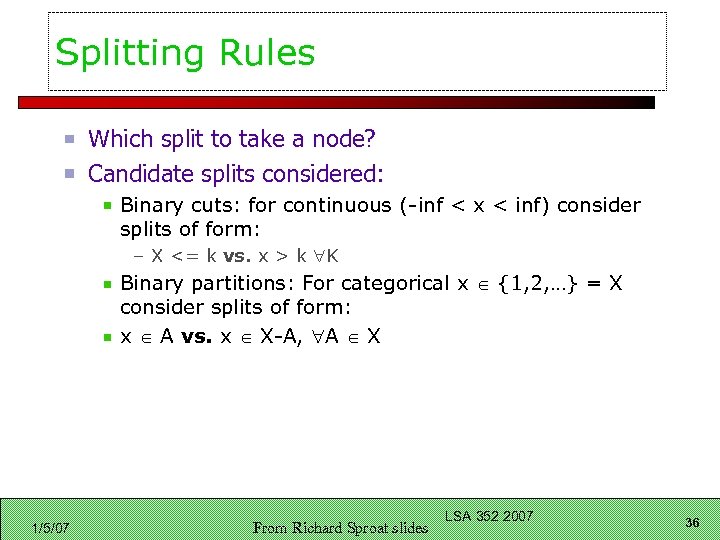 Splitting Rules Which split to take a node? Candidate splits considered: Binary cuts: for continuous (-inf < x < inf) consider splits of form: – X <= k vs. x > k K Binary partitions: For categorical x {1, 2, …} = X consider splits of form: x A vs. x X-A, A X 1/5/07 From Richard Sproat slides LSA 352 2007 36
 Splitting Rules Choosing best candidate split. Method 1: Choose k (continuous) or A (categorical) that minimizes estimated classification (regression) error after split Method 2 (for classification): Choose k or A that minimizes estimated entropy after that split. 1/5/07 From Richard Sproat slides LSA 352 2007 37
 Decision Tree Stopping When to declare a node terminal? Strategy (Cost-Complexity pruning): 1. Grow over-large tree 2. Form sequence of subtrees, T 0…Tn ranging from full tree to just the root node. 3. Estimate “honest” error rate for each subtree. 4. Choose tree size with minimum “honest” error rate. To estimate “honest” error rate, test on data different from training data (I. e. grow tree on 9/10 of data, test on 1/10, repeating 10 times and averaging (cross-validation). 1/5/07 From Richard Sproat LSA 352 2007 38
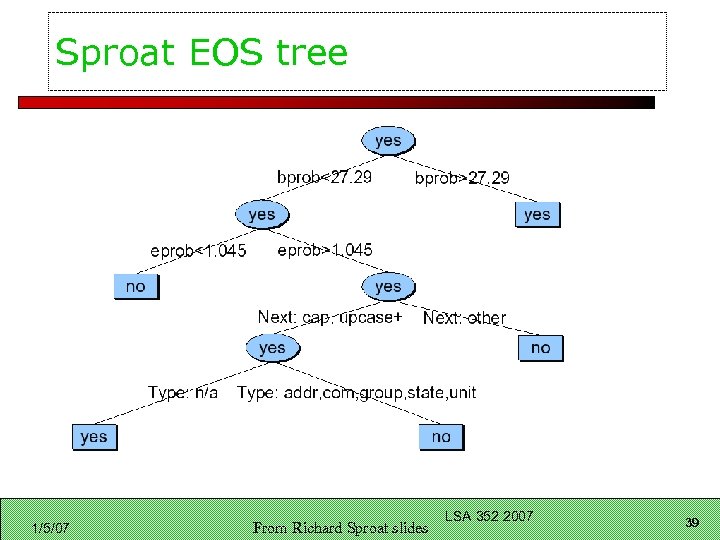 Sproat EOS tree 1/5/07 From Richard Sproat slides LSA 352 2007 39
 Summary on end-of-sentence detection Best references: David Palmer and Marti Hearst. 1997. Adaptive Multilingual Sentence Boundary Disambiguation. Computational Linguistics 23, 2. 241 -267. David Palmer. 2000. Tokenisation and Sentence Segmentation. In “Handbook of Natural Language Processing”, edited by Dale, Moisl, Somers. 1/5/07 LSA 352 2007 40
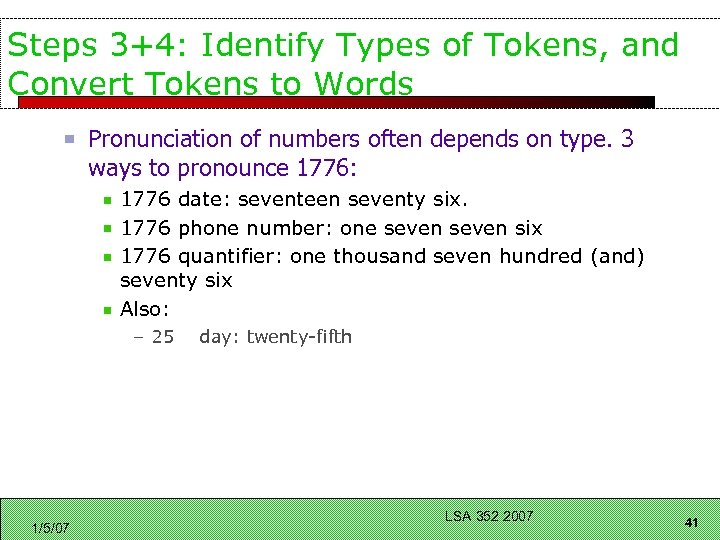 Steps 3+4: Identify Types of Tokens, and Convert Tokens to Words Pronunciation of numbers often depends on type. 3 ways to pronounce 1776: 1776 date: seventeen seventy six. 1776 phone number: one seven six 1776 quantifier: one thousand seven hundred (and) seventy six Also: – 25 1/5/07 day: twenty-fifth LSA 352 2007 41
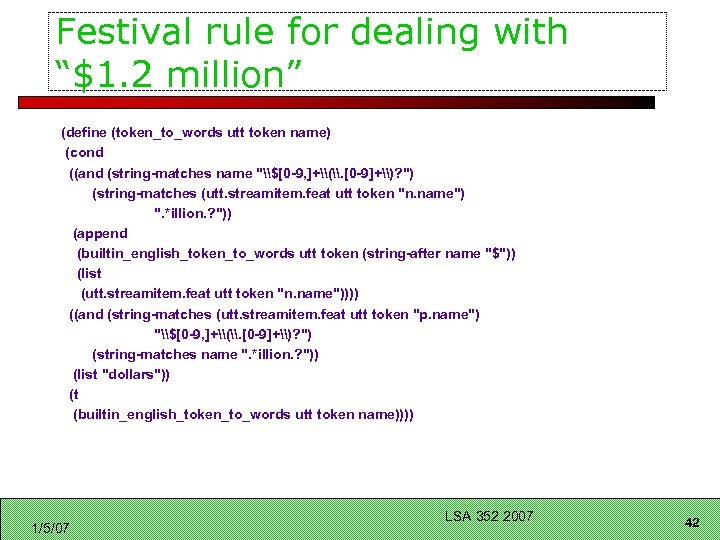 Festival rule for dealing with “$1. 2 million” (define (token_to_words utt token name) (cond ((and (string-matches name "\$[0 -9, ]+\(\. [0 -9]+\)? ") (string-matches (utt. streamitem. feat utt token "n. name") ". *illion. ? ")) (append (builtin_english_token_to_words utt token (string-after name "$")) (list (utt. streamitem. feat utt token "n. name")))) ((and (string-matches (utt. streamitem. feat utt token "p. name") "\$[0 -9, ]+\(\. [0 -9]+\)? ") (string-matches name ". *illion. ? ")) (list "dollars")) (t (builtin_english_token_to_words utt token name)))) 1/5/07 LSA 352 2007 42
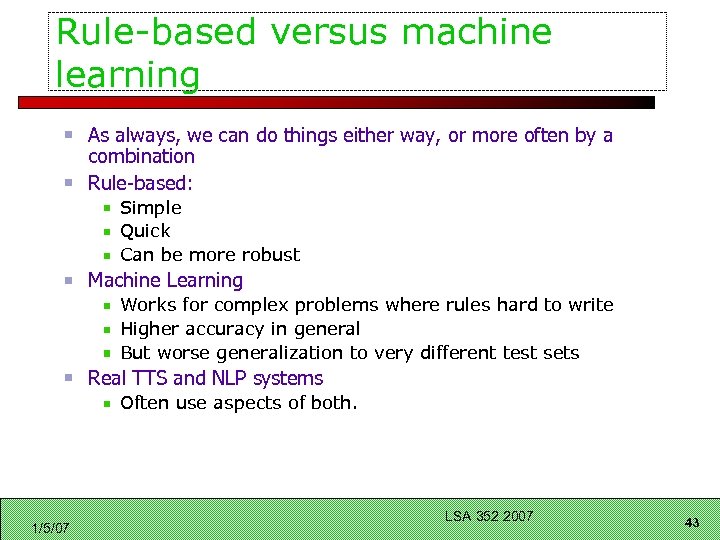 Rule-based versus machine learning As always, we can do things either way, or more often by a combination Rule-based: Simple Quick Can be more robust Machine Learning Works for complex problems where rules hard to write Higher accuracy in general But worse generalization to very different test sets Real TTS and NLP systems Often use aspects of both. 1/5/07 LSA 352 2007 43
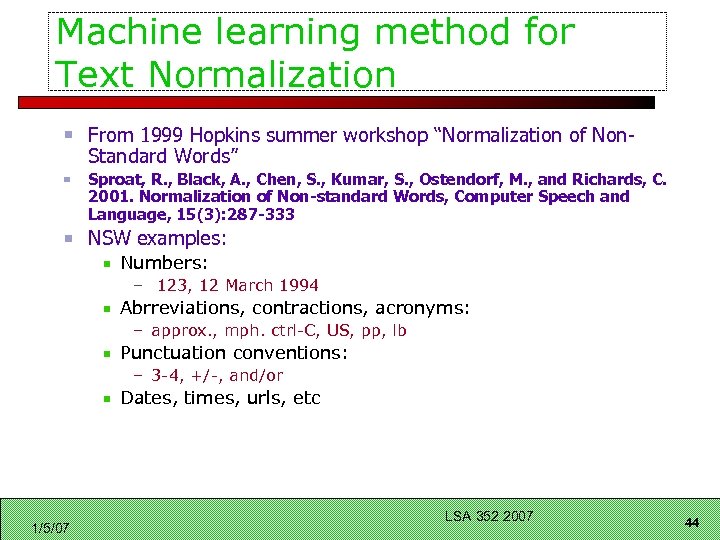 Machine learning method for Text Normalization From 1999 Hopkins summer workshop “Normalization of Non. Standard Words” Sproat, R. , Black, A. , Chen, S. , Kumar, S. , Ostendorf, M. , and Richards, C. 2001. Normalization of Non-standard Words, Computer Speech and Language, 15(3): 287 -333 NSW examples: Numbers: – 123, 12 March 1994 Abrreviations, contractions, acronyms: – approx. , mph. ctrl-C, US, pp, lb Punctuation conventions: – 3 -4, +/-, and/or Dates, times, urls, etc 1/5/07 LSA 352 2007 44
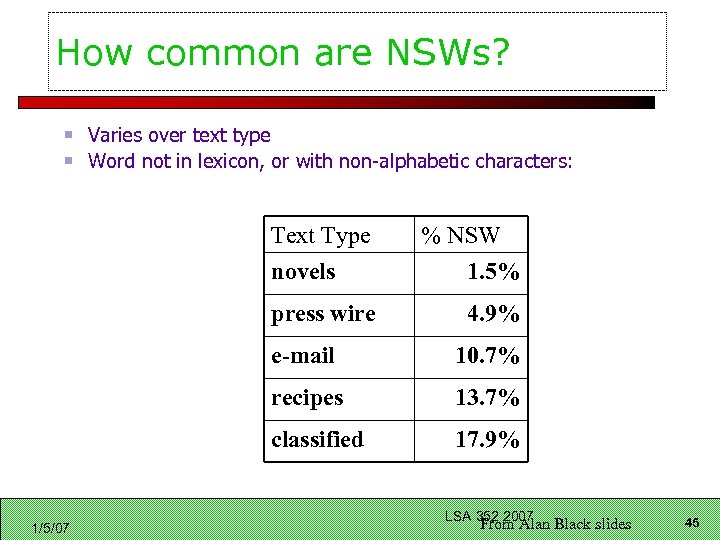 How common are NSWs? Varies over text type Word not in lexicon, or with non-alphabetic characters: Text Type novels % NSW 1. 5% press wire 4. 9% e-mail recipes 13. 7% classified 1/5/07 10. 7% 17. 9% LSA 352 2007 From Alan Black slides 45
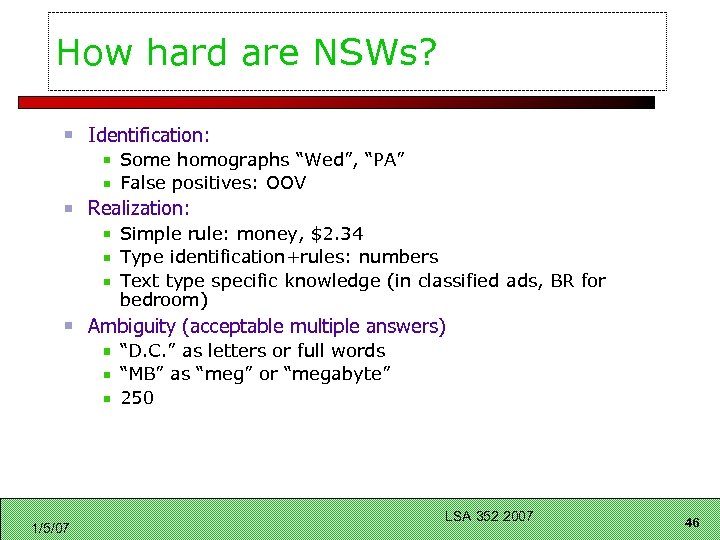 How hard are NSWs? Identification: Some homographs “Wed”, “PA” False positives: OOV Realization: Simple rule: money, $2. 34 Type identification+rules: numbers Text type specific knowledge (in classified ads, BR for bedroom) Ambiguity (acceptable multiple answers) “D. C. ” as letters or full words “MB” as “meg” or “megabyte” 250 1/5/07 LSA 352 2007 46
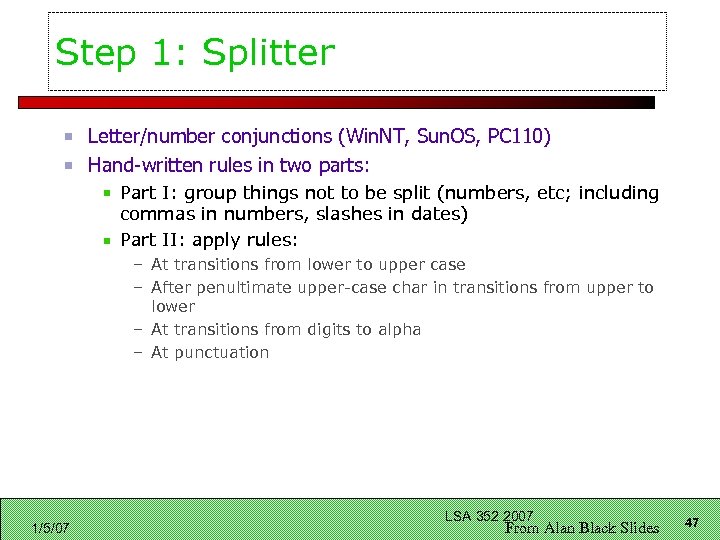 Step 1: Splitter Letter/number conjunctions (Win. NT, Sun. OS, PC 110) Hand-written rules in two parts: Part I: group things not to be split (numbers, etc; including commas in numbers, slashes in dates) Part II: apply rules: – At transitions from lower to upper case – After penultimate upper-case char in transitions from upper to lower – At transitions from digits to alpha – At punctuation 1/5/07 LSA 352 2007 From Alan Black Slides 47
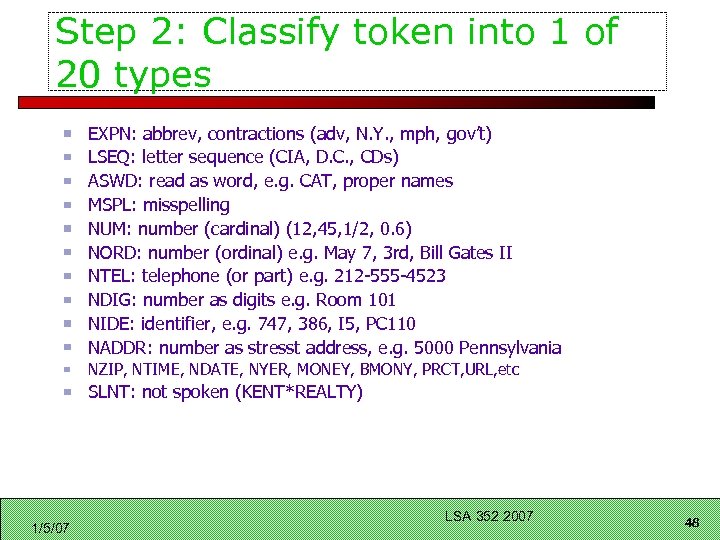 Step 2: Classify token into 1 of 20 types EXPN: abbrev, contractions (adv, N. Y. , mph, gov’t) LSEQ: letter sequence (CIA, D. C. , CDs) ASWD: read as word, e. g. CAT, proper names MSPL: misspelling NUM: number (cardinal) (12, 45, 1/2, 0. 6) NORD: number (ordinal) e. g. May 7, 3 rd, Bill Gates II NTEL: telephone (or part) e. g. 212 -555 -4523 NDIG: number as digits e. g. Room 101 NIDE: identifier, e. g. 747, 386, I 5, PC 110 NADDR: number as stresst address, e. g. 5000 Pennsylvania NZIP, NTIME, NDATE, NYER, MONEY, BMONY, PRCT, URL, etc SLNT: not spoken (KENT*REALTY) 1/5/07 LSA 352 2007 48
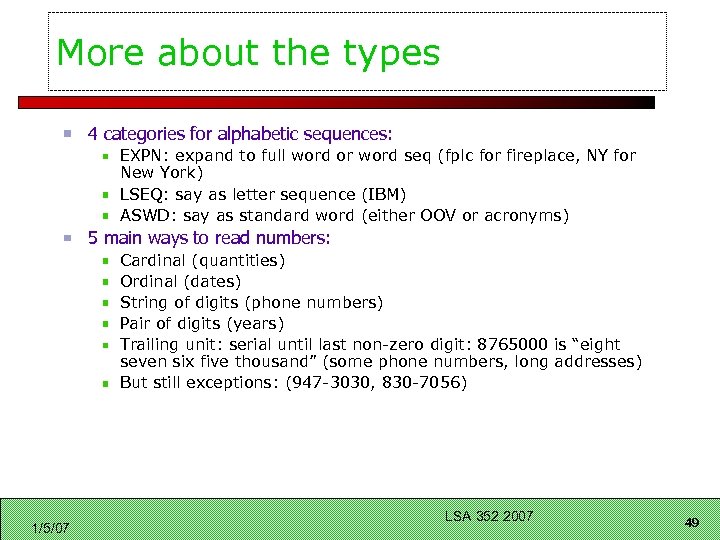 More about the types 4 categories for alphabetic sequences: EXPN: expand to full word or word seq (fplc for fireplace, NY for New York) LSEQ: say as letter sequence (IBM) ASWD: say as standard word (either OOV or acronyms) 5 main ways to read numbers: Cardinal (quantities) Ordinal (dates) String of digits (phone numbers) Pair of digits (years) Trailing unit: serial until last non-zero digit: 8765000 is “eight seven six five thousand” (some phone numbers, long addresses) But still exceptions: (947 -3030, 830 -7056) 1/5/07 LSA 352 2007 49
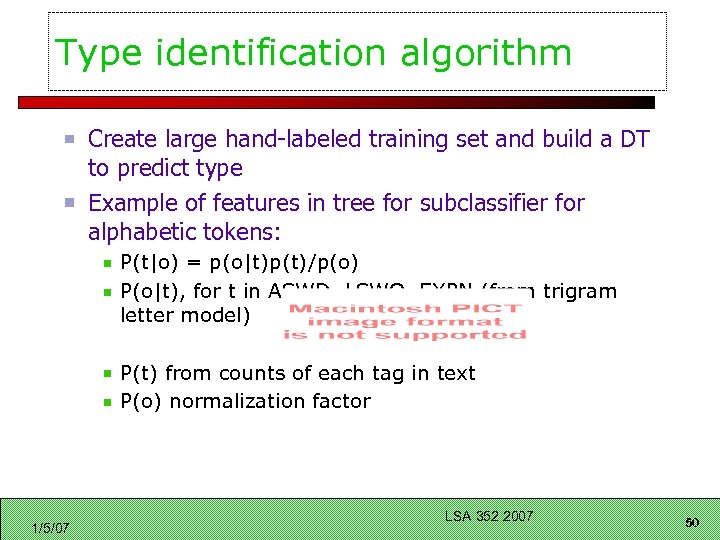 Type identification algorithm Create large hand-labeled training set and build a DT to predict type Example of features in tree for subclassifier for alphabetic tokens: P(t|o) = p(o|t)p(t)/p(o) P(o|t), for t in ASWD, LSWQ, EXPN (from trigram letter model) P(t) from counts of each tag in text P(o) normalization factor 1/5/07 LSA 352 2007 50
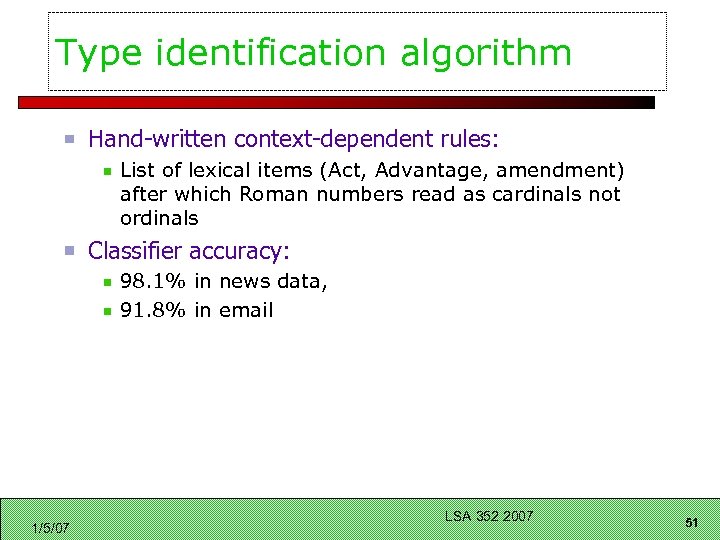 Type identification algorithm Hand-written context-dependent rules: List of lexical items (Act, Advantage, amendment) after which Roman numbers read as cardinals not ordinals Classifier accuracy: 98. 1% in news data, 91. 8% in email 1/5/07 LSA 352 2007 51
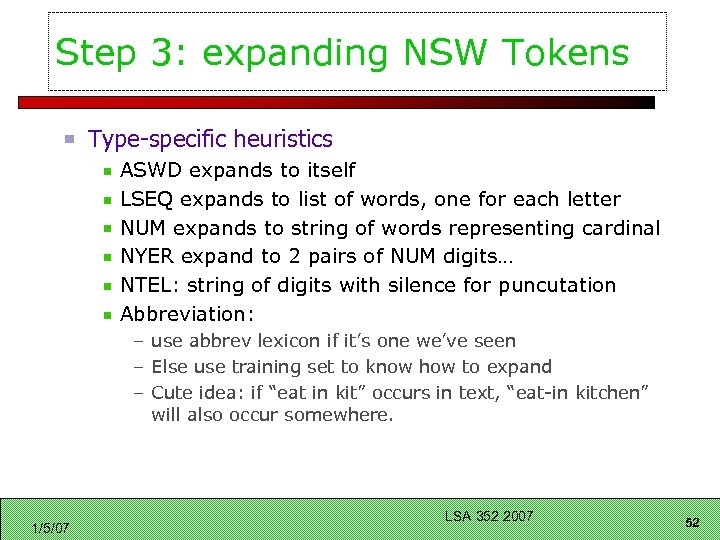 Step 3: expanding NSW Tokens Type-specific heuristics ASWD expands to itself LSEQ expands to list of words, one for each letter NUM expands to string of words representing cardinal NYER expand to 2 pairs of NUM digits… NTEL: string of digits with silence for puncutation Abbreviation: – use abbrev lexicon if it’s one we’ve seen – Else use training set to know how to expand – Cute idea: if “eat in kit” occurs in text, “eat-in kitchen” will also occur somewhere. 1/5/07 LSA 352 2007 52
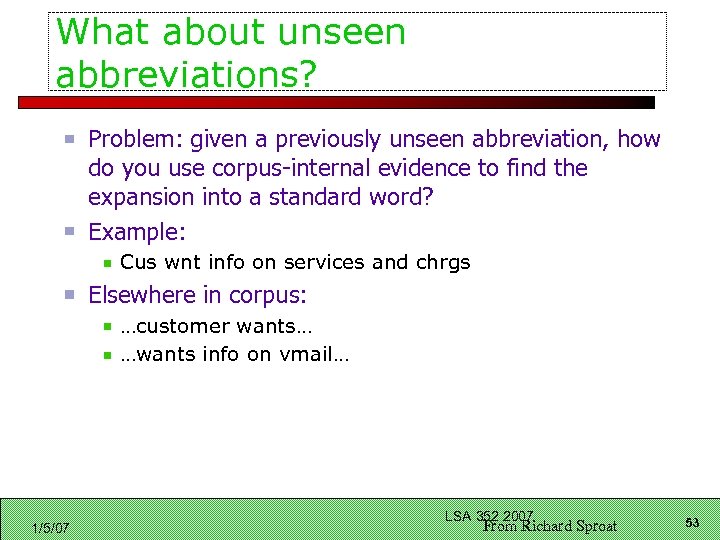 What about unseen abbreviations? Problem: given a previously unseen abbreviation, how do you use corpus-internal evidence to find the expansion into a standard word? Example: Cus wnt info on services and chrgs Elsewhere in corpus: …customer wants… …wants info on vmail… 1/5/07 LSA 352 2007 From Richard Sproat 53
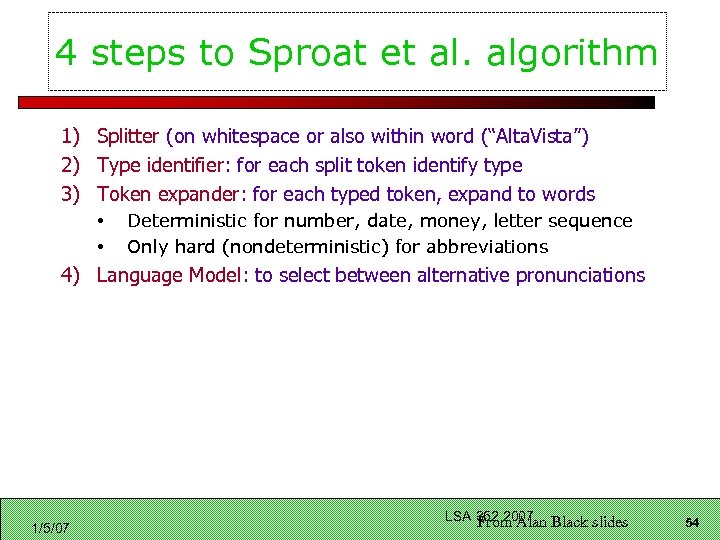 4 steps to Sproat et al. algorithm 1) Splitter (on whitespace or also within word (“Alta. Vista”) 2) Type identifier: for each split token identify type 3) Token expander: for each typed token, expand to words • • Deterministic for number, date, money, letter sequence Only hard (nondeterministic) for abbreviations 4) Language Model: to select between alternative pronunciations 1/5/07 LSA 352 2007 Black slides From Alan 54
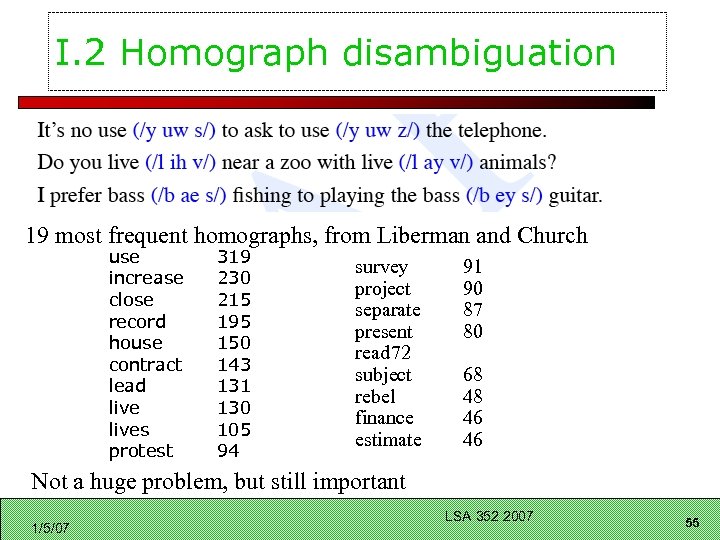 I. 2 Homograph disambiguation 19 most frequent homographs, from Liberman and Church use increase close record house contract lead lives protest 319 230 215 195 150 143 131 130 105 94 survey project separate present read 72 subject rebel finance estimate 91 90 87 80 68 48 46 46 Not a huge problem, but still important 1/5/07 LSA 352 2007 55
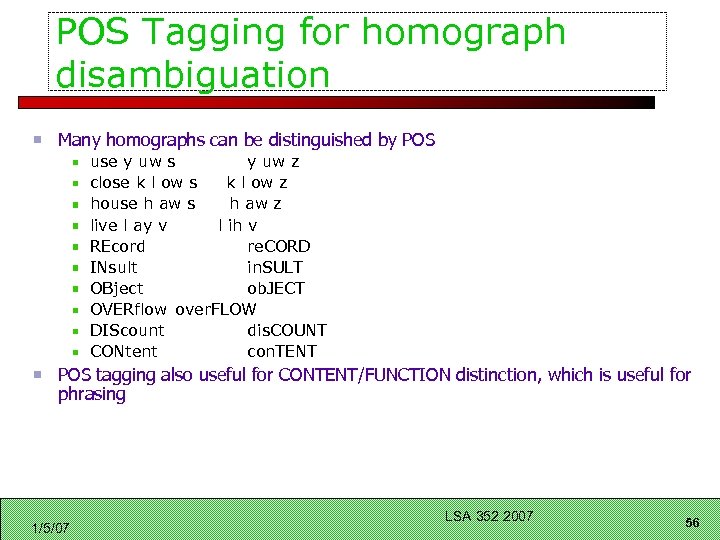 POS Tagging for homograph disambiguation Many homographs can be distinguished by POS use y uw s y uw z close k l ow s k l ow z house h aw s h aw z live l ay v l ih v REcord re. CORD INsult in. SULT OBject ob. JECT OVERflow over. FLOW DIScount dis. COUNT CONtent con. TENT POS tagging also useful for CONTENT/FUNCTION distinction, which is useful for phrasing 1/5/07 LSA 352 2007 56
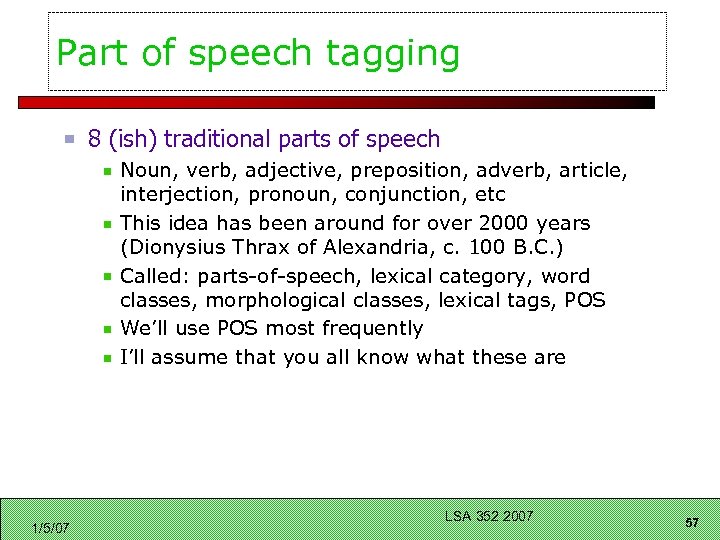 Part of speech tagging 8 (ish) traditional parts of speech Noun, verb, adjective, preposition, adverb, article, interjection, pronoun, conjunction, etc This idea has been around for over 2000 years (Dionysius Thrax of Alexandria, c. 100 B. C. ) Called: parts-of-speech, lexical category, word classes, morphological classes, lexical tags, POS We’ll use POS most frequently I’ll assume that you all know what these are 1/5/07 LSA 352 2007 57
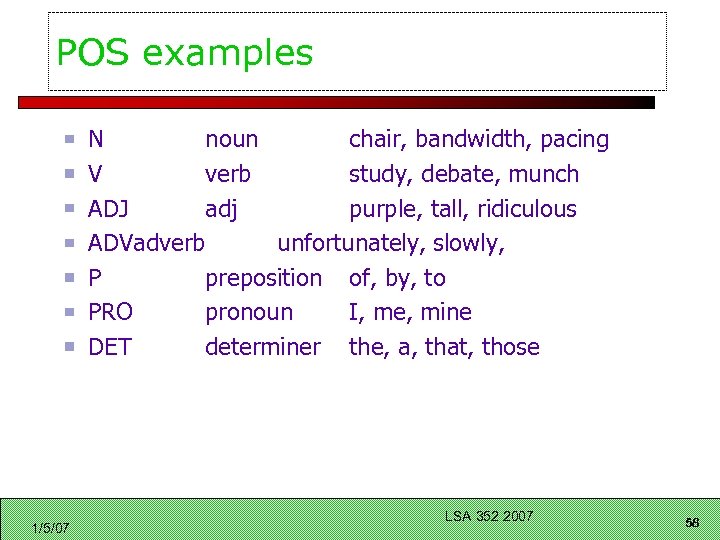 POS examples N noun chair, bandwidth, pacing V verb study, debate, munch ADJ adj purple, tall, ridiculous ADVadverb unfortunately, slowly, P preposition of, by, to PRO pronoun I, me, mine DET determiner the, a, that, those 1/5/07 LSA 352 2007 58
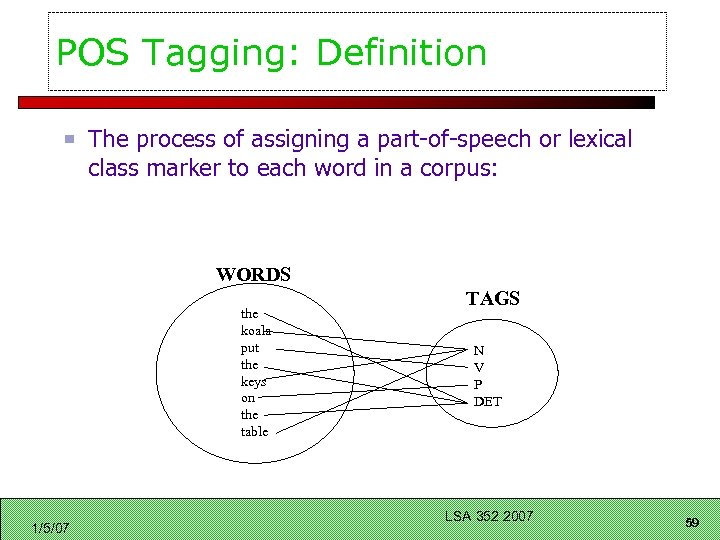 POS Tagging: Definition The process of assigning a part-of-speech or lexical class marker to each word in a corpus: WORDS the koala put the keys on the table 1/5/07 TAGS N V P DET LSA 352 2007 59
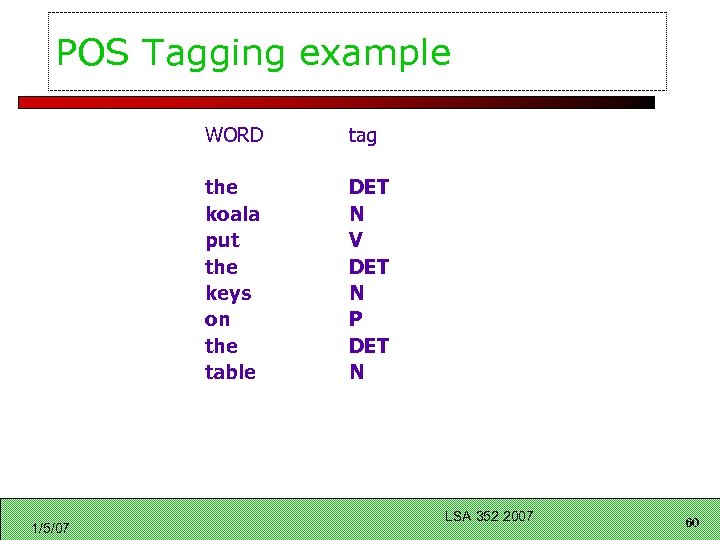 POS Tagging example WORD the koala put the keys on the table 1/5/07 tag DET N V DET N P DET N LSA 352 2007 60
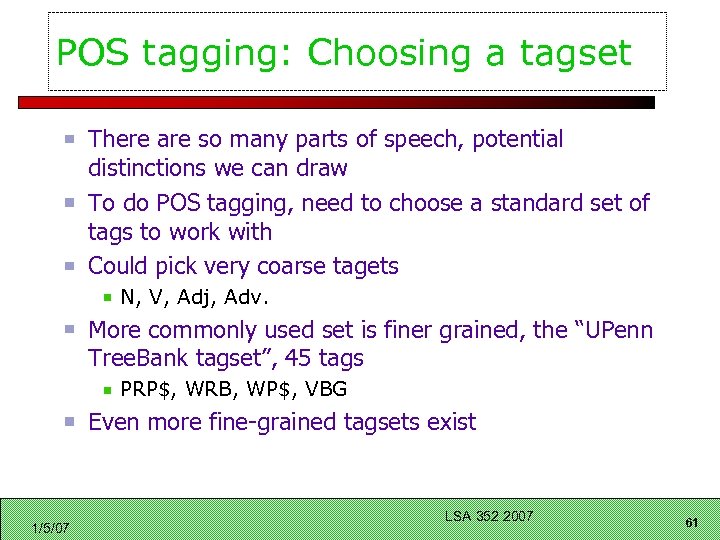 POS tagging: Choosing a tagset There are so many parts of speech, potential distinctions we can draw To do POS tagging, need to choose a standard set of tags to work with Could pick very coarse tagets N, V, Adj, Adv. More commonly used set is finer grained, the “UPenn Tree. Bank tagset”, 45 tags PRP$, WRB, WP$, VBG Even more fine-grained tagsets exist 1/5/07 LSA 352 2007 61
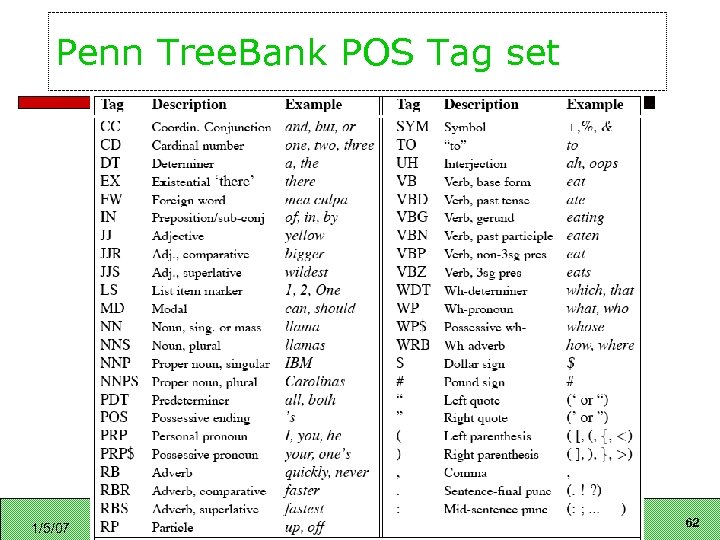 Penn Tree. Bank POS Tag set 1/5/07 LSA 352 2007 62
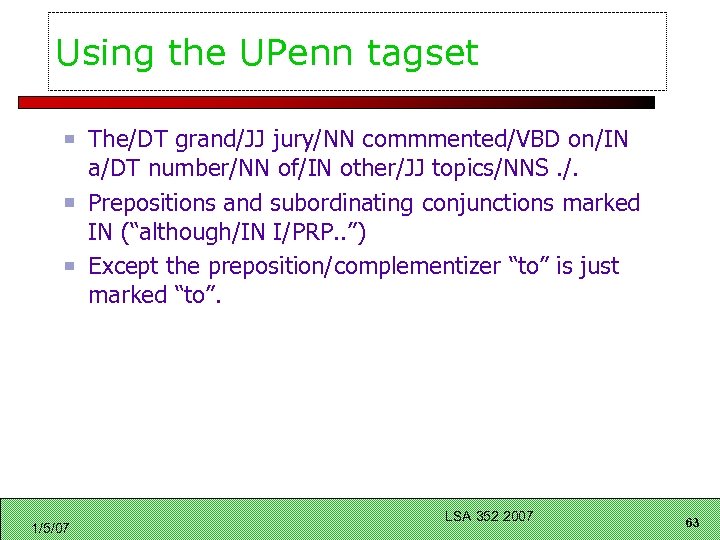 Using the UPenn tagset The/DT grand/JJ jury/NN commmented/VBD on/IN a/DT number/NN of/IN other/JJ topics/NNS. /. Prepositions and subordinating conjunctions marked IN (“although/IN I/PRP. . ”) Except the preposition/complementizer “to” is just marked “to”. 1/5/07 LSA 352 2007 63
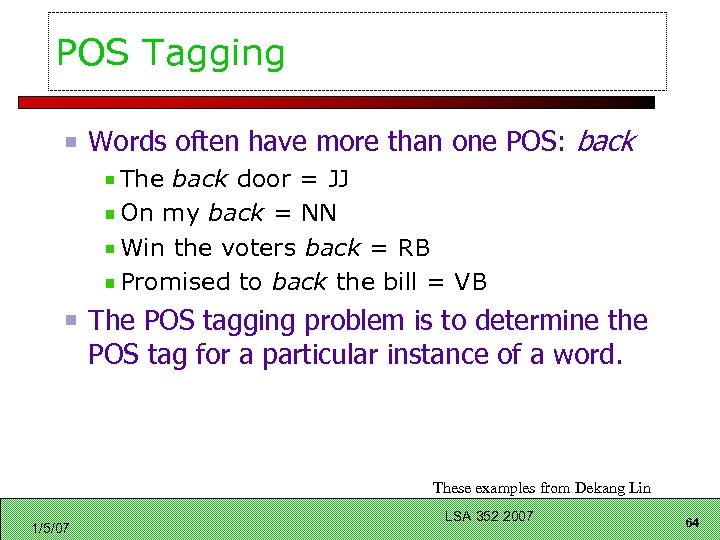 POS Tagging Words often have more than one POS: back The back door = JJ On my back = NN Win the voters back = RB Promised to back the bill = VB The POS tagging problem is to determine the POS tag for a particular instance of a word. These examples from Dekang Lin 1/5/07 LSA 352 2007 64
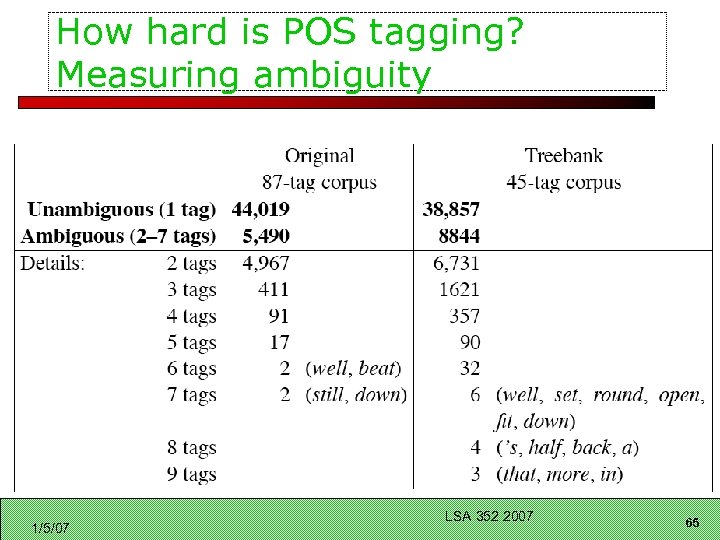 How hard is POS tagging? Measuring ambiguity 1/5/07 LSA 352 2007 65
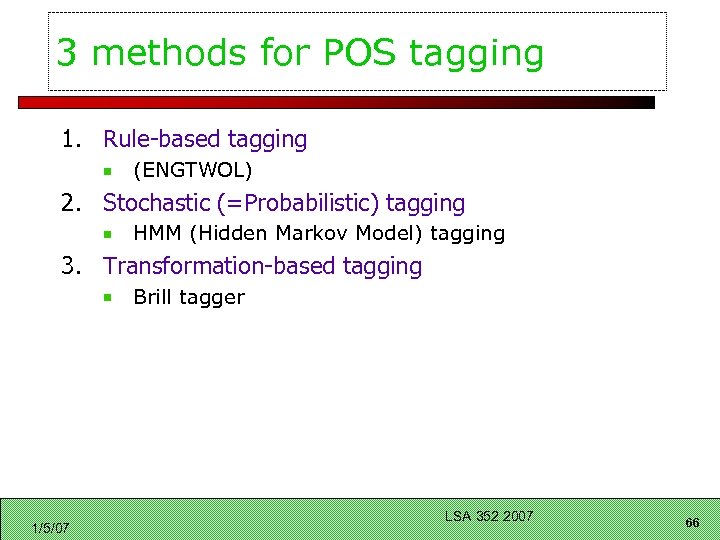 3 methods for POS tagging 1. Rule-based tagging (ENGTWOL) 2. Stochastic (=Probabilistic) tagging HMM (Hidden Markov Model) tagging 3. Transformation-based tagging Brill tagger 1/5/07 LSA 352 2007 66
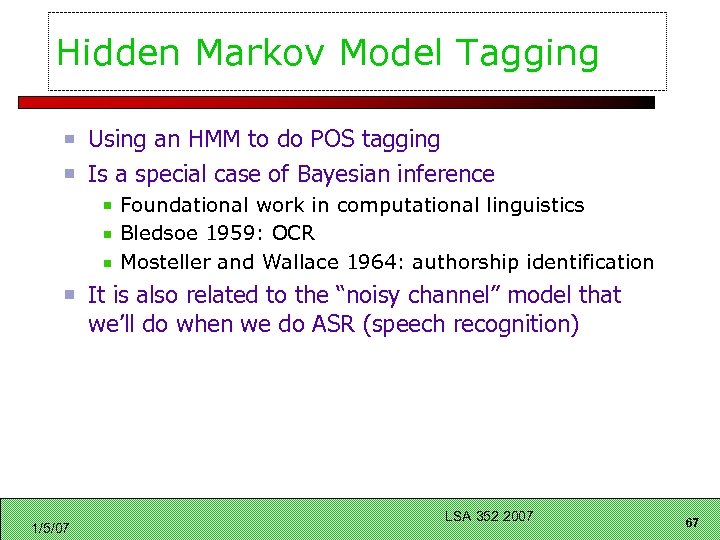 Hidden Markov Model Tagging Using an HMM to do POS tagging Is a special case of Bayesian inference Foundational work in computational linguistics Bledsoe 1959: OCR Mosteller and Wallace 1964: authorship identification It is also related to the “noisy channel” model that we’ll do when we do ASR (speech recognition) 1/5/07 LSA 352 2007 67
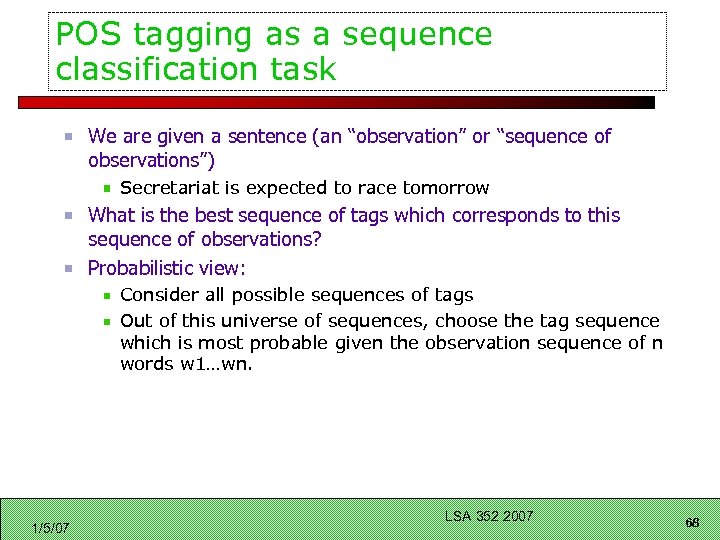 POS tagging as a sequence classification task We are given a sentence (an “observation” or “sequence of observations”) Secretariat is expected to race tomorrow What is the best sequence of tags which corresponds to this sequence of observations? Probabilistic view: Consider all possible sequences of tags Out of this universe of sequences, choose the tag sequence which is most probable given the observation sequence of n words w 1…wn. 1/5/07 LSA 352 2007 68
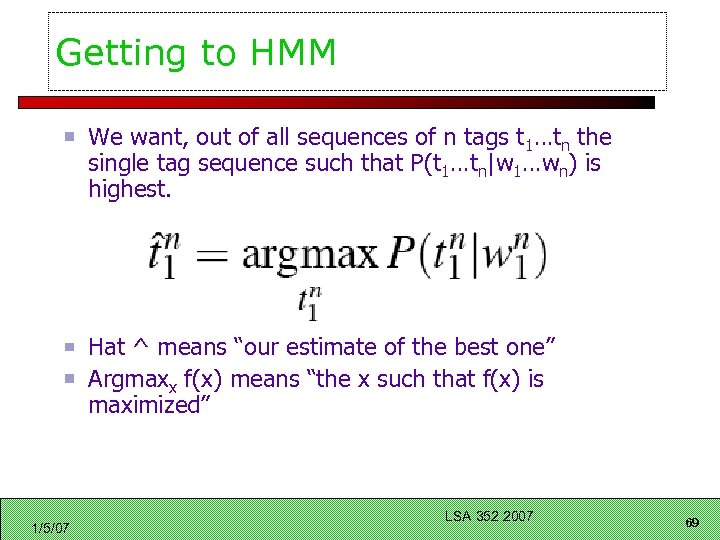 Getting to HMM We want, out of all sequences of n tags t 1…tn the single tag sequence such that P(t 1…tn|w 1…wn) is highest. Hat ^ means “our estimate of the best one” Argmaxx f(x) means “the x such that f(x) is maximized” 1/5/07 LSA 352 2007 69
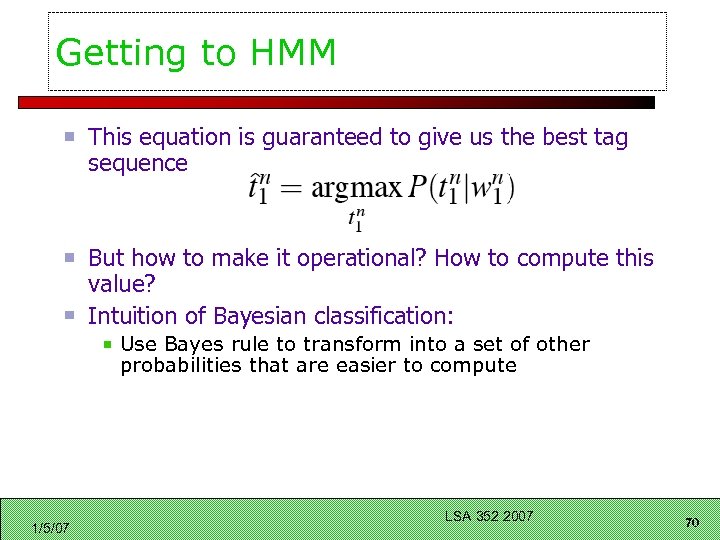 Getting to HMM This equation is guaranteed to give us the best tag sequence But how to make it operational? How to compute this value? Intuition of Bayesian classification: Use Bayes rule to transform into a set of other probabilities that are easier to compute 1/5/07 LSA 352 2007 70
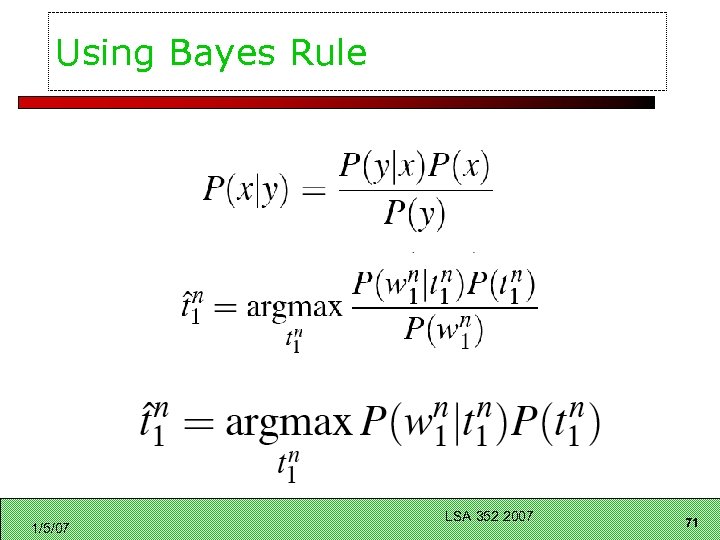 Using Bayes Rule 1/5/07 LSA 352 2007 71
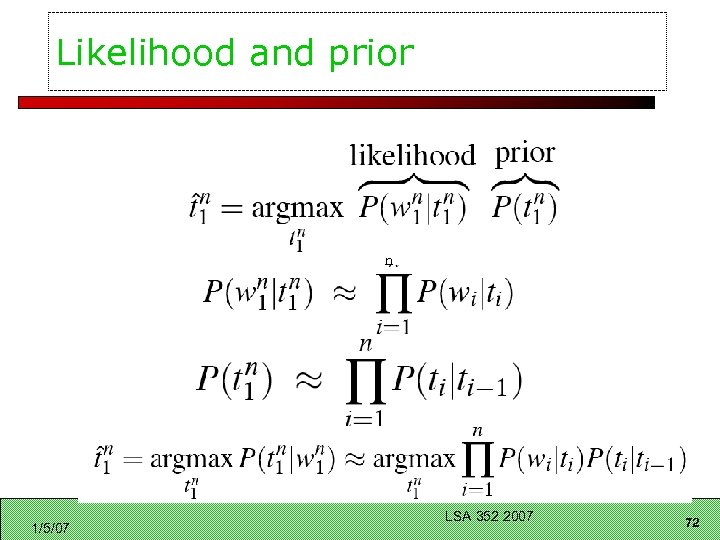 Likelihood and prior n 1/5/07 LSA 352 2007 72
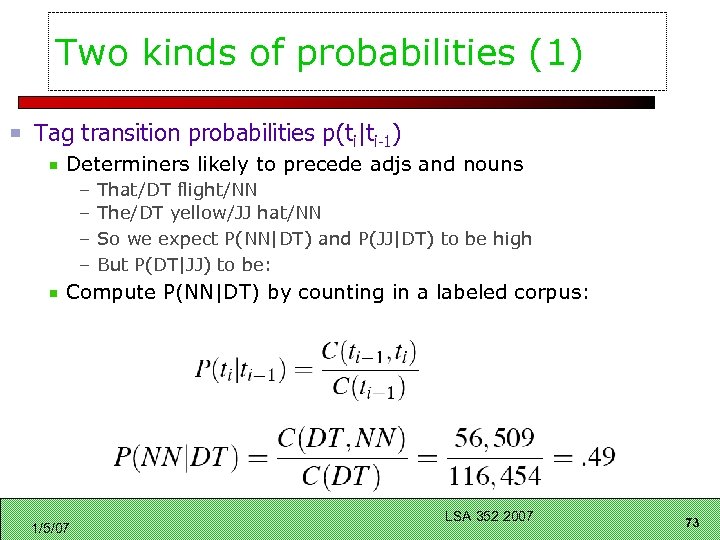 Two kinds of probabilities (1) Tag transition probabilities p(ti|ti-1) Determiners likely to precede adjs and nouns – – That/DT flight/NN The/DT yellow/JJ hat/NN So we expect P(NN|DT) and P(JJ|DT) to be high But P(DT|JJ) to be: Compute P(NN|DT) by counting in a labeled corpus: 1/5/07 LSA 352 2007 73
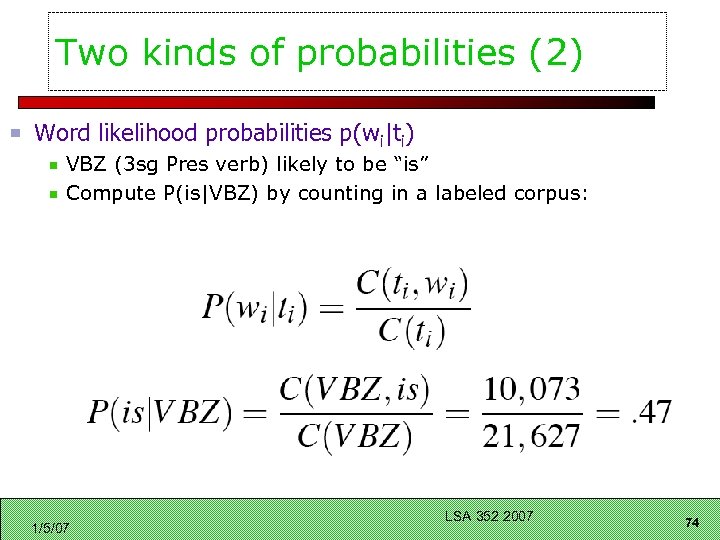 Two kinds of probabilities (2) Word likelihood probabilities p(wi|ti) VBZ (3 sg Pres verb) likely to be “is” Compute P(is|VBZ) by counting in a labeled corpus: 1/5/07 LSA 352 2007 74
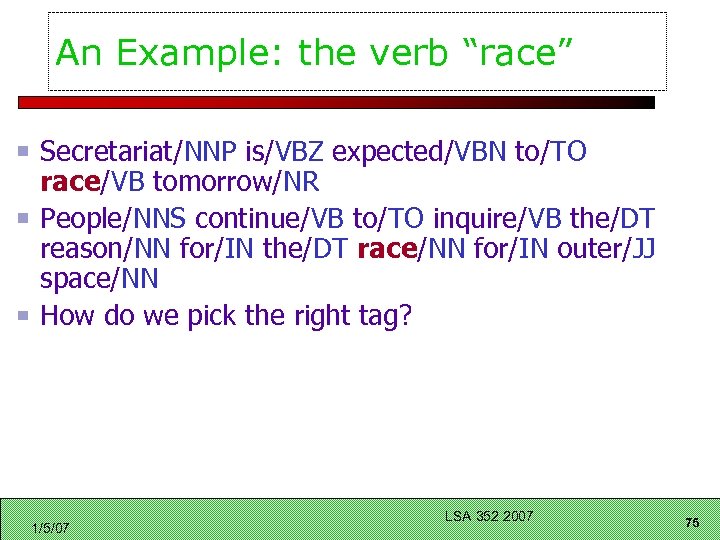 An Example: the verb “race” Secretariat/NNP is/VBZ expected/VBN to/TO race/VB tomorrow/NR People/NNS continue/VB to/TO inquire/VB the/DT reason/NN for/IN the/DT race/NN for/IN outer/JJ space/NN How do we pick the right tag? 1/5/07 LSA 352 2007 75
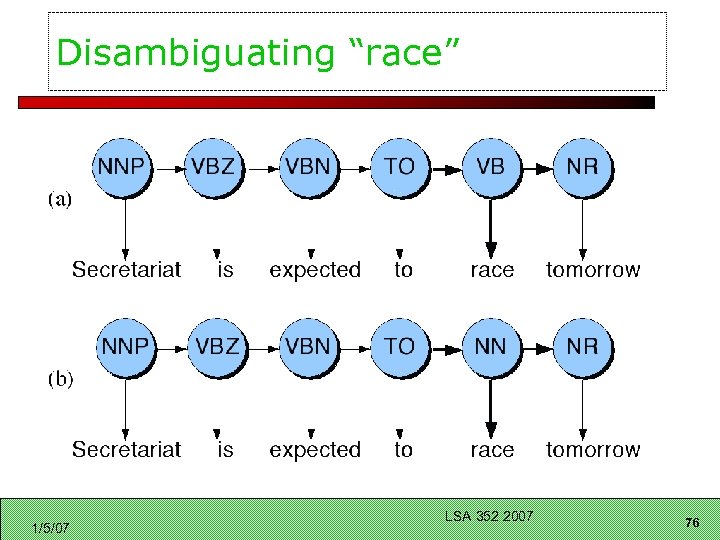 Disambiguating “race” 1/5/07 LSA 352 2007 76
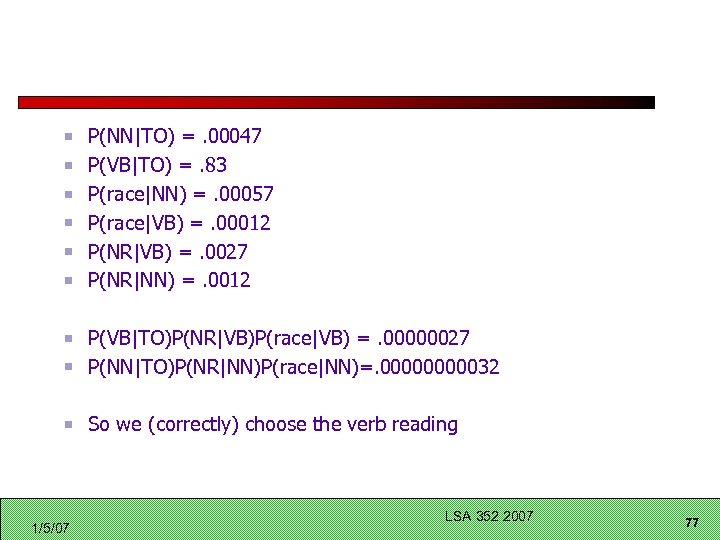 P(NN|TO) =. 00047 P(VB|TO) =. 83 P(race|NN) =. 00057 P(race|VB) =. 00012 P(NR|VB) =. 0027 P(NR|NN) =. 0012 P(VB|TO)P(NR|VB)P(race|VB) =. 00000027 P(NN|TO)P(NR|NN)P(race|NN)=. 0000032 So we (correctly) choose the verb reading 1/5/07 LSA 352 2007 77
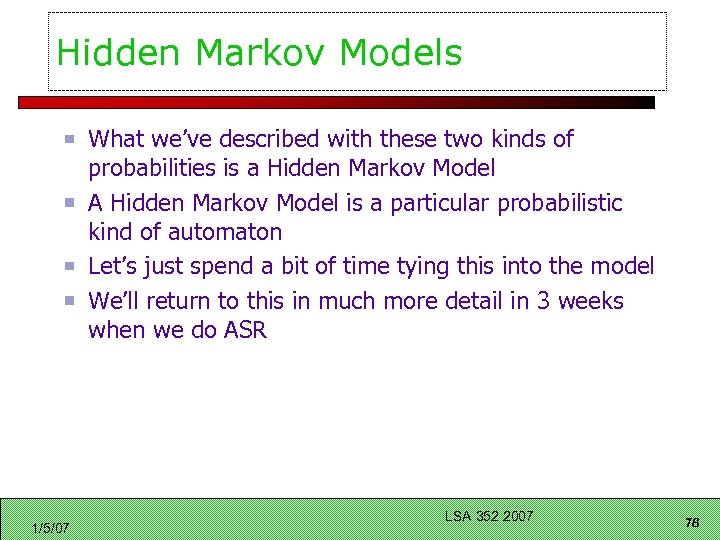 Hidden Markov Models What we’ve described with these two kinds of probabilities is a Hidden Markov Model A Hidden Markov Model is a particular probabilistic kind of automaton Let’s just spend a bit of time tying this into the model We’ll return to this in much more detail in 3 weeks when we do ASR 1/5/07 LSA 352 2007 78
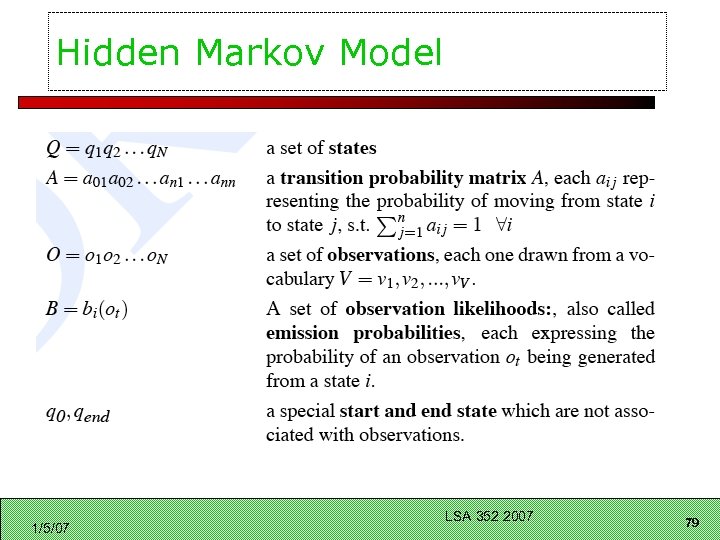 Hidden Markov Model 1/5/07 LSA 352 2007 79
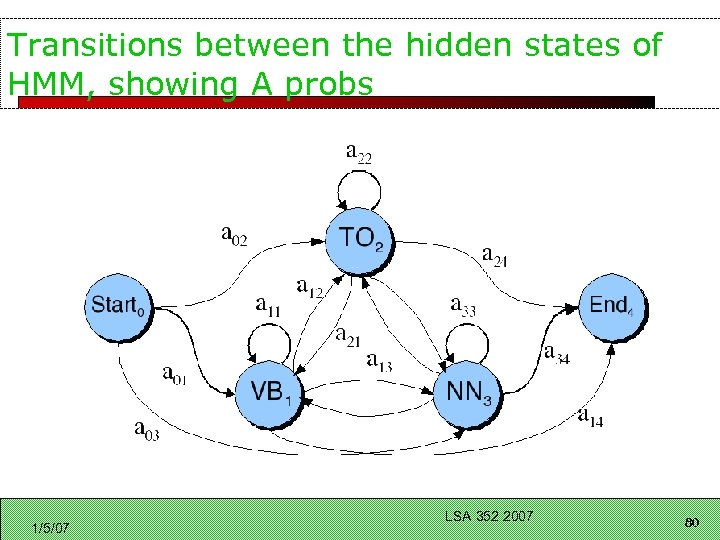 Transitions between the hidden states of HMM, showing A probs 1/5/07 LSA 352 2007 80
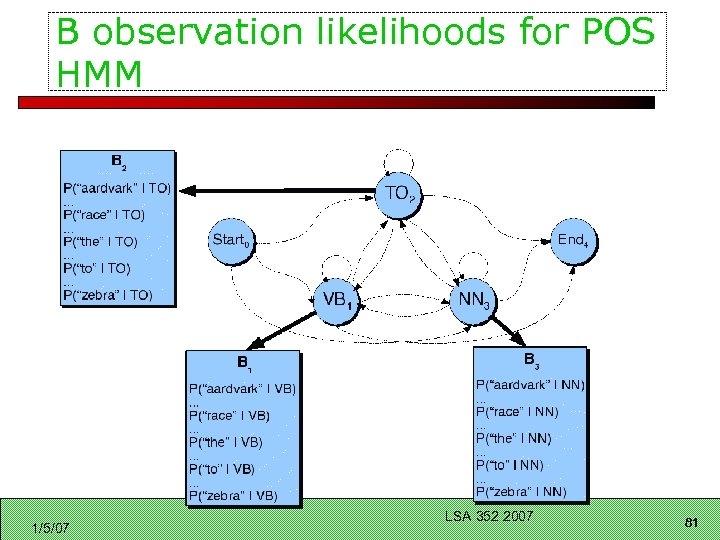 B observation likelihoods for POS HMM 1/5/07 LSA 352 2007 81
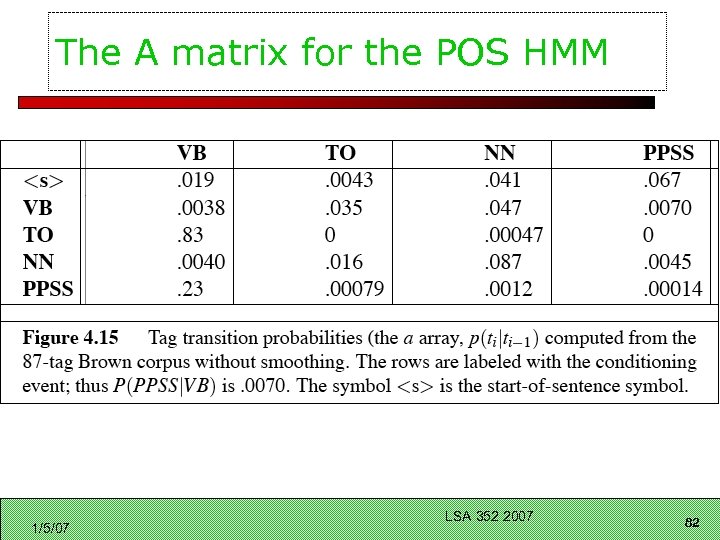 The A matrix for the POS HMM 1/5/07 LSA 352 2007 82
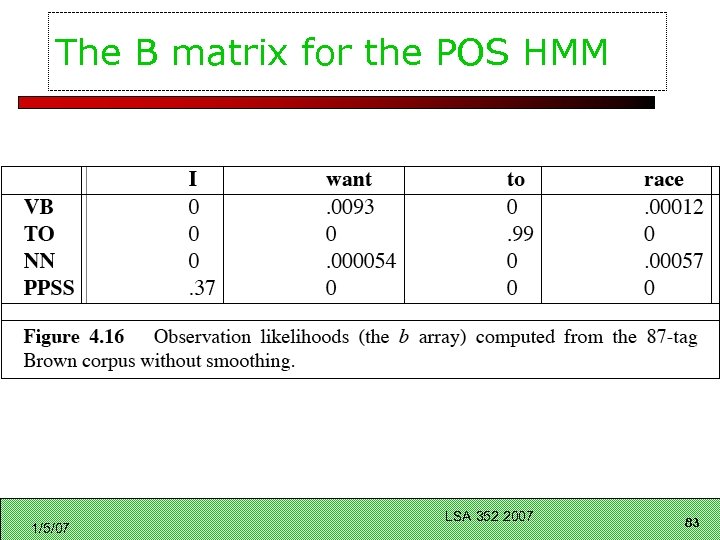 The B matrix for the POS HMM 1/5/07 LSA 352 2007 83
 Viterbi intuition: we are looking for the best ‘path’ S 1 1/5/07 S 2 S 3 S 4 S 5 LSA 352 2007 Slide from Dekang Lin 84
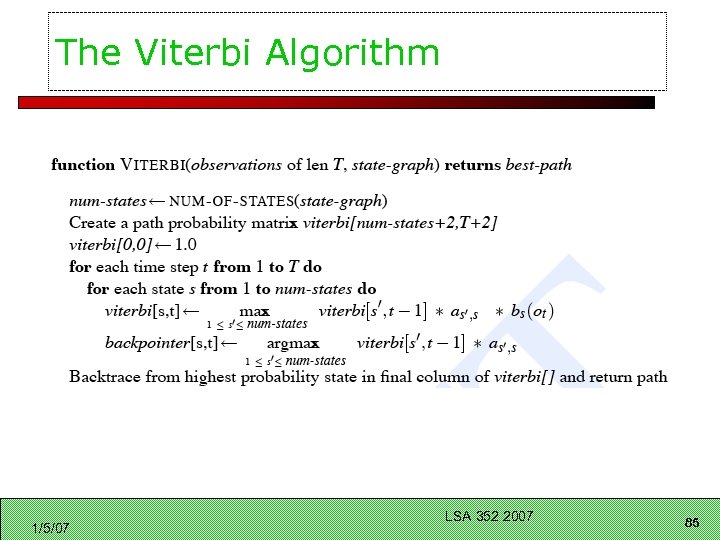 The Viterbi Algorithm 1/5/07 LSA 352 2007 85
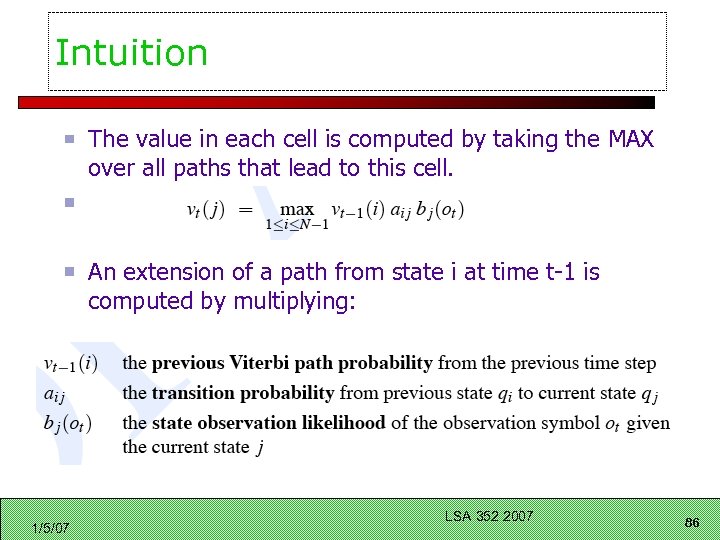 Intuition The value in each cell is computed by taking the MAX over all paths that lead to this cell. An extension of a path from state i at time t-1 is computed by multiplying: 1/5/07 LSA 352 2007 86
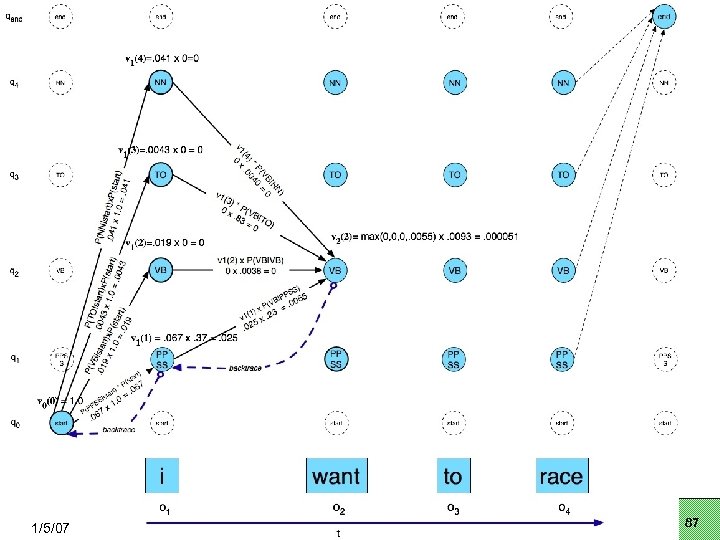 Viterbi example 1/5/07 LSA 352 2007 87
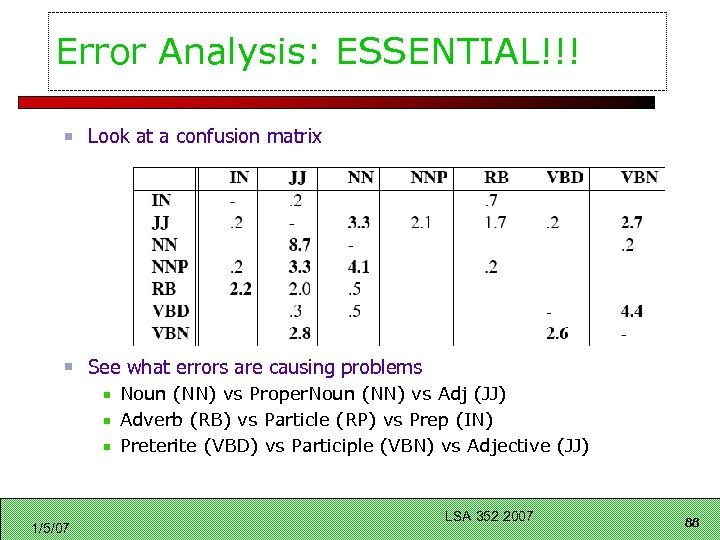 Error Analysis: ESSENTIAL!!! Look at a confusion matrix See what errors are causing problems Noun (NN) vs Proper. Noun (NN) vs Adj (JJ) Adverb (RB) vs Particle (RP) vs Prep (IN) Preterite (VBD) vs Participle (VBN) vs Adjective (JJ) 1/5/07 LSA 352 2007 88
 Evaluation The result is compared with a manually coded “Gold Standard” Typically accuracy reaches 96 -97% This may be compared with result for a baseline tagger (one that uses no context). Important: 100% is impossible even for human annotators. 1/5/07 LSA 352 2007 89
 Summary Part of speech tagging plays important role in TTS Most algorithms get 96 -97% tag accuracy Not a lot of studies on whether remaining error tends to cause problems in TTS 1/5/07 LSA 352 2007 90
 Summary I. Text Processing 1) Text Normalization • • 2) 3) Homograph disambiguation Part-of-speech tagging • 1/5/07 Tokenization End of sentence detection • Methodology: decision trees Methodology: Hidden Markov Models LSA 352 2007 91