 Скачать презентацию Low Risk Obstetrics Session 2 Birthing Suite
b6c5c276cc2519a261d93dba1f2d8a44.ppt
- Количество слайдов: 88



Low Risk Obstetrics Session 2 Birthing Suite & Puerperium Dr. Kristine Whitehead 2015 BUILDING A HEALTHY COMMUNITY
BUILDING A HEALTHY COMMUNITY
Objectives • Able to diagnosis and manage early labour • Able to practice active management of labour, including augmentation • Prepare for expected procedures: ARM, fetal scalp electrode, SVD • Able to provide early postpartum care BUILDING A HEALTHY COMMUNITY
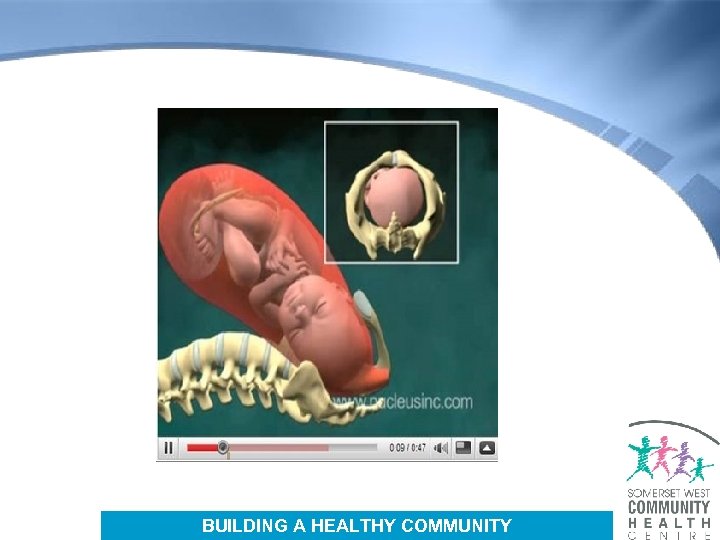
Spontaneous vaginal delivery • video BUILDING A HEALTHY COMMUNITY
Management of Labour • Your main responsibility on this rotation • Respect labour, do not fear labour • Active management is practiced at TOH BUILDING A HEALTHY COMMUNITY
Definition of Labour • Regular, Frequent Contractions PLUS • Cervical Change (Dilatation and Effacement) BUILDING A HEALTHY COMMUNITY
Definition of Labour • Must diagnose labour correctly • Otherwise can not diagnose labour dystocia BUILDING A HEALTHY COMMUNITY
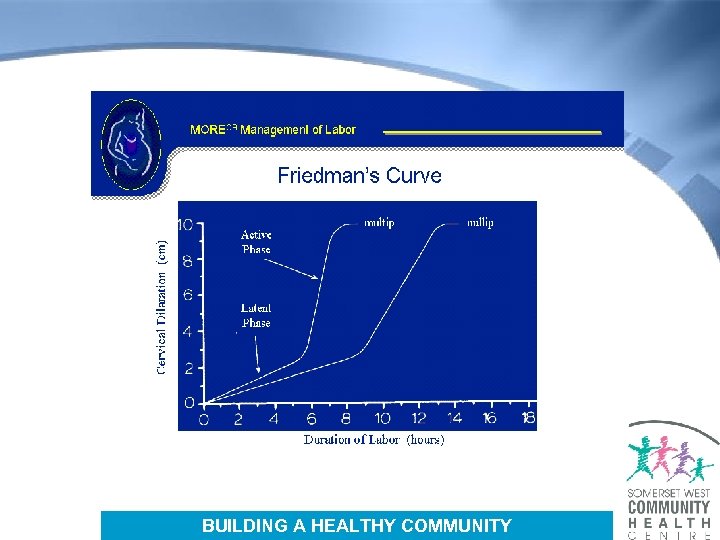
Stages of Labour First Stage A. Latent phase - up to 3 -4 cm in primip, 4 -5 cm in multip B. Active phase - more rapid cervical dilatation - follows latent phase - ends with full cervical dilatation BUILDING A HEALTHY COMMUNITY
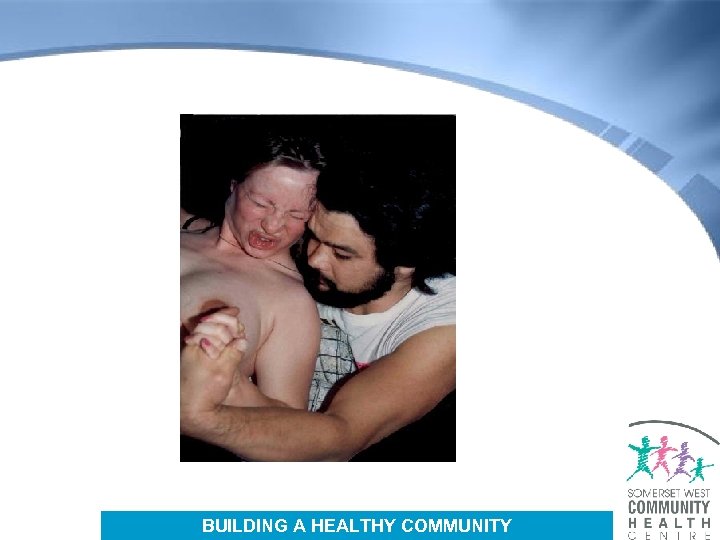
Second Stage • A. Early period is from full dilatation to +2 or urge to push • B. Second component is marked by maternal expulsive effort • lasts until delivery of fetus BUILDING A HEALTHY COMMUNITY
BUILDING A HEALTHY COMMUNITY
Third Stage • Delivery of placenta BUILDING A HEALTHY COMMUNITY
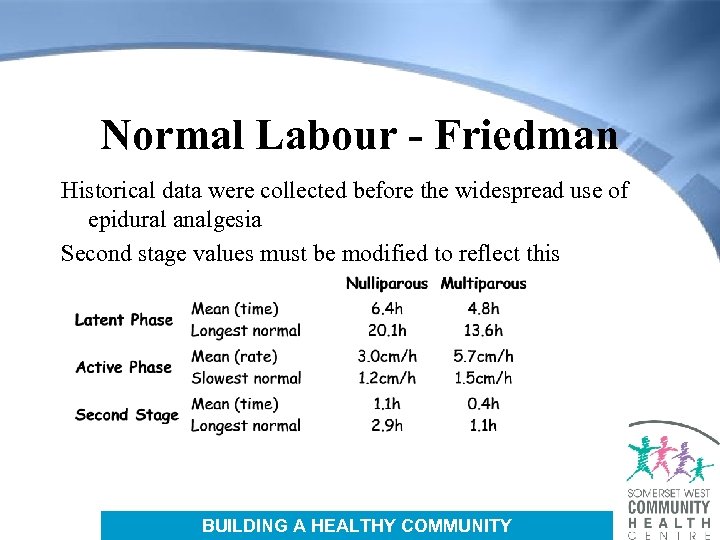
Normal Labour - Friedman Historical data were collected before the widespread use of epidural analgesia Second stage values must be modified to reflect this BUILDING A HEALTHY COMMUNITY
BUILDING A HEALTHY COMMUNITY
1969 O’Driscoll • Active management of labour • To prevent primips from labouring >24 hrs • Objective to decrease C/S rate BUILDING A HEALTHY COMMUNITY
O’Driscoll’s methods • Only admit in true active labour • ARM on admission • Midwife to “monitor the labour and encourage the mother” • 1 cm/hr or oxytocin titrated to achieve 5 -7 contractions q 15 mins BUILDING A HEALTHY COMMUNITY
Results • • C/S rate increased from 4% to 9% 40% women required oxytocin 12 X increase in epidural analgesia Cochrane review: only continuous psychological support in labour lowered the C/S rate BUILDING A HEALTHY COMMUNITY
• Labor seems to progress more slowly now than in the 1950 s • Mean duration active labor 4. 6 hrs. in 195060’s • Mean duration active labor 8 hrs. in 198090 s • WHY? BUILDING A HEALTHY COMMUNITY
What’s different? • • Mean body mass higher (BMI) Increased fetal size Increased maternal age Obstetric management eg. Induction, oxytocin, epidural, continuous monitoring BUILDING A HEALTHY COMMUNITY
Normal Labour • 90% women who have successful vaginal birth progress >1 cm/hr after 5 cm cervical dilatation Peisner DB, Rosen MG: Transition from latent to active labor. Obstet Gynecol 68: 448, 1986. BUILDING A HEALTHY COMMUNITY
Normal Labour - Partogram • Used routinely in caseroom • Nurse starts plotting when (and only when) in labour • to follow progress of labour and descent of presenting part BUILDING A HEALTHY COMMUNITY
Labour Dystocia • Definition >4 hrs of <0. 5 cm/hr dilatation (< 2 cm dilatation in 4 hrs. ) or >1 hr of no descent during active pushing BUILDING A HEALTHY COMMUNITY
Labour Dystocia - Diagnosis Most common reasons for non-elective csection (LSCS): 1) 2) 3) 4) labour dystocia/failure to progress – 30% non-reassuring FHR tracing – 22% Malposition/malpresentation – 12% Breech – 9% BUILDING A HEALTHY COMMUNITY
Labour Dystocia - Diagnosis Therefore… Must diagnose dystocia correctly to reduce number of inappropriate C/S WHAT CAN GO WRONG? BUILDING A HEALTHY COMMUNITY
Labour Dystocia - 3 “P’s” • POWER - hypotonic contractions - uncoordinated contractions - weak maternal expulsive effort BUILDING A HEALTHY COMMUNITY
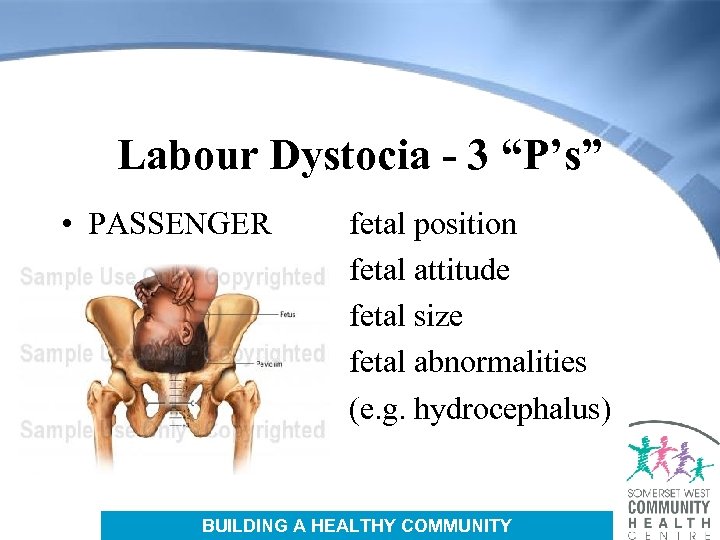
Labour Dystocia - 3 “P’s” • PASSENGER fetal position fetal attitude fetal size fetal abnormalities (e. g. hydrocephalus) BUILDING A HEALTHY COMMUNITY
Labour Dystocia - 3 “P’s” • PASSAGE bony pelvis soft tissue (full bladder/rectum) BUILDING A HEALTHY COMMUNITY
BUILDING A HEALTHY COMMUNITY
Labour Dystocia - 3 “P’s” + • Person - the woman (her beliefs, preparation, knowledge & "capacity" for doing the work of labour & birth • Partner - her support & his/her knowledge, beliefs & preparation • People – the others involved BUILDING A HEALTHY COMMUNITY
Labour Dystocia - 3 “P’s” + • Pain – impact of experience of pain & socio-cultural beliefs/environment on capacity for coping • Professionals – how the health care team supports, informs & collaborates in care & share info with the woman & her partner BUILDING A HEALTHY COMMUNITY
Labour Dystocia - 3 “P’s” + • Patience – difficult to be passive • Peripherals - reasonable privacy, quiet, adequate accessories for labour and delivery (functioning birthing beds, lights, birthing balls, hot water, mirrors, linens) BUILDING A HEALTHY COMMUNITY
How can we prevent dystocia? • • Accurate diagnosis of labour Management of latent labour Prepared childbirth (e. g. classes) Birthing companion (e. g. doula) & consistent nursing • Ambulation (? ) – Cochrane review 2009 BUILDING A HEALTHY COMMUNITY
Continuous Intrapartum Support (RN, family/friend, doula) • Greatest benefit for vulnerable populations • Compared to limited support as control • Benefits: shortened duration of labour, increased SVD, fewer epidurals, less oxytocin, fewer AVD/C-sections, greater patient satisfaction • Continuous labour support from labor attendant for primiparous women: a meta-analysis. Zhang et al, Obstet Gynecol 1996 BUILDING A HEALTHY COMMUNITY
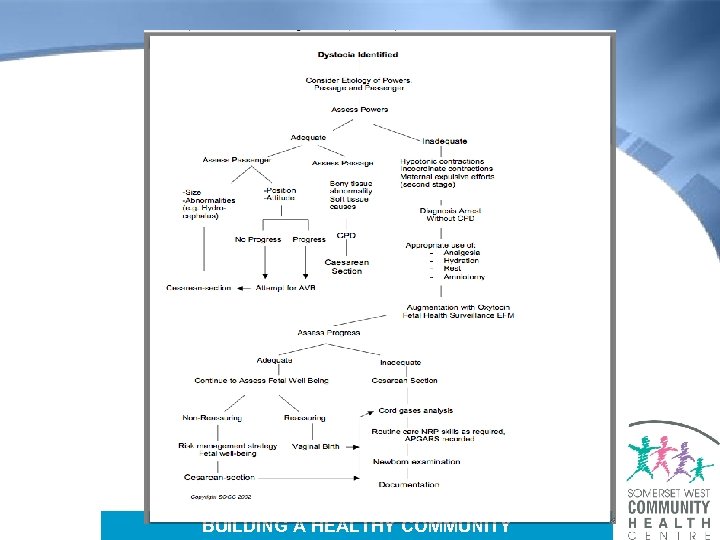
How do we manage dystocia? • • • ARM Oxytocin augmentation Therapeutic rest with analgesia Repositioning of patient Empty bladder If dystocia persists, then consider Dx CPD and proceed to delivery BUILDING A HEALTHY COMMUNITY
BUILDING A HEALTHY COMMUNITY
ARM • Routine ROM does not accelerate spontaneous labour – Cochrane 2007, reviewed 14 RCTs • Insignificant shortening of first and second stage, both primips and multips • Does reduce need for oxytocin • Does not increase maternal infection or epidurals • Cochrane 2009, review 12 RCTs, shortened labor by 1. 11 hrs if ARM + pitocin in prolonged labor BUILDING A HEALTHY COMMUNITY
ARM • Amniotomy for shortening spontaneous labour. Smyth RM, Markham C, Dowswell T. Cochrane Database Syst Rev. 2013 June; 6: CD 006167 • ? More FHR tracing abnormalities afterwards • Intervention for dystocia, not for prevention BUILDING A HEALTHY COMMUNITY
Indications for ARM • • Assess for meconium Application of fetal scalp electrode Insertion of IUPC Prior to initiation of oxytocin, to augment labor • Consider presentation first (ensure cephalic) • Commits you to delivery • Ensure explicit consent BUILDING A HEALTHY COMMUNITY
Technique ( ↓ risk of cord prolapse): 1. Avoid dislodging fetal head 2. Fundal pressure/suprapubic pressure 3. ARM during contraction 4. Head is preferably engaged (station = 0) BUILDING A HEALTHY COMMUNITY

Photos - amnihook • practice BUILDING A HEALTHY COMMUNITY
Contraindications to ARM • Unengaged presenting part - absolute • Relative - Polyhydramnios • Relative - Hepatitis B/C or HIV, GBS not on ABs BUILDING A HEALTHY COMMUNITY
Augmentation of labor • Low dose vs. high dose protocol • Risks and benefits: must have informed consent • Properties of pitocin BUILDING A HEALTHY COMMUNITY
Oxytocin/pitocin • Receptors in myoepithelial cells of breast, myometrium, decidua • Causes rhythmic contractions of myometrial smooth muscle at low dose • 8 -10 m. U/min infusion gives same clinical response found in spontaneous labour • Hypotension possible with bolus iv admin • Antidiuretic activity – water intoxication possible with high-dose (> 40 m. U/min) • Half-life appx 5 mins BUILDING A HEALTHY COMMUNITY
Oxytocin/Pitocin • Low dose protocol – less hyperstim, smaller overall dose • High dose protocol – more hyperstim but no increased maternal/neonatal morbidity, may shorten labour and lower C/S rate (2010 metaanalysis of RCTs) • Potential risk of fetal compromise with hyperstim • Tiny risk of uterine rupture, water intox BUILDING A HEALTHY COMMUNITY
Persistent dystocia • True CPD (craniopelvic disproportion) management = c-section • Most CPD is relative so try other maneuvers first BUILDING A HEALTHY COMMUNITY
Second Stage Management • Debate exists re. setting time limit in the absence of fetal compromise • Woman should not be encouraged to push unless she feels the urge • Non-directed pushing in NCB BUILDING A HEALTHY COMMUNITY
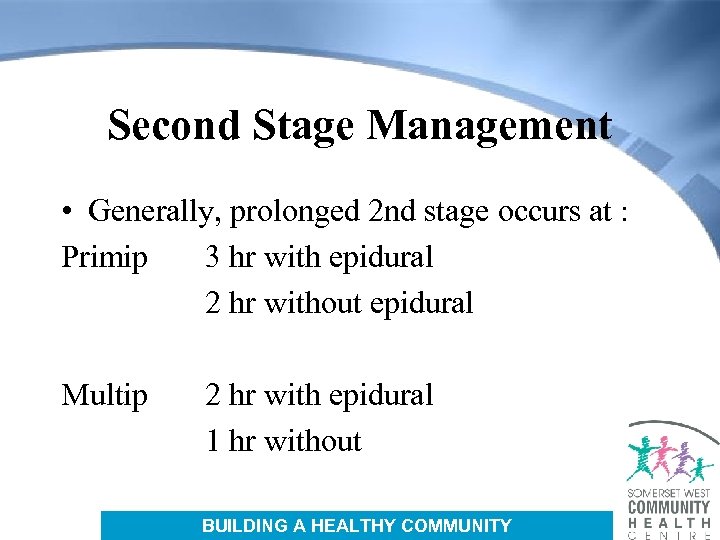
Second Stage Management • Generally, prolonged 2 nd stage occurs at : Primip 3 hr with epidural 2 hr without epidural Multip 2 hr with epidural 1 hr without BUILDING A HEALTHY COMMUNITY
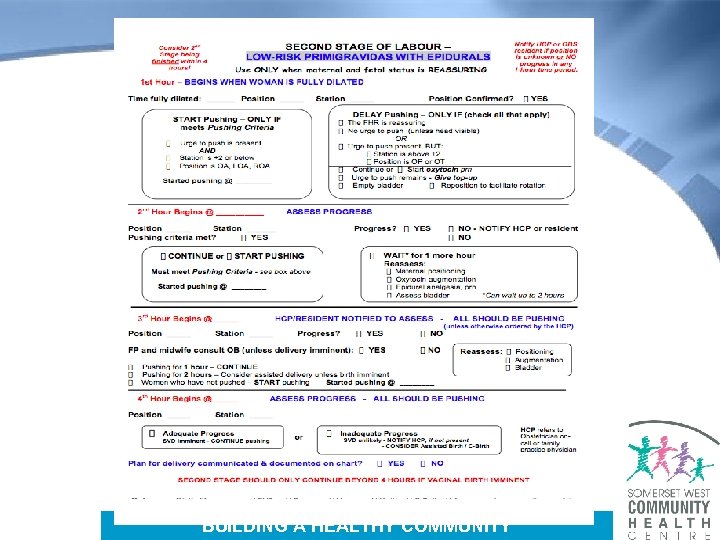
Second Stage Management • Ottawa Hospital uses In-House Clinical Practice Guidelines (CPG’s), see my. Hospital • Categorized = Primip with and without regional anesthesia = Multip with and without regional anesthesia BUILDING A HEALTHY COMMUNITY
BUILDING A HEALTHY COMMUNITY
Third Stage Management • Active management of the third stage should be offered, since it reduces incidence of PPH due to uterine atony • This includes: oxytocin, controlled cord traction, uterine massage after delivery of placenta • Active management of the third stage of labour: prevention and treatment of postpartum hemorrhage – SOGC Oct. 2009 BUILDING A HEALTHY COMMUNITY
Active Management of the Third Stage • Signs of Separation – Gush of blood – Lengthening of umbilical cord – Anterior-cephalad movement of fundus – Firm, globular fundus BUILDING A HEALTHY COMMUNITY
Active Management of the Third Stage • Active Management – Early cord clamping (no longer recommended) – Controlled cord traction – Uterotonic agent: oxytocin vs. duratocin – Know dose and route, order prior to delivery BUILDING A HEALTHY COMMUNITY
Delayed Cord Clamping • Benefits: elevated hematocrit/ferritin up to 6 months, less anemia at 3 -6 months • Increased asymptomatic polycythemia • ? Increased neonatal jaundice requiring phototherapy • See my. Hospital for policy and procedure • Late vs. early clamping of the umbilical cord in full-term neonates: systematic review and meta-analysis of controlled trials: Hutton, EK et al, JAMA 2007 Mar 21 BUILDING A HEALTHY COMMUNITY
Management of Labour - Case • • • Phillipa 28 y. o. G 1 P 0 EGA = 39+5 weeks Presents at 1700 to triage Contraction q 7 -10 min since last night More frequent this afternoon x 1. 5 hours Very uncomfortable • What do you need to know? • V/E BUILDING A HEALTHY COMMUNITY
1 cm dil, 2 cm long, stn – 2 FHR = 155 bpm, + accels, no decels on IA Your assessment? What is your management? BUILDING A HEALTHY COMMUNITY
• She goes home with nubain 20 mg IM • Rest/sleep, returns at 0200 - contractions now q 3 -4 min • Uncomfortable - wants to “go natural” • What do you need to know? • V/E - BUILDING A HEALTHY COMMUNITY
4 cm dil. , thin (1/4 cm), cephalic, intact FHR normal, 140 -145 bpm, + accels, no decels Your assessment? What now? BUILDING A HEALTHY COMMUNITY
• Uses shower/tub • V/E 4 hrs later (0600) BUILDING A HEALTHY COMMUNITY
• Cx = 5 cm, station -1 • FHR normal Assessment? Management? She has many questions about the epidural BUILDING A HEALTHY COMMUNITY
Epidural • See info sheet in each room • Informed consent – from anesthesia • Risks – sytemic toxicity, high spinal, hypotension, inadequate or failed block, pruritis, N and V, resp depression, spinal HA, backache, infxn, PP neuropathy • ? Prolonged labour, increased AVD/CS BUILDING A HEALTHY COMMUNITY
• Epidural inserted 0700 Now what? Do you need continuous EFM? When to reassess? Next exam BUILDING A HEALTHY COMMUNITY
• • V/E at 0900: 8 cm, station -1 Bulging membranes, head well applied FH shows frequent variable decelerations FHR - baseline 145 bpm, acceleration with scalp stim • Comfortable but contractions spacing out to q 4 -5 mins • T = 37. 7 C Assessment? Management? BUILDING A HEALTHY COMMUNITY
• Successful ARM for abundant clear liquor • Over 30 mins. contractions increase to q 2 -3 mins. BUILDING A HEALTHY COMMUNITY
• V/E at 1100 hr: Fully / station 0 • FH - occasional uncomplicated variable decels • Uncomfortable with contractions, especially in her back What do you do? BUILDING A HEALTHY COMMUNITY
• • Top-up the epidural Frequent postion change RN empties her bladder Re-assess in 1 hour as per protocol BUILDING A HEALTHY COMMUNITY
• V/E at 1200: fully dilated, stn 0, prominent anterior lip • RN wonders re. OP? , wants OB resident to check • Contr q 3 -4 min X 45 sec • FHR normal • Comfortable with epidural Management plan? BUILDING A HEALTHY COMMUNITY
• • • OBS Resident advises you to call your staff Staff confirms position is LOA Oxytocin started Repositioned to knee-chest Staff returns briefly to office, near by RN wants scalp electrode What now? When to recheck? A HEALTHY COMMUNITY BUILDING
Fetal scalp electrode • • Technique: see instructions with packaging Risks – superficial scalp trauma, infxn Benefits – accuracy, consistency of FHR Must have informed consent BUILDING A HEALTHY COMMUNITY

BUILDING A HEALTHY COMMUNITY
• V/E at 1300 (one hour later): spines +3 • Urge to push Plan? BUILDING A HEALTHY COMMUNITY
• Start pushing!! • Call staff back BUILDING A HEALTHY COMMUNITY
• FH shows prolonged deceleration to 60 bpm x 3 minutes at 1400 • Presenting part can be seen easily with pushing BUILDING A HEALTHY COMMUNITY
• OB staff present, supervises your vacuum delivery (FM staff coming up the elevator) • Baby boy 4050 g delivered over 2 pulls, no popoffs • Neonates in attendance • Apgars 9, 9 What are the important issues here? BUILDING A HEALTHY COMMUNITY
Summary - Management of Dystocia • ARM • Oxytocin augmentation • Therapeutic rest with analgesia • Repositioning • Empty bladder • Always assess maternal and fetal wellbeing If dystocia persists, consider CPD/FTP and proceed to operative delivery BUILDING A HEALTHY COMMUNITY
• Break • Practice simulation: ARM, scalp electrode BUILDING A HEALTHY COMMUNITY
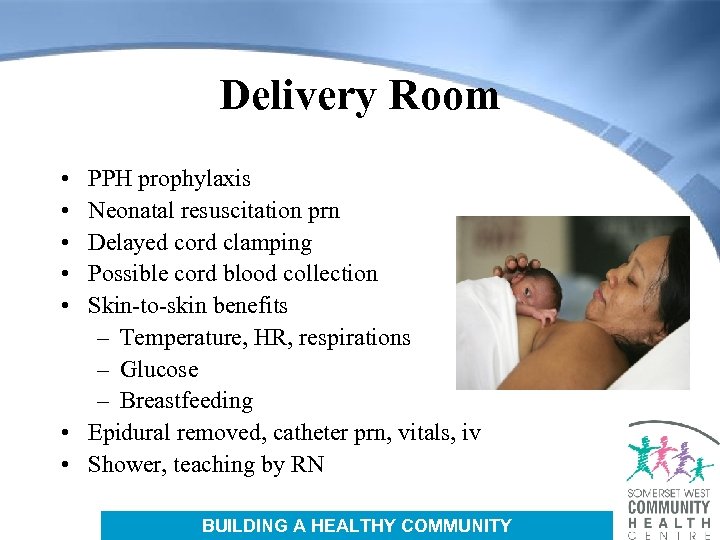
Delivery Room • • • PPH prophylaxis Neonatal resuscitation prn Delayed cord clamping Possible cord blood collection Skin-to-skin benefits – Temperature, HR, respirations – Glucose – Breastfeeding • Epidural removed, catheter prn, vitals, iv • Shower, teaching by RN BUILDING A HEALTHY COMMUNITY
A 4/8 E • • • PP orders Vitals, care map assessment Breastfeeding on demand, rooming in LC, SW, DPH prn Vaccination (MMR, influenza), Rhogam prn Discharge planning BUILDING A HEALTHY COMMUNITY
Early Maternal Issues • • After pains Engorgement: milk, edema Urinary retention: protocol, pudendal nerve injury Hemorrhoids Musculoskeletal pain Headache DVT: 21 -84 times more common for 2/52 PP Anemia BUILDING A HEALTHY COMMUNITY
Case #1 • • 23 year old G 2 P 2, healthy SVD, healthy girl, epidural Second degree perineal tear PPD # 1 - slightly tender uterine fundus, some breastfeeding trouble • PPD # 2 – T = 38. 0 deg C • What do you do? BUILDING A HEALTHY COMMUNITY
Postpartum Endometritis Presentation • Fever +/- chills • Tenderness, pain - uterus • Lochia may be foul, heavier bleeding BUILDING A HEALTHY COMMUNITY
Postpartum Endometritis • Polymicrobial: anaerobes and aerobes • Potentially lethal: esp GAS, clostridium • Both cause toxic shock syndrome BUILDING A HEALTHY COMMUNITY
Postpartum Endometritis Treatment • • Clindamycin and Gentamicin iv Clindamycin po Doxycycline and Metronidazole Clavulin BUILDING A HEALTHY COMMUNITY
• Breastfeeding problem ie. Pain, weight loss, hungry baby • Risk of dehydration, xs wt loss >10% • ? Risk of pacifier • ? Risk of formula • ? Risk of PPD BUILDING A HEALTHY COMMUNITY
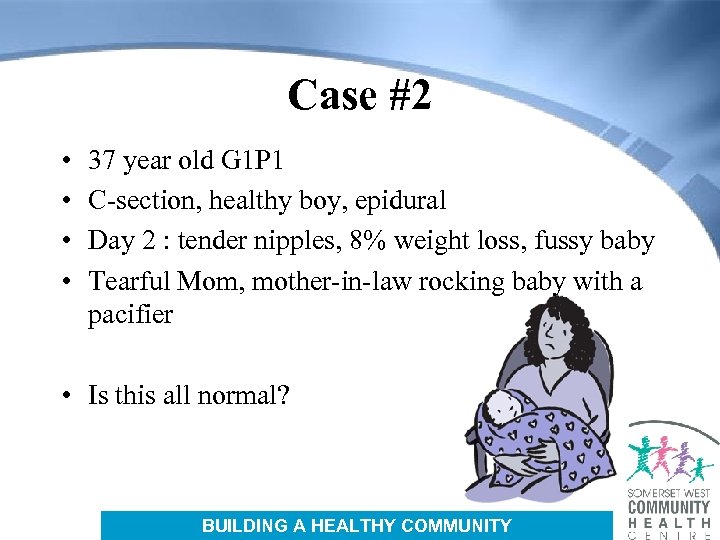
Case #2 • • 37 year old G 1 P 1 C-section, healthy boy, epidural Day 2 : tender nipples, 8% weight loss, fussy baby Tearful Mom, mother-in-law rocking baby with a pacifier • Is this all normal? BUILDING A HEALTHY COMMUNITY
Management • Support/encourage/teach +++ • LC consult • Start hand expression, pumping BUILDING A HEALTHY COMMUNITY
Case #3 • • 30 year old G 2 P 2 SVD, healthy girl First degree tear Increasing perineal pain on day 2 • Is this normal? • What should you do? BUILDING A HEALTHY COMMUNITY
Case #4 • • 32 year old G 4 P 4 Day 2 : exhausted, lethargic, new Canadian History of depression Limited supports • Is there anything you can do to help? BUILDING A HEALTHY COMMUNITY
• Assess supports • SW consult • PHD referral/HBHC – request early visit BUILDING A HEALTHY COMMUNITY

QUESTIONS/COMMENTS BUILDING A HEALTHY COMMUNITY
Скачать презентацию Low Risk Obstetrics Session 2 Birthing Suite
b6c5c276cc2519a261d93dba1f2d8a44.ppt