


 Скачать презентацию Low-Mass e e- Pairs Itzhak Tserruya Weizmann Institute Rehovot
c2c232312d4525dbc6979affb3232ef2.ppt
- Количество слайдов: 19
 Low-Mass e+e- Pairs Itzhak Tserruya Weizmann Institute, Rehovot, Israel Mini Workshop on PHENIX upgrade plans, BNL Aug. 5 -6, 2002 5 August 2002 Itzhak Tserruya PHENIX Upgrades Mini- Workshop 1
 Outline 1. Motivation 2. System requirements 1. 3. Principle Monte Carlo Feasibility 1. 2. Can we tolerate the irreducible level of background from open charm? 3. 4. Can we beat the combinatorial background from Dalitz and conversions? How much silicon can we tolerate within the acceptance? Rate estimates and the need of a trigger 5 August 2002 Itzhak Tserruya PHENIX Upgrades Mini- Workshop 2
 Low-Mass e+ e-: Motivation Very rich physics potential… Chiral symmetry restoration and in-medium effects. Key players: * meson * e+e- and K+K- Thermal radiation (at least from high density HG) Strangeness production (ssbar) Unique PHENIX potential: can measure the whole dilepton spectrum from the 0 Dalitz decays up to above the J/. … confirmed by the CERN results …. Systematic study of low-mass dileptons by the CERES experiment: * p-Be, p-Au at 450 Ge. V * S-Au at 200 A Ge. V * Pb-Au at 158 and 40 A Ge. V. …. with excellent perspectives at RHIC Mini- Workshop Itzhak Tserruya PHENIX Upgrades 5 August 2002 3
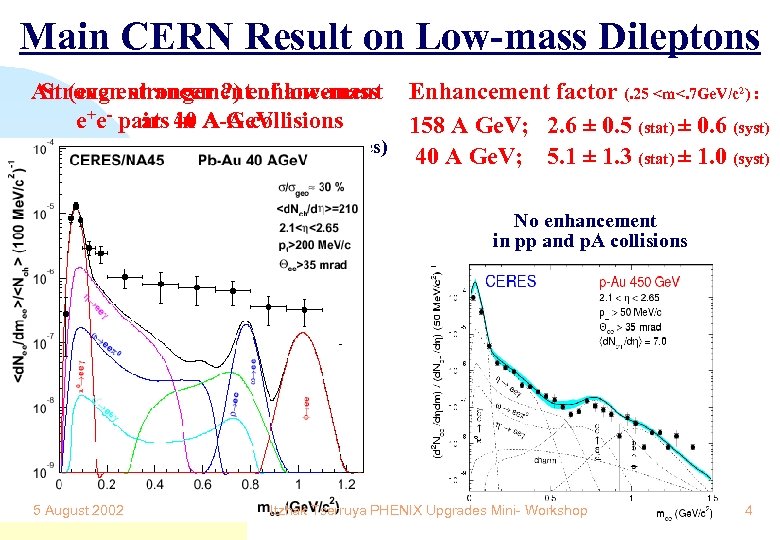 Main CERN Result on Low-mass Dileptons An (even stronger ? ) enhancement Strong enhancement of low-mass e+e- pairs 40 A-A collisions at in A Ge. V Enhancement factor (. 25
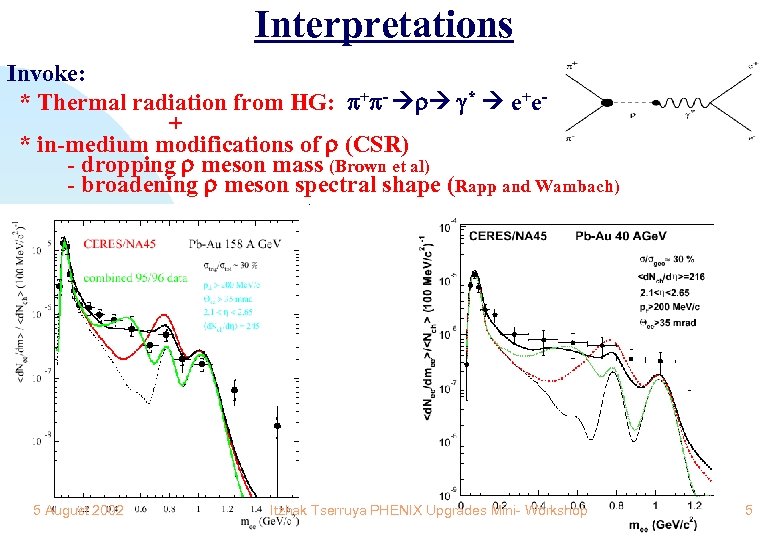 Interpretations Invoke: * Thermal radiation from HG: + - * e+e+ * in-medium modifications of (CSR) - dropping meson mass (Brown et al) - broadening meson spectral shape (Rapp and Wambach) 5 August 2002 Itzhak Tserruya PHENIX Upgrades Mini- Workshop 5
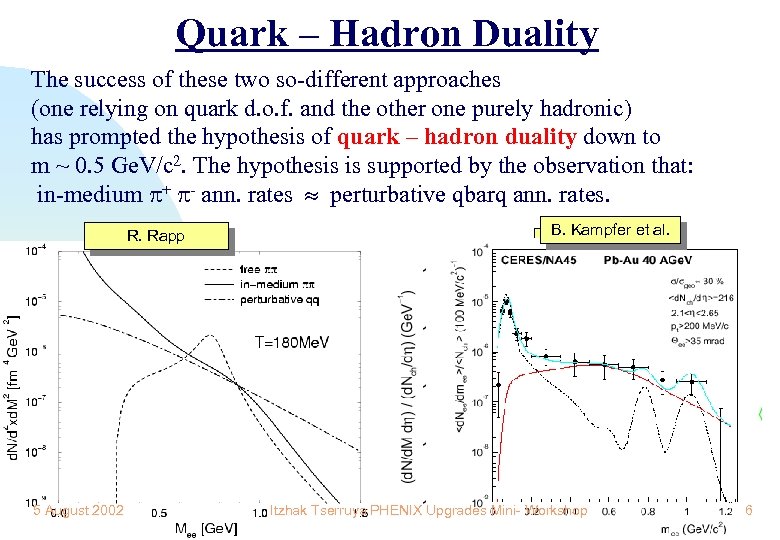 Quark – Hadron Duality The success of these two so-different approaches (one relying on quark d. o. f. and the other one purely hadronic) has prompted the hypothesis of quark – hadron duality down to m ~ 0. 5 Ge. V/c 2. The hypothesis is supported by the observation that: in-medium + - ann. rates perturbative qbarq ann. rates. R. Rapp 5 August 2002 B. Kampfer et al. Itzhak Tserruya PHENIX Upgrades Mini- Workshop 6
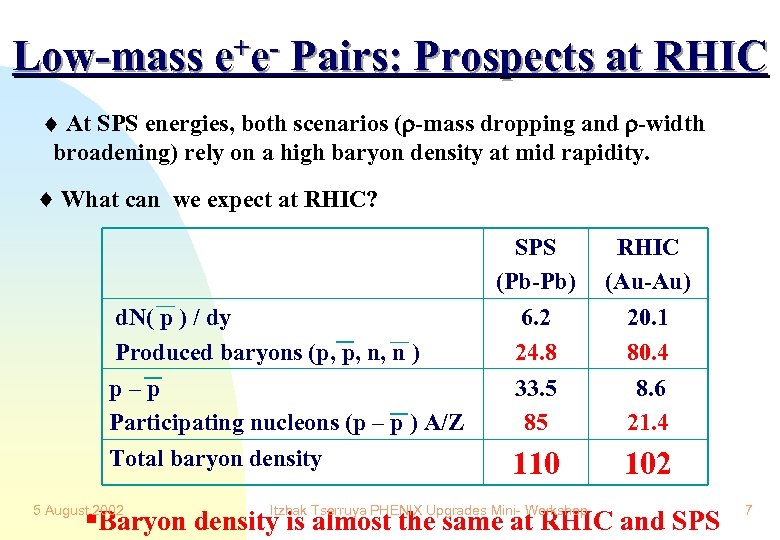 Low-mass e+e- Pairs: Prospects at RHIC At SPS energies, both scenarios ( -mass dropping and -width broadening) rely on a high baryon density at mid rapidity. What can we expect at RHIC? d. N( p ) / dy Produced baryons (p, p, n, n ) p–p Participating nucleons (p – p ) A/Z Total baryon density 5 August 2002 SPS (Pb-Pb) 6. 2 24. 8 33. 5 85 RHIC (Au-Au) 20. 1 80. 4 8. 6 21. 4 110 102 Itzhak Tserruya PHENIX Upgrades Mini- Workshop Baryon density is almost the same at RHIC and SPS 7
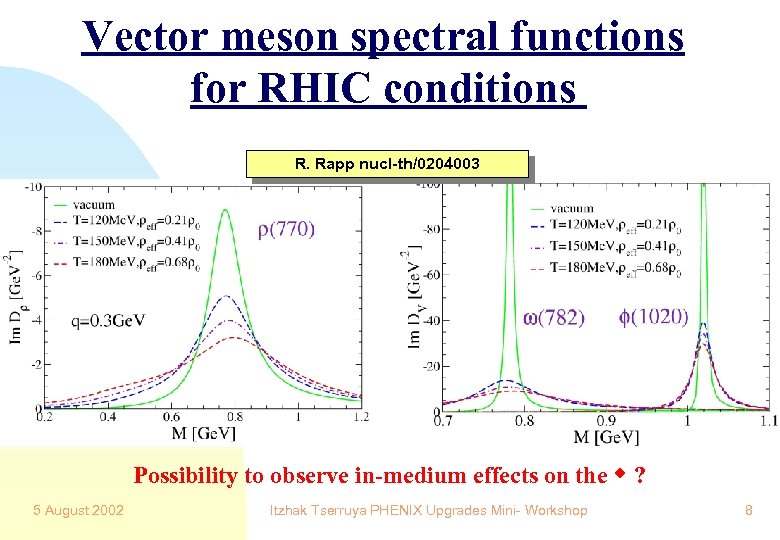 Vector meson spectral functions for RHIC conditions R. Rapp nucl-th/0204003 Possibility to observe in-medium effects on the ? 5 August 2002 Itzhak Tserruya PHENIX Upgrades Mini- Workshop 8
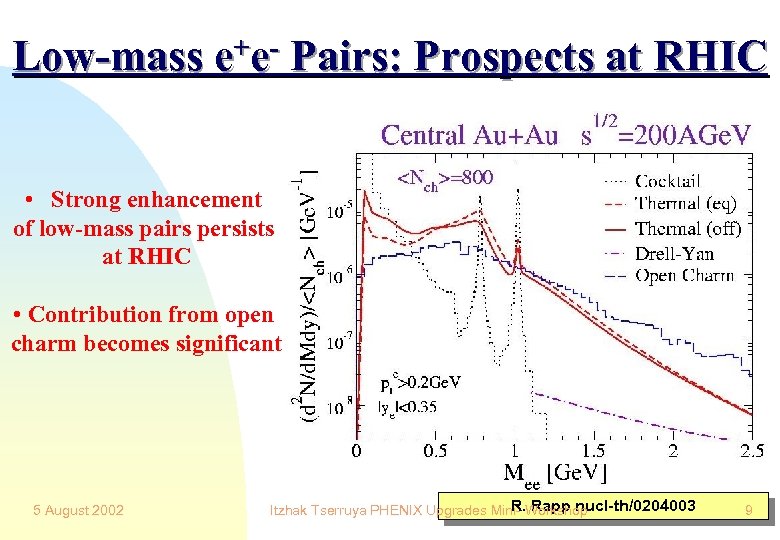 Low-mass e+e- Pairs: Prospects at RHIC • Strong enhancement of low-mass pairs persists at RHIC • Contribution from open charm becomes significant 5 August 2002 R. Rapp nucl-th/0204003 Itzhak Tserruya PHENIX Upgrades Mini- Workshop 9
 System requirements and limitations System requirements to beat the CB from 0 Dalitz and conversions: Electron identification with efficiency > 90% including double hit recognition Moderate pion rejection factor as low as 100 -200 Detector must fit within the radial distance 20 < r < 70 cm Detector should cover slightly larger acceptance than the PHENIX central arms (“veto area”) As low a radiation budget as possible (how much Si can we tolerate? ). System limitations: the irreducible CB from open charm decays. Unless we have a high resolution silicon vertex detector to recognize displaced vertices. But then, can we tolerate the unavoidable associated radiation length? 5 August 2002 Itzhak Tserruya PHENIX Upgrades Mini- Workshop 10
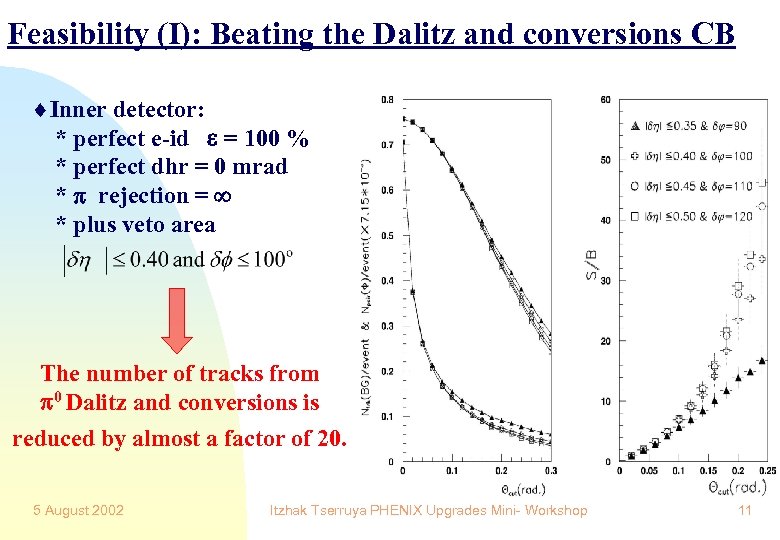 Feasibility (I): Beating the Dalitz and conversions CB ¨Inner detector: * perfect e-id = 100 % * perfect dhr = 0 mrad * rejection = * plus veto area The number of tracks from 0 Dalitz and conversions is reduced by almost a factor of 20. 5 August 2002 Itzhak Tserruya PHENIX Upgrades Mini- Workshop 11
 Feasibility (II): the irreducible background from charm ¨ (pp ccbar) = 650 b and tot = 41 mb Assume scaling to AA with Nbin = 1000 Nccbar = 16 in full space ¨From ppg 011: d ccbar/dy 1/ 4 ccbar d. Nccbar/dy 4 ¨ ccbar fragmentation: f(c D 0) = 0. 549 BR( e+ + …. )=0. 0675 x 2 for cbar 0. 074 D+ 0. 232 0. 172 0. 08 c 0. 076 0. 02 0. 03 Ds+ 0. 101 0. 08 0. 016 0. 17 e± /ccbar ¨ Electron tracks per central event from charm origin: d. Nc e/dy 4 * 0. 17 = 0. 68 Nc e in 5 August 2002 central arms = 0. 68* 1/2 * 0. 7 = 0. 23 Itzhak Tserruya PHENIX Upgrades Mini- Workshop 12
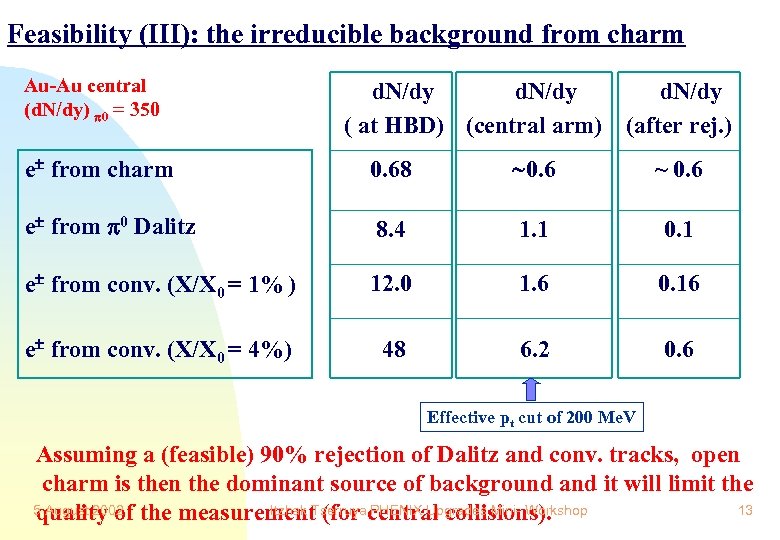 Feasibility (III): the irreducible background from charm Au-Au central (d. N/dy) 0 = 350 d. N/dy ( at HBD) (central arm) (after rej. ) e from charm 0. 68 0. 6 ~ 0. 6 e from 0 Dalitz 8. 4 1. 1 0. 1 e from conv. (X/X 0 = 1% ) 12. 0 1. 6 0. 16 e from conv. (X/X 0 = 4%) 48 6. 2 0. 6 Effective pt cut of 200 Me. V Assuming a (feasible) 90% rejection of Dalitz and conv. tracks, open charm is then the dominant source of background and it will limit the 5 August 2002 the measurement (for central collisions). Itzhak Tserruya PHENIX Upgrades Mini- Workshop 13 quality of
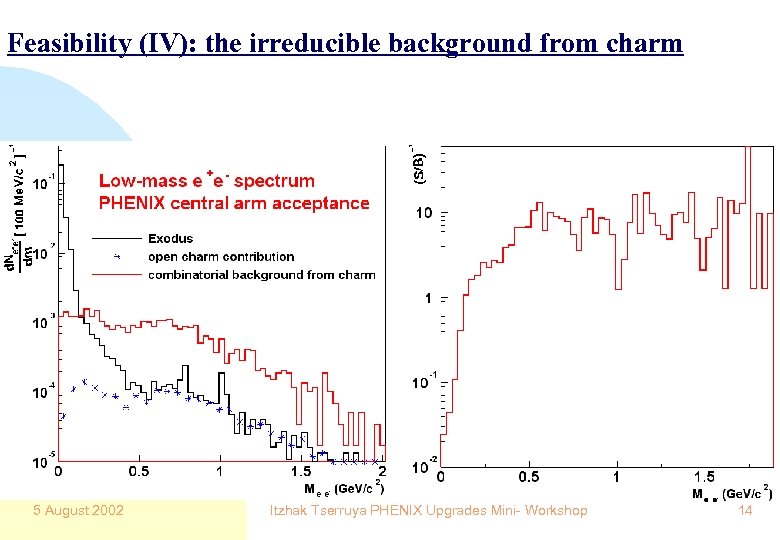 Feasibility (IV): the irreducible background from charm 5 August 2002 Itzhak Tserruya PHENIX Upgrades Mini- Workshop 14
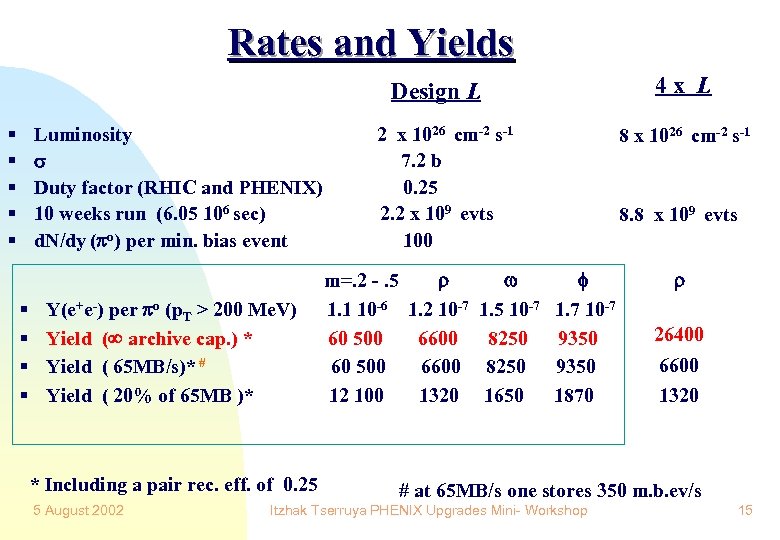 Rates and Yields 4 x L Design L § § § Luminosity Duty factor (RHIC and PHENIX) 10 weeks run (6. 05 106 sec) d. N/dy ( o) per min. bias event § § Y(e+e-) per o (p. T > 200 Me. V) Yield ( archive cap. ) * Yield ( 65 MB/s)* # Yield ( 20% of 65 MB )* * Including a pair rec. eff. of 0. 25 5 August 2002 2 x 1026 cm-2 s-1 7. 2 b 0. 25 2. 2 x 10⁹ evts 100 m=. 2 -. 5 1. 1 10 -6 1. 2 10 -7 60 500 6600 12 100 1320 1. 5 10 -7 8250 1650 8 x 1026 cm-2 s-1 8. 8 x 10⁹ evts 1. 7 10 -7 9350 1870 26400 6600 1320 # at 65 MB/s one stores 350 m. b. ev/s Itzhak Tserruya PHENIX Upgrades Mini- Workshop 15
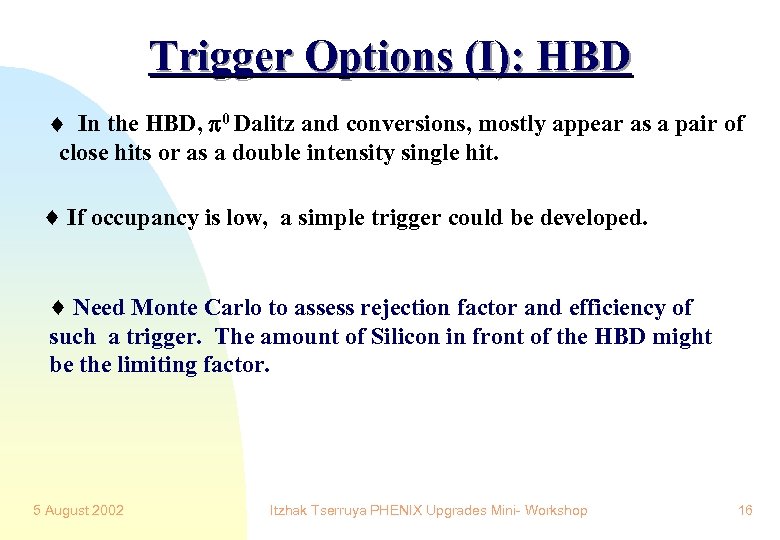 Trigger Options (I): HBD In the HBD, 0 Dalitz and conversions, mostly appear as a pair of close hits or as a double intensity single hit. If occupancy is low, a simple trigger could be developed. Need Monte Carlo to assess rejection factor and efficiency of such a trigger. The amount of Silicon in front of the HBD might be the limiting factor. 5 August 2002 Itzhak Tserruya PHENIX Upgrades Mini- Workshop 16
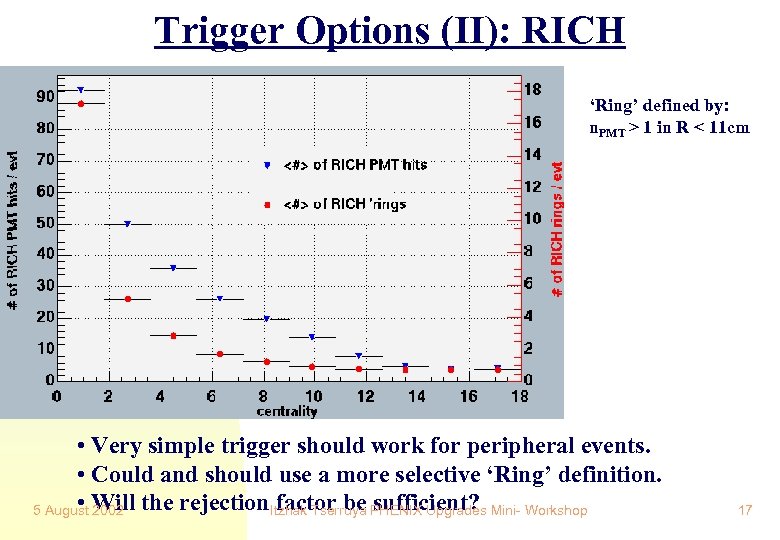 Trigger Options (II): RICH ‘Ring’ defined by: n. PMT > 1 in R < 11 cm • Very simple trigger should work for peripheral events. • Could and should use a more selective ‘Ring’ definition. • 2002 factor be sufficient? 5 August Will the rejection. Itzhak Tserruya PHENIX Upgrades Mini- Workshop 17
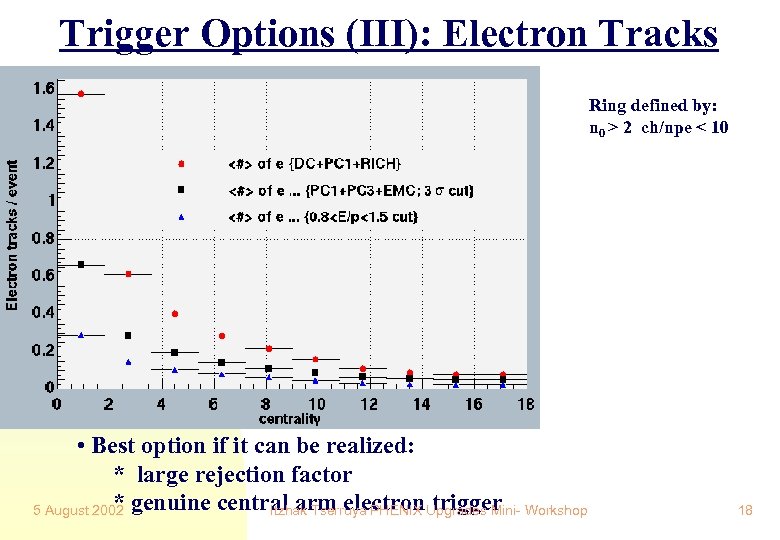 Trigger Options (III): Electron Tracks Ring defined by: n 0 > 2 ch/npe < 10 • Best option if it can be realized: * large rejection factor * 5 August 2002 genuine central arm electron. Upgrades Mini- Workshop Itzhak Tserruya PHENIX trigger 18
 Summary The physics case is as strong as ever. CB problem arising from 0 Dalitz and conversions can be solved. Open charm becomes the most significant factor, limiting the S/B to ~1/10. How much Si can we tolerate in front of the HBD? Can a high precision Si vertex detector help overcome the CB from open charm? We need a trigger. There are several attractive options. Use exixting data and Monte Carlo to assess rejection factor and efficiency of various trigger schemes. The amount of Silicon in 5 front of the HBD might again be the limiting factor. August 2002 Itzhak Tserruya PHENIX Upgrades Mini- Workshop 19