


 Скачать презентацию Low Literacy Hispanics A Case Study Mrs Yolanda
f4140920493fe5df60608543ea4bd489.ppt
- Количество слайдов: 56
 Low Literacy Hispanics: A Case Study Mrs. Yolanda Medina Executive Director Centro Latino de Educación para Adultos Dallas Norte Literacy Texas Conference 2017
 We acknowledge that being an adult learner is difficult, that being an adult second language learner is even more difficult, and that being a pre-literate adult second language learner must be short of a painful situation. Donna Mc. Gee, 1978 Pre-Literacy Definitions 2
 “There is much research evidence to support the fact that the rate of English language acquisition is positively correlated with the literacy skills in one’s native language. Therefore, for the Latino population with limited literacy in Spanish, ESL classes can neither advance their literacy skills or their English language skills. For them, a more integrative approach, taking into account their literacy needs, as well as their second language needs is necessary. ” Cummins, 1981
 What is basic literacy? The ability to read and write (Merriam-Webster Dictionary) Ability to use printed and written information to function in society, to achieve one’s goals, and to develop one’s knowledge and potential (National Assessment of Adult Literacy) Set of tangible skills – particularly the cognitive skills of reading and writing – that are independent of the context in which they are acquired and the background of the person who acquires them (Education for All Global Monitoring Report 2006 – UNESCO)
 Why is basic literacy needed? Adult learners who are illiterate in their native tongue cannot learn to read and write in a second language. They can converse. Adult learners are required to possess a strong foundation that will allow the acquisition of a second language Statistics collected consider illiterate those who cannot read and write in English regardless of their background – measured in English (English Proficiency Survey) Our focus is on those illiterate or low literacy in their native language - Spanish We need real engagement!!!
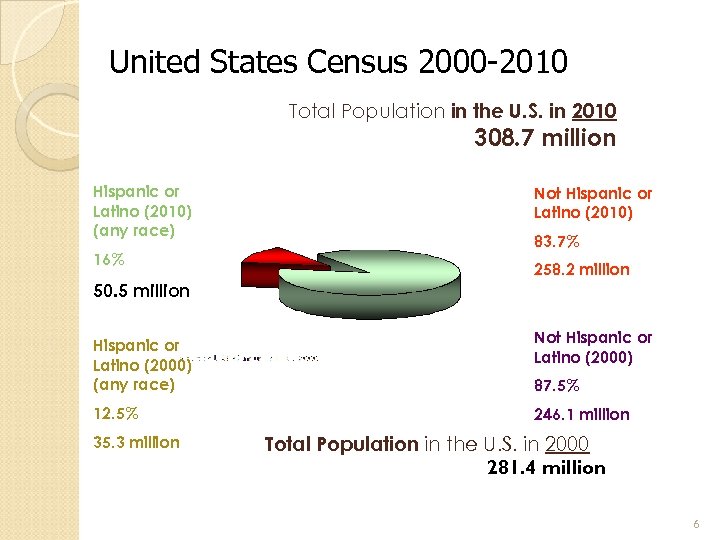 United States Census 2000 -2010 Total Population in the U. S. in 2010 308. 7 million Hispanic or Latino (2010) (any race) 16% Not Hispanic or Latino (2010) 83. 7% 258. 2 million 50. 5 million Hispanic or Latino (2000) (any race) 12. 5% 35. 3 million Not Hispanic or Latino (2000) 87. 5% 246. 1 million Total Population in the U. S. in 2000 281. 4 million 6
 Largest and fastest-growing • Spanish Speaking population grew 43%, which was 4 times the growth in the total population at 10 percent. • There are 50. 5 million (2010 Census) people of Hispanic origin in U. S. , compared to 22. 4 million in 1990. • 75% of Hispanics live in 8 states: o California, Texas, Florida, New York, Illinois, Arizona, New Jersey, and Colorado • U. S. has the world’s third largest Hispanic population, after Mexico, and Colombia. 7
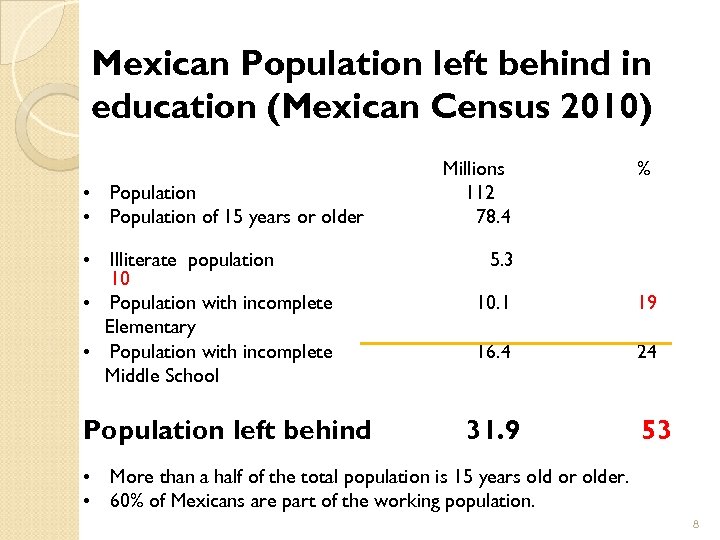 Mexican Population left behind in education (Mexican Census 2010) • Population of 15 years or older • Illiterate population 10 • Population with incomplete Elementary • Population with incomplete Middle School Population left behind Millions 112 78. 4 % 5. 3 10. 1 19 16. 4 24 31. 9 53 • More than a half of the total population is 15 years old or older. • 60% of Mexicans are part of the working population. 8
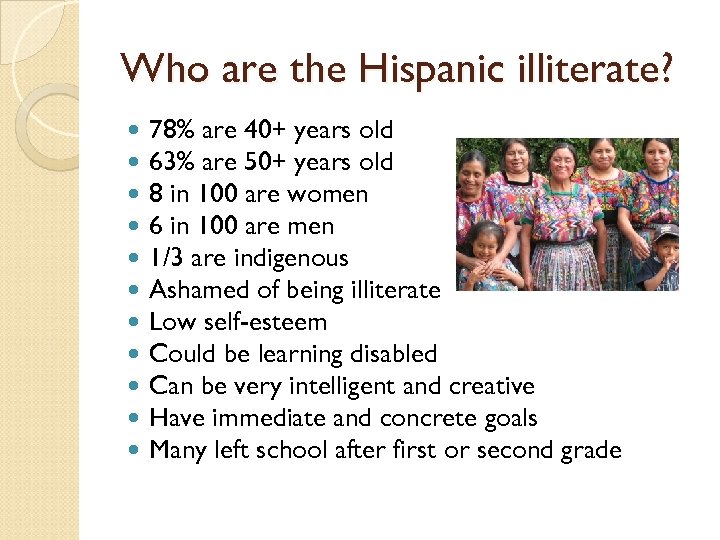 Who are the Hispanic illiterate? 78% are 40+ years old 63% are 50+ years old 8 in 100 are women 6 in 100 are men 1/3 are indigenous Ashamed of being illiterate Low self-esteem Could be learning disabled Can be very intelligent and creative Have immediate and concrete goals Many left school after first or second grade
 How many in the U. S. ? There are 3. 6 million illiterate Mexicans in the United States. These numbers do not include Central Americans (Honduras, El Salvador, Guatemala, Nicaragua, etc. ) where illiteracy is higher due to civil wars. Seven of every ten Mexican illiterate adults come from 9 states: Veracruz, Chiapas, Estado de México, Oaxaca, Puebla, Guerrero, Guanajuato, Michoacán and Jalisco).
 Why is the education level so low in Mexico? Lack of school facilities near student's communities, especially in rural areas. Parents keep their children home to help with housekeeping or field activities. Illiterate parents (20% of the population) Parents can't afford to send children to school. Lack of motivation to become teachers, due to low salaries. Mistrust of the indigenous population towards government 54 indigenous tribes with 54 different oral languages (some are also written languages) 11
 Why are Mexican educational resources so important? Reduce the achievement gap among students. Accelerate the acquisition of the English language. Offer cultural background and improve self-esteem. Provide parents new tools to support their children's educational process and reduce the generation gap. 12
 Setting up the Pl@za Comunitaria or Study Groups 13
 Bilateral Agreement Mexico. United States – November 1990 (Norm ISO 9001) Establishes the Mexico-United States Commission of Educational and Cultural Exchange Valid until 2020 with possibilities of continuation through addendums
 Plaza Comunitaria - Objectives Provide free of charge educational curriculums through new information technologies to Mexicans and Hispanics living in the USA. Facilitate the accreditation and certification of Adult Basic Education to any Hispanic over 15 years old. 15
 Mexican Agencies INEA (Instituto Nacional para la Educación de Adultos / Mexican National Institute for Adult Education) SEP (Secretaría de Educación / Dept. of Education) IME (Instituto de los Mexicanos en el Exterior / Institute for Mexicans Abroad) CONEVYT (Consejo Nacional de Educación para la Vida y el Trabajo / National Council for Education for Life and Work) Consulado General de México / Mexican Consulate Offices in your area 16
 What is a Plaza Comunitaria? The Plaza Comunitaria is a physical space where educational services are offered to Mexicans and Hispanics free of charge using new technology. It requires: Classroom area Computer Lab Basic Plaza program includes: Basic literacy (learn to read and write) Elementary level education Middle School level education Additional services that can be provided (Transition Program) GED preparation courses ESL classes Citizenship classes Basic computer skills TOEFL preparation courses 17
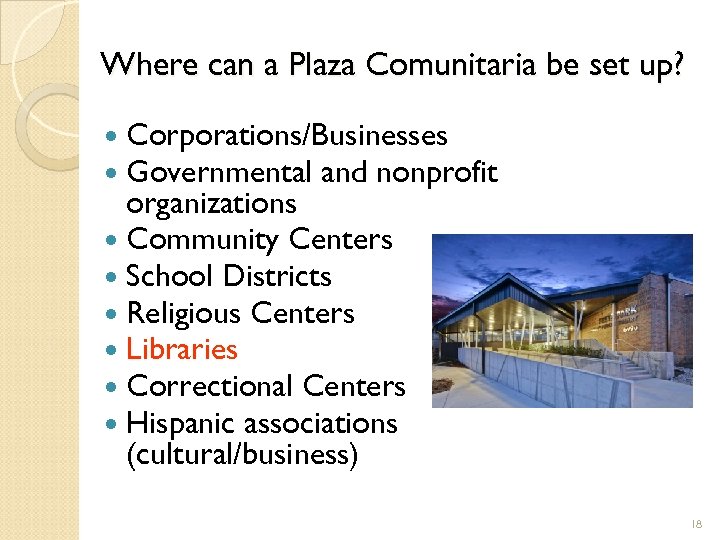 Where can a Plaza Comunitaria be set up? Corporations/Businesses Governmental and nonprofit organizations Community Centers School Districts Religious Centers Libraries Correctional Centers Hispanic associations (cultural/business) 18
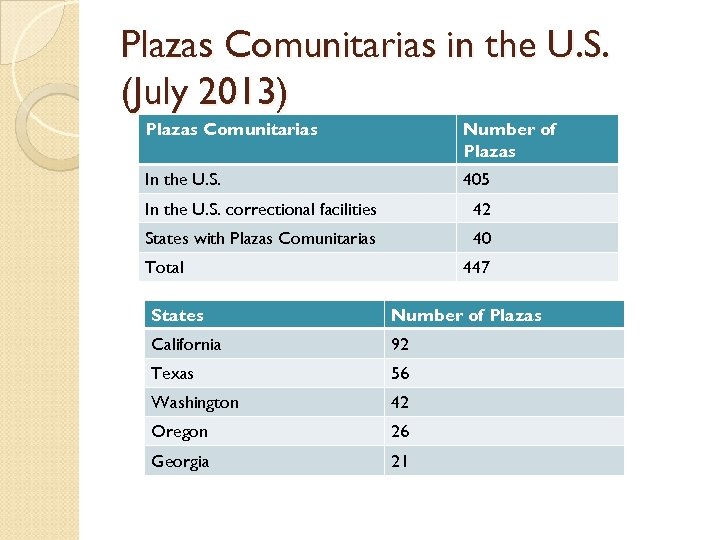 Plazas Comunitarias in the U. S. (July 2013) Plazas Comunitarias Number of Plazas In the U. S. 405 In the U. S. correctional facilities 42 States with Plazas Comunitarias 40 Total 447 States Number of Plazas California 92 Texas 56 Washington 42 Oregon 26 Georgia 21
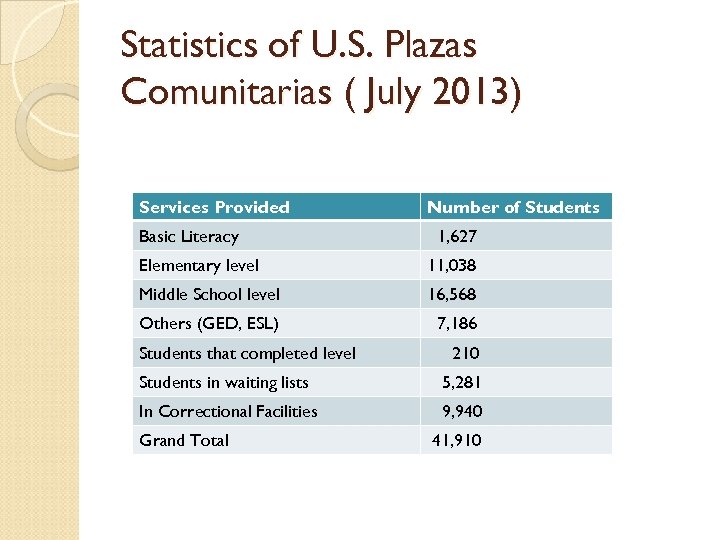 Statistics of U. S. Plazas Comunitarias ( July 2013) Services Provided Basic Literacy Number of Students 1, 627 Elementary level 11, 038 Middle School level 16, 568 Others (GED, ESL) 7, 186 Students that completed level 210 Students in waiting lists 5, 281 In Correctional Facilities 9, 940 Grand Total 41, 910
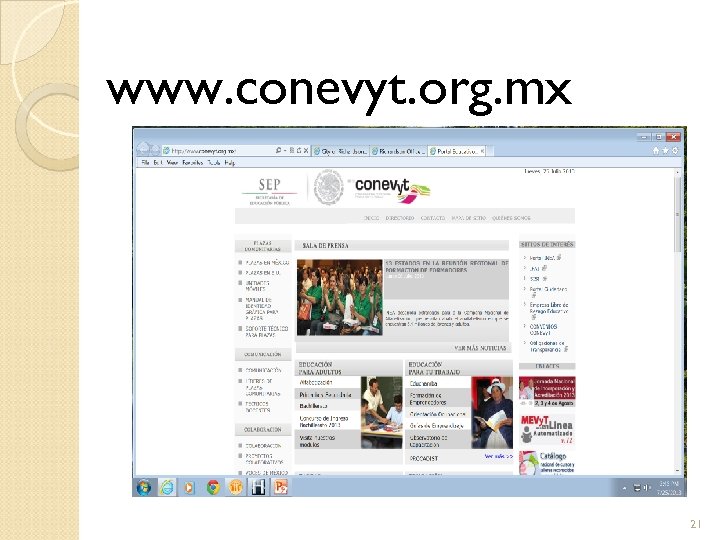 www. conevyt. org. mx 21
 SASA – Registration and Testing Database
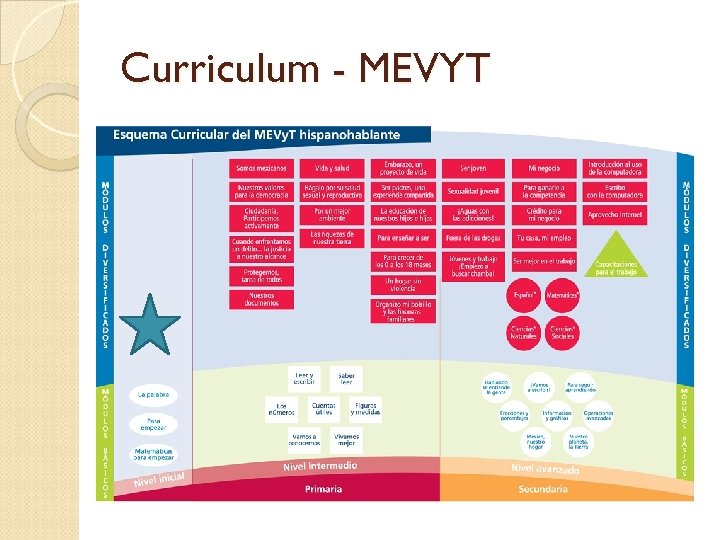 Curriculum - MEVYT
 MEVYT (Modelo de Educación para la Vida y el Trabajo) Basic literacy ◦ 3 books (La Palabra, Para Empezar, Matemáticas para Empezar Elementary level ◦ 7 books (Language Arts, Math, Health, Social Studies) (Leer y Escribir, Saber Leer, Los Números, Cuentas Utiles, Figuras y Medidas, Vamos a Conocernos, Vivamos Mejor) ◦ 2 optional books (students select) Total of 12 books to become certified by Mexico 24
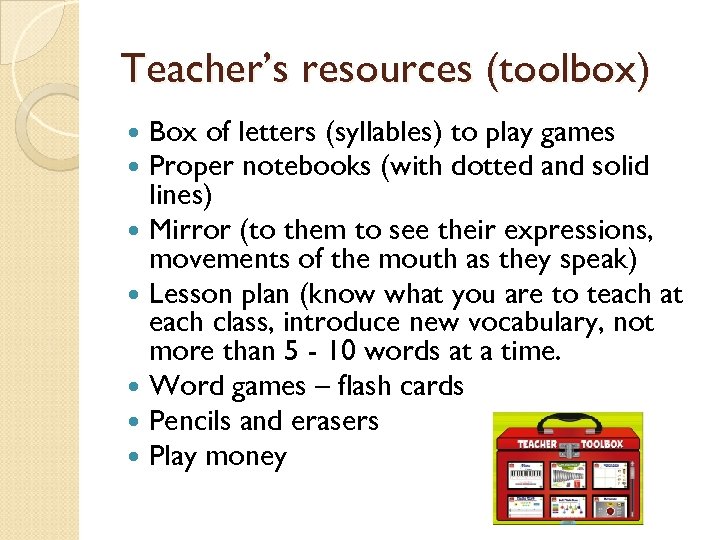 Teacher’s resources (toolbox) Box of letters (syllables) to play games Proper notebooks (with dotted and solid lines) Mirror (to them to see their expressions, movements of the mouth as they speak) Lesson plan (know what you are to teach at each class, introduce new vocabulary, not more than 5 - 10 words at a time. Word games – flash cards Pencils and erasers Play money
 Be patient! Give your adult learner a sense of safety and well-being. ◦ Distraction-free setting ◦ Trust and respect ◦ “Just right” challenges – not too easy and not too hard ◦ Create a culture of learning from mistakes ◦ Connect lesson to life experiences ◦ Make learning fun, playful and surprising Games, puzzles, role-playing, new situations ◦ Average time of learning: 2 years Value x Expectation of Success = Motivation
 Be respectful! Respect the differences between adult learners Motivate your students Create trustworthy environment Do not yell or call names
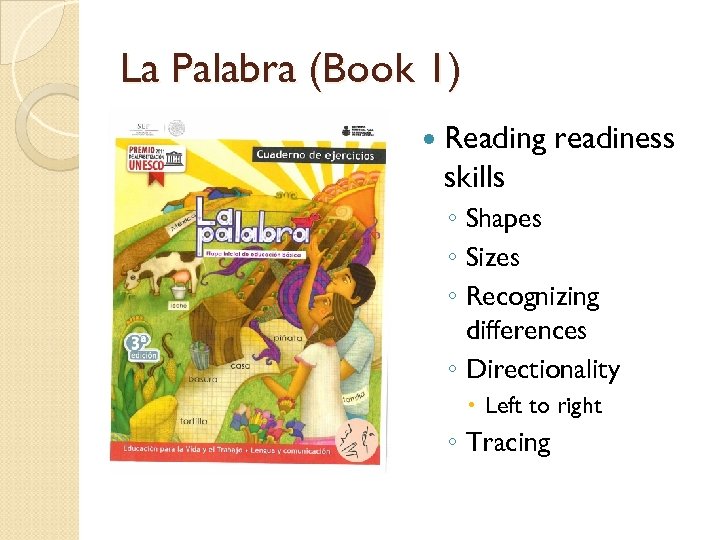 La Palabra (Book 1) Reading readiness skills ◦ Shapes ◦ Sizes ◦ Recognizing differences ◦ Directionality Left to right ◦ Tracing
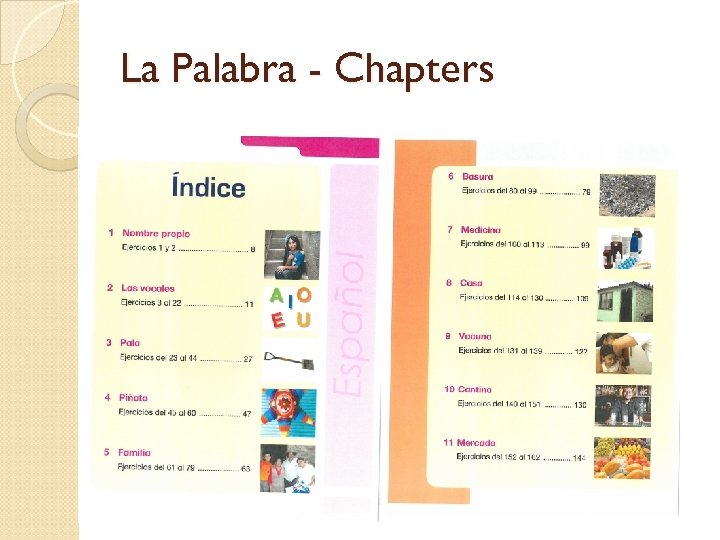 La Palabra - Chapters
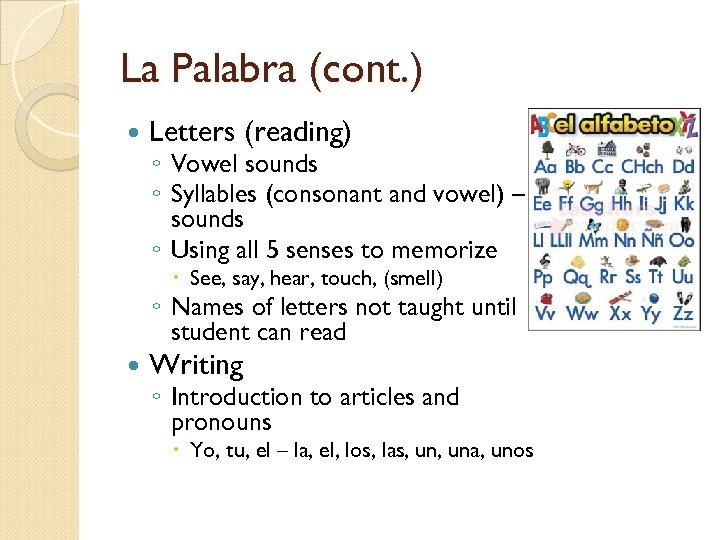 La Palabra (cont. ) Letters (reading) ◦ Vowel sounds ◦ Syllables (consonant and vowel) – sounds ◦ Using all 5 senses to memorize See, say, hear, touch, (smell) ◦ Names of letters not taught until student can read Writing ◦ Introduction to articles and pronouns Yo, tu, el – la, el, los, las, una, unos
 La Palabra (cont. ) Introduction to proper names ◦ Their name ◦ Pepe, Maria, Lupe, Texas Starting a sentence with a capital letter Introduction to punctuation Writing very short sentences ◦ Lupe ama a Pepe. Supplementary reading (Lots) ◦ Short stories ◦ Short articles ◦ Bible or other religious works Read together Provide word student cannot figure out
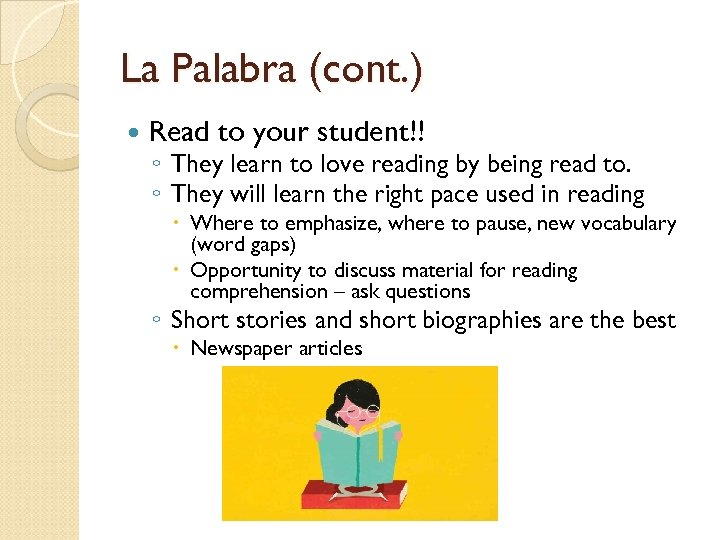 La Palabra (cont. ) Read to your student!! ◦ They learn to love reading by being read to. ◦ They will learn the right pace used in reading Where to emphasize, where to pause, new vocabulary (word gaps) Opportunity to discuss material for reading comprehension – ask questions ◦ Short stories and short biographies are the best Newspaper articles
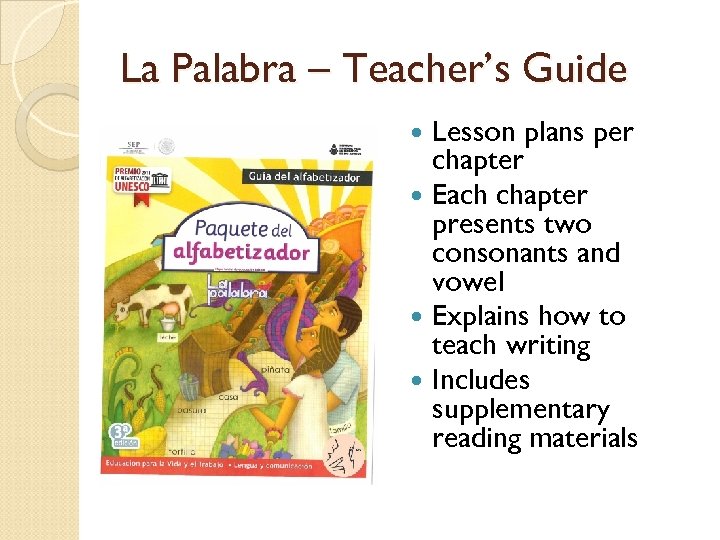 La Palabra – Teacher’s Guide Lesson plans per chapter Each chapter presents two consonants and vowel Explains how to teach writing Includes supplementary reading materials
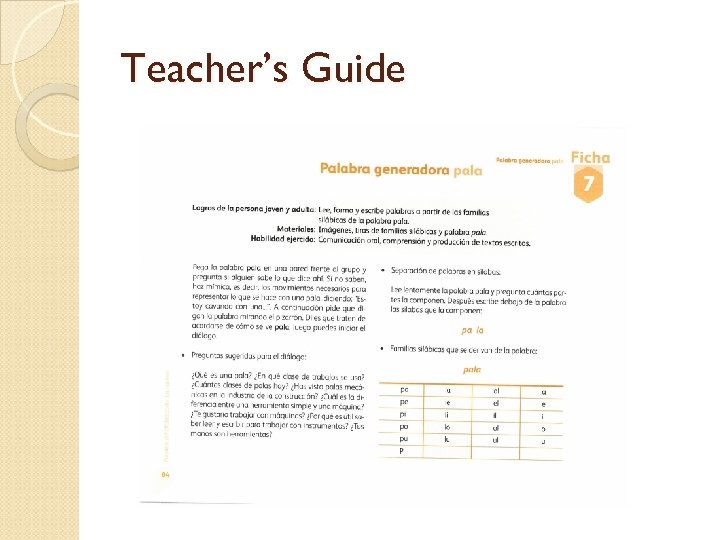 Teacher’s Guide
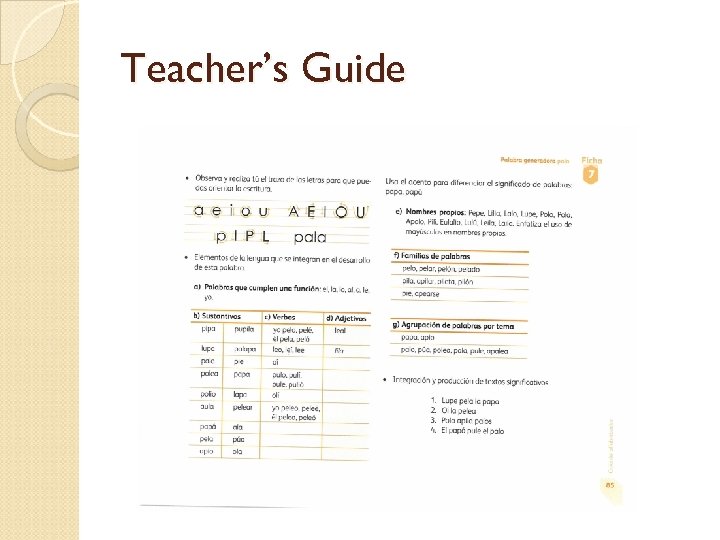 Teacher’s Guide
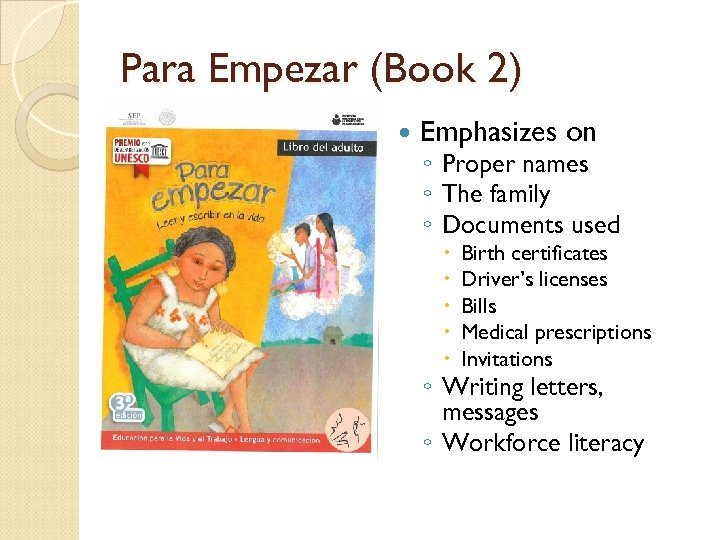 Para Empezar (Book 2) Emphasizes on ◦ Proper names ◦ The family ◦ Documents used Birth certificates Driver’s licenses Bills Medical prescriptions Invitations ◦ Writing letters, messages ◦ Workforce literacy
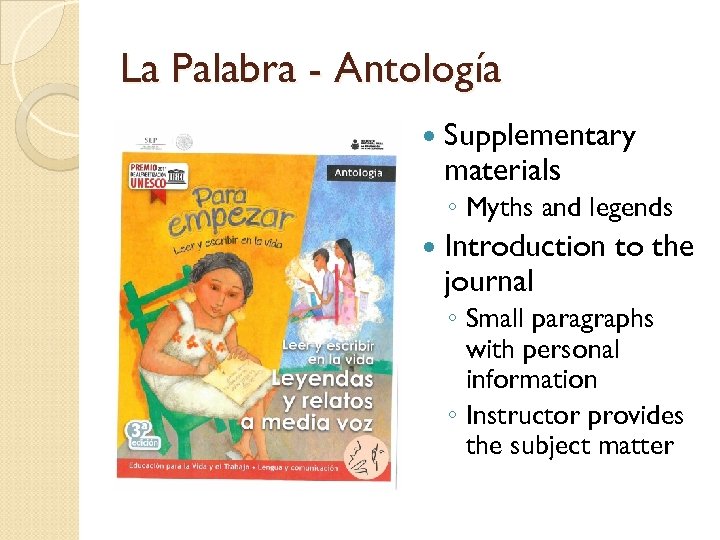 La Palabra - Antología Supplementary materials ◦ Myths and legends Introduction to the journal ◦ Small paragraphs with personal information ◦ Instructor provides the subject matter
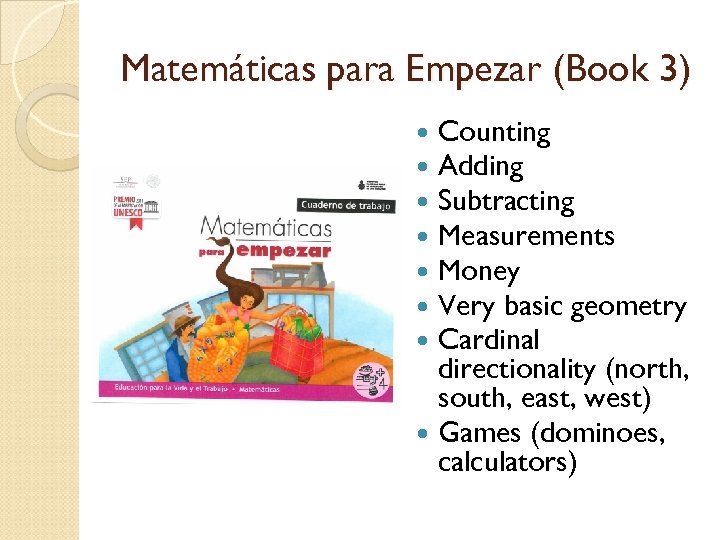 Matemáticas para Empezar (Book 3) Counting Adding Subtracting Measurements Money Very basic geometry Cardinal directionality (north, south, east, west) Games (dominoes, calculators)
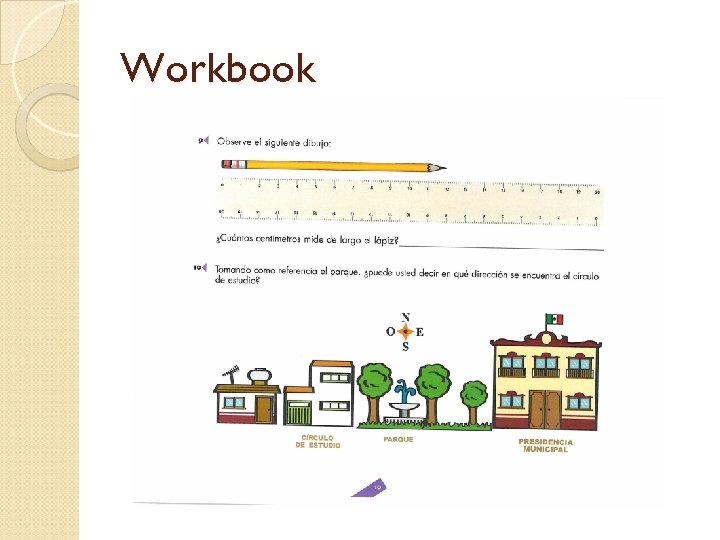 Workbook
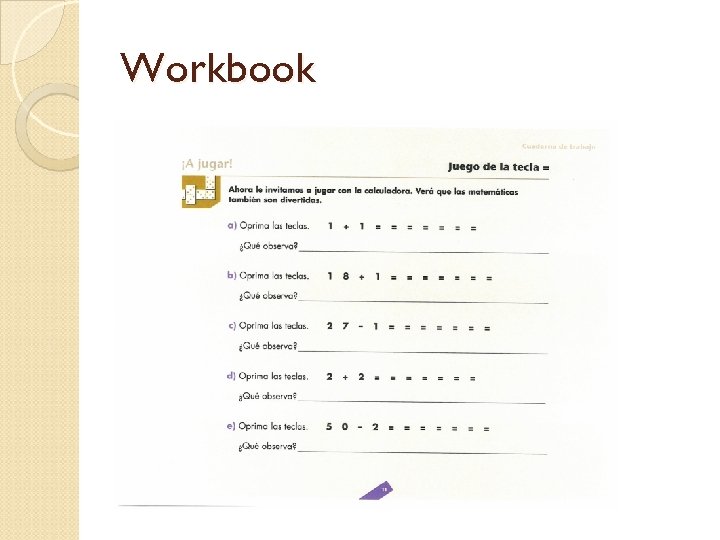 Workbook
 Testing SASA ◦ Database created by Mexico’s National Institute for Adult Education. ◦ Must have a signed agreement with Mexican Consulate in your area ◦ Used for registering students and testing purposes ◦ For those who do not want or cannot sign the agreement, copies of the tests are included in your cd (along with the books). ◦ Most exams are multiple choice questions Access to pdf files of books and database are free (www. conevyt. org. mx)
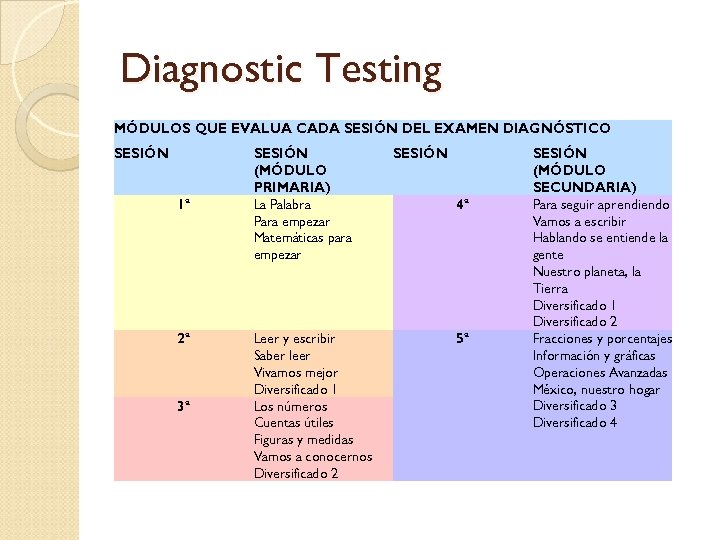 Diagnostic Testing MÓDULOS QUE EVALUA CADA SESIÓN DEL EXAMEN DIAGNÓSTICO SESIÓN 1ª 2ª 3ª SESIÓN (MÓDULO PRIMARIA) La Palabra Para empezar Matemáticas para empezar Leer y escribir Saber leer Vivamos mejor Diversificado 1 Los números Cuentas útiles Figuras y medidas Vamos a conocernos Diversificado 2 SESIÓN 4ª 5ª SESIÓN (MÓDULO SECUNDARIA) Para seguir aprendiendo Vamos a escribir Hablando se entiende la gente Nuestro planeta, la Tierra Diversificado 1 Diversificado 2 Fracciones y porcentajes Información y gráficas Operaciones Avanzadas México, nuestro hogar Diversificado 3 Diversificado 4
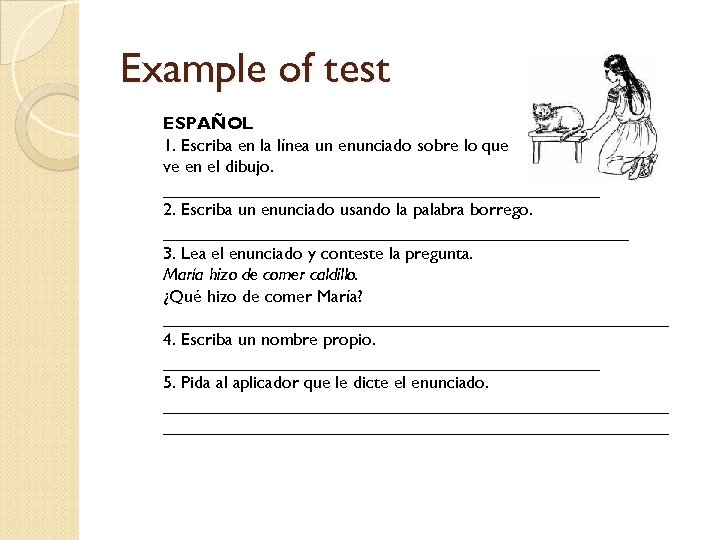 Example of test ESPAÑOL 1. Escriba en la línea un enunciado sobre lo que ve en el dibujo. ______________________ 2. Escriba un enunciado usando la palabra borrego. ________________________ 3. Lea el enunciado y conteste la pregunta. María hizo de comer caldillo. ¿Qué hizo de comer María? __________________________ 4. Escriba un nombre propio. ______________________ 5. Pida al aplicador que le dicte el enunciado. ___________________________________________________
 Problems Encountered Unstable community ◦ Immigration status ◦ Variety of jobs ◦ Absenteeism Education is low priority for students 30% of registered students are unaccounted for Volunteer tutors turnaround (retention) ◦ Continuous recruiting Lack of day care One-on-one tutors are required – Hispanics only One - two years to complete the first book ◦ The older the student, the more time it takes 45
 Partnerships
 Partnerships Provide ◦ Training ◦ Recruitment ◦ Teaching materials ◦ Money ◦ Marketing ◦ Networking
 Milagro – 46 years old Entered the program in 2009 Could not read or write at all Salvadorian Mother of two children Three years for basic literacy – one-on-one tutoring Two to finish Elementary level education - group Two years to finish Middle School education -group Registered for ESL classes, doing well Taking Nutrition classes with Texas A & M Program Can read to her children and help with homework Works for Pappadeux restaurant and has been promoted
 Berna – 51 years old Entered the program in 2009 Totally illiterate Mexican Basic literacy, three years – one-on-one tutoring Two years, completed Elementary level education Two years, completed Middle School level education Was able to terminate an abusive marriage Became a better mother and grandmother Found love again (self-esteem) Currently taking ESL classes as well as Nutrition classes
 Angela – 84 years old Entered the program in 2012 Had completed third grade, elementary level education in Mexico Came from a Ranch in Mexico Completed elementary level education in 2014 Completed Middle School level education in 2016 Our oldest graduate Seamstress by profession Currently taking ESL classes and Nutrition classes (walks to the library for classes) Became a U. S. citizen
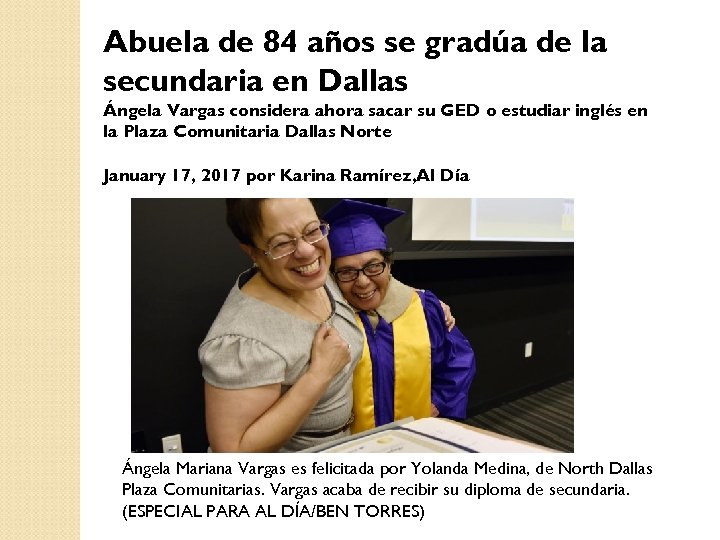 Abuela de 84 años se gradúa de la secundaria en Dallas Ángela Vargas considera ahora sacar su GED o estudiar inglés en la Plaza Comunitaria Dallas Norte January 17, 2017 por Karina Ramírez, Al Día Ángela Mariana Vargas es felicitada por Yolanda Medina, de North Dallas Plaza Comunitarias. Vargas acaba de recibir su diploma de secundaria. (ESPECIAL PARA AL DÍA/BEN TORRES)
 https: //youtu. be/ya. ODAKs 5 bz. E
 Suggested reading Cummins, J. 1981. The role of primary language development in promoting educational success for language minority students. In California State Department of Education’s (ed. ) Schooling and Language Minority Students: A Theoretical Framework, 3 -49. Los Angeles: Evaluation, Dissemination and Assessment Center, California State University. Garcia, Ofelia. 1991. The politics of the language of literacy: Spanish literacy for New York latinos. In Information Update, 7(Fall/Winter): 9 -10. Marcias, Reynaldo F. 1988. Latino illiteracy in the United States. Claremont, CA: Tomas Rivera Policy Center. Wiley, Terrence G. 1989. Literacy, biliteracy and educational achievement among the Mexican-origin population in the United States. Bilingual Research Journal: 14: 109 -127.
 Other basic literacy programs in Spanish (not free) Esperanza: A Spanish Language Program prepared by the Valley Speech Language and Learning Center in Brownsville, TX Leamos, created by Centro Latino for Literacy in California (online) ◦ www. centrolatinoliteracy. org ◦ www. leamos. org
 Questions?
 ¡Gracias! Yolanda Medina Supervisor, Technical Services, Richardson Public Library Adult Literacy Coordinator, Plaza Comunitaria @ Richardson Public Library 900 Civic Center Drive Richardson, TX 75080 972 -744 -4368 yolanda. medina@cor. gov 56