


 Скачать презентацию Low Income Diet and Nutrition Survey summary and
95109da354d3430344a51cc38480b043.ppt
- Количество слайдов: 118
 Low Income Diet and Nutrition Survey: summary and analysis of the main findings prepared by Dr Alan Stewart www. stewartnutrition. co. uk
 Low Income Diet and Nutrition Survey: Lecture Contents and Slides • Introduction 3 -5 • Methodology, Analysis, Population Characteristics 6 -12 • Malnutrition: undernutrition 13 -20 • Malnutrition: overnutrition 21 -24 • Malnutrition Risk Factors: socio-economic and personal 25 -55 • Lessons from History
 Poverty and Malnutrition: Background • Though the industrial and agricultural revolutions did much to reduce widespread food shortages malnutrition still occurs • Landmark discoveries in nutrition made in the 20 th century began to document the specific impact of poor nutrient intake on health • These discoveries and the need for even food distribution during the two World Wars resulted in the formulation of advice and food policies to prevent undernutrition in the general population • Financial hardship and deprivation are not the only determinants of inadequate food intake and malnutrition in the UK population • Poor nutrient status affects all age groups - growth, development, physical and mental health, earning capability and longevity • Correcting undernutrition benefits both the individual and society • To correct problems of malnutrition requires an understanding of the findings of nutritional surveys as well as lessons from history
 Malnutrition and Health • The term malnutrition covers both undernutrition and overnutrition • In the UK obvious severe undernutrition is not common outside of serious illness or dietary problems but overnutrition – obesity, is • Numerous nutritional surveys of the UK population reveal that mild deficiencies of micronutrients are not uncommon, may co-exist with overnutrition and can adversely influence physical or mental health • Deficiencies of three micronutrients (iron, vitamin A and iodine) in all countries are monitored by the WHO and are only marginally more common in the low income groups in the UK. www. int/vmnis/en • However, deficiencies of folate, vitamins D and C are more common and potentially affect health in all age groups • The causes of these and other deficiencies include poor food choices, illness, smoking, alcohol excess and lack of sun exposure
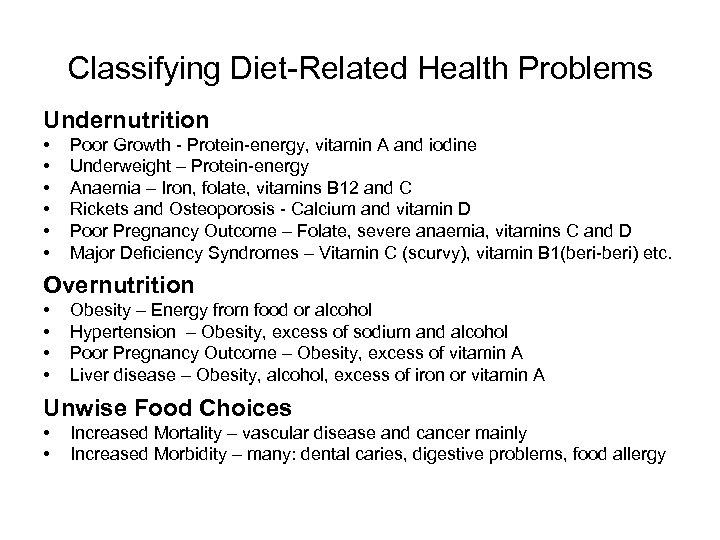 Classifying Diet-Related Health Problems Undernutrition • • • Poor Growth - Protein-energy, vitamin A and iodine Underweight – Protein-energy Anaemia – Iron, folate, vitamins B 12 and C Rickets and Osteoporosis - Calcium and vitamin D Poor Pregnancy Outcome – Folate, severe anaemia, vitamins C and D Major Deficiency Syndromes – Vitamin C (scurvy), vitamin B 1(beri-beri) etc. Overnutrition • • Obesity – Energy from food or alcohol Hypertension – Obesity, excess of sodium and alcohol Poor Pregnancy Outcome – Obesity, excess of vitamin A Liver disease – Obesity, alcohol, excess of iron or vitamin A Unwise Food Choices • • Increased Mortality – vascular disease and cancer mainly Increased Morbidity – many: dental caries, digestive problems, food allergy
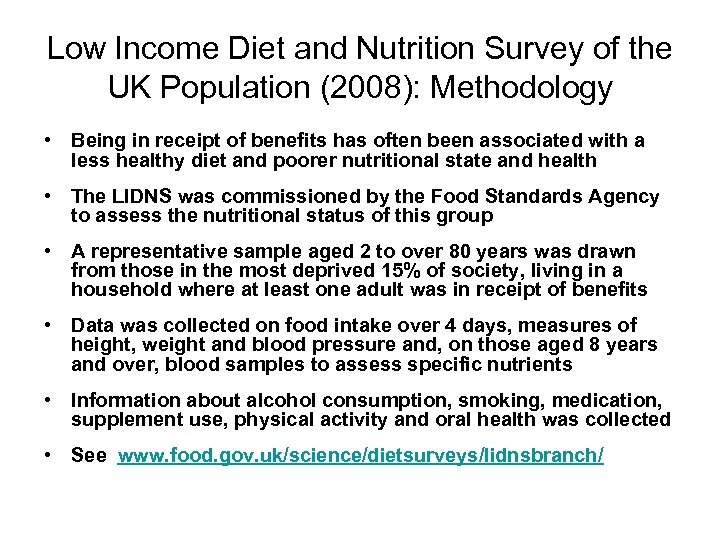 Low Income Diet and Nutrition Survey of the UK Population (2008): Methodology • Being in receipt of benefits has often been associated with a less healthy diet and poorer nutritional state and health • The LIDNS was commissioned by the Food Standards Agency to assess the nutritional status of this group • A representative sample aged 2 to over 80 years was drawn from those in the most deprived 15% of society, living in a household where at least one adult was in receipt of benefits • Data was collected on food intake over 4 days, measures of height, weight and blood pressure and, on those aged 8 years and over, blood samples to assess specific nutrients • Information about alcohol consumption, smoking, medication, supplement use, physical activity and oral health was collected • See www. food. gov. uk/science/dietsurveys/lidnsbranch/
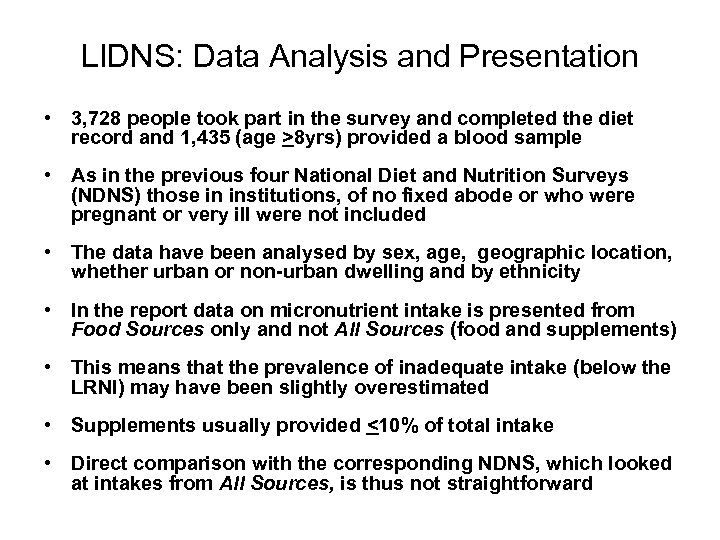 LIDNS: Data Analysis and Presentation • 3, 728 people took part in the survey and completed the diet record and 1, 435 (age >8 yrs) provided a blood sample • As in the previous four National Diet and Nutrition Surveys (NDNS) those in institutions, of no fixed abode or who were pregnant or very ill were not included • The data have been analysed by sex, age, geographic location, whether urban or non-urban dwelling and by ethnicity • In the report data on micronutrient intake is presented from Food Sources only and not All Sources (food and supplements) • This means that the prevalence of inadequate intake (below the LRNI) may have been slightly overestimated • Supplements usually provided <10% of total intake • Direct comparison with the corresponding NDNS, which looked at intakes from All Sources, is thus not straightforward
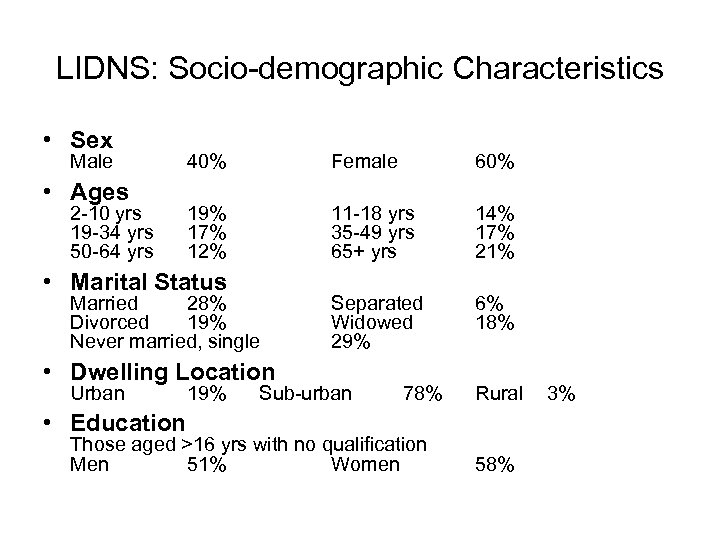 LIDNS: Socio-demographic Characteristics • Sex Male • Ages 2 -10 yrs 19 -34 yrs 50 -64 yrs 40% Female 60% 19% 17% 12% 11 -18 yrs 35 -49 yrs 65+ yrs 14% 17% 21% Separated Widowed 29% 6% 18% • Marital Status Married 28% Divorced 19% Never married, single • Dwelling Location Urban 19% Sub-urban 78% Rural • Education Those aged >16 yrs with no qualification Men 51% Women 58% 3%
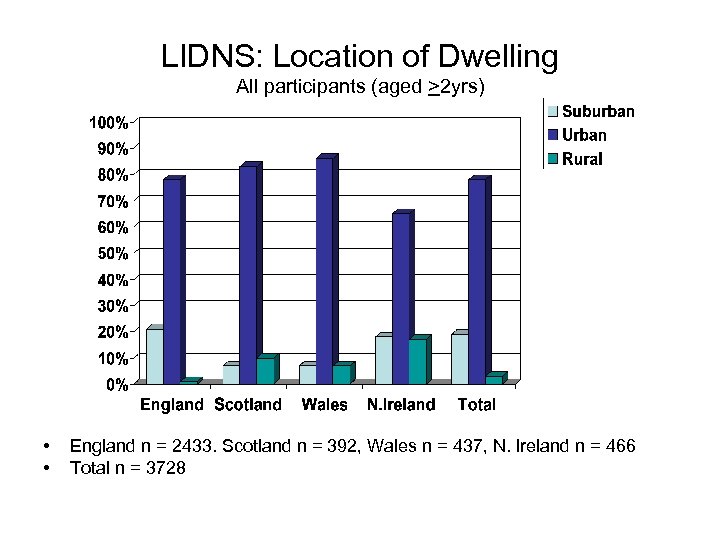 LIDNS: Location of Dwelling All participants (aged >2 yrs) • • England n = 2433. Scotland n = 392, Wales n = 437, N. Ireland n = 466 Total n = 3728
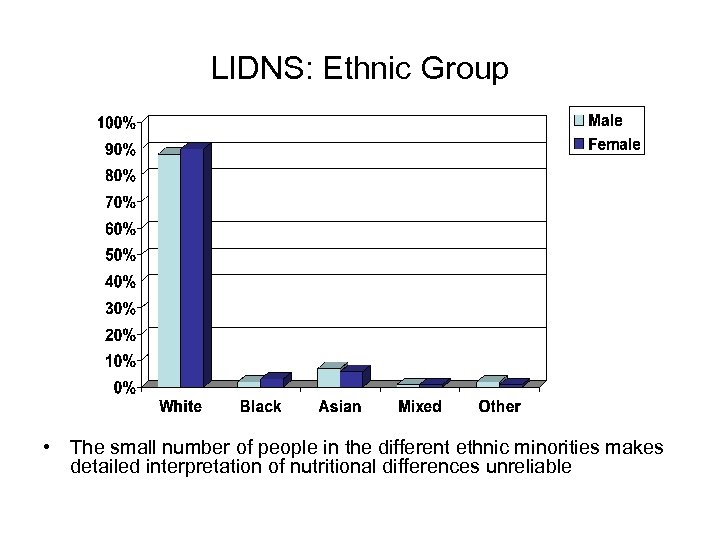 LIDNS: Ethnic Group • The small number of people in the different ethnic minorities makes detailed interpretation of nutritional differences unreliable
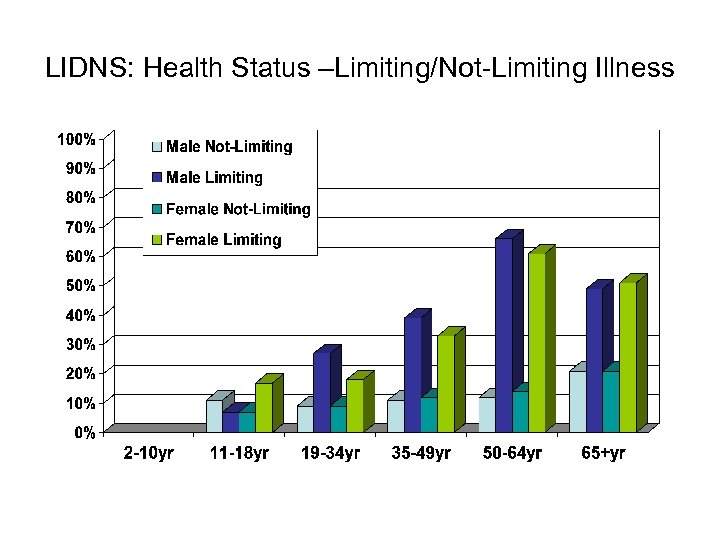 LIDNS: Health Status –Limiting/Not-Limiting Illness
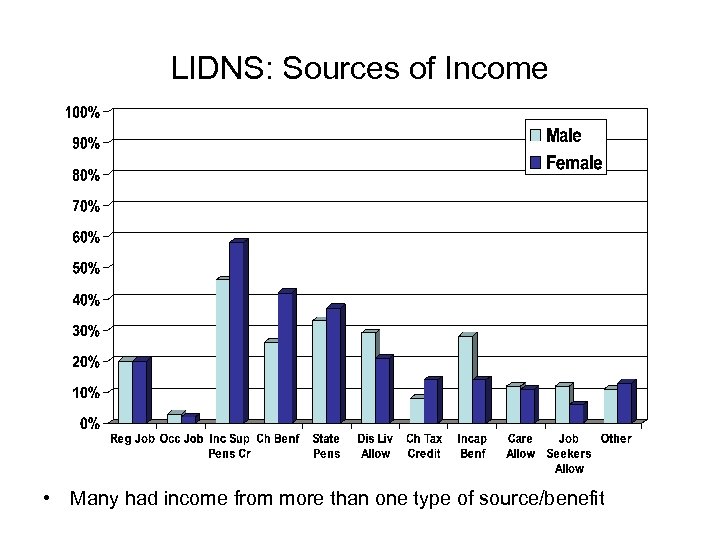 LIDNS: Sources of Income • Many had income from more than one type of source/benefit
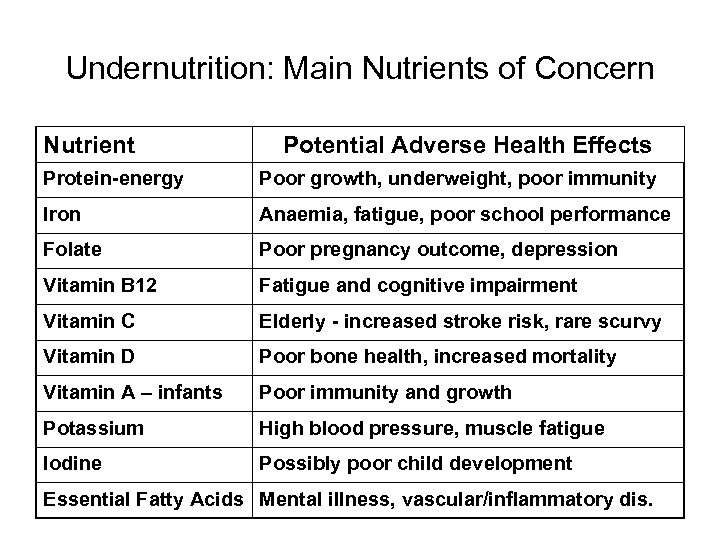 Undernutrition: Main Nutrients of Concern Nutrient Potential Adverse Health Effects Protein-energy Poor growth, underweight, poor immunity Iron Anaemia, fatigue, poor school performance Folate Poor pregnancy outcome, depression Vitamin B 12 Fatigue and cognitive impairment Vitamin C Elderly - increased stroke risk, rare scurvy Vitamin D Poor bone health, increased mortality Vitamin A – infants Poor immunity and growth Potassium High blood pressure, muscle fatigue Iodine Possibly poor child development Essential Fatty Acids Mental illness, vascular/inflammatory dis.
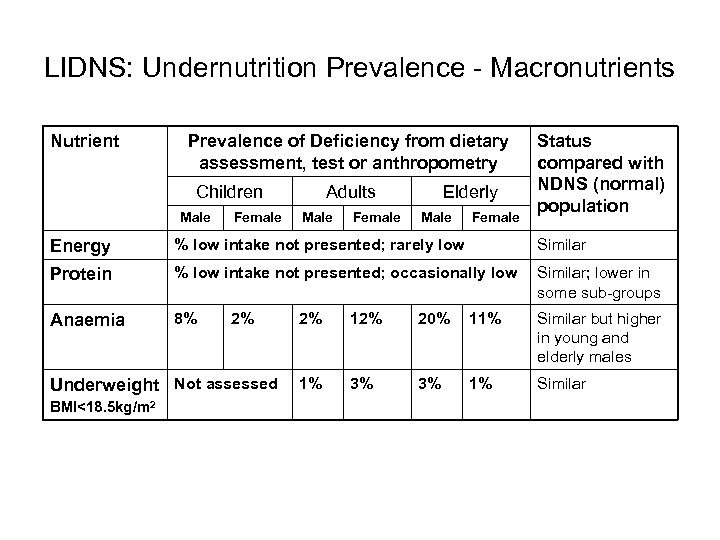 LIDNS: Undernutrition Prevalence - Macronutrients Nutrient Prevalence of Deficiency from dietary assessment, test or anthropometry Children Male Female Adults Male Female Elderly Male Female Status compared with NDNS (normal) population Energy % low intake not presented; rarely low Similar Protein % low intake not presented; occasionally low Similar; lower in some sub-groups Anaemia 8% 2% Underweight Not assessed BMI<18. 5 kg/m 2 2% 12% 20% 11% Similar but higher in young and elderly males 1% 3% 3% 1% Similar
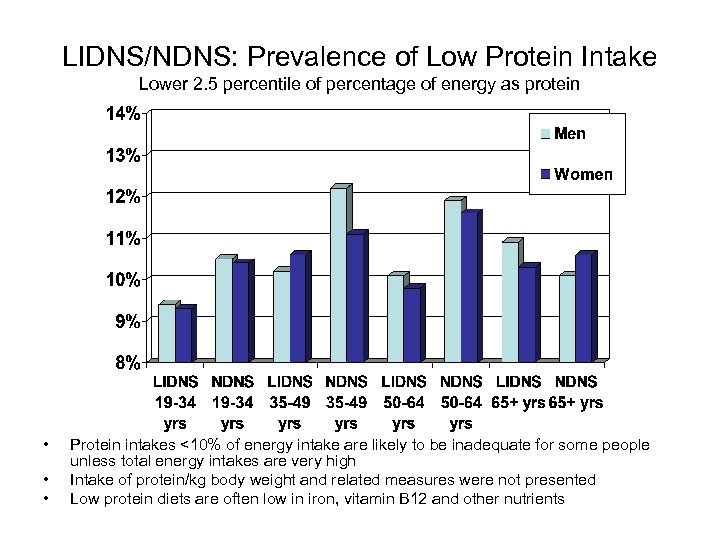 LIDNS/NDNS: Prevalence of Low Protein Intake Lower 2. 5 percentile of percentage of energy as protein • • • Protein intakes <10% of energy intake are likely to be inadequate for some people unless total energy intakes are very high Intake of protein/kg body weight and related measures were not presented Low protein diets are often low in iron, vitamin B 12 and other nutrients
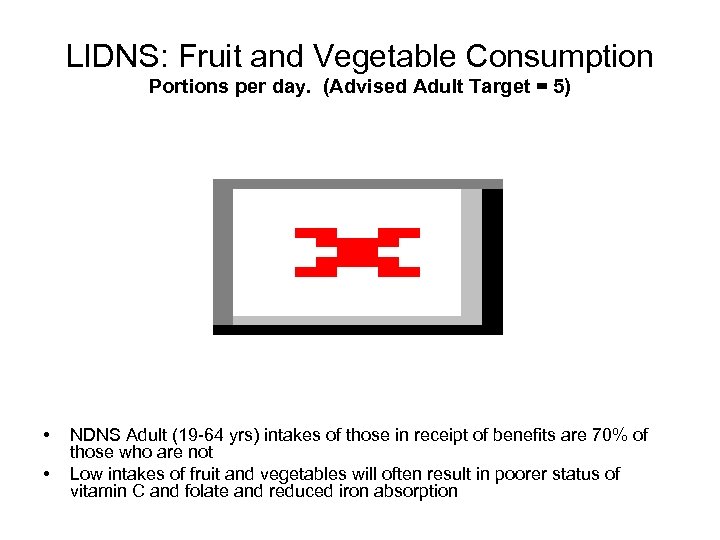 LIDNS: Fruit and Vegetable Consumption Portions per day. (Advised Adult Target = 5) • • NDNS Adult (19 -64 yrs) intakes of those in receipt of benefits are 70% of those who are not Low intakes of fruit and vegetables will often result in poorer status of vitamin C and folate and reduced iron absorption
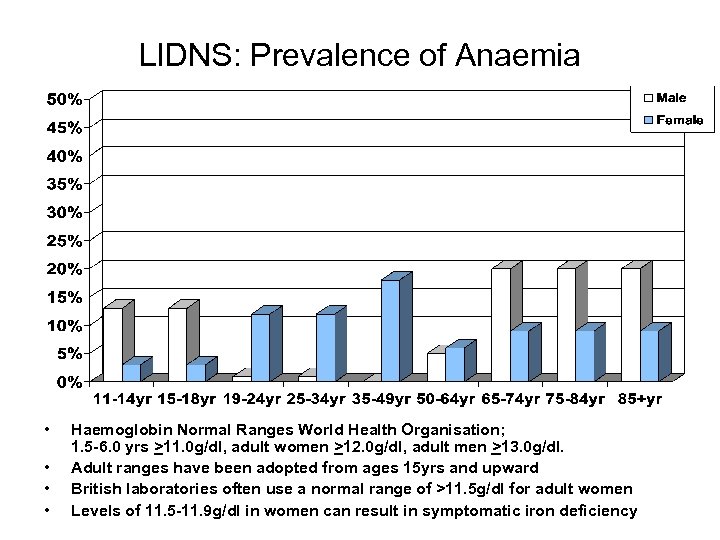 LIDNS: Prevalence of Anaemia • • Haemoglobin Normal Ranges World Health Organisation; 1. 5 -6. 0 yrs >11. 0 g/dl, adult women >12. 0 g/dl, adult men >13. 0 g/dl. Adult ranges have been adopted from ages 15 yrs and upward British laboratories often use a normal range of >11. 5 g/dl for adult women Levels of 11. 5 -11. 9 g/dl in women can result in symptomatic iron deficiency
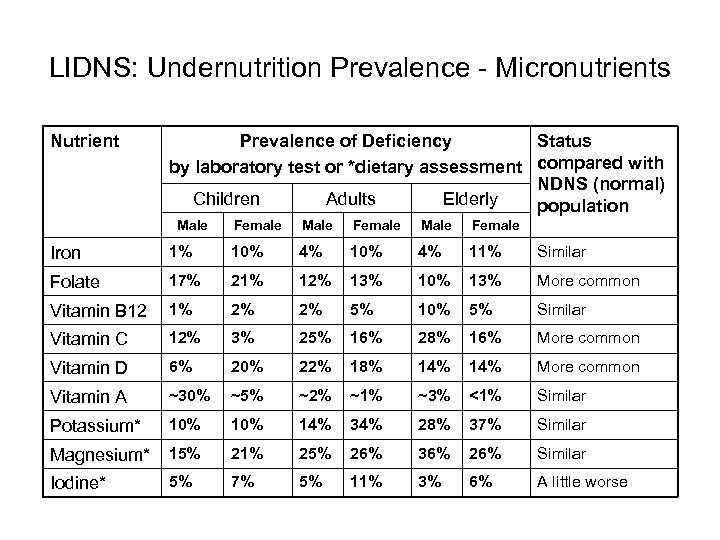 LIDNS: Undernutrition Prevalence - Micronutrients Nutrient Prevalence of Deficiency Status by laboratory test or *dietary assessment compared with NDNS (normal) Children Adults Elderly population Male Female Iron 1% 10% 4% 11% Similar Folate 17% 21% 12% 13% 10% 13% More common Vitamin B 12 1% 2% 2% 5% 10% 5% Similar Vitamin C 12% 3% 25% 16% 28% 16% More common Vitamin D 6% 20% 22% 18% 14% More common Vitamin A ~30% ~5% ~2% ~1% ~3% <1% Similar Potassium* 10% 14% 34% 28% 37% Similar Magnesium* 15% 21% 25% 26% 36% 26% Similar Iodine* 5% 7% 5% 11% 3% 6% A little worse
 LIDNS: Prevalence of Folate Deficiency I Red Cell Folate • • • Test red cell folate; normal range is >350 nmol/l Group Boys age 8 -10 yrs only 7 subjects - too few to analyse Symptomatic deficiency often develops before macrocytic anaemia develops
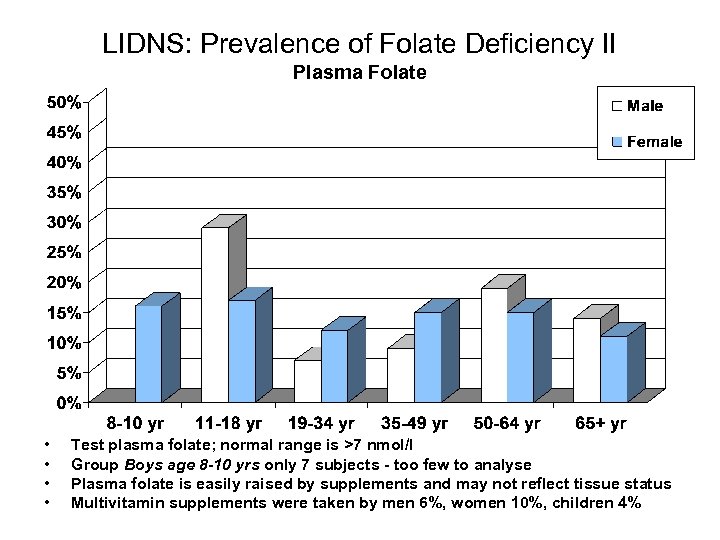 LIDNS: Prevalence of Folate Deficiency II Plasma Folate • • Test plasma folate; normal range is >7 nmol/l Group Boys age 8 -10 yrs only 7 subjects - too few to analyse Plasma folate is easily raised by supplements and may not reflect tissue status Multivitamin supplements were taken by men 6%, women 10%, children 4%
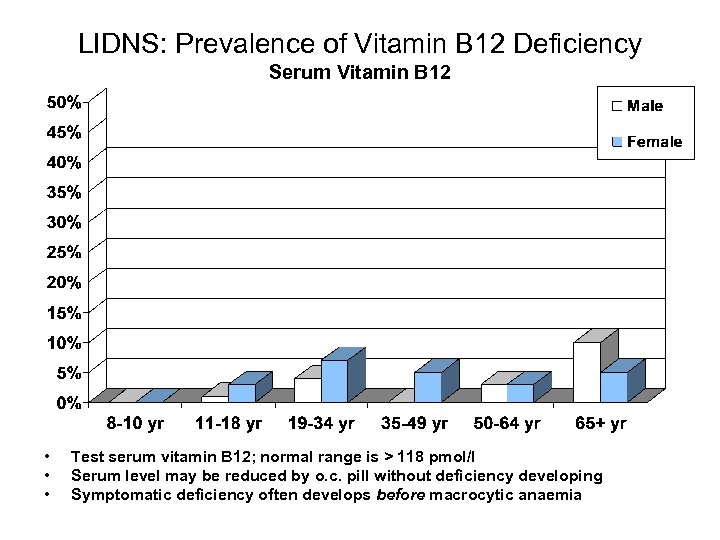 LIDNS: Prevalence of Vitamin B 12 Deficiency Serum Vitamin B 12 • • • Test serum vitamin B 12; normal range is > 118 pmol/l Serum level may be reduced by o. c. pill without deficiency developing Symptomatic deficiency often develops before macrocytic anaemia
 LIDNS: Prevalence of Vitamin C Deficiency Plasma Vitamin C • • Test plasma vitamin C; normal range is >11 umol/l Milder depletion was present in ~7% of 8 -18 yr olds and ~20% of adults
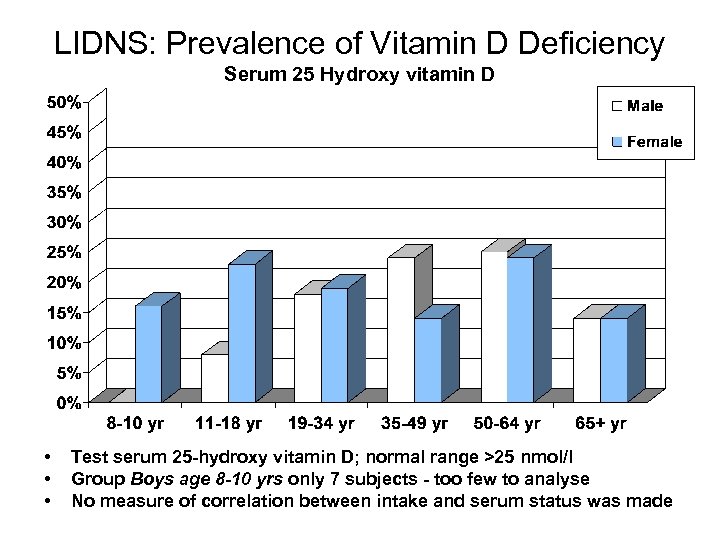 LIDNS: Prevalence of Vitamin D Deficiency Serum 25 Hydroxy vitamin D • • • Test serum 25 -hydroxy vitamin D; normal range >25 nmol/l Group Boys age 8 -10 yrs only 7 subjects - too few to analyse No measure of correlation between intake and serum status was made
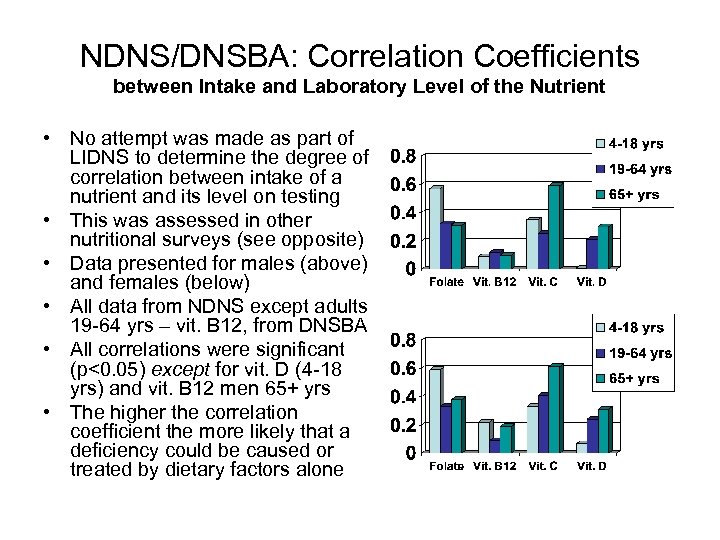 NDNS/DNSBA: Correlation Coefficients between Intake and Laboratory Level of the Nutrient • No attempt was made as part of LIDNS to determine the degree of correlation between intake of a nutrient and its level on testing • This was assessed in other nutritional surveys (see opposite) • Data presented for males (above) and females (below) • All data from NDNS except adults 19 -64 yrs – vit. B 12, from DNSBA • All correlations were significant (p<0. 05) except for vit. D (4 -18 yrs) and vit. B 12 men 65+ yrs • The higher the correlation coefficient the more likely that a deficiency could be caused or treated by dietary factors alone
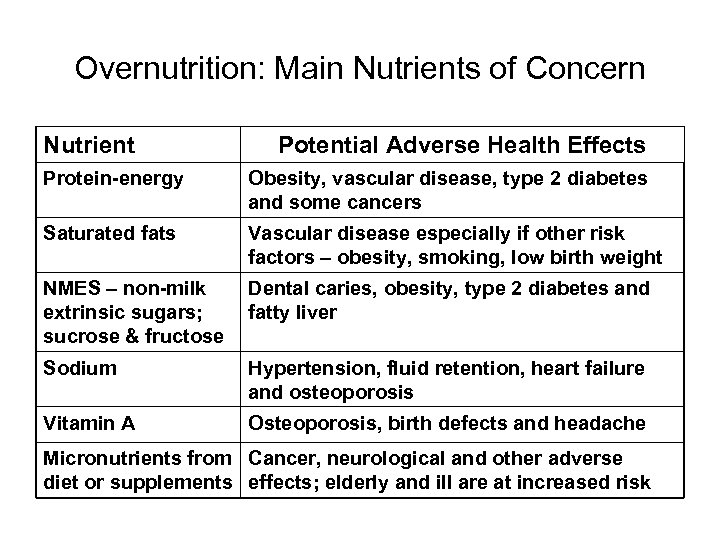 Overnutrition: Main Nutrients of Concern Nutrient Potential Adverse Health Effects Protein-energy Obesity, vascular disease, type 2 diabetes and some cancers Saturated fats Vascular disease especially if other risk factors – obesity, smoking, low birth weight NMES – non-milk extrinsic sugars; sucrose & fructose Dental caries, obesity, type 2 diabetes and fatty liver Sodium Hypertension, fluid retention, heart failure and osteoporosis Vitamin A Osteoporosis, birth defects and headache Micronutrients from Cancer, neurological and other adverse diet or supplements effects; elderly and ill are at increased risk
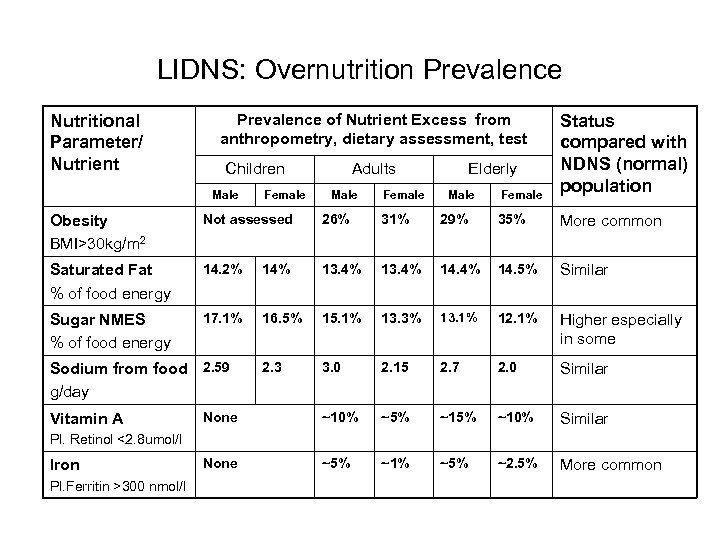 LIDNS: Overnutrition Prevalence Nutritional Parameter/ Nutrient Prevalence of Nutrient Excess from anthropometry, dietary assessment, test Children Male Female Adults Male Female Status compared with NDNS (normal) population Elderly Male Obesity BMI>30 kg/m 2 Not assessed 26% 31% 29% 35% More common Saturated Fat % of food energy 14. 2% 14% 13. 4% 14. 5% Similar Sugar NMES % of food energy 17. 1% 16. 5% 15. 1% 13. 3% 13. 1% 12. 1% Higher especially in some 2. 3 3. 0 2. 15 2. 7 2. 0 Similar None ~10% ~5% ~10% Similar None ~5% ~1% ~5% ~2. 5% More common Sodium from food 2. 59 g/day Vitamin A Pl. Retinol <2. 8 umol/l Iron Pl. Ferritin >300 nmol/l
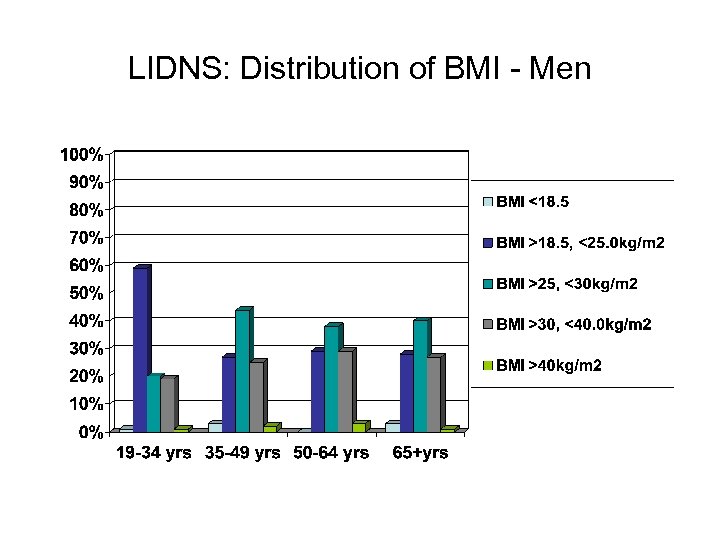 LIDNS: Distribution of BMI - Men
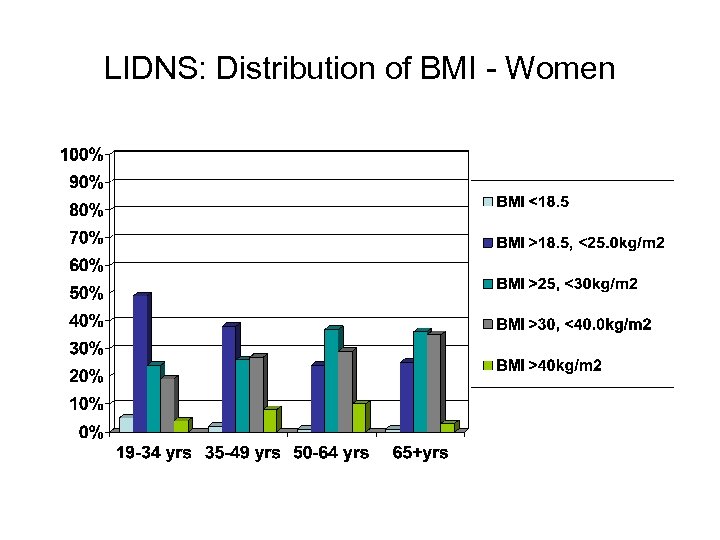 LIDNS: Distribution of BMI - Women
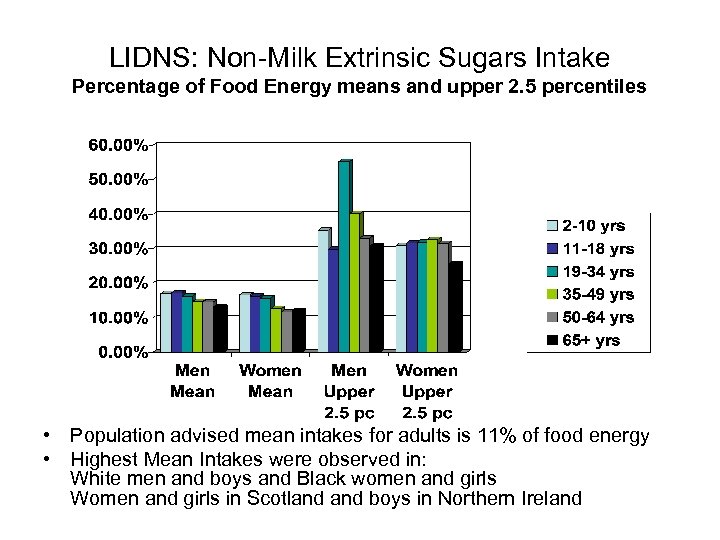 LIDNS: Non-Milk Extrinsic Sugars Intake Percentage of Food Energy means and upper 2. 5 percentiles • Population advised mean intakes for adults is 11% of food energy • Highest Mean Intakes were observed in: White men and boys and Black women and girls Women and girls in Scotland boys in Northern Ireland
 LIDNS: Dietary Sources of Non-Milk Extrinsic Sugars Percentage of total intake of NMES
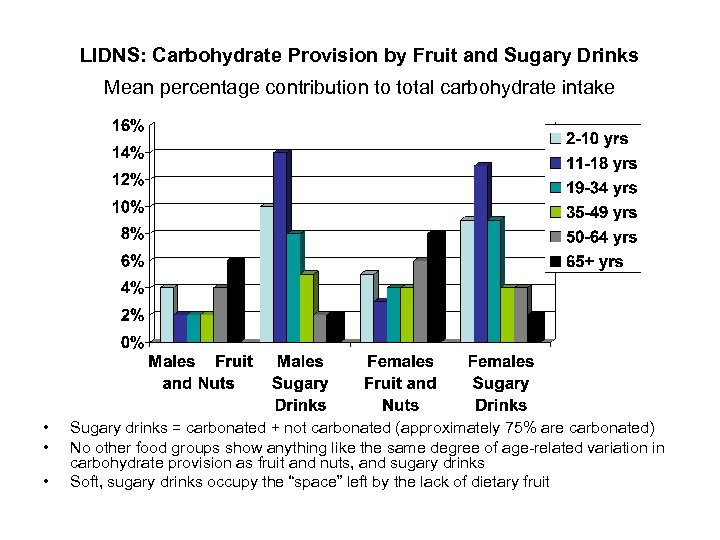 LIDNS: Carbohydrate Provision by Fruit and Sugary Drinks Mean percentage contribution to total carbohydrate intake • • • Sugary drinks = carbonated + not carbonated (approximately 75% are carbonated) No other food groups show anything like the same degree of age-related variation in carbohydrate provision as fruit and nuts, and sugary drinks Soft, sugary drinks occupy the “space” left by the lack of dietary fruit
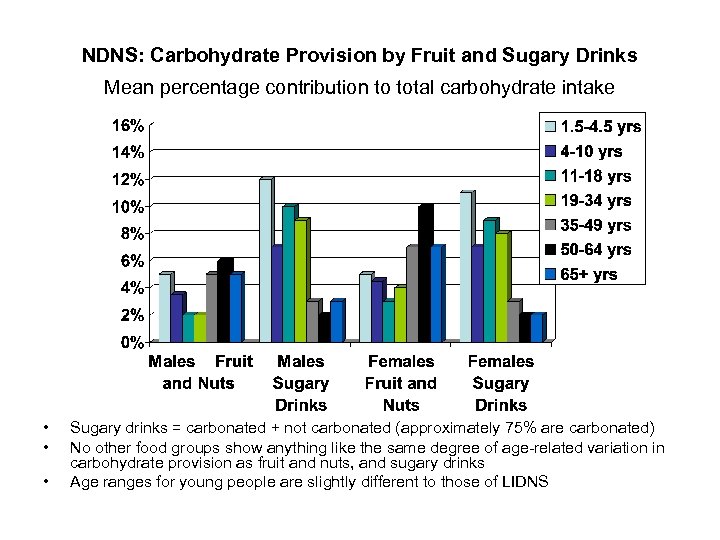 NDNS: Carbohydrate Provision by Fruit and Sugary Drinks Mean percentage contribution to total carbohydrate intake • • • Sugary drinks = carbonated + not carbonated (approximately 75% are carbonated) No other food groups show anything like the same degree of age-related variation in carbohydrate provision as fruit and nuts, and sugary drinks Age ranges for young people are slightly different to those of LIDNS
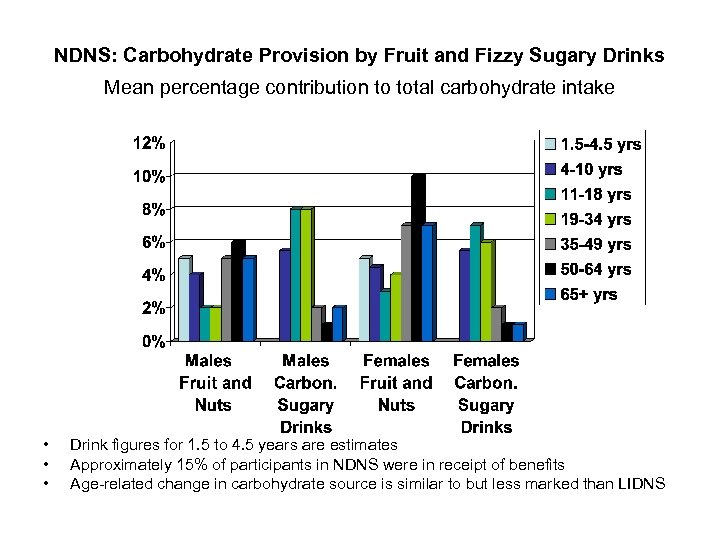 NDNS: Carbohydrate Provision by Fruit and Fizzy Sugary Drinks Mean percentage contribution to total carbohydrate intake • • • Drink figures for 1. 5 to 4. 5 years are estimates Approximately 15% of participants in NDNS were in receipt of benefits Age-related change in carbohydrate source is similar to but less marked than LIDNS
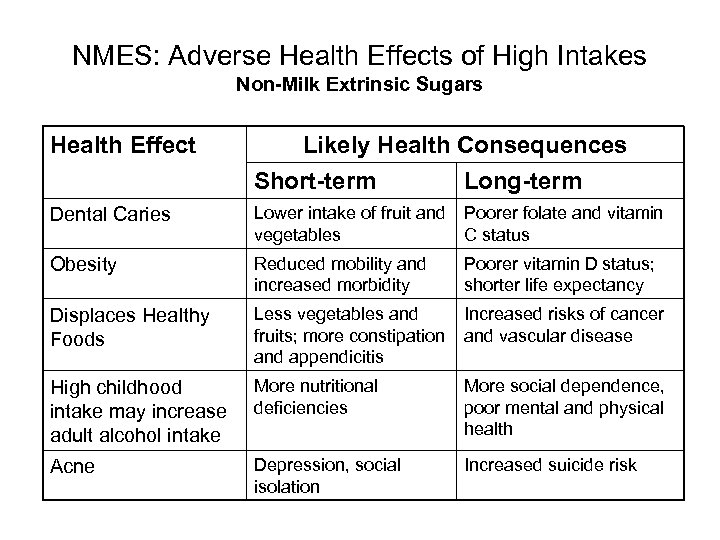 NMES: Adverse Health Effects of High Intakes Non-Milk Extrinsic Sugars Health Effect Likely Health Consequences Short-term Long-term Dental Caries Lower intake of fruit and Poorer folate and vitamin vegetables C status Obesity Reduced mobility and increased morbidity Poorer vitamin D status; shorter life expectancy Displaces Healthy Foods Less vegetables and fruits; more constipation and appendicitis Increased risks of cancer and vascular disease High childhood intake may increase adult alcohol intake More nutritional deficiencies More social dependence, poor mental and physical health Acne Depression, social isolation Increased suicide risk
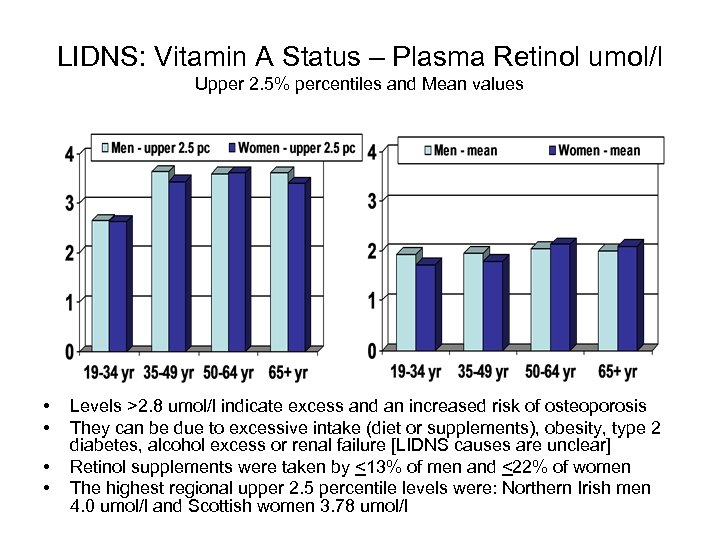 LIDNS: Vitamin A Status – Plasma Retinol umol/l Upper 2. 5% percentiles and Mean values • • Levels >2. 8 umol/l indicate excess and an increased risk of osteoporosis They can be due to excessive intake (diet or supplements), obesity, type 2 diabetes, alcohol excess or renal failure [LIDNS causes are unclear] Retinol supplements were taken by <13% of men and <22% of women The highest regional upper 2. 5 percentile levels were: Northern Irish men 4. 0 umol/l and Scottish women 3. 78 umol/l
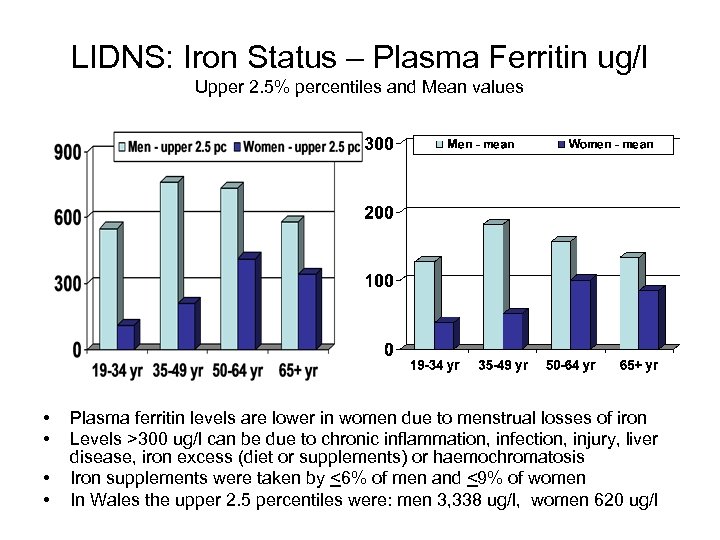 LIDNS: Iron Status – Plasma Ferritin ug/l Upper 2. 5% percentiles and Mean values • • Plasma ferritin levels are lower in women due to menstrual losses of iron Levels >300 ug/l can be due to chronic inflammation, infection, injury, liver disease, iron excess (diet or supplements) or haemochromatosis Iron supplements were taken by <6% of men and <9% of women In Wales the upper 2. 5 percentiles were: men 3, 338 ug/l, women 620 ug/l
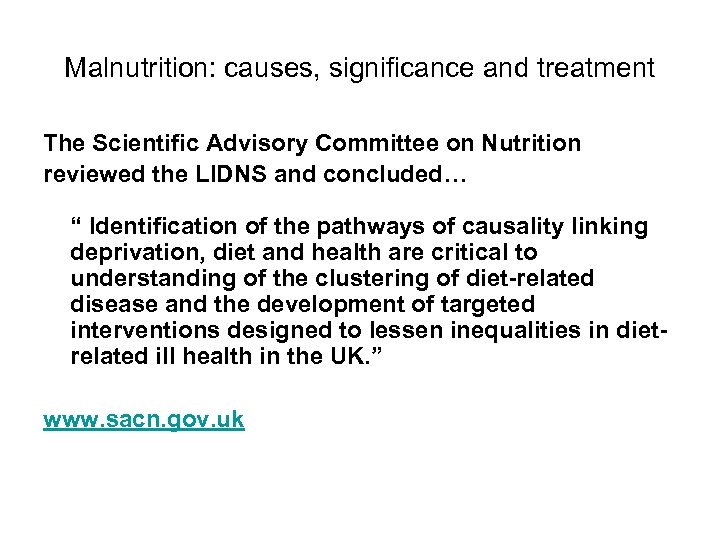 Malnutrition: causes, significance and treatment The Scientific Advisory Committee on Nutrition reviewed the LIDNS and concluded… “ Identification of the pathways of causality linking deprivation, diet and health are critical to understanding of the clustering of diet-related disease and the development of targeted interventions designed to lessen inequalities in dietrelated ill health in the UK. ” www. sacn. gov. uk
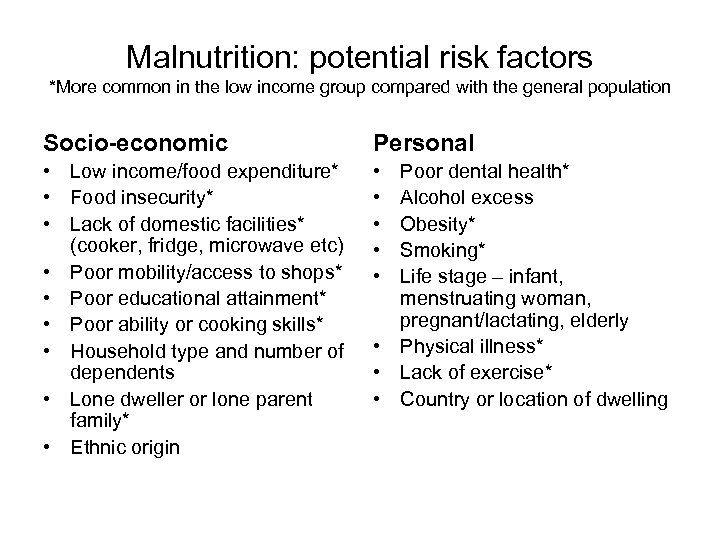 Malnutrition: potential risk factors *More common in the low income group compared with the general population Socio-economic Personal • Low income/food expenditure* • Food insecurity* • Lack of domestic facilities* (cooker, fridge, microwave etc) • Poor mobility/access to shops* • Poor educational attainment* • Poor ability or cooking skills* • Household type and number of dependents • Lone dweller or lone parent family* • Ethnic origin • • • Poor dental health* Alcohol excess Obesity* Smoking* Life stage – infant, menstruating woman, pregnant/lactating, elderly • Physical illness* • Lack of exercise* • Country or location of dwelling
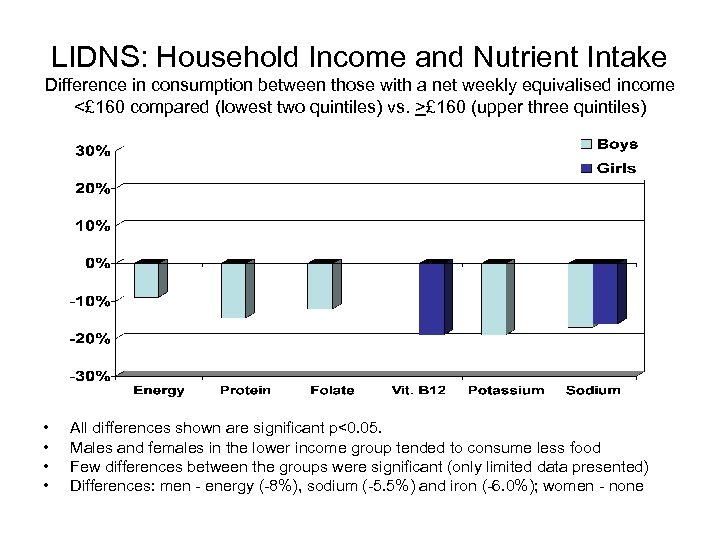 LIDNS: Household Income and Nutrient Intake Difference in consumption between those with a net weekly equivalised income <£ 160 compared (lowest two quintiles) vs. >£ 160 (upper three quintiles) • • All differences shown are significant p<0. 05. Males and females in the lower income group tended to consume less food Few differences between the groups were significant (only limited data presented) Differences: men - energy (-8%), sodium (-5. 5%) and iron (-6. 0%); women - none
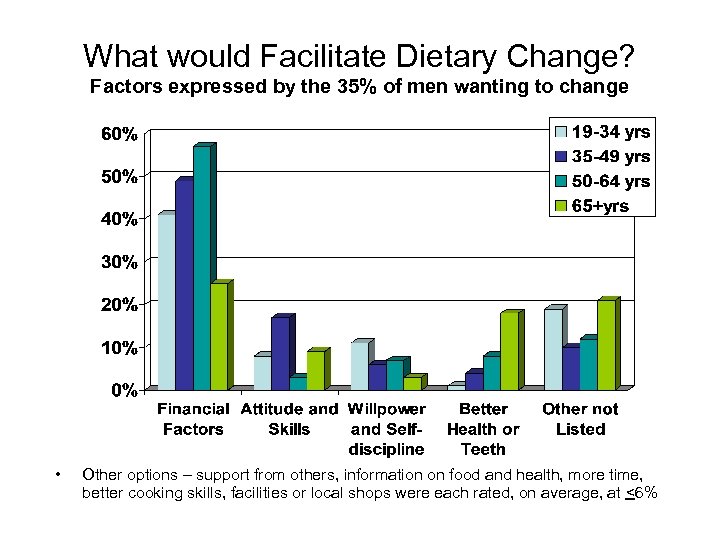 What would Facilitate Dietary Change? Factors expressed by the 35% of men wanting to change • Other options – support from others, information on food and health, more time, better cooking skills, facilities or local shops were each rated, on average, at <6%
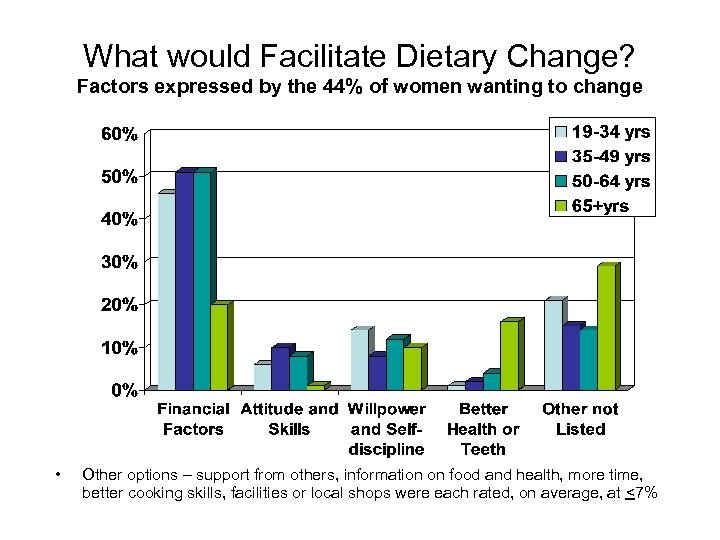 What would Facilitate Dietary Change? Factors expressed by the 44% of women wanting to change • Other options – support from others, information on food and health, more time, better cooking skills, facilities or local shops were each rated, on average, at <7%
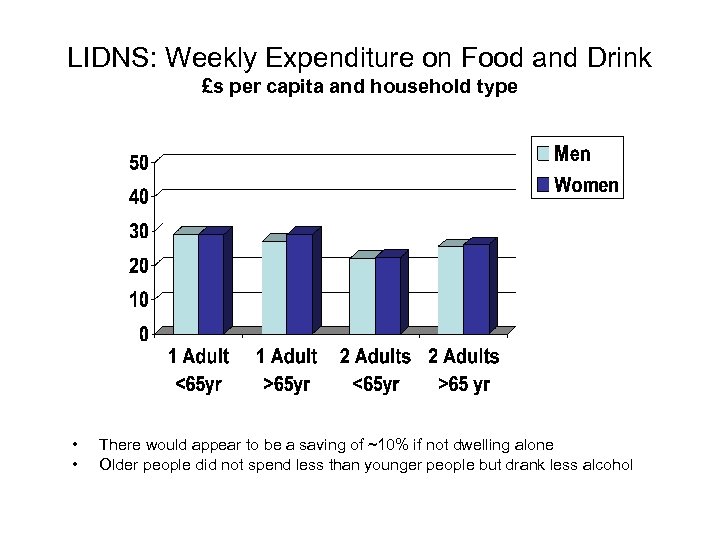 LIDNS: Weekly Expenditure on Food and Drink £s per capita and household type • • There would appear to be a saving of ~10% if not dwelling alone Older people did not spend less than younger people but drank less alcohol
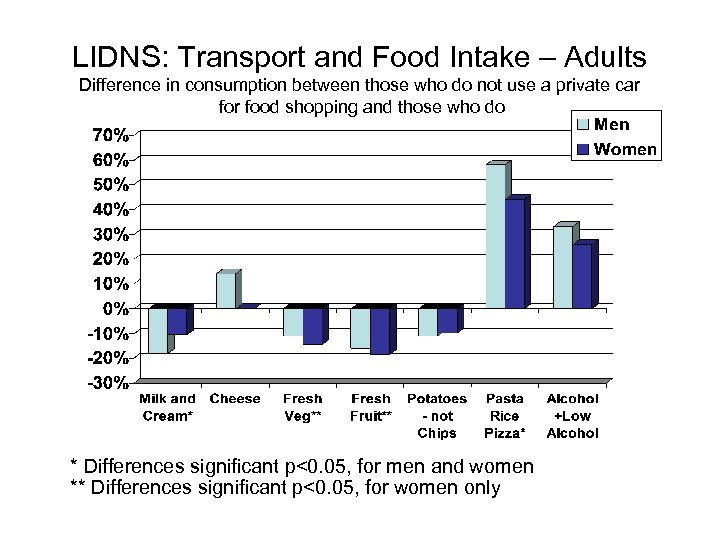 LIDNS: Transport and Food Intake – Adults Difference in consumption between those who do not use a private car food shopping and those who do * Differences significant p<0. 05, for men and women ** Differences significant p<0. 05, for women only
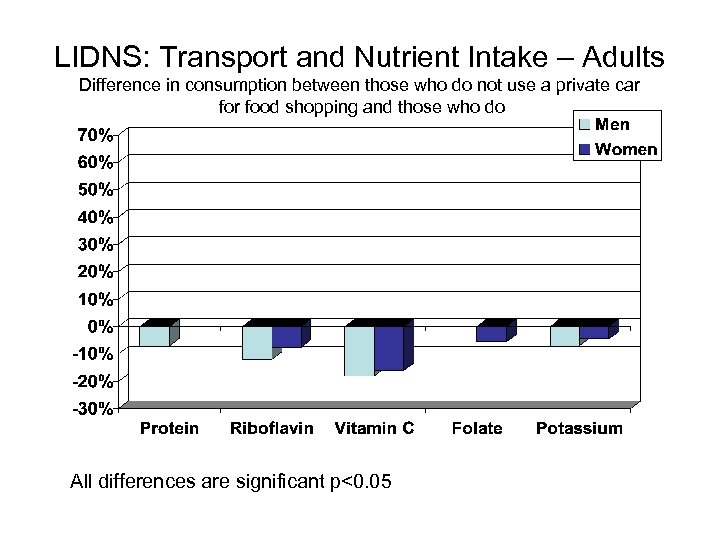 LIDNS: Transport and Nutrient Intake – Adults Difference in consumption between those who do not use a private car food shopping and those who do All differences are significant p<0. 05
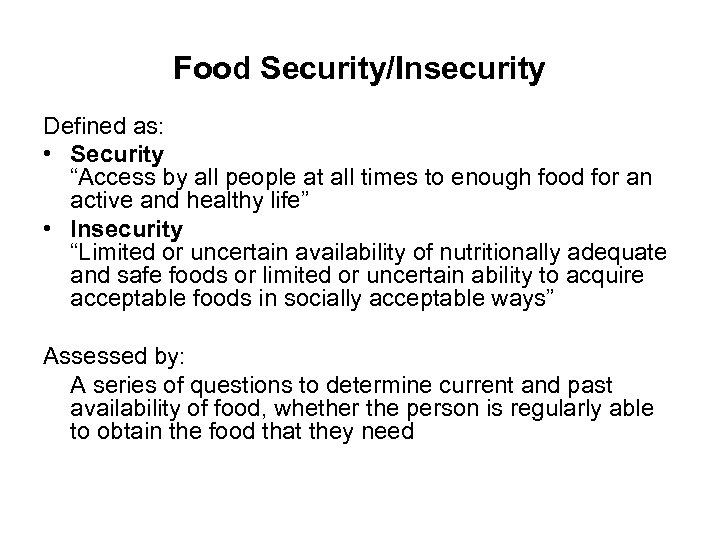 Food Security/Insecurity Defined as: • Security “Access by all people at all times to enough food for an active and healthy life” • Insecurity “Limited or uncertain availability of nutritionally adequate and safe foods or limited or uncertain ability to acquire acceptable foods in socially acceptable ways” Assessed by: A series of questions to determine current and past availability of food, whether the person is regularly able to obtain the food that they need
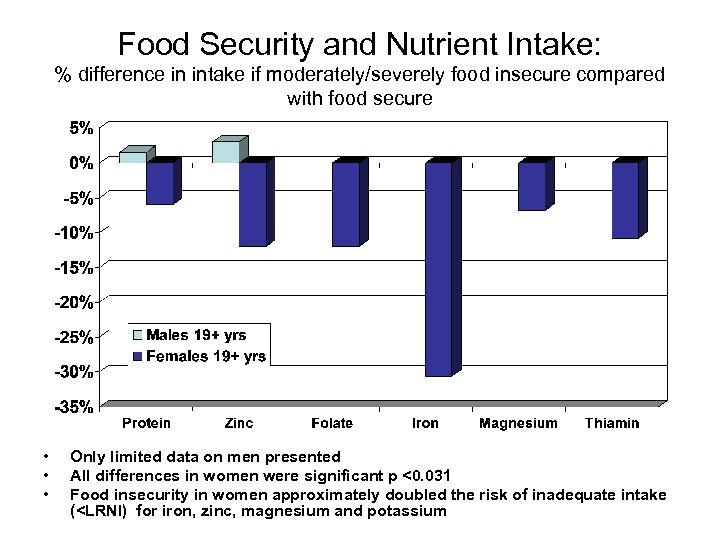 Food Security and Nutrient Intake: % difference in intake if moderately/severely food insecure compared with food secure • • • Only limited data on men presented All differences in women were significant p <0. 031 Food insecurity in women approximately doubled the risk of inadequate intake (
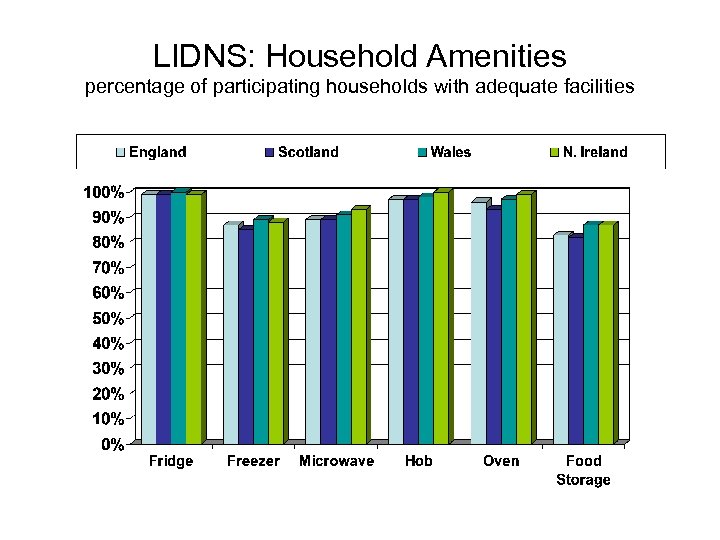 LIDNS: Household Amenities percentage of participating households with adequate facilities
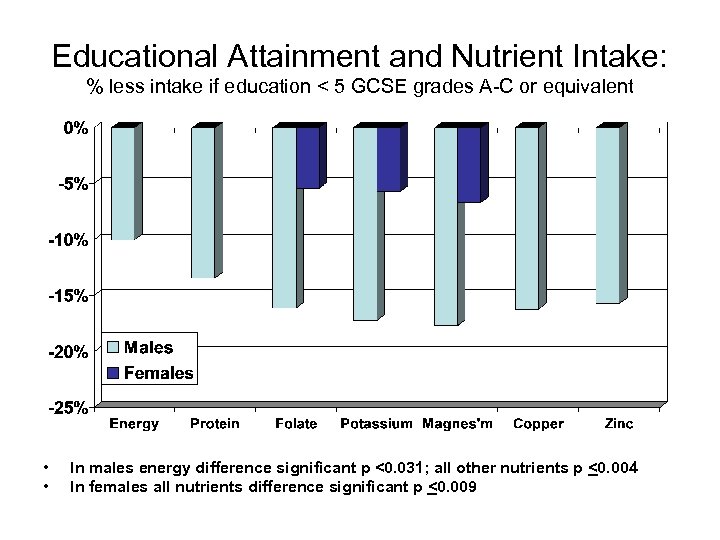 Educational Attainment and Nutrient Intake: % less intake if education < 5 GCSE grades A-C or equivalent • • In males energy difference significant p <0. 031; all other nutrients p <0. 004 In females all nutrients difference significant p <0. 009
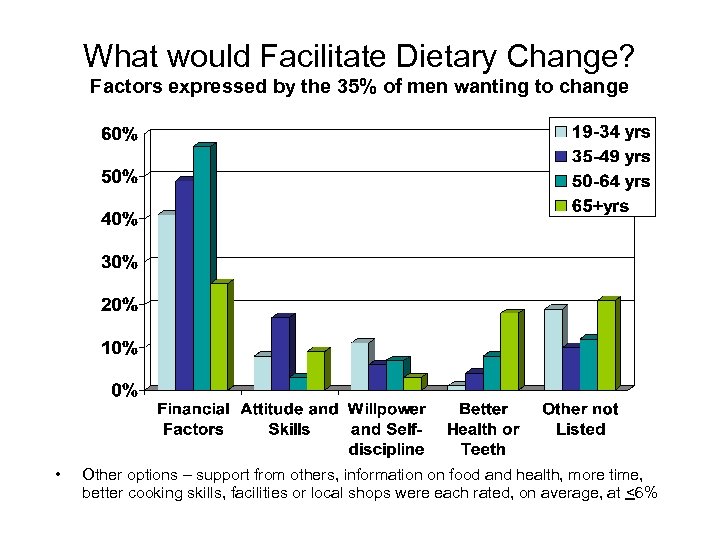 What would Facilitate Dietary Change? Factors expressed by the 35% of men wanting to change • Other options – support from others, information on food and health, more time, better cooking skills, facilities or local shops were each rated, on average, at <6%
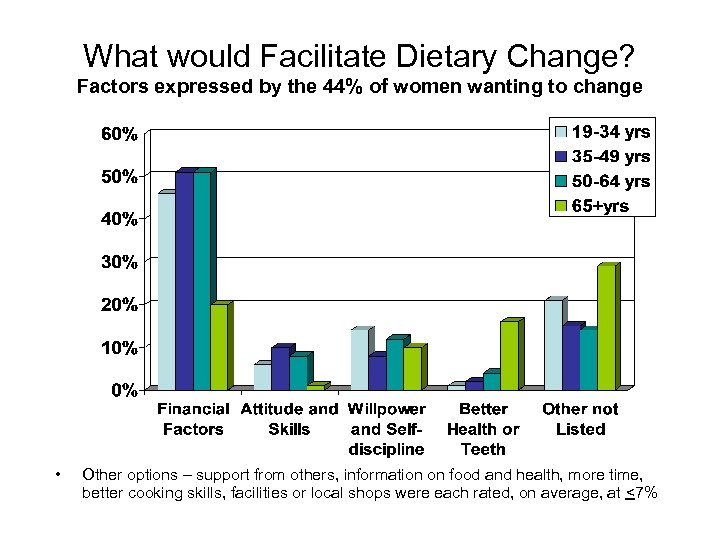 What would Facilitate Dietary Change? Factors expressed by the 44% of women wanting to change • Other options – support from others, information on food and health, more time, better cooking skills, facilities or local shops were each rated, on average, at <7%
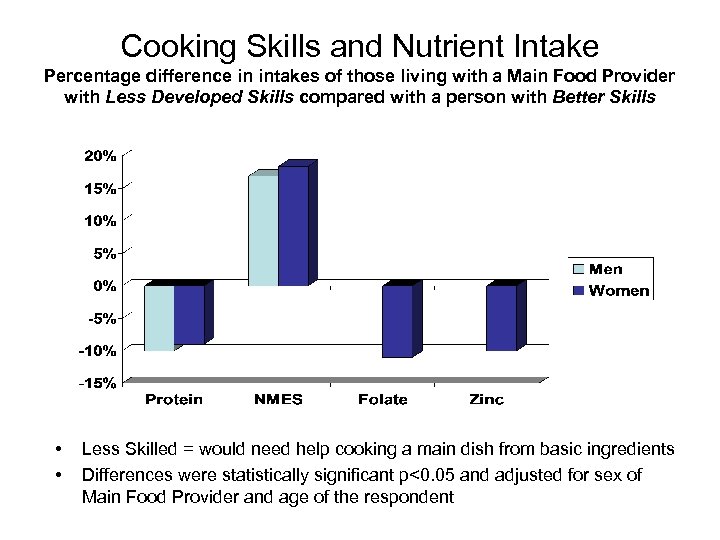 Cooking Skills and Nutrient Intake Percentage difference in intakes of those living with a Main Food Provider with Less Developed Skills compared with a person with Better Skills • • Less Skilled = would need help cooking a main dish from basic ingredients Differences were statistically significant p<0. 05 and adjusted for sex of Main Food Provider and age of the respondent
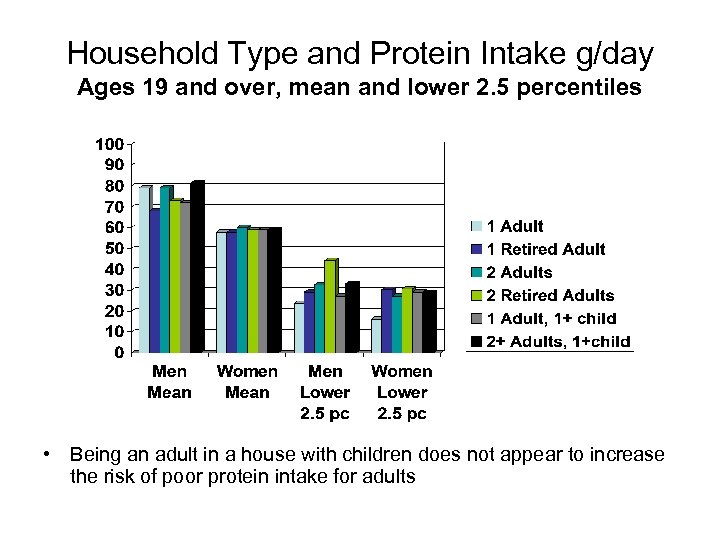 Household Type and Protein Intake g/day Ages 19 and over, mean and lower 2. 5 percentiles • Being an adult in a house with children does not appear to increase the risk of poor protein intake for adults
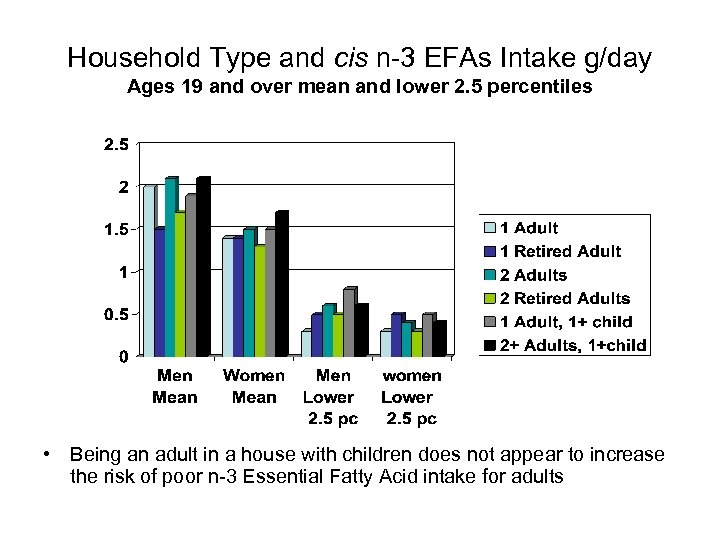 Household Type and cis n-3 EFAs Intake g/day Ages 19 and over mean and lower 2. 5 percentiles • Being an adult in a house with children does not appear to increase the risk of poor n-3 Essential Fatty Acid intake for adults
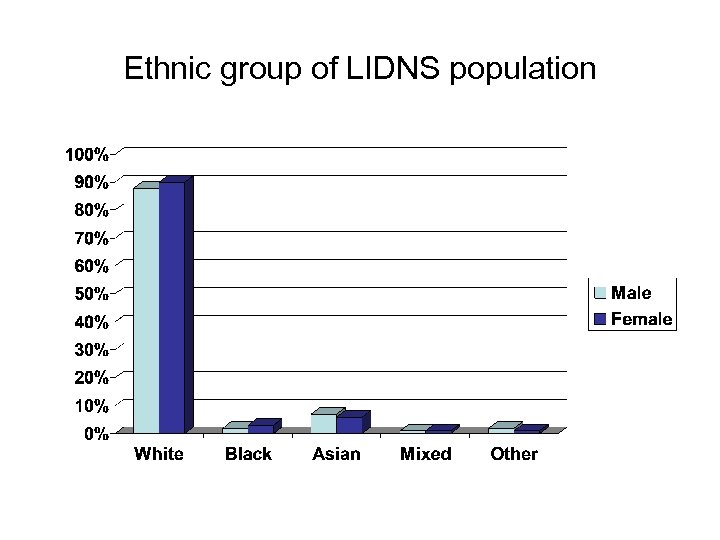 Ethnic group of LIDNS population
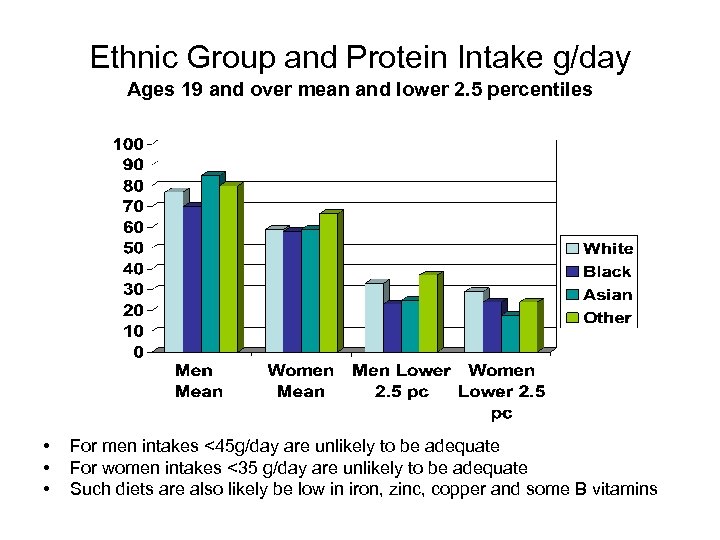 Ethnic Group and Protein Intake g/day Ages 19 and over mean and lower 2. 5 percentiles • • • For men intakes <45 g/day are unlikely to be adequate For women intakes <35 g/day are unlikely to be adequate Such diets are also likely be low in iron, zinc, copper and some B vitamins
 Other National Surveys: Dietary Intake Other similar National Surveys have been conducted over the last 25 years in Britain and include (date of publication) • DNSBA (1990) The Diet and Nutritional Survey of British Adults ages 16 to 64 yrs looked at the influence of social class on nutrient intake • NDNS (1995 - 2004) Four National Diet and Nutrition Surveys looked at nutrient intake and, sometimes, status of those in receipt of benefits compared with those who were not
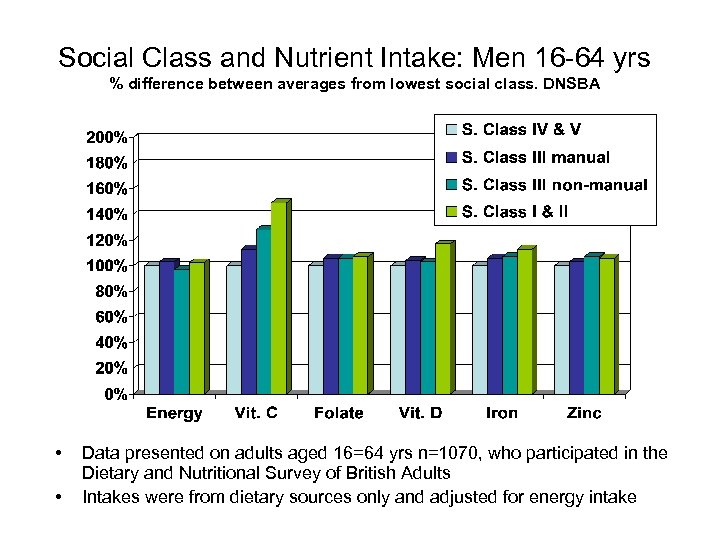 Social Class and Nutrient Intake: Men 16 -64 yrs % difference between averages from lowest social class. DNSBA • • Data presented on adults aged 16=64 yrs n=1070, who participated in the Dietary and Nutritional Survey of British Adults Intakes were from dietary sources only and adjusted for energy intake
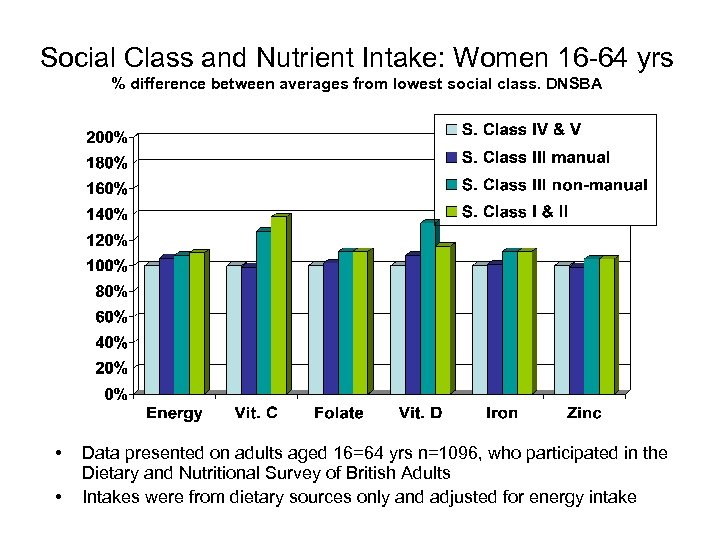 Social Class and Nutrient Intake: Women 16 -64 yrs % difference between averages from lowest social class. DNSBA • • Data presented on adults aged 16=64 yrs n=1096, who participated in the Dietary and Nutritional Survey of British Adults Intakes were from dietary sources only and adjusted for energy intake
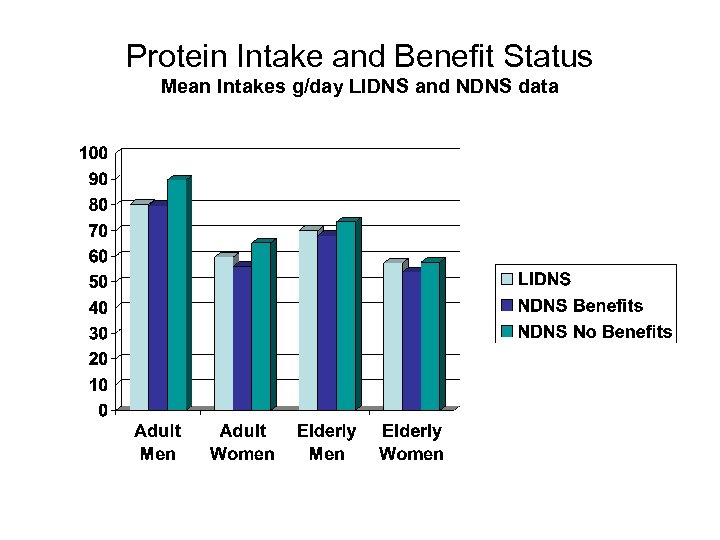 Protein Intake and Benefit Status Mean Intakes g/day LIDNS and NDNS data
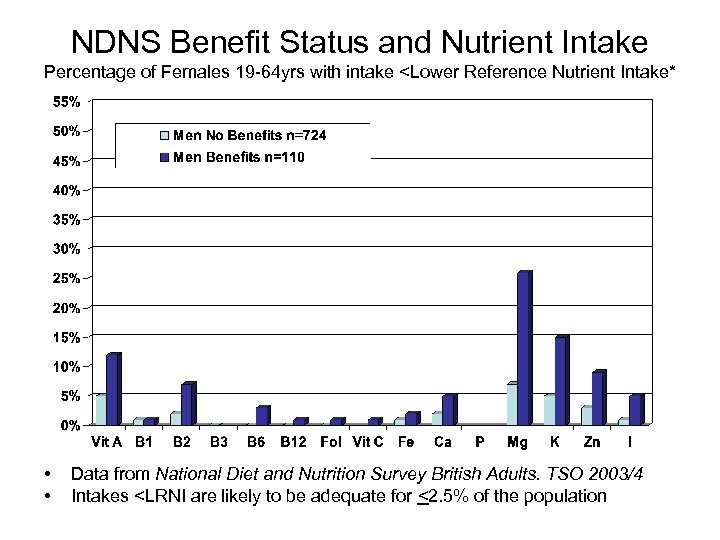 NDNS Benefit Status and Nutrient Intake Percentage of Females 19 -64 yrs with intake
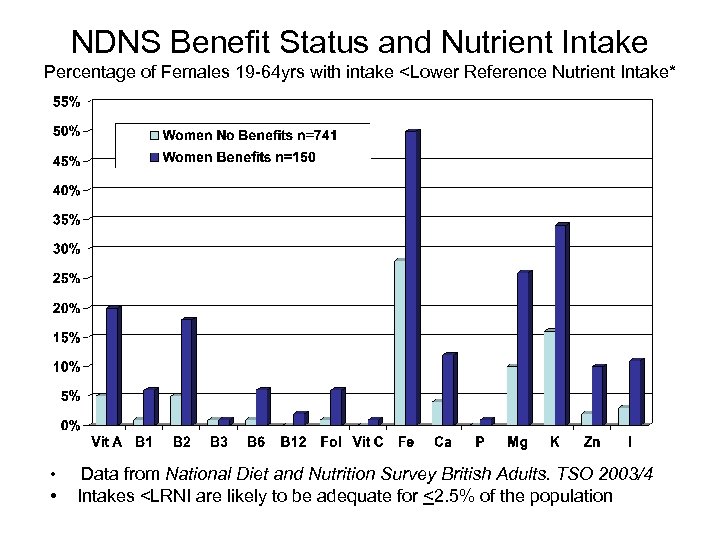 NDNS Benefit Status and Nutrient Intake Percentage of Females 19 -64 yrs with intake
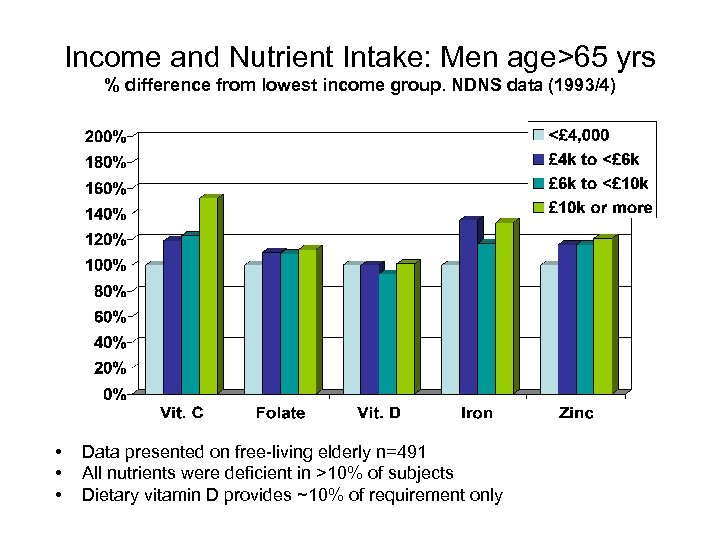 Income and Nutrient Intake: Men age>65 yrs % difference from lowest income group. NDNS data (1993/4) • • • Data presented on free-living elderly n=491 All nutrients were deficient in >10% of subjects Dietary vitamin D provides ~10% of requirement only
 Income and Nutrient Intake: Women age>65 yrs % difference from lowest income group. NDNS data (1993/4) • • • Data presented on free-living elderly n=491 All nutrients were deficient in >10% of subjects Dietary vitamin D provides ~10% of requirement only
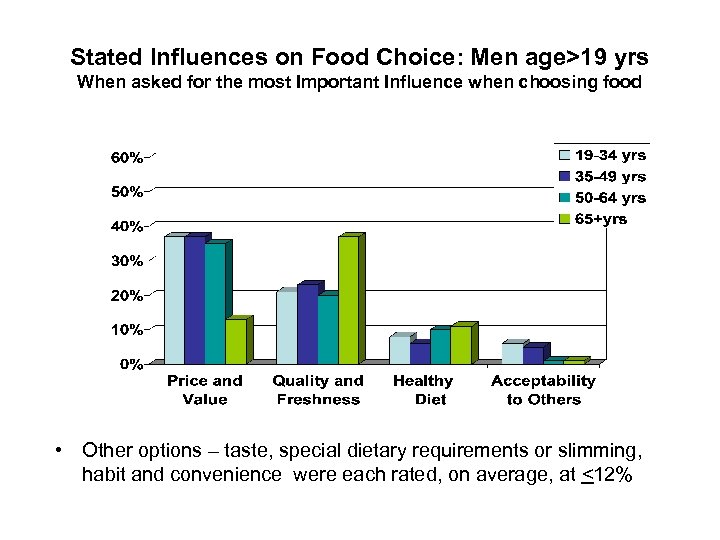 Stated Influences on Food Choice: Men age>19 yrs When asked for the most Important Influence when choosing food • Other options – taste, special dietary requirements or slimming, habit and convenience were each rated, on average, at <12%
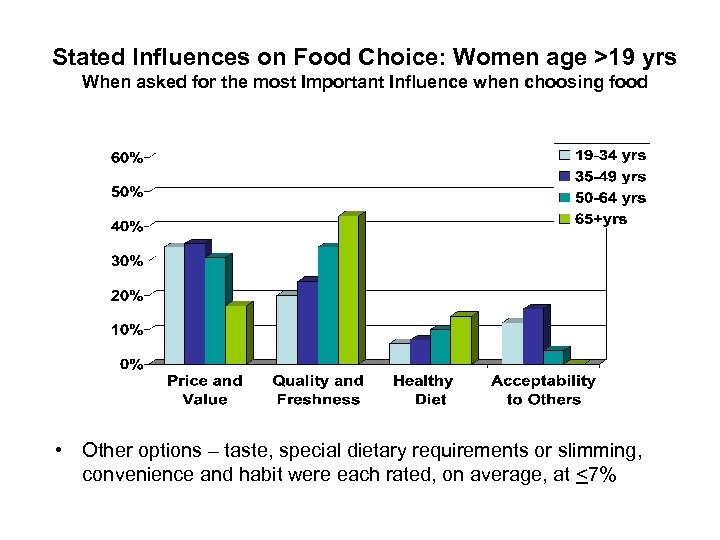 Stated Influences on Food Choice: Women age >19 yrs When asked for the most Important Influence when choosing food • Other options – taste, special dietary requirements or slimming, convenience and habit were each rated, on average, at <7%
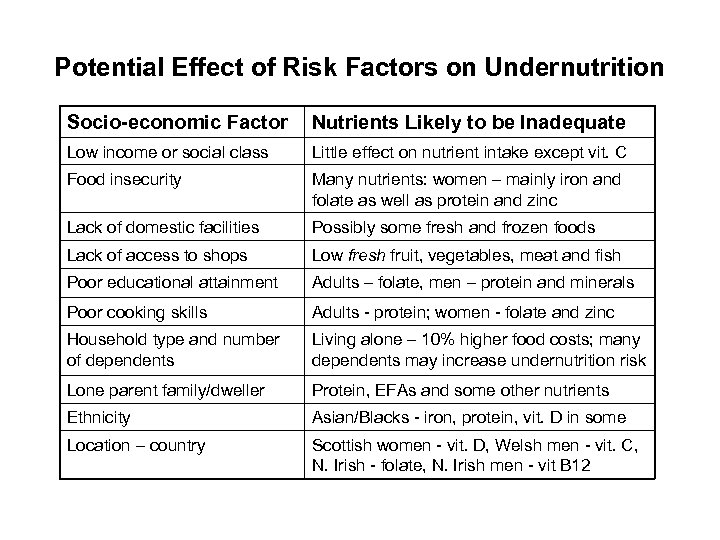 Potential Effect of Risk Factors on Undernutrition Socio-economic Factor Nutrients Likely to be Inadequate Low income or social class Little effect on nutrient intake except vit. C Food insecurity Many nutrients: women – mainly iron and folate as well as protein and zinc Lack of domestic facilities Possibly some fresh and frozen foods Lack of access to shops Low fresh fruit, vegetables, meat and fish Poor educational attainment Adults – folate, men – protein and minerals Poor cooking skills Adults - protein; women - folate and zinc Household type and number of dependents Living alone – 10% higher food costs; many dependents may increase undernutrition risk Lone parent family/dweller Protein, EFAs and some other nutrients Ethnicity Asian/Blacks - iron, protein, vit. D in some Location – country Scottish women - vit. D, Welsh men - vit. C, N. Irish - folate, N. Irish men - vit B 12
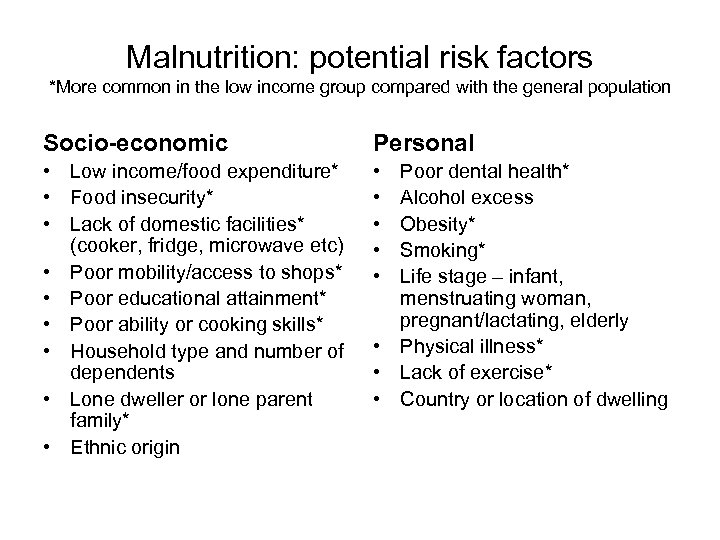 Malnutrition: potential risk factors *More common in the low income group compared with the general population Socio-economic Personal • Low income/food expenditure* • Food insecurity* • Lack of domestic facilities* (cooker, fridge, microwave etc) • Poor mobility/access to shops* • Poor educational attainment* • Poor ability or cooking skills* • Household type and number of dependents • Lone dweller or lone parent family* • Ethnic origin • • • Poor dental health* Alcohol excess Obesity* Smoking* Life stage – infant, menstruating woman, pregnant/lactating, elderly • Physical illness* • Lack of exercise* • Country or location of dwelling
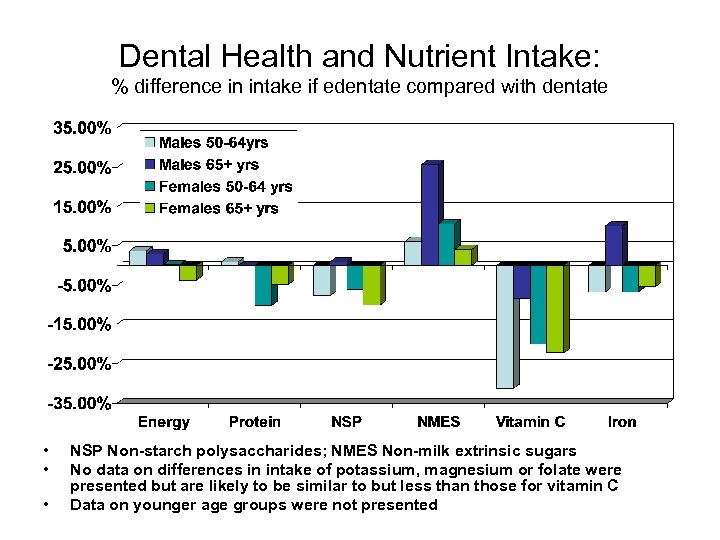 Dental Health and Nutrient Intake: % difference in intake if edentate compared with dentate • • • NSP Non-starch polysaccharides; NMES Non-milk extrinsic sugars No data on differences in intake of potassium, magnesium or folate were presented but are likely to be similar to but less than those for vitamin C Data on younger age groups were not presented
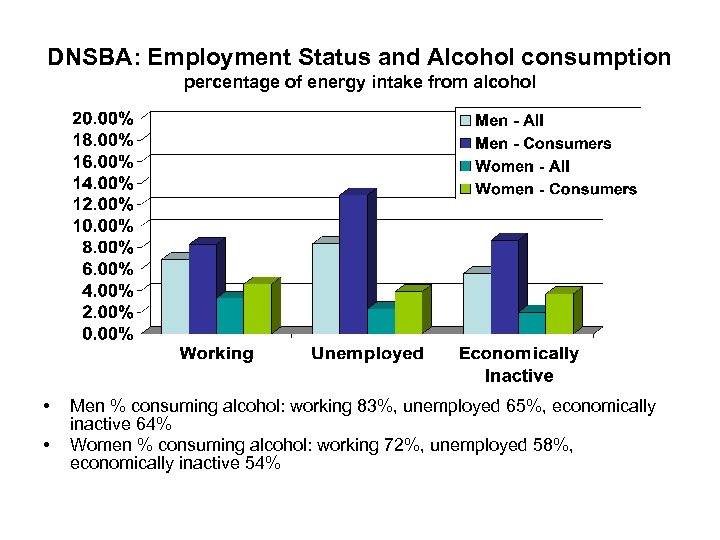 DNSBA: Employment Status and Alcohol consumption percentage of energy intake from alcohol • • Men % consuming alcohol: working 83%, unemployed 65%, economically inactive 64% Women % consuming alcohol: working 72%, unemployed 58%, economically inactive 54%
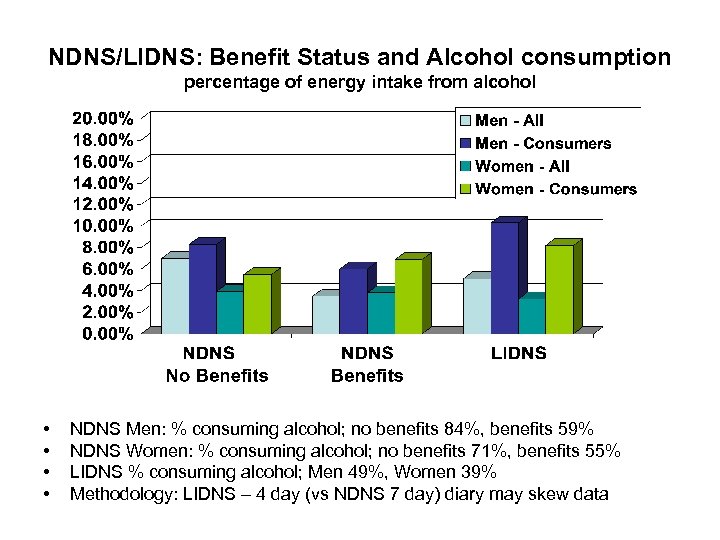 NDNS/LIDNS: Benefit Status and Alcohol consumption percentage of energy intake from alcohol • • NDNS Men: % consuming alcohol; no benefits 84%, benefits 59% NDNS Women: % consuming alcohol; no benefits 71%, benefits 55% LIDNS % consuming alcohol; Men 49%, Women 39% Methodology: LIDNS – 4 day (vs NDNS 7 day) diary may skew data
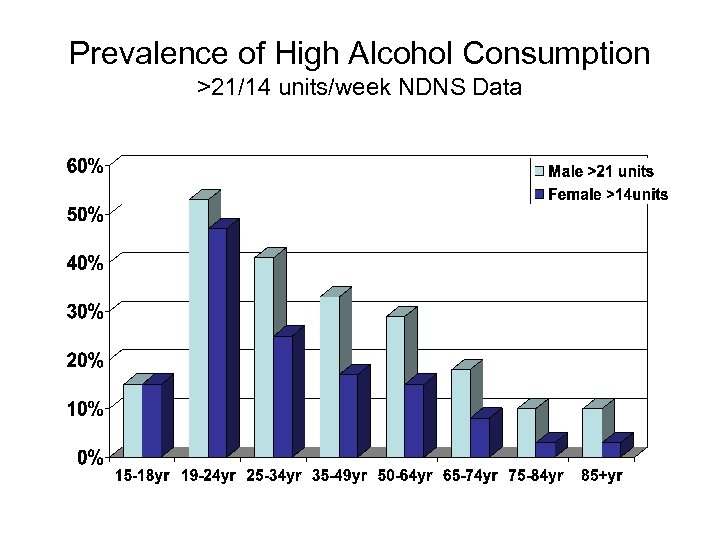 Prevalence of High Alcohol Consumption >21/14 units/week NDNS Data
 Prevalence of High Alcohol Consumption >21/14 units/week LIDNS Data
 Other National Surveys: Dietary Intake Other National Surveys have been conducted over the last 25 years in Britain and include (date of publication) • DNSBA (1990) The Diet and Nutritional Survey of British Adults looked at the influence of social class on nutrient intake • NDNS (1995 - 2004) Four National Diet and Nutrition Surveys looked at nutrient intake and, sometimes, status of those in receipt of benefits compared with those who were not
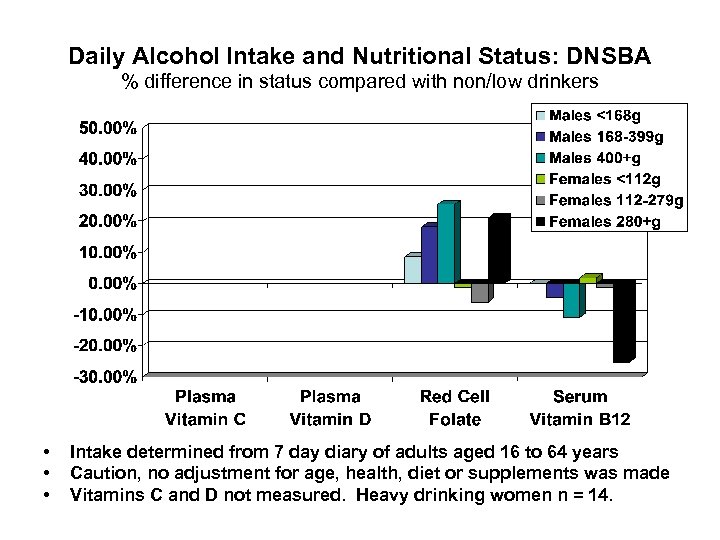 Daily Alcohol Intake and Nutritional Status: DNSBA % difference in status compared with non/low drinkers • • • Intake determined from 7 day diary of adults aged 16 to 64 years Caution, no adjustment for age, health, diet or supplements was made Vitamins C and D not measured. Heavy drinking women n = 14.
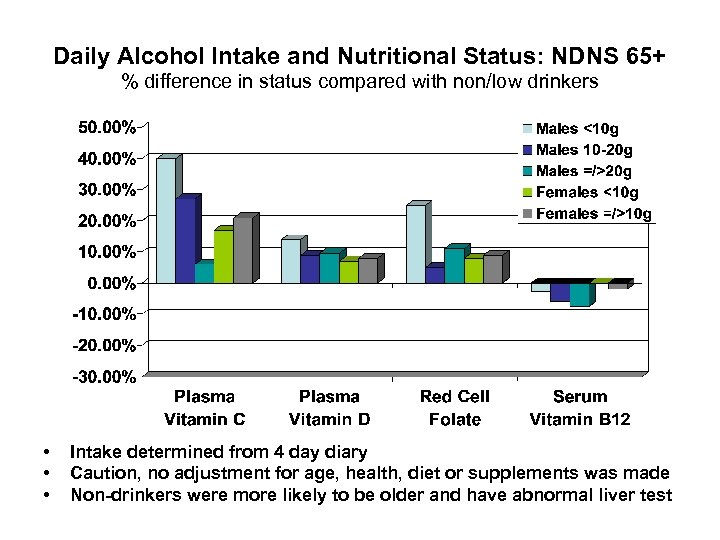 Daily Alcohol Intake and Nutritional Status: NDNS 65+ % difference in status compared with non/low drinkers • • • Intake determined from 4 day diary Caution, no adjustment for age, health, diet or supplements was made Non-drinkers were more likely to be older and have abnormal liver test
 Prevalence of Smoking: LIDNS Data • Smoking prevalence in the general adult population (2008) males 24%, females 20%
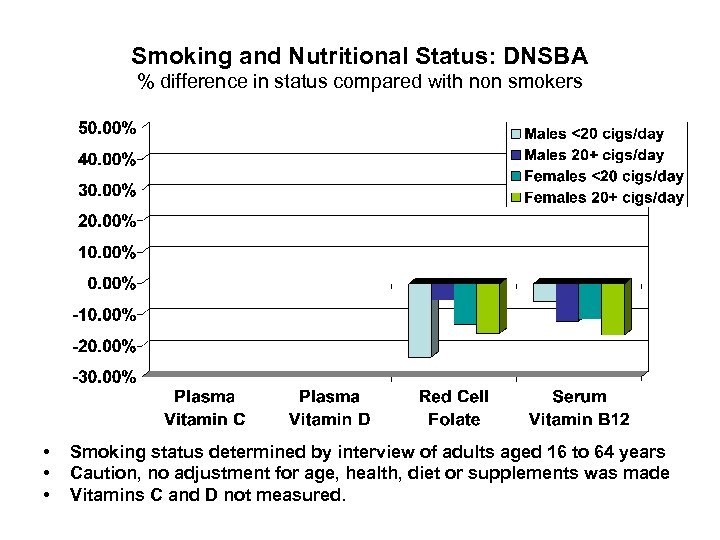 Smoking and Nutritional Status: DNSBA % difference in status compared with non smokers • • • Smoking status determined by interview of adults aged 16 to 64 years Caution, no adjustment for age, health, diet or supplements was made Vitamins C and D not measured.
 Smoking and Nutritional Status: NDNS 65+ % difference in status compared with non smokers • • • Smoking status determined by interview of adults aged > 65 years Caution, no adjustment for age, health, diet or supplements was made Heavy smoking men n = 28; women n = 13
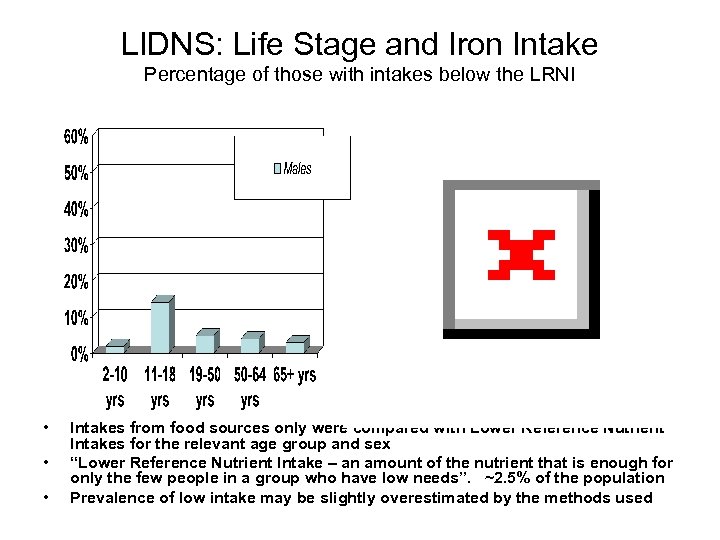 LIDNS: Life Stage and Iron Intake Percentage of those with intakes below the LRNI • • • Intakes from food sources only were compared with Lower Reference Nutrient Intakes for the relevant age group and sex “Lower Reference Nutrient Intake – an amount of the nutrient that is enough for only the few people in a group who have low needs”. ~2. 5% of the population Prevalence of low intake may be slightly overestimated by the methods used
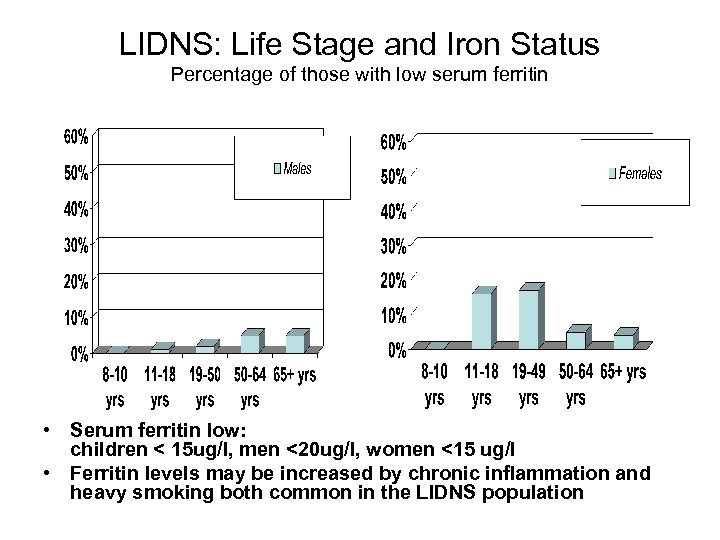 LIDNS: Life Stage and Iron Status Percentage of those with low serum ferritin • Serum ferritin low: children < 15 ug/l, men <20 ug/l, women <15 ug/l • Ferritin levels may be increased by chronic inflammation and heavy smoking both common in the LIDNS population
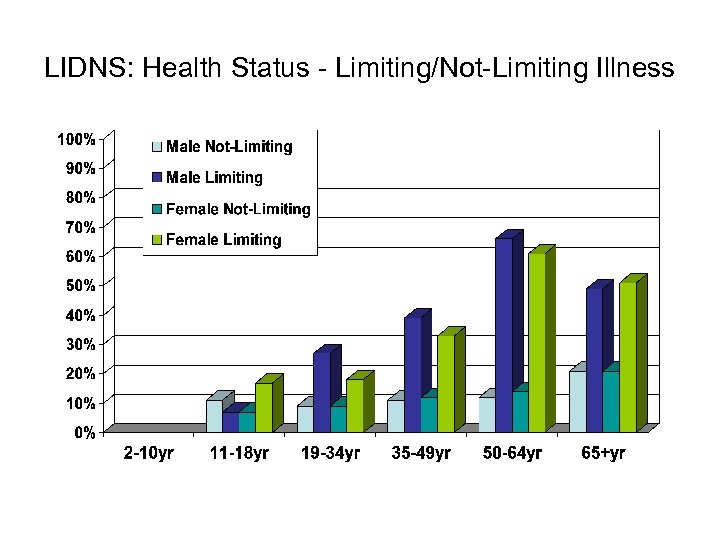 LIDNS: Health Status - Limiting/Not-Limiting Illness
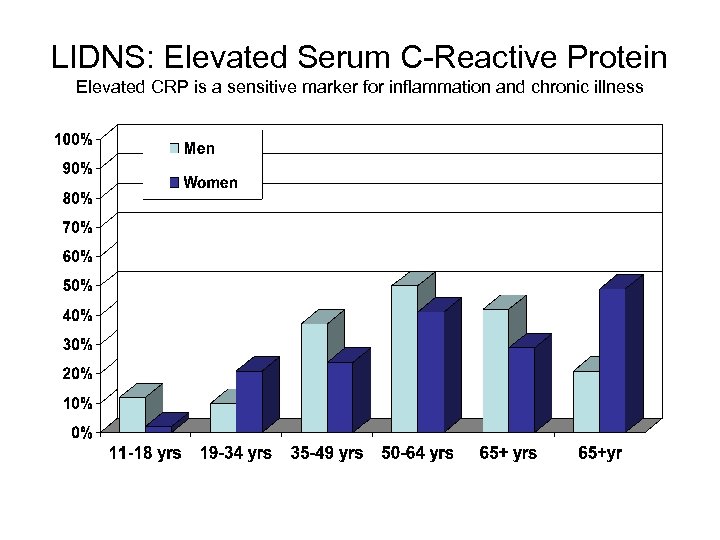 LIDNS: Elevated Serum C-Reactive Protein Elevated CRP is a sensitive marker for inflammation and chronic illness
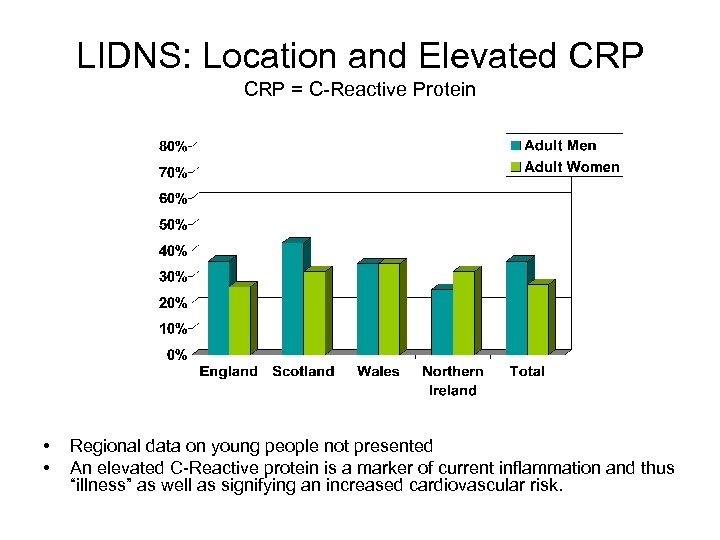 LIDNS: Location and Elevated CRP = C-Reactive Protein • • Regional data on young people not presented An elevated C-Reactive protein is a marker of current inflammation and thus “illness” as well as signifying an increased cardiovascular risk.
 LIDNS: Exercise Levels in Children and Adults
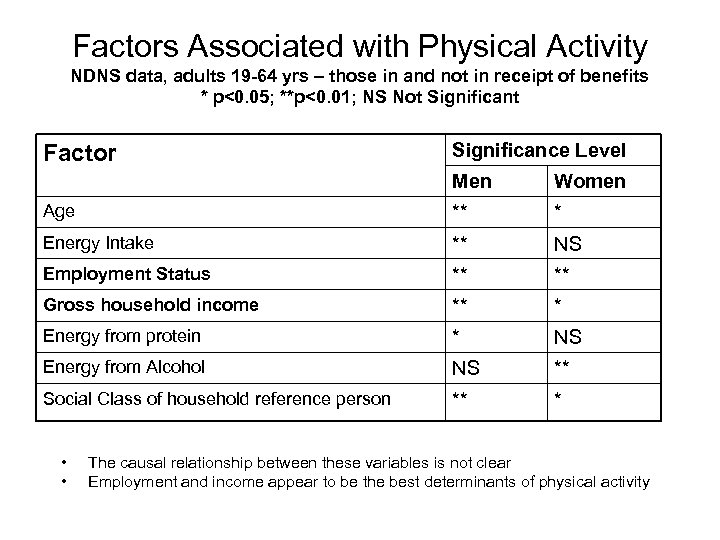 Factors Associated with Physical Activity NDNS data, adults 19 -64 yrs – those in and not in receipt of benefits * p<0. 05; **p<0. 01; NS Not Significant Factor Significance Level Men Women Age ** * Energy Intake ** NS Employment Status ** ** Gross household income ** * Energy from protein * NS Energy from Alcohol NS ** Social Class of household reference person ** * • • The causal relationship between these variables is not clear Employment and income appear to be the best determinants of physical activity
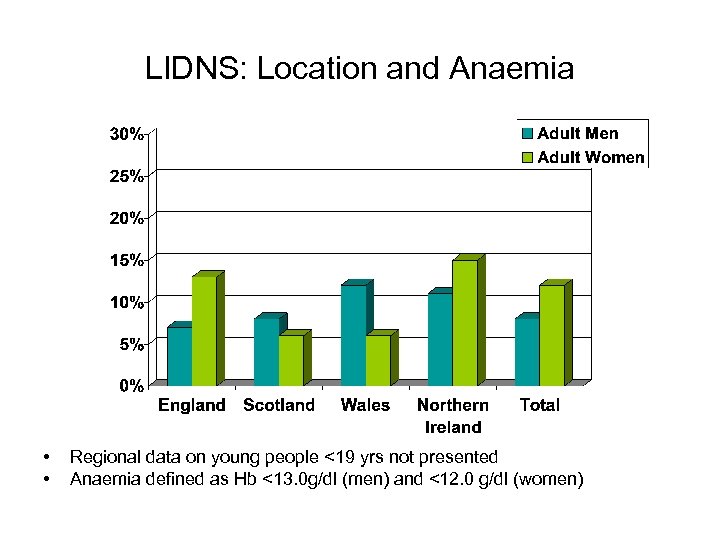 LIDNS: Location and Anaemia • • Regional data on young people <19 yrs not presented Anaemia defined as Hb <13. 0 g/dl (men) and <12. 0 g/dl (women)
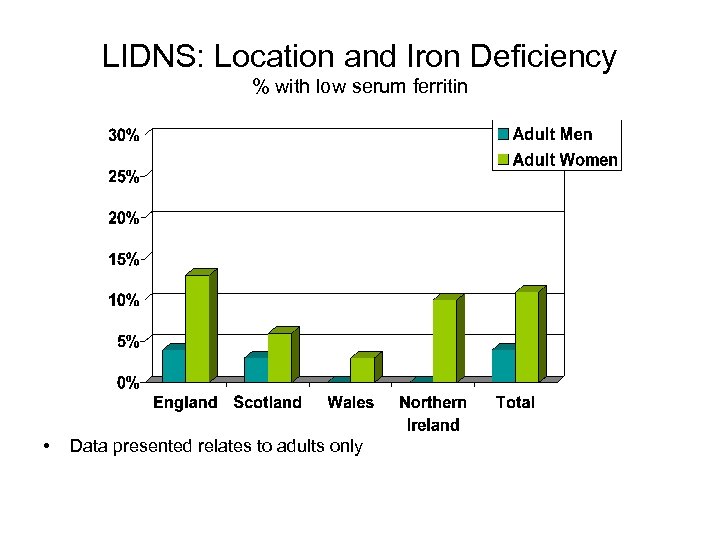 LIDNS: Location and Iron Deficiency % with low serum ferritin • Data presented relates to adults only
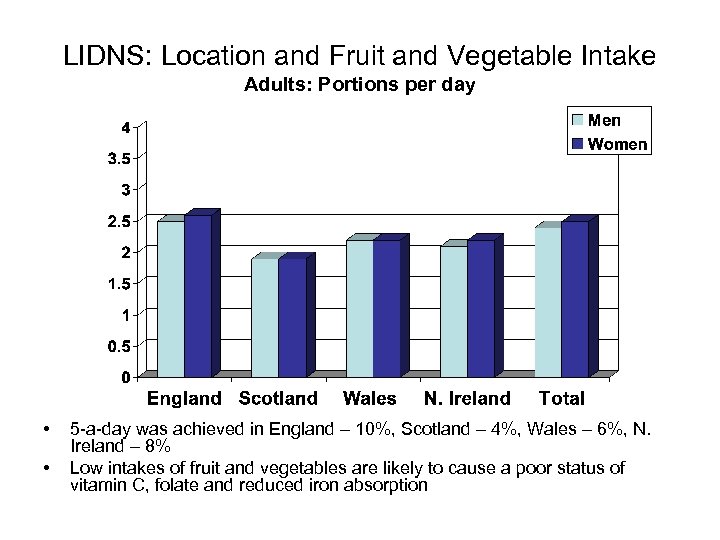 LIDNS: Location and Fruit and Vegetable Intake Adults: Portions per day • • 5 -a-day was achieved in England – 10%, Scotland – 4%, Wales – 6%, N. Ireland – 8% Low intakes of fruit and vegetables are likely to cause a poor status of vitamin C, folate and reduced iron absorption
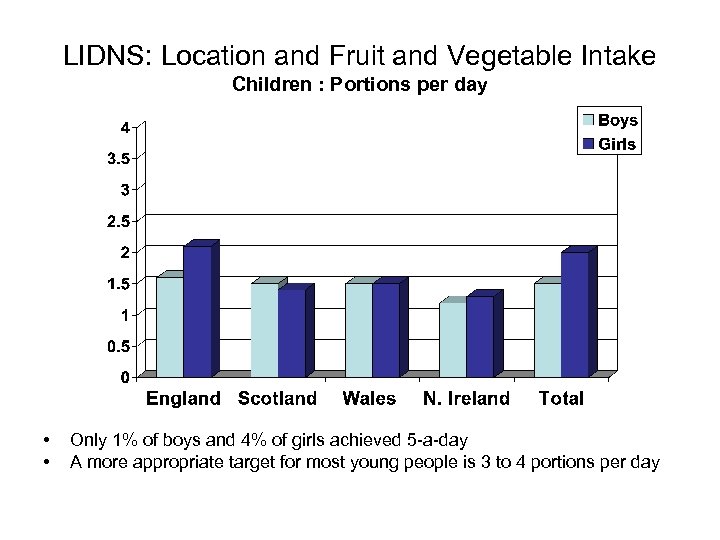 LIDNS: Location and Fruit and Vegetable Intake Children : Portions per day • • Only 1% of boys and 4% of girls achieved 5 -a-day A more appropriate target for most young people is 3 to 4 portions per day
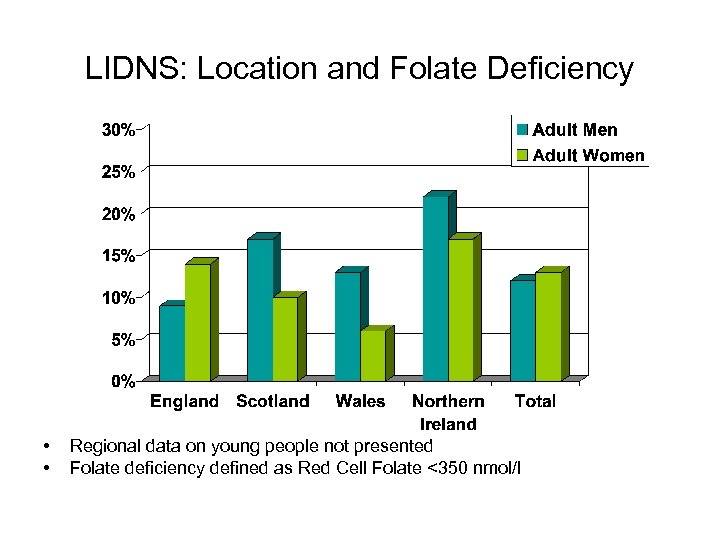 LIDNS: Location and Folate Deficiency • • Regional data on young people not presented Folate deficiency defined as Red Cell Folate <350 nmol/l
 LIDNS: Location and Vitamin B 12 Deficiency • • Regional data on young people not presented Deficiency defined as Serum <118 pmol/l
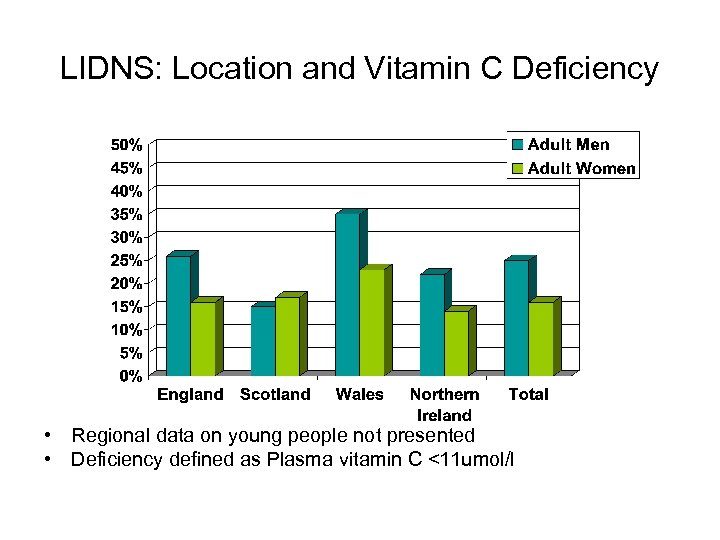 LIDNS: Location and Vitamin C Deficiency • Regional data on young people not presented • Deficiency defined as Plasma vitamin C <11 umol/l
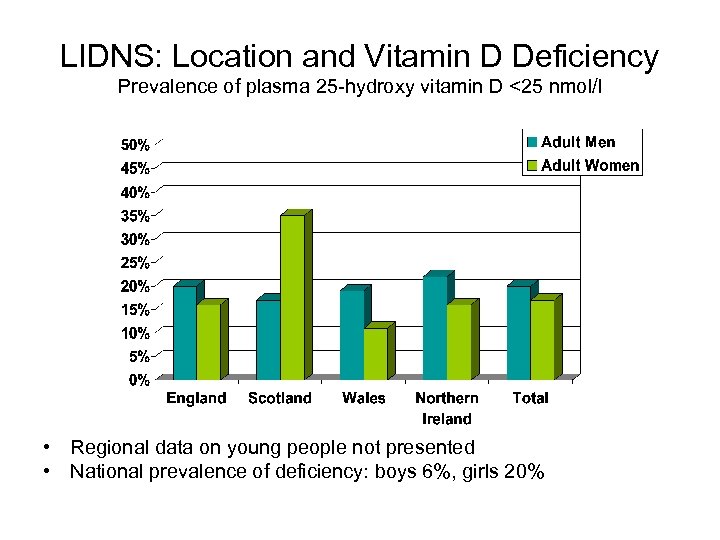 LIDNS: Location and Vitamin D Deficiency Prevalence of plasma 25 -hydroxy vitamin D <25 nmol/l • Regional data on young people not presented • National prevalence of deficiency: boys 6%, girls 20%
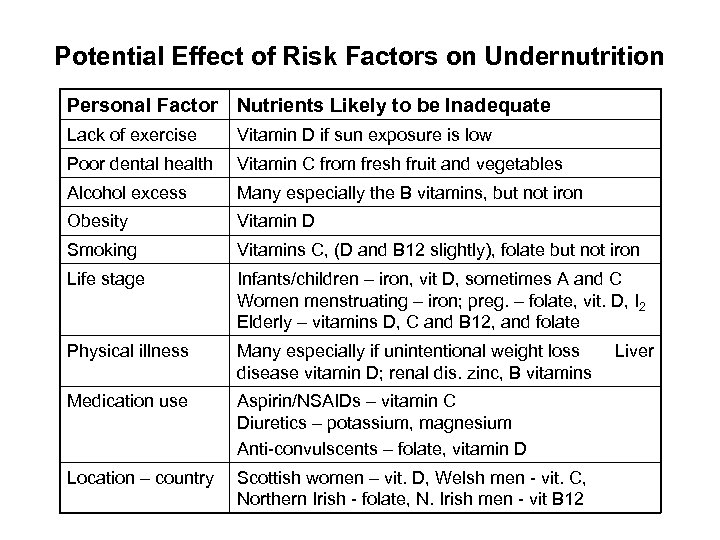 Potential Effect of Risk Factors on Undernutrition Personal Factor Nutrients Likely to be Inadequate Lack of exercise Vitamin D if sun exposure is low Poor dental health Vitamin C from fresh fruit and vegetables Alcohol excess Many especially the B vitamins, but not iron Obesity Vitamin D Smoking Vitamins C, (D and B 12 slightly), folate but not iron Life stage Infants/children – iron, vit D, sometimes A and C Women menstruating – iron; preg. – folate, vit. D, I 2 Elderly – vitamins D, C and B 12, and folate Physical illness Many especially if unintentional weight loss disease vitamin D; renal dis. zinc, B vitamins Medication use Aspirin/NSAIDs – vitamin C Diuretics – potassium, magnesium Anti-convulscents – folate, vitamin D Location – country Scottish women – vit. D, Welsh men - vit. C, Northern Irish - folate, N. Irish men - vit B 12 Liver
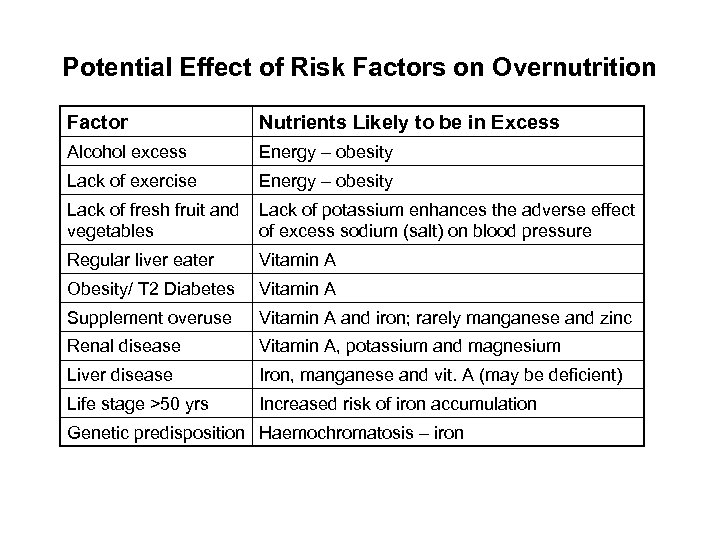 Potential Effect of Risk Factors on Overnutrition Factor Nutrients Likely to be in Excess Alcohol excess Energy – obesity Lack of exercise Energy – obesity Lack of fresh fruit and vegetables Lack of potassium enhances the adverse effect of excess sodium (salt) on blood pressure Regular liver eater Vitamin A Obesity/ T 2 Diabetes Vitamin A Supplement overuse Vitamin A and iron; rarely manganese and zinc Renal disease Vitamin A, potassium and magnesium Liver disease Iron, manganese and vit. A (may be deficient) Life stage >50 yrs Increased risk of iron accumulation Genetic predisposition Haemochromatosis – iron
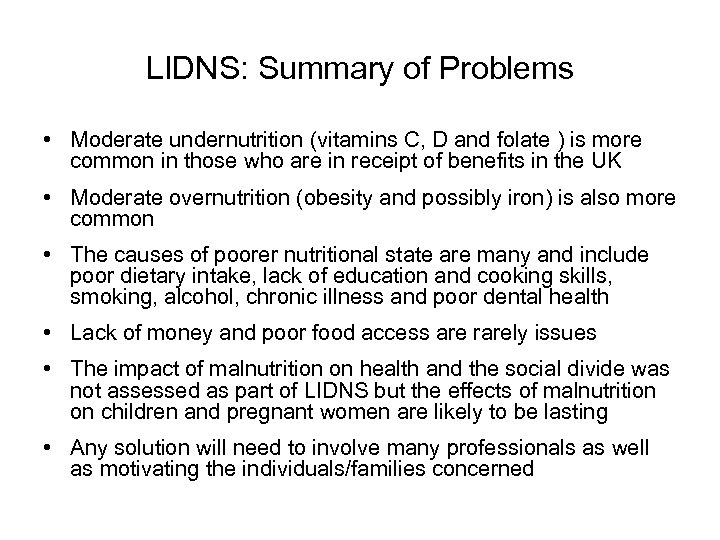 LIDNS: Summary of Problems • Moderate undernutrition (vitamins C, D and folate ) is more common in those who are in receipt of benefits in the UK • Moderate overnutrition (obesity and possibly iron) is also more common • The causes of poorer nutritional state are many and include poor dietary intake, lack of education and cooking skills, smoking, alcohol, chronic illness and poor dental health • Lack of money and poor food access are rarely issues • The impact of malnutrition on health and the social divide was not assessed as part of LIDNS but the effects of malnutrition on children and pregnant women are likely to be lasting • Any solution will need to involve many professionals as well as motivating the individuals/families concerned
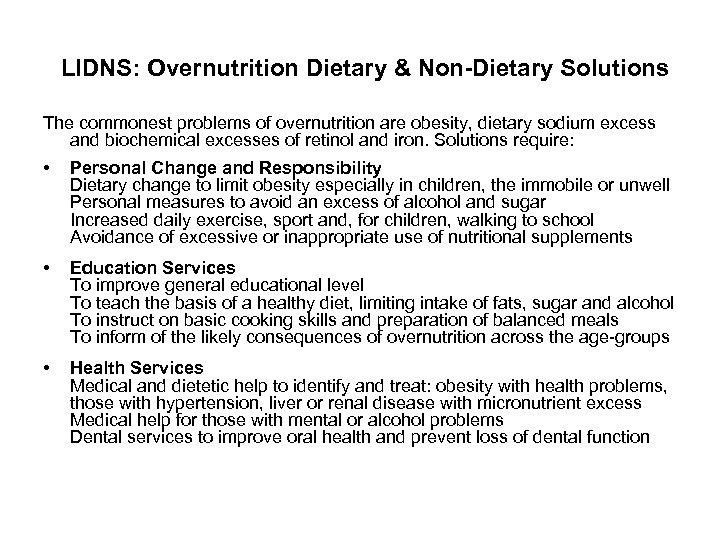 LIDNS: Overnutrition Dietary & Non-Dietary Solutions The commonest problems of overnutrition are obesity, dietary sodium excess and biochemical excesses of retinol and iron. Solutions require: • Personal Change and Responsibility Dietary change to limit obesity especially in children, the immobile or unwell Personal measures to avoid an excess of alcohol and sugar Increased daily exercise, sport and, for children, walking to school Avoidance of excessive or inappropriate use of nutritional supplements • Education Services To improve general educational level To teach the basis of a healthy diet, limiting intake of fats, sugar and alcohol To instruct on basic cooking skills and preparation of balanced meals To inform of the likely consequences of overnutrition across the age-groups • Health Services Medical and dietetic help to identify and treat: obesity with health problems, those with hypertension, liver or renal disease with micronutrient excess Medical help for those with mental or alcohol problems Dental services to improve oral health and prevent loss of dental function
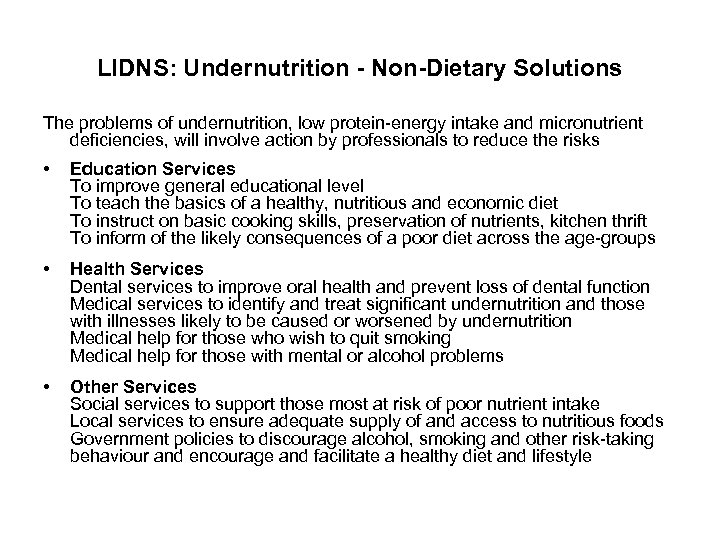 LIDNS: Undernutrition - Non-Dietary Solutions The problems of undernutrition, low protein-energy intake and micronutrient deficiencies, will involve action by professionals to reduce the risks • Education Services To improve general educational level To teach the basics of a healthy, nutritious and economic diet To instruct on basic cooking skills, preservation of nutrients, kitchen thrift To inform of the likely consequences of a poor diet across the age-groups • Health Services Dental services to improve oral health and prevent loss of dental function Medical services to identify and treat significant undernutrition and those with illnesses likely to be caused or worsened by undernutrition Medical help for those who wish to quit smoking Medical help for those with mental or alcohol problems • Other Services Social services to support those most at risk of poor nutrient intake Local services to ensure adequate supply of and access to nutritious foods Government policies to discourage alcohol, smoking and other risk-taking behaviour and encourage and facilitate a healthy diet and lifestyle
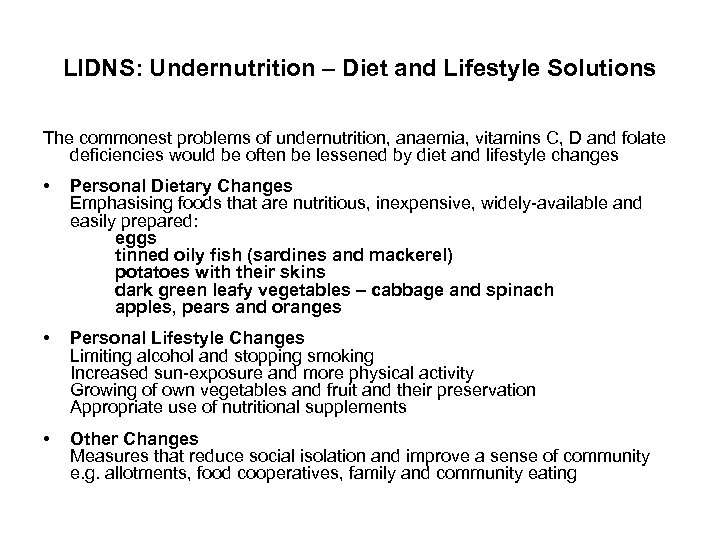 LIDNS: Undernutrition – Diet and Lifestyle Solutions The commonest problems of undernutrition, anaemia, vitamins C, D and folate deficiencies would be often be lessened by diet and lifestyle changes • Personal Dietary Changes Emphasising foods that are nutritious, inexpensive, widely-available and easily prepared: eggs tinned oily fish (sardines and mackerel) potatoes with their skins dark green leafy vegetables – cabbage and spinach apples, pears and oranges • Personal Lifestyle Changes Limiting alcohol and stopping smoking Increased sun-exposure and more physical activity Growing of own vegetables and fruit and their preservation Appropriate use of nutritional supplements • Other Changes Measures that reduce social isolation and improve a sense of community e. g. allotments, food cooperatives, family and community eating
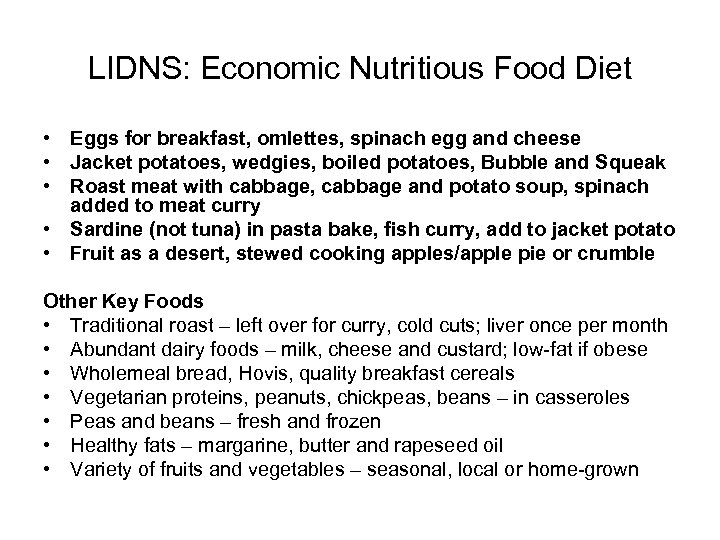 LIDNS: Economic Nutritious Food Diet • Eggs for breakfast, omlettes, spinach egg and cheese • Jacket potatoes, wedgies, boiled potatoes, Bubble and Squeak • Roast meat with cabbage, cabbage and potato soup, spinach added to meat curry • Sardine (not tuna) in pasta bake, fish curry, add to jacket potato • Fruit as a desert, stewed cooking apples/apple pie or crumble Other Key Foods • Traditional roast – left over for curry, cold cuts; liver once per month • Abundant dairy foods – milk, cheese and custard; low-fat if obese • Wholemeal bread, Hovis, quality breakfast cereals • Vegetarian proteins, peanuts, chickpeas, beans – in casseroles • Peas and beans – fresh and frozen • Healthy fats – margarine, butter and rapeseed oil • Variety of fruits and vegetables – seasonal, local or home-grown
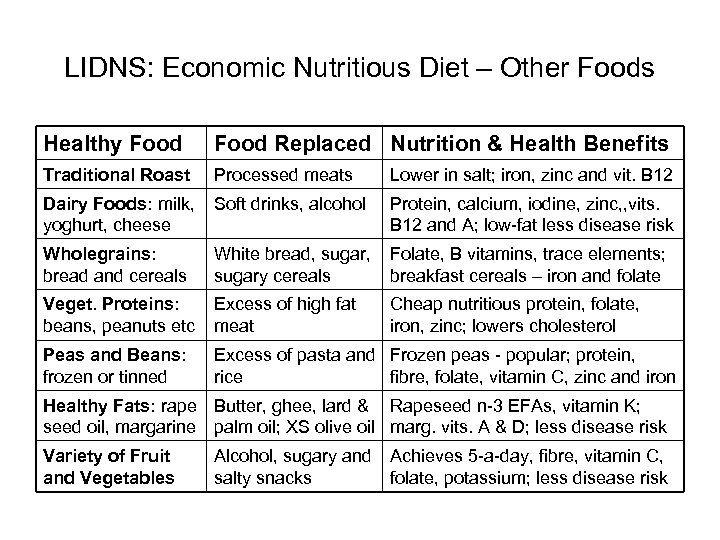 LIDNS: Economic Nutritious Diet – Other Foods Healthy Food Replaced Nutrition & Health Benefits Traditional Roast Processed meats Lower in salt; iron, zinc and vit. B 12 Dairy Foods: milk, yoghurt, cheese Soft drinks, alcohol Protein, calcium, iodine, zinc, , vits. B 12 and A; low-fat less disease risk Wholegrains: bread and cereals White bread, sugary cereals Folate, B vitamins, trace elements; breakfast cereals – iron and folate Veget. Proteins: beans, peanuts etc Excess of high fat meat Cheap nutritious protein, folate, iron, zinc; lowers cholesterol Peas and Beans: frozen or tinned Excess of pasta and Frozen peas - popular; protein, rice fibre, folate, vitamin C, zinc and iron Healthy Fats: rape Butter, ghee, lard & Rapeseed n-3 EFAs, vitamin K; seed oil, margarine palm oil; XS olive oil marg. vits. A & D; less disease risk Variety of Fruit and Vegetables Alcohol, sugary and Achieves 5 -a-day, fibre, vitamin C, salty snacks folate, potassium; less disease risk
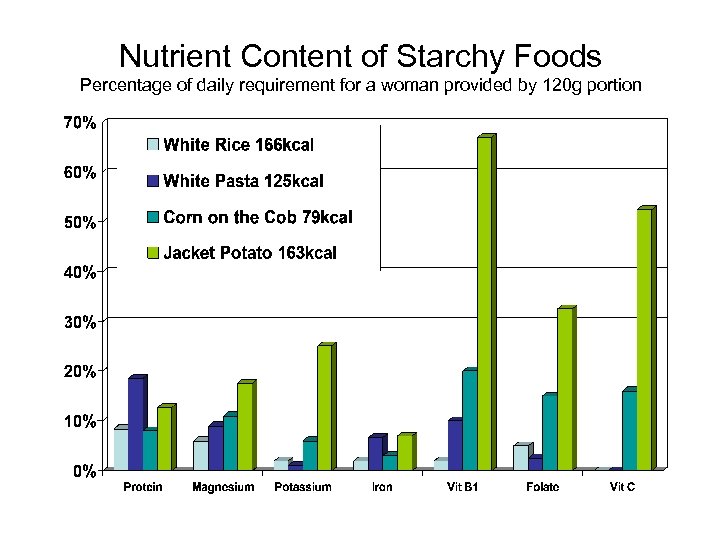 Nutrient Content of Starchy Foods Percentage of daily requirement for a woman provided by 120 g portion
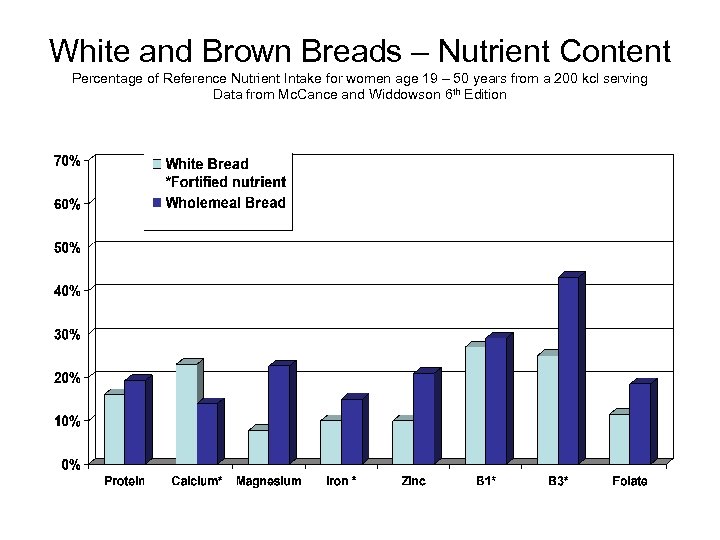 White and Brown Breads – Nutrient Content Percentage of Reference Nutrient Intake for women age 19 – 50 years from a 200 kcl serving Data from Mc. Cance and Widdowson 6 th Edition
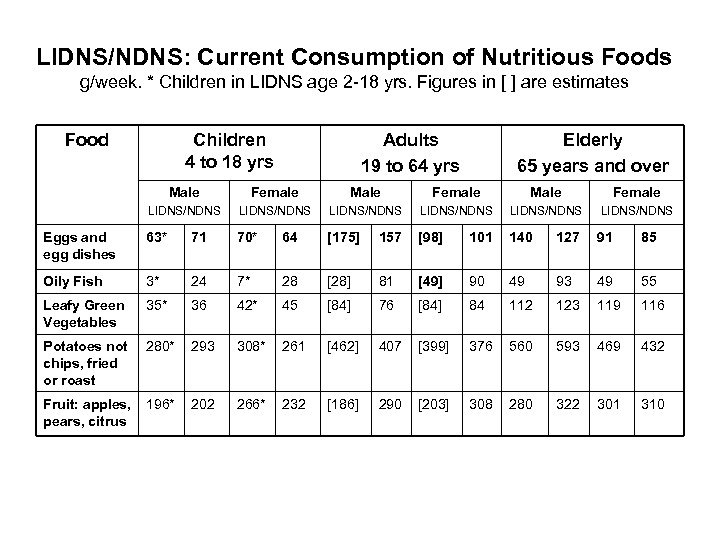 LIDNS/NDNS: Current Consumption of Nutritious Foods g/week. * Children in LIDNS age 2 -18 yrs. Figures in [ ] are estimates Food Children 4 to 18 yrs Adults 19 to 64 yrs Elderly 65 years and over Male Female LIDNS/NDNS LIDNS/NDNS Eggs and egg dishes 63* 71 70* 64 [175] 157 [98] 101 140 127 91 85 Oily Fish 3* 24 7* 28 [28] 81 [49] 90 49 93 49 55 Leafy Green Vegetables 35* 36 42* 45 [84] 76 [84] 84 112 123 119 116 Potatoes not chips, fried or roast 280* 293 308* 261 [462] 407 [399] 376 560 593 469 432 Fruit: apples, pears, citrus 196* 202 266* 232 [186] 290 [203] 308 280 322 301 310
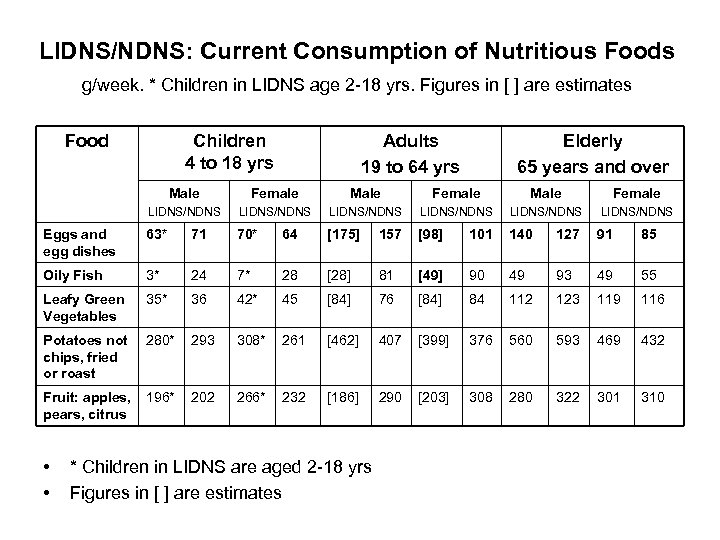 LIDNS/NDNS: Current Consumption of Nutritious Foods g/week. * Children in LIDNS age 2 -18 yrs. Figures in [ ] are estimates Food Children 4 to 18 yrs Adults 19 to 64 yrs Elderly 65 years and over Male Female LIDNS/NDNS LIDNS/NDNS Eggs and egg dishes 63* 71 70* 64 [175] 157 [98] 101 140 127 91 85 Oily Fish 3* 24 7* 28 [28] 81 [49] 90 49 93 49 55 Leafy Green Vegetables 35* 36 42* 45 [84] 76 [84] 84 112 123 119 116 Potatoes not chips, fried or roast 280* 293 308* 261 [462] 407 [399] 376 560 593 469 432 Fruit: apples, pears, citrus 196* 202 266* 232 [186] 290 [203] 308 280 322 301 310 • • * Children in LIDNS are aged 2 -18 yrs Figures in [ ] are estimates
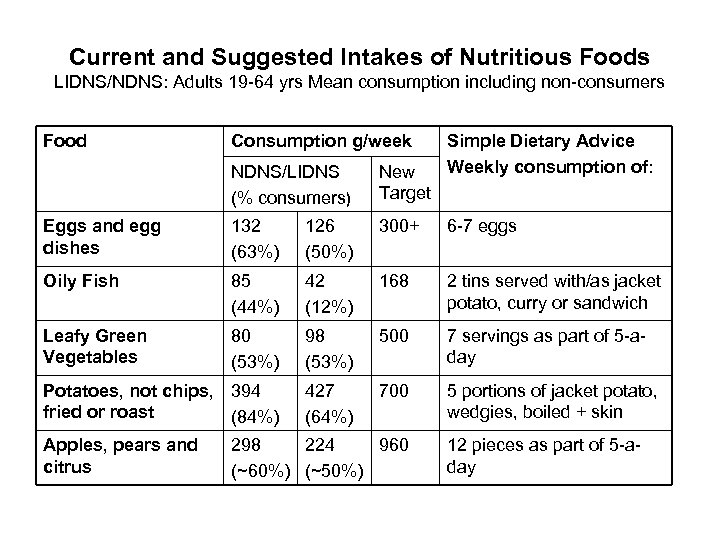 Current and Suggested Intakes of Nutritious Foods LIDNS/NDNS: Adults 19 -64 yrs Mean consumption including non-consumers Food Consumption g/week Simple Dietary Advice Weekly consumption of: NDNS/LIDNS (% consumers) New Target Eggs and egg dishes 132 (63%) 126 (50%) 300+ 6 -7 eggs Oily Fish 85 (44%) 42 (12%) 168 2 tins served with/as jacket potato, curry or sandwich Leafy Green Vegetables 80 (53%) 98 (53%) 500 7 servings as part of 5 -aday Potatoes, not chips, 394 fried or roast (84%) 427 (64%) 700 5 portions of jacket potato, wedgies, boiled + skin Apples, pears and citrus 298 224 960 (~60%) (~50%) 12 pieces as part of 5 -aday
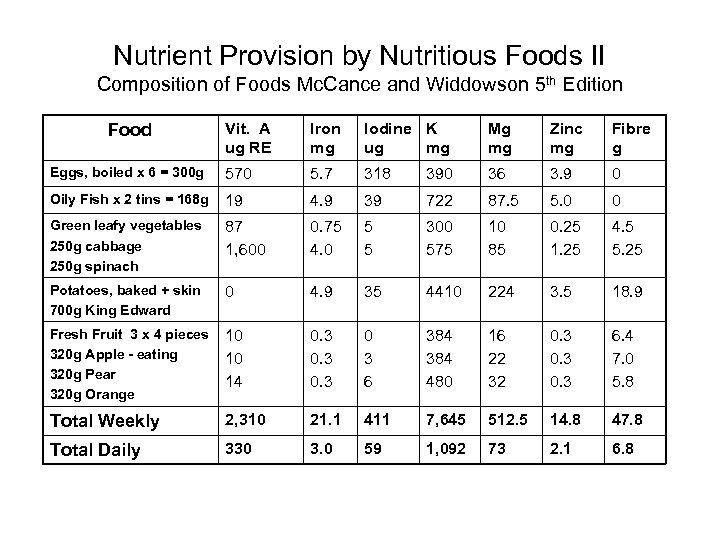 Nutrient Provision by Nutritious Foods II Composition of Foods Mc. Cance and Widdowson 5 th Edition Vit. A ug RE Iron mg Iodine K ug mg Mg mg Zinc mg Fibre g Eggs, boiled x 6 = 300 g 570 5. 7 318 390 36 3. 9 0 Oily Fish x 2 tins = 168 g 19 4. 9 39 722 87. 5 5. 0 0 Green leafy vegetables 250 g cabbage 250 g spinach 87 1, 600 0. 75 4. 0 5 5 300 575 10 85 0. 25 1. 25 4. 5 5. 25 Potatoes, baked + skin 700 g King Edward 0 4. 9 35 4410 224 3. 5 18. 9 Fresh Fruit 3 x 4 pieces 320 g Apple - eating 320 g Pear 320 g Orange 10 10 14 0. 3 0 3 6 384 480 16 22 32 0. 3 6. 4 7. 0 5. 8 Total Weekly 2, 310 21. 1 411 7, 645 512. 5 14. 8 47. 8 Total Daily 330 3. 0 59 1, 092 73 2. 1 6. 8 Food
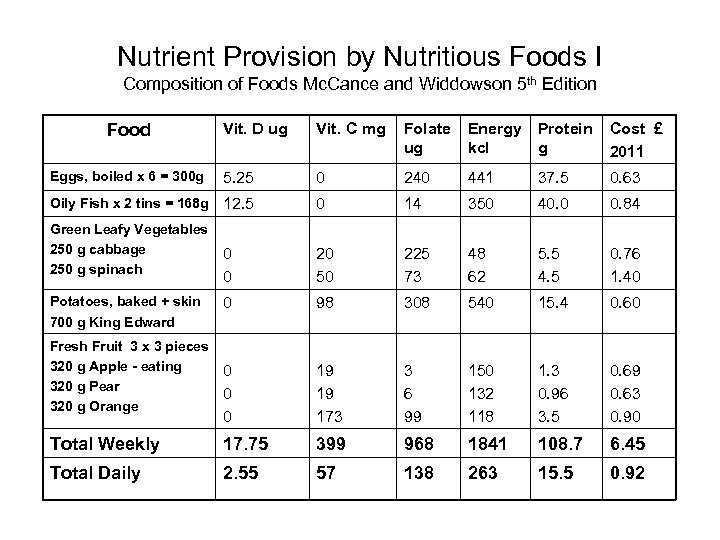 Nutrient Provision by Nutritious Foods I Composition of Foods Mc. Cance and Widdowson 5 th Edition Vit. D ug Vit. C mg Folate ug Energy Protein kcl g Cost £ 2011 Eggs, boiled x 6 = 300 g 5. 25 0 240 441 37. 5 0. 63 Oily Fish x 2 tins = 168 g 12. 5 0 14 350 40. 0 0. 84 0 0 20 50 225 73 48 62 5. 5 4. 5 0. 76 1. 40 0 98 308 540 15. 4 0. 60 0 19 19 173 3 6 99 150 132 118 1. 3 0. 96 3. 5 0. 69 0. 63 0. 90 Total Weekly 17. 75 399 968 1841 108. 7 6. 45 Total Daily 2. 55 57 138 263 15. 5 0. 92 Food Green Leafy Vegetables 250 g cabbage 250 g spinach Potatoes, baked + skin 700 g King Edward Fresh Fruit 3 x 3 pieces 320 g Apple - eating 320 g Pear 320 g Orange
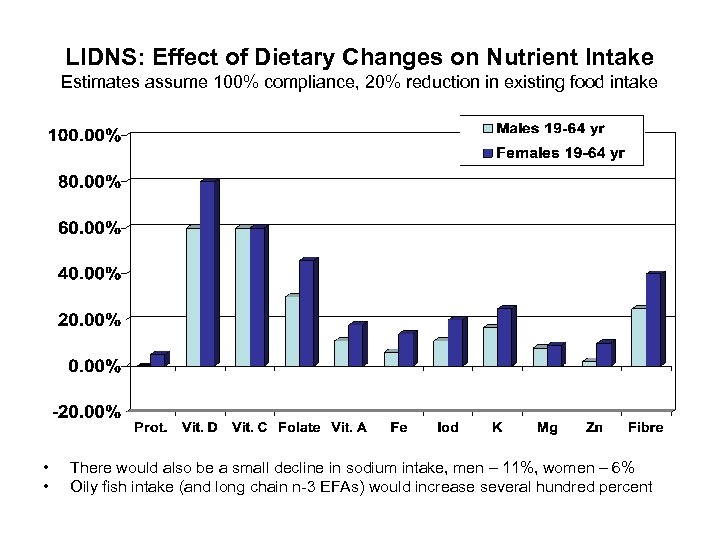 LIDNS: Effect of Dietary Changes on Nutrient Intake Estimates assume 100% compliance, 20% reduction in existing food intake • • There would also be a small decline in sodium intake, men – 11%, women – 6% Oily fish intake (and long chain n-3 EFAs) would increase several hundred percent
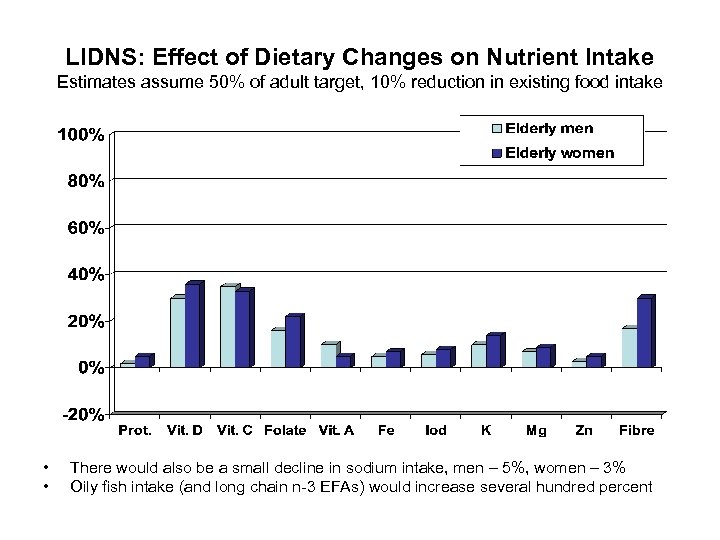 LIDNS: Effect of Dietary Changes on Nutrient Intake Estimates assume 50% of adult target, 10% reduction in existing food intake • • There would also be a small decline in sodium intake, men – 5%, women – 3% Oily fish intake (and long chain n-3 EFAs) would increase several hundred percent
 LIDNS: Effect of Dietary Changes on Nutrient Intake Estimates assume 50% of adult target, 10% reduction in existing food intake • • There would also be a small decline in sodium intake, boys – 4%, girls – 3. 5% Oily fish intake (and long chain n-3 EFAs) would increase several hundred percent
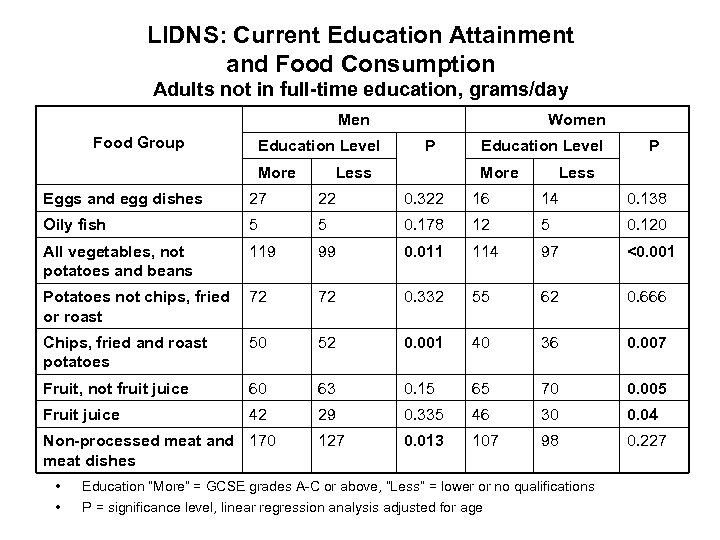 LIDNS: Current Education Attainment and Food Consumption Adults not in full-time education, grams/day Men Food Group Education Level More Women P Less Education Level More P Less Eggs and egg dishes 27 22 0. 322 16 14 0. 138 Oily fish 5 5 0. 178 12 5 0. 120 All vegetables, not potatoes and beans 119 99 0. 011 114 97 <0. 001 Potatoes not chips, fried or roast 72 72 0. 332 55 62 0. 666 Chips, fried and roast potatoes 50 52 0. 001 40 36 0. 007 Fruit, not fruit juice 60 63 0. 15 65 70 0. 005 Fruit juice 42 29 0. 335 46 30 0. 04 127 0. 013 107 98 0. 227 Non-processed meat and 170 meat dishes • • Education “More” = GCSE grades A-C or above, “Less” = lower or no qualifications P = significance level, linear regression analysis adjusted for age
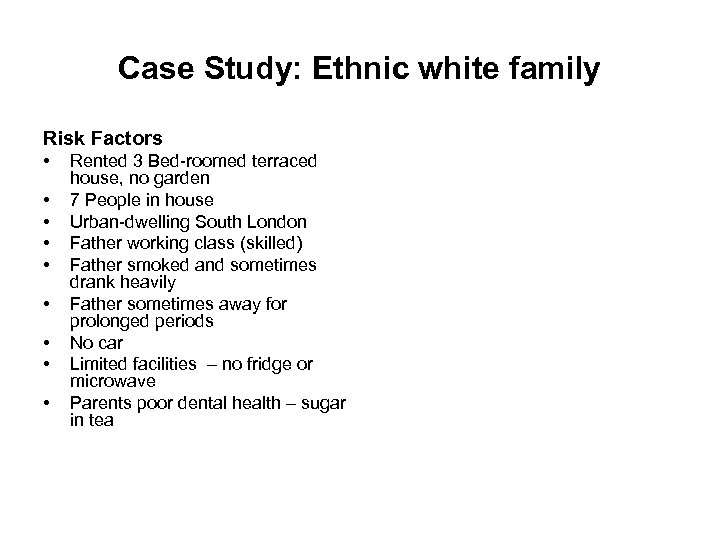 Case Study: Ethnic white family Risk Factors • • • Rented 3 Bed-roomed terraced house, no garden 7 People in house Urban-dwelling South London Father working class (skilled) Father smoked and sometimes drank heavily Father sometimes away for prolonged periods No car Limited facilities – no fridge or microwave Parents poor dental health – sugar in tea
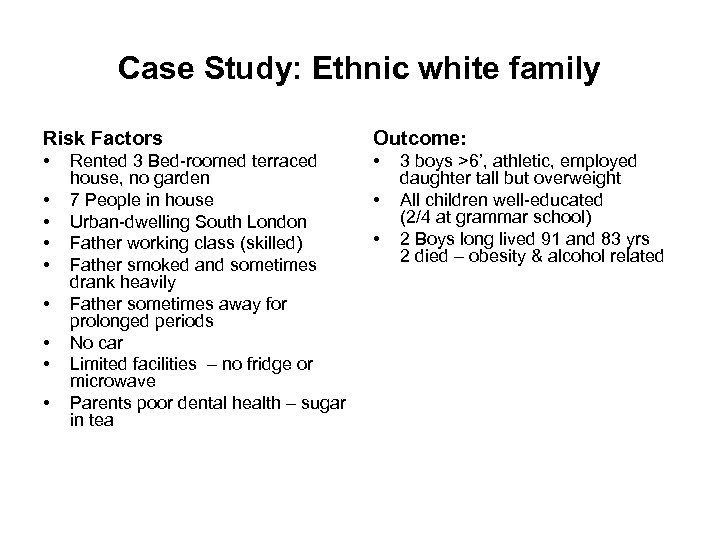 Case Study: Ethnic white family Risk Factors Outcome: • • • Rented 3 Bed-roomed terraced house, no garden 7 People in house Urban-dwelling South London Father working class (skilled) Father smoked and sometimes drank heavily Father sometimes away for prolonged periods No car Limited facilities – no fridge or microwave Parents poor dental health – sugar in tea • • 3 boys >6’, athletic, employed daughter tall but overweight All children well-educated (2/4 at grammar school) 2 Boys long lived 91 and 83 yrs 2 died – obesity & alcohol related
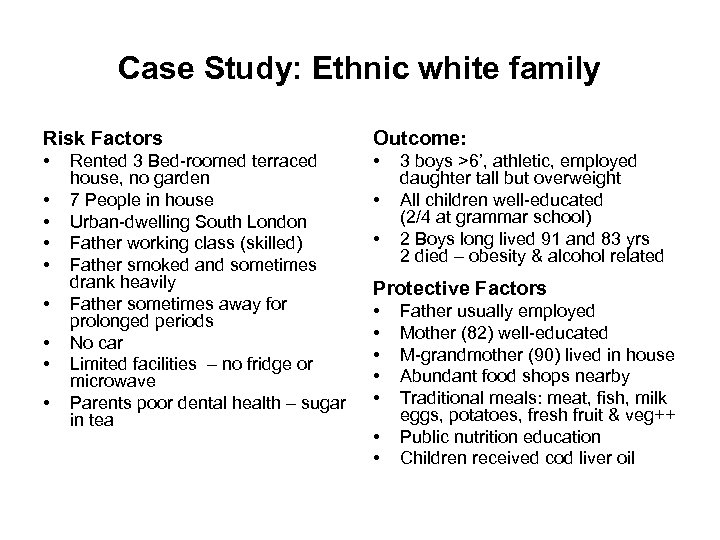 Case Study: Ethnic white family Risk Factors Outcome: • • • Rented 3 Bed-roomed terraced house, no garden 7 People in house Urban-dwelling South London Father working class (skilled) Father smoked and sometimes drank heavily Father sometimes away for prolonged periods No car Limited facilities – no fridge or microwave Parents poor dental health – sugar in tea • • 3 boys >6’, athletic, employed daughter tall but overweight All children well-educated (2/4 at grammar school) 2 Boys long lived 91 and 83 yrs 2 died – obesity & alcohol related Protective Factors • • Father usually employed Mother (82) well-educated M-grandmother (90) lived in house Abundant food shops nearby Traditional meals: meat, fish, milk eggs, potatoes, fresh fruit & veg++ Public nutrition education Children received cod liver oil
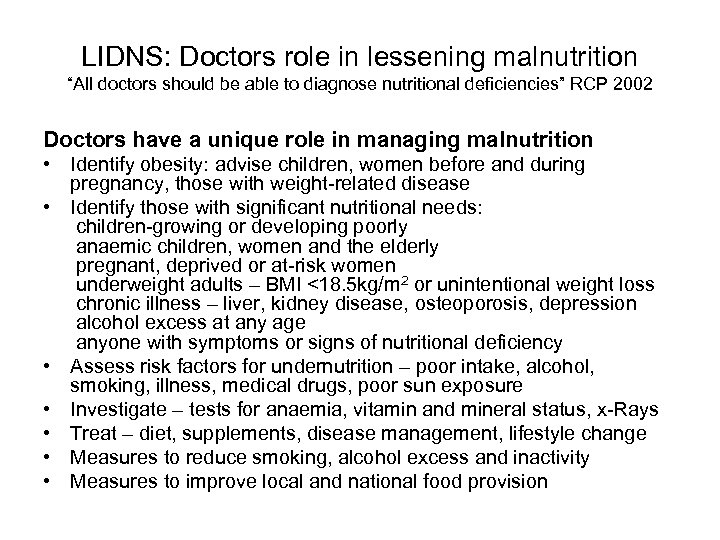 LIDNS: Doctors role in lessening malnutrition “All doctors should be able to diagnose nutritional deficiencies” RCP 2002 Doctors have a unique role in managing malnutrition • Identify obesity: advise children, women before and during pregnancy, those with weight-related disease • Identify those with significant nutritional needs: children-growing or developing poorly anaemic children, women and the elderly pregnant, deprived or at-risk women underweight adults – BMI <18. 5 kg/m 2 or unintentional weight loss chronic illness – liver, kidney disease, osteoporosis, depression alcohol excess at any age anyone with symptoms or signs of nutritional deficiency • Assess risk factors for undernutrition – poor intake, alcohol, smoking, illness, medical drugs, poor sun exposure • Investigate – tests for anaemia, vitamin and mineral status, x-Rays • Treat – diet, supplements, disease management, lifestyle change • Measures to reduce smoking, alcohol excess and inactivity • Measures to improve local and national food provision
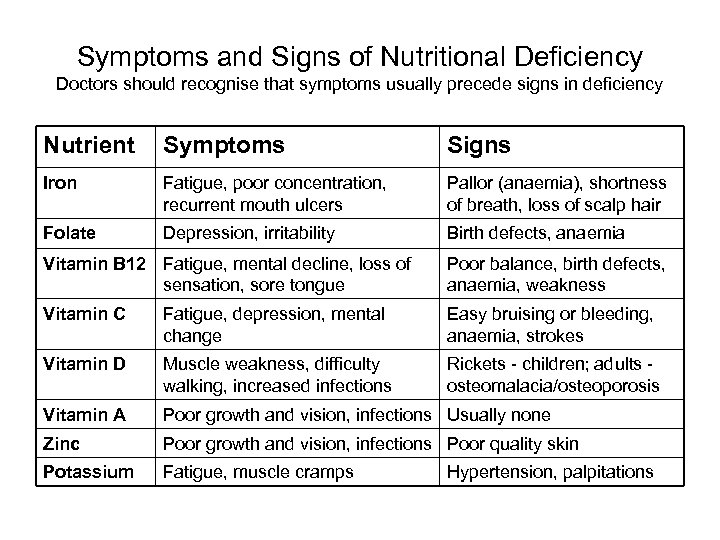 Symptoms and Signs of Nutritional Deficiency Doctors should recognise that symptoms usually precede signs in deficiency Nutrient Symptoms Signs Iron Fatigue, poor concentration, recurrent mouth ulcers Pallor (anaemia), shortness of breath, loss of scalp hair Folate Depression, irritability Birth defects, anaemia Vitamin B 12 Fatigue, mental decline, loss of sensation, sore tongue Poor balance, birth defects, anaemia, weakness Vitamin C Fatigue, depression, mental change Easy bruising or bleeding, anaemia, strokes Vitamin D Muscle weakness, difficulty walking, increased infections Rickets - children; adults osteomalacia/osteoporosis Vitamin A Poor growth and vision, infections Usually none Zinc Poor growth and vision, infections Poor quality skin Potassium Fatigue, muscle cramps Hypertension, palpitations
 Thank you for your attention. I would welcome you comments. Contact me at dr. stewart@stewartnutrition. co. uk