


 Скачать презентацию Low Impact Development Overview Alternative to end
d907befacc780c51a1ef4e62185611ba.ppt
- Количество слайдов: 20
 Low Impact Development Overview § Alternative to end of pipe approach to SWM § Maintain hydrologic function of local ecosystem § Treat stormwater close to the source of runoff § Decentralized small scale devices § Maintain runoff rates and connection with groundwater § History § Prince Georges County Maryland, 1980’s § Means to address economical, environmental and physical shortcomings of traditional stormwater designs § Key Elements § Uses common stormwater BMPs § Combination of devices results in more efficient land use
 LID-EZ § Development § Similar programs in use in Wake County and Manteo. § Local and NC Coastal Federation Funding § Cooperation with NC DWQ § Wilmington Version § Written to comply with proposed Coastal Rules § Quantitative approach to LID developments § Based on local ordinances and NC DWQ BMP manual
 LID Calculations § SCS Method § Described in TR-55 § Per NC DWQ, allowable method for LID Projects only § Accounts for soil conditions on site § NC DWQ Involvement § No changes required for new Coastal Rules § Permitting guidelines in development by DWQ § Clarification of policies § Disconnected Impervious Area § Pervious Pavement § First Flush Calculations
 Connected / Disconnected Impervious Area § Connected Impervious Area § Directly connected to drainage conveyance § Minimal opportunity for volume reduction before reaching analysis point § Disconnected Impervious Area § Runoff has contact with pervious surfaces before reaching analysis point § Recommended 50’ sheet flow or sheet flow length equal to width of impervious surface § Benefit is dependant on soil type § Net result is a reduction of CN
![Calculating Runoff Depth, Q [in] – TR-55 Chapter 2 § Q [in] = (P](https://present5.com/presentation/d907befacc780c51a1ef4e62185611ba/image-6.jpg "Calculating Runoff Depth, Q [in] – TR-55 Chapter 2 § Q [in] = (P") Calculating Runoff Depth, Q [in] – TR-55 Chapter 2 § Q [in] = (P – Ia)2 / (P + 0. 8 S), § § when (P – Ia) > 0; otherwise Q[in] = 0 in § § § P = Precipitation depth in inches Ia = Initial hydrologic abstraction = 0. 2 S S = Potential maximum retention after runoff begins in inches § S = 1000/CN – 10
Calculating Runoff Depth, Q [in] – TR-55 Chapter 2 § Q [in] = (P – Ia)2 / (P + 0. 8 S), § § when (P – Ia) > 0; otherwise Q[in] = 0 in § § § P = Precipitation depth in inches Ia = Initial hydrologic abstraction = 0. 2 S S = Potential maximum retention after runoff begins in inches § S = 1000/CN – 10
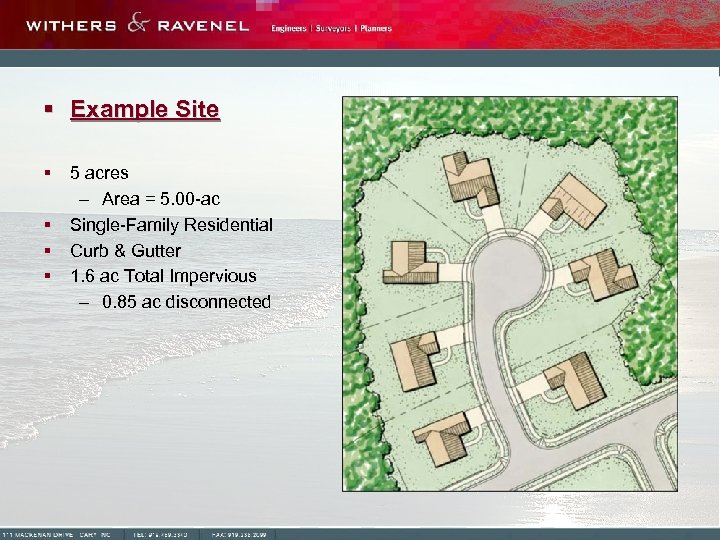 § Example Site § § 5 acres – Area = 5. 00 -ac Single-Family Residential Curb & Gutter 1. 6 ac Total Impervious – 0. 85 ac disconnected
![Calculating Q 1 -YR [in] TR-55 Composite CN Method: (with disconnected impervious area) 1.](https://present5.com/presentation/d907befacc780c51a1ef4e62185611ba/image-8.jpg "Calculating Q 1 -YR [in] TR-55 Composite CN Method: (with disconnected impervious area) 1.") Calculating Q 1 -YR [in] TR-55 Composite CN Method: (with disconnected impervious area) 1. Calculate CNcomp: CNcomp = CNp + (Pimp / 100)*(98 - CNp)*(1 - 0. 5 R) CNcomp = Composite Curve Number CNp = Pervious Curve Number Pimp = Percent Total Impervious R = Aimp(disconn) ÷ Aimp(total) 2. Calculate Q 1 -YR for CNcomp
Calculating Q 1 -YR [in] TR-55 Composite CN Method: (with disconnected impervious area) 1. Calculate CNcomp: CNcomp = CNp + (Pimp / 100)*(98 - CNp)*(1 - 0. 5 R) CNcomp = Composite Curve Number CNp = Pervious Curve Number Pimp = Percent Total Impervious R = Aimp(disconn) ÷ Aimp(total) 2. Calculate Q 1 -YR for CNcomp
![Calculating Q 1 -YR [in] - Continued § § CNp = 61 (in this](https://present5.com/presentation/d907befacc780c51a1ef4e62185611ba/image-9.jpg "Calculating Q 1 -YR [in] - Continued § § CNp = 61 (in this") Calculating Q 1 -YR [in] - Continued § § CNp = 61 (in this example) P [in] = 3. 41 in (in this example) Pimp = Aimp(tot) ÷ ATot = (0. 75 ac + 0. 85 ac) ÷ 5 ac = 32 % R = Aimp(disconn) ÷ Aimp(total) = 0. 85 ac ÷ 1. 60 ac = 0. 53
Calculating Q 1 -YR [in] - Continued § § CNp = 61 (in this example) P [in] = 3. 41 in (in this example) Pimp = Aimp(tot) ÷ ATot = (0. 75 ac + 0. 85 ac) ÷ 5 ac = 32 % R = Aimp(disconn) ÷ Aimp(total) = 0. 85 ac ÷ 1. 60 ac = 0. 53
![Calculating Q 1 -YR [in] - Continued § § § CNcomp = CNp +](https://present5.com/presentation/d907befacc780c51a1ef4e62185611ba/image-10.jpg "Calculating Q 1 -YR [in] - Continued § § § CNcomp = CNp +") Calculating Q 1 -YR [in] - Continued § § § CNcomp = CNp + (Pimp / 100)*(98 - CNp)*(1 - 0. 5 R) = 61 + (32 / 100)*(98 - 61)*(1 - 0. 5*0. 53) = 70 *Note – Without Disconnection CN = 73 S = 1000/CNcomp - 10 = 1000 / 70 - 10 = 4. 29 Q 1 -YR = (P – Ia)2 / (P + 0. 8 S) = (3. 41 – 0. 2*4. 29)2 / (3. 41 + 0. 8*4. 29) = 0. 95 in
Calculating Q 1 -YR [in] - Continued § § § CNcomp = CNp + (Pimp / 100)*(98 - CNp)*(1 - 0. 5 R) = 61 + (32 / 100)*(98 - 61)*(1 - 0. 5*0. 53) = 70 *Note – Without Disconnection CN = 73 S = 1000/CNcomp - 10 = 1000 / 70 - 10 = 4. 29 Q 1 -YR = (P – Ia)2 / (P + 0. 8 S) = (3. 41 – 0. 2*4. 29)2 / (3. 41 + 0. 8*4. 29) = 0. 95 in
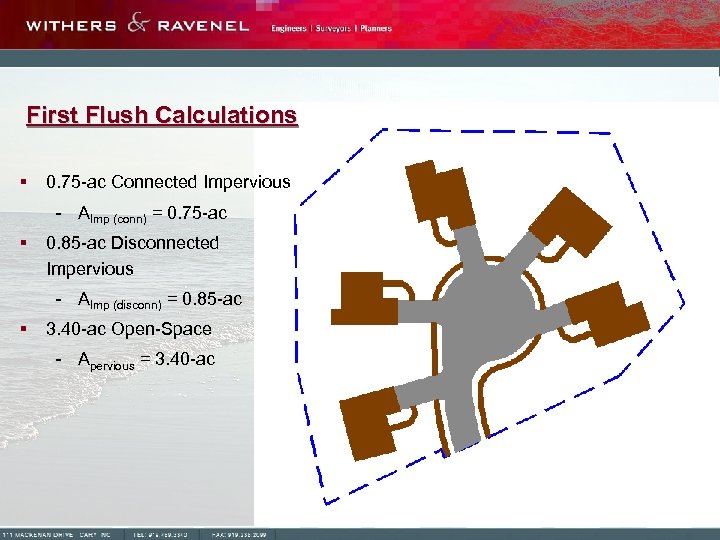 First Flush Calculations § 0. 75 -ac Connected Impervious - AImp (conn) = 0. 75 -ac § 0. 85 -ac Disconnected Impervious - AImp (disconn) = 0. 85 -ac § 3. 40 -ac Open-Space - Apervious = 3. 40 -ac
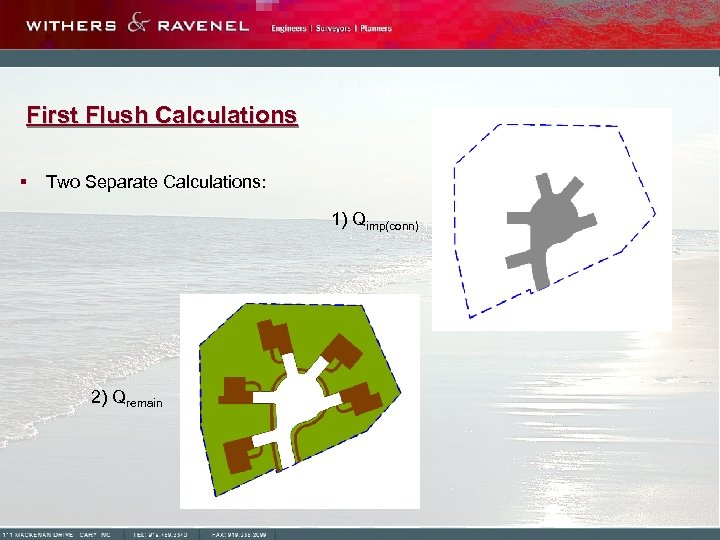 First Flush Calculations § Two Separate Calculations: 1) Qimp(conn) 2) Qremain
![Calculating QFF [in] – First Flush (1. 5”) Discrete CN Method: 1. Obtain CN](https://present5.com/presentation/d907befacc780c51a1ef4e62185611ba/image-13.jpg "Calculating QFF [in] – First Flush (1. 5”) Discrete CN Method: 1. Obtain CN") Calculating QFF [in] – First Flush (1. 5”) Discrete CN Method: 1. Obtain CN for Connected Impervious Area § CNimp(conn) = 98 2. Calculate CN for Remaining Area § CNremaining = CNp + (Pimp / 100)*(98 - CNp)*(1 - 0. 5 R) *R = 1 always because connected impervious area has already been accounted for 3. Calculate QFF. for each CN 4. Obtain the Area-Weighted Average QFF.
Calculating QFF [in] – First Flush (1. 5”) Discrete CN Method: 1. Obtain CN for Connected Impervious Area § CNimp(conn) = 98 2. Calculate CN for Remaining Area § CNremaining = CNp + (Pimp / 100)*(98 - CNp)*(1 - 0. 5 R) *R = 1 always because connected impervious area has already been accounted for 3. Calculate QFF. for each CN 4. Obtain the Area-Weighted Average QFF.
![Calculating QFF [in] – First Flush (continued) § § § CNp = 61 (in](https://present5.com/presentation/d907befacc780c51a1ef4e62185611ba/image-14.jpg "Calculating QFF [in] – First Flush (continued) § § § CNp = 61 (in") Calculating QFF [in] – First Flush (continued) § § § CNp = 61 (in this example) P [in] = 1. 5 in (in this example) CNimp(conn) = 98 Pimp = Aimp(disconn) ÷ (ATot - Aimp(conn)) = 0. 85 ac ÷ (5 ac - 0. 75 ac) = 20 % R=1
Calculating QFF [in] – First Flush (continued) § § § CNp = 61 (in this example) P [in] = 1. 5 in (in this example) CNimp(conn) = 98 Pimp = Aimp(disconn) ÷ (ATot - Aimp(conn)) = 0. 85 ac ÷ (5 ac - 0. 75 ac) = 20 % R=1
![Calculating QFF [in] – First Flush (continued) § § § CNremain = CNp +](https://present5.com/presentation/d907befacc780c51a1ef4e62185611ba/image-15.jpg "Calculating QFF [in] – First Flush (continued) § § § CNremain = CNp +") Calculating QFF [in] – First Flush (continued) § § § CNremain = CNp + (Pimp / 100)*(98 - CNp)*(1 - 0. 5 R) = 61 + (20 / 100)*(98 - 61)*(1 - 0. 5*1) = 65 Sremain = 1000/CNremain - 10 = 1000 / 65 - 10 = 5. 38 Qremain = (P – Ia)2 / (P + 0. 8 S) = (1. 5 – 0. 2*5. 38)2 / (1. 5 + 0. 8*5. 38) = 0. 03 in
Calculating QFF [in] – First Flush (continued) § § § CNremain = CNp + (Pimp / 100)*(98 - CNp)*(1 - 0. 5 R) = 61 + (20 / 100)*(98 - 61)*(1 - 0. 5*1) = 65 Sremain = 1000/CNremain - 10 = 1000 / 65 - 10 = 5. 38 Qremain = (P – Ia)2 / (P + 0. 8 S) = (1. 5 – 0. 2*5. 38)2 / (1. 5 + 0. 8*5. 38) = 0. 03 in
![Calculating QFF [in] – First Flush (continued) § § § Simp(conn) = 1000/CNimp(conn) -](https://present5.com/presentation/d907befacc780c51a1ef4e62185611ba/image-16.jpg "Calculating QFF [in] – First Flush (continued) § § § Simp(conn) = 1000/CNimp(conn) -") Calculating QFF [in] – First Flush (continued) § § § Simp(conn) = 1000/CNimp(conn) - 10 = 1000 / 98 - 10 = 0. 20 Qimp(conn) = (P – Ia)2 / (P + 0. 8 S) = (1. 5 – 0. 2*0. 20)2 / (1. 5 + 0. 8*0. 20) = 1. 28 in QF. F. = [(QA)remain + (QA)imp(conn)] / ATot = [(0. 03 in * 4. 25 ac) + (1. 28 in * 0. 75 ac)] / 5 ac = 0. 22 in
Calculating QFF [in] – First Flush (continued) § § § Simp(conn) = 1000/CNimp(conn) - 10 = 1000 / 98 - 10 = 0. 20 Qimp(conn) = (P – Ia)2 / (P + 0. 8 S) = (1. 5 – 0. 2*0. 20)2 / (1. 5 + 0. 8*0. 20) = 1. 28 in QF. F. = [(QA)remain + (QA)imp(conn)] / ATot = [(0. 03 in * 4. 25 ac) + (1. 28 in * 0. 75 ac)] / 5 ac = 0. 22 in
 LID-EZ Features § § § Storage devices increase effective soil storage capacity, reducing CN – “Effective Volume” varies based on storm event – Effective Volume used in Peak Flow calculations Disconnected Impervious Pavement – Land Use or Storage Area Lakes and Wetlands – Coastal Wetlands Pollutant Removal – BMPs in series
 LID-EZ – Residential Development - Lakeside Example Site: Lakeside § 42. 62 -ac Parcel § “B” Soils § § Predevelopment – 100 % Pervious, Natural Area – 35% Open Space, 64% Woods Post-Development – 24 % Impervious (Lots and Roadways) – 14 % Managed Open-Space Stormwater Management: § 8 Bioretention Cells, 4 Vegetated Swales § Total Storage Volume = 167, 729 ft 3 § Total Effective WQV = 33, 197 ft 3
 LID-EZ – Condominium Development Example Site: § 9. 38 -ac Parcel § “A” Soils § § Predevelopment – 100 % Pervious, Natural Area Post-Development – 62 % Impervious (Connected) – 38 % Managed Open-Space Stormwater Management: § 1 Wet Pond, 4 Sand Filters, 6 Infiltration Basins, 1 Bioretention Cell § Total Storage Volume = 29, 390 ft 3
 LID-EZ – Quick Calculator – Retrofit Site Example Site: House Addition § § 0. 22 -ac Lot “A” Soils § § Pre-Construction – 21 % Impervious (CN = 52) Post-Construction – 25 % Impervious (CN = 54)