


 Скачать презентацию Low Cost High Accuracy GPS Timing z Tom
333fedb8893a9a83a812fee59b19dfb6.ppt
- Количество слайдов: 24
 Low Cost, High Accuracy GPS Timing z Tom Clark NASA Goddard Space Flight Center Greenbelt, MD _______________________________ z Rick Hambly CNS Systems, Inc. Severna Park, MD ______________________________ z Reza Abtahi Custom Navigation Systems San Jose, CA ION -- Sept. 20, 2000 Salt Lake City
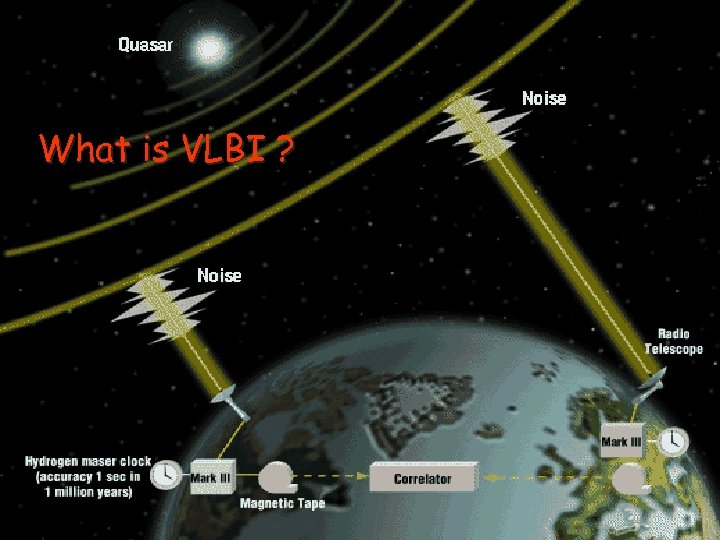 What is VLBI ?
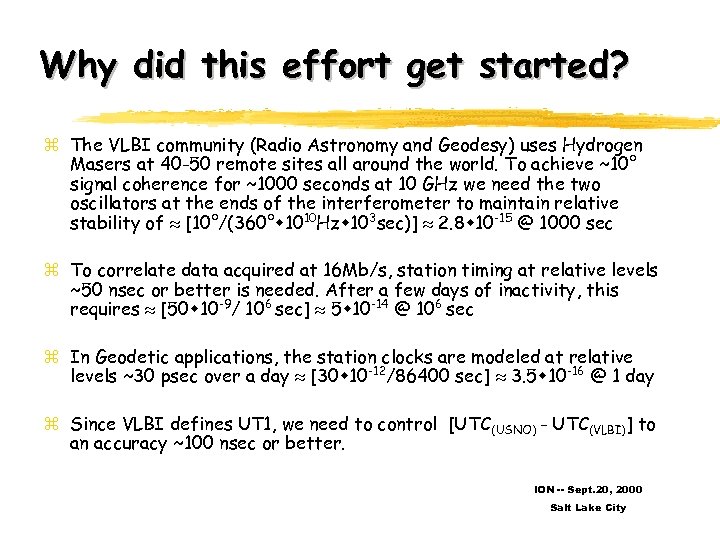 Why did this effort get started? z The VLBI community (Radio Astronomy and Geodesy) uses Hydrogen Masers at 40 -50 remote sites all around the world. To achieve ~10° signal coherence for ~1000 seconds at 10 GHz we need the two oscillators at the ends of the interferometer to maintain relative stability of [10°/(360° 1010 Hz 103 sec)] 2. 8 10 -15 @ 1000 sec z To correlate data acquired at 16 Mb/s, station timing at relative levels ~50 nsec or better is needed. After a few days of inactivity, this requires [50 10 -9/ 106 sec] 5 10 -14 @ 106 sec z In Geodetic applications, the station clocks are modeled at relative levels ~30 psec over a day [30 10 -12/86400 sec] 3. 5 10 -16 @ 1 day z Since VLBI defines UT 1, we need to control [UTC(USNO) - UTC(VLBI)] to an accuracy ~100 nsec or better. ION -- Sept. 20, 2000 Salt Lake City
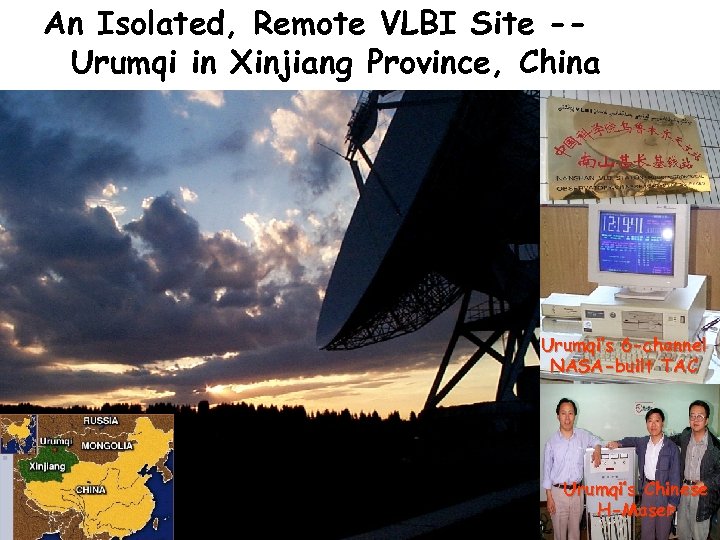 An Isolated, Remote VLBI Site -Urumqi in Xinjiang Province, China Urumqi’s 6 -channel NASA-built TAC Urumqi’s Chinese H-Maser
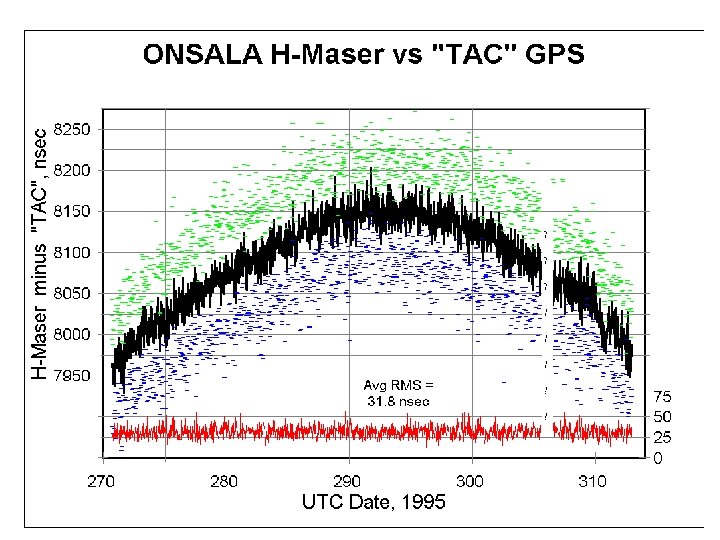
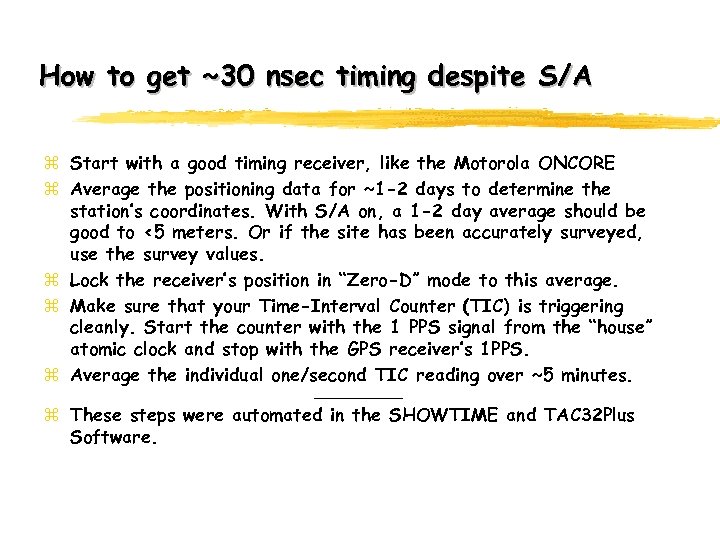 How to get ~30 nsec timing despite S/A z Start with a good timing receiver, like the Motorola ONCORE z Average the positioning data for ~1 -2 days to determine the station’s coordinates. With S/A on, a 1 -2 day average should be good to <5 meters. Or if the site has been accurately surveyed, use the survey values. z Lock the receiver’s position in “Zero-D” mode to this average. z Make sure that your Time-Interval Counter (TIC) is triggering cleanly. Start the counter with the 1 PPS signal from the “house” atomic clock and stop with the GPS receiver’s 1 PPS. z Average the individual one/second TIC reading over ~5 minutes. _______ z These steps were automated in the SHOWTIME and TAC 32 Plus Software.
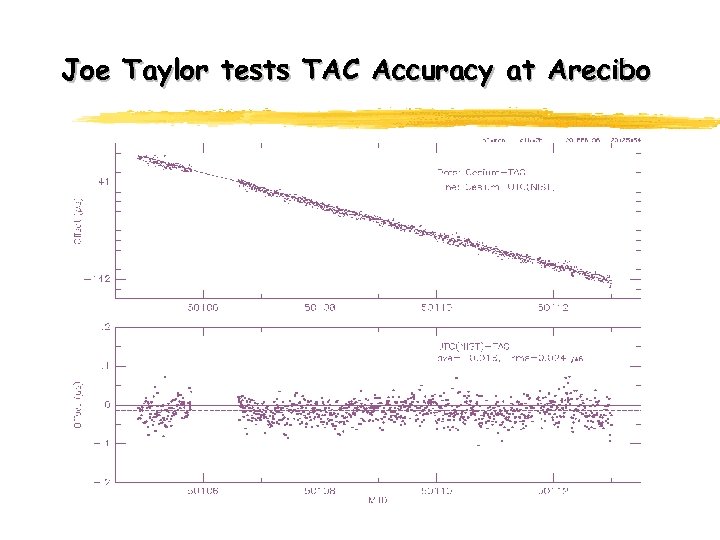 Joe Taylor tests TAC Accuracy at Arecibo
 Our Intent for this Paper Changed. . . z We originally planned to discuss the performance and some applications of single frequency GPS-Based timing receivers based primarily on our experiences with the Motorola VP and UT+ timing receivers. We planned to discuss some of the “tricks” we have used to mitigate against S/A’s effects. . . -- BUT -- z Do. D turned off S/A in early May -- AND -- z Motorola discontinued the VP receiver ION -- Sept. 20, 2000 Salt Lake City
 So Now we will Discuss. . . z A discussion of what happened when S/A was turned off. z Some recent results obtained with prototypes of a new, low cost timing receiver: OEM Chipset: Si. RFStar 1 Receiver Hardware: Axiom Navigation’s Sandpiper with Custom Firmware by Reza Abtahi/CNST z A comparison of the new Si. RF-based receiver with the venerable Motorola VP and UT+ receivers. z A discussion of the timing accuracy that can be obtained with single-frequency receivers now that S/A is off. ION -- Sept. 20, 2000 Salt Lake City
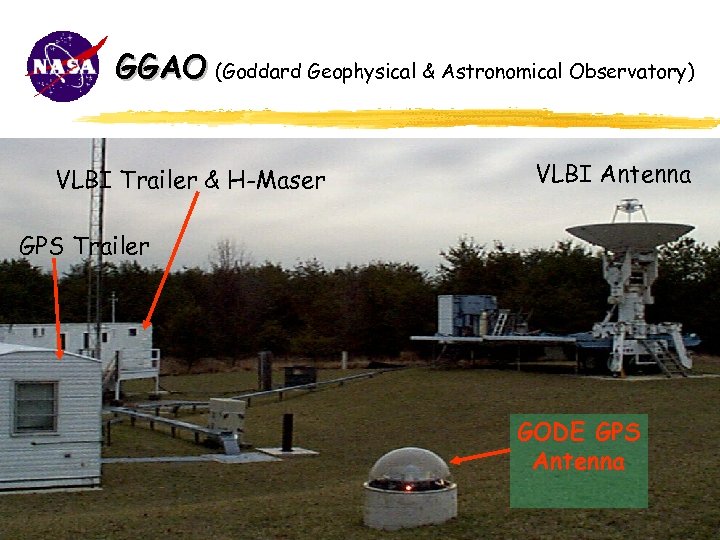 GGAO (Goddard Geophysical & Astronomical Observatory) VLBI Trailer & H-Maser VLBI Antenna GPS Trailer GODE GPS Antenna

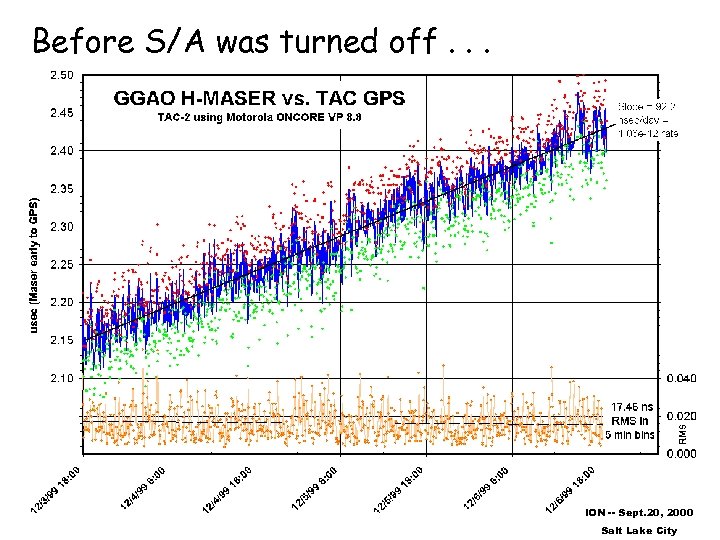 Before S/A was turned off. . . ION -- Sept. 20, 2000 Salt Lake City

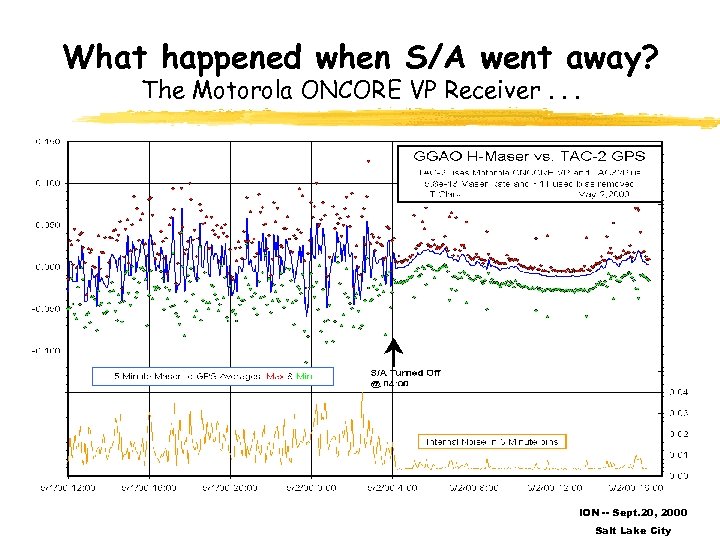 What happened when S/A went away? The Motorola ONCORE VP Receiver. . . ION -- Sept. 20, 2000 Salt Lake City
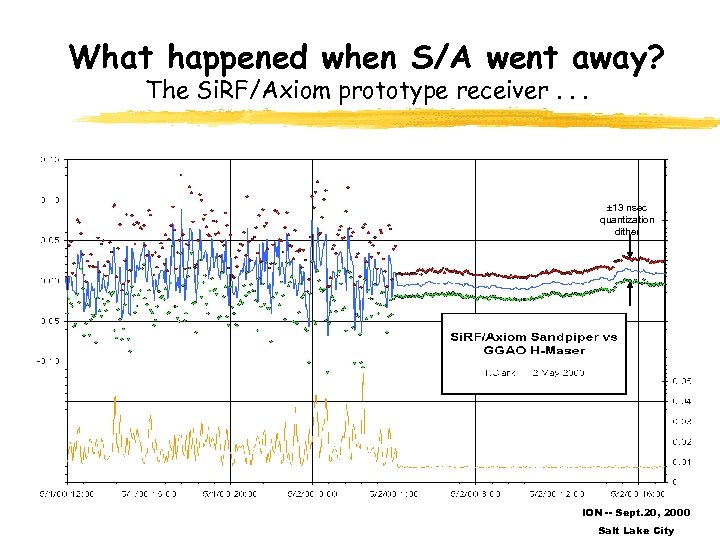 What happened when S/A went away? The Si. RF/Axiom prototype receiver. . . 13 nsec quantization dither ION -- Sept. 20, 2000 Salt Lake City
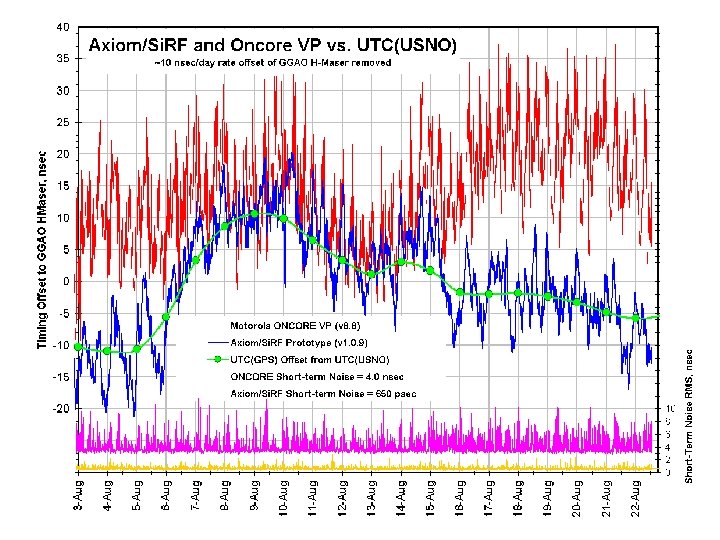
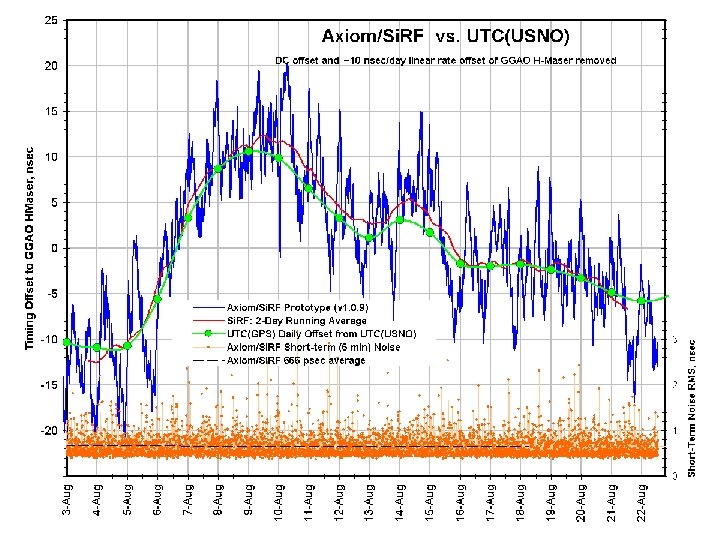
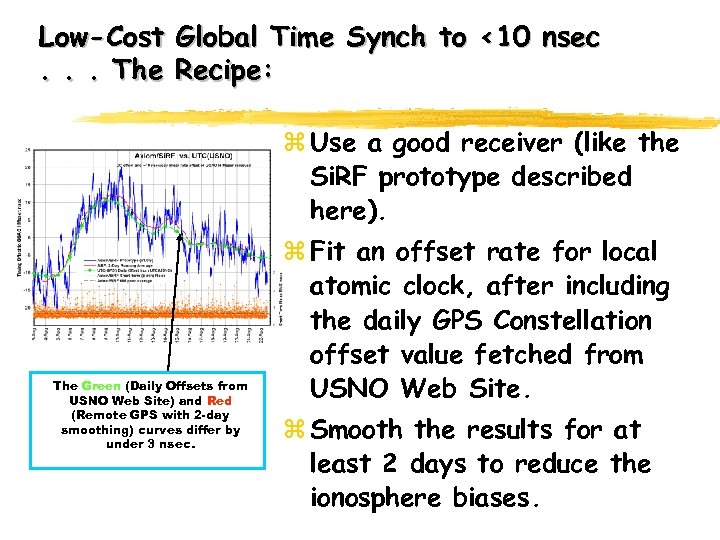 Low-Cost Global Time Synch to <10 nsec. . . The Recipe: z Use a good receiver (like the Si. RF prototype described here). The Green (Daily Offsets from USNO Web Site) and Red (Remote GPS with 2 -day smoothing) curves differ by under 3 nsec. z Fit an offset rate for local atomic clock, after including the daily GPS Constellation offset value fetched from USNO Web Site. z Smooth the results for at least 2 days to reduce the ionosphere biases.
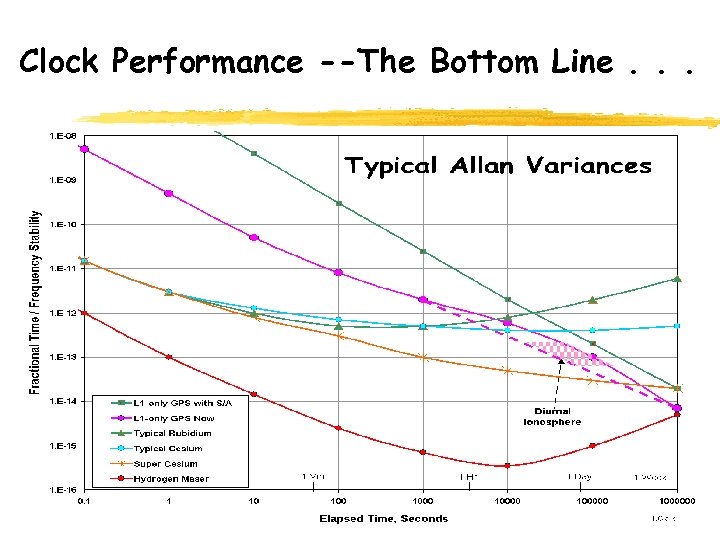 Clock Performance --The Bottom Line. . .
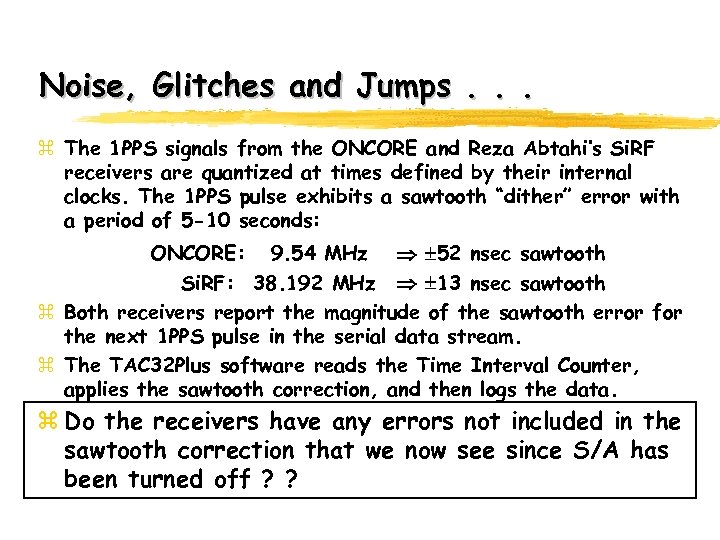 Noise, Glitches and Jumps. . . z The 1 PPS signals from the ONCORE and Reza Abtahi’s Si. RF receivers are quantized at times defined by their internal clocks. The 1 PPS pulse exhibits a sawtooth “dither” error with a period of 5 -10 seconds: ONCORE: 9. 54 MHz 52 nsec sawtooth Si. RF: 38. 192 MHz 13 nsec sawtooth z Both receivers report the magnitude of the sawtooth error for the next 1 PPS pulse in the serial data stream. z The TAC 32 Plus software reads the Time Interval Counter, applies the sawtooth correction, and then logs the data. z Do the receivers have any errors not included in the sawtooth correction that we now see since S/A has been turned off ? ?
 ONCORE UT+ V 3. 1 Short-Term Noise
 ONCORE UT+ V 3. 2 Short-Term Noise
 ONCORE VP V 10. 0 Short-Term Noise
 Si. RF/Axiom/CNST V 1. 0. 8 Short-Term Noise