 Скачать презентацию Low Carbon China Global Social Change Dr
eb79ad4417dcaabe8b30f1670d32d6ad.ppt
- Количество слайдов: 20



Low Carbon China & Global Social Change Dr David Tyfield Ce. Mo. Re/Sociology, Lancaster University Risk, Finance and Modernisation: A Chinese-European Summit Shanghai, 29 th September 2009
Overview • Climate change and low carbon innovation – social and global challenges • Explore the multiple overlapping and parallel dimensions of these problems - incorporating STS, innovation studies and political economy within a ‘mobility paradigm’ of dynamized sociology • Strengths, weaknesses and prospects of LCI in China • The International Division of Labour of Innovation • Multi-dimensional, Contested and Normative:
Global Low Carbon Systems Transition • Climate change as a global and social problem • Change in socio-economic systems needed • Massive reductions in GHG emissions • Bankruptcy of existing social models and socioeconomic development precedents – ‘highcarbon’ society • Not ‘reducing’ but transforming human impact • Time limit (e. g. Stern Review) • How effect this shift? • Innovation • International collaboration
China & Climate Change: A Social Problem • China both vulnerable climatically and crucial to solution • China is a developing country: cannot and must not be forced to choose between environment and development • Globally no. 1 in GHG emissions now and growing • Low historical and per capita emissions BUT changing: as early as 2020 per capita could be double EU. • Vhuge opportunity from massive infrastructure investment (e. g. equivalent of entire European building stock) – how? not if • China must take a leading role in a global low carbon shift
Low Carbon Innovation - 1 • Great interest from policy BUT what is it? • “Systems” change – climate change as social issue • Innovation is always a socio-political process of socio-technical change – both in parallel At least 3 -fold interaction of social, political economic and cultural-political dimensions AND Globalized in each case Constructing/performing the ‘global’ • The emergence (or not) of low-carbon world, with China at its core, is a clear example of this process
(Low Carbon) Innovation - 2 Social • Socio-technical: parallel; embedding; unpredictable/ synchronicity • Global synchronicity: GINs & International Do. L of Innovation (IDLI) • Social (low-tech) and disruptive innovation – fundamental changes • ‘Democratic’, dispersed, open, user… innovation Political Economy • ‘KB(B)E’ and value ‘ladder’ – global distribution & development: IDLI • Models of support for innovation (capacity) – state vs. market • Global implications for dominant regime (IPRs, finance,
• • Low Carbon Innovation Challenges Global problem with local implications and dependencies No country has effected a low carbon shift – no exemplar Systems change: need for wide social participation Systems changes have been unpredictable/ unpredicted but this time desired ex ante and to be expedited ‘transition management’? Not a ‘Manhattan project’ Profound test for state/market funding, even the entire debate Exceptional dependence on geo-politics Need for international collaboration in innovation
China and LCI - Policy • Significant legislative drive (energy security, economic devt) • ‘Scientific Development’, ‘Harmonious Society’, Zizhu chuangxin • 11 th Five Year Plan (2006) and Medium to Long-Term Plan • Climate Change White Paper and National Climate Change Programme • Energy Conservation Law, Renewable Energy Law, Promotion Law of Clean Production, Circular Economy Law • State support through STI programmes: 863, 973, Torch… • Ambitious targets for energy efficiency, renewables
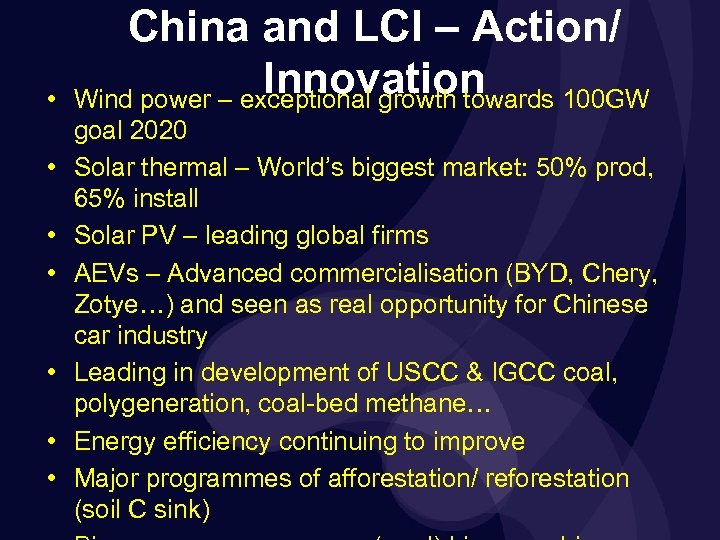
• • China and LCI – Action/ Innovation Wind power – exceptional growth towards 100 GW goal 2020 Solar thermal – World’s biggest market: 50% prod, 65% install Solar PV – leading global firms AEVs – Advanced commercialisation (BYD, Chery, Zotye…) and seen as real opportunity for Chinese car industry Leading in development of USCC & IGCC coal, polygeneration, coal-bed methane… Energy efficiency continuing to improve Major programmes of afforestation/ reforestation (soil C sink)
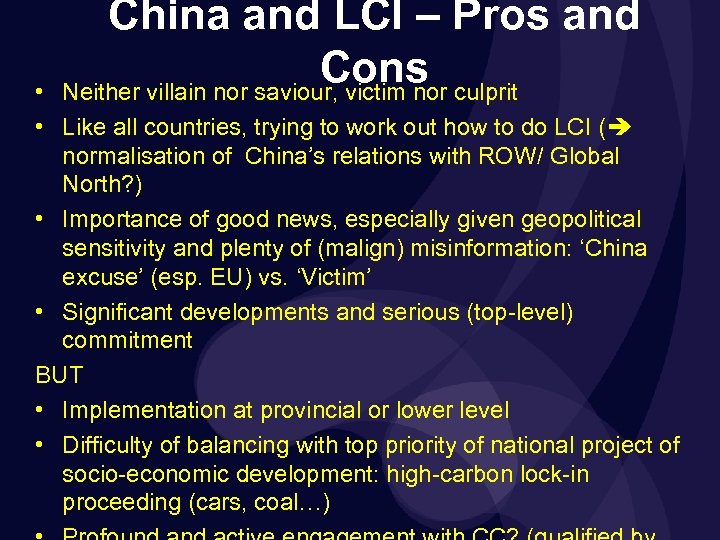
China and LCI – Pros and Cons culprit Neither villain nor saviour, victim nor • • Like all countries, trying to work out how to do LCI ( normalisation of China’s relations with ROW/ Global North? ) • Importance of good news, especially given geopolitical sensitivity and plenty of (malign) misinformation: ‘China excuse’ (esp. EU) vs. ‘Victim’ • Significant developments and serious (top-level) commitment BUT • Implementation at provincial or lower level • Difficulty of balancing with top priority of national project of socio-economic development: high-carbon lock-in proceeding (cars, coal…)
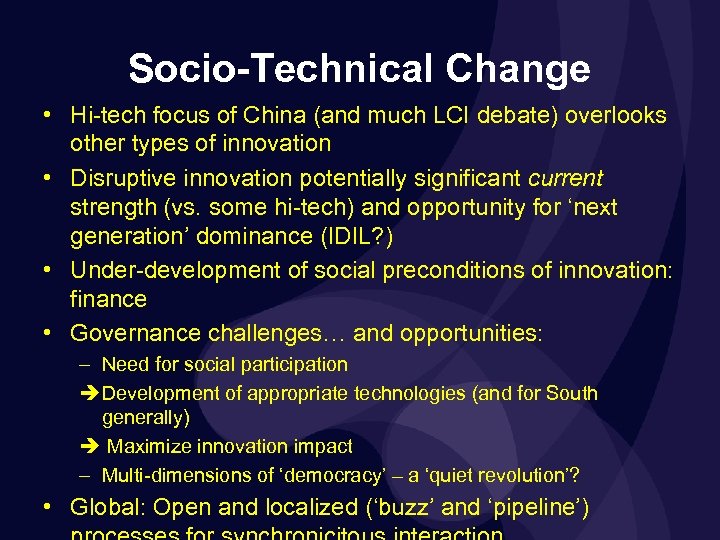
Socio-Technical Change • Hi-tech focus of China (and much LCI debate) overlooks other types of innovation • Disruptive innovation potentially significant current strength (vs. some hi-tech) and opportunity for ‘next generation’ dominance (IDIL? ) • Under-development of social preconditions of innovation: finance • Governance challenges… and opportunities: – Need for social participation Development of appropriate technologies (and for South generally) Maximize innovation impact – Multi-dimensions of ‘democracy’ – a ‘quiet revolution’? • Global: Open and localized (‘buzz’ and ‘pipeline’)
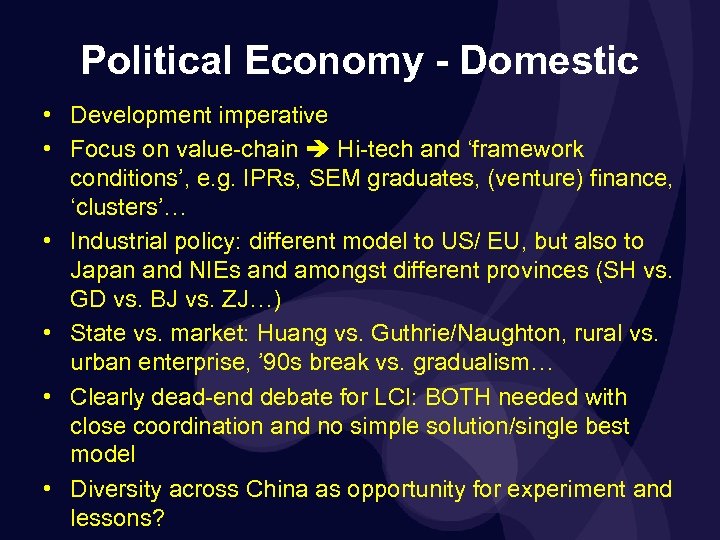
Political Economy - Domestic • Development imperative • Focus on value-chain Hi-tech and ‘framework conditions’, e. g. IPRs, SEM graduates, (venture) finance, ‘clusters’… • Industrial policy: different model to US/ EU, but also to Japan and NIEs and amongst different provinces (SH vs. GD vs. BJ vs. ZJ…) • State vs. market: Huang vs. Guthrie/Naughton, rural vs. urban enterprise, ’ 90 s break vs. gradualism… • Clearly dead-end debate for LCI: BOTH needed with close coordination and no simple solution/single best model • Diversity across China as opportunity for experiment and lessons?
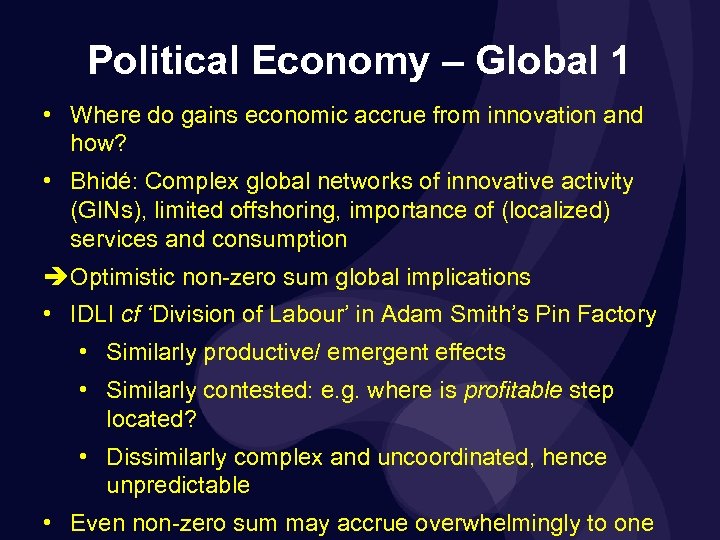
Political Economy – Global 1 • Where do gains economic accrue from innovation and how? • Bhidé: Complex global networks of innovative activity (GINs), limited offshoring, importance of (localized) services and consumption Optimistic non-zero sum global implications • IDLI cf ‘Division of Labour’ in Adam Smith’s Pin Factory • Similarly productive/ emergent effects • Similarly contested: e. g. where is profitable step located? • Dissimilarly complex and uncoordinated, hence unpredictable • Even non-zero sum may accrue overwhelmingly to one
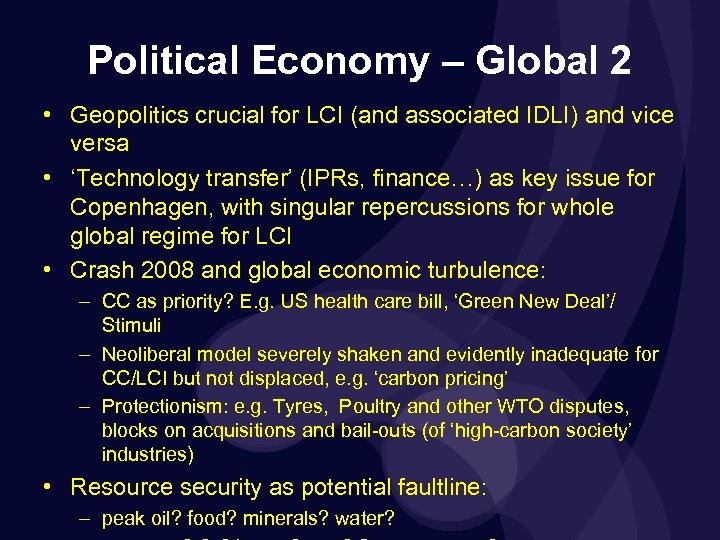
Political Economy – Global 2 • Geopolitics crucial for LCI (and associated IDLI) and vice versa • ‘Technology transfer’ (IPRs, finance…) as key issue for Copenhagen, with singular repercussions for whole global regime for LCI • Crash 2008 and global economic turbulence: – CC as priority? E. g. US health care bill, ‘Green New Deal’/ Stimuli – Neoliberal model severely shaken and evidently inadequate for CC/LCI but not displaced, e. g. ‘carbon pricing’ – Protectionism: e. g. Tyres, Poultry and other WTO disputes, blocks on acquisitions and bail-outs (of ‘high-carbon society’ industries) • Resource security as potential faultline: – peak oil? food? minerals? water?
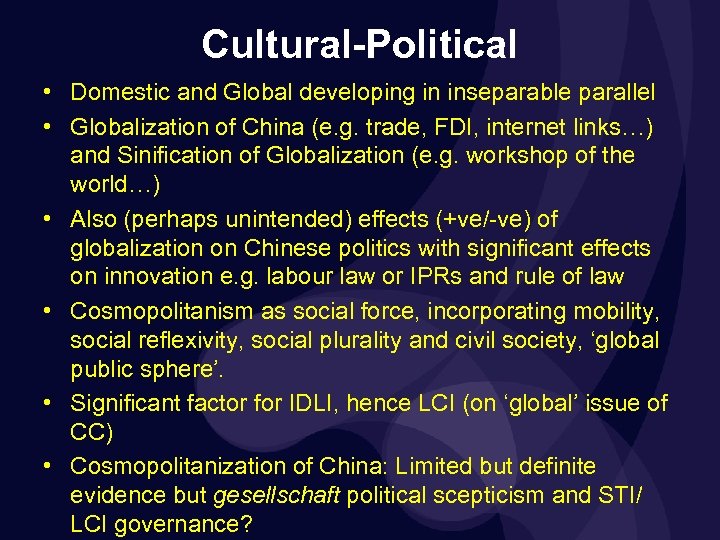
Cultural-Political • Domestic and Global developing in inseparable parallel • Globalization of China (e. g. trade, FDI, internet links…) and Sinification of Globalization (e. g. workshop of the world…) • Also (perhaps unintended) effects (+ve/-ve) of globalization on Chinese politics with significant effects on innovation e. g. labour law or IPRs and rule of law • Cosmopolitanism as social force, incorporating mobility, social reflexivity, social plurality and civil society, ‘global public sphere’. • Significant factor for IDLI, hence LCI (on ‘global’ issue of CC) • Cosmopolitanization of China: Limited but definite evidence but gesellschaft political scepticism and STI/ LCI governance?

Why is Innovation Important? • Innovation direction not just scale Not necessarily good • Not just about economic growth/productivity (and for ‘us’) • Crucial for socio-economic trajectories of development towards desired ways of life: • Which innovation? ‘Desired’ by whom? (Global) politics and policy (Taking the European Knowledge Society Seriously (TEKSS) DG Research 2008) • A dynamized, enabled society capable of dealing with uncertainty and risk • Cosmopolitan innovation, equitable IDLI and
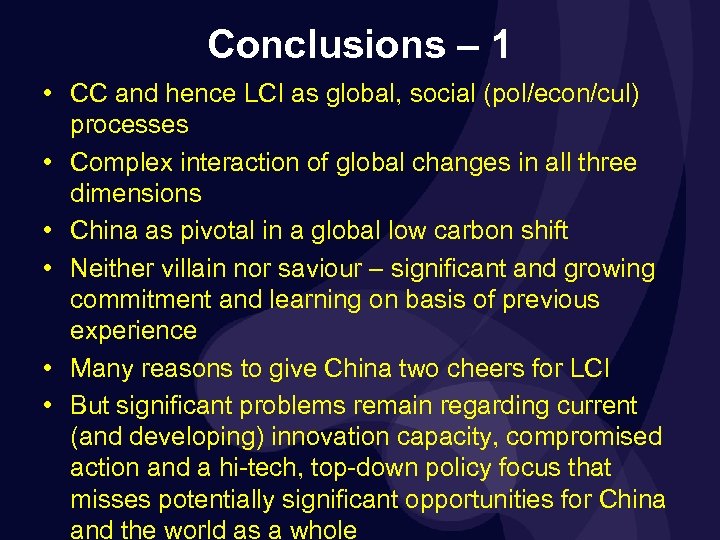
Conclusions – 1 • CC and hence LCI as global, social (pol/econ/cul) processes • Complex interaction of global changes in all three dimensions • China as pivotal in a global low carbon shift • Neither villain nor saviour – significant and growing commitment and learning on basis of previous experience • Many reasons to give China two cheers for LCI • But significant problems remain regarding current (and developing) innovation capacity, compromised action and a hi-tech, top-down policy focus that misses potentially significant opportunities for China and the world as a whole
Conclusions – 2 • Which IDLI emerges as crucial determinant of LCI in China and LCI/ CC more broadly, to optimize unpredictable S-T change • ‘Leapfrog’ China will need to work with partners and vice versa Joint setting of S-T trajectory over the medium term • Direction of development of LCI and IDLI Shape (global) low-carbon societies - equity, liberty, community • No single model for state/market support of LCI and no ex ante correct solution for multiple intersecting issues: ‘wicked problem’ • Understanding of interaction and nature of
China-UK Workshop on Chinese Disruptive Low-Carbon Innovation Hangzhou, 20 th November 2009
谢谢 This research forms part of the ‘EU-China Low Carbon Networks’ Project at Lancaster University. We gratefully note the funding of the ESRC and AIM EU/China Low Carbon Project Team: Dr David Tyfield d. tyfield@lancaster. ac. uk Prof John Urry j. urry@lancaster. ac. uk Dr James Wilsdon james. wilsdon@royalsociety. org Prof Brian Wynne b. wynne@lancaster. ac. uk
Скачать презентацию Low Carbon China Global Social Change Dr
eb79ad4417dcaabe8b30f1670d32d6ad.ppt