


 Скачать презентацию Los Mandatos Spanish III Mrs Pacheco What
2fac866676bffcaee8ac349642b643ec.ppt
- Количество слайдов: 53
 Los Mandatos Spanish III Mrs. Pacheco
 What does these words have in common? Stop! Sit down! Please open the window. Please wash the dishes. Go to the party. Pet the puppy. Do not eat the cookies! Don't take the car out tonight! ← (command) ← (request) ← (grant permission) ← (deny permission)
 Commands are used when ordering, or telling someone to do something. This is often referred to as the "imperative mood" form of the verb. By now, you are well acquainted with the fact that Spanish has both a formal and an informal style of speech (Tú / Usted). This distinction applies to commands. Informal, or familiar, speech is used among friends, coworkers, relatives, or when addressing a child. Formal speech is generally used to be polite or to express respect. For that reason, the formal commands are often referred to as polite commands.
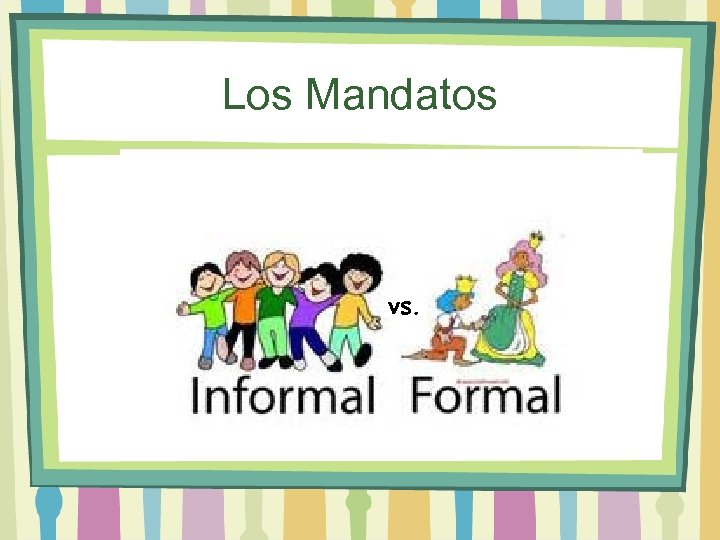 Los Mandatos vs.
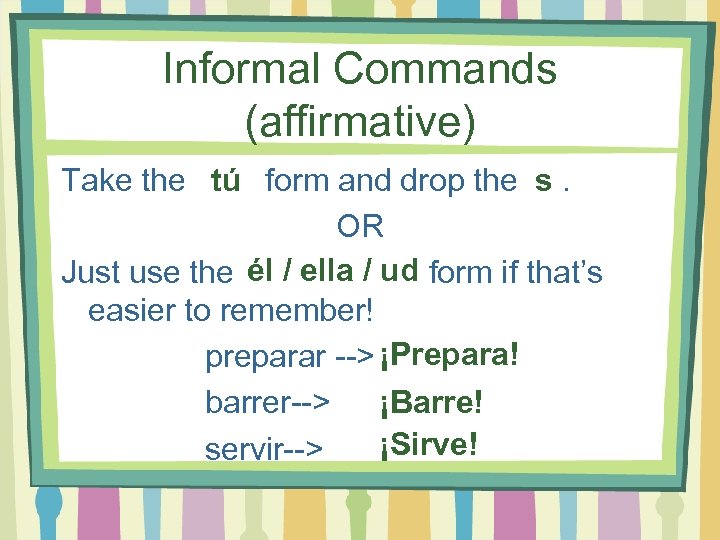 Informal Commands (affirmative) Take the tú form and drop the s. OR Just use the él / ella / ud form if that’s easier to remember! preparar --> ¡Prepara! ¡Barre! barrer--> ¡Sirve! servir-->
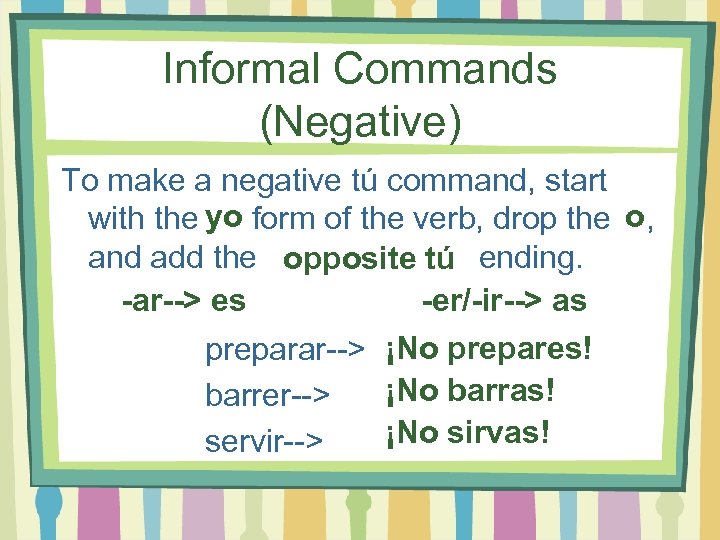 Informal Commands (Negative) To make a negative tú command, start with the yo form of the verb, drop the o , and add the opposite tú ending. -ar--> es -er/-ir--> as preparar--> ¡No prepares! ¡No barras! barrer--> ¡No sirvas! servir-->
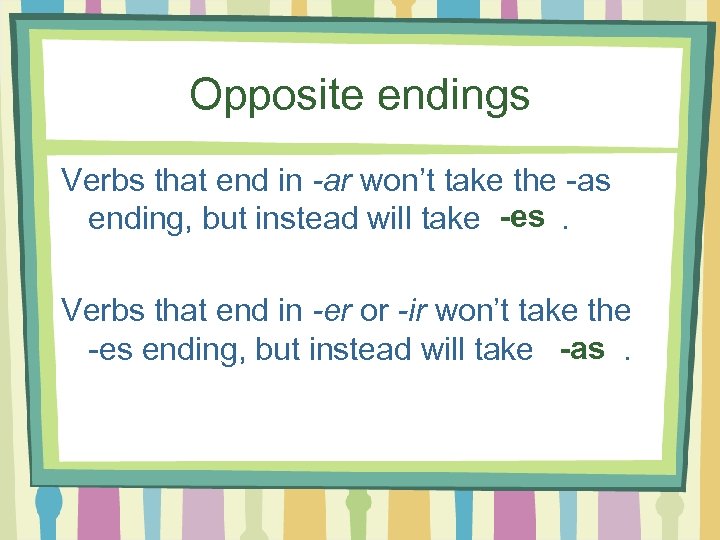 Opposite endings Verbs that end in -ar won’t take the -as ending, but instead will take -es. Verbs that end in -er or -ir won’t take the -es ending, but instead will take -as.
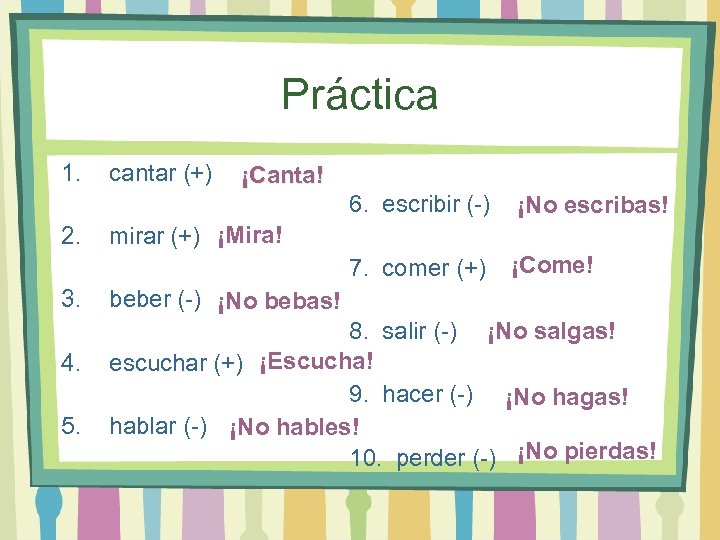 Práctica 1. cantar (+) ¡Canta! 6. escribir (-) 7. comer (+) 2. 3. 4. 5. ¡No escribas! ¡Come! mirar (+) ¡Mira! beber (-) ¡No bebas! 8. salir (-) ¡No salgas! escuchar (+) ¡Escucha! 9. hacer (-) ¡No hagas! hablar (-) ¡No hables! 10. perder (-) ¡No pierdas!
 -car, -gar, -zar verbs When we make negative commands from a verb that ends in -car, -gar, or -zar, we make some spelling changes to keep the original sound.
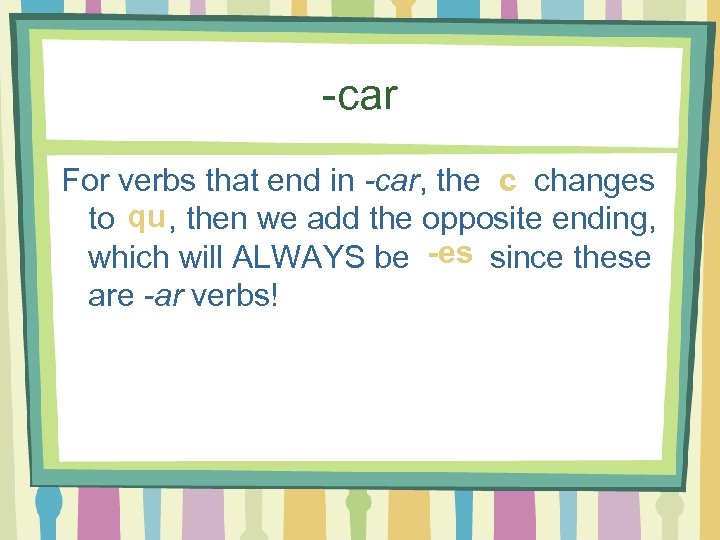 -car For verbs that end in -car, the c changes to qu , then we add the opposite ending, which will ALWAYS be -es since these are -ar verbs!
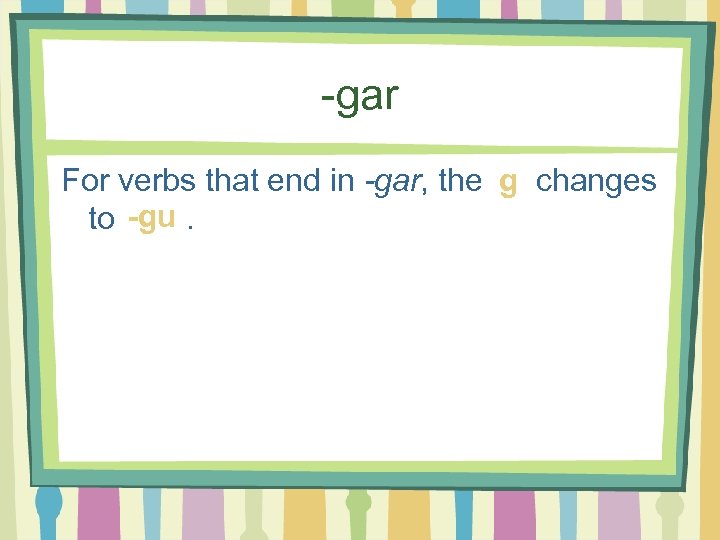 -gar For verbs that end in -gar, the g changes to -gu.
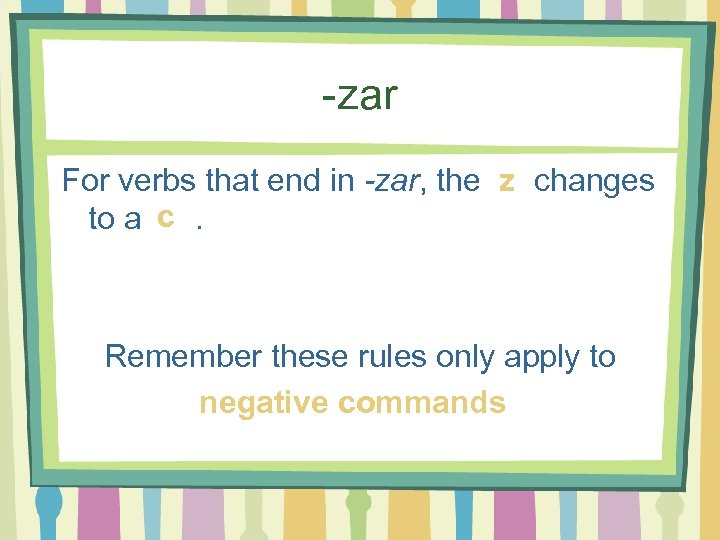 -zar For verbs that end in -zar, the z changes to a c. Remember these rules only apply to negative commands
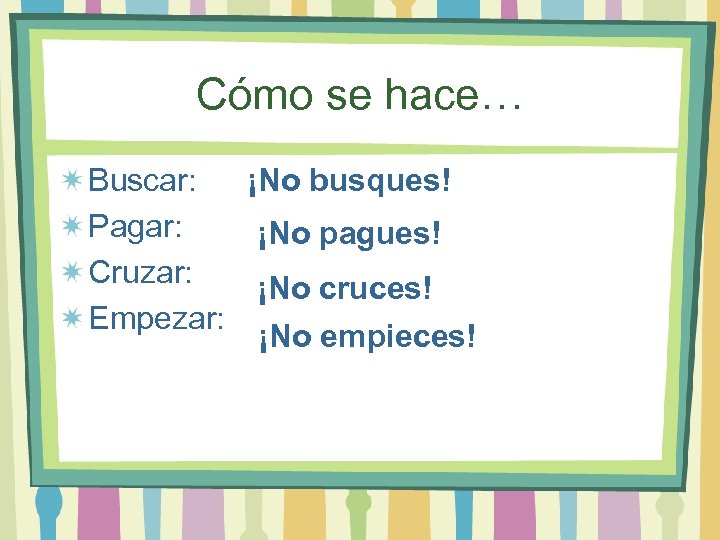 Cómo se hace… Buscar: ¡No busques! Pagar: ¡No pagues! Cruzar: ¡No cruces! Empezar: ¡No empieces!
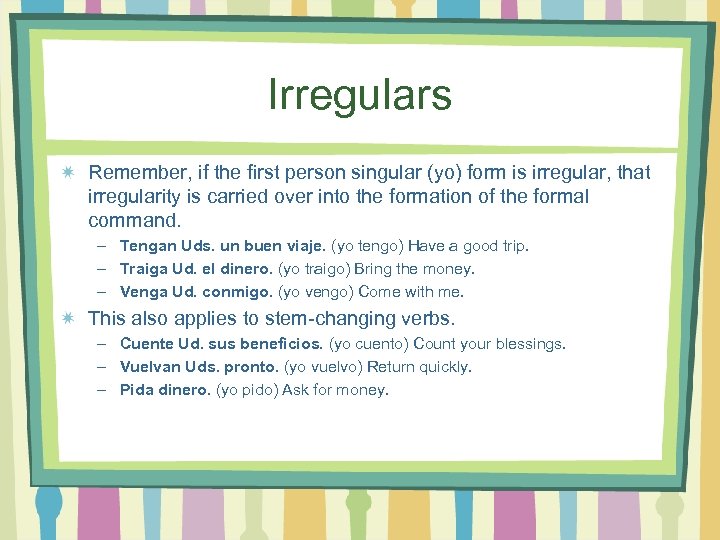 Irregulars Remember, if the first person singular (yo) form is irregular, that irregularity is carried over into the formation of the formal command. – Tengan Uds. un buen viaje. (yo tengo) Have a good trip. – Traiga Ud. el dinero. (yo traigo) Bring the money. – Venga Ud. conmigo. (yo vengo) Come with me. This also applies to stem-changing verbs. – Cuente Ud. sus beneficios. (yo cuento) Count your blessings. – Vuelvan Uds. pronto. (yo vuelvo) Return quickly. – Pida dinero. (yo pido) Ask for money.
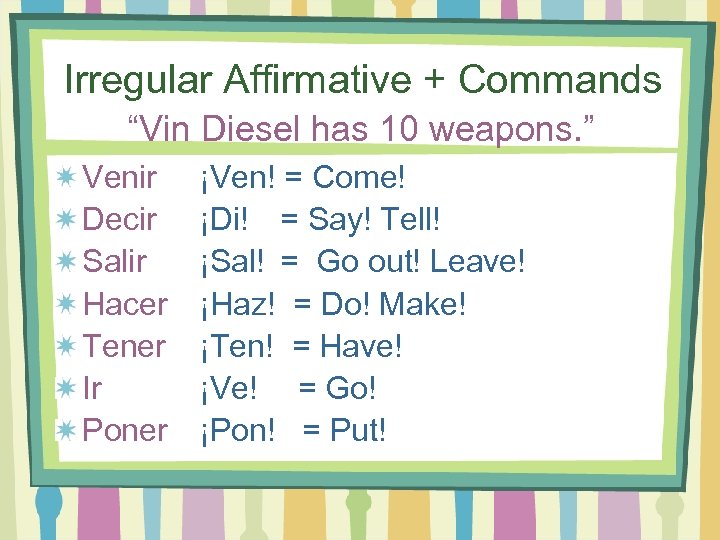 Irregular Affirmative + Commands “Vin Diesel has 10 weapons. ” Venir Decir Salir Hacer Tener Ir Poner ¡Ven! = Come! ¡Di! = Say! Tell! ¡Sal! = Go out! Leave! ¡Haz! = Do! Make! ¡Ten! = Have! ¡Ve! = Go! ¡Pon! = Put!
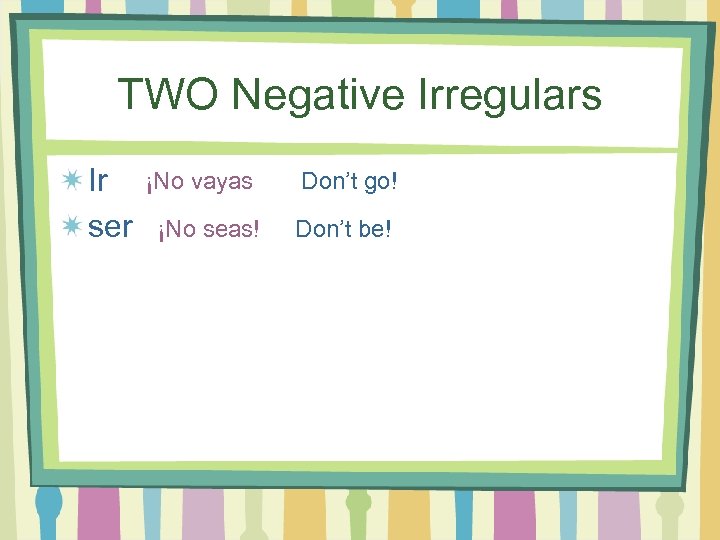 TWO Negative Irregulars Ir ser ¡No vayas Don’t go! ¡No seas! Don’t be!
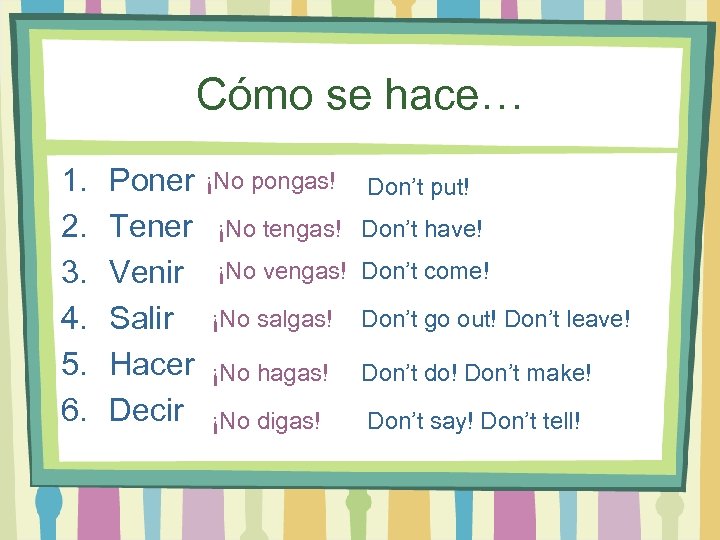 Cómo se hace… 1. 2. 3. 4. 5. 6. Poner Tener Venir Salir Hacer Decir ¡No pongas! Don’t put! ¡No tengas! Don’t have! ¡No vengas! Don’t come! ¡No salgas! Don’t go out! Don’t leave! ¡No hagas! Don’t do! Don’t make! ¡No digas! Don’t say! Don’t tell!
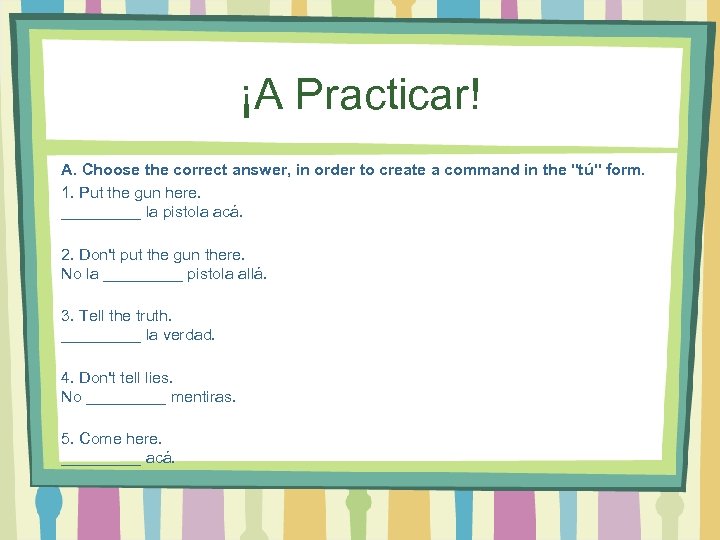 ¡A Practicar! A. Choose the correct answer, in order to create a command in the "tú" form. 1. Put the gun here. _____ la pistola acá. 2. Don't put the gun there. No la _____ pistola allá. 3. Tell the truth. _____ la verdad. 4. Don't tell lies. No _____ mentiras. 5. Come here. _____ acá.
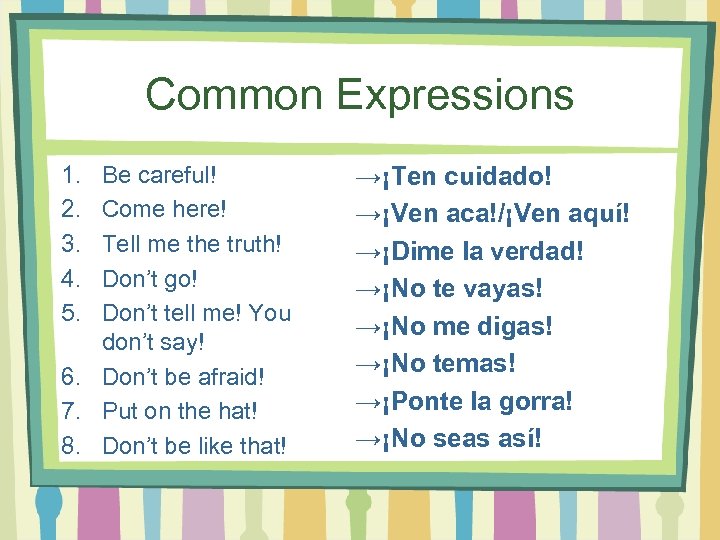 Common Expressions 1. 2. 3. 4. 5. Be careful! Come here! Tell me the truth! Don’t go! Don’t tell me! You don’t say! 6. Don’t be afraid! 7. Put on the hat! 8. Don’t be like that! →¡Ten cuidado! →¡Ven aca!/¡Ven aquí! →¡Dime la verdad! →¡No te vayas! →¡No me digas! →¡No temas! →¡Ponte la gorra! →¡No seas así!
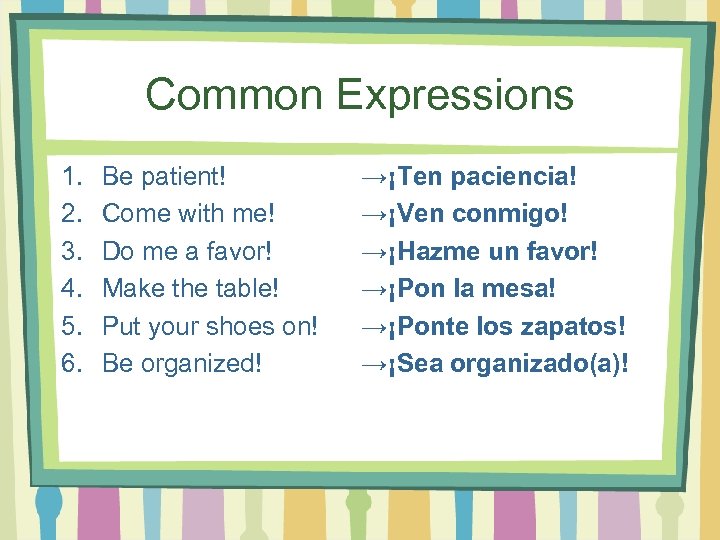 Common Expressions 1. 2. 3. 4. 5. 6. Be patient! Come with me! Do me a favor! Make the table! Put your shoes on! Be organized! →¡Ten paciencia! →¡Ven conmigo! →¡Hazme un favor! →¡Pon la mesa! →¡Ponte los zapatos! →¡Sea organizado(a)!
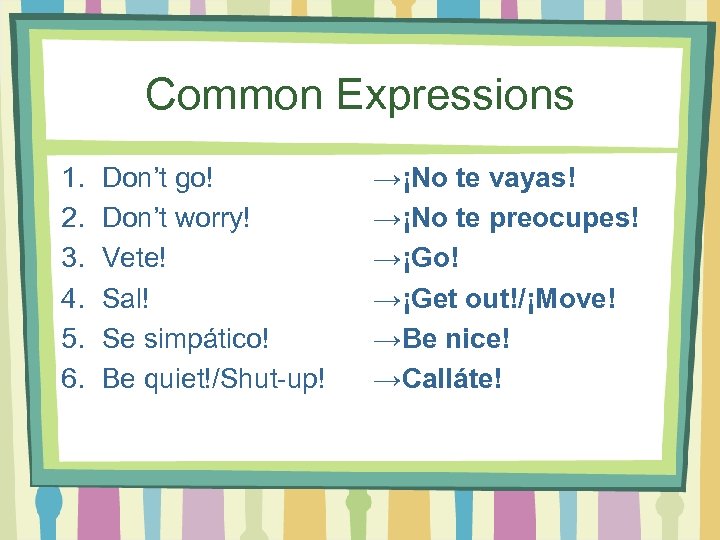 Common Expressions 1. 2. 3. 4. 5. 6. Don’t go! Don’t worry! Vete! Sal! Se simpático! Be quiet!/Shut-up! →¡No te vayas! →¡No te preocupes! →¡Go! →¡Get out!/¡Move! →Be nice! →Calláte!
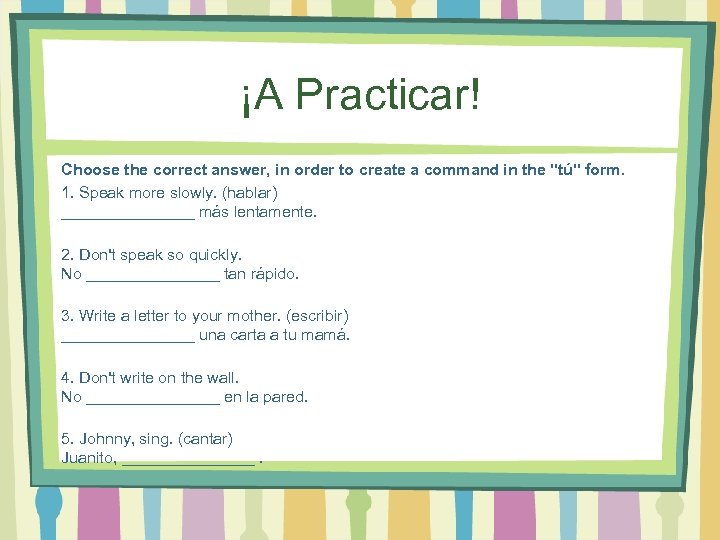 ¡A Practicar! Choose the correct answer, in order to create a command in the "tú" form. 1. Speak more slowly. (hablar) ________ más lentamente. 2. Don't speak so quickly. No ________ tan rápido. 3. Write a letter to your mother. (escribir) ________ una carta a tu mamá. 4. Don't write on the wall. No ________ en la pared. 5. Johnny, sing. (cantar) Juanito, ________.
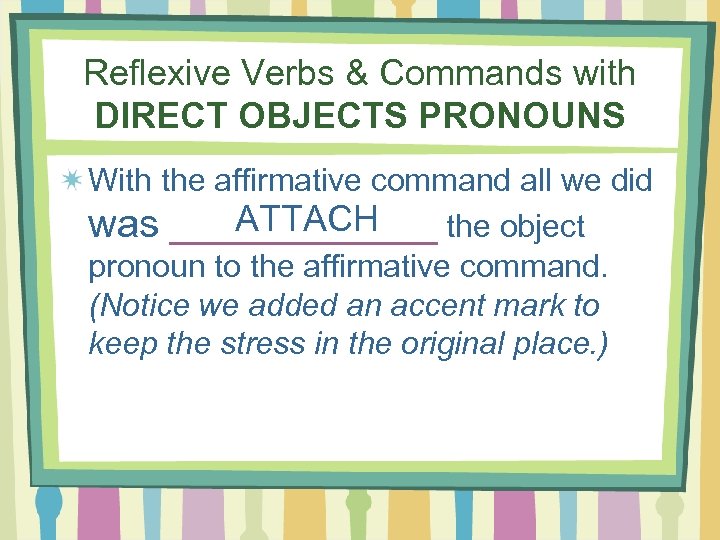 Reflexive Verbs & Commands with DIRECT OBJECTS PRONOUNS With the affirmative command all we did ATTACH was ______ the object pronoun to the affirmative command. (Notice we added an accent mark to keep the stress in the original place. )
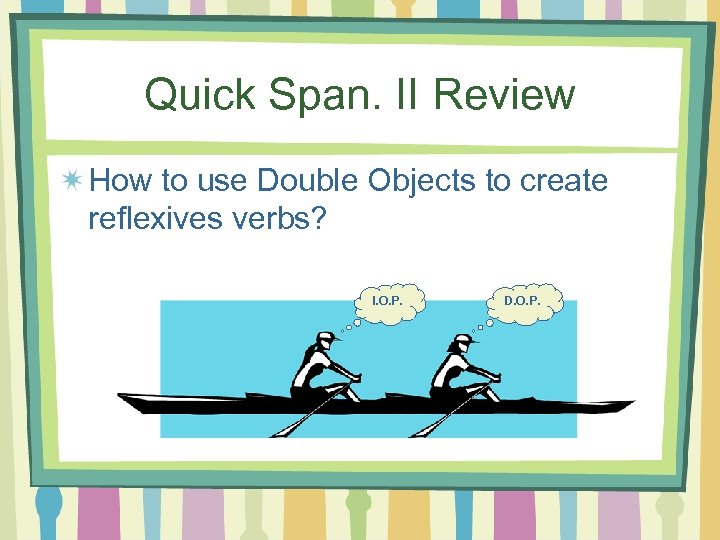 Quick Span. II Review How to use Double Objects to create reflexives verbs? I. O. P. D. O. P.
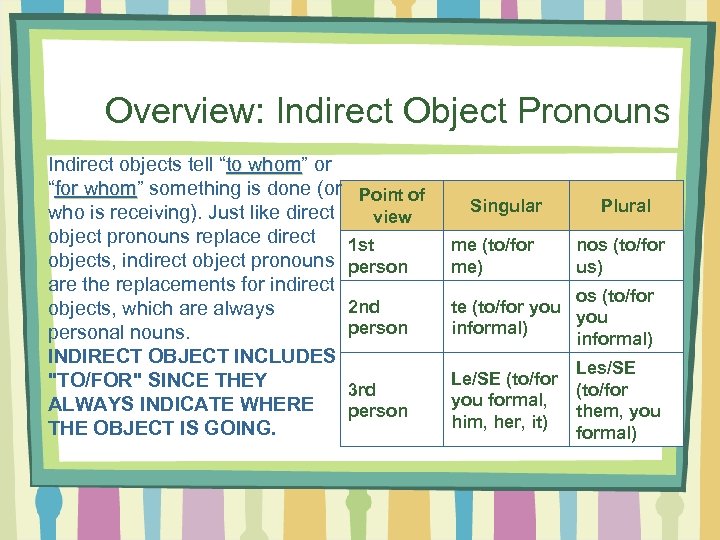 Overview: Indirect Object Pronouns Indirect objects tell “to whom” or whom “for whom” something is done (or whom who is receiving). Just like direct object pronouns replace direct objects, indirect object pronouns are the replacements for indirect objects, which are always personal nouns. INDIRECT OBJECT INCLUDES "TO/FOR" SINCE THEY ALWAYS INDICATE WHERE THE OBJECT IS GOING. Point of view Singular Plural 1 st person me (to/for me) nos (to/for us) 2 nd person os (to/for te (to/for you informal) 3 rd person Le/SE (to/for you formal, him, her, it) Les/SE (to/for them, you formal)
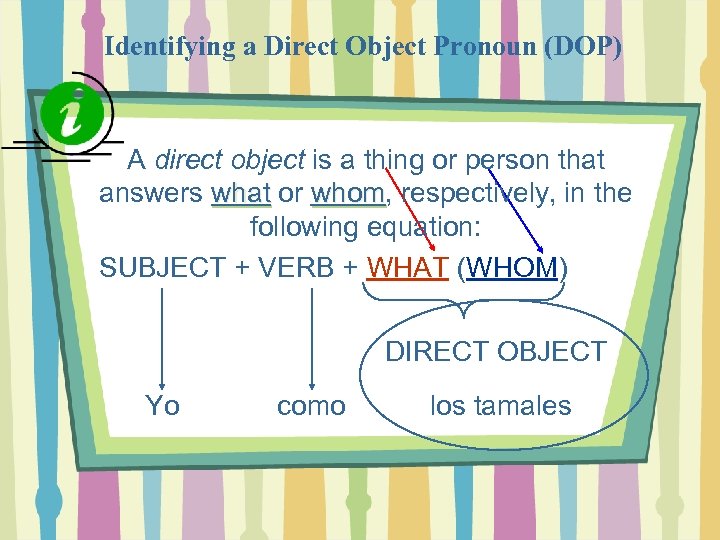 Identifying a Direct Object Pronoun (DOP) A direct object is a thing or person that answers what or whom, respectively, in the whom following equation: SUBJECT + VERB + WHAT (WHOM) DIRECT OBJECT Yo como los tamales
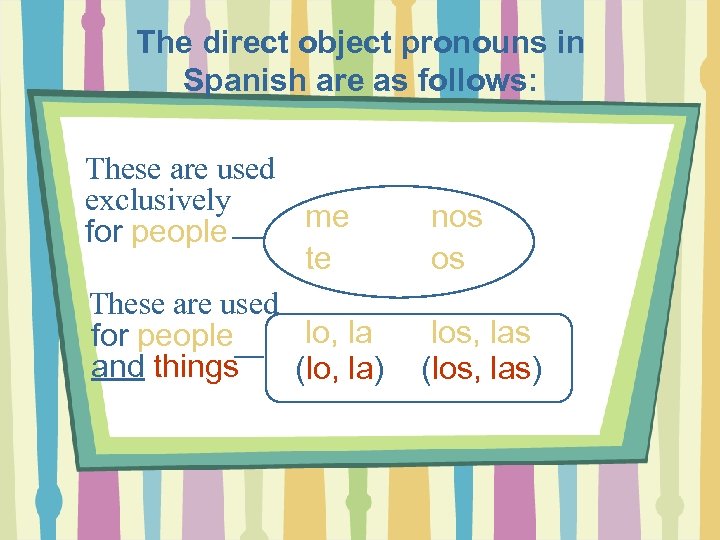 The direct object pronouns in Spanish are as follows: These are used exclusively me for people te These are used lo, la for people and things (lo, la) nos os los, las (los, las)
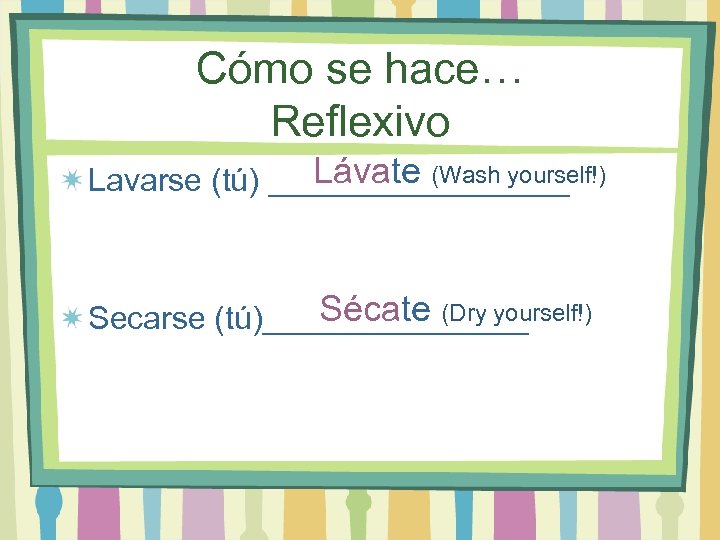 Cómo se hace… Reflexivo Lávate (Wash yourself!) Lavarse (tú) _________ Sécate (Dry yourself!) Secarse (tú)________
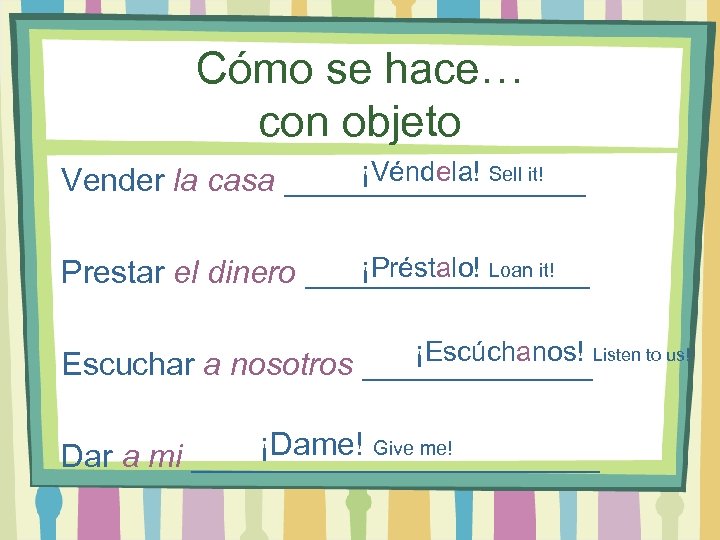 Cómo se hace… con objeto ¡Véndela! Sell it! Vender la casa _________ ¡Préstalo! Loan it! Prestar el dinero ________ ¡Escúchanos! Escuchar a nosotros _______Listen to us! ¡Dame! Give me! Dar a mi ____________
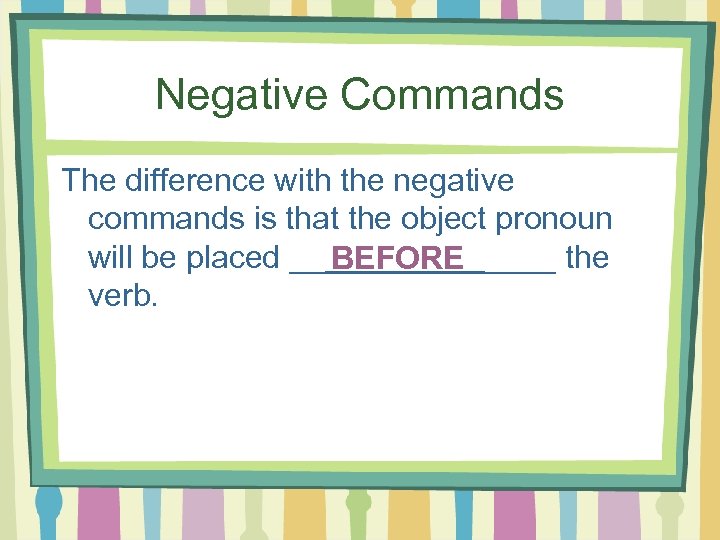 Negative Commands The difference with the negative commands is that the object pronoun will be placed ________ the BEFORE verb.
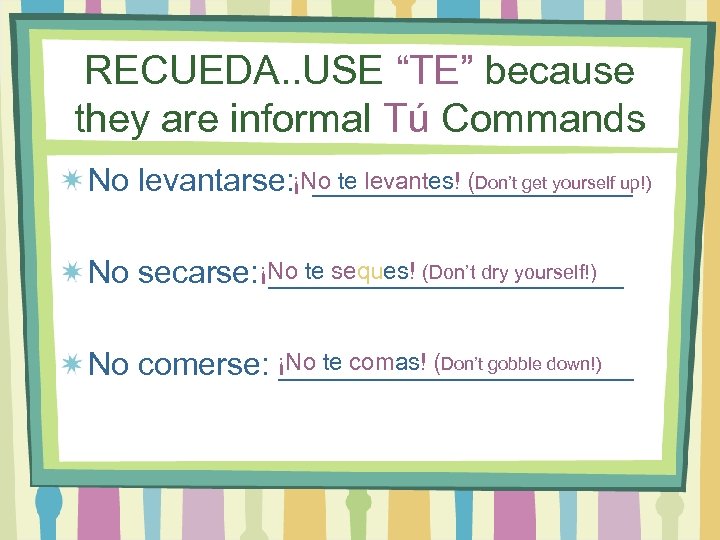 RECUEDA. . USE “TE” because they are informal Tú Commands No levantarse: ¡No te levantes! (Don’t get yourself up!) _________ No secarse: ¡No te seques! (Don’t dry yourself!) __________ No comerse: ¡No te comas! (Don’t gobble down!) __________
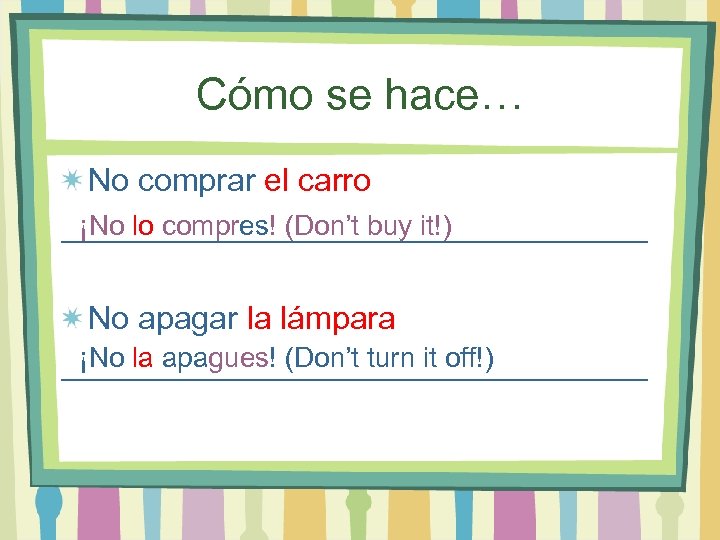 Cómo se hace… No comprar el carro ¡No lo compres! (Don’t buy it!) _________________ No apagar la lámpara ¡No la apagues! (Don’t turn it off!) _________________
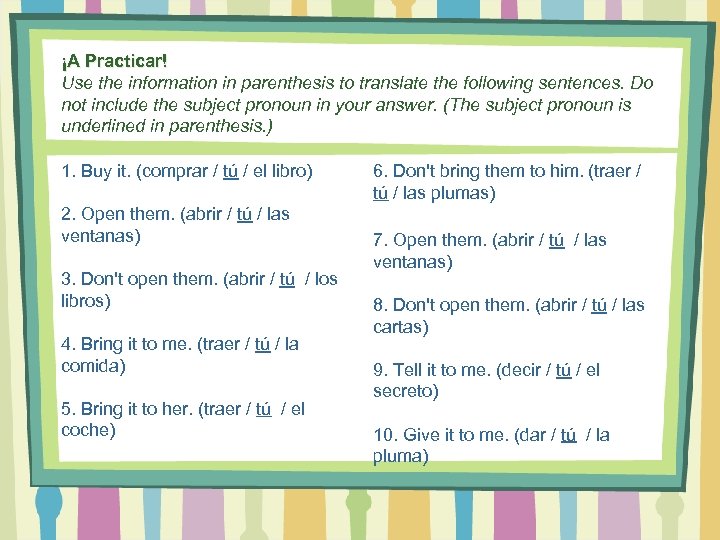 ¡A Practicar! Use the information in parenthesis to translate the following sentences. Do not include the subject pronoun in your answer. (The subject pronoun is underlined in parenthesis. ) 1. Buy it. (comprar / tú / el libro) 2. Open them. (abrir / tú / las ventanas) 3. Don't open them. (abrir / tú / los libros) 4. Bring it to me. (traer / tú / la comida) 5. Bring it to her. (traer / tú / el coche) 6. Don't bring them to him. (traer / tú / las plumas) 7. Open them. (abrir / tú / las ventanas) 8. Don't open them. (abrir / tú / las cartas) 9. Tell it to me. (decir / tú / el secreto) 10. Give it to me. (dar / tú / la pluma)
 Los Mandatos Formales
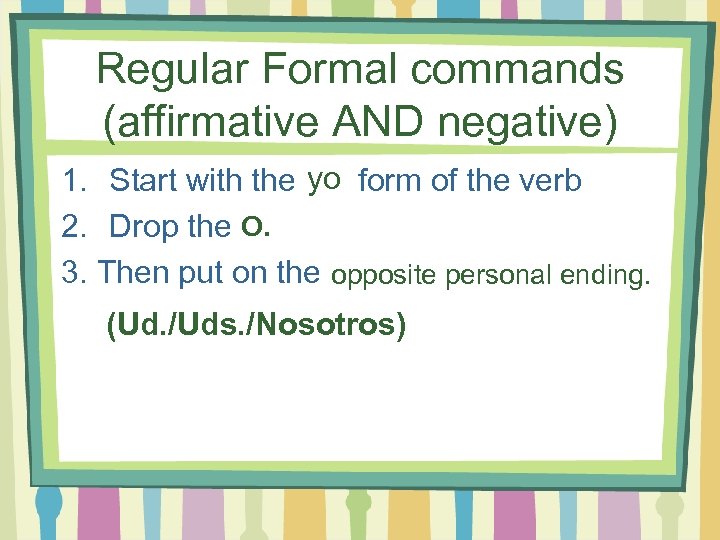 Regular Formal commands (affirmative AND negative) 1. Start with the yo form of the verb 2. Drop the O. 3. Then put on the opposite personal ending. (Ud. /Uds. /Nosotros)
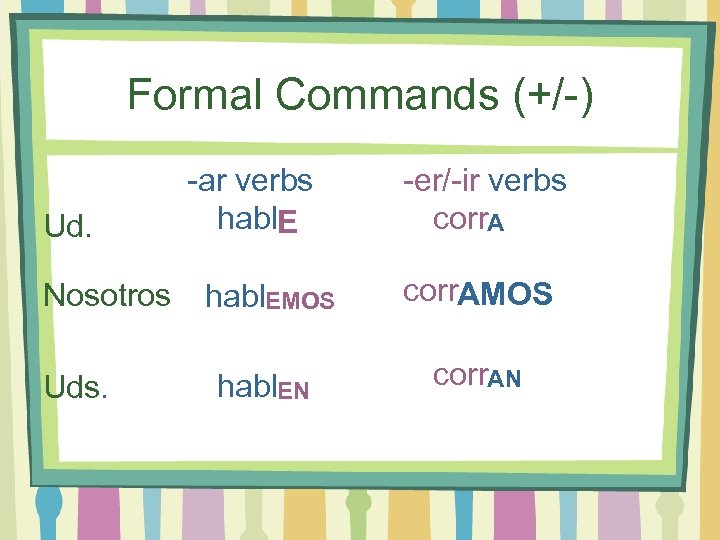 Formal Commands (+/-) Ud. Nosotros Uds. -ar verbs habl. E -er/-ir verbs corr. A habl. EMOS corr. AMOS habl. EN corr. AN
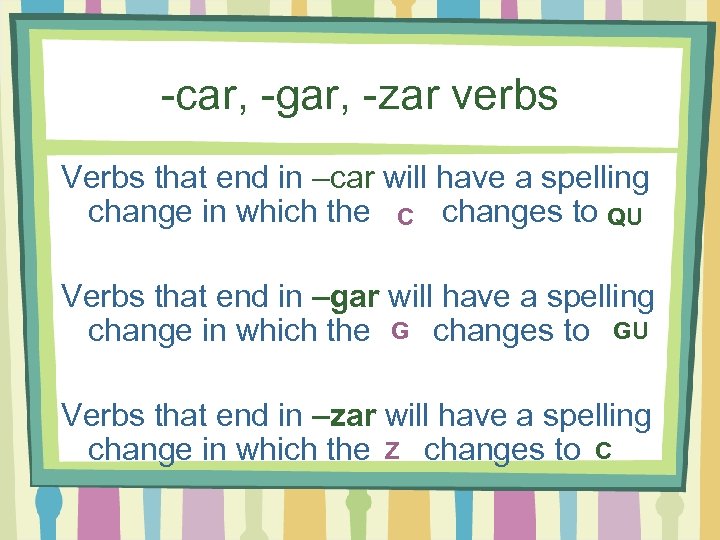 -car, -gar, -zar verbs Verbs that end in –car will have a spelling change in which the C changes to QU Verbs that end in –gar will have a spelling change in which the G changes to GU Verbs that end in –zar will have a spelling change in which the Z changes to C
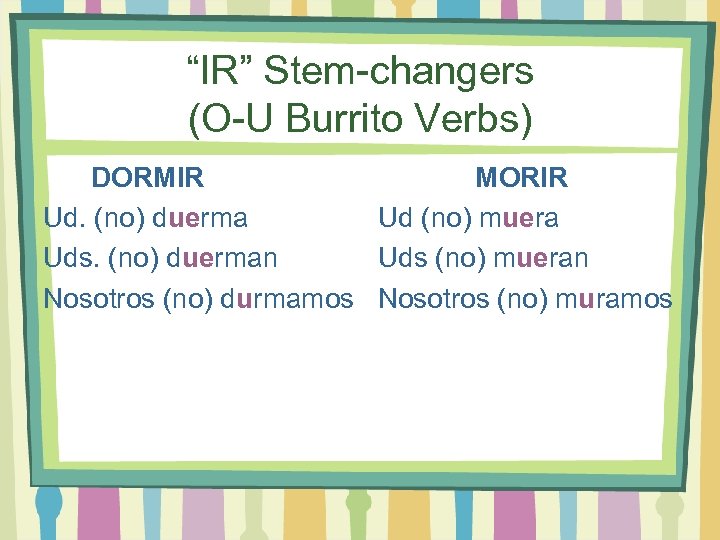 “IR” Stem-changers (O-U Burrito Verbs) DORMIR MORIR Ud. (no) duerma Ud (no) muera Uds. (no) duerman Uds (no) mueran Nosotros (no) durmamos Nosotros (no) muramos
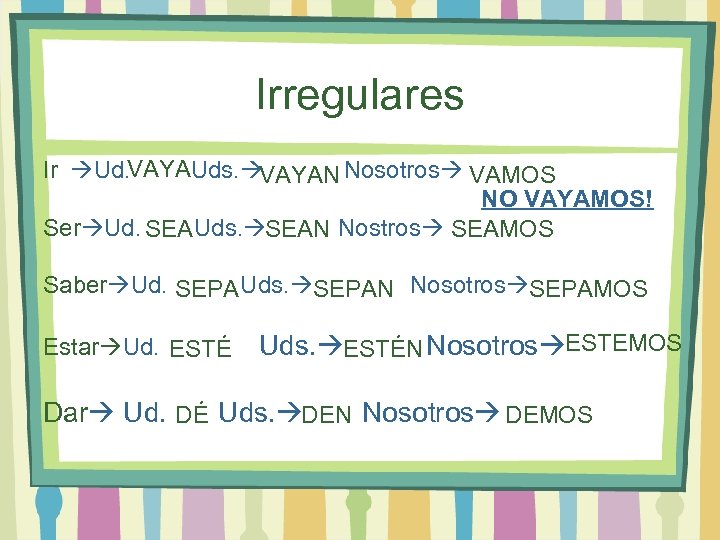 Irregulares Ir Ud. VAYAUds. VAYAN Nosotros VAMOS NO VAYAMOS! Ser Ud. SEAUds. SEAN Nostros SEAMOS Saber Ud. SEPA Uds. SEPAN Nosotros SEPAMOS Estar Ud. ESTÉ Uds. ESTÉN Nosotros ESTEMOS Dar Ud. DÉ Uds. DEN Nosotros DEMOS
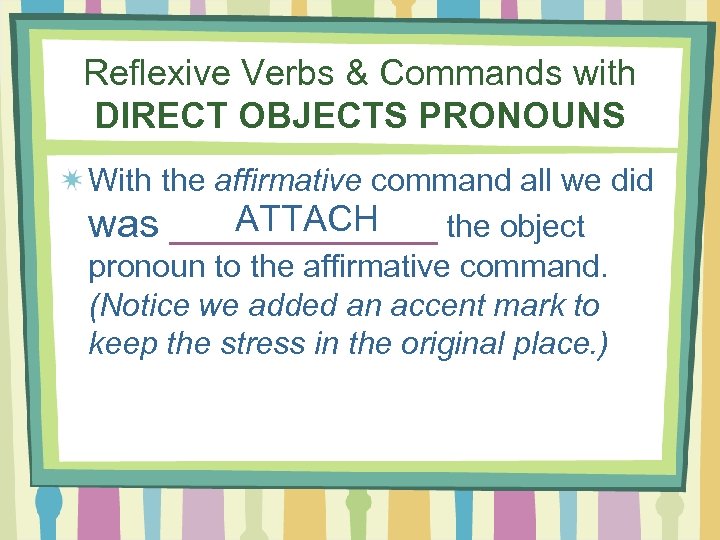 Reflexive Verbs & Commands with DIRECT OBJECTS PRONOUNS With the affirmative command all we did ATTACH was ______ the object pronoun to the affirmative command. (Notice we added an accent mark to keep the stress in the original place. )
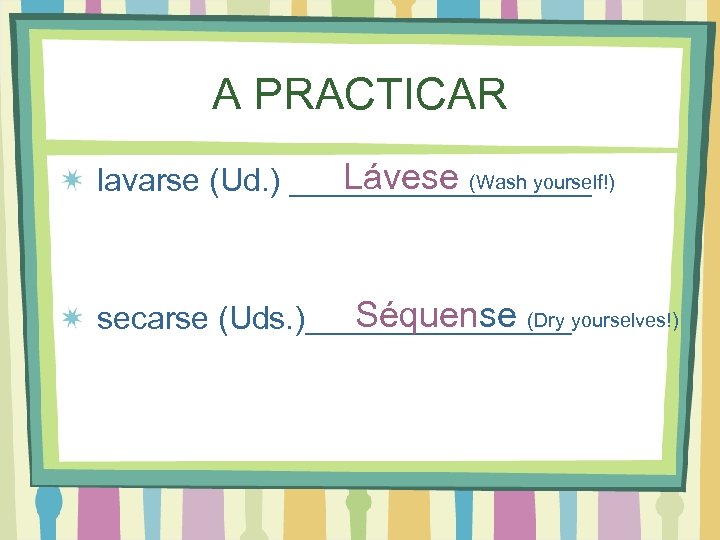 A PRACTICAR Lávese (Wash yourself!) lavarse (Ud. ) _________ Séquense (Dry secarse (Uds. )________yourselves!)
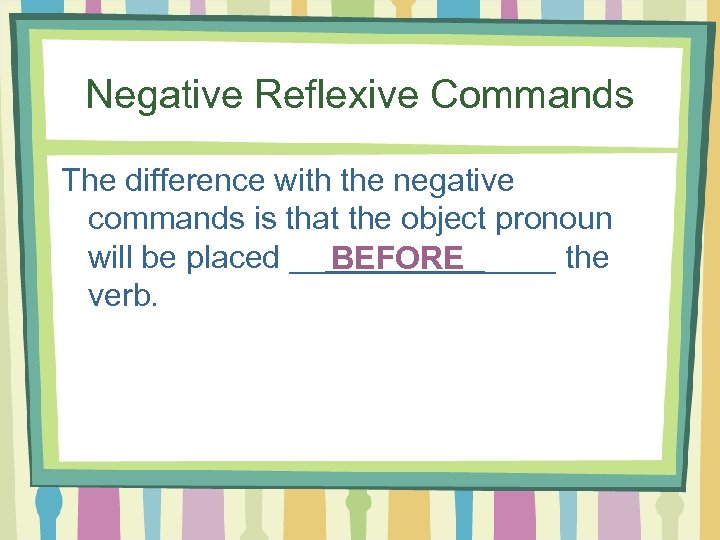 Negative Reflexive Commands The difference with the negative commands is that the object pronoun will be placed ________ the BEFORE verb.
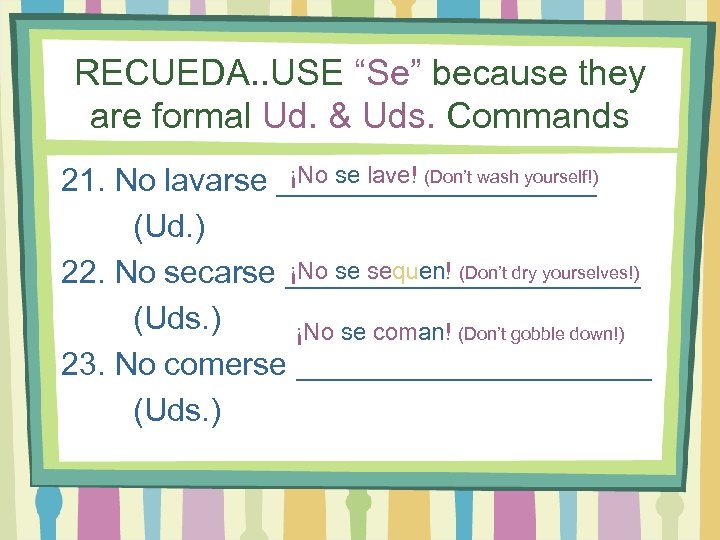 RECUEDA. . USE “Se” because they are formal Ud. & Uds. Commands ¡No se lave! (Don’t wash yourself!) 21. No lavarse _________ (Ud. ) ¡No se sequen! (Don’t dry yourselves!) 22. No secarse __________ (Uds. ) ¡No se coman! (Don’t gobble down!) 23. No comerse __________ (Uds. )
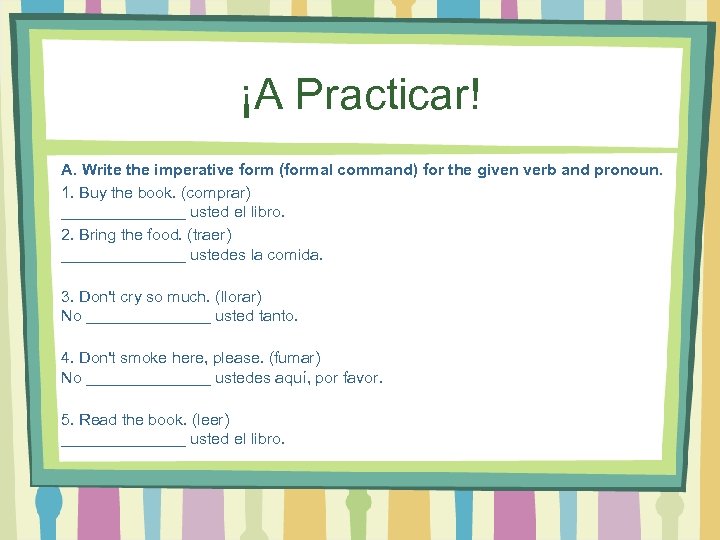 ¡A Practicar! A. Write the imperative form (formal command) for the given verb and pronoun. 1. Buy the book. (comprar) _______ usted el libro. 2. Bring the food. (traer) _______ ustedes la comida. 3. Don't cry so much. (llorar) No _______ usted tanto. 4. Don't smoke here, please. (fumar) No _______ ustedes aquí, por favor. 5. Read the book. (leer) _______ usted el libro.
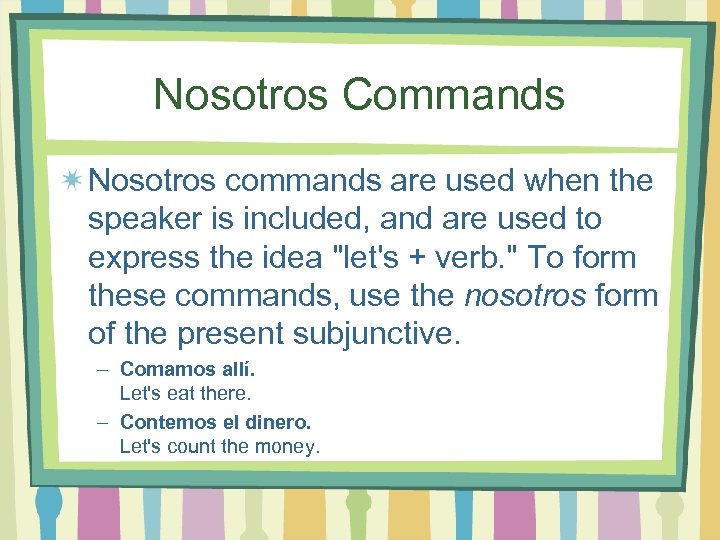 Nosotros Commands Nosotros commands are used when the speaker is included, and are used to express the idea "let's + verb. " To form these commands, use the nosotros form of the present subjunctive. – Comamos allí. Let's eat there. – Contemos el dinero. Let's count the money.
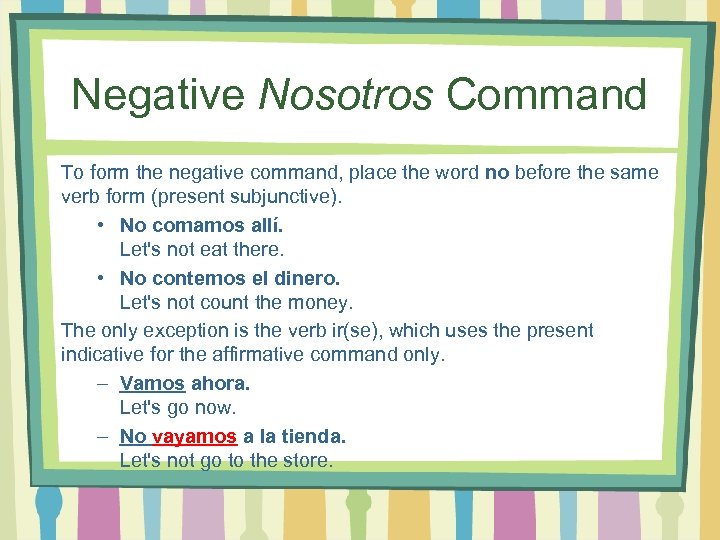 Negative Nosotros Command To form the negative command, place the word no before the same verb form (present subjunctive). • No comamos allí. Let's not eat there. • No contemos el dinero. Let's not count the money. The only exception is the verb ir(se), which uses the present indicative for the affirmative command only. – Vamos ahora. Let's go now. – No vayamos a la tienda. Let's not go to the store.
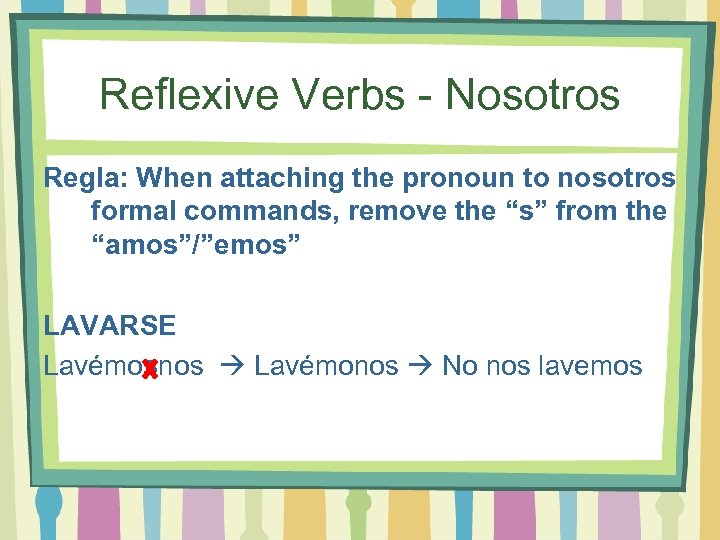 Reflexive Verbs - Nosotros Regla: When attaching the pronoun to nosotros formal commands, remove the “s” from the “amos”/”emos” LAVARSE Lavémosnos Lavémonos No nos lavemos
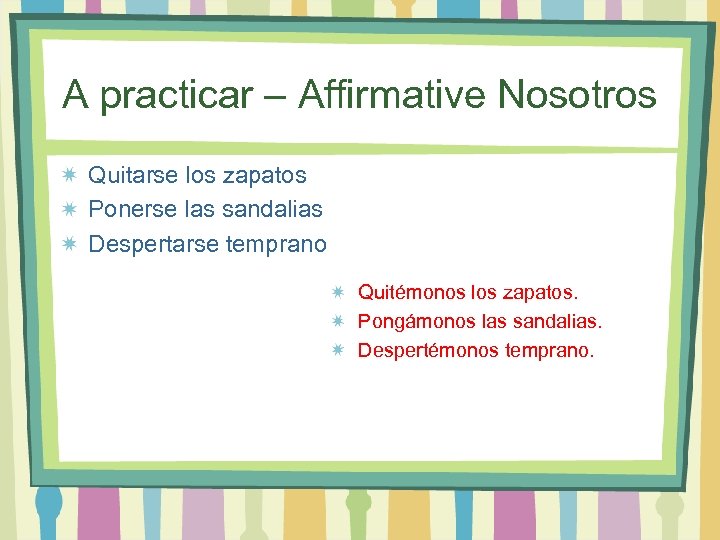 A practicar – Affirmative Nosotros Quitarse los zapatos Ponerse las sandalias Despertarse temprano Quitémonos los zapatos. Pongámonos las sandalias. Despertémonos temprano.
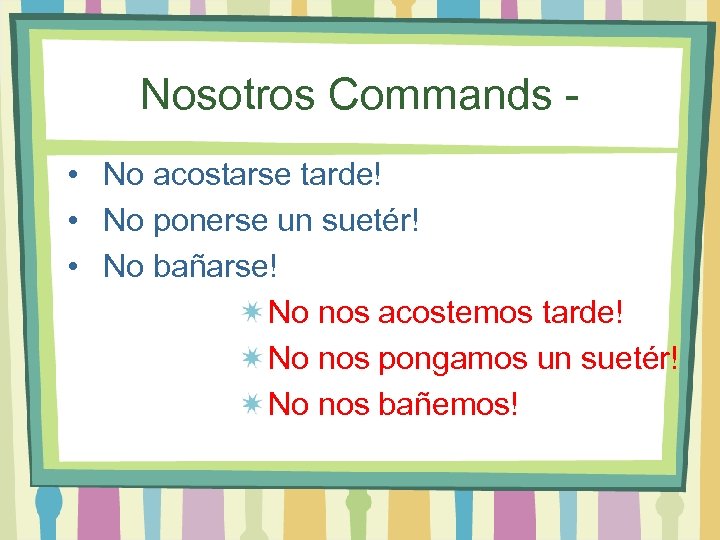 Nosotros Commands • No acostarse tarde! • No ponerse un suetér! • No bañarse! No nos acostemos tarde! No nos pongamos un suetér! No nos bañemos!
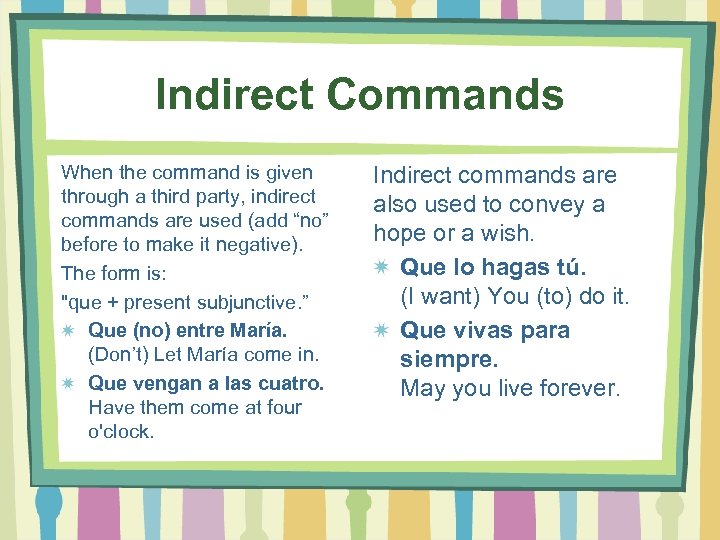 Indirect Commands When the command is given through a third party, indirect commands are used (add “no” before to make it negative). The form is: "que + present subjunctive. ” Que (no) entre María. (Don’t) Let María come in. Que vengan a las cuatro. Have them come at four o'clock. Indirect commands are also used to convey a hope or a wish. Que lo hagas tú. (I want) You (to) do it. Que vivas para siempre. May you live forever.
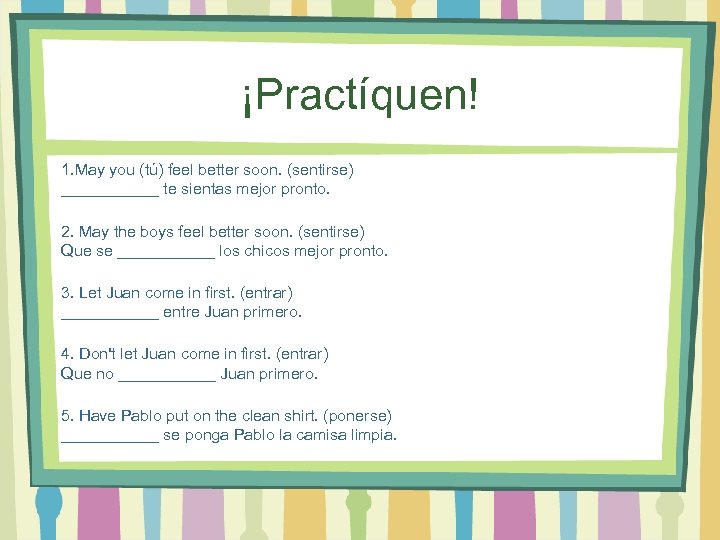 ¡Practíquen! 1. May you (tú) feel better soon. (sentirse) ______ te sientas mejor pronto. 2. May the boys feel better soon. (sentirse) Que se ______ los chicos mejor pronto. 3. Let Juan come in first. (entrar) ______ entre Juan primero. 4. Don't let Juan come in first. (entrar) Que no ______ Juan primero. 5. Have Pablo put on the clean shirt. (ponerse) ______ se ponga Pablo la camisa limpia.
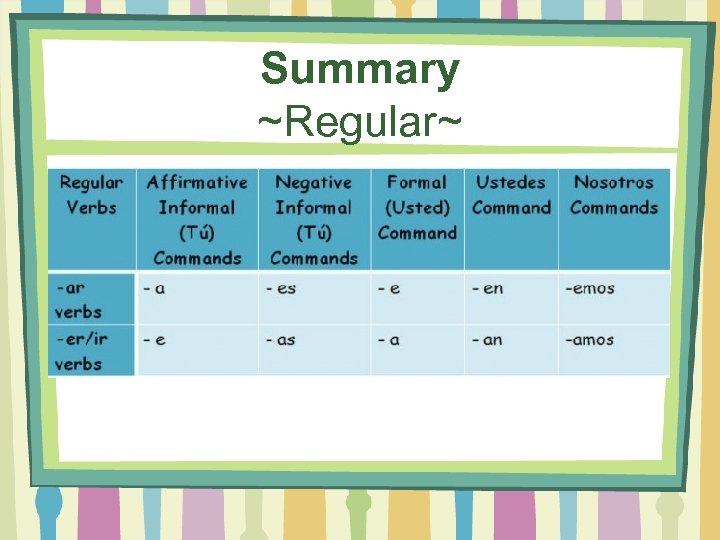 Summary ~Regular~
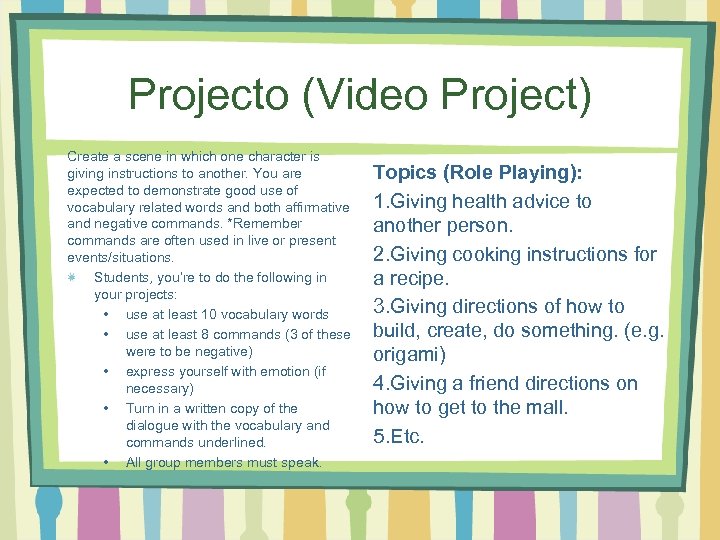 Projecto (Video Project) Create a scene in which one character is giving instructions to another. You are expected to demonstrate good use of vocabulary related words and both affirmative and negative commands. *Remember commands are often used in live or present events/situations. Students, you’re to do the following in your projects: • use at least 10 vocabulary words • use at least 8 commands (3 of these were to be negative) • express yourself with emotion (if necessary) • Turn in a written copy of the dialogue with the vocabulary and commands underlined. • All group members must speak. Topics (Role Playing): 1. Giving health advice to another person. 2. Giving cooking instructions for a recipe. 3. Giving directions of how to build, create, do something. (e. g. origami) 4. Giving a friend directions on how to get to the mall. 5. Etc.