


 Скачать презентацию Los Angeles Unified School District Facilities Information Systems
9b6d0223983b4f97ab72d52af68ee027.ppt
- Количество слайдов: 14
 Los Angeles Unified School District Facilities Information Systems LAUSD Earthquake Preparedness: Using Shake. Cast in Emergency Response Executive Briefing Prepared* for: EMC Training October 18, 2010 * By Bob Spears, Director Office of Emergency Services, LAUSD
 Los Angeles Unified School District Facilities Information Systems Existing Facilities Emergency Preparedness: Shake. Cast LAUSD Shake. Cast Project Status: • 740, 000 students; 1045 schools; 80, 000 employees, $7 B annual budget, serves 500, 000 lunches per day; • Large areal extent of district (LA Basin/SF/SG Valleys) • 1096 Schools/Office locations monitored • Shake. Cast is now successfully generating damage notifications and test scenarios. • 60+ key Existing Facilities users set up in Shake. Cast system • LAUSD installation using default damage thresholds based on Modified Mercalli Intensity (MMI) metric.
 Los Angeles Unified School District Facilities Information Systems Existing Facilities Emergency Preparedness: Shake. Cast - Background • Designed by USGS to assist in post-earthquake decision-making • Extension of existing Shake. Map application to help users determine possible impact on specific facilities • Application installed and runs in our environment on the 9 th floor of Beaudry* • Application requests information from USGS web servers using RSS & interval polling *Now hosted in Amazon Cloud; East Coast priority service (Stefan Otto, LAUSD, personal communication, 1/10/12)
 Los Angeles Unified School District Facilities Information Systems Existing Facilities Emergency Preparedness: Shake. Cast - Background • Stores GIS geographical coordinates of facility information from FIS. • Default damage thresholds. Can be configured at the building level using up to 36 structure types based on FEMA’s loss modeling software - HAZUS • Damage estimates based on shaking distribution • Text-based notifications can be configured by user & type of loss estimate • Existing delivery options: Email, pager, text message
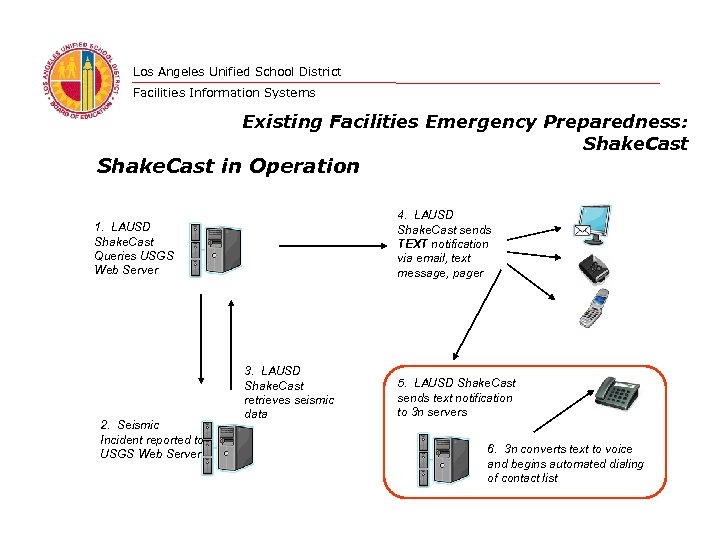 Los Angeles Unified School District Facilities Information Systems Existing Facilities Emergency Preparedness: Shake. Cast in Operation 4. LAUSD Shake. Cast sends TEXT notification via email, text message, pager 1. LAUSD Shake. Cast Queries USGS Web Server 2. Seismic Incident reported to USGS Web Server 3. LAUSD Shake. Cast retrieves seismic data 5. LAUSD Shake. Cast sends text notification to 3 n servers 6. 3 n converts text to voice and begins automated dialing of contact list
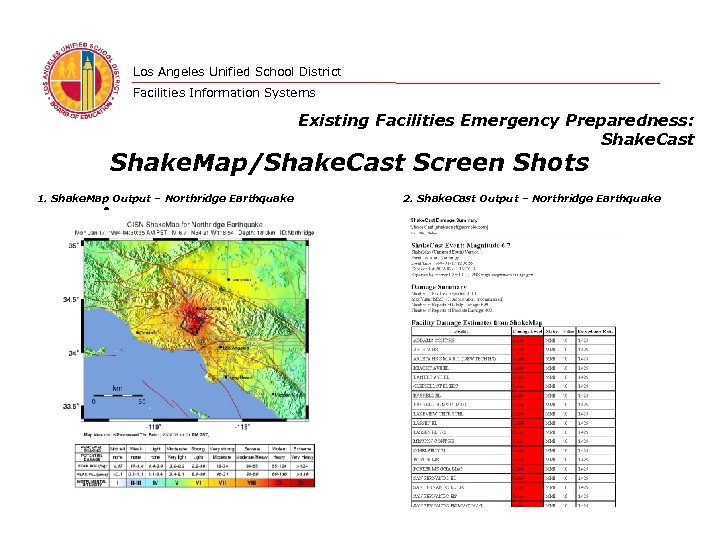 Los Angeles Unified School District Facilities Information Systems Existing Facilities Emergency Preparedness: Shake. Cast Shake. Map/Shake. Cast Screen Shots 1. Shake. Map Output – Northridge Earthquake • 2. Shake. Cast Output – Northridge Earthquake
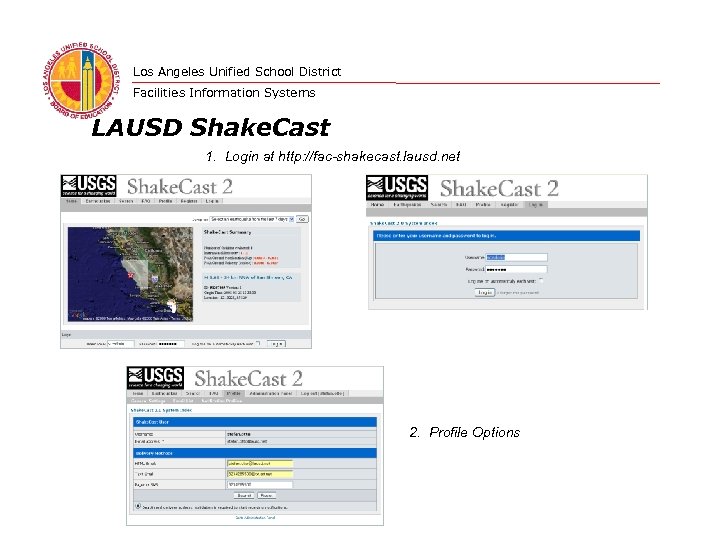 Los Angeles Unified School District Facilities Information Systems LAUSD Shake. Cast 1. Login at http: //fac-shakecast. lausd. net 2. Profile Options
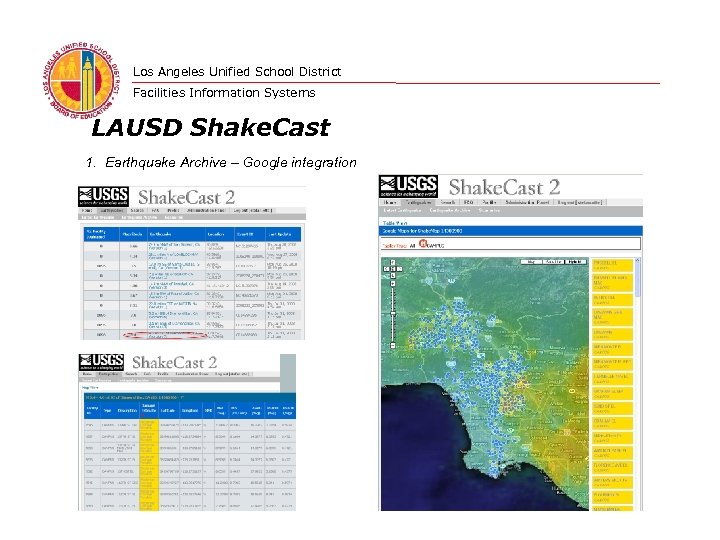 Los Angeles Unified School District Facilities Information Systems LAUSD Shake. Cast 1. Earthquake Archive – Google integration
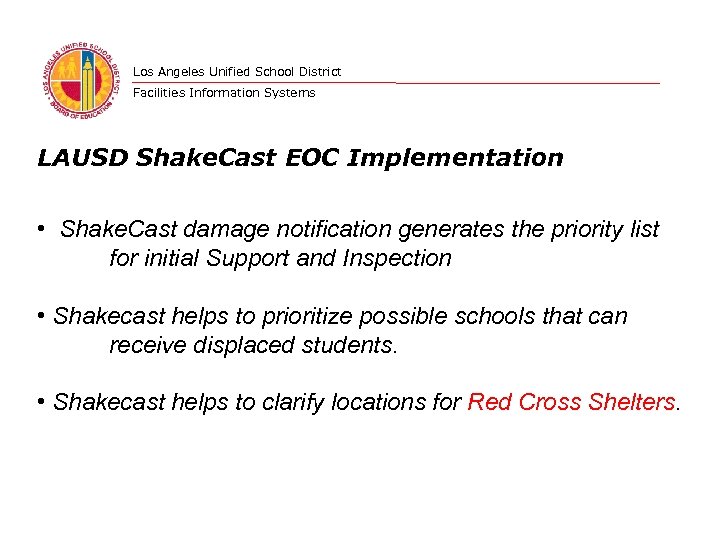 Los Angeles Unified School District Facilities Information Systems LAUSD Shake. Cast EOC Implementation • Shake. Cast damage notification generates the priority list for initial Support and Inspection • Shakecast helps to prioritize possible schools that can receive displaced students. • Shakecast helps to clarify locations for Red Cross Shelters.
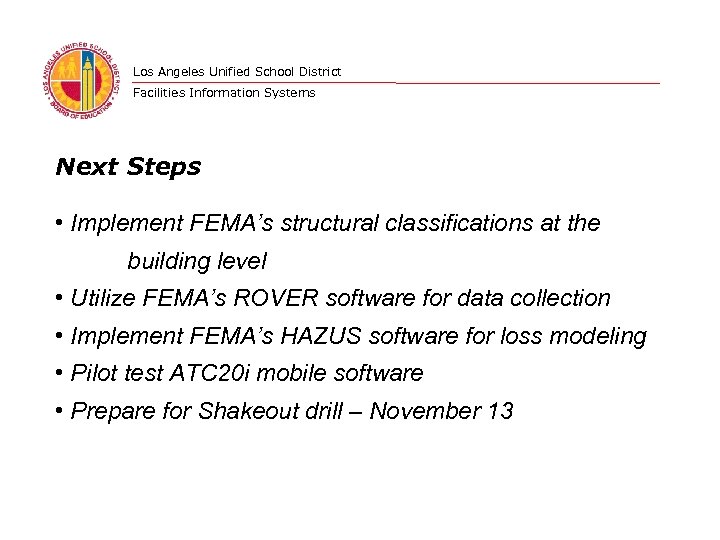 Los Angeles Unified School District Facilities Information Systems Next Steps • Implement FEMA’s structural classifications at the building level • Utilize FEMA’s ROVER software for data collection • Implement FEMA’s HAZUS software for loss modeling • Pilot test ATC 20 i mobile software • Prepare for Shakeout drill – November 13
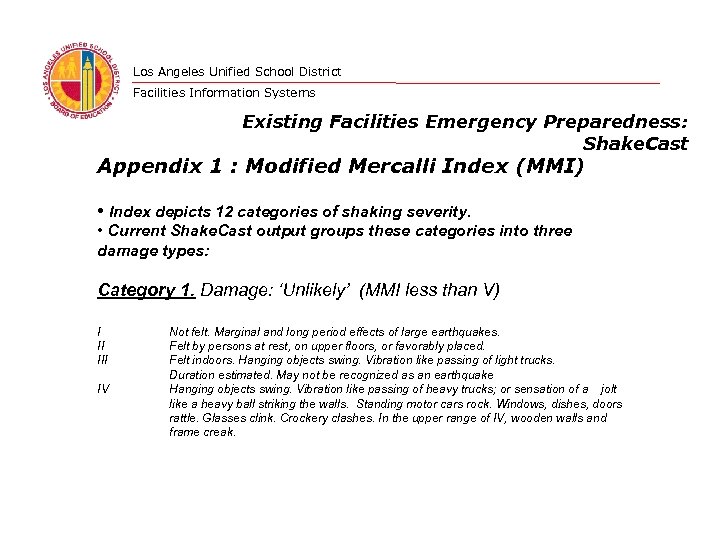 Los Angeles Unified School District Facilities Information Systems Existing Facilities Emergency Preparedness: Shake. Cast Appendix 1 : Modified Mercalli Index (MMI) • Index depicts 12 categories of shaking severity. • Current Shake. Cast output groups these categories into three damage types: Category 1. Damage: ‘Unlikely’ (MMI less than V) I II IV Not felt. Marginal and long period effects of large earthquakes. Felt by persons at rest, on upper floors, or favorably placed. Felt indoors. Hanging objects swing. Vibration like passing of light trucks. Duration estimated. May not be recognized as an earthquake Hanging objects swing. Vibration like passing of heavy trucks; or sensation of a jolt like a heavy ball striking the walls. Standing motor cars rock. Windows, dishes, doors rattle. Glasses clink. Crockery clashes. In the upper range of IV, wooden walls and frame creak.
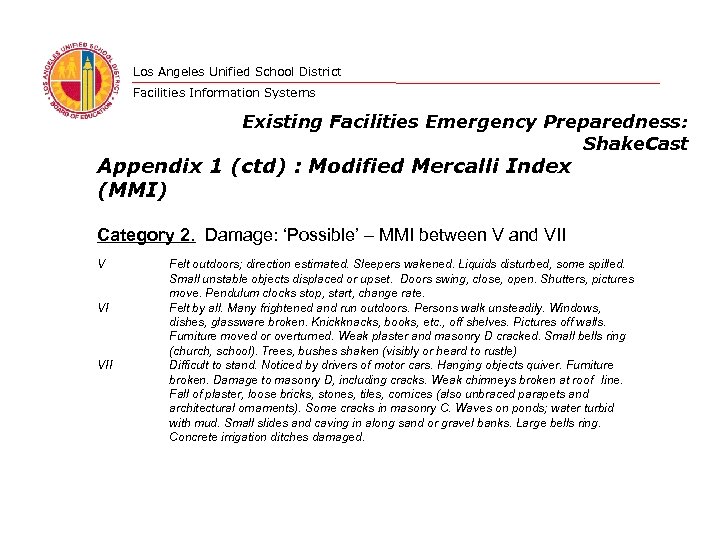 Los Angeles Unified School District Facilities Information Systems Existing Facilities Emergency Preparedness: Shake. Cast Appendix 1 (ctd) : Modified Mercalli Index (MMI) Category 2. Damage: ‘Possible’ – MMI between V and VII V VI VII Felt outdoors; direction estimated. Sleepers wakened. Liquids disturbed, some spilled. Small unstable objects displaced or upset. Doors swing, close, open. Shutters, pictures move. Pendulum clocks stop, start, change rate. Felt by all. Many frightened and run outdoors. Persons walk unsteadily. Windows, dishes, glassware broken. Knickknacks, books, etc. , off shelves. Pictures off walls. Furniture moved or overturned. Weak plaster and masonry D cracked. Small bells ring (church, school). Trees, bushes shaken (visibly or heard to rustle) Difficult to stand. Noticed by drivers of motor cars. Hanging objects quiver. Furniture broken. Damage to masonry D, including cracks. Weak chimneys broken at roof line. Fall of plaster, loose bricks, stones, tiles, cornices (also unbraced parapets and architectural ornaments). Some cracks in masonry C. Waves on ponds; water turbid with mud. Small slides and caving in along sand or gravel banks. Large bells ring. Concrete irrigation ditches damaged.
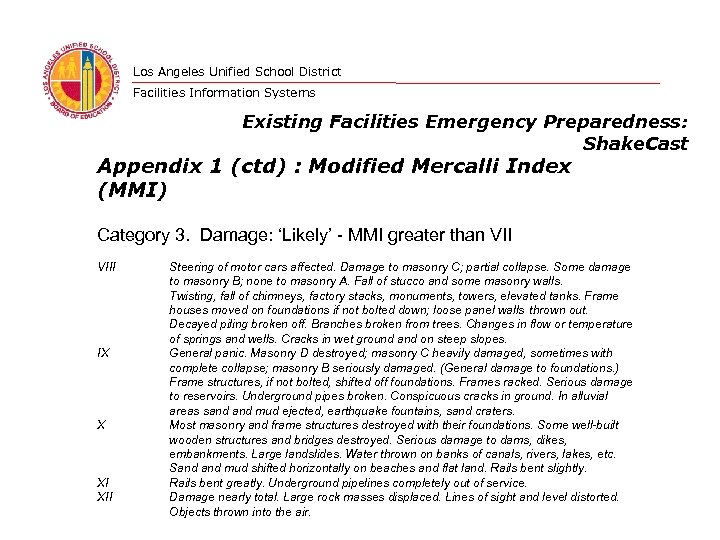 Los Angeles Unified School District Facilities Information Systems Existing Facilities Emergency Preparedness: Shake. Cast Appendix 1 (ctd) : Modified Mercalli Index (MMI) Category 3. Damage: ‘Likely’ - MMI greater than VIII IX X XI XII Steering of motor cars affected. Damage to masonry C; partial collapse. Some damage to masonry B; none to masonry A. Fall of stucco and some masonry walls. Twisting, fall of chimneys, factory stacks, monuments, towers, elevated tanks. Frame houses moved on foundations if not bolted down; loose panel walls thrown out. Decayed piling broken off. Branches broken from trees. Changes in flow or temperature of springs and wells. Cracks in wet ground and on steep slopes. General panic. Masonry D destroyed; masonry C heavily damaged, sometimes with complete collapse; masonry B seriously damaged. (General damage to foundations. ) Frame structures, if not bolted, shifted off foundations. Frames racked. Serious damage to reservoirs. Underground pipes broken. Conspicuous cracks in ground. In alluvial areas sand mud ejected, earthquake fountains, sand craters. Most masonry and frame structures destroyed with their foundations. Some well-built wooden structures and bridges destroyed. Serious damage to dams, dikes, embankments. Large landslides. Water thrown on banks of canals, rivers, lakes, etc. Sand mud shifted horizontally on beaches and flat land. Rails bent slightly. Rails bent greatly. Underground pipelines completely out of service. Damage nearly total. Large rock masses displaced. Lines of sight and level distorted. Objects thrown into the air.
 Los Angeles Unified School District Facilities Information Systems Existing Facilities Emergency Preparedness: Shake. Cast “Every year, all 1045 schools in the Los Angeles Unified School District plan and drill for the day that an earthquake strikes when schools are in session. They carefully practice how they will protect, shelter and care for the students. At District headquarters the Superintendent makes plans and convenes drills so that the District can provide information to parents and support the schools during such a disaster. Because the District is so large, the first challenge the Superintendent has is to decide where our resources should be sent and what can he tell the parents about the safety of their children. At the same time the American Red Cross will be asking the Superintendent what schools are safe to be used as shelters for the displaced population. Before the District had the Shakecast system, there was no easy way to answer those questions. The District would dispatch support to schools using the highly inaccurate “best guess” system. Now, because we have Shakecast, vital support can be sent to the schools that are impacted on a priority basis. Parents and the Red Cross can be re-assured that their child’s school was not subjected to extreme seismic activity. The District can direct support and services where they are needed. In the end, the District can more accurately protect students and promote public safety. ” * * Bob Spears, Director Office of Emergency Services, LAUSD