 Скачать презентацию Longwood Non-invasive Cardiac Imaging Seminar December 14 2009
488f050c050a1e47f461b31fc2463a84.ppt
- Количество слайдов: 100



Longwood Non-invasive Cardiac Imaging Seminar December 14, 2009 CTPA 2009 Vassilios Raptopoulos, MD Beth Israel Deaconess Medical Center Harvard Medical School
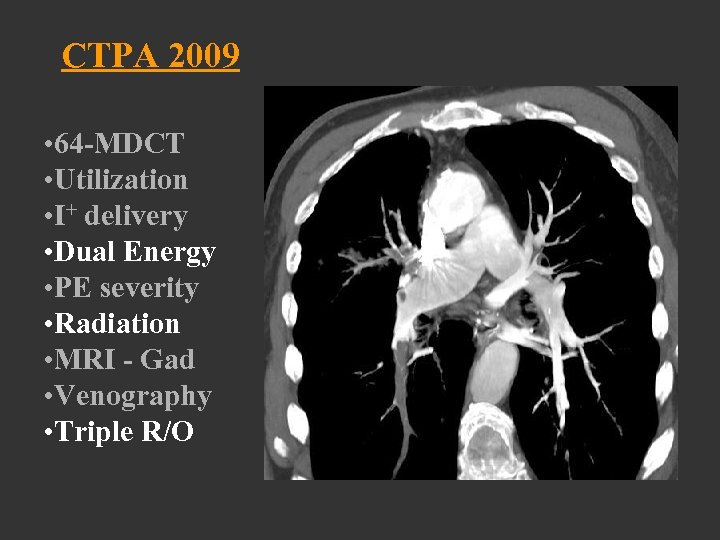
CTPA 2009 • 64 -MDCT • Utilization • I+ delivery • Dual Energy • PE severity • Radiation • MRI - Gad • Venography • Triple R/O
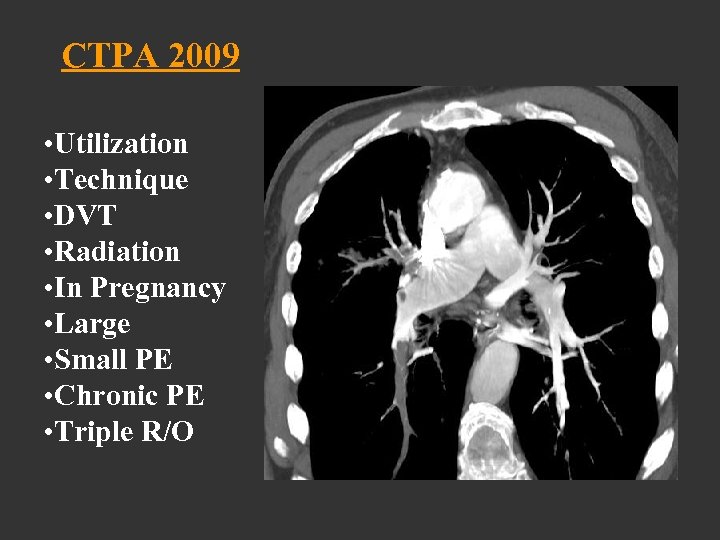
CTPA 2009 • Utilization • Technique • DVT • Radiation • In Pregnancy • Large • Small PE • Chronic PE • Triple R/O

Utilization
MDCT for PE “a technological marvel” • “revolutionized our diagnostic approach” – non-invasive, fast, comfortable, < mm resolution in < 10 sec (4 sec w 64 MDCT) • Massive embolism (surgical planning) 6 th order thrombi (? clinical significance) • Lung & chest wall - CT venography • Prognosis – RV enlargement - Thrombus burden Goldhaber SZ. (from BWH) N Engl JMed Apr 28 2005; 352: 1812 (Editorial)
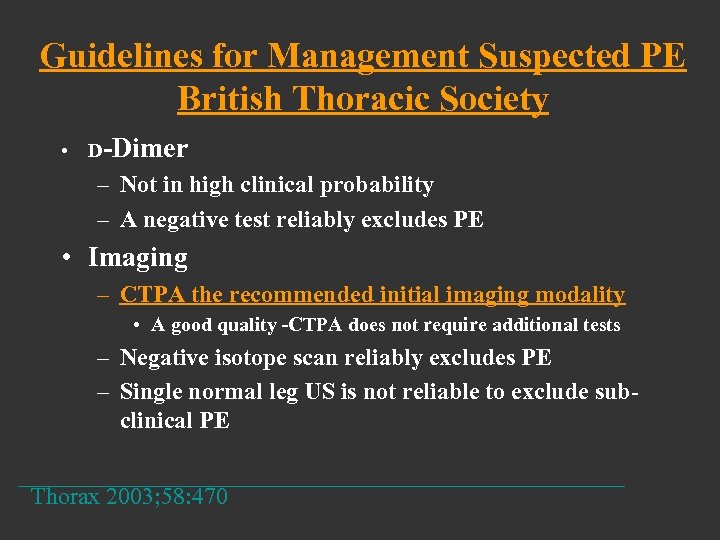
Guidelines for Management Suspected PE British Thoracic Society • D-Dimer – Not in high clinical probability – A negative test reliably excludes PE • Imaging – CTPA the recommended initial imaging modality • A good quality -CTPA does not require additional tests – Negative isotope scan reliably excludes PE – Single normal leg US is not reliable to exclude subclinical PE Thorax 2003; 58: 470
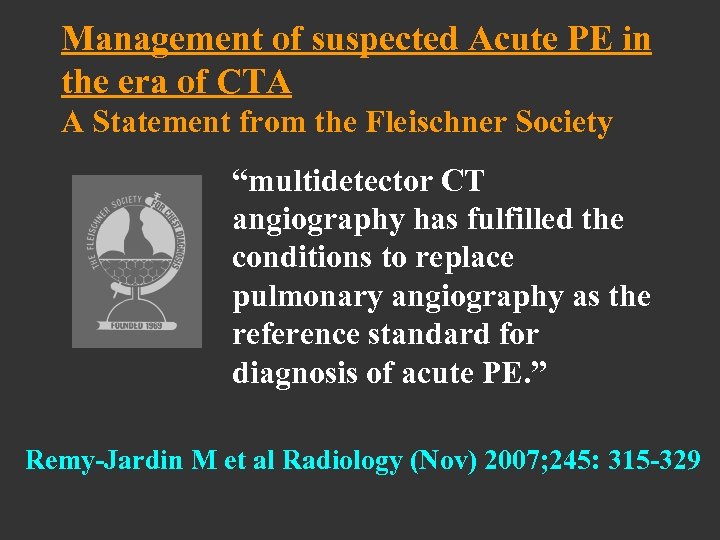
Management of suspected Acute PE in the era of CTA A Statement from the Fleischner Society “multidetector CT angiography has fulfilled the conditions to replace pulmonary angiography as the reference standard for diagnosis of acute PE. ” Remy-Jardin M et al Radiology (Nov) 2007; 245: 315 -329
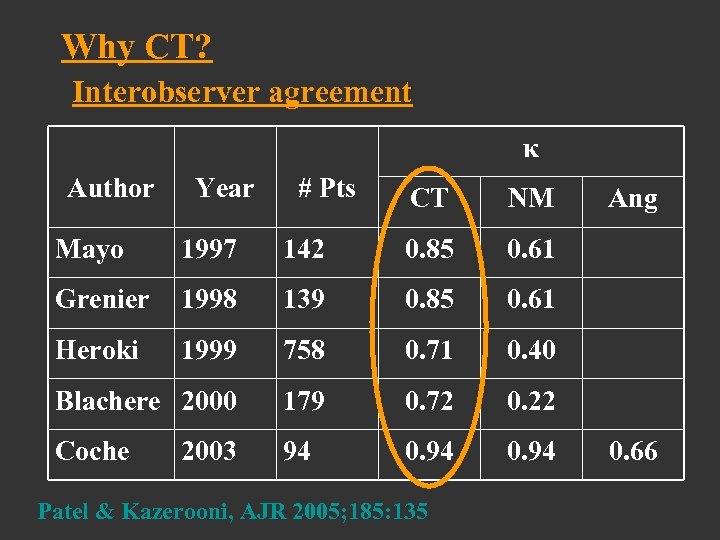
Why CT? Interobserver agreement κ Author Year # Pts CT NM Mayo 1997 142 0. 85 0. 61 Grenier 1998 139 0. 85 0. 61 Heroki 1999 758 0. 71 0. 40 Blachere 2000 179 0. 72 0. 22 Coche 94 0. 94 Ang 2003 Patel & Kazerooni, AJR 2005; 185: 135 0. 66
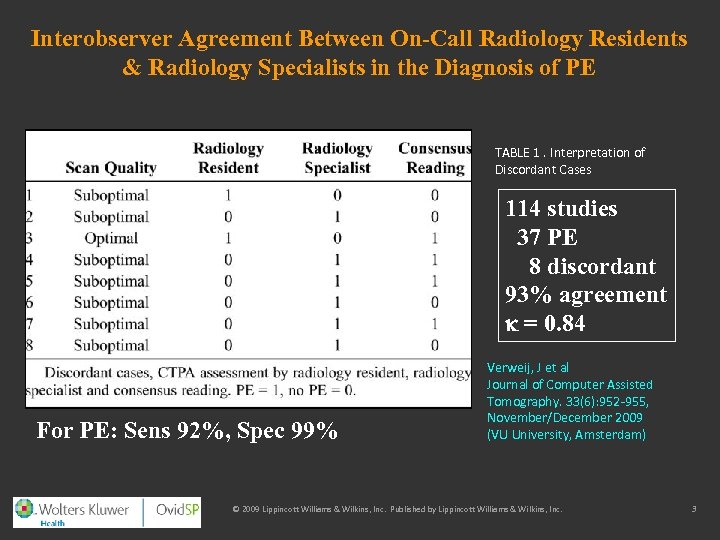
Interobserver Agreement Between On-Call Radiology Residents & Radiology Specialists in the Diagnosis of PE TABLE 1. Interpretation of Discordant Cases 114 studies 37 PE 8 discordant 93% agreement = 0. 84 For PE: Sens 92%, Spec 99% Verweij, J et al Journal of Computer Assisted Tomography. 33(6): 952 -955, November/December 2009 (VU University, Amsterdam) © 2009 Lippincott Williams & Wilkins, Inc. Published by Lippincott Williams & Wilkins, Inc. 3
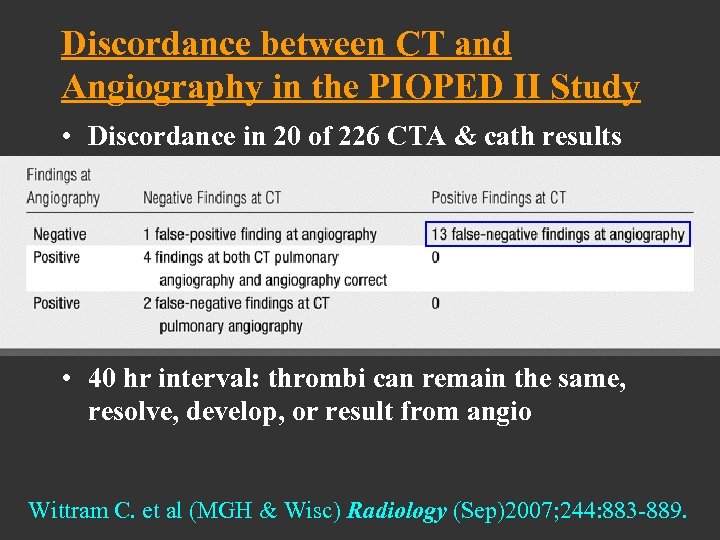
Discordance between CT and Angiography in the PIOPED II Study • Discordance in 20 of 226 CTA & cath results • 40 hr interval: thrombi can remain the same, resolve, develop, or result from angio Wittram C. et al (MGH & Wisc) Radiology (Sep)2007; 244: 883 -889.
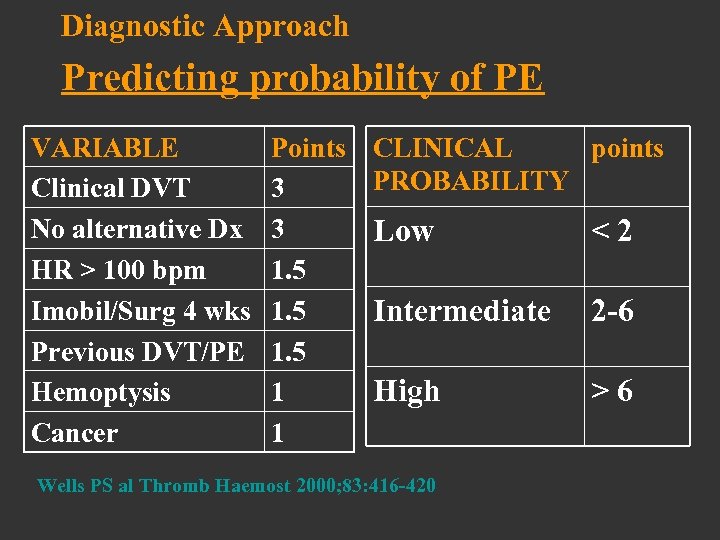
Diagnostic Approach Predicting probability of PE VARIABLE Clinical DVT No alternative Dx HR > 100 bpm Imobil/Surg 4 wks Previous DVT/PE Hemoptysis Cancer Points 3 3 1. 5 1 1 CLINICAL points PROBABILITY Low < 2 Intermediate 2 -6 High > 6 Wells PS al Thromb Haemost 2000; 83: 416 -420
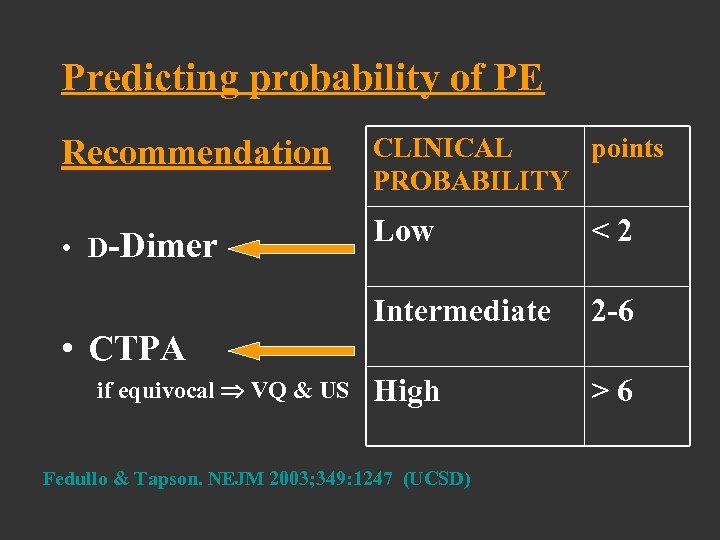
Predicting probability of PE Recommendation CLINICAL points PROBABILITY • D-Dimer Low < 2 Intermediate 2 -6 High > 6 • CTPA if equivocal VQ & US Fedullo & Tapson. NEJM 2003; 349: 1247 (UCSD)
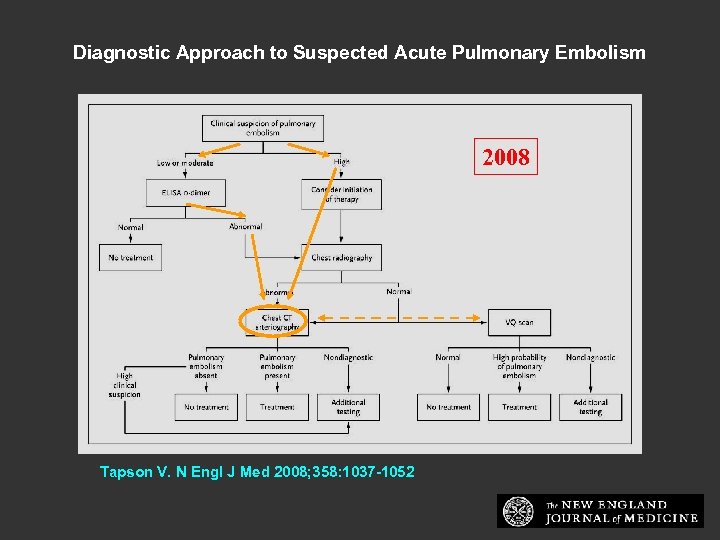
Diagnostic Approach to Suspected Acute Pulmonary Embolism 2008 Tapson V. N Engl J Med 2008; 358: 1037 -1052
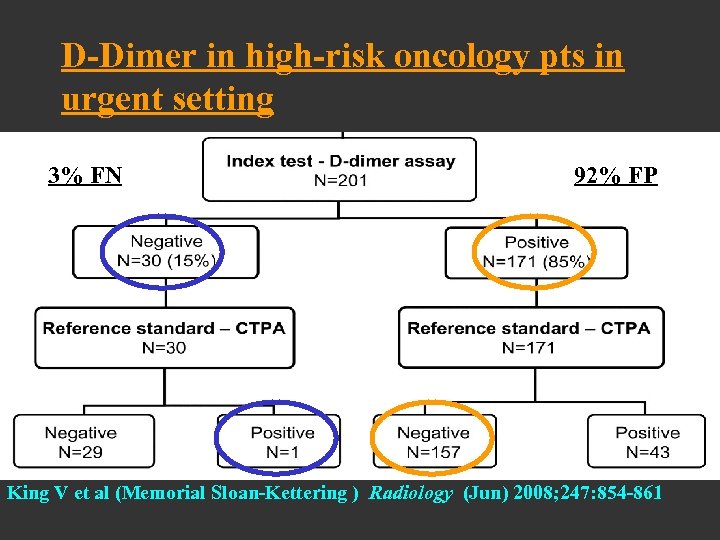
D-Dimer in high-risk oncology pts in urgent setting 3% FN 92% FP King V et al (Memorial Sloan-Kettering ) Radiology (Jun) 2008; 247: 854 -861
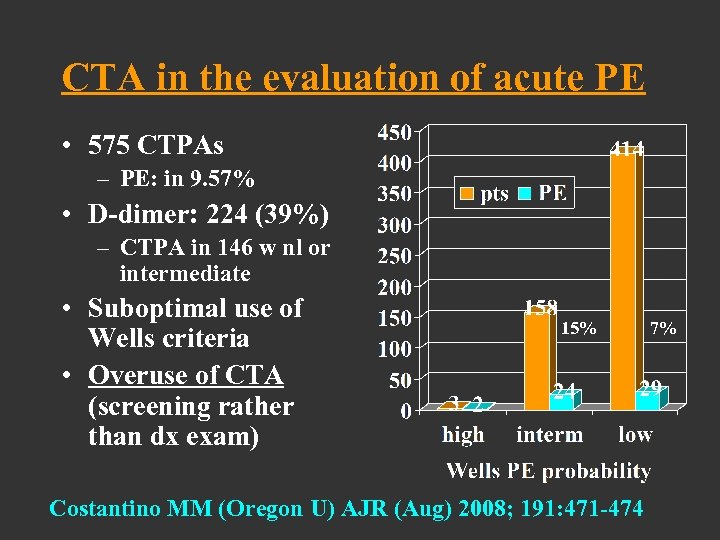
CTA in the evaluation of acute PE • 575 CTPAs – PE: in 9. 57% • D-dimer: 224 (39%) – CTPA in 146 w nl or intermediate • Suboptimal use of Wells criteria • Overuse of CTA (screening rather than dx exam) 15% Costantino MM (Oregon U) AJR (Aug) 2008; 191: 471 -474 7%
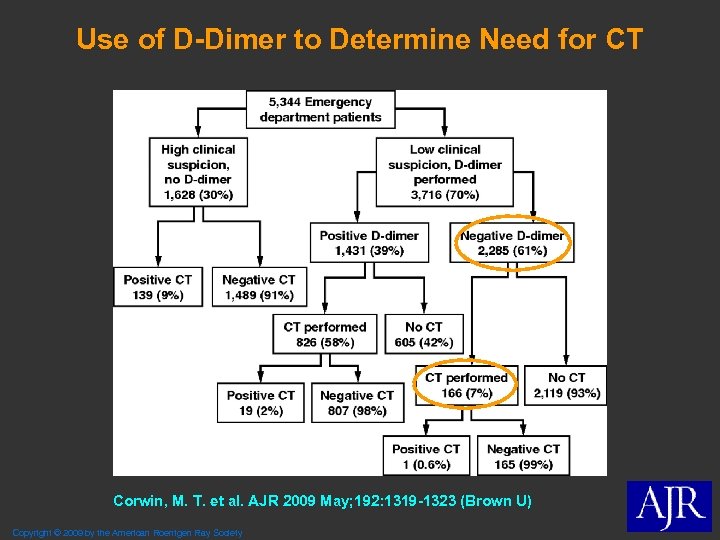
Use of D-Dimer to Determine Need for CT Corwin, M. T. et al. AJR 2009 May; 192: 1319 -1323 (Brown U) Copyright © 2009 by the American Roentgen Ray Society
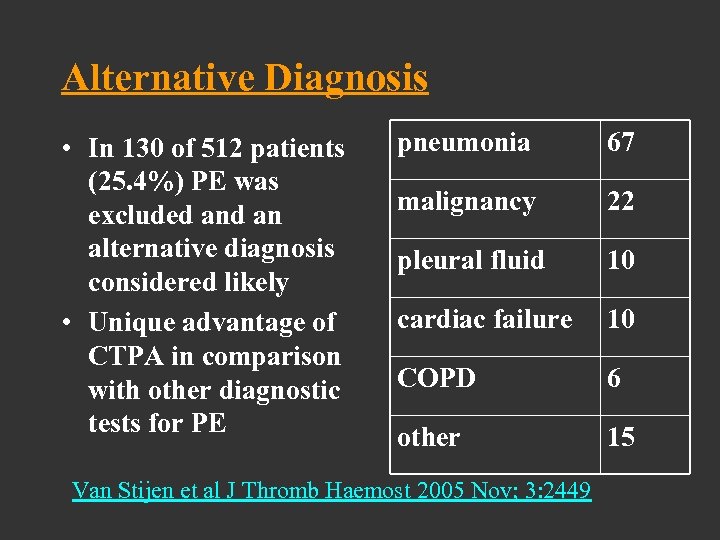
Alternative Diagnosis • In 130 of 512 patients (25. 4%) PE was excluded an alternative diagnosis considered likely • Unique advantage of CTPA in comparison with other diagnostic tests for PE pneumonia 67 malignancy 22 pleural fluid 10 cardiac failure 10 COPD 6 other 15 Van Stijen et al J Thromb Haemost 2005 Nov; 3: 2449
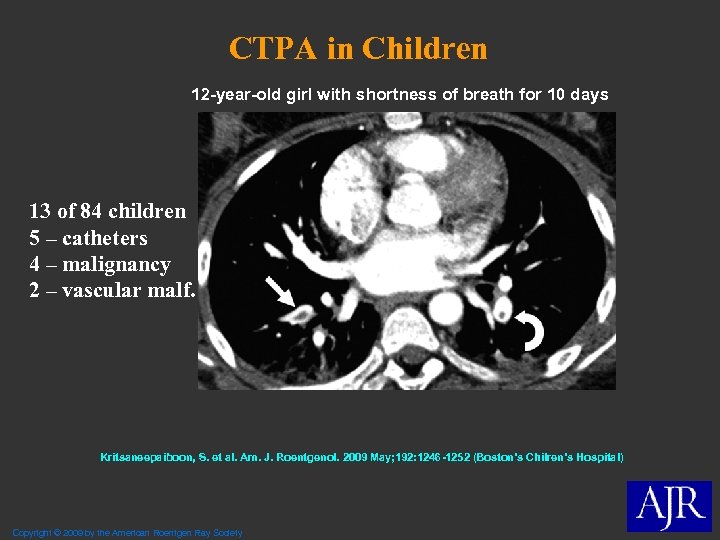
CTPA in Children 12 -year-old girl with shortness of breath for 10 days 13 of 84 children 5 – catheters 4 – malignancy 2 – vascular malf. Kritsaneepaiboon, S. et al. Am. J. Roentgenol. 2009 May; 192: 1246 -1252 (Boston’s Chilren’s Hospital) Copyright © 2009 by the American Roentgen Ray Society
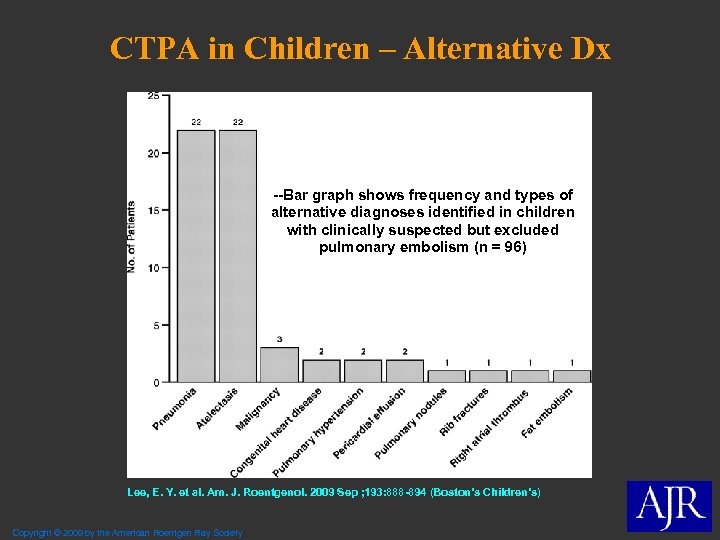
CTPA in Children – Alternative Dx --Bar graph shows frequency and types of alternative diagnoses identified in children with clinically suspected but excluded pulmonary embolism (n = 96) Lee, E. Y. et al. Am. J. Roentgenol. 2009 Sep ; 193: 888 -894 (Boston’s Children’s) Copyright © 2009 by the American Roentgen Ray Society
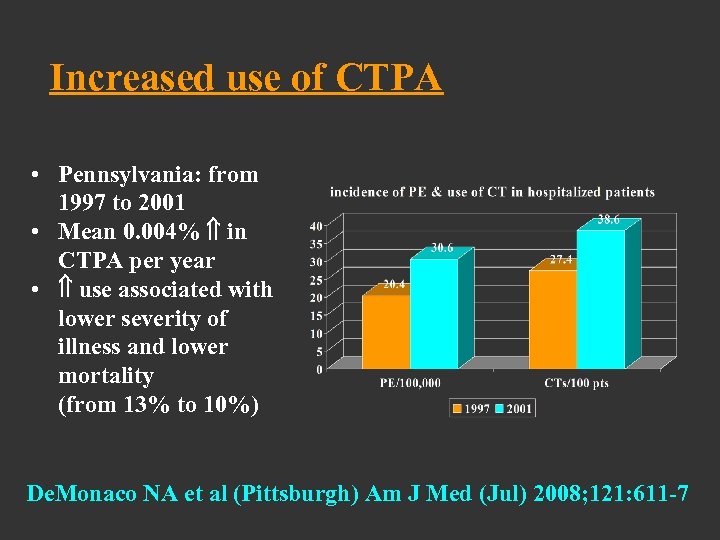
Increased use of CTPA • Pennsylvania: from 1997 to 2001 • Mean 0. 004% in CTPA per year • use associated with lower severity of illness and lower mortality (from 13% to 10%) De. Monaco NA et al (Pittsburgh) Am J Med (Jul) 2008; 121: 611 -7
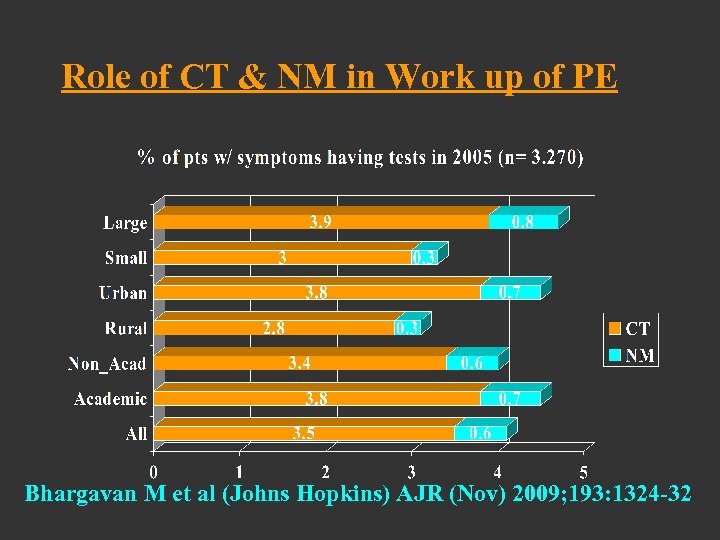
Role of CT & NM in Work up of PE Bhargavan M et al (Johns Hopkins) AJR (Nov) 2009; 193: 1324 -32

Technique MDCT Pulmonary Angiography
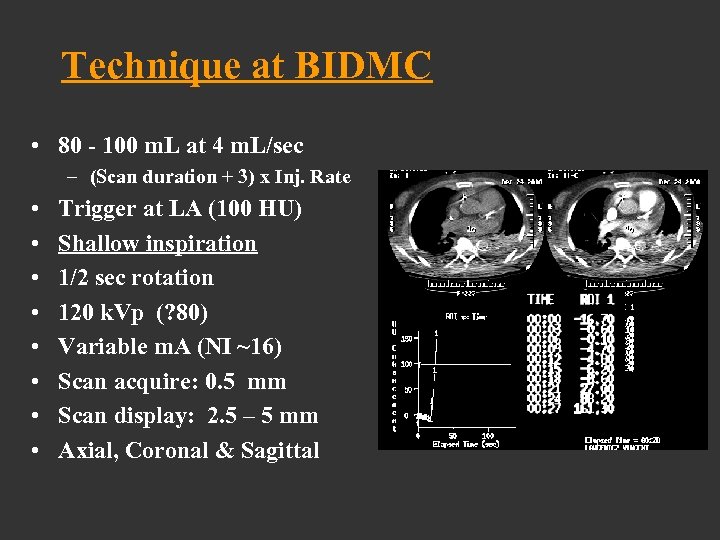
Technique at BIDMC • 80 - 100 m. L at 4 m. L/sec – (Scan duration + 3) x Inj. Rate • • Trigger at LA (100 HU) Shallow inspiration 1/2 sec rotation 120 k. Vp (? 80) Variable m. A (NI ~16) Scan acquire: 0. 5 mm Scan display: 2. 5 – 5 mm Axial, Coronal & Sagittal
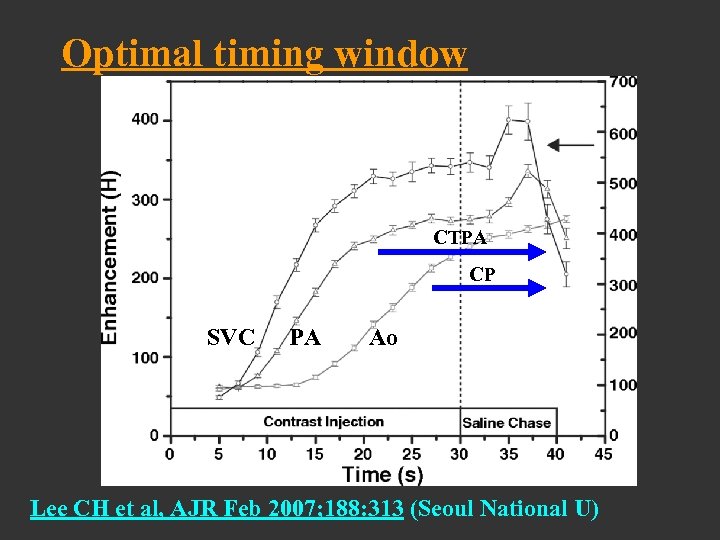
Optimal timing window CTPA CP SVC PA Ao Lee CH et al, AJR Feb 2007; 188: 313 (Seoul National U)
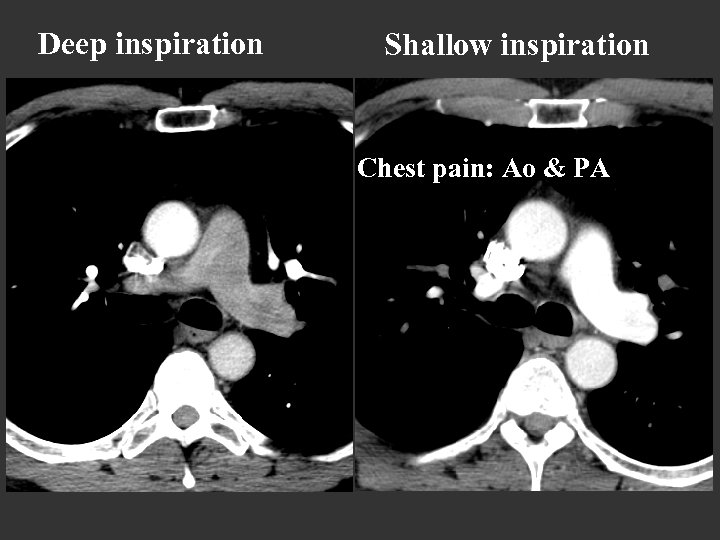
Deep inspiration Shallow inspiration Chest pain: Ao & PA
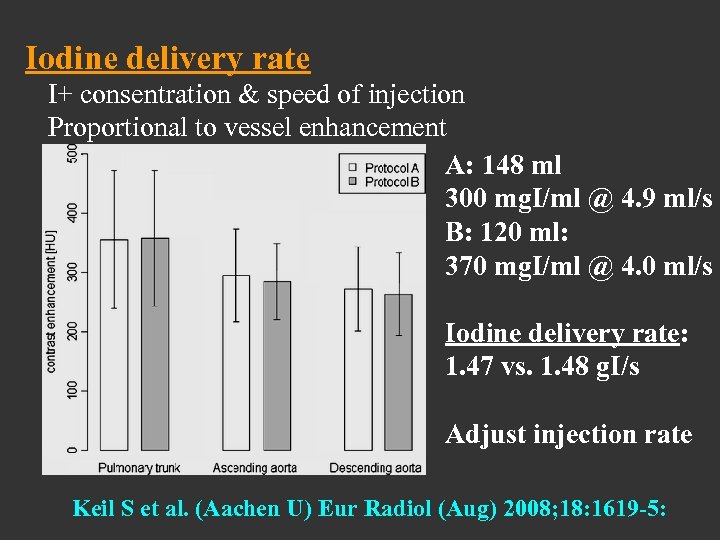
Iodine delivery rate I+ consentration & speed of injection Proportional to vessel enhancement A: 148 ml 300 mg. I/ml @ 4. 9 ml/s B: 120 ml: 370 mg. I/ml @ 4. 0 ml/s Iodine delivery rate: 1. 47 vs. 1. 48 g. I/s Adjust injection rate Keil S et al. (Aachen U) Eur Radiol (Aug) 2008; 18: 1619 -5:
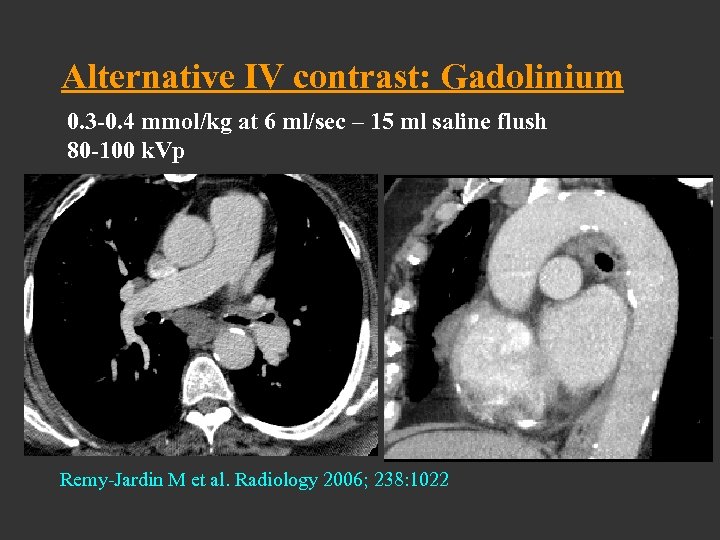
Alternative IV contrast: Gadolinium 0. 3 -0. 4 mmol/kg at 6 ml/sec – 15 ml saline flush 80 -100 k. Vp Remy-Jardin M et al. Radiology 2006; 238: 1022
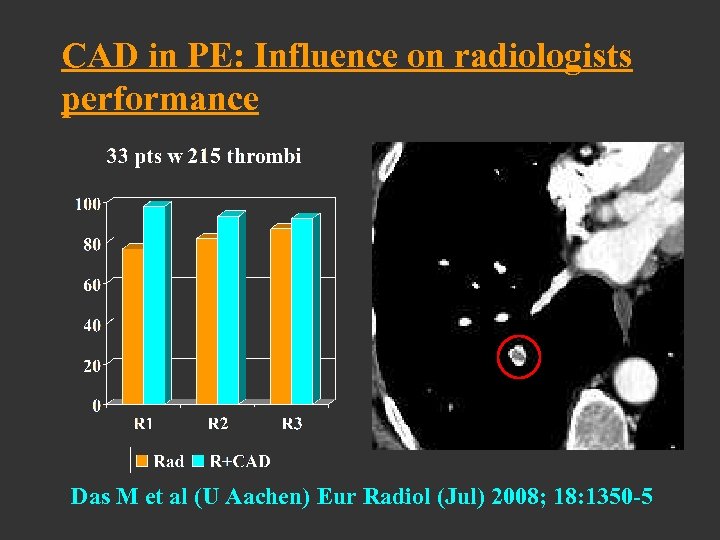
CAD in PE: Influence on radiologists performance Das M et al (U Aachen) Eur Radiol (Jul) 2008; 18: 1350 -5
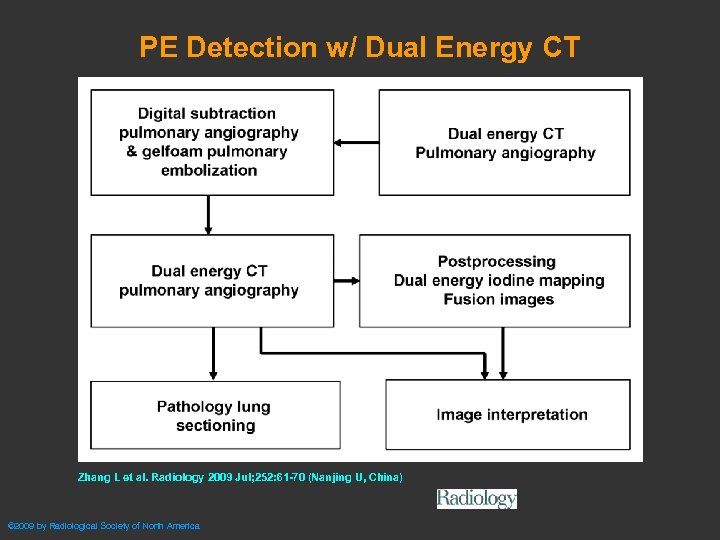
PE Detection w/ Dual Energy CT Zhang L et al. Radiology 2009 Jul; 252: 61 -70 (Nanjing U, China) © 2009 by Radiological Society of North America
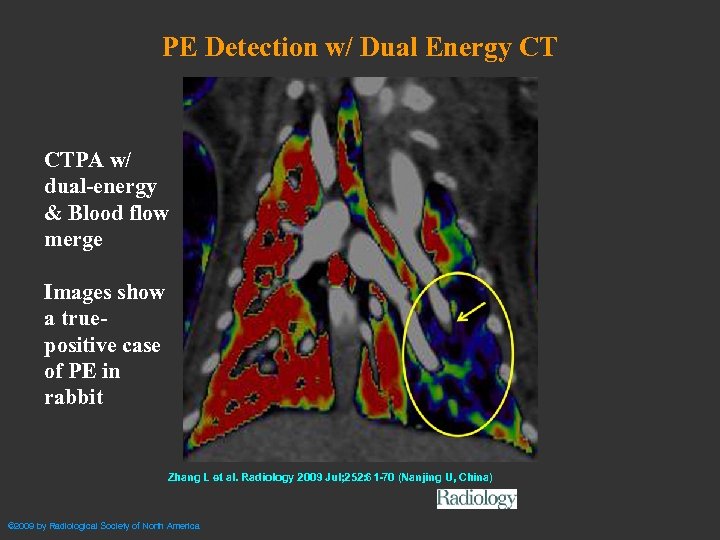
PE Detection w/ Dual Energy CT CTPA w/ dual-energy & Blood flow merge Images show a truepositive case of PE in rabbit Zhang L et al. Radiology 2009 Jul; 252: 61 -70 (Nanjing U, China) © 2009 by Radiological Society of North America
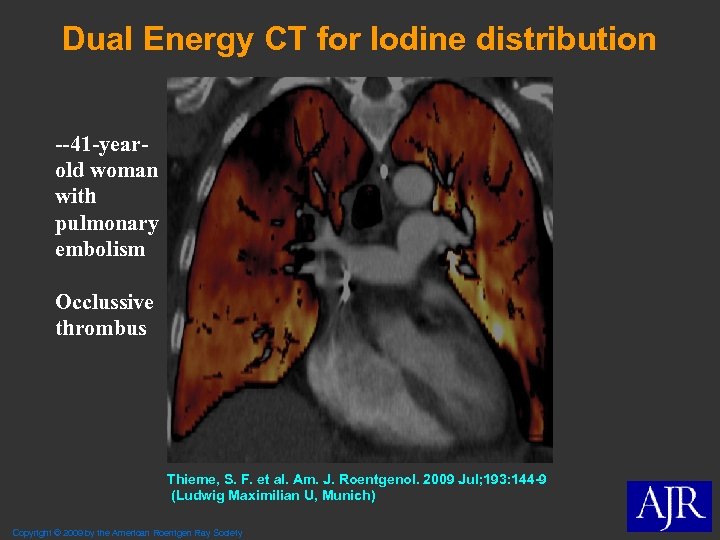
Dual Energy CT for Iodine distribution --41 -yearold woman with pulmonary embolism Occlussive thrombus Thieme, S. F. et al. Am. J. Roentgenol. 2009 Jul; 193: 144 -9 (Ludwig Maximilian U, Munich) Copyright © 2009 by the American Roentgen Ray Society

Thromboembolic Disease - DVT
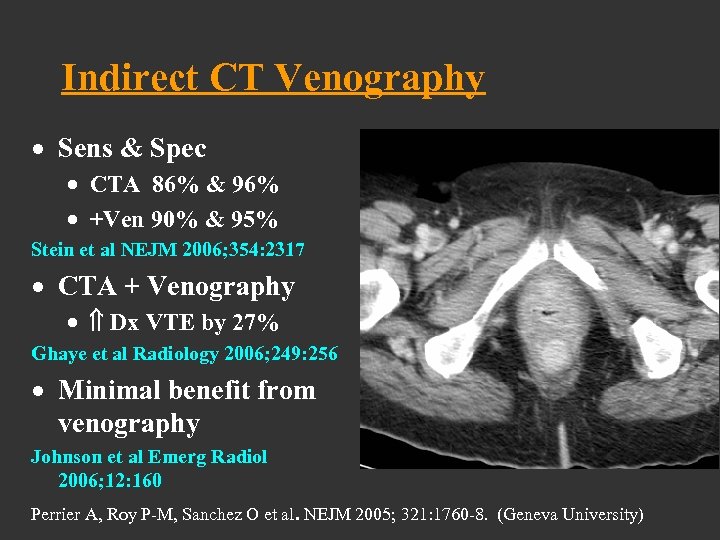
Indirect CT Venography Sens & Spec CTA 86% & 96% +Ven 90% & 95% Stein et al NEJM 2006; 354: 2317 CTA + Venography Dx VTE by 27% Ghaye et al Radiology 2006; 249: 256 Minimal benefit from venography Johnson et al Emerg Radiol 2006; 12: 160 Perrier A, Roy P-M, Sanchez O et al. NEJM 2005; 321: 1760 -8. (Geneva University)
Routine indirect CT Venography in patients undergoing CTPA • Pts: 446 high risk - 383 low risk – malignancy, h/o VTE & CV, post surgery • Incremental value of CTV: 3. 4% – 0. 72% in low-risk & 2. 6% in high-risk • CTV may only be useful in patients with a high probability for PE Andetta R et al (BWH) AJR (Feb) 2008; 190: 322 - 326
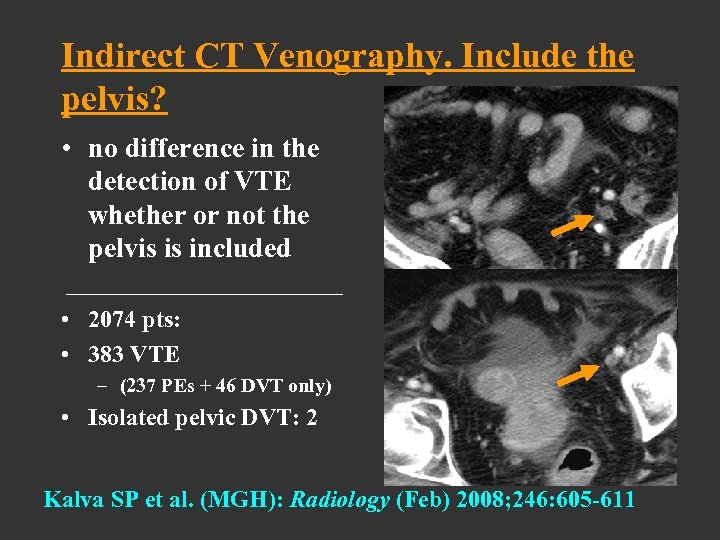
Indirect CT Venography. Include the pelvis? • no difference in the detection of VTE whether or not the pelvis is included • 2074 pts: • 383 VTE – (237 PEs + 46 DVT only) • Isolated pelvic DVT: 2 Kalva SP et al. (MGH): Radiology (Feb) 2008; 246: 605 -611
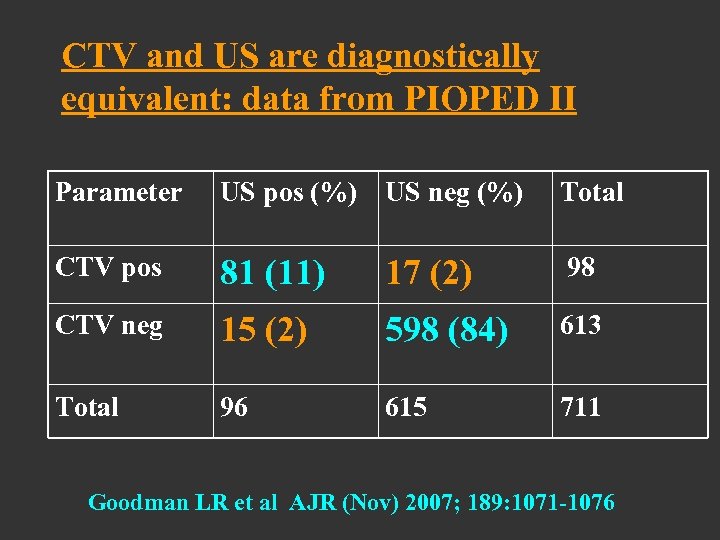
CTV and US are diagnostically equivalent: data from PIOPED II Parameter US pos (%) US neg (%) Total CTV pos 81 (11) 17 (2) 98 CTV neg 15 (2) 598 (84) 613 Total 96 615 711 Goodman LR et al AJR (Nov) 2007; 189: 1071 -1076
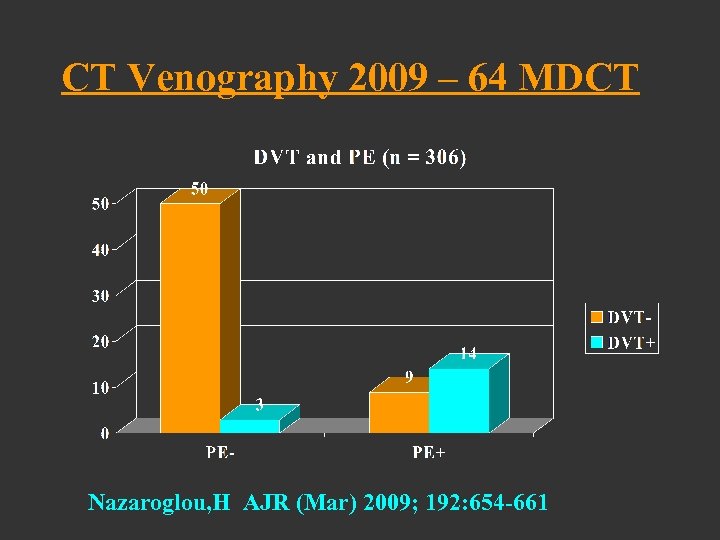
CT Venography 2009 – 64 MDCT Nazaroglou, H AJR (Mar) 2009; 192: 654 -661
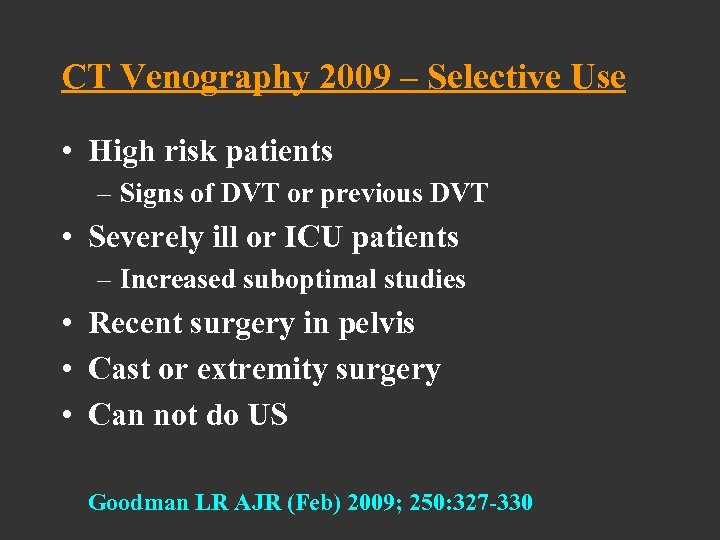
CT Venography 2009 – Selective Use • High risk patients – Signs of DVT or previous DVT • Severely ill or ICU patients – Increased suboptimal studies • Recent surgery in pelvis • Cast or extremity surgery • Can not do US Goodman LR AJR (Feb) 2009; 250: 327 -330

Radiation & Image Quality
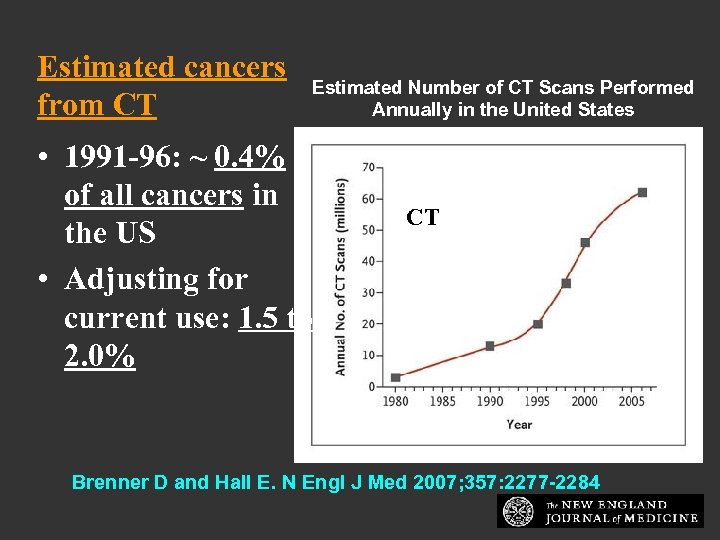
Estimated cancers from CT Estimated Number of CT Scans Performed Annually in the United States • 1991 -96: ~ 0. 4% of all cancers in the US • Adjusting for current use: 1. 5 to 2. 0% CT Brenner D and Hall E. N Engl J Med 2007; 357: 2277 -2284
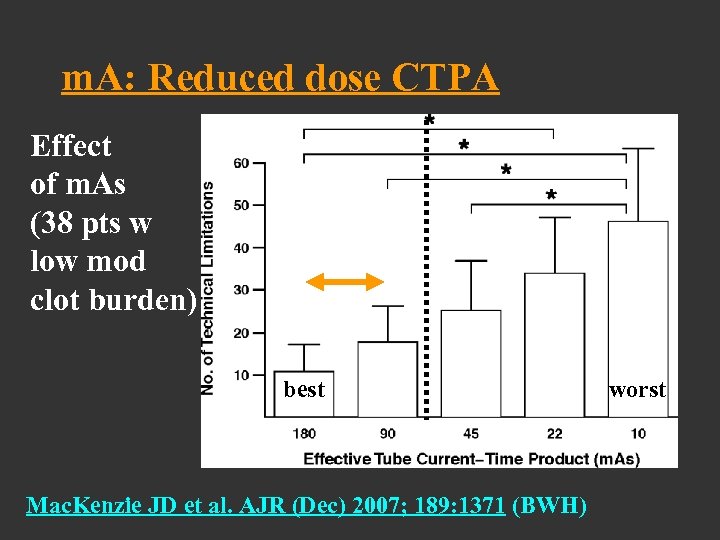
m. A: Reduced dose CTPA Effect of m. As (38 pts w low mod clot burden) best Mac. Kenzie JD et al. AJR (Dec) 2007; 189: 1371 (BWH) worst
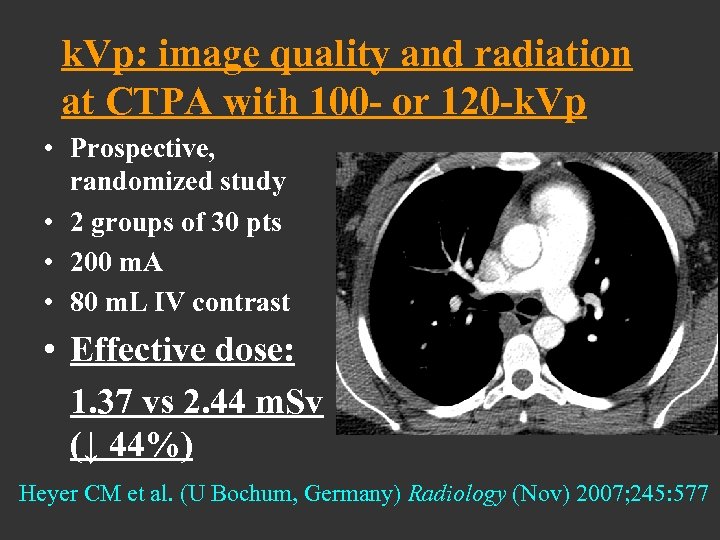
k. Vp: image quality and radiation at CTPA with 100 - or 120 -k. Vp • Prospective, randomized study • 2 groups of 30 pts • 200 m. A • 80 m. L IV contrast • Effective dose: 1. 37 vs 2. 44 m. Sv (↓ 44%) Heyer CM et al. (U Bochum, Germany) Radiology (Nov) 2007; 245: 577
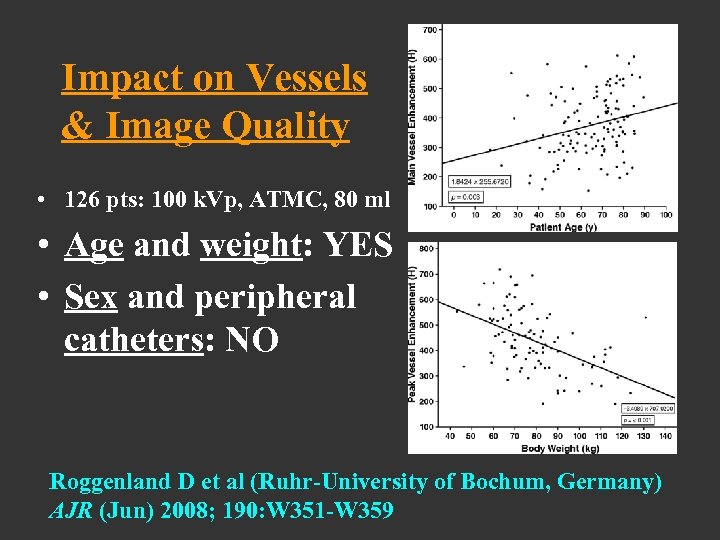
Impact on Vessels & Image Quality • 126 pts: 100 k. Vp, ATMC, 80 ml • Age and weight: YES • Sex and peripheral catheters: NO Roggenland D et al (Ruhr-University of Bochum, Germany) AJR (Jun) 2008; 190: W 351 -W 359
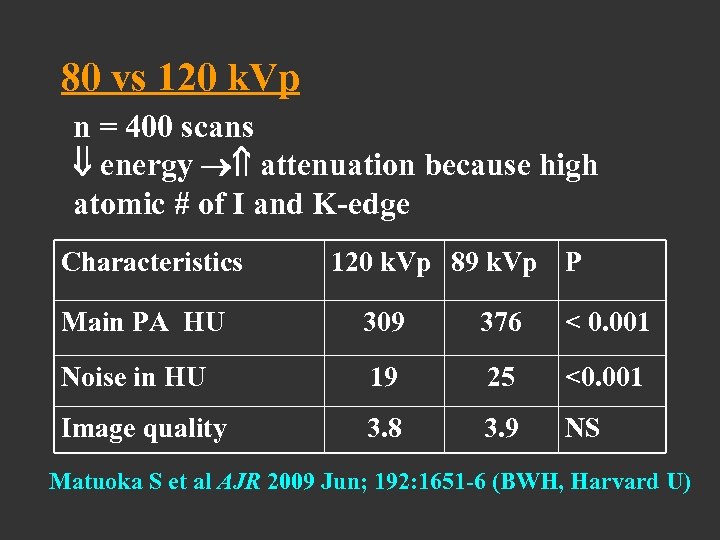
80 vs 120 k. Vp n = 400 scans energy attenuation because high atomic # of I and K-edge Characteristics 120 k. Vp 89 k. Vp P Main PA HU 309 376 < 0. 001 Noise in HU 19 25 <0. 001 Image quality 3. 8 3. 9 NS Matuoka S et al AJR 2009 Jun; 192: 1651 -6 (BWH, Harvard U)
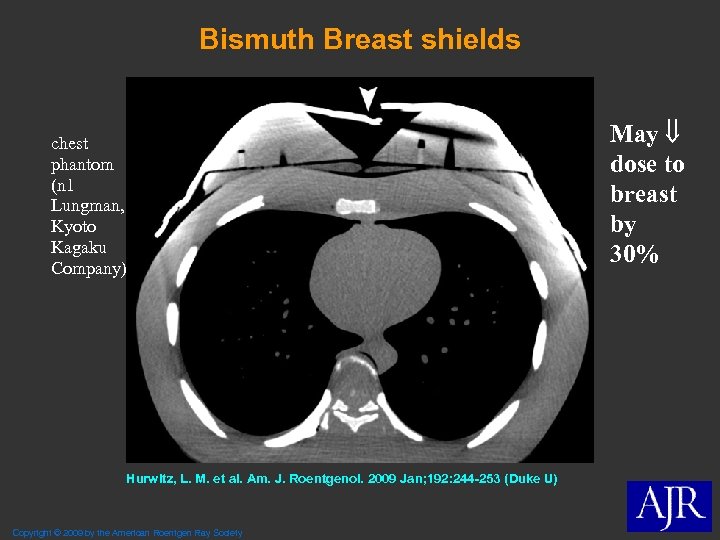
Bismuth Breast shields chest phantom (n 1 Lungman, Kyoto Kagaku Company) Hurwitz, L. M. et al. Am. J. Roentgenol. 2009 Jan; 192: 244 -253 (Duke U) Copyright © 2009 by the American Roentgen Ray Society May dose to breast by 30%

CTPA in Pregnancy
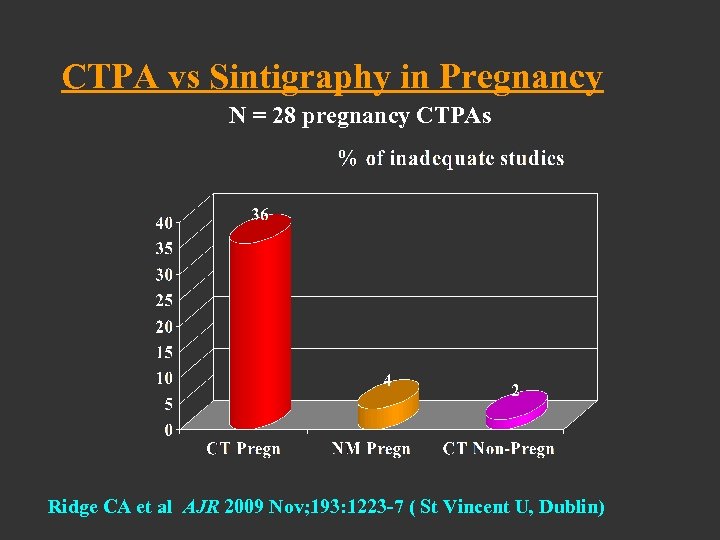
CTPA vs Sintigraphy in Pregnancy N = 28 pregnancy CTPAs Ridge CA et al AJR 2009 Nov; 193: 1223 -7 ( St Vincent U, Dublin)
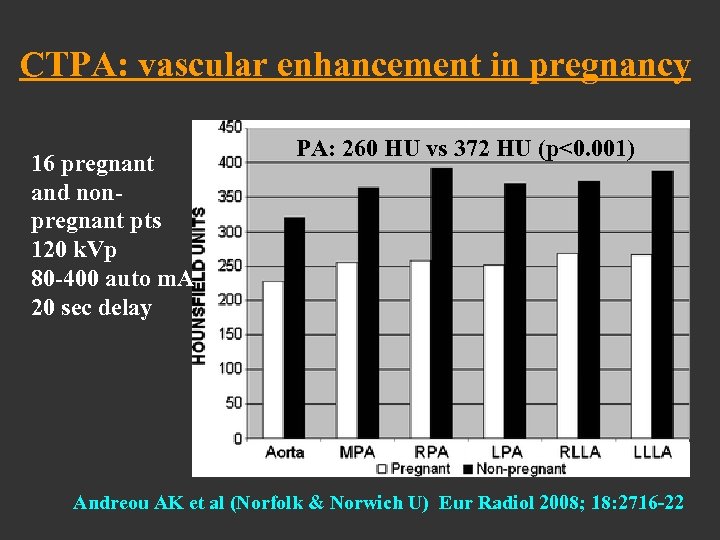
CTPA: vascular enhancement in pregnancy 16 pregnant and non- pregnant pts 120 k. Vp 80 -400 auto m. A 20 sec delay PA: 260 HU vs 372 HU (p<0. 001) Andreou AK et al (Norfolk & Norwich U) Eur Radiol 2008; 18: 2716 -22
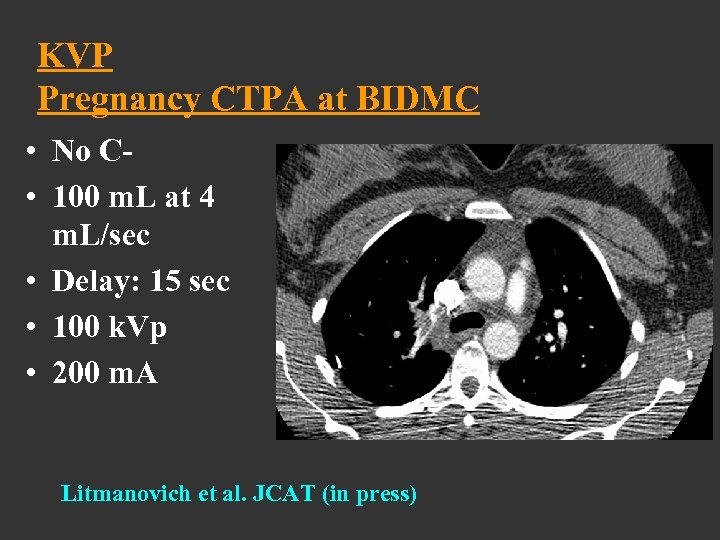
KVP Pregnancy CTPA at BIDMC • No C • 100 m. L at 4 m. L/sec • Delay: 15 sec • 100 k. Vp • 200 m. A Litmanovich et al. JCAT (in press)
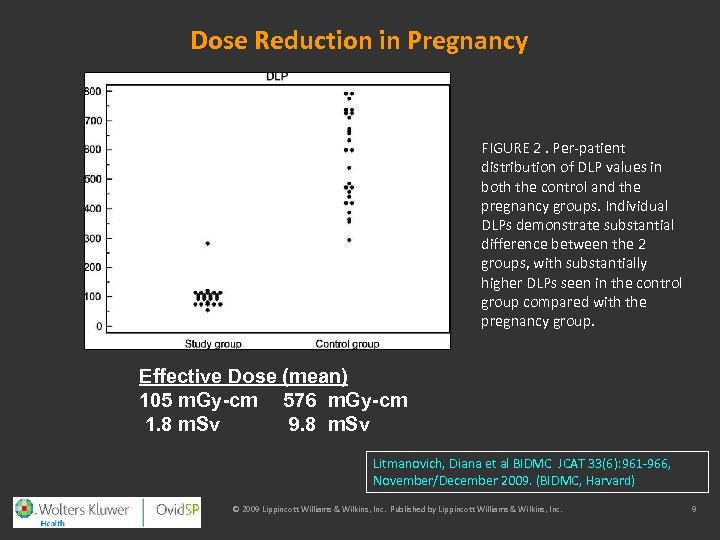
Dose Reduction in Pregnancy FIGURE 2. Per-patient distribution of DLP values in both the control and the pregnancy groups. Individual DLPs demonstrate substantial difference between the 2 groups, with substantially higher DLPs seen in the control group compared with the pregnancy group. Effective Dose (mean) 105 m. Gy-cm 576 m. Gy-cm 1. 8 m. Sv 9. 8 m. Sv Litmanovich, Diana et al BIDMC JCAT 33(6): 961 -966, November/December 2009. (BIDMC, Harvard) © 2009 Lippincott Williams & Wilkins, Inc. Published by Lippincott Williams & Wilkins, Inc. 9
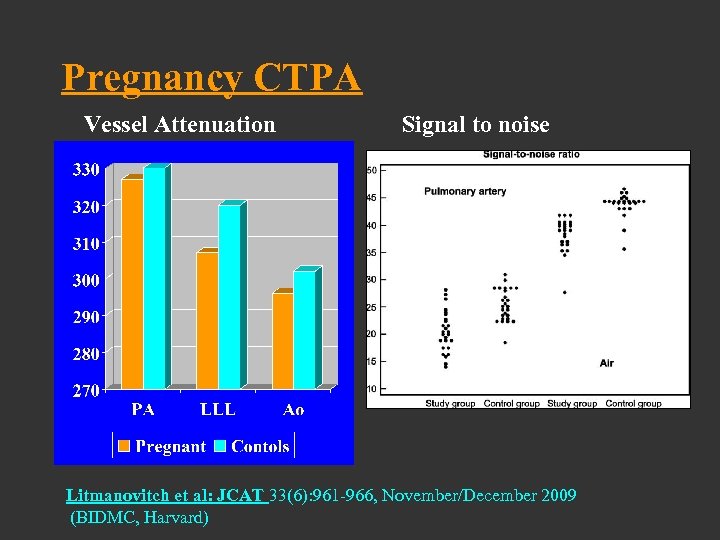
Pregnancy CTPA Vessel Attenuation Signal to noise Litmanovitch et al: JCAT 33(6): 961 -966, November/December 2009 (BIDMC, Harvard)
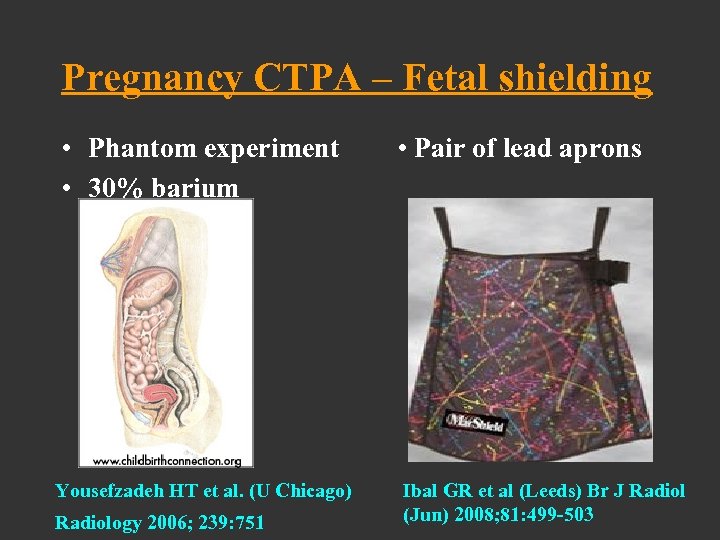
Pregnancy CTPA – Fetal shielding • Phantom experiment • 30% barium • Pair of lead aprons Yousefzadeh HT et al. (U Chicago) Ibal GR et al (Leeds) Br J Radiol (Jun) 2008; 81: 499 -503 Radiology 2006; 239: 751
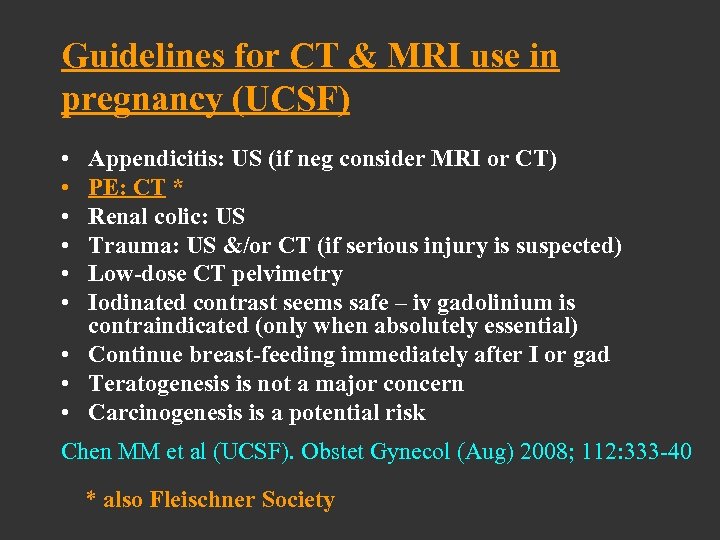
Guidelines for CT & MRI use in pregnancy (UCSF) • • • Appendicitis: US (if neg consider MRI or CT) PE: CT * Renal colic: US Trauma: US &/or CT (if serious injury is suspected) Low-dose CT pelvimetry Iodinated contrast seems safe – iv gadolinium is contraindicated (only when absolutely essential) • Continue breast-feeding immediately after I or gad • Teratogenesis is not a major concern • Carcinogenesis is a potential risk Chen MM et al (UCSF). Obstet Gynecol (Aug) 2008; 112: 333 -40 * also Fleischner Society
CTPA in Pregnancy • bolus triggering with short start delays, • high flow rates or high contrast medium concentration, • preferential use of fast CT systems and • the use of low k. Vp CT techniques. • shallow respiration Schaefer-Prokof C & Procof M (Amsterdam & Ultrecht MC) Eur Radiol 18: 1705 -6

CTPA Imaging Findings
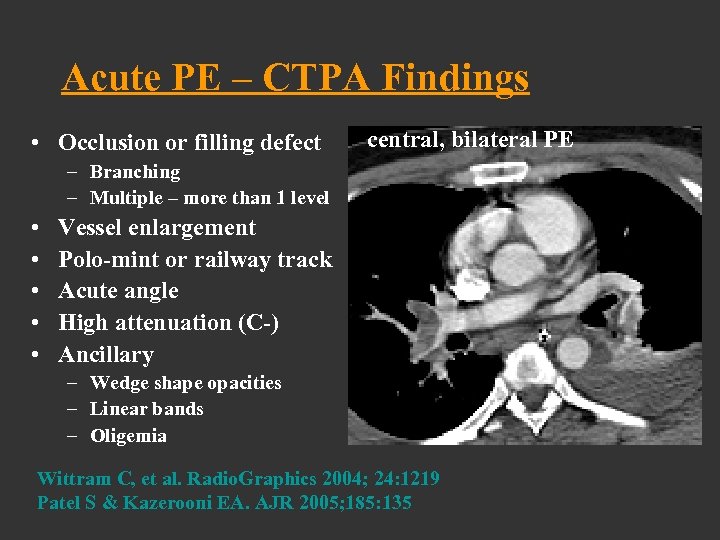
Acute PE – CTPA Findings • Occlusion or filling defect central, bilateral PE – Branching – Multiple – more than 1 level • • • Vessel enlargement Polo-mint or railway track Acute angle High attenuation (C-) Ancillary – Wedge shape opacities – Linear bands – Oligemia Wittram C, et al. Radio. Graphics 2004; 24: 1219 Patel S & Kazerooni EA. AJR 2005; 185: 135
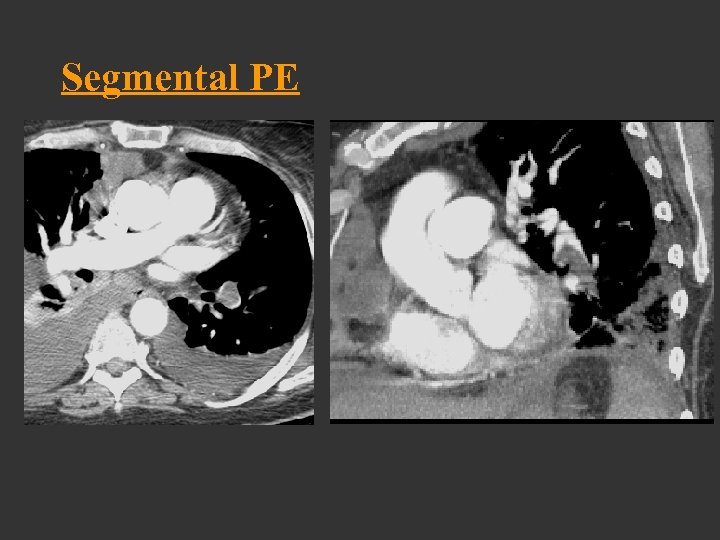
Segmental PE
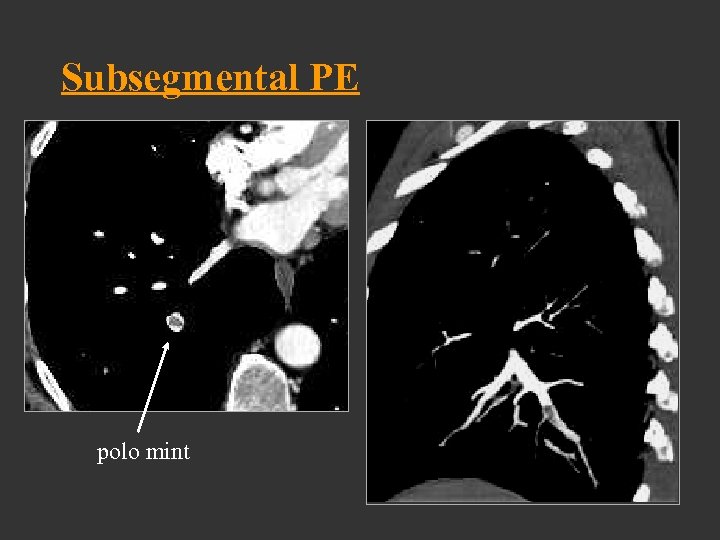
Subsegmental PE polo mint
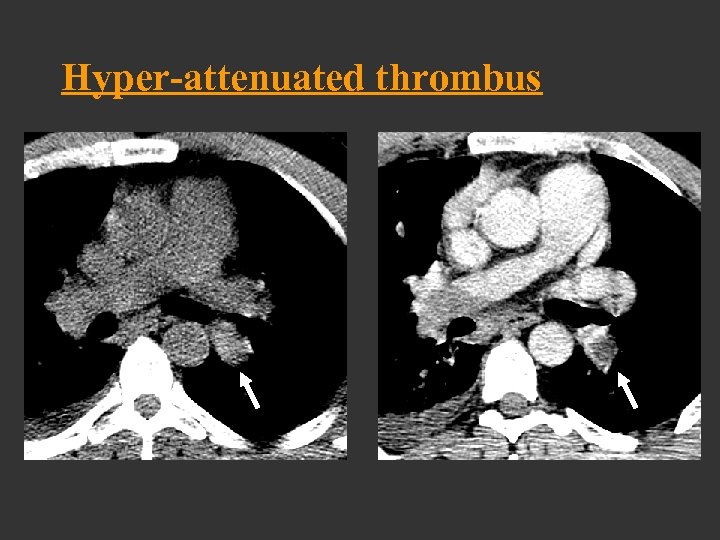
Hyper-attenuated thrombus
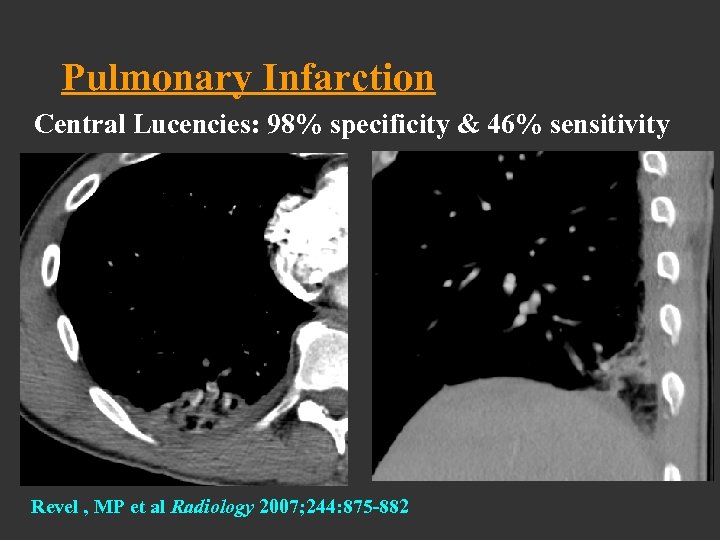
Pulmonary Infarction Central Lucencies: 98% specificity & 46% sensitivity Revel , MP et al Radiology 2007; 244: 875 -882
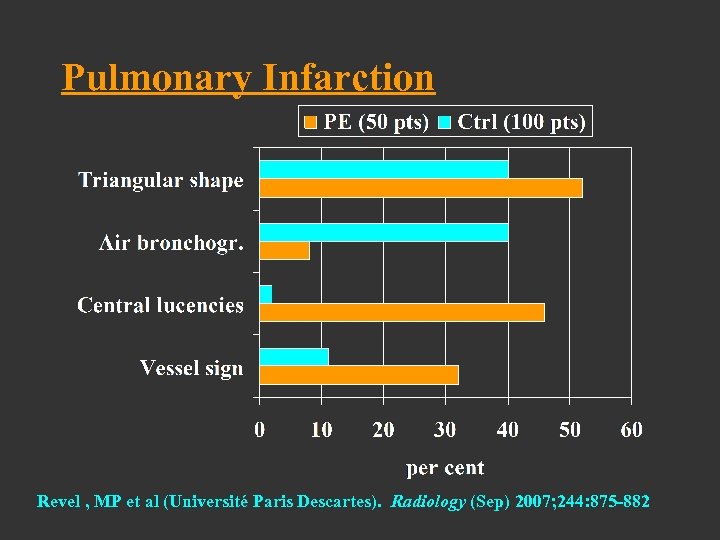
Pulmonary Infarction Revel , MP et al (Université Paris Descartes). Radiology (Sep) 2007; 244: 875 -882
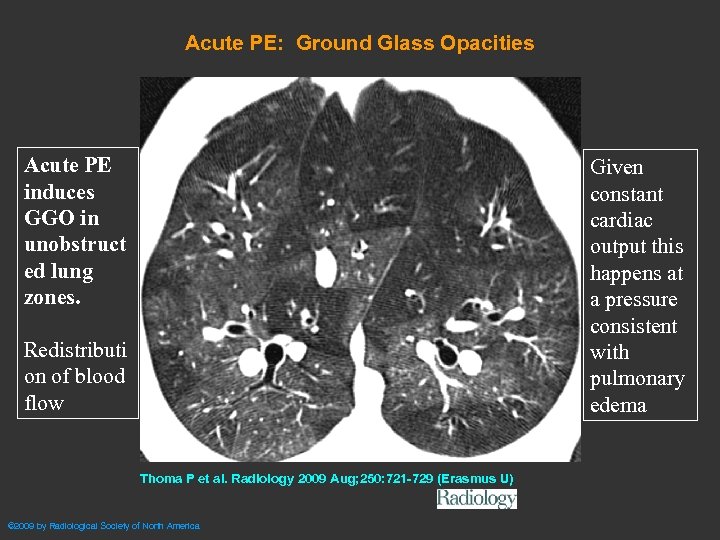
Acute PE: Ground Glass Opacities Acute PE induces GGO in unobstruct ed lung zones. Given constant cardiac output this happens at a pressure consistent with pulmonary edema Redistributi on of blood flow Thoma P et al. Radiology 2009 Aug; 250: 721 -729 (Erasmus U) © 2009 by Radiological Society of North America
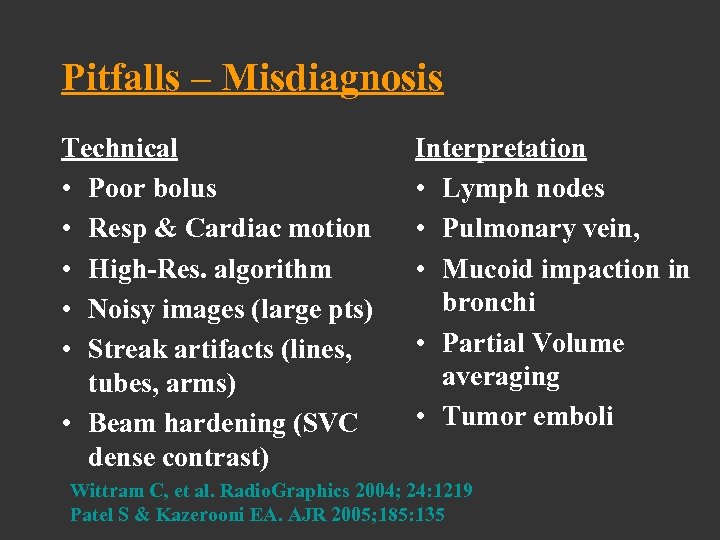
Pitfalls – Misdiagnosis Technical • Poor bolus • Resp & Cardiac motion • High-Res. algorithm • Noisy images (large pts) • Streak artifacts (lines, tubes, arms) • Beam hardening (SVC dense contrast) Interpretation • Lymph nodes • Pulmonary vein, • Mucoid impaction in bronchi • Partial Volume averaging • Tumor emboli Wittram C, et al. Radio. Graphics 2004; 24: 1219 Patel S & Kazerooni EA. AJR 2005; 185: 135
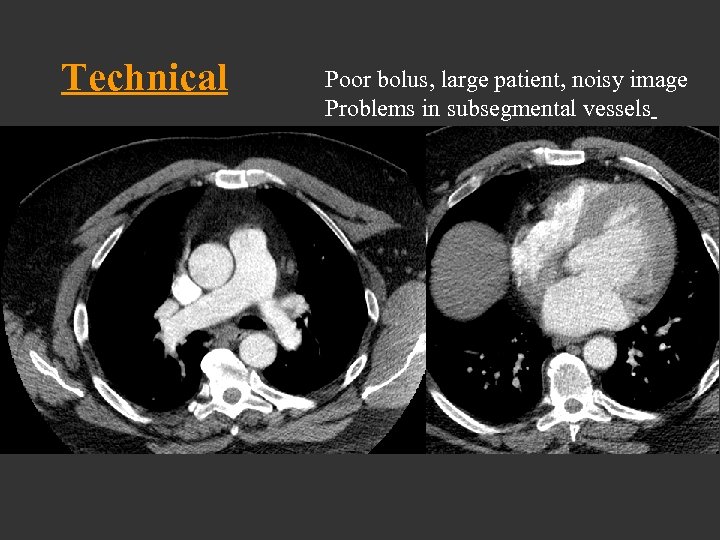
Technical Poor bolus, large patient, noisy image Problems in subsegmental vessels
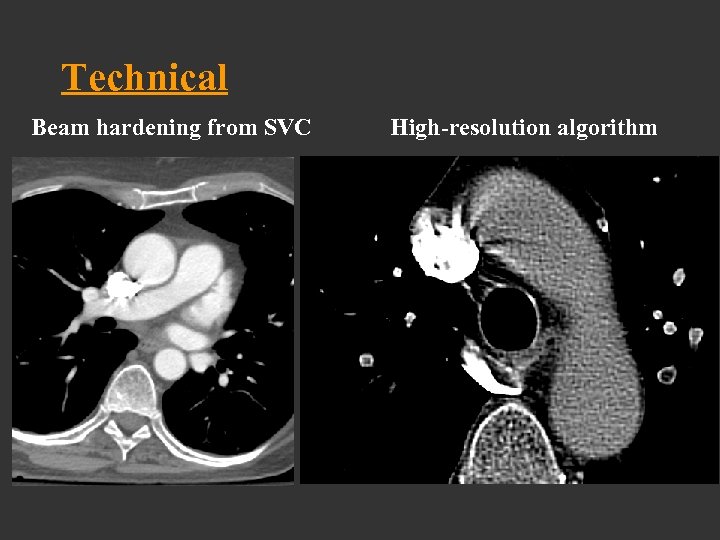
Technical Beam hardening from SVC High-resolution algorithm
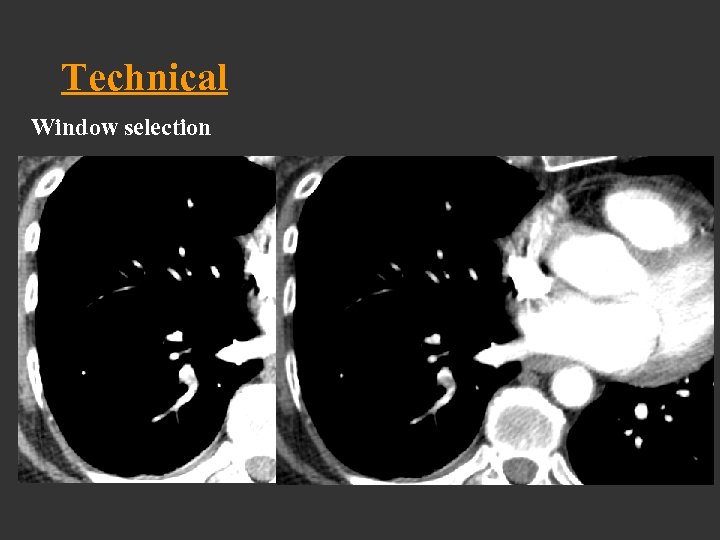
Technical Window selection
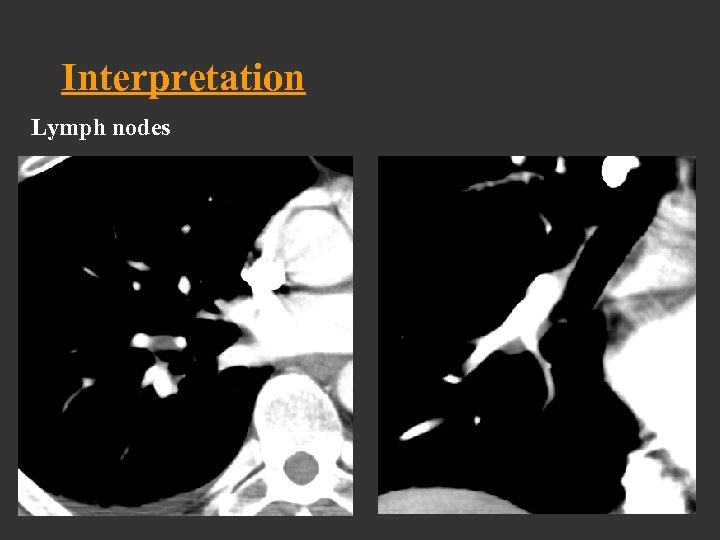
Interpretation Lymph nodes
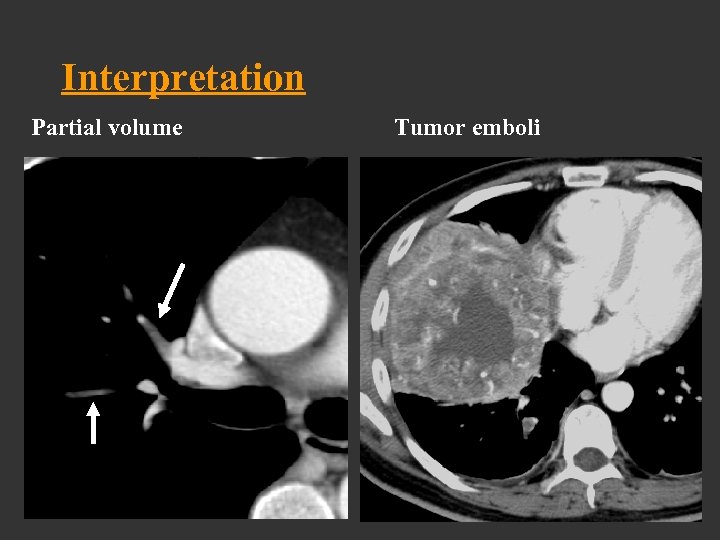
Interpretation Partial volume Tumor emboli
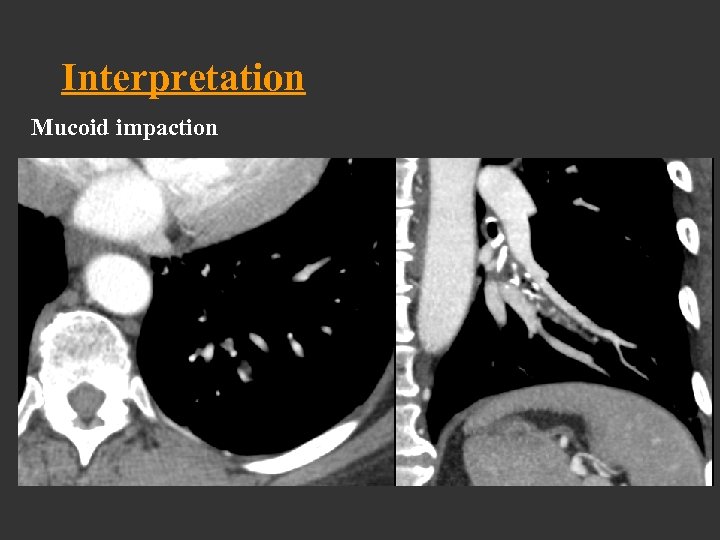
Interpretation Mucoid impaction

Large PE
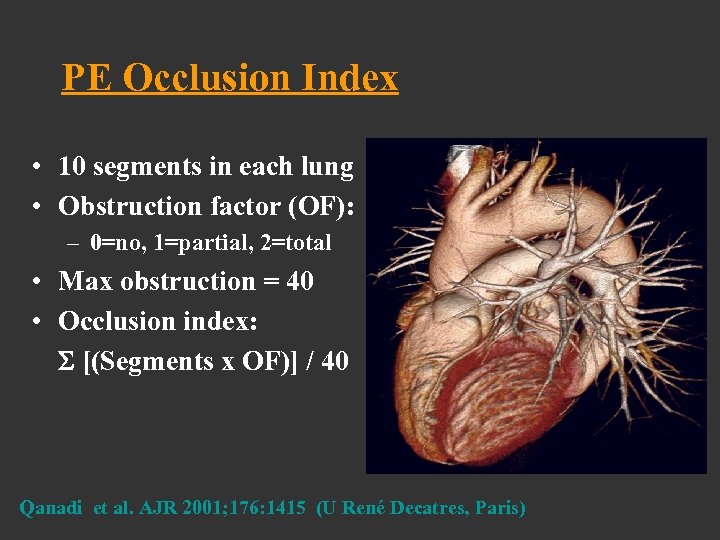
PE Occlusion Index • 10 segments in each lung • Obstruction factor (OF): – 0=no, 1=partial, 2=total • Max obstruction = 40 • Occlusion index: [(Segments x OF)] / 40 Qanadi et al. AJR 2001; 176: 1415 (U René Decatres, Paris)
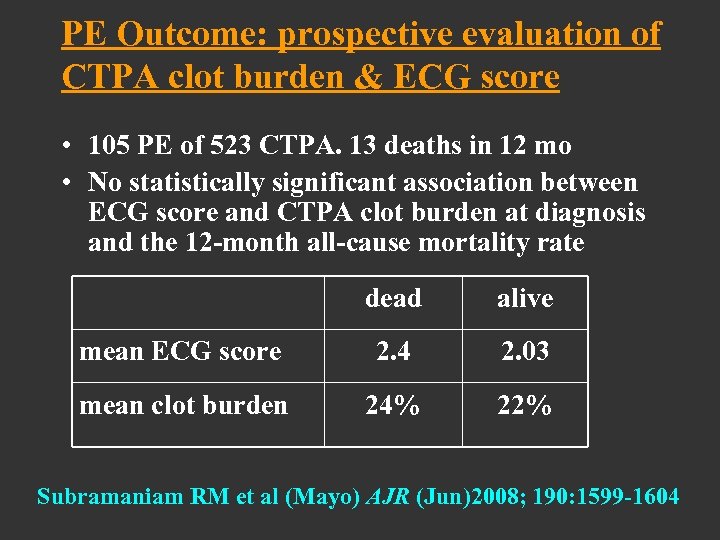
PE Outcome: prospective evaluation of CTPA clot burden & ECG score • 105 PE of 523 CTPA. 13 deaths in 12 mo • No statistically significant association between ECG score and CTPA clot burden at diagnosis and the 12 -month all-cause mortality rate dead alive mean ECG score 2. 4 2. 03 mean clot burden 24% 22% Subramaniam RM et al (Mayo) AJR (Jun)2008; 190: 1599 -1604
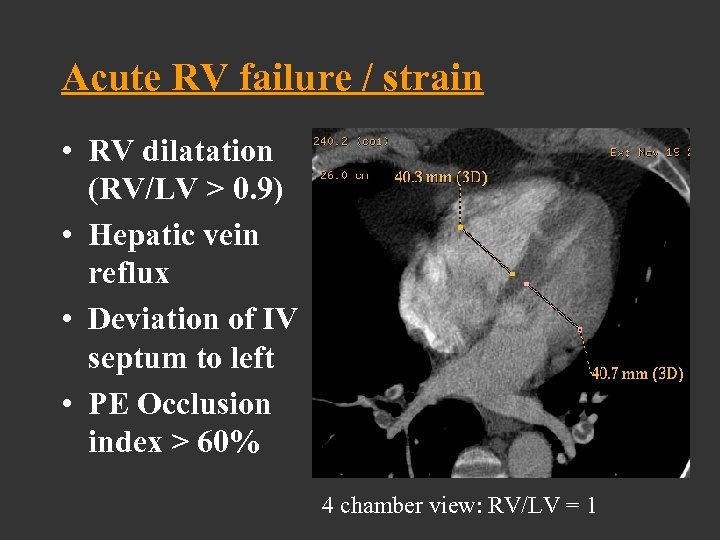
Acute RV failure / strain • RV dilatation (RV/LV > 0. 9) • Hepatic vein reflux • Deviation of IV septum to left • PE Occlusion index > 60% 4 chamber view: RV/LV = 1
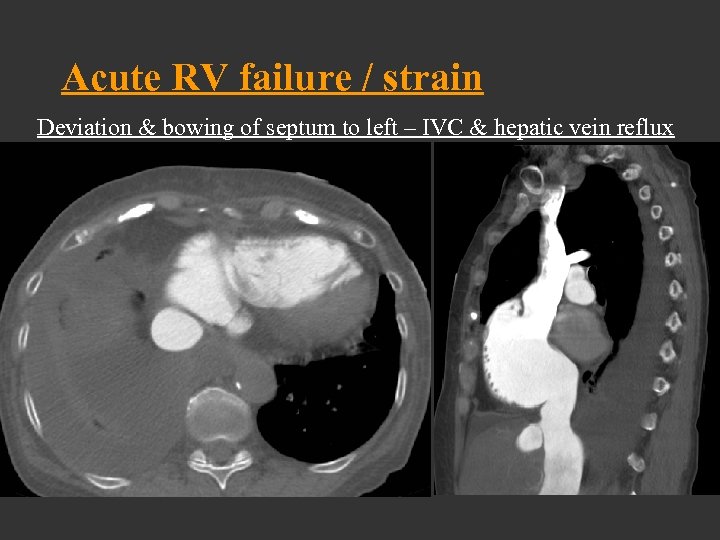
Acute RV failure / strain Deviation & bowing of septum to left – IVC & hepatic vein reflux
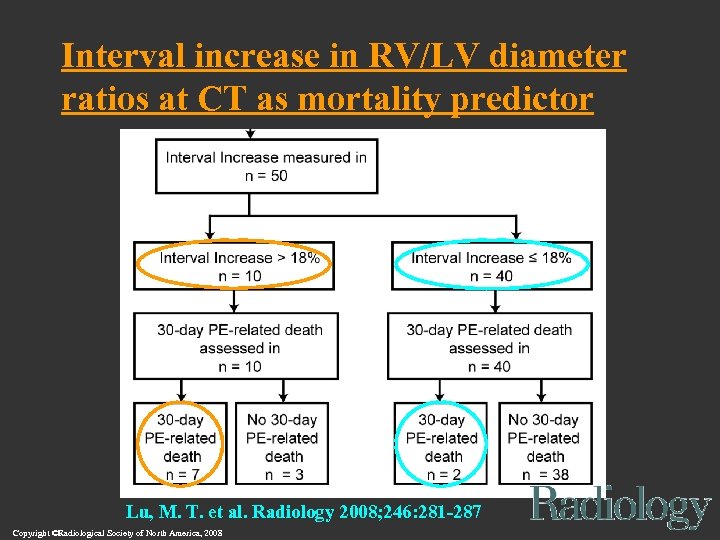
Interval increase in RV/LV diameter ratios at CT as mortality predictor Lu, M. T. et al. Radiology 2008; 246: 281 -287 Copyright ©Radiological Society of North America, 2008
Small PE Incidental Subsegmental PE (ISPE)
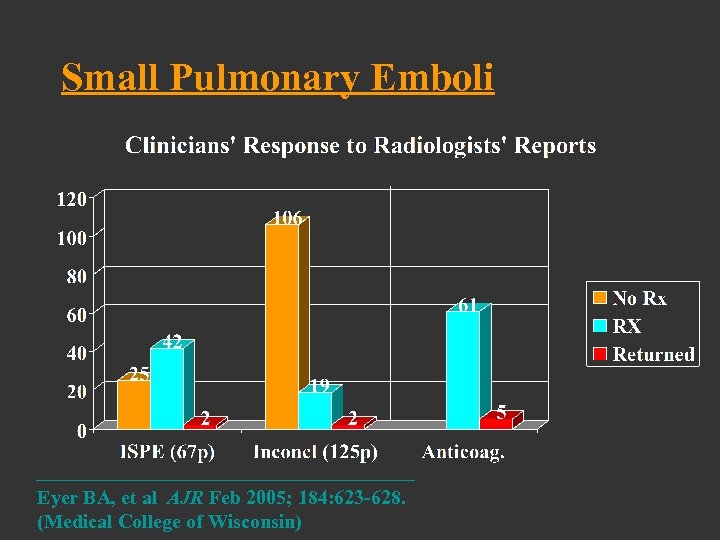
Small Pulmonary Emboli Eyer BA, et al AJR Feb 2005; 184: 623 -628. (Medical College of Wisconsin)
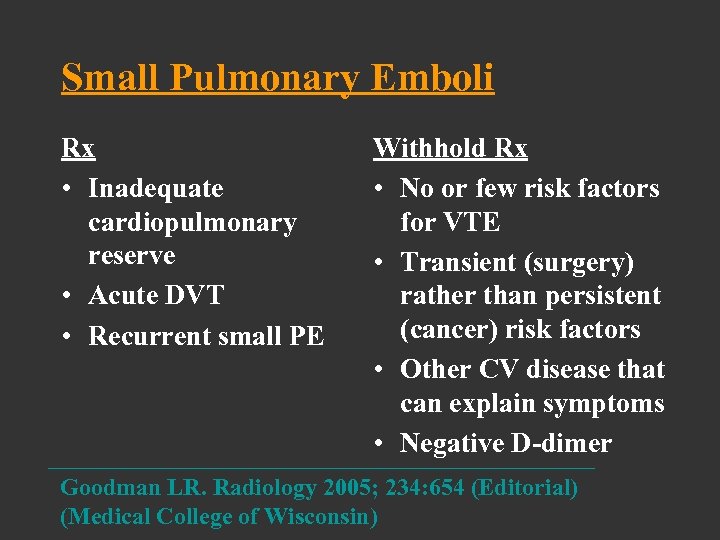
Small Pulmonary Emboli Rx • Inadequate cardiopulmonary reserve • Acute DVT • Recurrent small PE Withhold Rx • No or few risk factors for VTE • Transient (surgery) rather than persistent (cancer) risk factors • Other CV disease that can explain symptoms • Negative D-dimer Goodman LR. Radiology 2005; 234: 654 (Editorial) (Medical College of Wisconsin)

Chronic PE
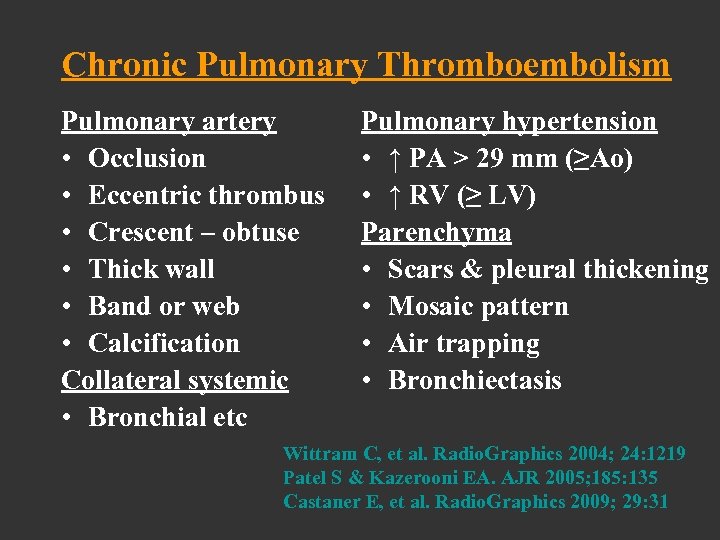
Chronic Pulmonary Thromboembolism Pulmonary artery • Occlusion • Eccentric thrombus • Crescent – obtuse • Thick wall • Band or web • Calcification Collateral systemic • Bronchial etc Pulmonary hypertension • ↑ PA > 29 mm (≥Ao) • ↑ RV (≥ LV) Parenchyma • Scars & pleural thickening • Mosaic pattern • Air trapping • Bronchiectasis Wittram C, et al. Radio. Graphics 2004; 24: 1219 Patel S & Kazerooni EA. AJR 2005; 185: 135 Castaner E, et al. Radio. Graphics 2009; 29: 31
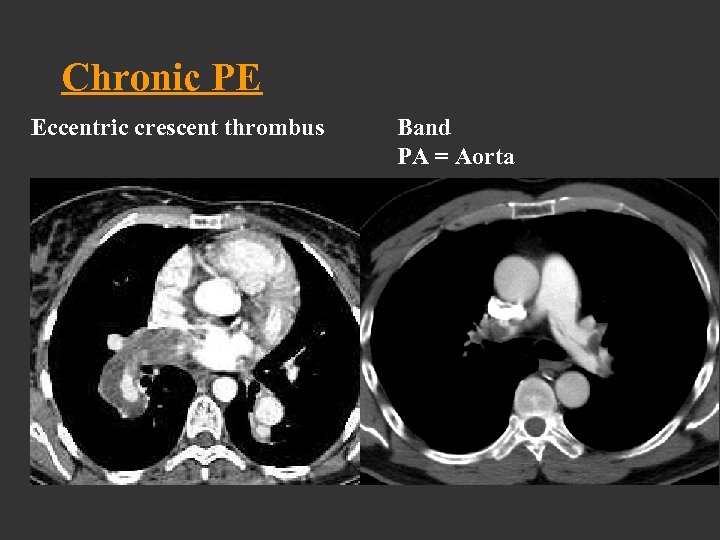
Chronic PE Eccentric crescent thrombus Band PA = Aorta
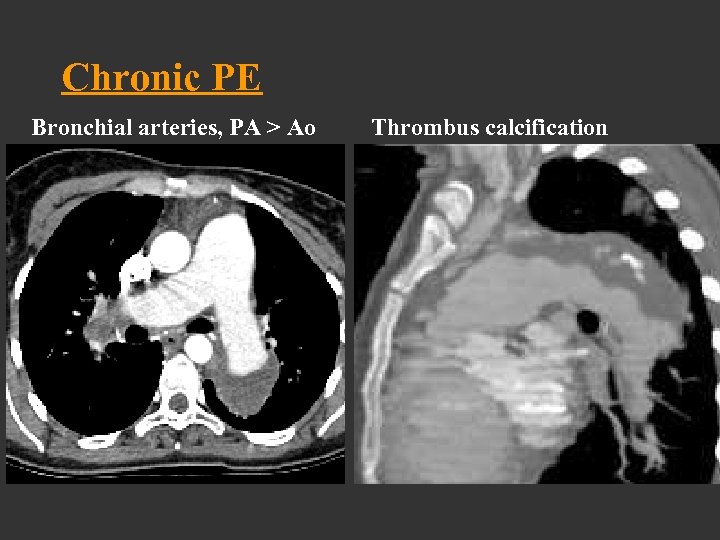
Chronic PE Bronchial arteries, PA > Ao Thrombus calcification
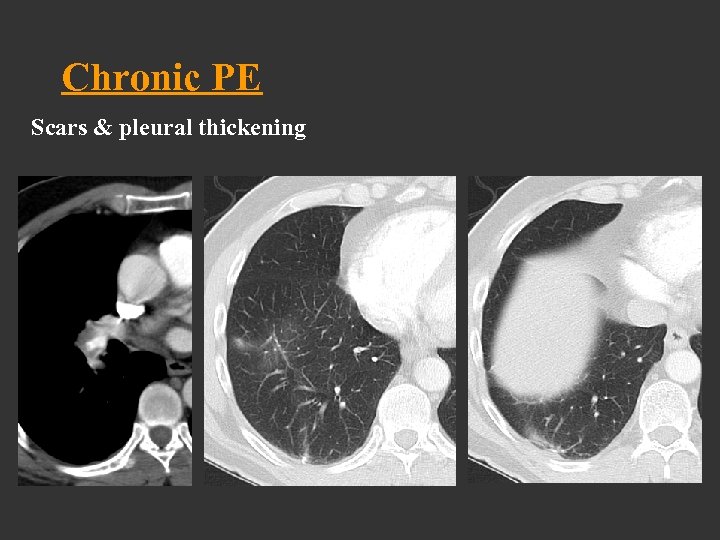
Chronic PE Scars & pleural thickening
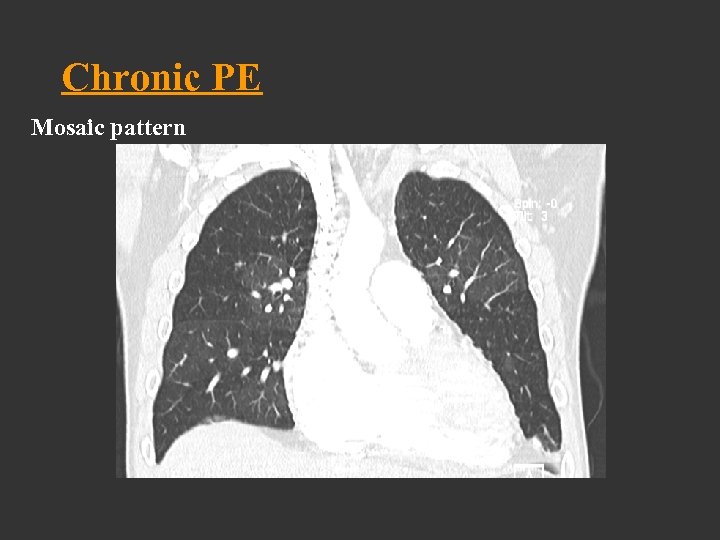
Chronic PE Mosaic pattern

Triple Rule-out
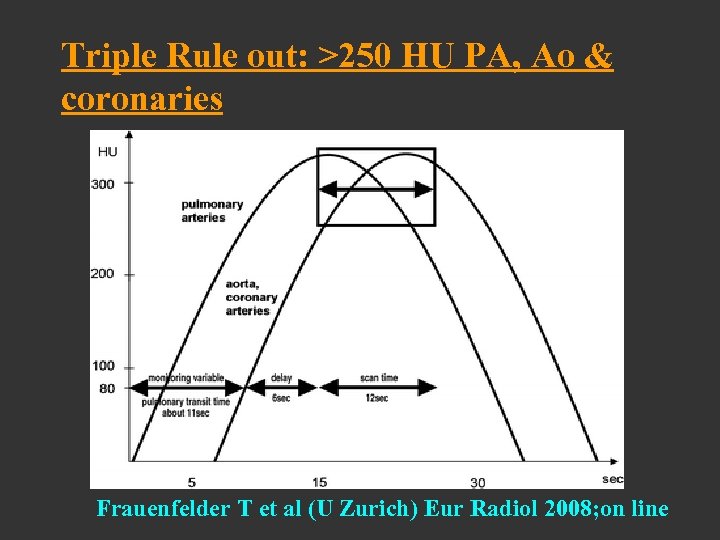
Triple Rule out: >250 HU PA, Ao & coronaries Frauenfelder T et al (U Zurich) Eur Radiol 2008; on line
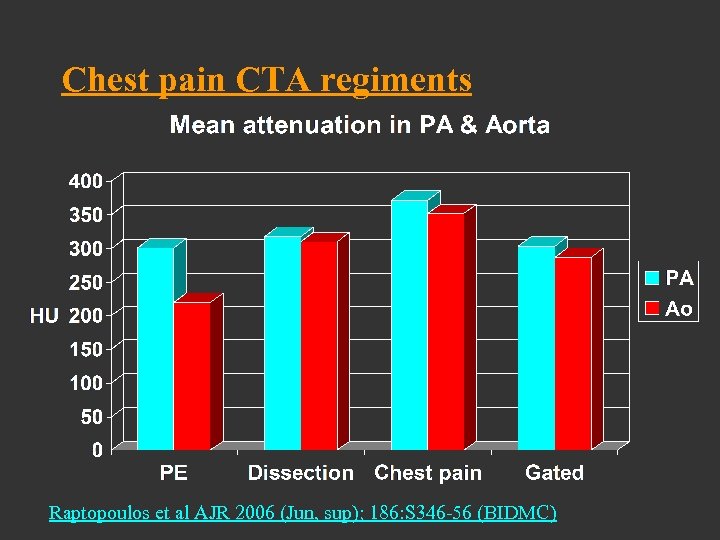
Chest pain CTA regiments Raptopoulos et al AJR 2006 (Jun, sup); 186: S 346 -56 (BIDMC)
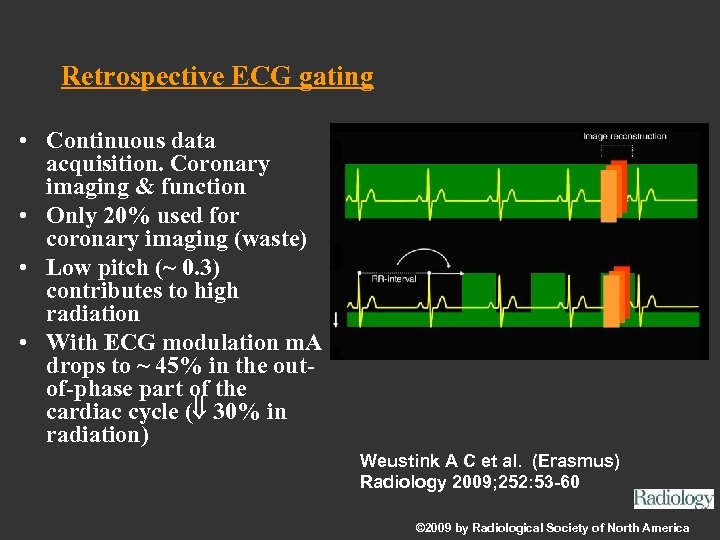
Retrospective ECG gating • Continuous data acquisition. Coronary imaging & function • Only 20% used for coronary imaging (waste) • Low pitch (~ 0. 3) contributes to high radiation • With ECG modulation m. A drops to ~ 45% in the outof-phase part of the cardiac cycle ( 30% in radiation) Weustink A C et al. (Erasmus) Radiology 2009; 252: 53 -60 © 2009 by Radiological Society of North America
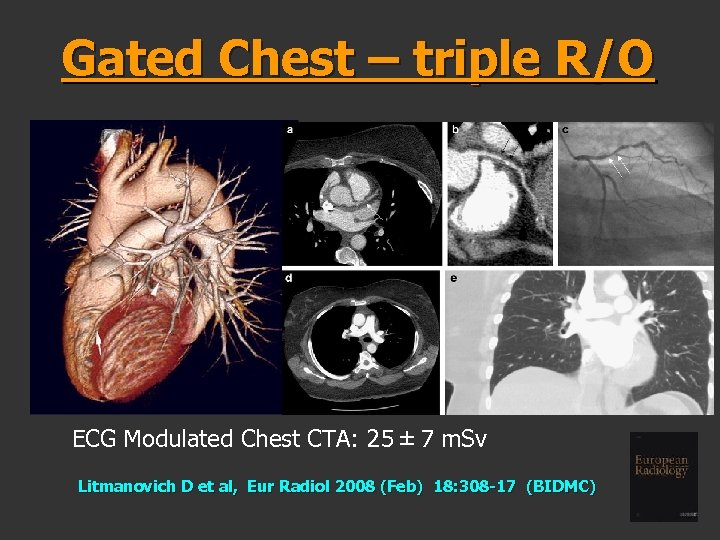
Gated Chest – triple R/O ECG Modulated Chest CTA: 25 ± 7 m. Sv Litmanovich D et al, Eur Radiol 2008 (Feb) 18: 308 -17 (BIDMC)
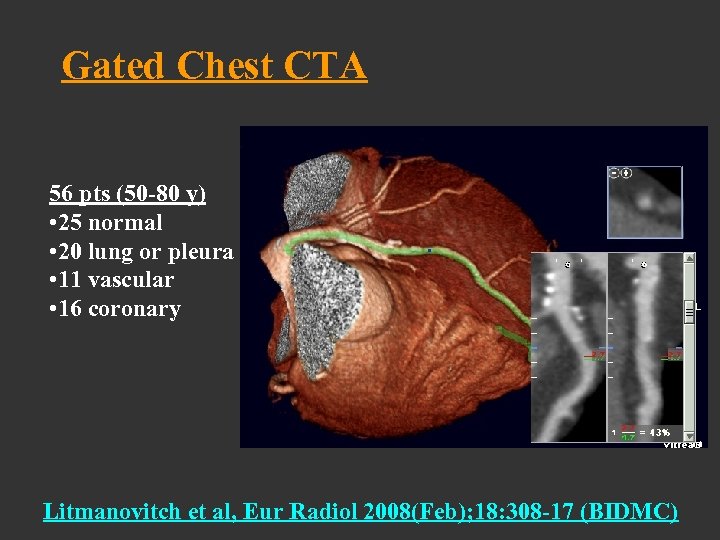
Gated Chest CTA 56 pts (50 -80 y) • 25 normal • 20 lung or pleura • 11 vascular • 16 coronary Litmanovitch et al, Eur Radiol 2008(Feb); 18: 308 -17 (BIDMC)
"Triple Rule-Out" Co. CTA protocol in ED pts w ACS • • • 197 Low-to-Moderate Risk ED patients 30 day follow up Important non coronary dx : 22 (11%) Important incidental dx : 27 (14%) Moderate & severe CAD : 22 (11%) Preclude additional cardiac testing in 175 pts Takakuwa KM & Halpern EJ (Thomas Jefferson U): Radiology (Aug) 2008; 248: 438 -446
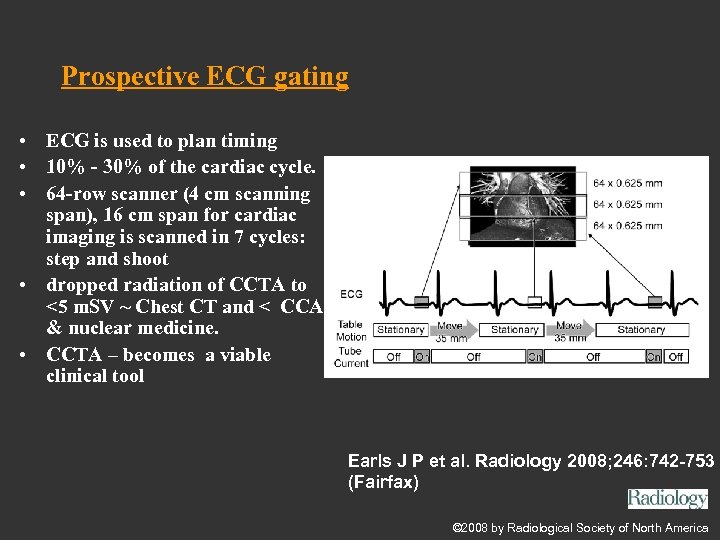
Prospective ECG gating • ECG is used to plan timing • 10% - 30% of the cardiac cycle. • 64 -row scanner (4 cm scanning span), 16 cm span for cardiac imaging is scanned in 7 cycles: step and shoot • dropped radiation of CCTA to <5 m. SV ~ Chest CT and < CCA & nuclear medicine. • CCTA – becomes a viable clinical tool Earls J P et al. Radiology 2008; 246: 742 -753 (Fairfax) © 2008 by Radiological Society of North America
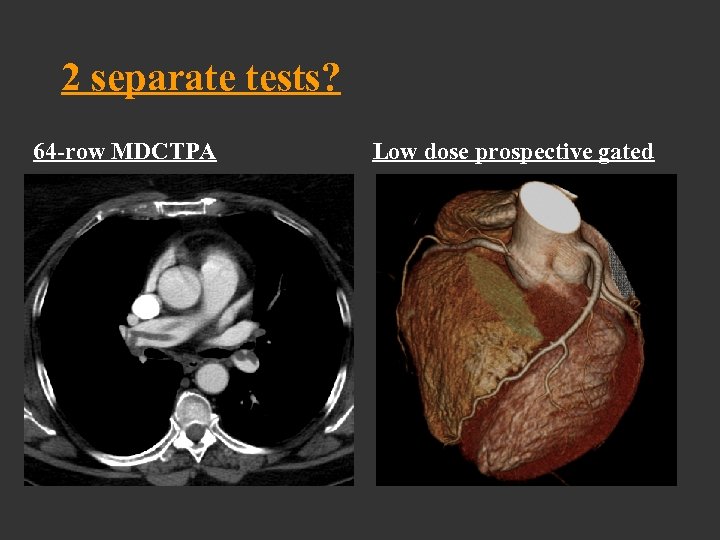
2 separate tests? 64 -row MDCTPA Low dose prospective gated
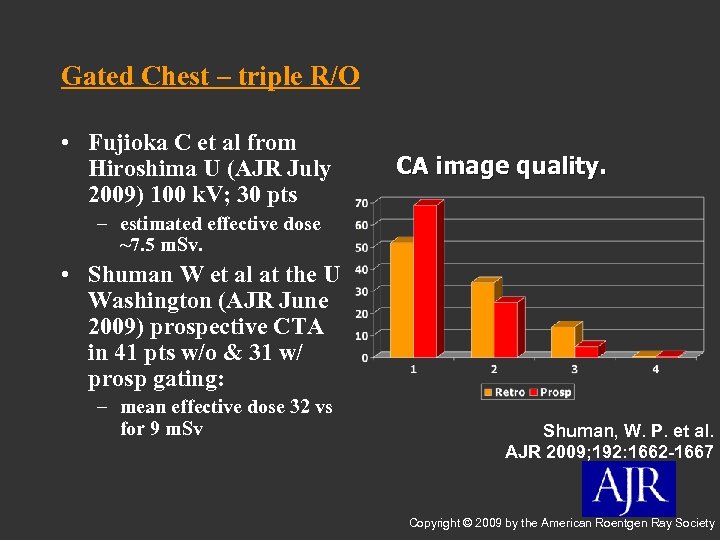
Gated Chest – triple R/O • Fujioka C et al from Hiroshima U (AJR July 2009) 100 k. V; 30 pts CA image quality. – estimated effective dose ~7. 5 m. Sv. • Shuman W et al at the U Washington (AJR June 2009) prospective CTA in 41 pts w/o & 31 w/ prosp gating: – mean effective dose 32 vs for 9 m. Sv Shuman, W. P. et al. AJR 2009; 192: 1662 -1667 Copyright © 2009 by the American Roentgen Ray Society
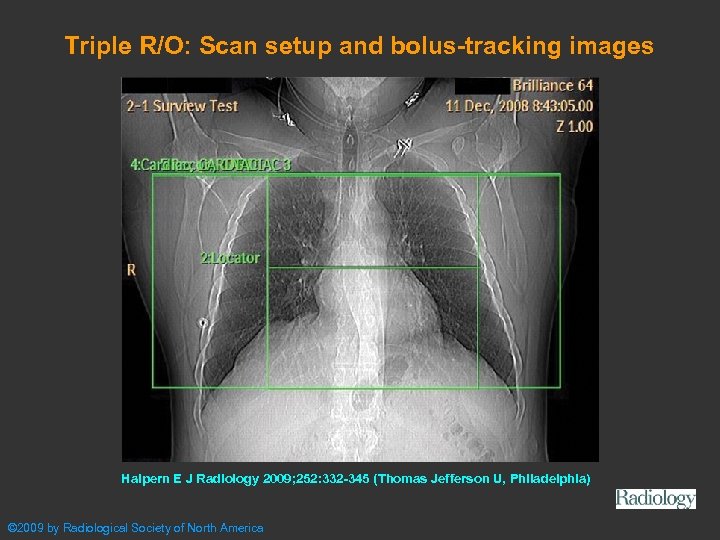
Triple R/O: Scan setup and bolus-tracking images Halpern E J Radiology 2009; 252: 332 -345 (Thomas Jefferson U, Philadelphia) © 2009 by Radiological Society of North America
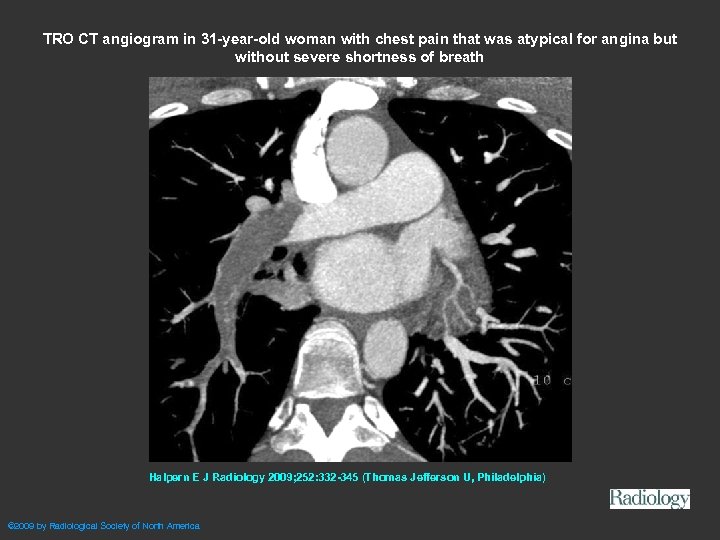
TRO CT angiogram in 31 -year-old woman with chest pain that was atypical for angina but without severe shortness of breath Halpern E J Radiology 2009; 252: 332 -345 (Thomas Jefferson U, Philadelphia) © 2009 by Radiological Society of North America
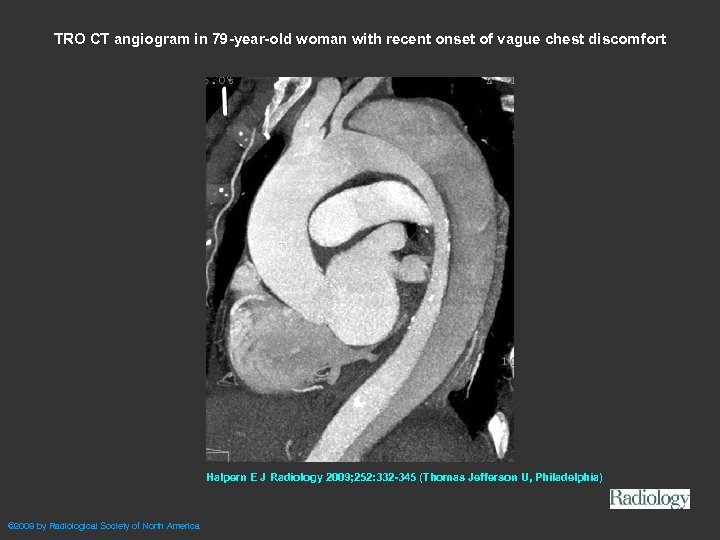
TRO CT angiogram in 79 -year-old woman with recent onset of vague chest discomfort Halpern E J Radiology 2009; 252: 332 -345 (Thomas Jefferson U, Philadelphia) © 2009 by Radiological Society of North America
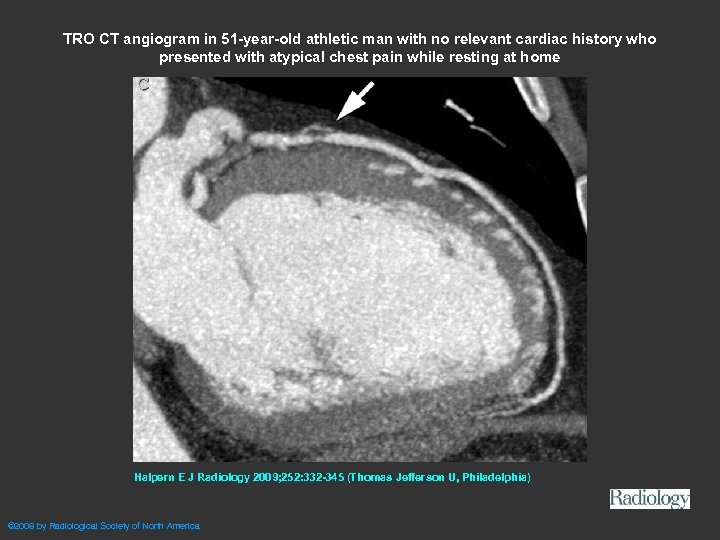
TRO CT angiogram in 51 -year-old athletic man with no relevant cardiac history who presented with atypical chest pain while resting at home Halpern E J Radiology 2009; 252: 332 -345 (Thomas Jefferson U, Philadelphia) © 2009 by Radiological Society of North America
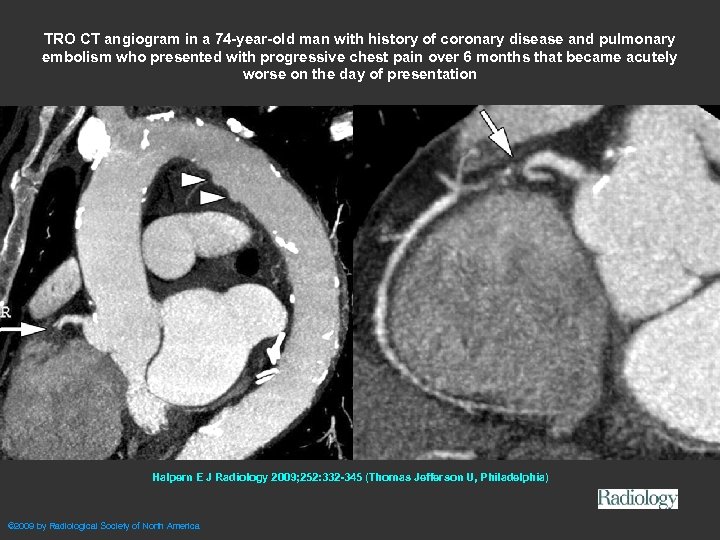
TRO CT angiogram in a 74 -year-old man with history of coronary disease and pulmonary embolism who presented with progressive chest pain over 6 months that became acutely worse on the day of presentation Halpern E J Radiology 2009; 252: 332 -345 (Thomas Jefferson U, Philadelphia) © 2009 by Radiological Society of North America
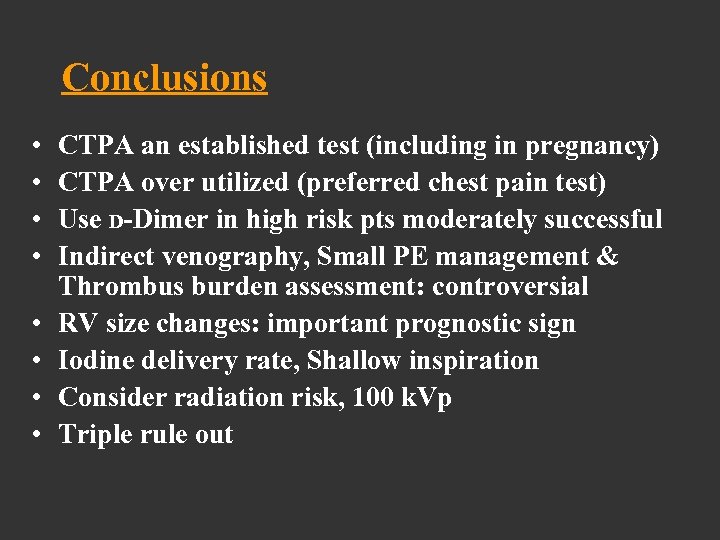
Conclusions • • CTPA an established test (including in pregnancy) CTPA over utilized (preferred chest pain test) Use D-Dimer in high risk pts moderately successful Indirect venography, Small PE management & Thrombus burden assessment: controversial RV size changes: important prognostic sign Iodine delivery rate, Shallow inspiration Consider radiation risk, 100 k. Vp Triple rule out
Скачать презентацию Longwood Non-invasive Cardiac Imaging Seminar December 14 2009
488f050c050a1e47f461b31fc2463a84.ppt