


 Скачать презентацию Long-Term Rates of Denudation and Sediment Generation Over
df7bc91396eb360536602ef089a7c014.ppt
- Количество слайдов: 49
 Long-Term Rates of Denudation and Sediment Generation Over Different Spatial Scales Quantified Using In Situ Produced Cosmogenic 10 Be and 26 Al in Sediment and Rock A Dissertation Presented by Erik Matthew Clapp to The Faculty of the Graduate College Of The University of Vermont
 Burlington Inquirer Saturday 50 cents March 29, 2003 Scientist predicts time for world to crumble into the sea, using strange particles from outer space! 10 Be and 26 Al were measured in bedrock and sediment from three arid region drainage basins of different scales and geologic complexities, to determine long-term, timeintegrated rates of sediment generation and bedrockequivalent lowering (denudation), identify sediment source areas and mechanisms of sediment delivery, and evaluate the effects of basin scale on the interpretation of cosmogenic nuclide concentrations measured in sediment. By measuring nuclide activities in individual geomorphic features throughout each drainage basin, the assumptions necessary for the interpretation of basin-wide erosion rates from stream channel sediments were tested. The results of the three studies suggest that for small basins (<20 km 2), storage of sediment is generally small, the nuclide concentration of bedrock surfaces, hillslope colluvium, alluvial fans and terraces, and stream channel sediments are similar, and the drainage network appears to satisfactorily integrate sediment and associated cosmogenic nuclides from throughout a drainage basin. Thus for small drainage basins, measuring nuclide activities in stream channel sediments leaving the basin via the trunk stream appears to provide reasonable estimates of nuclide activities from throughout the basin and thus provide a reasonable estimate of basin-wide erosion rates calculated from the nuclide activities in the sediment. However, at larger scales (>100 km 2), sediment storage becomes significant, and the nuclide signature of the stream channel sediments in the trunk stream are most representative of the geomorphic features currently yielding the greatest amount of sediment. However, at larger scales (>100 km 2), sediment storage becomes significant, and the nuclide signature of the stream channel sediments in the trunk stream 10 Be and 26 Al were measured in bedrock and sediment from three arid region drainage basins of different scales and geologic complexities, to determine long-term, time-integrated rates of sediment generation and bedrock-equivalent lowering (denudation), identify sediment source areas and mechanisms of sediment delivery, and evaluate the effects of basin scale on the interpretation of cosmogenic nuclide concentrations measured in sediment. By measuring nuclide activities in individual geomorphic features throughout each drainage basin, the assumptions necessary for the interpretation of basin -wide erosion rates from stream channel sediments were tested. The results of the three studies suggest that for small basins (<20 km 2), storage of sediment is generally small, the nuclide concentration of bedrock surfaces, hillslope colluvium, alluvial fans and terraces, and stream channel sediments are similar, and the drainage network appears to satisfactorily integrate sediment and associated cosmogenic nuclides from throughout a drainage basin. Thus for small drainage basins, measuring nuclide activities in stream channel sediments leaving the basin via the trunk stream appears to provide reasonable estimates of nuclide activities from throughout the basin and thus provide a reasonable estimate of basin-wide erosion rates calculated from the nuclide activities in the sediment. However, at larger scales (>100 km 2), sediment storage becomes significant, and the nuclide signature of the stream channel sediments in the trunk stream are most representative of the geomorphic features currently yielding the greatest amount of sediment. However, at larger scales (>100 km 2), sediment storage becomes significant, and the nuclide signature of the stream channel sediments in the trunk streamgreatest amount of sediment. However, at larger scales (>100 km 2), sediment storage becomes significant, and the Were methods learned from psychic alien baby? 10 Be and 26 Al were measured in bedrock and sediment from three arid region drainage basins of different scales and geologic complexities, to determine long-term, time-integrated rates of sediment generation and bedrock-equivalent lowering (denudation), identify sediment source areas and mechanisms of sediment delivery, and evaluate the effects of basin scale on the interpretation of cosmogenic nuclide concentrations measured in sediment. By measuring nuclide activities in individual geomorphic features throughout each drainage basin, the assumptions necessary for the interpretation of basin-wide erosion rates from stream channel sediments were tested. The results of the three studies suggest that for small basins (<20 km 2), storage of sediment is generally small, the nuclide concentration of bedrock surfaces, hillslope colluvium, alluvial The results of the three studies suggest that for small basins (<20 km 2), storage of sediment is generally small, the nuclide concentration of bedrock surfaces, hillslope colluvium, alluvial
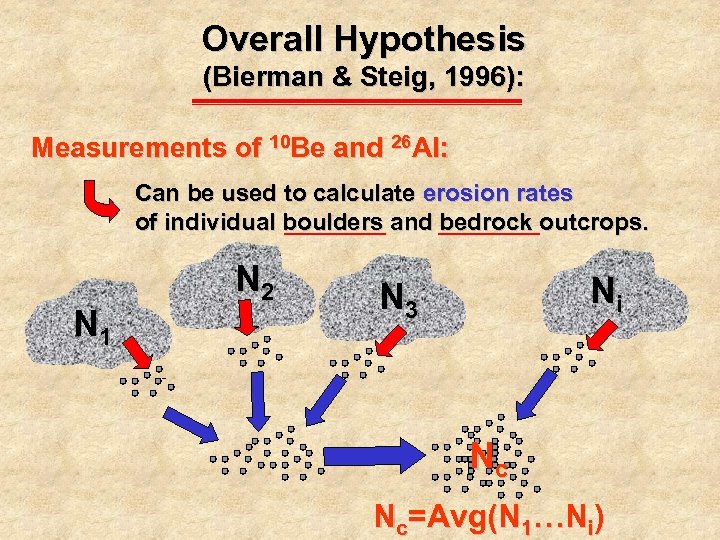 Overall Hypothesis (Bierman & Steig, 1996): Measurements of 10 Be and 26 Al: Can be used to calculate erosion rates of individual boulders and bedrock outcrops. N 1 N 2 Ni N 3 Nc Nc=Avg(N 1…Ni)
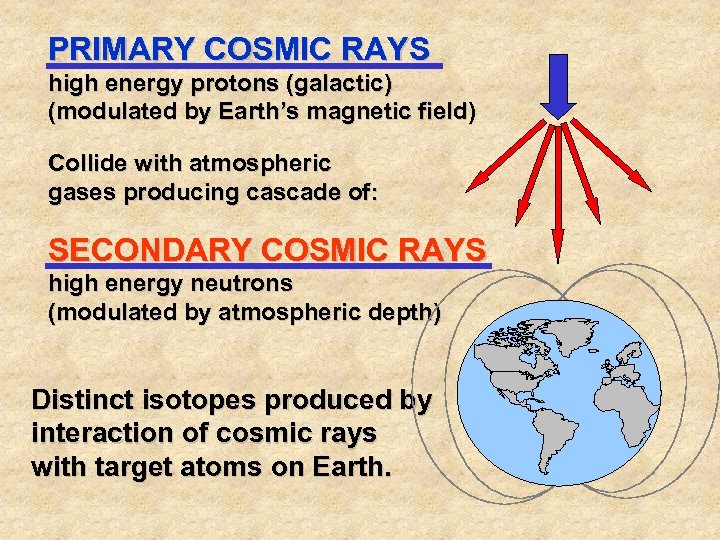 PRIMARY COSMIC RAYS high energy protons (galactic) (modulated by Earth’s magnetic field) Collide with atmospheric gases producing cascade of: SECONDARY COSMIC RAYS high energy neutrons (modulated by atmospheric depth) Distinct isotopes produced by interaction of cosmic rays with target atoms on Earth.
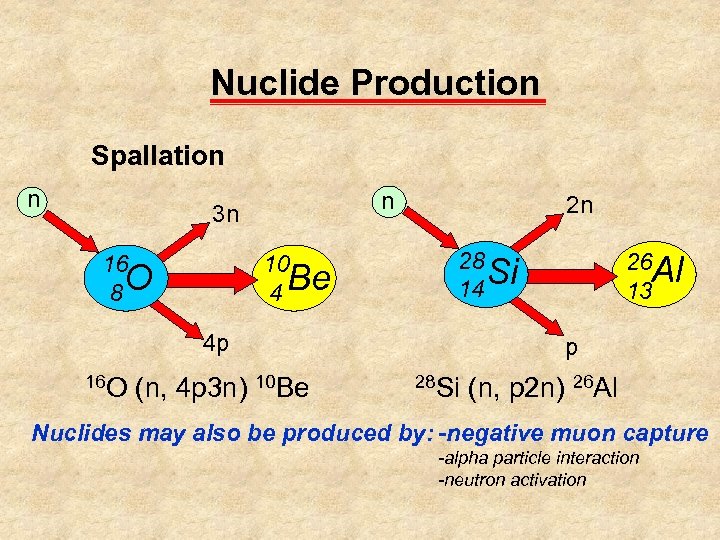 Nuclide Production Spallation n n 3 n 16 8 O 10 4 Be 2 n 28 Si 14 4 p 16 O (n, 4 p 3 n) 10 Be 26 Al 13 p 28 Si (n, p 2 n) 26 Al Nuclides may also be produced by: -negative muon capture -alpha particle interaction -neutron activation
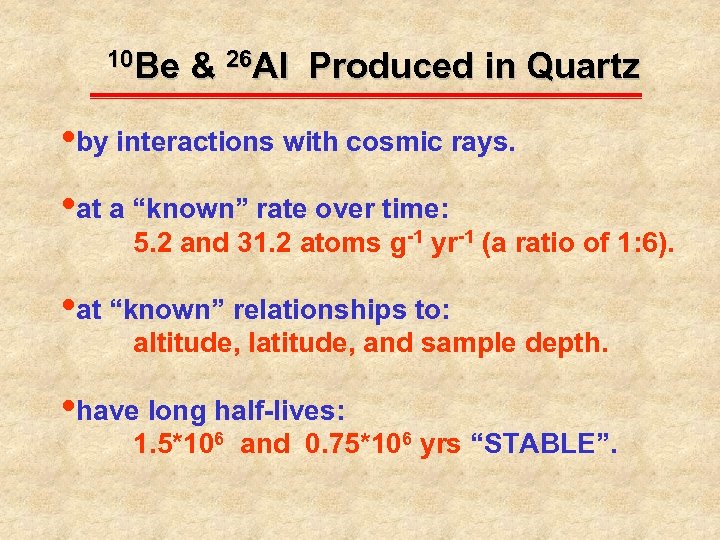 10 Be & 26 Al Produced in Quartz • by interactions with cosmic rays. • at a “known” rate over time: 5. 2 and 31. 2 atoms g-1 yr-1 (a ratio of 1: 6). • at “known” relationships to: altitude, latitude, and sample depth. • have long half-lives: 1. 5*106 and 0. 75*106 yrs “STABLE”.
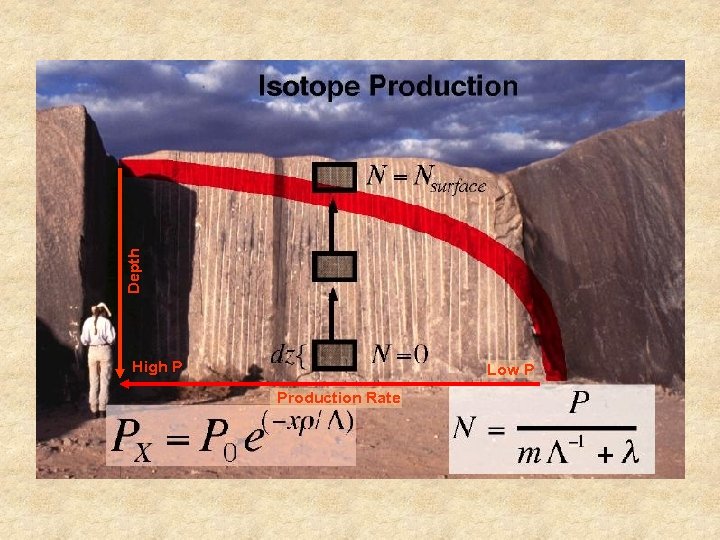 Depth High P Low P Production Rate
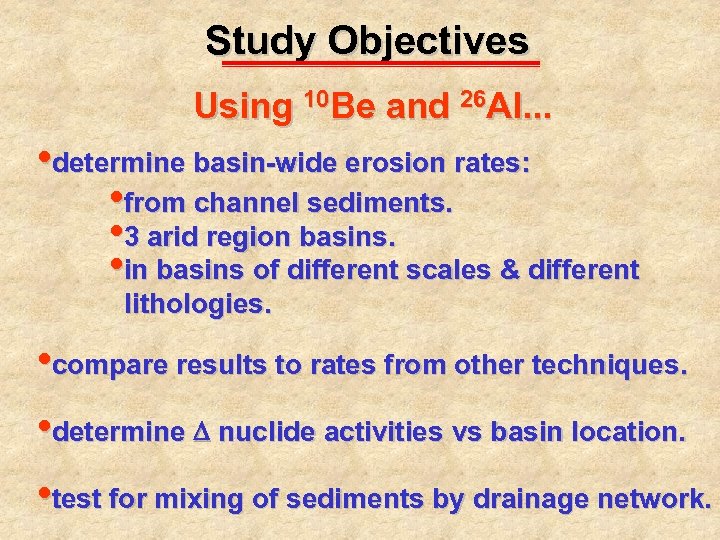 Study Objectives Using 10 Be and 26 Al. . . • determine basin-wide erosion rates: • from channel sediments. • 3 arid region basins. • in basins of different scales & different lithologies. • compare results to rates from other techniques. • determine D nuclide activities vs basin location. • test for mixing of sediments by drainage network.
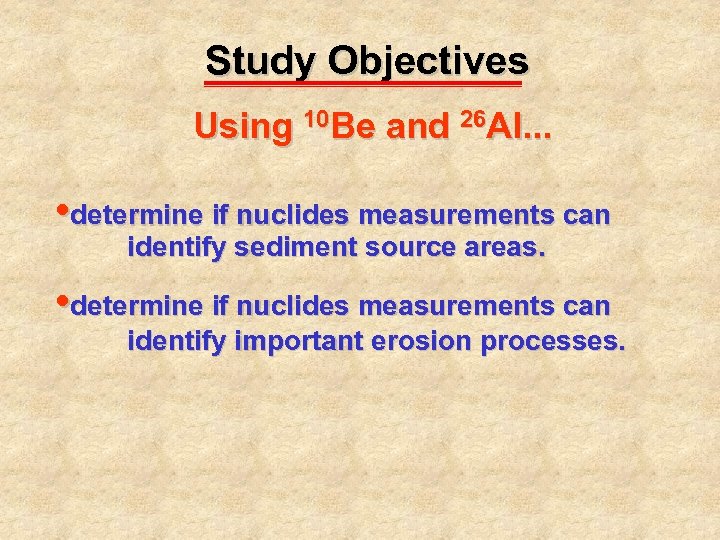 Study Objectives Using 10 Be and 26 Al. . . • determine if nuclides measurements can identify sediment source areas. • determine if nuclides measurements can identify important erosion processes.
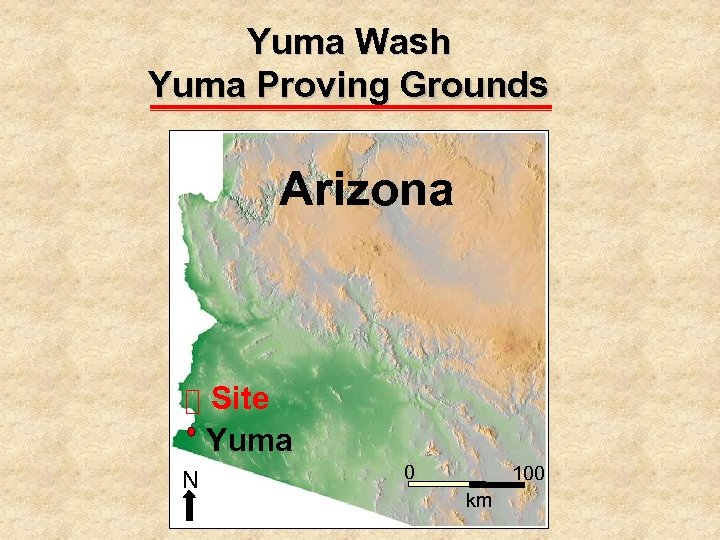
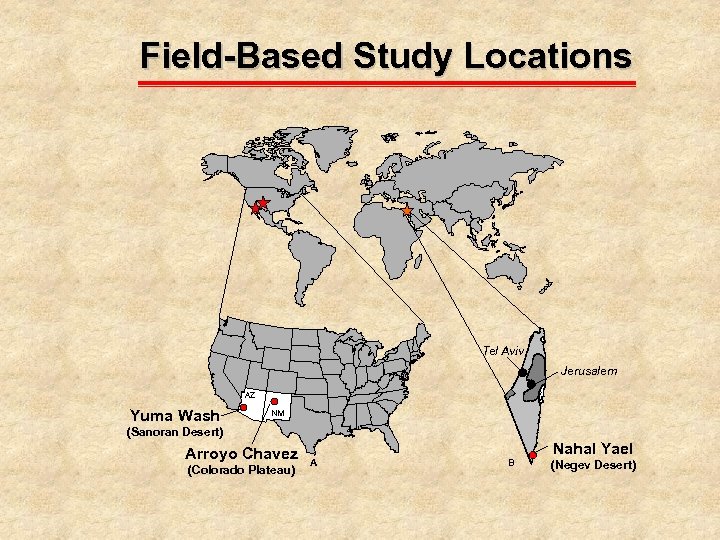 Field-Based Study Locations Tel Aviv Jerusalem AZ Yuma Wash NM (Sanoran Desert) Arroyo Chavez (Colorado Plateau) A B Nahal Yael (Negev Desert)
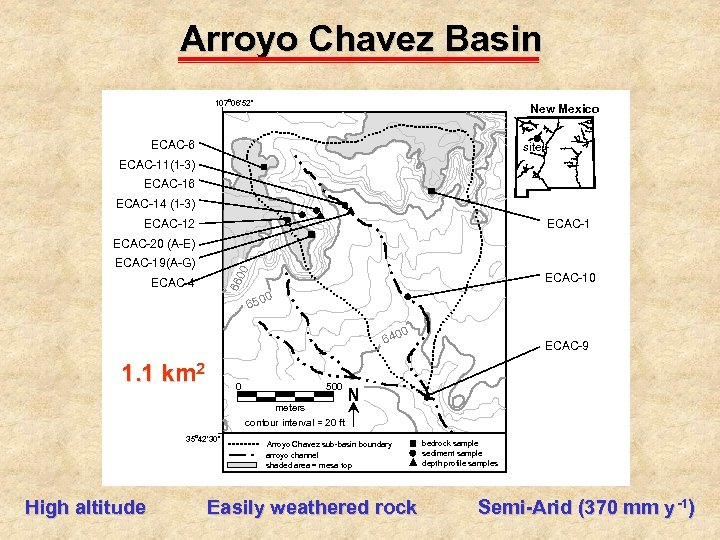 Arroyo Chavez Basin 107 o 06’ 52” New Mexico ECAC-6 site ECAC-11(1 -3) ECAC-16 ECAC-14 (1 -3) ECAC-12 ECAC-1 ECAC-20 (A-E) 0 ECAC-19(A-G) ECAC-10 660 ECAC-4 0 650 640 1. 1 km 2 0 500 meters contour interval = 20 ft 35 o 42’ 30” High altitude 0 ECAC-9 N Arroyo Chavez sub-basin boundary arroyo channel shaded area = mesa top Easily weathered rock bedrock sample sediment sample depth profile samples Semi-Arid (370 mm y -1)
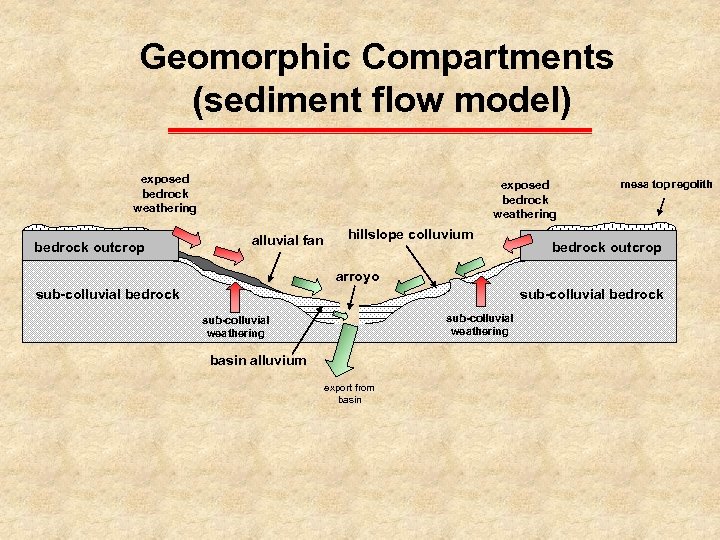 Geomorphic Compartments (sediment flow model) exposed bedrock weathering bedrock outcrop exposed bedrock weathering alluvial fan hillslope colluvium mesa top regolith bedrock outcrop arroyo sub-colluvial bedrock sub-colluvial weathering basin alluvium export from basin
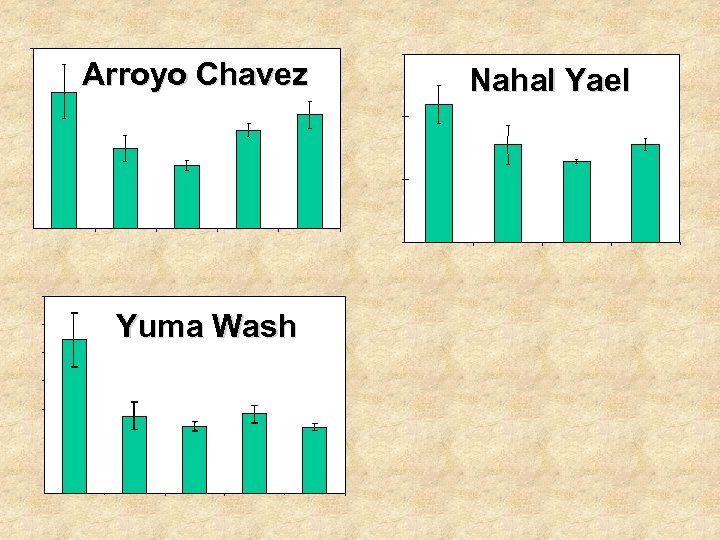
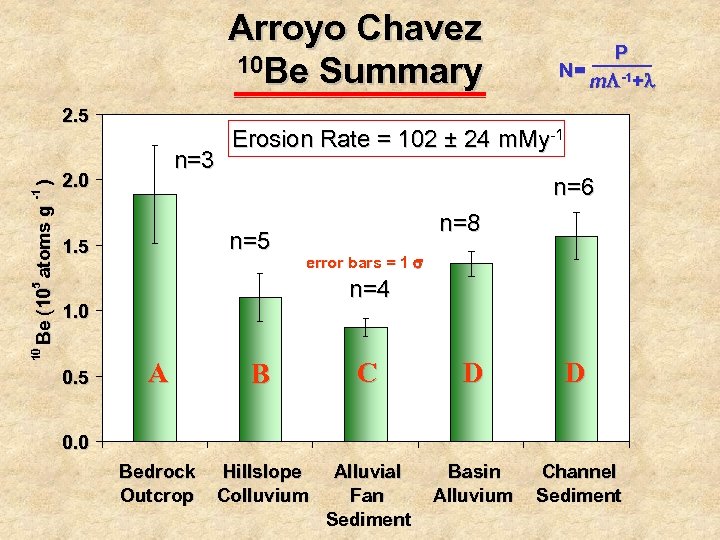 Arroyo Chavez 10 Be Summary n=3 2. 0 Erosion Rate = 102 ± 24 m. My-1 n=6 n=5 1. 5 n=8 error bars = 1 s n=4 5 -1 Be (105 atoms g -1 ) 2. 5 10 1. 0 0. 5 P N= m. L-1+l A B C D D Bedrock Outcrop Hillslope Colluvium Alluvial Fan Sediment Basin Alluvium Channel Sediment 0. 0
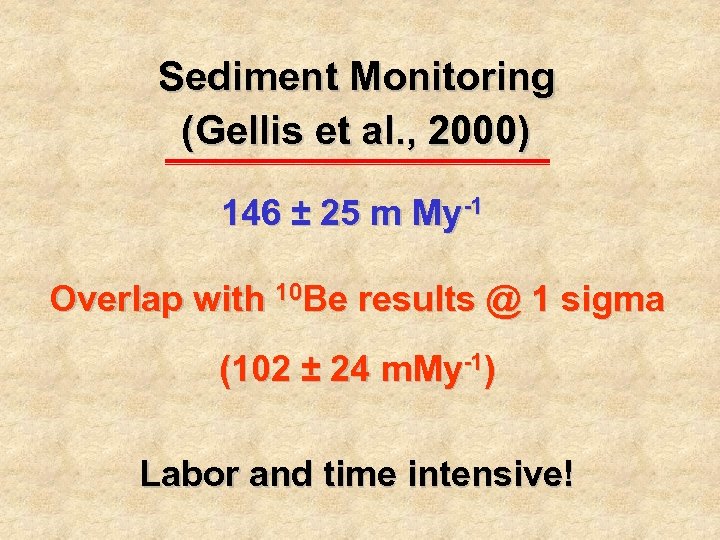 Sediment Monitoring (Gellis et al. , 2000) 146 ± 25 m My-1 Overlap with 10 Be results @ 1 sigma (102 ± 24 m. My-1) Labor and time intensive!
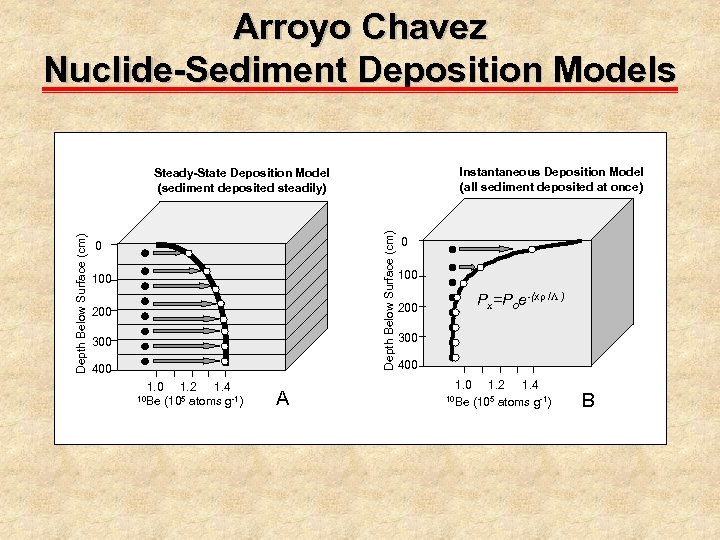 Arroyo Chavez Nuclide-Sediment Deposition Models Instantaneous Deposition Model (all sediment deposited at once) Depth Below Surface (cm) Steady-State Deposition Model (sediment deposited steadily) 0 100 200 300 400 1. 0 10 Be 1. 2 1. 4 (105 atoms g-1) A 0 100 Px=Poe-(x / ) 200 300 400 1. 0 10 Be 1. 2 1. 4 (105 atoms g-1) B
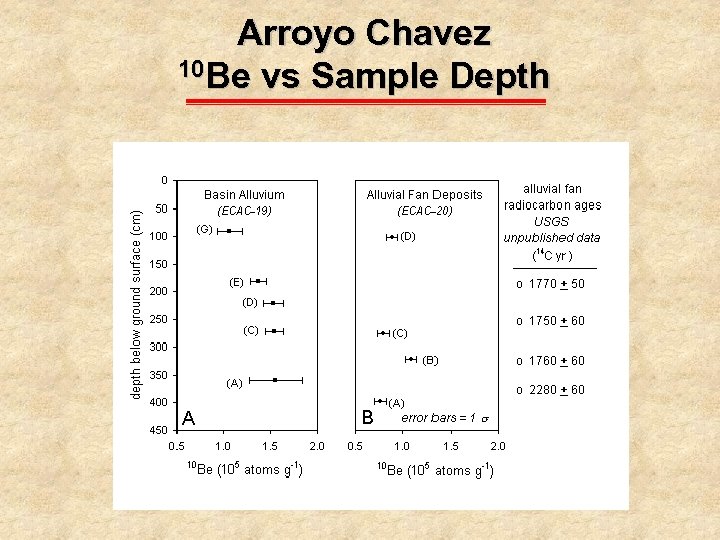 Arroyo Chavez 10 Be vs Sample Depth
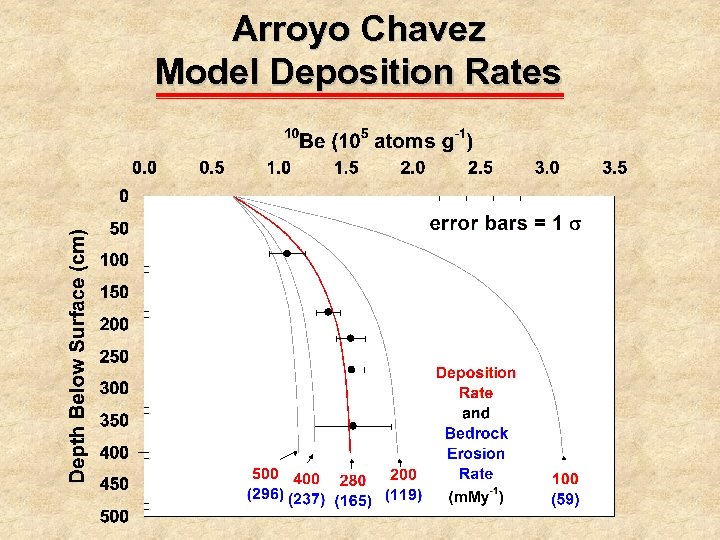 Arroyo Chavez Model Deposition Rates
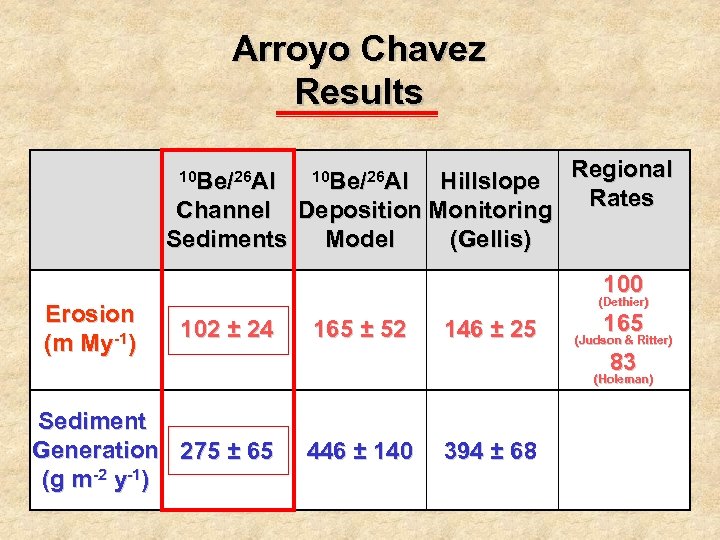 Arroyo Chavez Results Hillslope Regional Rates Channel Deposition Monitoring Sediments Model (Gellis) 10 Be/26 Al 100 Erosion (m My-1) (Dethier) 102 ± 24 165 ± 52 146 ± 25 165 (Judson & Ritter) 83 (Holeman) Sediment Generation 275 ± 65 (g m-2 y-1) 446 ± 140 394 ± 68
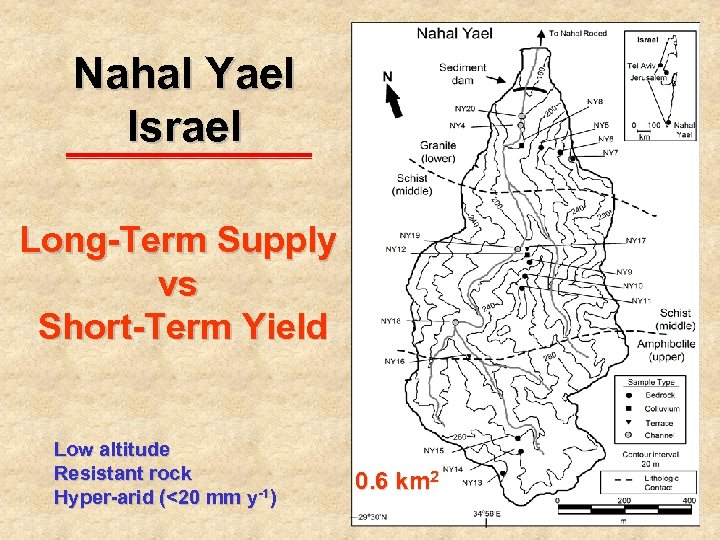 Nahal Yael Israel Long-Term Supply vs Short-Term Yield Low altitude Resistant rock Hyper-arid (<20 mm y-1) 0. 6 km 2
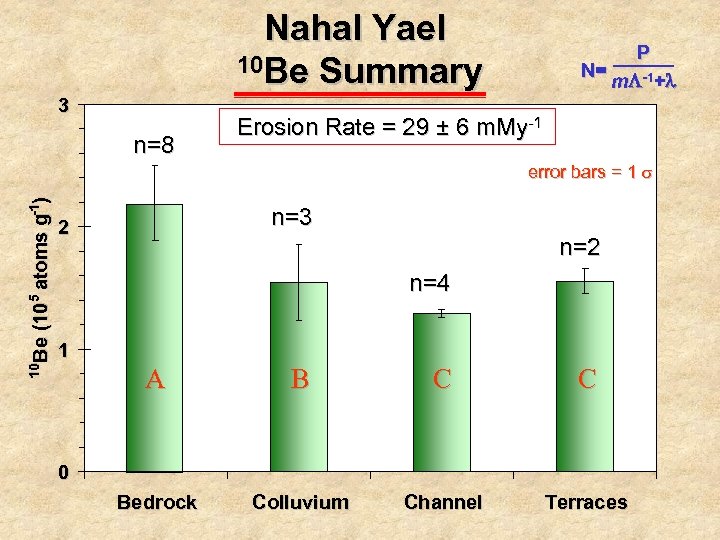 Nahal Yael 10 Be Summary 3 n=8 P N= m. L-1+l Erosion Rate = 29 ± 6 m. My-1 n=3 2 n=4 1 10 Be (105 atoms g-1) error bars = 1 s A B C C Bedrock Colluvium Channel Terraces 0
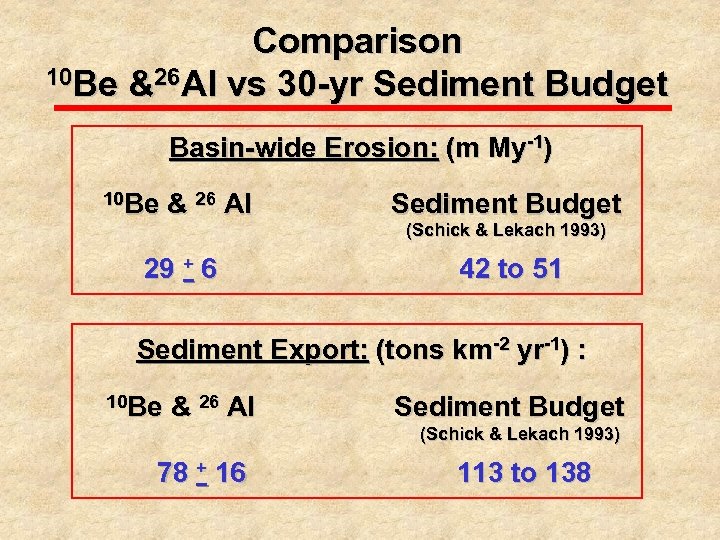 Comparison 10 Be &26 Al vs 30 -yr Sediment Budget Basin-wide Erosion: (m My-1) 10 Be & 26 Al 29 + 6 Sediment Budget (Schick & Lekach 1993) 42 to 51 Sediment Export: (tons km-2 yr-1) : 10 Be & 26 Al Sediment Budget (Schick & Lekach 1993) 78 + 16 113 to 138
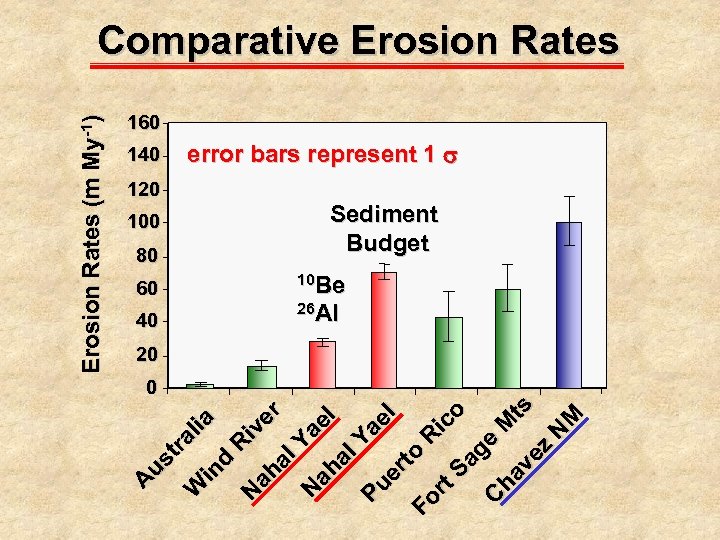 160 140 120 100 80 error bars represent 1 s Sediment Budget 60 10 Be 40 26 Al 20 0 A us tr al W ia in d R N ah ive r al Ya N ah el al Ya P el ue rto Fo R ic rt o Sa ge C M ha ve ts z NM Erosion Rates (m My-1) Comparative Erosion Rates
 Yuma Wash Yuma Proving Grounds Arizona Site Yuma N 0 100 km
 8 km 2 187 km 2 Low altitude Resistant rock Arid (<91 mm y-1)
 Yuma Wash Southwest Sub-basin
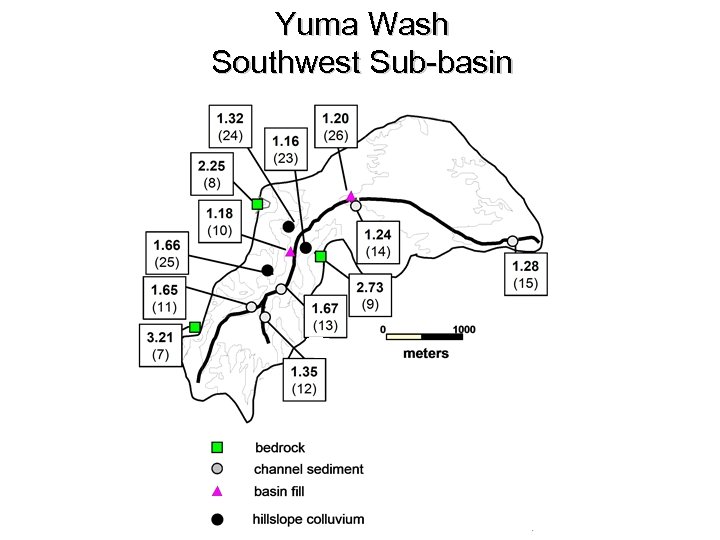
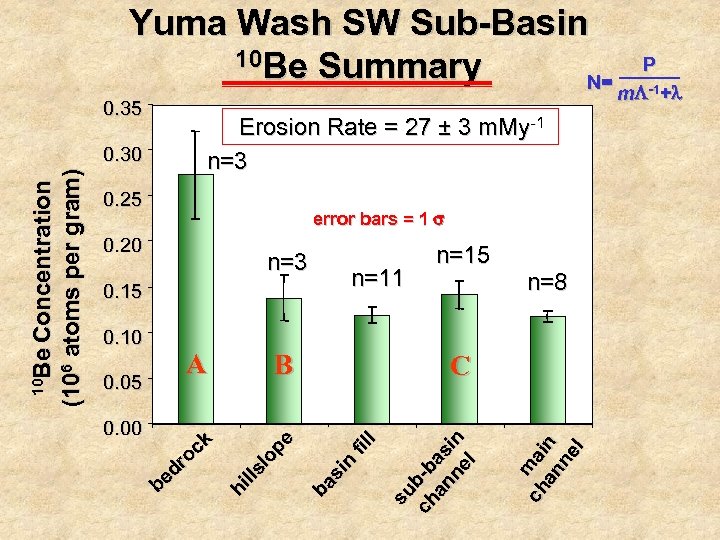 Yuma Wash SW Sub-Basin 10 Be Summary N= 0. 25 error bars = 1 s n=3 0. 15 0. 00 ck ro ed b B n=8 C fil l 0. 05 A ba si n 0. 10 n=11 n=15 ch mai an n ne l 0. 20 hi lls lo pe (106 atoms per gram) 10 Be Concentration 0. 30 Erosion Rate = 27 ± 3 m. My-1 n=3 su ch b-b an as ne in l 0. 35 P m. L-1+l
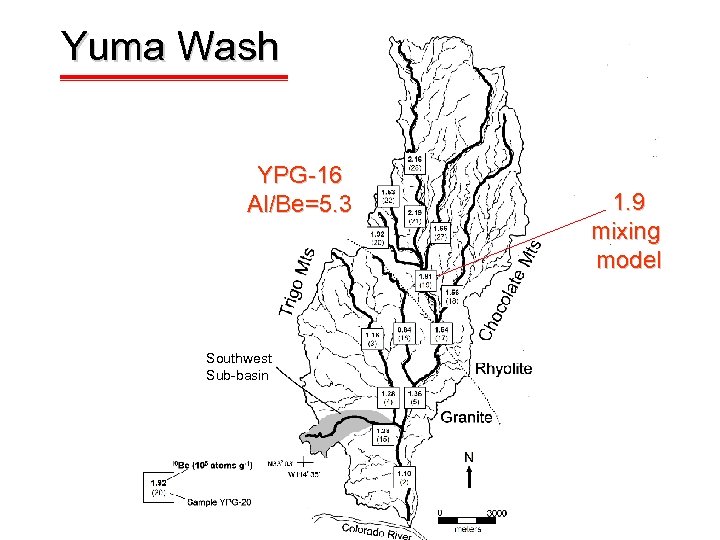 Yuma Wash YPG-16 Al/Be=5. 3 Southwest Sub-basin 1. 9 mixing model
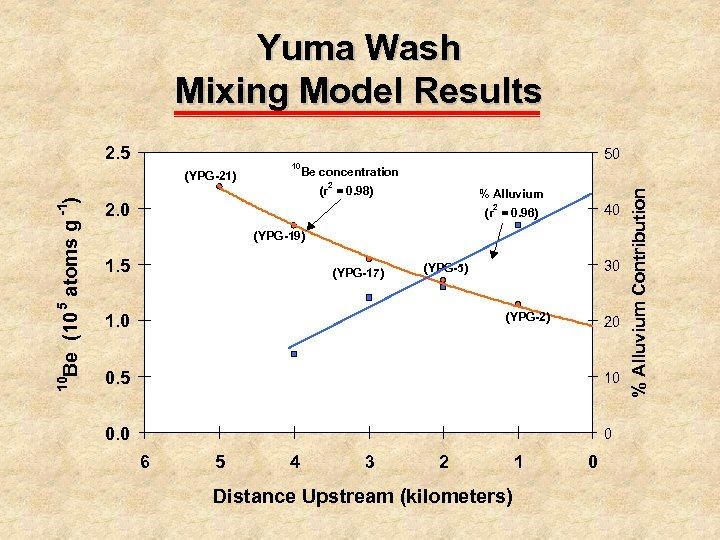 Yuma Wash Mixing Model Results 2. 5 50 Be concentration 2 10 Be (10 5 atoms g -1) (r = 0. 98) % Alluvium 2. 0 40 2 (r = 0. 96) (YPG-19) 1. 5 (YPG-17) 30 (YPG-5) (YPG-2) 1. 0 20 0. 5 10 0. 0 0 6 5 4 3 2 Distance Upstream (kilometers) 1 0 % Alluvium Contribution (YPG-21) 10
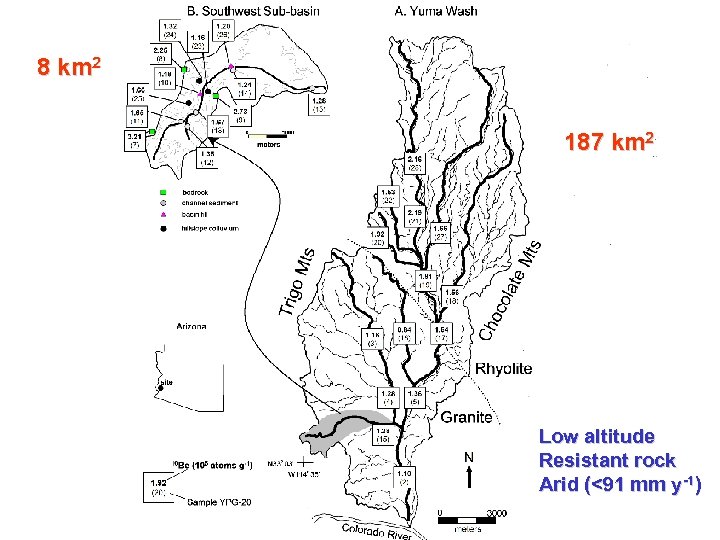
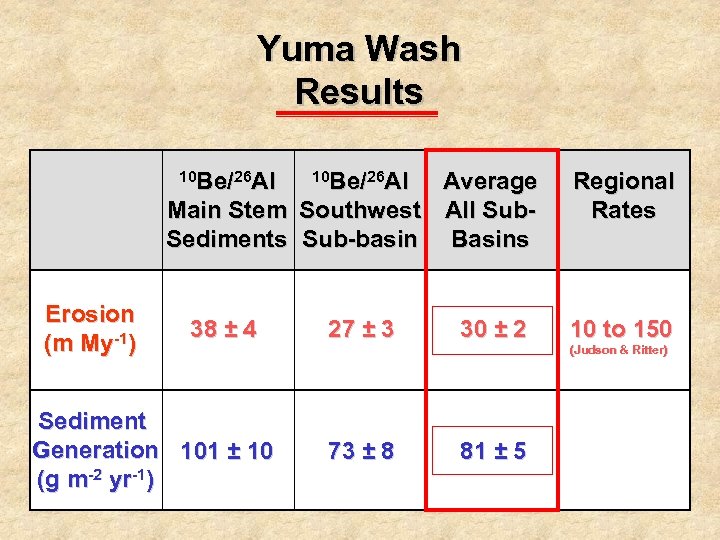 Yuma Wash Results 10 Be/26 Al Average Main Stem Southwest All Sub. Sediments Sub-basin Basins Erosion (m My-1) 10 Be/26 Al 38 ± 4 27 ± 3 Sediment Generation 101 ± 10 (g m-2 yr-1) 30 ± 2 Regional Rates 10 to 150 (Judson & Ritter) 73 ± 8 81 ± 5
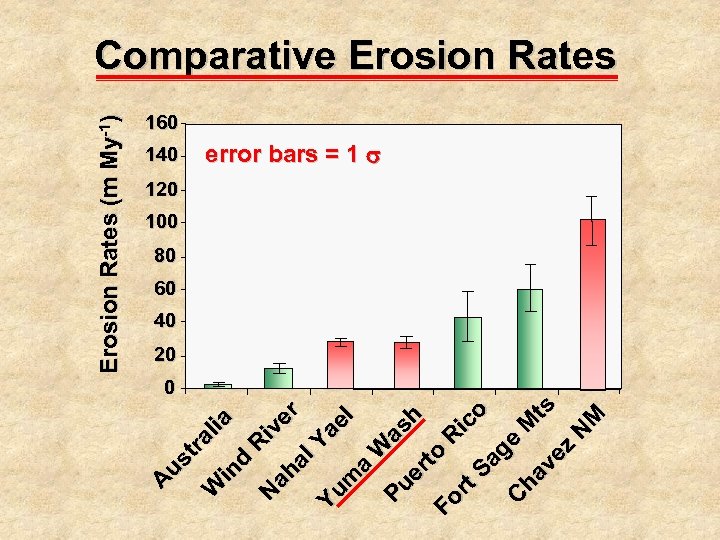 A us tr al W ia in d R N ah ive r al Ya Yu el m a W Pu as h er to Fo R ic rt o Sa ge C M ha ve t s z N M Erosion Rates (m My-1) Comparative Erosion Rates 160 140 error bars = 1 s 120 100 80 60 40 20 0
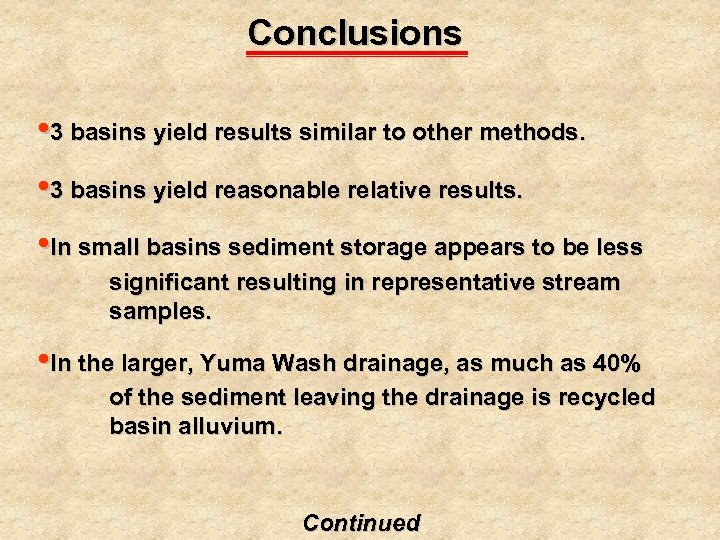 Conclusions • 3 basins yield results similar to other methods. • 3 basins yield reasonable relative results. • In small basins sediment storage appears to be less significant resulting in representative stream samples. • In the larger, Yuma Wash drainage, as much as 40% of the sediment leaving the drainage is recycled basin alluvium. Continued
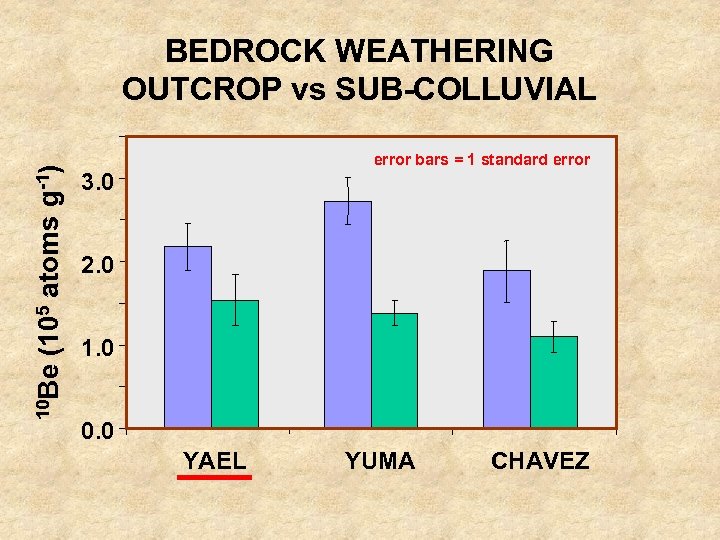
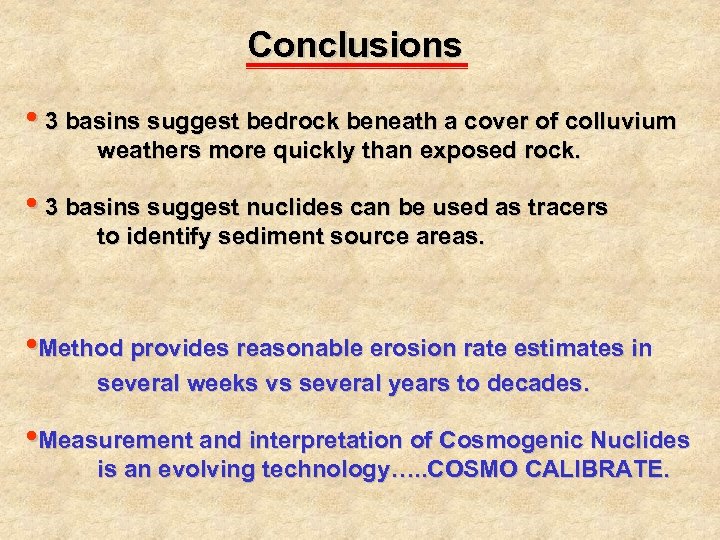 Conclusions • 3 basins suggest bedrock beneath a cover of colluvium weathers more quickly than exposed rock. • 3 basins suggest nuclides can be used as tracers to identify sediment source areas. • Method provides reasonable erosion rate estimates in several weeks vs several years to decades. • Measurement and interpretation of Cosmogenic Nuclides is an evolving technology…. . COSMO CALIBRATE.
 Thanks To. . . Paul Bierman Al Cassell Deane Wang Andrea Lini Rolfe Stanley Asher Schick Mike Abbott Kyle Nichols Sara Gran Christine Massey Kim Marsella Susan Nies Milan Pavich (USGS) Mark Caffee (LLNL) Russell Harmon (US DOD ARO) John Sevee & Peter Maher (SME) Yehouda Enzel Judith Lekach Val Morrill UVM Geology UVM SNR And Especially: Lynda & Henry! … (Sophie too!)

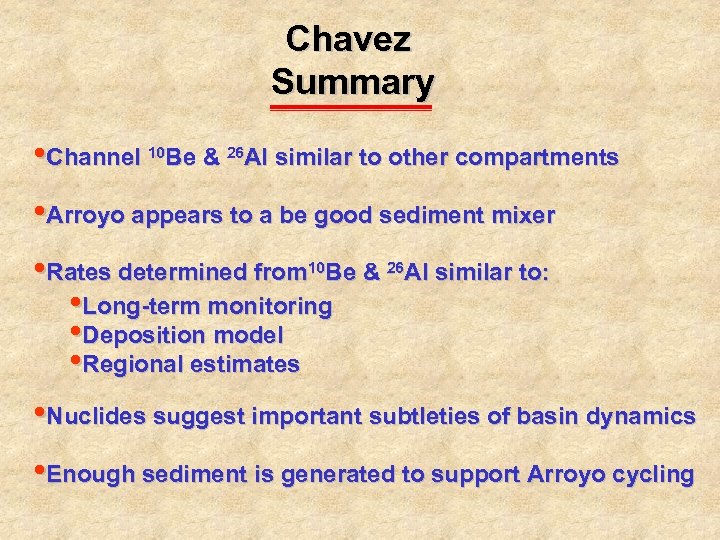 Chavez Summary • Channel 10 Be & 26 Al similar to other compartments • Arroyo appears to a be good sediment mixer • Rates determined from 10 Be & 26 Al similar to: • Long-term monitoring • Deposition model • Regional estimates • Nuclides suggest important subtleties of basin dynamics • Enough sediment is generated to support Arroyo cycling
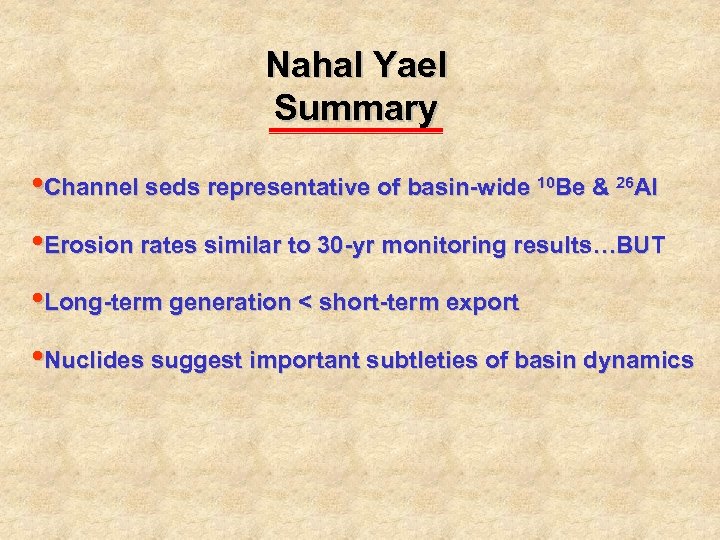 Nahal Yael Summary • Channel seds representative of basin-wide 10 Be & 26 Al • Erosion rates similar to 30 -yr monitoring results…BUT • Long-term generation < short-term export • Nuclides suggest important subtleties of basin dynamics
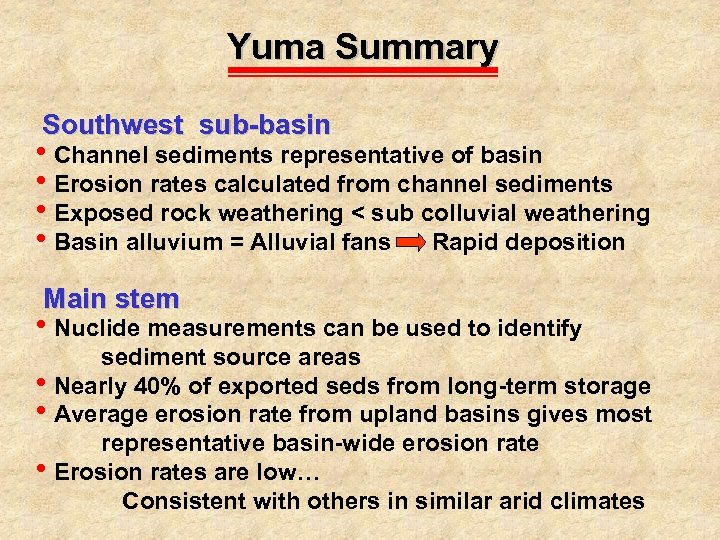 Yuma Summary Southwest sub-basin h. Channel sediments representative of basin h. Erosion rates calculated from channel sediments h. Exposed rock weathering < sub colluvial weathering h. Basin alluvium = Alluvial fans Rapid deposition Main stem h. Nuclide measurements can be used to identify sediment source areas h. Nearly 40% of exported seds from long-term storage h. Average erosion rate from upland basins gives most representative basin-wide erosion rate h. Erosion rates are low… Consistent with others in similar arid climates
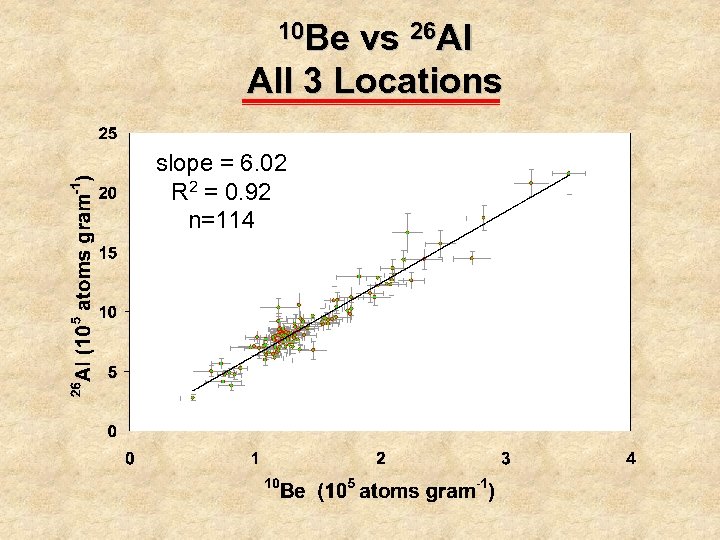 10 Be vs 26 Al All 3 Locations slope = 6. 02 R 2 = 0. 92 n=114
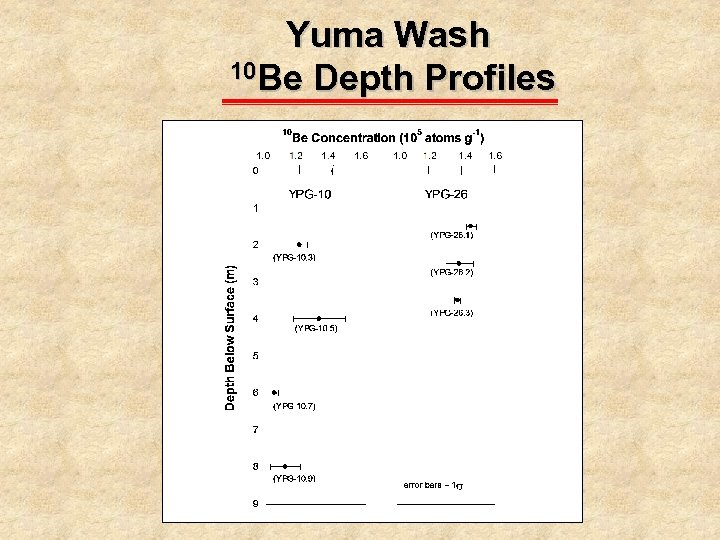 Yuma Wash 10 Be Depth Profiles
 Arroyo Chavez Yuma Wash Nahal Yael
 10 Be (105 atoms g-1) BEDROCK WEATHERING OUTCROP vs SUB-COLLUVIAL error bars = 1 standard error 3. 0 2. 0 1. 0 0. 0 YAEL YUMA CHAVEZ
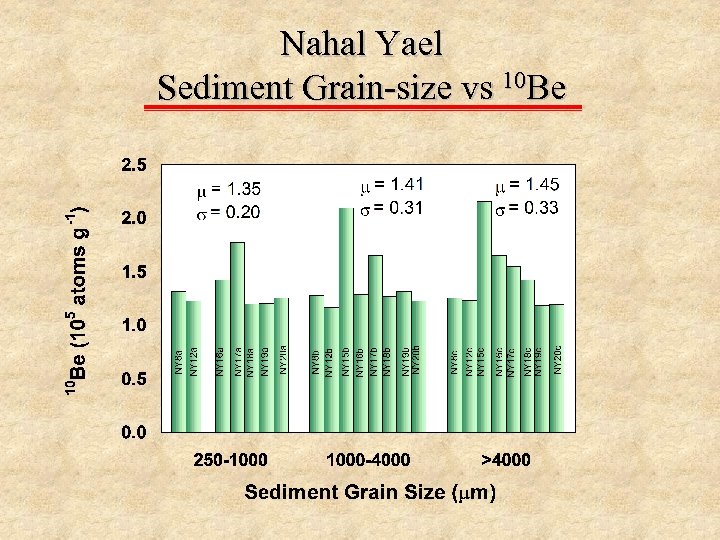 Nahal Yael Sediment Grain-size vs 10 Be
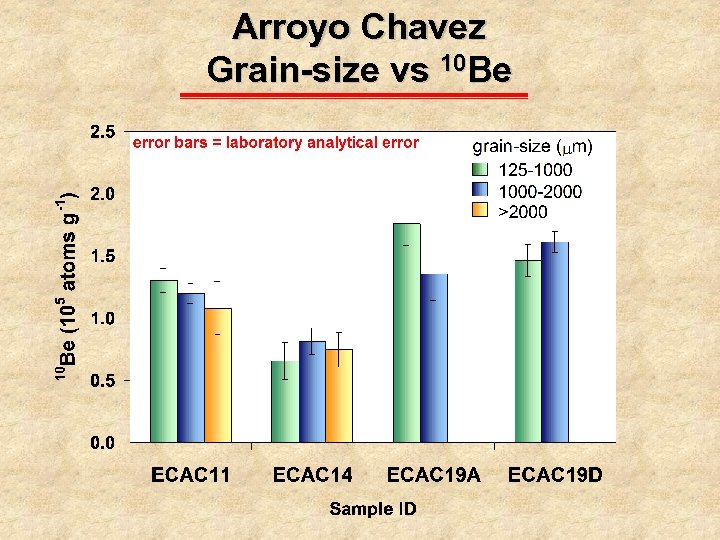 Arroyo Chavez Grain-size vs 10 Be
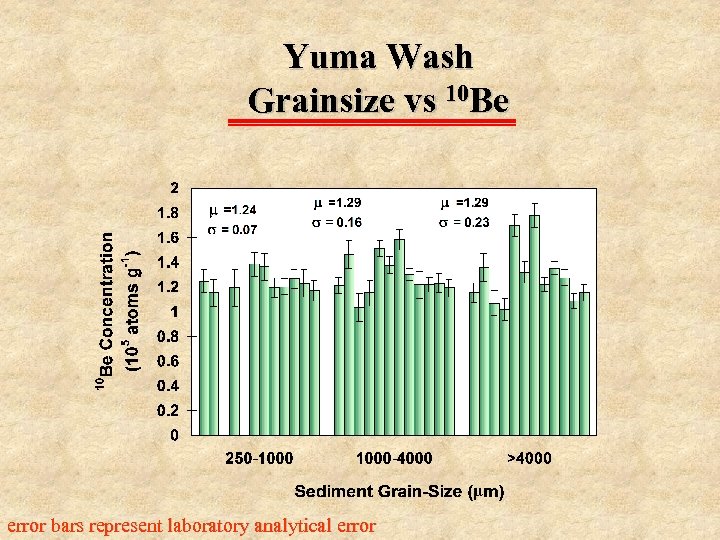 Yuma Wash Grainsize vs 10 Be error bars represent laboratory analytical error
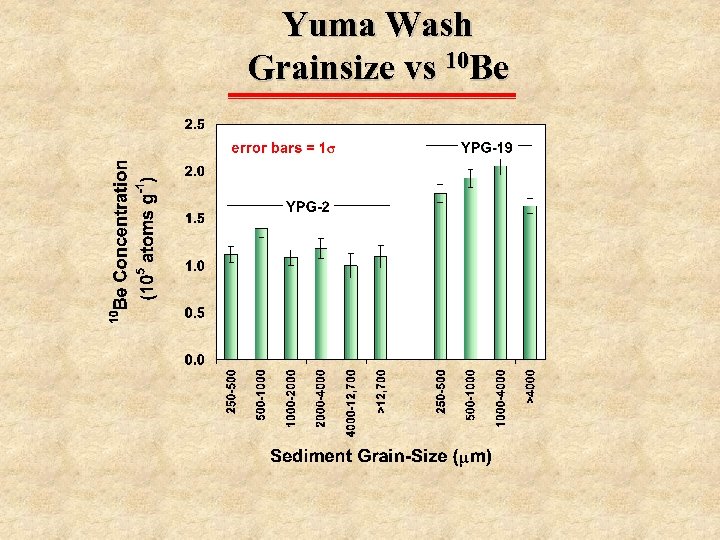 Yuma Wash Grainsize vs 10 Be
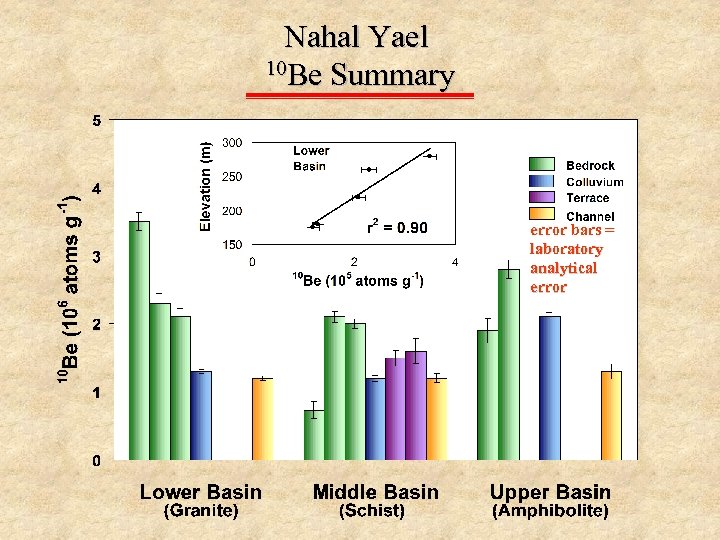 Nahal Yael 10 Be Summary error bars = laboratory analytical error
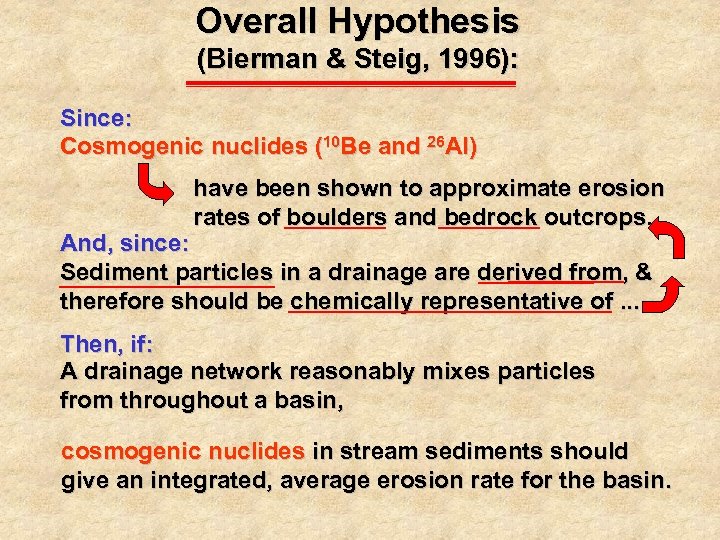 Overall Hypothesis (Bierman & Steig, 1996): Since: Cosmogenic nuclides (10 Be and 26 Al) have been shown to approximate erosion rates of boulders and bedrock outcrops. And, since: Sediment particles in a drainage are derived from, & therefore should be chemically representative of. . . Then, if: A drainage network reasonably mixes particles from throughout a basin, cosmogenic nuclides in stream sediments should give an integrated, average erosion rate for the basin.
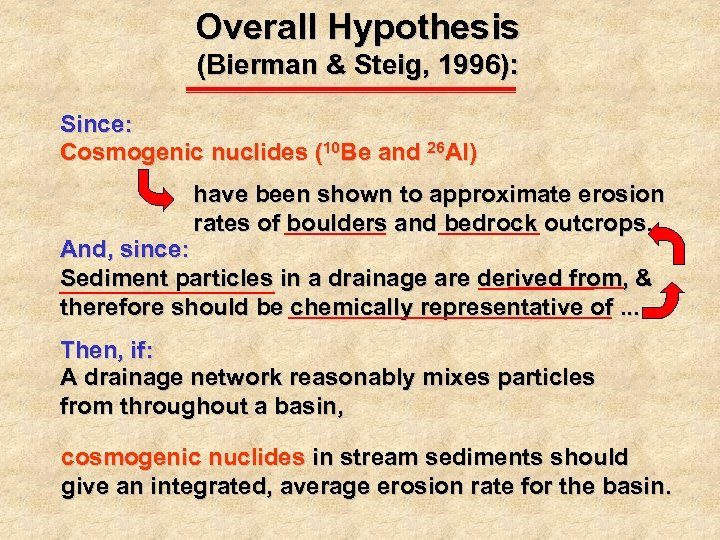 Overall Hypothesis (Bierman & Steig, 1996): Since: Cosmogenic nuclides (10 Be and 26 Al) have been shown to approximate erosion rates of boulders and bedrock outcrops. And, since: Sediment particles in a drainage are derived from, & therefore should be chemically representative of. . . Then, if: A drainage network reasonably mixes particles from throughout a basin, cosmogenic nuclides in stream sediments should give an integrated, average erosion rate for the basin.
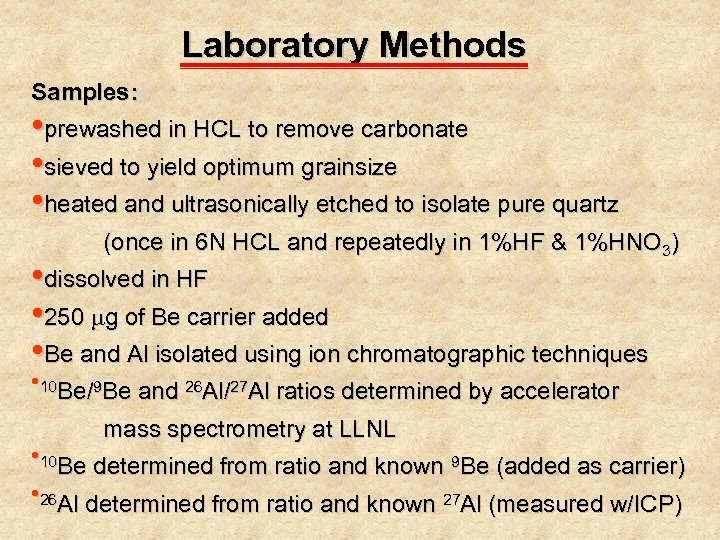 Laboratory Methods Samples: • prewashed in HCL to remove carbonate • sieved to yield optimum grainsize • heated and ultrasonically etched to isolate pure quartz (once in 6 N HCL and repeatedly in 1%HF & 1%HNO 3) • dissolved in HF • 250 mg of Be carrier added • Be and Al isolated using ion chromatographic techniques • 10 Be/9 Be and 26 Al/27 Al ratios determined by accelerator mass spectrometry at LLNL • 10 Be determined from ratio and known 9 Be (added as carrier) • 26 Al determined from ratio and known 27 Al (measured w/ICP)