


 Скачать презентацию Long Term Knowledge Retention Atlantic Meeting Chris Mc
32b139e130caa5a137e716587af3c57c.ppt
- Количество слайдов: 21
 Long Term Knowledge Retention Atlantic Meeting Chris Mc. Mahon University of Bath, 12 February 2007 1
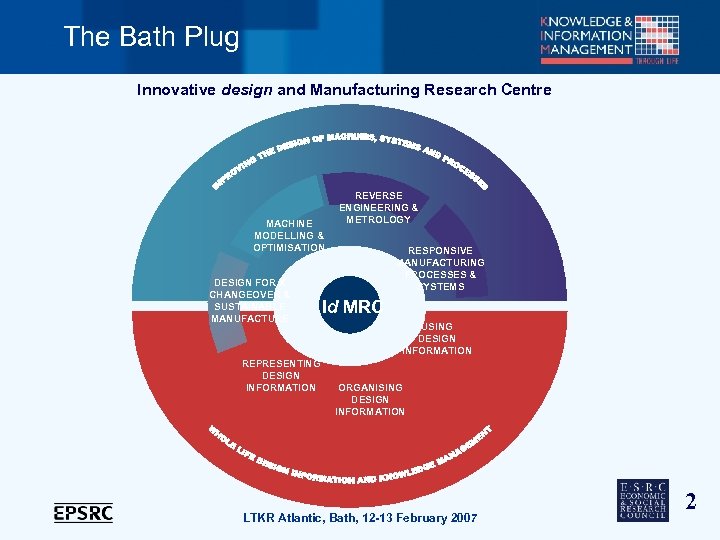 The Bath Plug Innovative design and Manufacturing Research Centre MACHINE MODELLING & OPTIMISATION DESIGN FOR X CHANGEOVER & SUSTAINABLE MANUFACTURE REPRESENTING DESIGN INFORMATION REVERSE ENGINEERING & METROLOGY RESPONSIVE MANUFACTURING PROCESSES & SYSTEMS Id MRC USING DESIGN INFORMATION ORGANISING DESIGN INFORMATION LTKR Atlantic, Bath, 12 -13 February 2007 2
 The Importance of Information • “'Knowledge management' is an umbrella term for a variety of organizational activities, none of which are concerned with the management of knowledge. Those activities that are not concerned with the management of information are concerned with the management of work practices, in the expectation that changes in such areas as communication practice will enable information sharing. ” • T. D. Wilson, “The nonsense of ‘knowledge management’”, Information Research, Vol. 8 No. 1, October 2002 LTKR Atlantic, Bath, 12 -13 February 2007 3
 The Need for Evidence • “Most clinical practice is based on limited evidence, mostly in the form of textbook information, obsolete premises, untrustworthy research or case studies, partial or unendorsed reviews, and anecdotal or personal clinical experience. Proven therapies backed by ample evidence are underutilized for lack of knowledge or grasp of available evidence and, often, clinicians do not believe that results observed in clinical trials can be directly translated into clinical practice” • Rodrigues, R. J. , Information systems: the key to evidence-based health practice, Bull World Health Organ vol. 78 no. 11 Genebra Nov. 2000 LTKR Atlantic, Bath, 12 -13 February 2007 4
 The Need for Evidence • “Most clinical practice is based on limited evidence, mostly in the form of textbook information, obsolete premises, untrustworthy research or case studies, partial or unendorsed reviews, and anecdotal or personal clinical experience. Proven therapies backed by ample evidence are underutilized for lack of knowledge or grasp of available evidence and, often, clinicians do not believe that results observed in clinical trials can be directly translated into clinical practice” • Rodrigues, R. J. , Information systems: the key to evidence-based health practice, Bull World Health Organ vol. 78 no. 11 Genebra Nov. 2000 LTKR Atlantic, Bath, 12 -13 February 2007 5
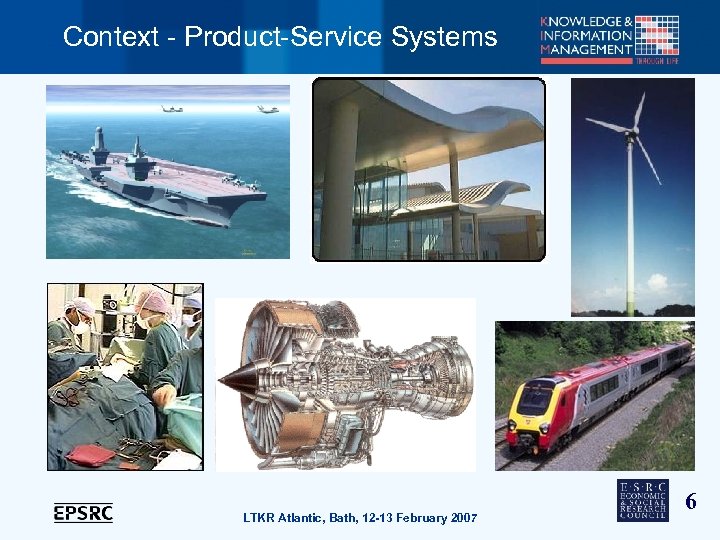 Context - Product-Service Systems LTKR Atlantic, Bath, 12 -13 February 2007 6
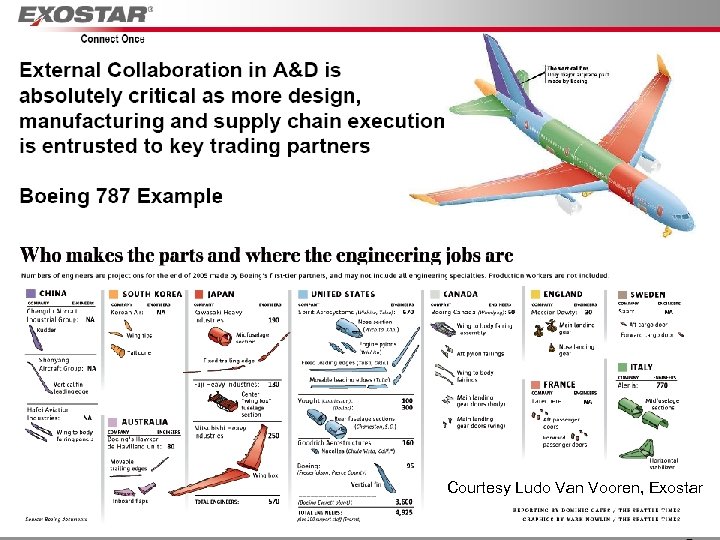 Distributed Business Courtesy Ludo Van Vooren, Exostar LTKR Atlantic, Bath, 12 -13 February 2007 7
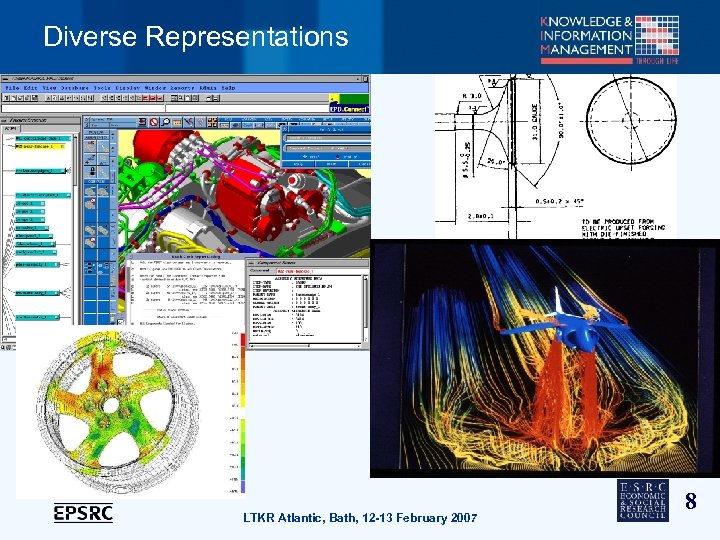 Diverse Representations LTKR Atlantic, Bath, 12 -13 February 2007 8
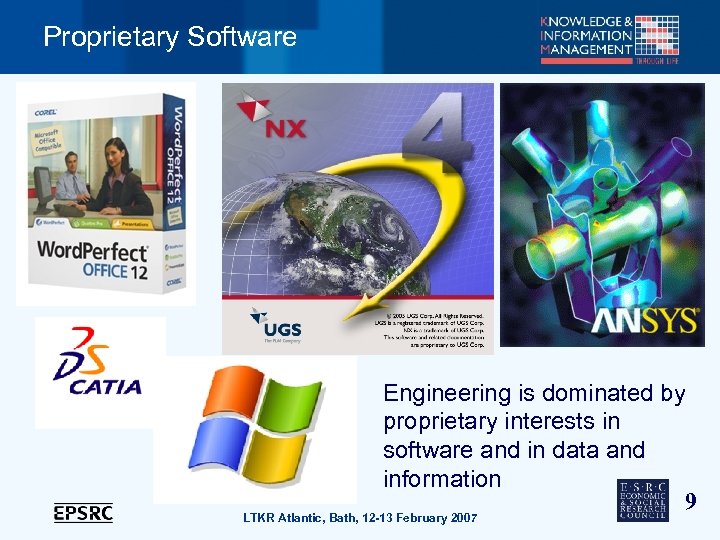 Proprietary Software Engineering is dominated by proprietary interests in software and in data and information 9 LTKR Atlantic, Bath, 12 -13 February 2007
 So How Are We Doing? We need to be able to 1. Record/represent our work and its outcomes – “engineering stuff” 2. Read/interpret different representations of stuff 3. Do (2) reliably into the future 4. Organise and find stuff 5. Maintain, correct, aggregate and discover stuff LTKR Atlantic, Bath, 12 -13 February 2007 10
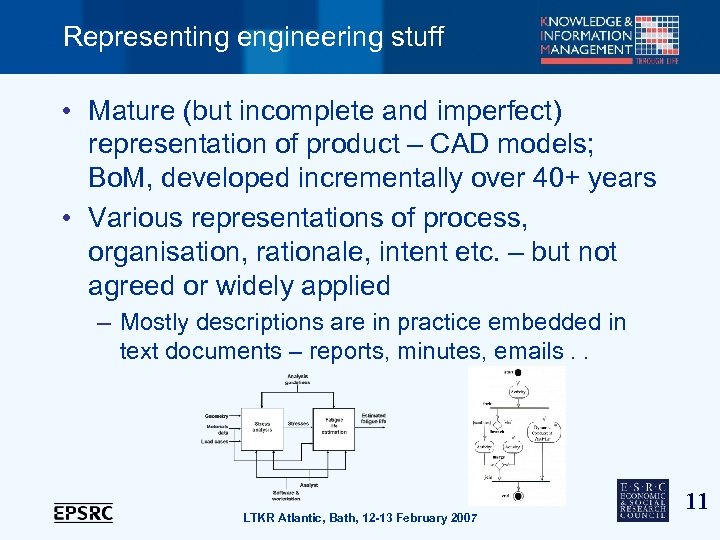 Representing engineering stuff • Mature (but incomplete and imperfect) representation of product – CAD models; Bo. M, developed incrementally over 40+ years • Various representations of process, organisation, rationale, intent etc. – but not agreed or widely applied – Mostly descriptions are in practice embedded in text documents – reports, minutes, emails. . LTKR Atlantic, Bath, 12 -13 February 2007 11
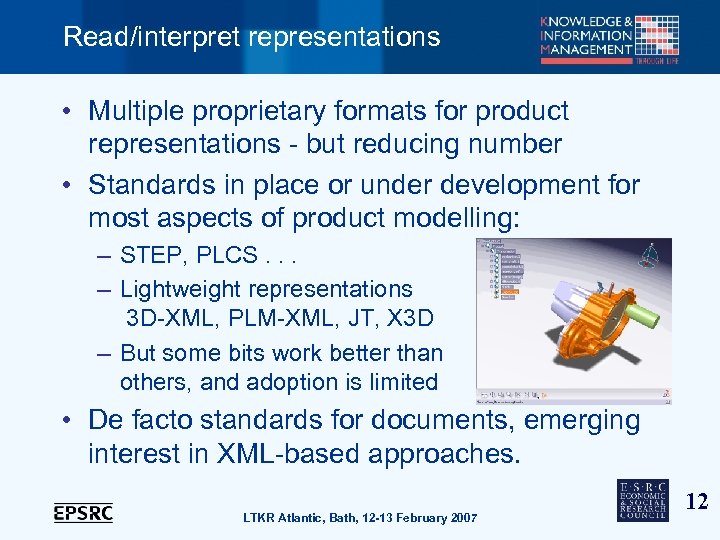 Read/interpret representations • Multiple proprietary formats for product representations - but reducing number • Standards in place or under development for most aspects of product modelling: – STEP, PLCS. . . – Lightweight representations 3 D-XML, PLM-XML, JT, X 3 D – But some bits work better than others, and adoption is limited • De facto standards for documents, emerging interest in XML-based approaches. LTKR Atlantic, Bath, 12 -13 February 2007 12
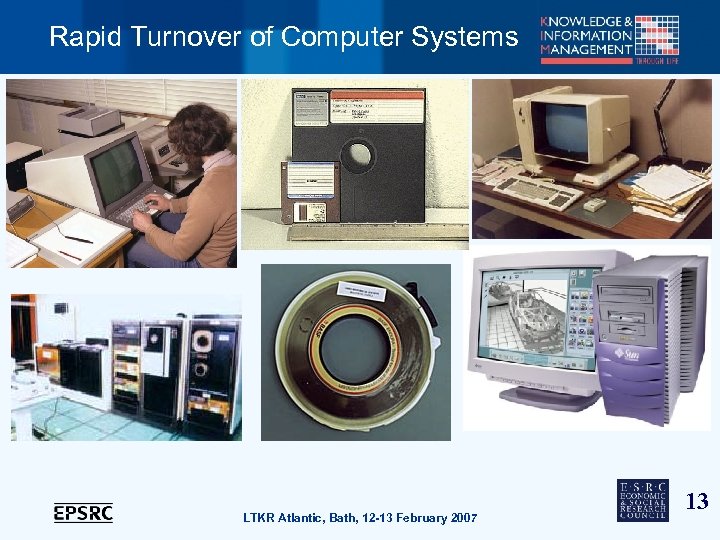 Rapid Turnover of Computer Systems LTKR Atlantic, Bath, 12 -13 February 2007 13
 Read reliably into future • Much of what has been done with computers is “lost” • Curation strategies include refreshing, preservation, transfer, emulation, migration, encapsulation – no single approach is the answer • Practice mainly based on time consuming transfer to new media/new versions of software • Future through OAIS, but will be very challenging in engineering LTKR Atlantic, Bath, 12 -13 February 2007 14
 Organise and find stuff • Mainly based on enumerative classifications/ directory structures/metadata in databases/free text search – “I can never find anything” • Affordances of traditional paper-based approaches lost • Emails often very uncontrolled: – need to treat as records and integrate with processes • Future: – Need equivalent to Page. Rank for organisational information – New approaches needed – ontology-driven? faceted classification? Topic Maps? 15 LTKR Atlantic, Bath, 12 -13 February 2007
 Maintain, update, aggregate, discover • “The only people who can find information are those that put it there” • “The only people who can use information are those that have read it” • Double loop learning is very difficult. • Aggregation is very time consuming • Discovery is impossible LTKR Atlantic, Bath, 12 -13 February 2007 16
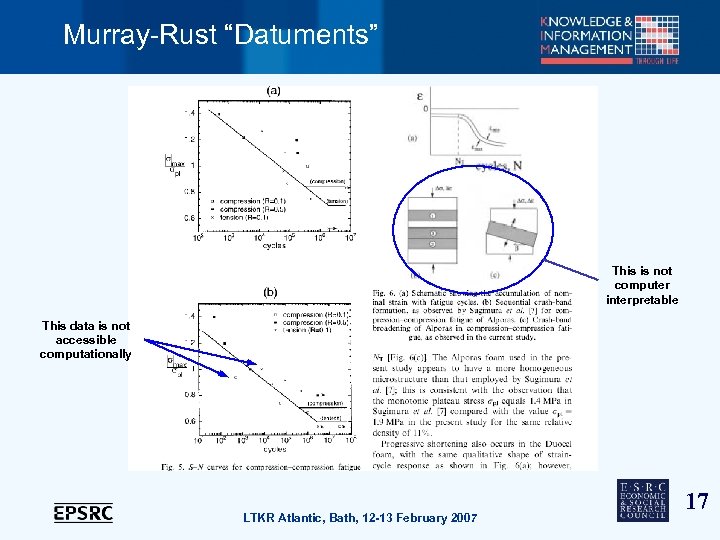 Murray-Rust “Datuments” This is not computer interpretable This data is not accessible computationally LTKR Atlantic, Bath, 12 -13 February 2007 17
 KIM Grand Challenge Project • Centred on the EPSRC Innovative Manufacturing programme and Innovative Manufacturing Research Centres (IMRCs) • Project on knowledge and information management through life is one of four funded from October 2005 • £ 5. 5 million (c$10 million) over 3. 5 years, 11 University partners, >25 industrial partners. LTKR Atlantic, Bath, 12 -13 February 2007 18
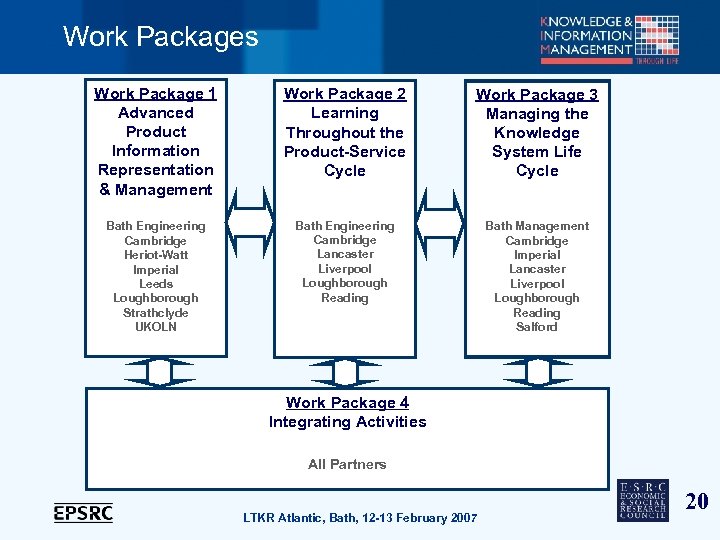 Work Packages Work Package 1 Advanced Product Information Representation & Management Work Package 2 Learning Throughout the Product-Service Cycle Work Package 3 Managing the Knowledge System Life Cycle Bath Engineering Cambridge Heriot-Watt Imperial Leeds Loughborough Strathclyde UKOLN Bath Engineering Cambridge Lancaster Liverpool Loughborough Reading Bath Management Cambridge Imperial Lancaster Liverpool Loughborough Reading Salford Work Package 4 Integrating Activities All Partners LTKR Atlantic, Bath, 12 -13 February 2007 20
 WP 1 Tasks 1. To develop combined product, process and rationale models that will allow the capture of extended models of product designs (including records of design trade-offs, results of negotiation, evidence of decision making and details of successful and unsuccessful designs) 2. To develop approaches to design information organisation based on these combined models and on the need to capture feedback from service 3. To explore automated techniques for the capture of design knowledge to reduce the overhead in building the new models. LTKR Atlantic, Bath, 12 -13 February 2007 21
 LTKR Atlantic, Bath, 12 -13 February 2007 23