


 Скачать презентацию LONG TERM CARE RESIDENT DIGNITY QUALITY OF
97f5a1aad9498d047e0c9e7bc49c9573.ppt
- Количество слайдов: 33
 LONG TERM CARE RESIDENT DIGNITY & QUALITY OF LIFE Advocacy Issues and Information for Long Term Care Ombudsmen Presented by Richard J. Mollot, Executive Director Long Term Care Community Coalition www. ltccc. org www. nursinghome 411. org www. assisted-living 411. org
 ABOUT LTCCC The Long Term Care Community Coalition (LTCCC) is a non profit organization devoted to improving care for the elderly and disabled. We work to ensure that long term care consumers, who are often very vulnerable, are cared for safely and treated with dignity. To accomplish these goals, LTCCC: Researches policies, laws and regulations affecting care for the elderly and disabled; Advocates for state and national policies to improve care; Addresses systemic problems in the delivery of long term care; Identifies good practices and develops recommendations to improve care and dignity of the elderly and disabled, and better conditions for professional caregivers; Educates and empowers the elderly and disabled to advocate for themselves; and Actively engages government agencies and elected officials in discussion and action on the needed changes.
 WHAT CAN LTCCC DO FOR YOU? Resources on the Internet: www. ltccc. org our home page, with all of our publications, reports & action alerts, etc… www. nursinghome 411. org information on nursing home issues such as residents’ rights, background information on how nursing homes are paid, nurse aide training and more. www. assisted living 411. org news and information on New York’s assisted living law, guidebooks on how to improve quality of life in assisted living, and our report on affordable assisted living. Free Newsletters Provide News and Information on Long Term Care Issues. Action Alerts – Send a Quick, Free Message on the Latest Issues Affecting Quality of Care. Join LTC Stakeholder Community – Online discussion with other consumers and ombudsmen, confidential survey to report problem nursing home or assisted living in your community. Visit Our Websites or Call 212 -385 -0355 for More Info.
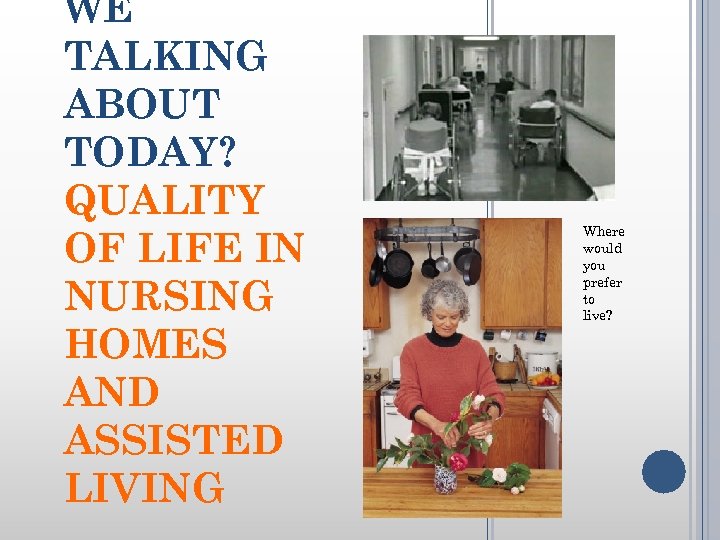 WE TALKING ABOUT TODAY? QUALITY OF LIFE IN NURSING HOMES AND ASSISTED LIVING Where would you prefer to live?
 Federal Law Sets Forth Minimum Standards for Nursing Home Care: Federal law requires that every nursing home resident is provided the care and quality of life sufficient for them to attain and maintain their highest practicable physical, emotional and social well being. This is what we pay for. This is what providers agree to provide. This is what every resident deserves. WHY ARE WE TALKING ABOUT THIS TODAY?
 Federal Law Sets Forth the Purposes of the Long Term Care Ombudsman Program: As noted in a 2008 Congressional Report, the functions of the state ombudsman programs are mandated by law and include: identifying, investigating, and resolving resident complaints; protecting the legal rights of residents; advocating for systemic change; providing information and consultation to residents and their families; and publicizing issues of importance to residents. Complaints investigated by ombudsmen relate to actions, inactions, or decisions of long term care providers or other agencies that adversely affect the health, safety, welfare, or rights of residents. WHY ARE WE TALKING ABOUT THIS TODAY?
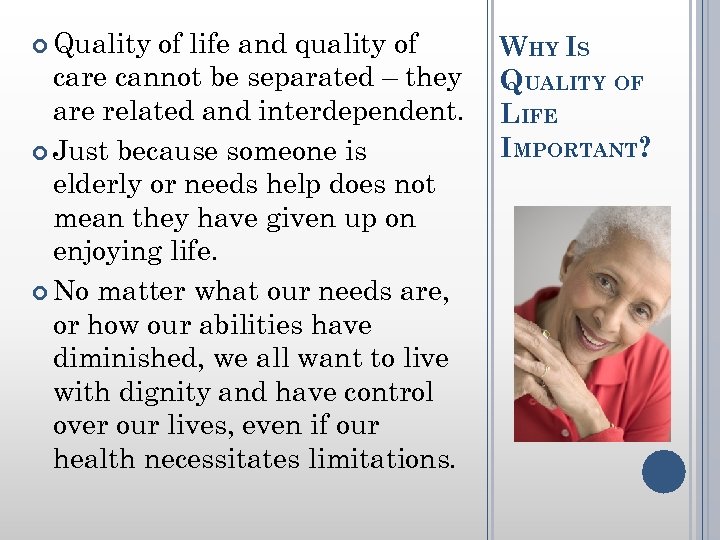 Quality of life and quality of care cannot be separated – they are related and interdependent. Just because someone is elderly or needs help does not mean they have given up on enjoying life. No matter what our needs are, or how our abilities have diminished, we all want to live with dignity and have control over our lives, even if our health necessitates limitations. WHY IS QUALITY OF LIFE IMPORTANT?
 WHAT DOES QUALITY OF LIFE MEAN TO YOU? _______________ ________
 NURSING HOME CARE IS CHANGING TO PROVIDE BETTER QUALITY OF LIFE “Culture Change” is a growing trend in nursing homes What does it mean? What is it? How does it work? Federal State oversight is changing to reflect understanding of the importance of quality of life CMS (Centers for Medicare and Medicaid Services) is making changes to how inspections are conducted by the state and federal surveyors (inspectors).
 HOW IS GOVERNMENT OVERSIGHT CHANGING? New surveyor “guidance” is being implemented across the country. Effective June 17, 2009. The guidance addresses important areas relating to: providing a home like environment; meeting the needs and desires of residents in terms of waking up and going to sleep, dining, dressing, bathing, etc. . . and more. The purpose of the guidance is to clarify and ensure understanding of every nursing homes' responsibility to each of its residents and to improve accountability for meeting these standards.
 HOW IS GOVERNMENT OVERSIGHT CHANGING? – EXAMPLES OF CHANGES TO SURVEYOR GUIDANCE Residents have right to receive visits, including from non relatives, 24 hours a day. Nursing home cannot restrict time of visits, subject to limited circumstances (like security risk). Important to remember that this is a right of the resident; his/her wishes prevail if they differ from that of a family member or other visitor. Resident Dignity Guidance states: “The facility must promote care for residents in a manner and in an environment that maintains or enhances each resident’s dignity and respect in full recognition of his or her individuality. ”
 HOW IS GOVERNMENT OVERSIGHT CHANGING? – EXAMPLES OF CHANGES TO SURVEYOR GUIDANCE Examples of Resident Dignity Grooming residents as they wish to be groomed (e. g. , hair combed and styled, beards shaved/trimmed, nails clean and clipped). Encouraging and assisting residents to dress in their own clothes appropriate to the time of day and individual preferences rather than hospital type gowns. Assisting residents to attend activities of their own choosing. Labeling each resident’s clothing in a way that respects his or her dignity (e. g. , placing labeling on the inside of shoes and clothing). Promoting resident independence and dignity in dining such as by avoidance of: Day to day use of plastic cutlery and paper/plastic dishware; Bibs (also known as clothing protectors) instead of napkins (except by resident choice); Staff standing over residents while assisting them to eat; Staff interacting/conversing only with each other rather than with residents while assisting residents.
 HOW IS GOVERNMENT OVERSIGHT CHANGING? – EXAMPLES OF CHANGES TO SURVEYOR GUIDANCE Examples of Resident Dignity (continued) Respecting residents’ private space and property by: not changing radio or television station without resident’s permission; knocking on doors and requesting permission to enter; closing doors as requested by the resident; and not moving or inspecting resident’s personal possessions without permission). Respecting residents by: speaking respectfully; addressing the resident with a name of the resident’s choice; avoiding use of labels for residents such as “feeders; ” not excluding residents from conversations or discussing residents in community settings in which others can overhear private information.
 HOW IS GOVERNMENT OVERSIGHT CHANGING? – EXAMPLES OF CHANGES TO SURVEYOR GUIDANCE Examples of Resident Dignity (continued) Maintaining resident privacy of body including keeping residents sufficiently covered, such as with a robe, while being taken to areas outside their room, such as the bathing area (one method of ensuring resident privacy and dignity is to transport residents while they are dressed and assist them to dress and undress in the bathing room). Refraining from practices demeaning to residents such as: keeping urinary catheter bags uncovered, refusing to comply with a resident’s request for toileting assistance during meal times, and restricting residents from use of common areas open to the general public such as lobbies and restrooms, unless they are on transmission based isolation precautions or are restricted according to their care planned needs. [An exception can be made for certain restrooms that are not equipped with call cords for safety. ]
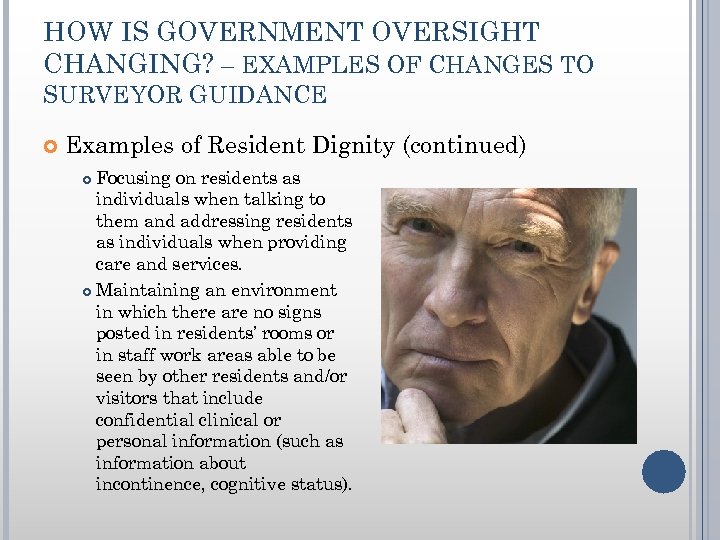 HOW IS GOVERNMENT OVERSIGHT CHANGING? – EXAMPLES OF CHANGES TO SURVEYOR GUIDANCE Examples of Resident Dignity (continued) Focusing on residents as individuals when talking to them and addressing residents as individuals when providing care and services. Maintaining an environment in which there are no signs posted in residents’ rooms or in staff work areas able to be seen by other residents and/or visitors that include confidential clinical or personal information (such as information about incontinence, cognitive status).
 IN RESIDENT RIGHTS, OR NEW RIGHTS, BUT RATHER CHANGES TO SURVEYOR GUIDANCE, TO BETTER INSURE THAT PEOPLE ARE NOT DEPRIVED OF THEIR RIGHTS TO DIGNITY, AUTONOMY & GOOD QUALITY OF LIFE WHEN THEY LIVE IN A NURSING HOME.
 WOULD YOU EVER WANT TO GIVE UP THESE RIGHTS, EVEN IF YOU LIVE TO BE 80 OR 90 OR 100?
 WHAT DOES THIS ALL MEAN FOR YOUR WORK AS AN OMBUDSMAN? WHAT CAN YOU DO? _______________ ________
 TOPIC 2: ASSISTED LIVING More and more people are turning to assisted living when they need or want residential long term care. Assisted living can provide: A more home like environment than typical nursing homes; Ability for residents to maintain independence and high quality of life; Safety of a residential care setting with 24 hours a day monitoring by care professionals.
 ASSISTED LIVING: SO, WHAT’S THE PROBLEM? No Federal standards. NY State standards are a mess! NY has: Adult homes and enriched housing – licensed by the state with state oversight. Assisted living – for years, many assisted living operated without license across NYS. In 2004, a law passed mandating licensure for all assisted living in NYS. The law started going into effect in 2008, thought the regulations are still being formulated in response to a lawsuit brought by providers which weakened the regulations developed by the state.
 ASSISTED LIVING: WHAT IS THE LAW IN NY STATE? The law clearly defines assisted living: “The term “assisted living”… means an entity which provides or arranges for housing, on site monitoring, and personal care services and/or home care services (either directly or indirectly), in a home like setting to five or more adult residents unrelated to the assisted living provider. ” Assisted living residences must supply: Daily food service; Twenty four hour on site monitoring; Case management services; and Individualized service plans for all residents.
 ASSISTED LIVING: WHAT IS THE LAW IN NY STATE? (CONTINUED) Providers who meet the definition, or who wish to provide assisted living, must first become licensed as an adult home or enriched housing program and then also become licensed as an assisted living residence. Adult homes and enriched housing programs are eligible to become licensed assisted living residences or, if they do not wish to become assisted living, may continue to operate under their current adult care facility (ACF) certification without additional requirements. Providers who want to become assisted living residences must apply to DOH for licensure and approval. As part of this approval process, DOH is required to solicit and consider public comment on its webpage.
 ASSISTED LIVING: WHAT IS THE LAW IN NY STATE? (CONTINUED) Licensure fees are payable every two years. The fees, along with revenue generated by monetary penalties for violations of the law and regulations, will be deposited into a special fund that will pay for the costs associated with the regulatory oversight of assisted living residences. $500, 000 will go to the ombudsmen program. Assisted living residences that choose to offer a higher level of care (permit “aging in place”) must apply for an “ nhanced e assisted living certificate. ” With this certificate, they can care for residents who are or have: Chronically chairfast and unable to transfer or chronically require the physical assistance of another person to transfer; Chronically require the physical assistance of another person in order to walk; Chronically require the physical assistance of another person to climb or descend stairs; Dependent on medical equipment and require more than intermittent or occasional assistance from medical personnel; or Chronic unmanaged urinary or bowel incontinence.
 ASSISTED LIVING: WHAT IS THE LAW IN NY STATE? (CONTINUED) Assisted living residences that choose to offer special care for people with significant dementia will be required to obtain a “special needs assisted living certificate” from the Department of Health (DOH) by applying to DOH and demonstrating that they can care for cognitively impaired residents. The law includes a section on resident rights similar to those currently in effect for residents of adult care facilities (ACFs). One notable exception is that operators will have to provide residents with 45 day notice in the event of a fee increase. Currently, ACFs are only required to provide 30 days notice.
 ASSISTED LIVING: WHY IS IT A MESS? Though NY’s assisted living law passed six years ago, from a consumer perspective there are still significant problem for consumers. While all facilities will have to be licensed eventually, there are still going to be five different types of assisted living in NY, with different requirements for licensure, different standards of care and different modes of payment. This is very confusing. The provider industry’s lobbying associations sued the state and succeeded last year in reducing some very important safeguards in licensed assisted living that had been in the regulations. LTCCC is concerned that the Department of Health and the Ombudsman Program are being given new responsibilities with licensed assisted living, but insufficient funding to provide good coverage of these facilities.
 ASSISTED LIVING: Q & A What has your experience been with adult homes and assisted living in your communities? LTCCC has been involved in the development of the law and of the regulations. Do you have any questions about assisted living law or policy? For more information in the future, visit www. assisted living 411. org. Information on NYS law and regulations and Guidebooks for consumers and workers on achieving “the promise” of assisted living.
 OTHER LONG TERM CARE PRIORITY ISSUES FOR LTCCC….
 LTCCC POLICY PRIORITIES: INCREASE LEVELS OF NURSING HOME STAFFING Many studies have indicated that staffing levels are one of the strongest corollaries of good care and quality of life – for both nursing home residents and workers. Research has indicated that the typical nursing home resident needs about 4. 2 hours of direct care staff time, per day, to achieve the outcomes we were talking about earlier (that are required by law). In reality, NY nursing homes provide about 3. 6 hours of direct care staff time per resident per day. LTCCC strongly supports minimum staffing requirements for nursing homes. Under current law, every nursing home must post current staff on duty for residents, visitors and ombudsman to see. Is your home doing that?
 LTCCC POLICY PRIORITIES: IMPROVE EFFECTIVENESS OF GOVERNMENT OVERSIGHT LTCCC just released a study: Government Monitoring & Oversight of Nursing Home Care: The Relationship Between Federal and State Agencies (available at www. nursinghome 411. org). This study examined the relationship between the federal and state agencies responsible for ensuring that nursing home residents are protected and receive adequate care and a good quality of life. The resulting report identifies and assesses the major issues relating to the functioning of state & federal oversight of nursing home care. Why do problems persist despite joint state and federal oversight? What can be done to overcome the challenges to ensuring that residents receive the care they are entitled to under the law? Report includes special case study on oversight of nursing homes in New York State.
 LTCCC POLICY PRIORITIES: IMPROVE NURSING HOME REIMBURSEMENT TO ENCOURAGE QUALITY, ACCESS & EFFICIENCY NY State is now working on revising its system of reimbursing nursing homes for the care they provide. To participate effectively in this work, in 2009 LTCCC conducted a major study that examined the laws and policies of all other states (35) using a “case mix” system of reimbursement (like NY) to identify and assess the ways in which states are encouraging the provision of good quality care, access to care for people with high needs and efficiency of the use of public monies. The resulting report, available at www. nursinghome 411. org, explains how nursing homes are paid and presents recommendations for improving quality, access and efficiency. LTCCC is currently working to implement our recommendations in state policy. Many of you hopefully saw our “action alerts” on the nursing home quality pools earlier in the year.
 LTCCC POLICY PRIORITIES: OTHER ISSUES Both state and federal efforts toward “Long Term Care Restructuring” are having a big impact on how and where people get long term care and will definitely shape how we all access long term care in the future. However, this raises many issues: People have the right to access care in the least restrictive setting possible. But is there adequate care available in most communities? Who is assuring that there is good quality? Who is monitoring for safety and dignity, like ombudsman and DOH surveyors do in nursing homes and adult homes? Over use of anti psychotic medications in nursing homes. 25% of residents in NY nursing homes were taking anti psychotics in 2007 while only 8% of residents had diagnoses indicating the need for such medication! Are our residents being doped up or chemically restrained?
 LTCCC POLICY PRIORITIES: WHAT YOU CAN DO Sign up to receive our free email newsletters: our quarterly Monitor and monthly LTC E-Newsletter. Both have news and information on issues relevant to long term care consumers and information on how people can make their voices heard to help the frail elderly and disabled. Email info@ltccc. org and note “please sign me up for newsletters. ” Join our listserv for long term care consumers and ombudsman. We have periodic meetings to discuss issues that we are facing and a listerv to share information and news. Email info@ltccc. org and note “please sign me up for LTC listserv. ” Join LTCCC – several of the local ombudsman offices are organizational members of LTCCC and help shape our work. Many other people across the state support LTCCC by joining as individual members. Call 212 385 0355 for more information.
 FOR MORE INFORMATION OR TO DOWNLOAD ANY OF OUR FREE RESOURCES PLEASE VISIT: WWW. LTCCC. ORG WWW. NURSINGHOME 411. ORG WWW. ASSISTED-LIVING 411. ORG