


 Скачать презентацию Long-Term Care Insurance Paying for Long-Term Care Understanding
3e34d942de64b1e548453946ba6deeff.ppt
- Количество слайдов: 113
 Long-Term Care Insurance Paying for Long-Term Care Understanding the Options 2008 01/29/08 1
 Counselor Training 01/29/08 2
 Disclaimer Note: The information provided by the Long-Term Care Insurance Education and Outreach Program is intended for the sole purpose of educating consumers in regard to the choices available for financing their future long-term care needs. Particular emphasis is placed on understanding long-term care insurance. Nothing herein is intended nor should it be construed as an endorsement by the State of New York of any specific insurance product or insurer. 01/29/08 3
 Materials compiled from the resources of the following agencies: n n n New York State Office for the Aging (NYSOFA) New York State Department of Insurance (DOI) New York State Department of Health (DOH) New York State Partnership for Long-Term Care (NYSPLTC) Centers for Medicare /Medicaid Management (CMS) 01/29/08 4
 What is Long-Term Care ? n Medical and non-medical support services needed by individuals who are unable to care for themselves because of prolonged illness or disability. Care can range from personal care to skilled care n Care can take place in a variety of settings n 01/29/08 5
 Long‑term care services can be provided in a wide range of settings: n n n In the home by family, friends, volunteer groups, aging organizations and agencies, and home health care agencies In the community at senior centers, adult day care programs, and adult care homes In institutions such as nursing homes or continuing care retirement communities 01/29/08 6
 What are your risks of needing Long-Term Care? n n Americans are living longer thanks to advances in medical technology, preventative care and healthier lifestyles. While this increased longevity is good news, it also has a downside. Longer life spans mean a greater number of people living with chronic conditions, disabilities and functional limitations that require on-going care. * * Beyond 50: A Report to the Nation on Trends in Health Security, AARP, Washington, DC, May 2002, p. 3 01/29/08 7
 What are your risks of needing Long-Term Care? § Reach age 65 and there is a greater than a 40% chance of entering a nursing home in your lifetime. § Ten percent of those who reach age 65 may have a stay of 5 years or longer. § For women who reach age 65 the risk is greater. One of two women may expect a nursing home experience. For men the risk is one in three. § The average stay in a nursing home is 2. 5 years, (in NY, 30% who enter will stay longer than 3 years). 01/29/08 8
 n According to some estimates, 4 million Americans-one in 10 persons over the age of 65 and almost half of those more than 85 years old-suffer from Alzheimer’s disease. * * 2001 -2002 Progress Report on Alzheimer's Disease, National Institute on Aging, p. 2 01/29/08 9
 Assessing Your Risk of Needing Long-Term Care n Risk depends on a number of factors n Age, marital/partnership status, gender, lifestyle, health & family history 01/29/08 10
 Age n The risk of needing long‑term care increases as people age. 01/29/08 11
 Marital/Partnership Status n For a single individual, the risk of needing “formal” long-term care is especially high. This is because they are less likely to have informal care options available (eg. , spouse/partner, children). 01/29/08 12
 Gender n Women, who tend to outlive their husbands, are at greater risk of needing long‑term care services. 01/29/08 13
 Lifestyle n Overindulgence (especially of alcohol and fats), unhealthy habits (especially smoking), too little exercise, and high stress levels all lead to a higher risk of developing chronic health conditions which require long‑term care services. 01/29/08 14
 Health n Any current chronic conditions such as emphysema, diabetes, or arthritis increase risk. 01/29/08 15
 Family History n If one’s family health history predisposes individuals to serious physical or mental illness, the risk is greater. 01/29/08 16
 Why Plan Ahead for Long-Term Care Needs? n n Most people neglect to think about their need for long-term care. They learn about long-term care the hard wayn When they or a loved one needs care 01/29/08 17
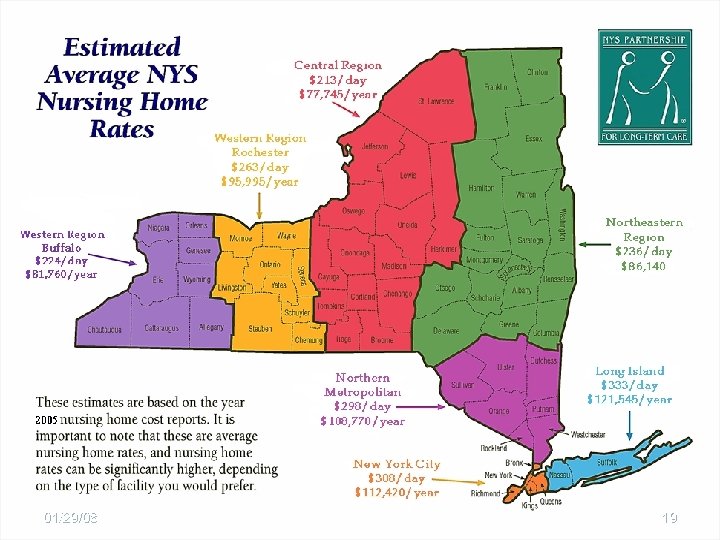
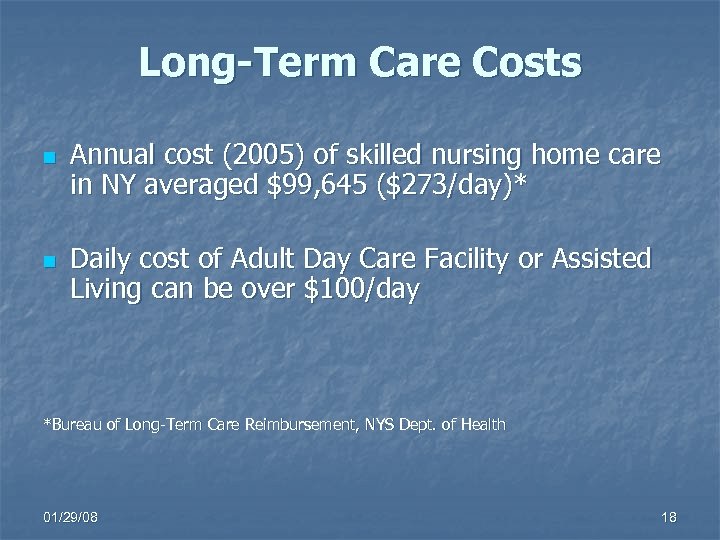 Long-Term Care Costs n n Annual cost (2005) of skilled nursing home care in NY averaged $99, 645 ($273/day)* Daily cost of Adult Day Care Facility or Assisted Living can be over $100/day *Bureau of Long-Term Care Reimbursement, NYS Dept. of Health 01/29/08 18
 01/29/08 19
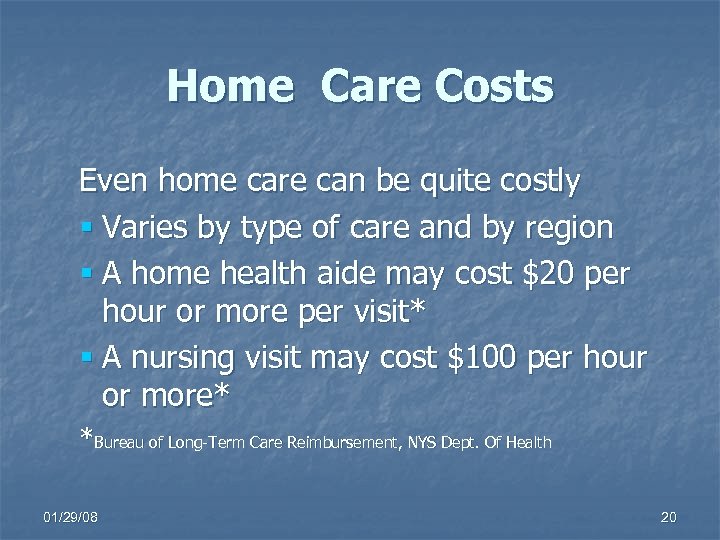 Home Care Costs Even home care can be quite costly § Varies by type of care and by region § A home health aide may cost $20 per hour or more per visit* § A nursing visit may cost $100 per hour or more* *Bureau of Long-Term Care Reimbursement, NYS Dept. Of Health 01/29/08 20
 Payment Options Medicare n Self Pay n Medicaid ………Or a combination of methods n 01/29/08 21
 Original Medicare: Home Health Care Coverage Overview n Must require skilled care on a part-time or intermittent basis n n n Physician must certify the need and must set up a home health care plan Can be combined with personal care Beneficiary must be confined to the home (restrictions have relaxed) n Receive care from a Certified Home Health Agency (CHHA) 01/29/08 22
 Original Medicare: Skilled Nursing Coverage Overview n Limited with strict eligibility guidelines n n n 01/29/08 Must follow a three day hospital stay Must require skilled care Typically for rehabilitation and must meet strict criteria for continued coverage Days 1 -20 Pays 100% of the cost Days 21 -100 You owe a daily coinsurance $128/day (2008) No coverage after 100 days 23
 Medicare Supplement Insurance n Designed to fill in some of the major gaps in Medicare coverage, but IT DOES NOT COVER MOST LONG-TERM CARE SERVICES 01/29/08 24
 Medicare n More information on Medicare and changes to the deductibles and coinsurance under Medicare is available on the web site of the Centers for Medicare and Medicaid Services at http: //cms. hhs. gov 01/29/08 25
 Private Health Insurance n Other private health insurance that you might already have covers mainly acute conditions and probably does NOT cover custodial care. 01/29/08 26
 Self Pay Options n Self Pay Income n Savings/Investments n Home Equity/Reverse Mortgage n Life Insurance n Other Housing n Trusts n Long-Term Care Insurance n 01/29/08 27
 Income n Monthly income may not be sufficient to pay for long-term care expenses. 01/29/08 28
 Savings and Investments n A savings or investment plan may help pay for long-term care services. A retirement plan such as an IRA or 401 K plan may also be available to pay for care. 01/29/08 29
 Home Equity/Reverse Mortgages n n If you have built up equity in your home, you could use the profit from the sale of your home to fund long-term care costs and move to less expensive accommodations. Another option is a "reverse mortgage, " which is a loan based on the amount of equity you have built up in your home. 01/29/08 30
 Life Insurance n A life insurance policy MAY offer one or more ways to cover the cost of long-term care: n n Loan of the cash value Accelerated payment of part or all of the value if: n n n Terminally ill Chronically ill and condition requires continuous care for the remainder of life in facility or home Chronically ill Cash lump sum (called a viatical settlement) from an outside firm (Note: These benefits reduce or replace the policy’s death benefit) 01/29/08 31
 Other Housing n Continuing Care Retirement Community n n 01/29/08 You may be able to buy into a CCRC where the cost includes future access to long-term care services. Entrance fees for CCRCs may be substantial, and depending on the size and type of the dwelling chosen by the resident, can range in price from approximately $200, 000 to $1 million. There is also an additional monthly fee that typically ranges from approximately $2, 000 to $5, 000. 32
 Other Housing n n Independent housing Shared Housing and Supportive Housing Adult Homes or Enriched Housing Assisted Living 01/29/08 33
 Trusts n Some middle class and affluent elders, create living trusts to shelter their assets so that they will qualify for Medicaid if they ever require long‑term care. n 01/29/08 There is great concern that these controversial Medicaid qualifying trusts add to the cost of the Medicaid program, a taxpayer‑supported program which was designed to help those who are unable to pay for their own care. 34
 Medicaid n Most frequent payer of long-term skilled nursing home care A needs-based payer of last resort for medically necessary expenses n Medicaid income and resource spend down rules apply n Ensures that everyone receives the care they need n 01/29/08 35
 Skilled Nursing Facility Medicaid n A single person is allowed to retain the following assets: n n Income applied to the cost of care n n $4, 350 in resources (2008) $1, 500 for funeral fund and/or any amount in an irrevocable funeral fund can retain car, house (with signed “intent to return home”) Except for $50/month Spousal Impoverishment Protection Act applies to the community spouse 01/29/08 36
 Long-Term Care Insurance n n Insurance policy that pays for long-term care expenses Reasons to purchase n Protect resources n Expand care options n Maintain independence and financial control 01/29/08 37
 Long-Term Care Insurance General Guidelines n According to “Shopper’s Guide to Long-Term Care Insurance” published by the National Association of Insurance Commissioners in 2006: n n 01/29/08 Assets: If you are considering long-term care insurance and “your assets are less than $30, 000, you may wish to consider other options for financing your long-term care. ” Income: “If you will be paying premiums with money received only from your own income, a rule of thumb is that you may not be able to afford this policy if the premiums will be more than 7% of your income. ” 38
 Long-Term Care Insurance: Insurability n Long-Term Care Insurance is medically underwritten -May be ineligible due to health status Underwriting standards may vary from company to company 01/29/08 39
 Factors to Consider When Purchasing Long-Term Care Insurance n n n n Daily Benefit Amount Elimination Period Benefit Trigger Length of Benefit Inflation Protection Premium Waiver Non-Forfeiture Tax Qualified 01/29/08 40
 Individual Long‑Term Care Insurance Policies n Long-term care insurance n Nursing home and home care insurance n Nursing home only insurance n Home care only insurance 01/29/08 41
 Daily Benefit Amount for Nursing Home n Benefit amount per day for skilled nursing care Currently average daily nursing home rate in NY is around $273 n Figure how much nursing home cost you can afford, then choose a policy that covers the rest n 01/29/08 42
 Daily Benefit Amount for Home Care n Usually between 50% and 100% of the Nursing Home Daily Benefit to cover home care At least 50% n Includes care at home, adult day care, assisted residential settings n Provides for custodial care that more and more meets the needs of older adults n 01/29/08 43
 Elimination Period n n Amount of time an individual must pay out of pocket before policy begins to pay daily benefit Most policies offer a single elimination period for the life of the policy 01/29/08 44
 Benefit Trigger n Policies require a “trigger” before the elimination period begins. n Usually trigger is tied to requiring help with: n performing a certain number of ADLs n Severe cognitive impairment or 01/29/08 45
 Length of Benefit n Number of years of coverage n n beginning at the end of the elimination period New York State Insurance law regulates policy coverage period. n For example: Long-Term Care Insurance must cover at least 24 months of nursing home coverage. n 01/29/08 The Partnership 1. 5/3/50 is an exception to this regulation 46
 Inflation Protection n n In NY, insurers must offer inflation protection Two common options n n * An automatic increase in benefit per year with no increase in premium. Premium is set initially to reflect inflation protection coverage on the policy that is chosen; or An increased benefit amount is offered periodically to the policy holder without requiring proof of insurability. The cost of the premium will increase if this increase in benefit amount is chosen. Inflation Protection, specific to the Partnership, will be addressed during the Partnership segment 01/29/08 47
 Premium Waiver n Permits the insured to stop making premium payments when receiving certain benefits 01/29/08 48
 Non-Forfeiture n A benefit designed to ensure that if an insurance policy is lapsed after a specific number of years, some of the benefits from the policy will be retained. n 01/29/08 A policy is considered lapsed when the insured ceases to make premium payments. 49
 Tax Deductibility of Premiums n n Policies must be labeled as qualified for the federal tax deduction. Policies identified as meeting federal requirements also meet requirements for the state and city tax deduction. n 01/29/08 A listing of insurers that have policies that qualify for federal, state, and city income tax deduction is available from the Insurance Department website or upon request. 50
 Tax Qualified Summary n Federal Income Tax Itemized deduction as a medical expense n Total medical expenses must exceed 7. 5% of adjusted gross income to claim a deduction n Maximum allowable deduction according to age n 01/29/08 51
 n NY State Income Tax n Above the line tax credit: 20% (IT-249 Claim for Long-Term Care Insurance Credit) 01/29/08 52
 Tax Qualified Summary n n Remember, not all long-term care policies qualify for favorable tax treatment. Insurers who market tax-qualified policies may also market non-taxqualified policies. 01/29/08 53
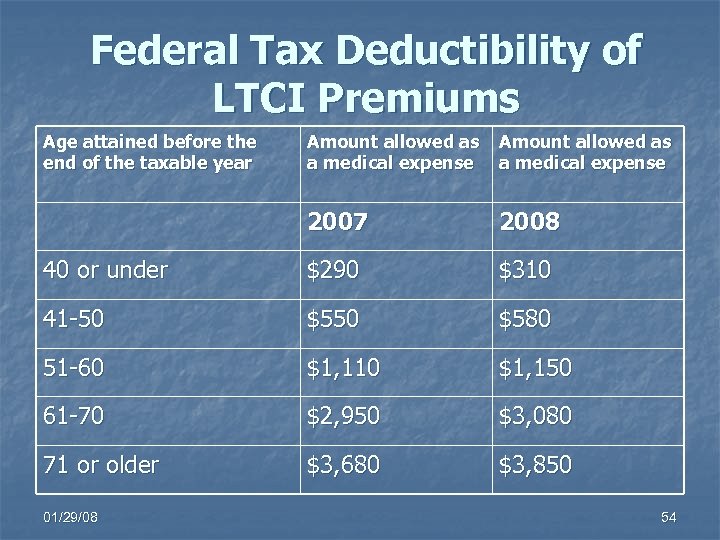 Federal Tax Deductibility of LTCI Premiums Age attained before the end of the taxable year Amount allowed as a medical expense 2007 2008 40 or under $290 $310 41 -50 $580 51 -60 $1, 110 $1, 150 61 -70 $2, 950 $3, 080 71 or older $3, 680 $3, 850 01/29/08 54
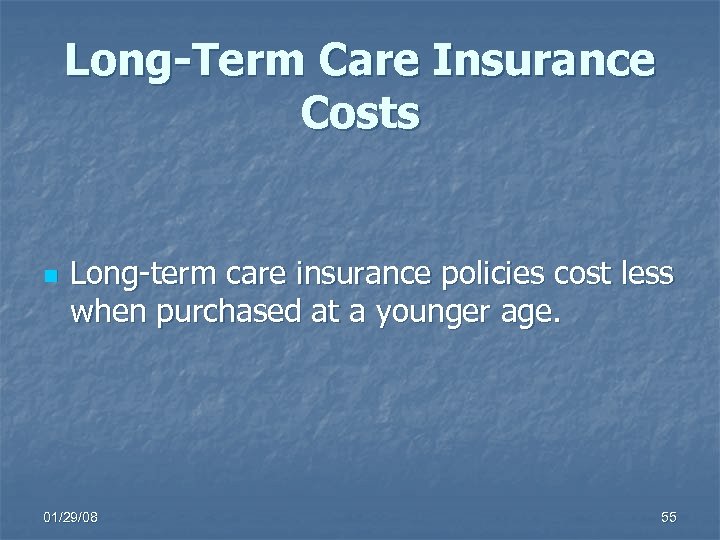 Long-Term Care Insurance Costs n Long-term care insurance policies cost less when purchased at a younger age. 01/29/08 55
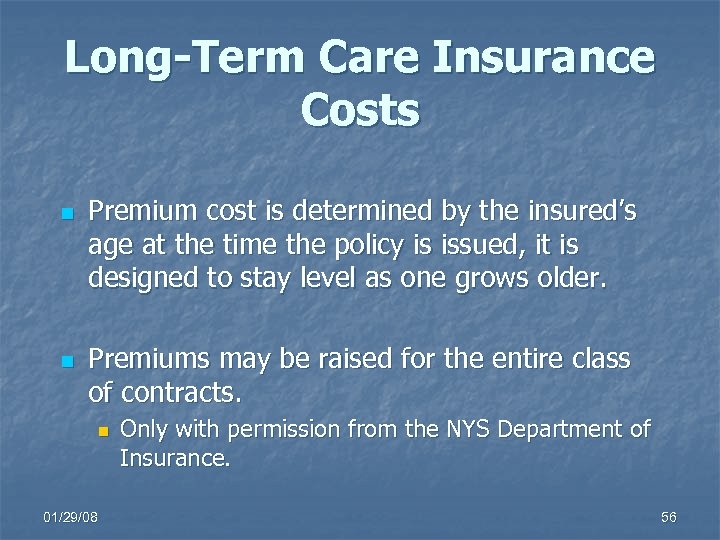 Long-Term Care Insurance Costs n n Premium cost is determined by the insured’s age at the time the policy is issued, it is designed to stay level as one grows older. Premiums may be raised for the entire class of contracts. n 01/29/08 Only with permission from the NYS Department of Insurance. 56
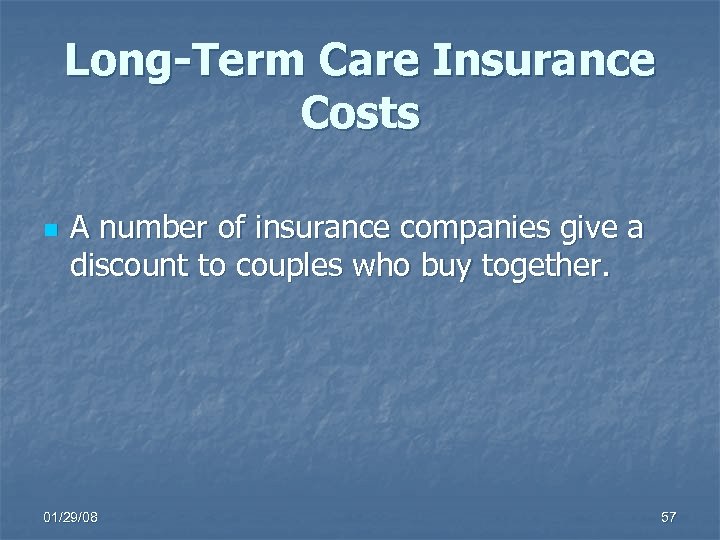 Long-Term Care Insurance Costs n A number of insurance companies give a discount to couples who buy together. 01/29/08 57
 Long-Term Care Insurance Costs n The cost of Long‑Term Care Insurance is also determined by the options one selects. n 01/29/08 Features that may make this insurance more costly include: high maximum policy benefits, high daily payment amounts , inflation protection, and short or zero day elimination periods. 58
 What are your Long-Term Care Insurance choices? n n n Employer Sponsored Long-Term Care Plan Association Sponsored Long-Term Care Plan Individual Long-Term Care Insurance Policies 01/29/08 59
 Employer Sponsored Long. Term Care Plans n Some employers now offer a group Long‑Term Care Insurance policy to their employees and/or their retirees; some employers will pay part of the premiums. n 01/29/08 A spouse and parents may be eligible to buy into this group plan as well. 60
 What is the New York State Partnership Program? Combines private long-term care insurance with Medicaid Extended Coverage Permits New Yorkers to protect some or all of their assets, while remaining eligible for Medicaid Extended Coverage. 01/29/08 61
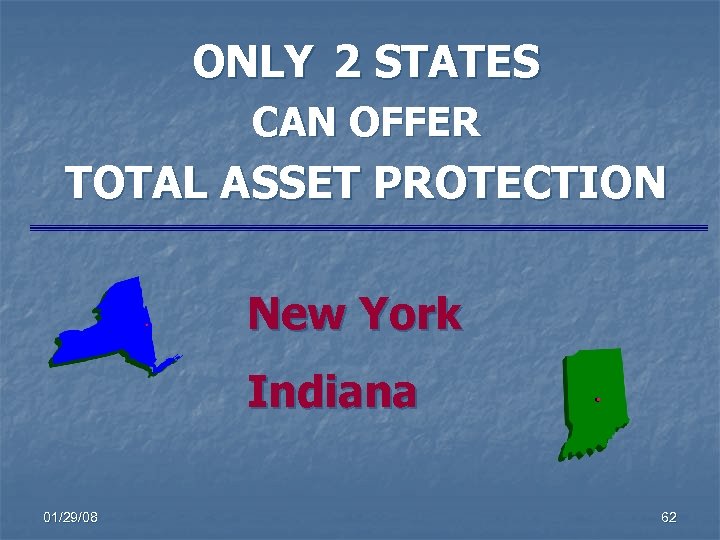 ONLY 2 STATES CAN OFFER TOTAL ASSET PROTECTION New York Indiana 01/29/08 62
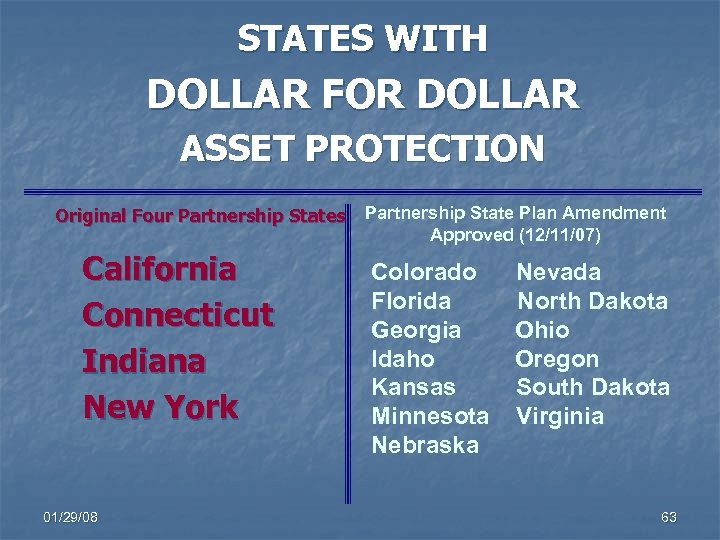 STATES WITH DOLLAR FOR DOLLAR ASSET PROTECTION Original Four Partnership States California Connecticut Indiana New York 01/29/08 Partnership State Plan Amendment Approved (12/11/07) Colorado Florida Georgia Idaho Kansas Minnesota Nebraska Nevada North Dakota Ohio Oregon South Dakota Virginia 63
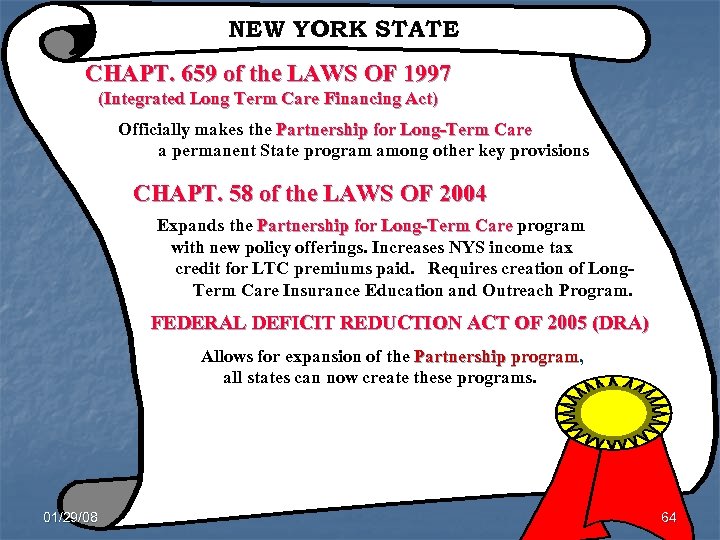 NEW YORK STATE CHAPT. 659 of the LAWS OF 1997 (Integrated Long Term Care Financing Act) Officially makes the Partnership for Long-Term Care a permanent State program among other key provisions CHAPT. 58 of the LAWS OF 2004 Expands the Partnership for Long-Term Care program with new policy offerings. Increases NYS income tax credit for LTC premiums paid. Requires creation of Long. Term Care Insurance Education and Outreach Program. FEDERAL DEFICIT REDUCTION ACT OF 2005 (DRA) Allows for expansion of the Partnership program, program all states can now create these programs. 01/29/08 64
 Why was the Partnership Program Created ? 01/29/08 65
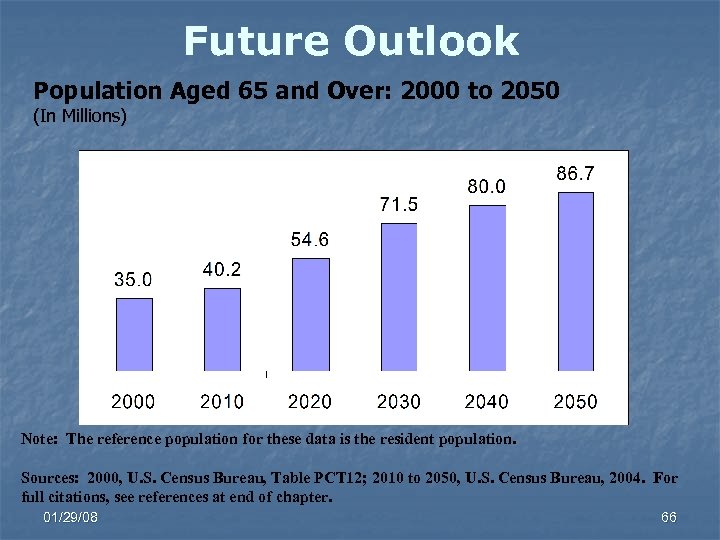 Future Outlook Population Aged 65 and Over: 2000 to 2050 (In Millions) Note: The reference population for these data is the resident population. Sources: 2000, U. S. Census Bureau, Table PCT 12; 2010 to 2050, U. S. Census Bureau, 2004. For full citations, see references at end of chapter. 01/29/08 66
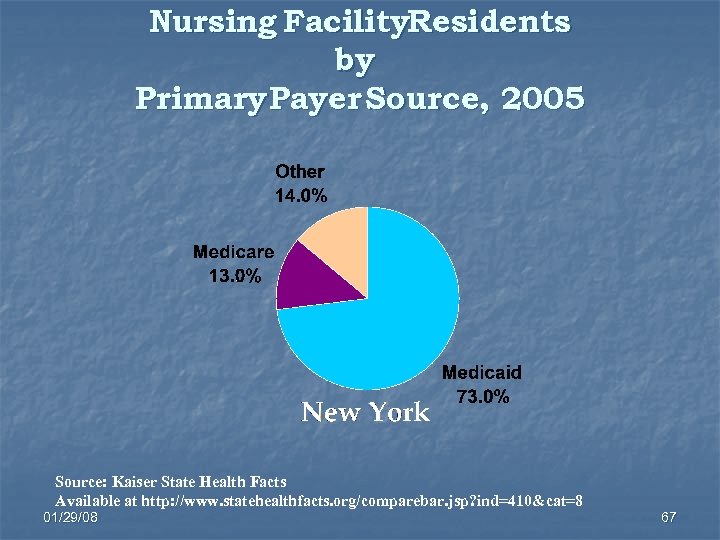 Nursing Facility. Residents by Primary Payer Source, 2005 Source: Kaiser State Health Facts Available at http: //www. statehealthfacts. org/comparebar. jsp? ind=410&cat=8 01/29/08 67
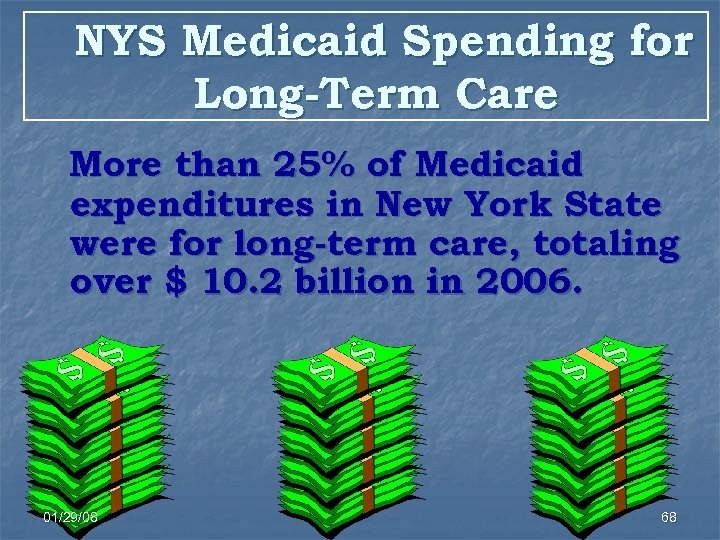 NYS Medicaid Spending for Long-Term Care More than 25% of Medicaid expenditures in New York State were for long-term care, totaling over $ 10. 2 billion in 2006. 01/29/08 68
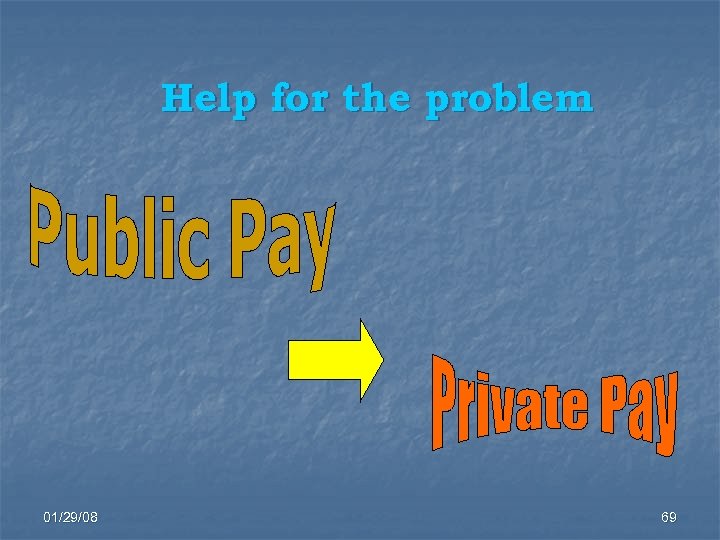 Help for the problem 01/29/08 69
 Why Buy a Partnership Policy? NYS Partnership offers: v v Total or Dollar for Dollar Asset Protection New York State Endorsement Lifetime Coverage Consumer Safeguards 01/29/08 70
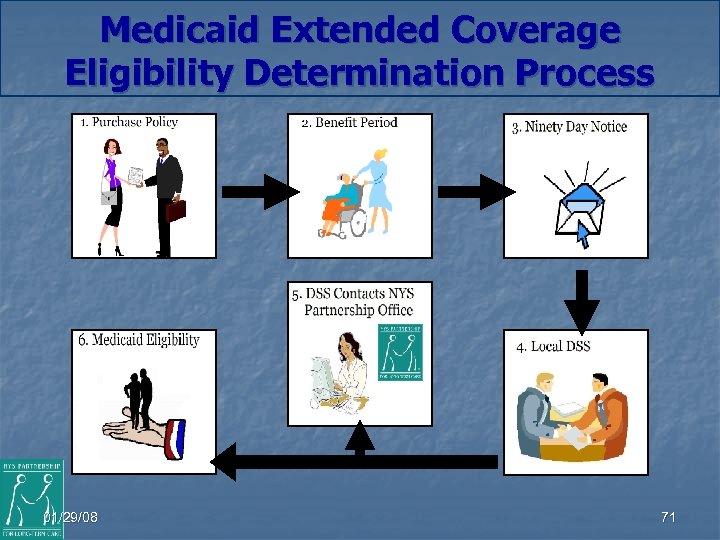 Medicaid Extended Coverage Eligibility Determination Process 01/29/08 71
 Key Difference When Applying for Medicaid Extended Coverage n n Total Asset Protection plans protect ALL assets. Under Dollar for Dollar Asset protection plans, the assets protected are equal to the amount of benefits paid by the insurer. 01/29/08 72
 Total Asset Protection Plans n Assets are fully protected when you apply for Medicaid Extended Coverage n BUT n You will be required to contribute your income to the cost of your care following Medicaid guidelines 01/29/08 73
 Dollar For Dollar Asset Protection Plans n n Assets in excess of asset protection and income will be subject to Medicaid rules in determining eligibility for Medicaid Extended Coverage. Asset protection in $ for $ plans is determined by the total amount of benefits paid from the policy 01/29/08 74
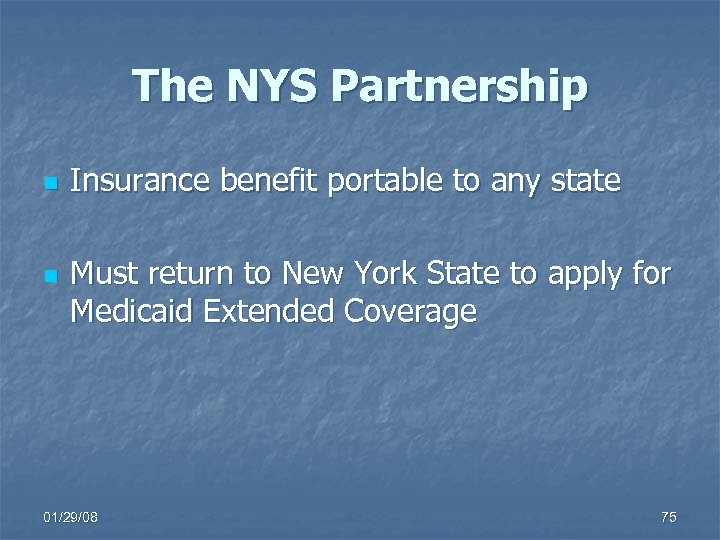 The NYS Partnership n n Insurance benefit portable to any state Must return to New York State to apply for Medicaid Extended Coverage 01/29/08 75
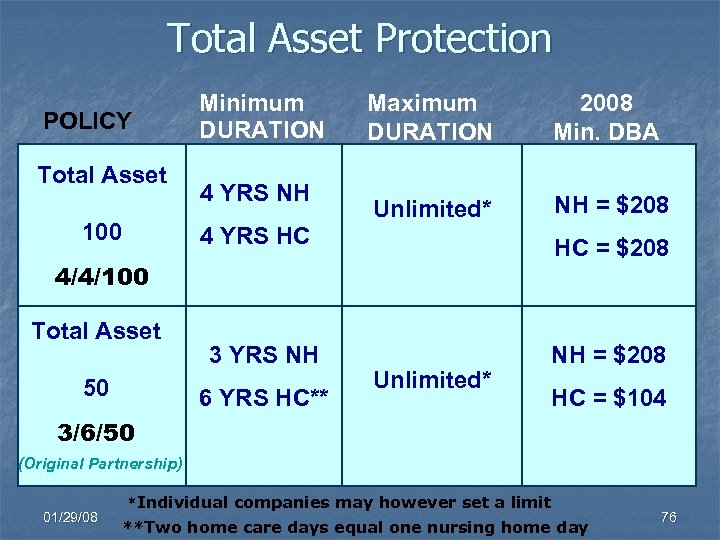 Total Asset Protection POLICY Total Asset 100 Minimum DURATION 4 YRS NH Maximum DURATION 2008 Min. DBA Unlimited* NH = $208 4 YRS HC HC = $208 4/4/100 Total Asset 50 3 YRS NH 6 YRS HC** Unlimited* NH = $208 HC = $104 3/6/50 (Original Partnership) 01/29/08 *Individual companies may however set a limit **Two home care days equal one nursing home day 76
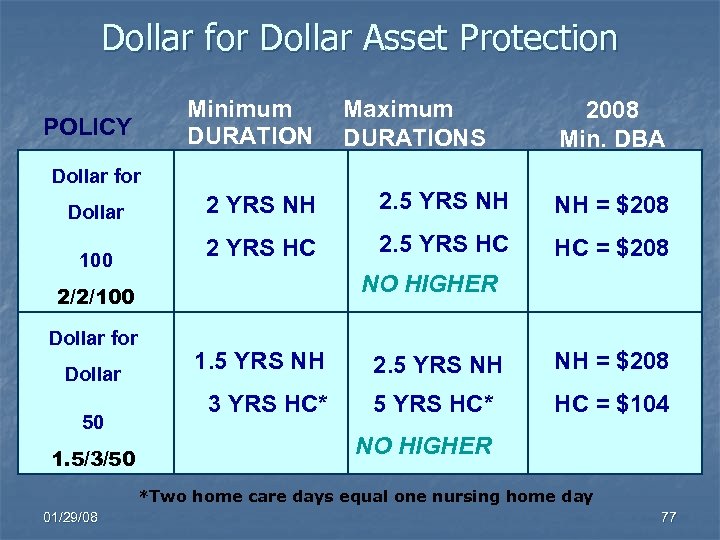 Dollar for Dollar Asset Protection Minimum DURATION POLICY Maximum DURATIONS 2008 Min. DBA Dollar for Dollar 2 YRS NH 2. 5 YRS NH NH = $208 100 2 YRS HC 2. 5 YRS HC HC = $208 NO HIGHER 2/2/100 Dollar for Dollar 50 1. 5/3/50 1. 5 YRS NH 3 YRS HC* 2. 5 YRS NH NH = $208 5 YRS HC* HC = $104 NO HIGHER *Two home care days equal one nursing home day 01/29/08 77
 Additional Partnership Training n n Coordinators and Counselors are invited to “sit in” for Agents Training Check the training schedule at www. nyspltc. org and contact the Partnership office at 518 -474 -0662 to register. 01/29/08 78
 Factors To Consider Before Purchasing Insurance Covering Long-Term Care Services 01/29/08 79
 n Are you eligible for Medicaid? n 01/29/08 If so, Medicaid will pay your long-term care expenses. 80
 n How much can you afford to pay out-ofpocket for long-term care expenses? 01/29/08 81
 n How much can you afford to pay for an insurance policy covering long-term care services? 01/29/08 82
 n If you are planning to retire, will your reduced income be adequate to meet the annual costs of the premium? 01/29/08 83
 n All long-term care policies are medically underwritten, i. e. , your physical/mental condition and health history will be evaluated, n 01/29/08 so if you intend to purchase a policy, don't wait until you have a medical condition that could make Long-Term care coverage more expensive or unavailable to you. 84
 n In most cases, the premium for a policy will be lower when purchased at a younger age. 01/29/08 85
 n n What types of long-term care services would best meet your own personal needs and preferences? What are the costs of these services in the locality where you would be receiving them? 01/29/08 86
 What Shopping Tips Should You Keep in Mind? Here are some points to keep in mind as you shop. Adapted from: A Shopper’s Guide to Long-Term Care Insurance, National Association of Insurance Commissioners, 2003 New York State specific information from the NYS Department of Insurance website 3/06 01/29/08 87
 Ask Questions n If you have questions about the agent, the insurance company, or the policy, contact the New York State Department of Insurance or the Long-Term Care Insurance Education and Outreach Program 01/29/08 88
 Check with Several Companies and Agents n n Contacting several companies (and agents) before you buy is wise. Be sure to compare benefits, the types of facilities you have to be in to get coverage, the limits on your coverage, what’s excluded, and, of course, the premium. n 01/29/08 (Policies that have the same coverage and benefits may not cost the same. ) 89
 Check Out The Companies’ Rate Increase Histories n Ask companies about their rate increase histories and whether they have increased rates on Long-Term Care insurance policies that they sell. 01/29/08 90
 Take Your Time and Compare Outlines of Coverage n n n Never let anyone pressure or scare you into making a quick decision. Don’t buy a policy the first time you see an agent. Ask for an outline of coverage. It outlines the policy’s benefits and points out important features. Compare outlines of coverage for several policies and make sure the outlines are similar (if not the same) when comparing premiums. 01/29/08 91
 Understand the Policies n Make sure you know what the policy covers and what it doesn’t. If you have any questions, call the insurance company before you buy. 01/29/08 92
 n If you receive any information that confuses you or is different from the information in the company literature, don’t hesitate to call or write the company to answer your questions. Don’t trust any sales presentation or literature that claims you have only one chance to buy a policy. 01/29/08 93
 n Some companies sell their products through agents, and others may sell their policies through the mail, skipping agents entirely. No matter how you buy your policy, check with the company if you don’t understand how the policy works. 01/29/08 94
 Talk about the policy with a friend or relative. n In New York State you may want to contact the state insurance department or contact the Long-Term Care Insurance Education and Outreach Program. n 01/29/08 95
 Don’t be Misled by Advertising n Most celebrity endorsers are professional actors paid to advertise. They are not insurance experts. 01/29/08 96
 Medicare does not endorse or sell long-term care insurance policies. n Be wary of any advertising that suggests Medicare is involved. n 01/29/08 97
 n Don’t trust cards you get in the mail that look like official government documents until you check with the government agency identified on the card. n 01/29/08 Insurance companies or agents trying to find buyers may have sent them. 98
 n Be careful if anyone asks you questions over the telephone about Medicare or your insurance. n 01/29/08 They may sell any information you give to long-term care insurance marketers, who might call you, come to your home, or try to sell you insurance by mail. 99
 Don’t Buy More Coverage Than You Need n n n You don’t have to buy more than one policy to get enough coverage. One good policy is enough. Also, don’t buy more insurance than you need. If you already own a policy and you are considering switching plans or upgrading your coverage investigate your options thoroughly. Be certain that the replacement policy is effective before you terminate the older policy. Be sure to discuss any change in your coverage with your financial advisor. 01/29/08 100
 Be Sure You Accurately Complete Your Application n n Don’t be misled by long-term care insurance marketers who say your medical history isn’t important-it is! Give correct information. If an agent fills out the application for you, don’t sign it until you have read it. n n 01/29/08 Make sure that all of the medical information is right. If it isn’t and the company used that information to decide whether to insure you, it can refuse to pay your claims and even cancel your policy. 101
 Never Pay in Cash n Use a check, money order made payable to the insurance company. 01/29/08 102
 Be Sure to Get the Name, Address, and Telephone Number of the Agent and the Company n Get a local or toll-free number for both the agent and the company. 01/29/08 103
 If You Don’t get Your Policy Within 60 Days, Contact the Company or Agent n n You have the right to expect prompt delivery of your policy. When you get it, keep it somewhere that you can easily find it. n 01/29/08 Tell a trusted friend or relative where it is. 104
 Be Sure You Look at Your Policy During the Free-Look Period n If you decide you don’t want the policy soon after you bought it, you cancel it and get your money back. You must tell the company you don’t want the policy within a certain number of days after you get it. n In New York State this period is 30 days. If you want to cancel, n Keep the envelope the policy was mailed in. Or ask the agent for a signed delivery receipt when he or she hands you the policy n Send the policy to the insurance company along with a short letter asking for a refund. n Send both the policy and the letter by certified mail. Keep the mailing receipt. n Keep a copy of all letters 01/29/08 n It usually takes four to six weeks to get your refund. 105 n
 Read the Policy Again and Make Sure it Gives You the Coverage You Want n n Check the policy to see if the benefits are what you expected. If you have any questions, call the agent or company right away. Also read the application you signed. It is part of the policy. n If it is not filled out correctly, contact the agent or company right away. n 01/29/08 106
 Think About Having the Premium Automatically Taken Out of Your Bank Account n n Automatic withdrawal may mean that you won’t lose your coverage if an illness makes you forget to pay your premium. If you decide not to renew your policy, be sure you tell the bank to stop the automatic withdrawals. 01/29/08 107
 Selecting an Insurance Company n n When selecting an insurance policy, you are also selecting an insurance company and you may wish to know how stable that company is financially. Many firms rate the financial soundness of insurance companies. Some provide the ratings free while others charge a fee, ranging from a small fee for an online rating to a larger amount for quarterly reports. 01/29/08 108
 Ratings are available from: n n n A. M. Best Insurance Review (908)439 -2200 ext 5742 www. ambest. com Fitch Ratings (800)75 -FITCH www. fitchratings. com Moody’s Investor’s Service (212)553 -0377 www. moodys. com Standard & Poor’s (212)438 -2400 www. standardandpoors Thestreet. com (800)289 -9222 www. thestreet. com 01/29/08 109
 Ratings Cont. n Each firm has a different rating scale and firms may differ in the conclusions they reach about a specific insurance company. n Therefore, you may wish to check with more than one firm before selecting an insurance company. 01/29/08 110
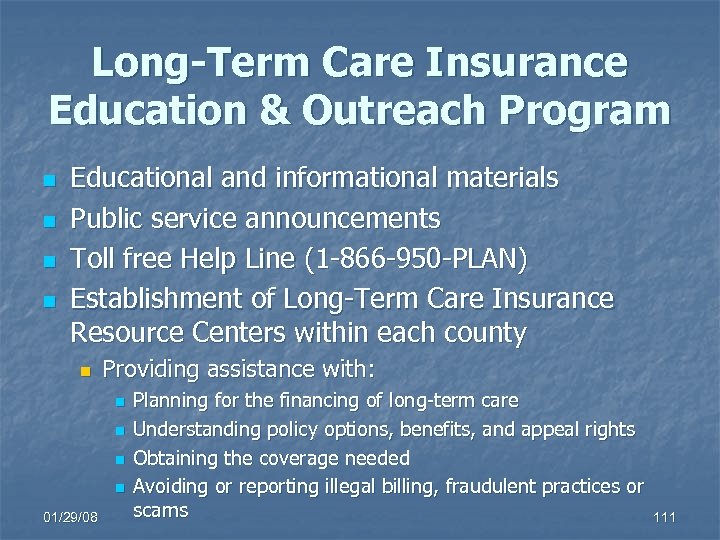 Long-Term Care Insurance Education & Outreach Program n n Educational and informational materials Public service announcements Toll free Help Line (1 -866 -950 -PLAN) Establishment of Long-Term Care Insurance Resource Centers within each county n Providing assistance with: n n 01/29/08 Planning for the financing of long-term care Understanding policy options, benefits, and appeal rights Obtaining the coverage needed Avoiding or reporting illegal billing, fraudulent practices or scams 111
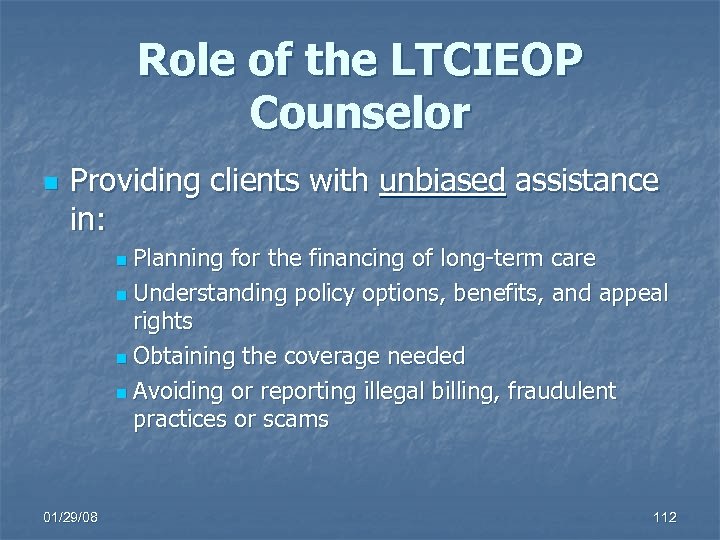 Role of the LTCIEOP Counselor n Providing clients with unbiased assistance in: Planning for the financing of long-term care n Understanding policy options, benefits, and appeal rights n Obtaining the coverage needed n Avoiding or reporting illegal billing, fraudulent practices or scams n 01/29/08 112
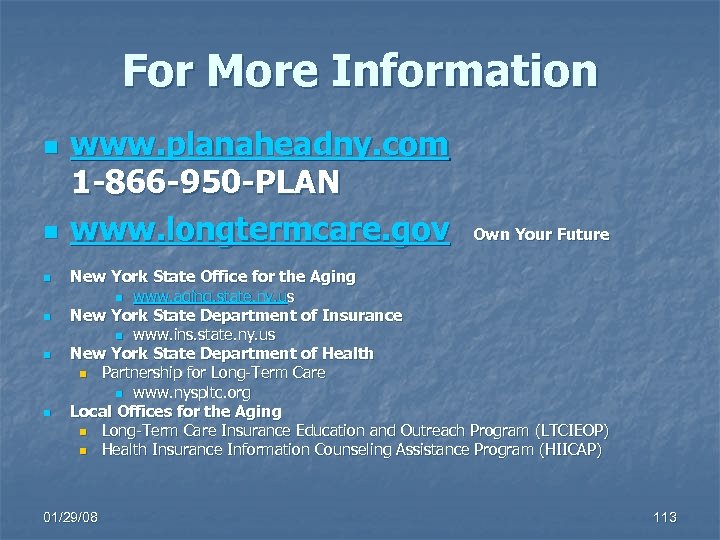 For More Information n n n www. planaheadny. com 1 -866 -950 -PLAN www. longtermcare. gov Own Your Future New York State Office for the Aging n www. aging. state. ny. us New York State Department of Insurance n www. ins. state. ny. us New York State Department of Health n Partnership for Long-Term Care n www. nyspltc. org Local Offices for the Aging n Long-Term Care Insurance Education and Outreach Program (LTCIEOP) n Health Insurance Information Counseling Assistance Program (HIICAP) 01/29/08 113