


 Скачать презентацию Long-term care in Europe discussing trends and
2eb0becdba9aa2ac19ccde089090c544.ppt
- Количество слайдов: 46
 “Long-term care in Europe – discussing trends and relevant issues” Conference held under the project “Mainstreaming Ageing: Indicators to Monitor Implementation” Budapest, 22 -23 February 2010 The role of migrant work in the LTC sector: opportunities & challenges Giovanni Lamura* *: INRCA (Italian National Research Centre on Ageing) Centre for socio-economic research and elder care Ancona, Italy, e-mail: g. lamura@inrca. it
 Contents of presentation 1. The role of migrant care workers in Europe 2. The role of migrant care workers in Italy 3. The perspective of the families employing migrant care workers 4. The migrant care workers’ perspective 5. Final remarks
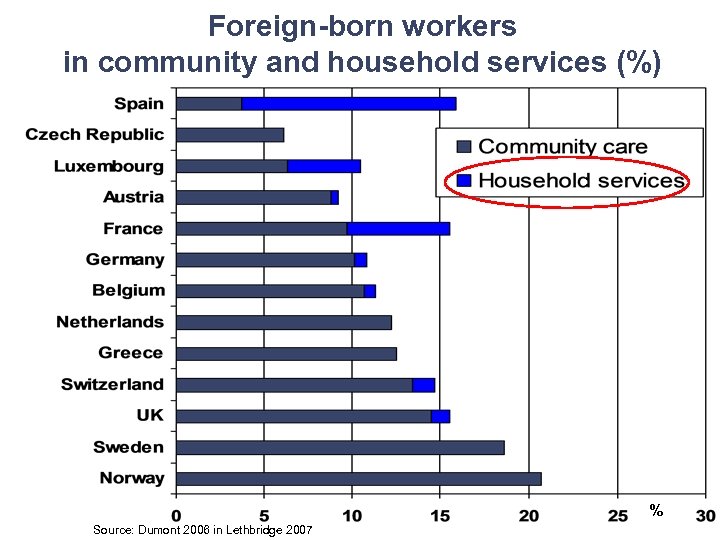
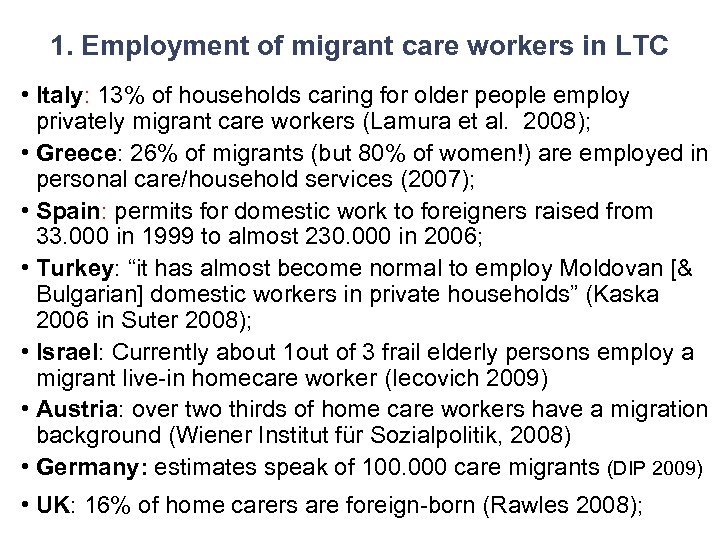 1. Employment of migrant care workers in LTC • Italy: 13% of households caring for older people employ privately migrant care workers (Lamura et al. 2008); • Greece: 26% of migrants (but 80% of women!) are employed in personal care/household services (2007); • Spain: permits for domestic work to foreigners raised from 33. 000 in 1999 to almost 230. 000 in 2006; • Turkey: “it has almost become normal to employ Moldovan [& Bulgarian] domestic workers in private households” (Kaska 2006 in Suter 2008); • Israel: Currently about 1 out of 3 frail elderly persons employ a migrant live-in homecare worker (Iecovich 2009) • Austria: over two thirds of home care workers have a migration background (Wiener Institut für Sozialpolitik, 2008) • Germany: estimates speak of 100. 000 care migrants (DIP 2009) • UK: 16% of home carers are foreign-born (Rawles 2008);
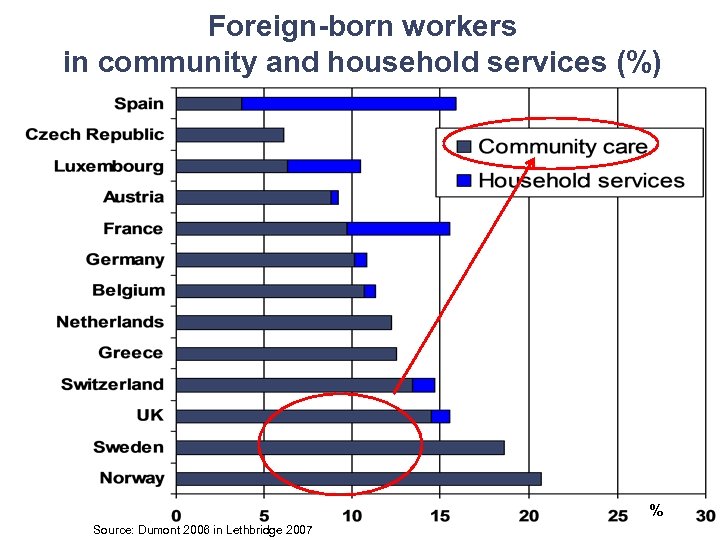 Foreign-born workers in community and household services (%) % Source: Dumont 2006 in Lethbridge 2007
 Foreign-born workers in community and household services (%) % Source: Dumont 2006 in Lethbridge 2007
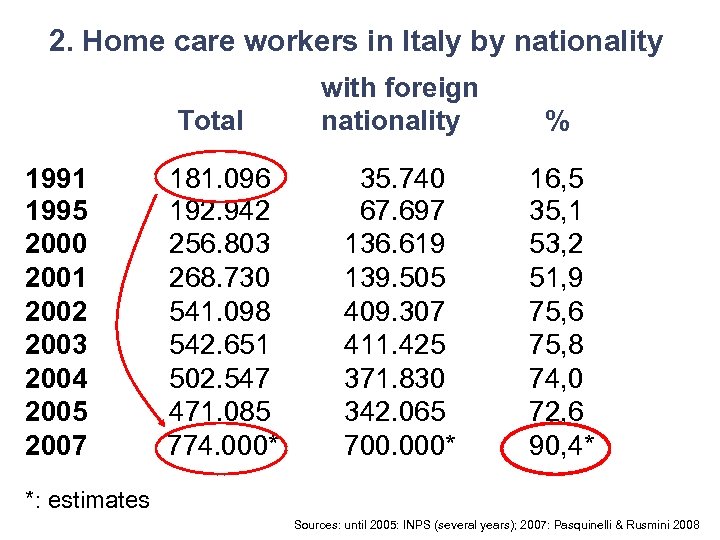 2. Home care workers in Italy by nationality Total 1991 1995 2000 2001 2002 2003 2004 2005 2007 181. 096 192. 942 256. 803 268. 730 541. 098 542. 651 502. 547 471. 085 774. 000* with foreign nationality % 35. 740 67. 697 136. 619 139. 505 409. 307 411. 425 371. 830 342. 065 700. 000* 16, 5 35, 1 53, 2 51, 9 75, 6 75, 8 74, 0 72, 6 90, 4* *: estimates Sources: until 2005: INPS (several years); 2007: Pasquinelli & Rusmini 2008
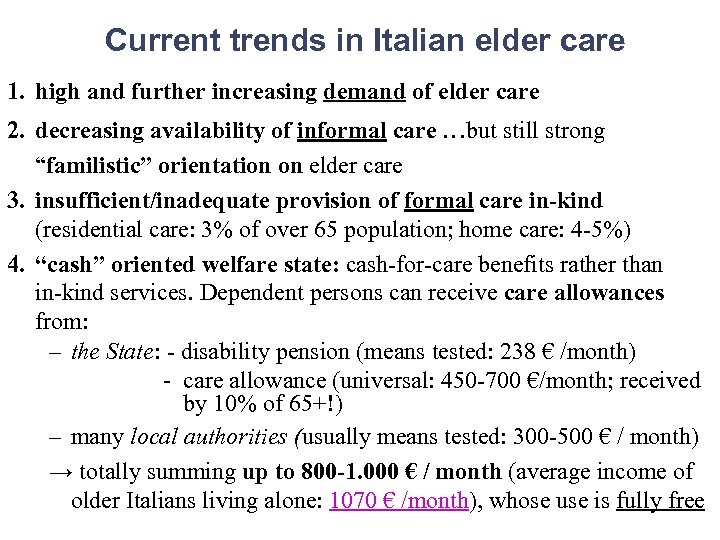 Current trends in Italian elder care 1. high and further increasing demand of elder care 2. decreasing availability of informal care …but still strong “familistic” orientation on elder care 3. insufficient/inadequate provision of formal care in-kind (residential care: 3% of over 65 population; home care: 4 -5%) 4. “cash” oriented welfare state: cash-for-care benefits rather than in-kind services. Dependent persons can receive care allowances from: – the State: - disability pension (means tested: 238 € /month) - care allowance (universal: 450 -700 €/month; received by 10% of 65+!) – many local authorities (usually means tested: 300 -500 € / month) → totally summing up to 800 -1. 000 € / month (average income of older Italians living alone: 1070 € /month), whose use is fully free
 The role of migrant home carers in Italy / 1 → strong public, implicit incentive to privately employ migrant care workers, coming from all over the world:
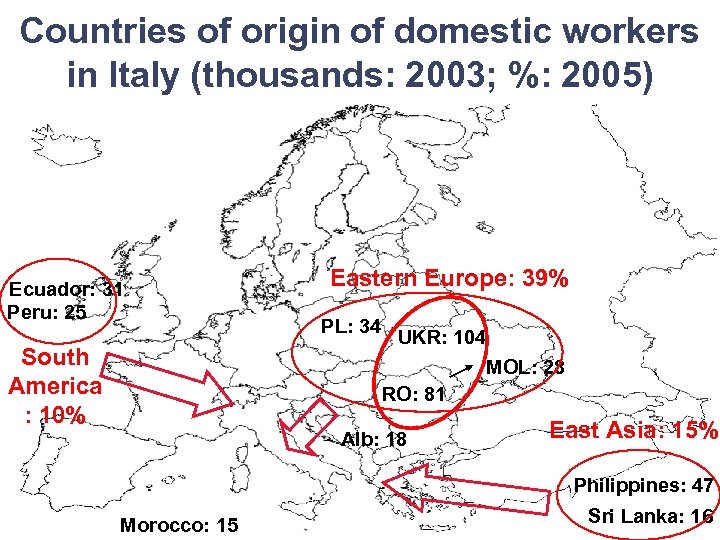 Countries of origin of domestic workers in Italy (thousands: 2003; %: 2005) Ecuador: 31 Peru: 25 South America : 10% Eastern Europe: 39% PL: 34 UKR: 104 MOL: 28 RO: 81 Alb: 18 East Asia: 15% Philippines: 47 Morocco: 15 Sri Lanka: 16
 The role of migrant home carers in Italy / 2 → strong public, implicit incentive to privately employ migrant care workers: • often cohabiting with the older person, to ensure a 24 -hour/day, 7 -day/week supervision;
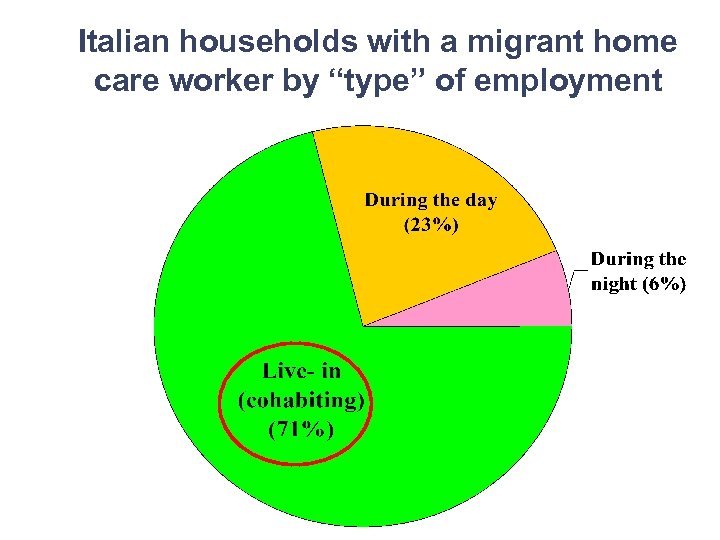 Italian households with a migrant home care worker by “type” of employment
 The role of migrant home carers in Italy / 3 → strong public, implicit incentive to privately employ migrant care workers: • often cohabiting with older person to ensure 24 -hoursupervision • low costs, thanks to: – the undeclared basis of employment (illegal immigrants or legal ones without contract providing full time, live-in care earn 900 -1000 €/month);
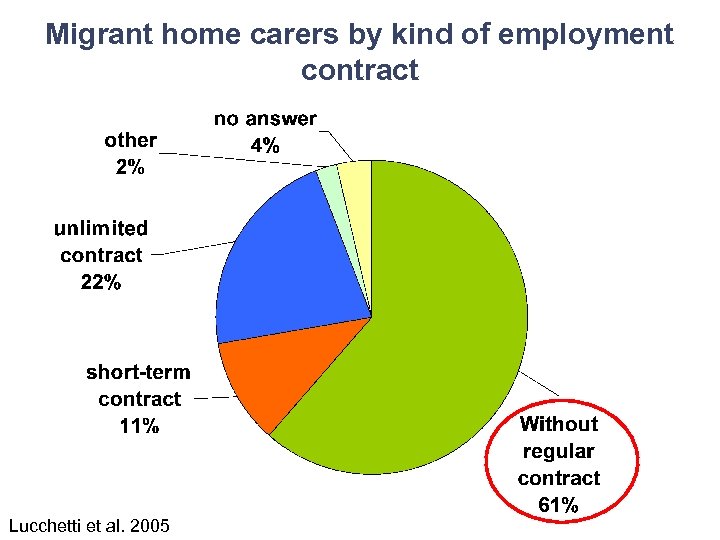 Migrant home carers by kind of employment contract Lucchetti et al. 2005
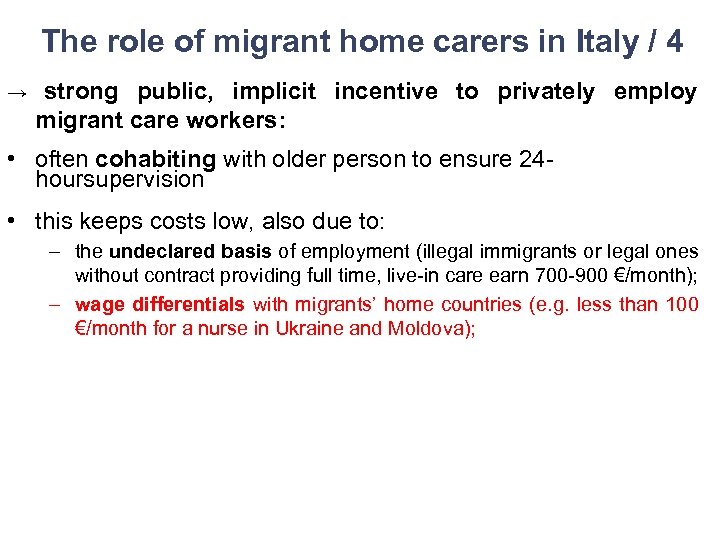 The role of migrant home carers in Italy / 4 → strong public, implicit incentive to privately employ migrant care workers: • often cohabiting with older person to ensure 24 hoursupervision • this keeps costs low, also due to: – the undeclared basis of employment (illegal immigrants or legal ones without contract providing full time, live-in care earn 700 -900 €/month); – wage differentials with migrants’ home countries (e. g. less than 100 €/month for a nurse in Ukraine and Moldova);
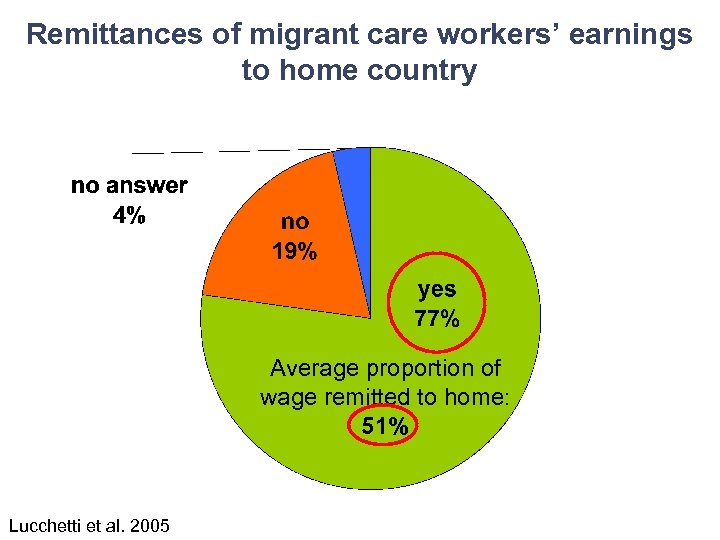 Remittances of migrant care workers’ earnings to home country Average proportion of wage remitted to home: 51% Lucchetti et al. 2005
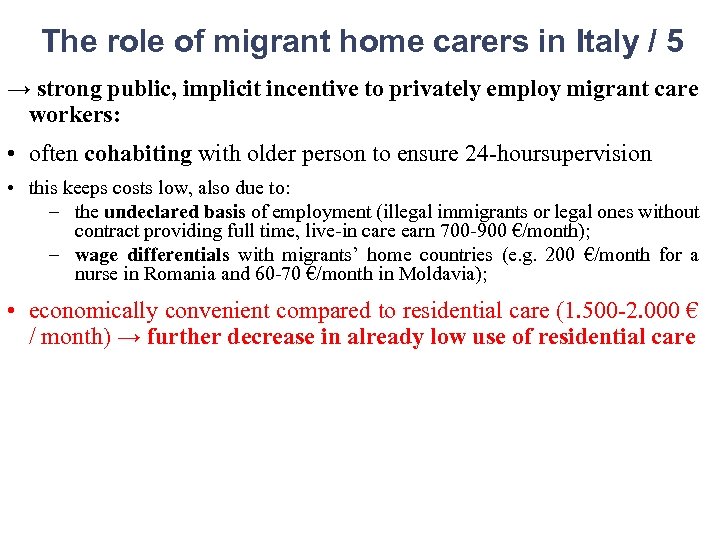 The role of migrant home carers in Italy / 5 → strong public, implicit incentive to privately employ migrant care workers: • often cohabiting with older person to ensure 24 -hoursupervision • this keeps costs low, also due to: – the undeclared basis of employment (illegal immigrants or legal ones without contract providing full time, live-in care earn 700 -900 €/month); – wage differentials with migrants’ home countries (e. g. 200 €/month for a nurse in Romania and 60 -70 €/month in Moldavia); • economically convenient compared to residential care (1. 500 -2. 000 € / month) → further decrease in already low use of residential care
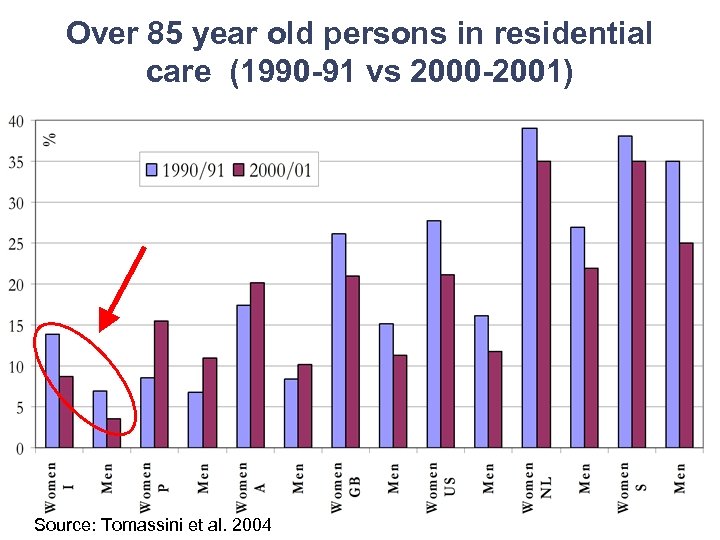 Over 85 year old persons in residential care (1990 -91 vs 2000 -2001) Source: Tomassini et al. 2004
 The role of migrant home carers in Italy / 6 → strong public, implicit incentive to privately employ migrant care workers: • often cohabiting with older person to ensure 24 -hoursupervision • often on an undeclared basis, to keep costs low (illegal immigrants or legal ones without contract providing full time, live-in care earn 700 -900 €/month, compared to 200 €/month in Romania for a nurse and 60 -70 €/month in Moldavia); • economically convenient compared to residential care (1. 500 -2. 000 € / month) → further decrease in already low use of residential care • “institutionalization” of migrant care work by means of: – legalizations allowing illegal migrants to gain a legitimate residence status (the last one in 2002 legalized 350. 000 domestic workers);
 The role of migrant home carers in Italy / 6 → strong public, implicit incentive to privately employ migrant care workers: • often cohabiting with older person to ensure 24 -hoursupervision • often on an undeclared basis, to keep costs low (illegal immigrants or legal ones without contract providing full time, live-in care earn 700 -900 €/month, compared to 200 €/month in Romania for a nurse and 60 -70 €/month in Moldavia); • economically convenient compared to residential care (1. 500 -2. 000 € / month) → further decrease in already low use of residential care • “institutionalization” of migrant care work by means of: – legalizations allowing illegal migrants to gain a legitimate residence status (the last one in 2002 legalized 350. 000 domestic workers); – immigration quotas for domestic workers (however regularly exceeded: in 2007 ca. 400. 000 applications were presented for 65. 000 positions);
 The role of migrant home carers in Italy / 6 → strong public, implicit incentive to privately employ migrant care workers: • often cohabiting with older person to ensure 24 -hoursupervision • often on an undeclared basis, to keep costs low (illegal immigrants or legal ones without contract providing full time, live-in care earn 700 -900 €/month, compared to 200 €/month in Romania for a nurse and 60 -70 €/month in Moldavia); • economically convenient compared to residential care (1. 500 -2. 000 € / month) → further decrease in already low use of residential care • “institutionalization” of migrant care work by means of: – legalizations allowing illegal migrants to gain a legitimate residence status (the last one in 2002 legalized 350. 000 domestic workers); – immigration quotas for domestic workers (however regularly exceeded: in 2007 ca. 400. 000 applications were presented for 65. 000 positions); – to fight undeclared work, fiscal incentives were introduced for those employing migrant care workers (allowing savings up to 480 Euros/year)
 The role of migrant home carers in Italy / 6 → strong public, implicit incentive to privately employ migrant care workers: • often cohabiting with older person to ensure 24 -hoursupervision • often on an undeclared basis, to keep costs low (illegal immigrants or legal ones without contract providing full time, live-in care earn 700 -900 €/month, compared to 200 €/month in Romania for a nurse and 60 -70 €/month in Moldavia); • economically convenient compared to residential care (1. 500 -2. 000 € / month) → further decrease in already low use of residential care • “institutionalization” of migrant care work by means of: – legalizations allowing illegal migrants to gain a legitimate residence status (the last one in 2002 legalized 350. 000 domestic workers); – immigration quotas for domestic workers (however regularly exceeded: in 2007 ca. 400. 000 applications were presented for 65. 000 positions); – to fight undeclared work, fiscal incentives were introduced for those employing migrant care workers (allowing savings up to 480 Euros/year) – new contract for domestic workers in 2007: increased protection but also costs (minimum wage by 30%): further incentive to undeclared work?
 The role of migrant home carers in Italy / 6 → strong public, implicit incentive to privately employ migrant care workers: • often cohabiting with older person to ensure 24 -hoursupervision • often on an undeclared basis, to keep costs low (illegal immigrants or legal ones without contract providing full time, live-in care earn 700 -900 €/month, compared to 200 €/month in Romania for a nurse and 60 -70 €/month in Moldavia); • economically convenient compared to residential care (1. 500 -2. 000 € / month) → further decrease in already low use of residential care • “institutionalization” of migrant care work by means of: – legalizations allowing illegal migrants to gain a legitimate residence status (the last one in 2002 legalized 350. 000 domestic workers); – immigration quotas for domestic workers (however regularly exceeded: in 2007 ca. 400. 000 applications were presented for 65. 000 positions); – to fight undeclared work, fiscal incentives were introduced for those employing migrant care workers (allowing savings up to 480 Euros/year) – new contract for domestic workers in 2007: increased protection but also costs (minimum wage by 30%): further incentive to undeclared work? – training and accreditation of migrant workers in combination to local care allowances
 3. The perspective of family carers: why do families employ migrant care workers?
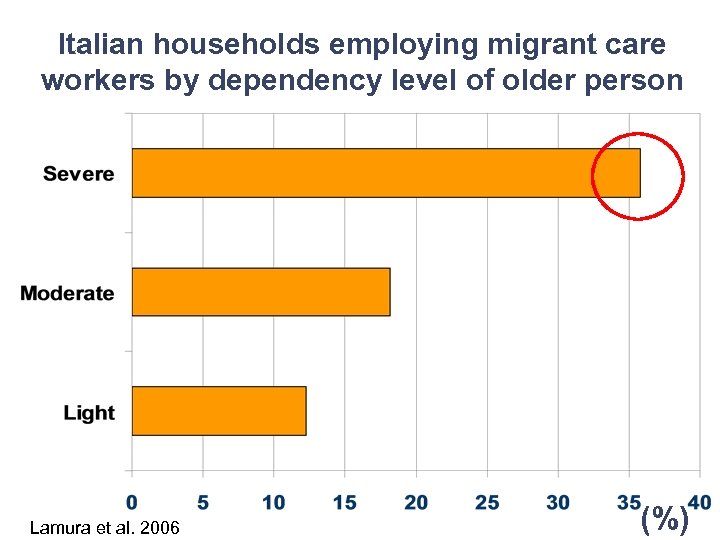 Italian households employing migrant care workers by dependency level of older person Lamura et al. 2006 (%)
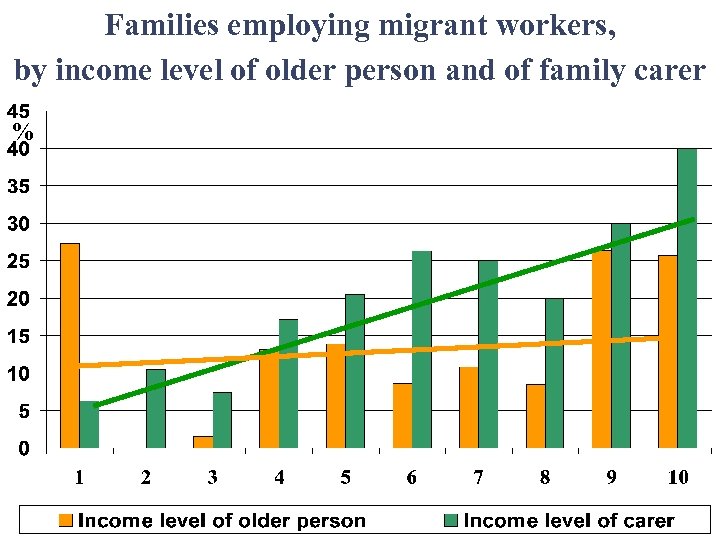 Families employing migrant workers, by income level of older person and of family carer %
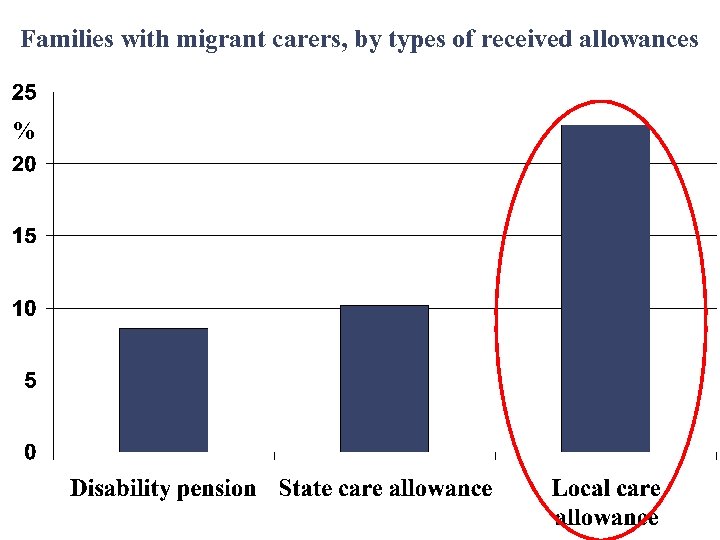 Families with migrant carers, by types of received allowances %
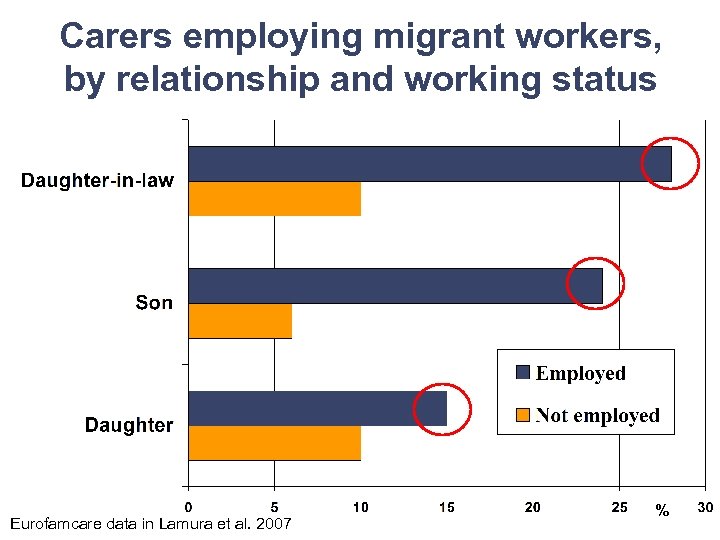 Carers employing migrant workers, by relationship and working status Eurofamcare data in Lamura et al. 2007 %
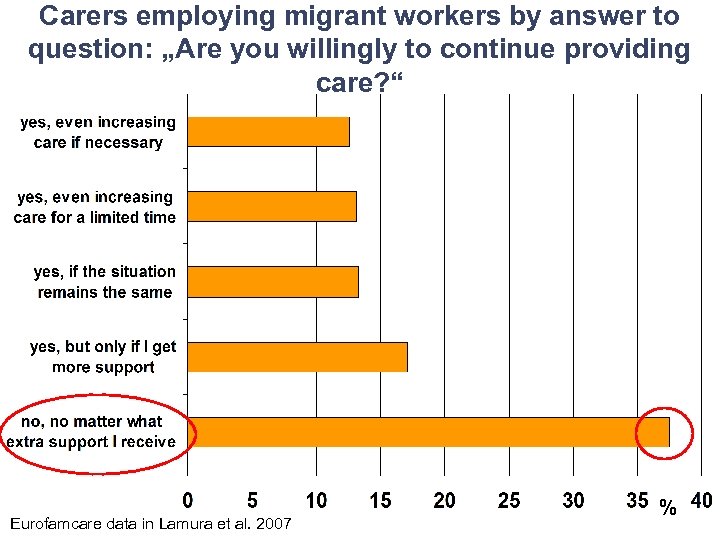 Carers employing migrant workers by answer to question: „Are you willingly to continue providing care? “ Eurofamcare data in Lamura et al. 2007 %
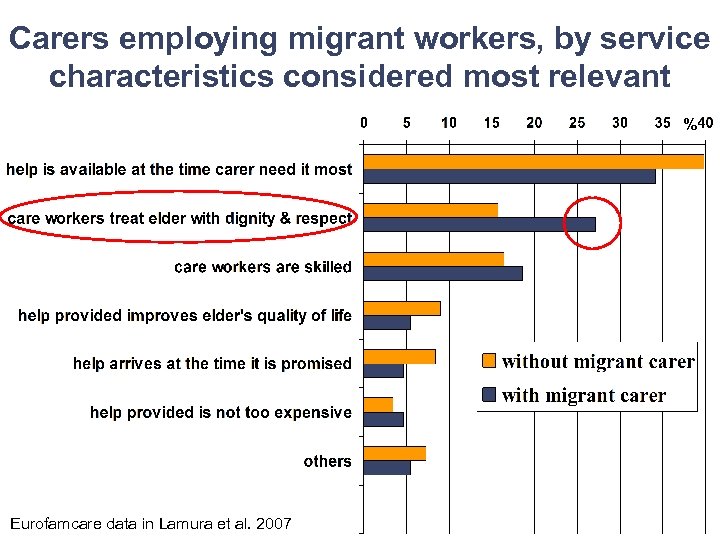 Carers employing migrant workers, by service characteristics considered most relevant % Eurofamcare data in Lamura et al. 2007
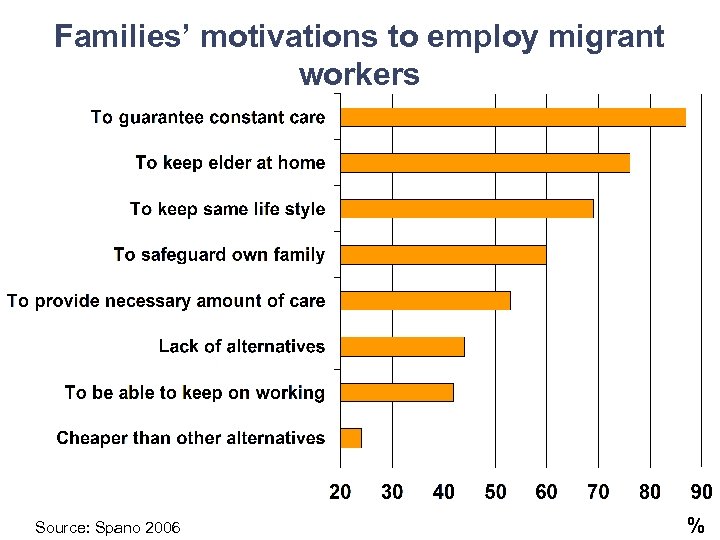 Families’ motivations to employ migrant workers Source: Spano 2006 %
 4. The perspective of migrant care workers
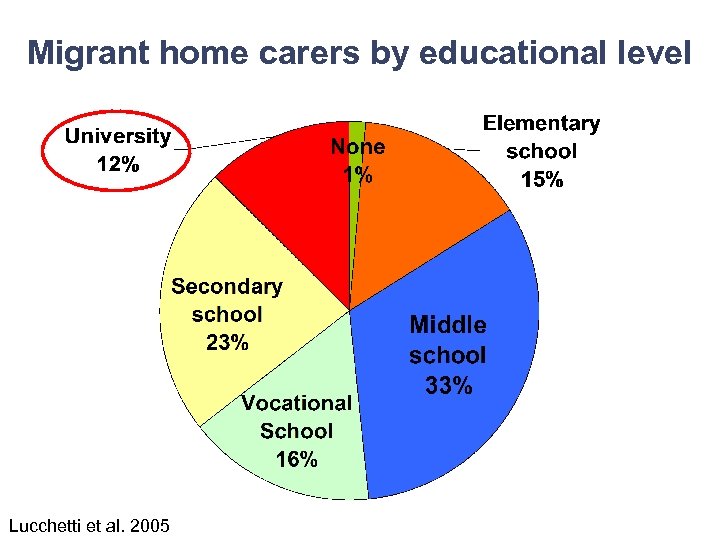 Migrant home carers by educational level Lucchetti et al. 2005
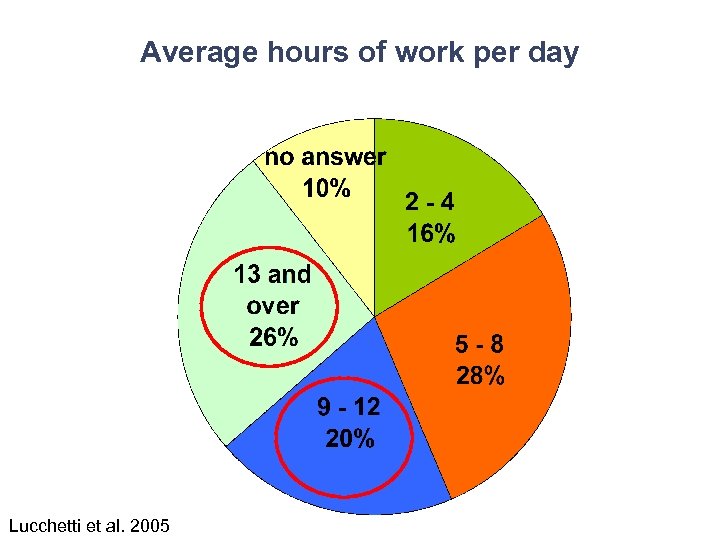 Average hours of work per day Lucchetti et al. 2005
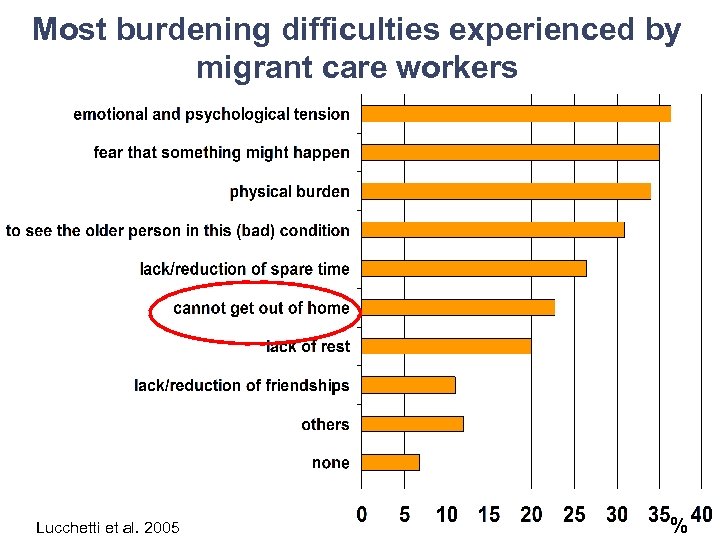 Most burdening difficulties experienced by migrant care workers Lucchetti et al. 2005 %
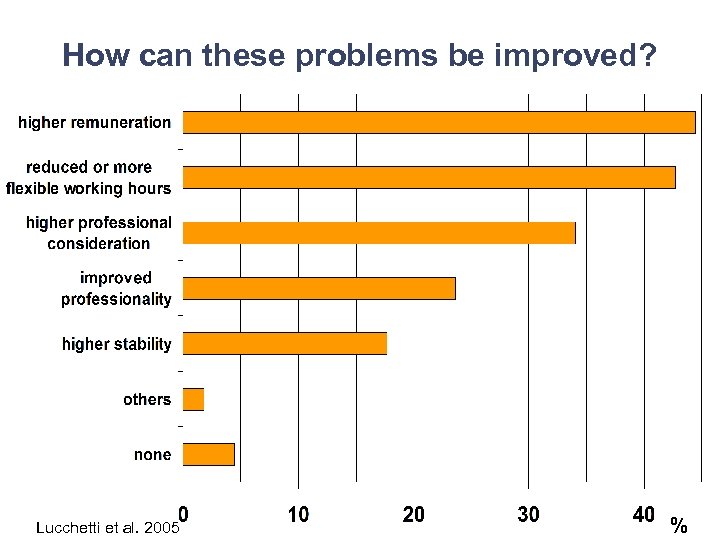 How can these problems be improved? Lucchetti et al. 2005 %
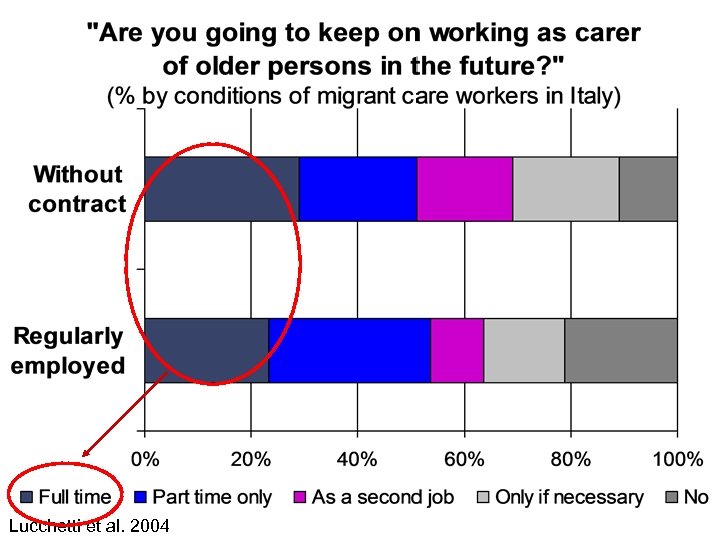 Lucchetti et al. 2004
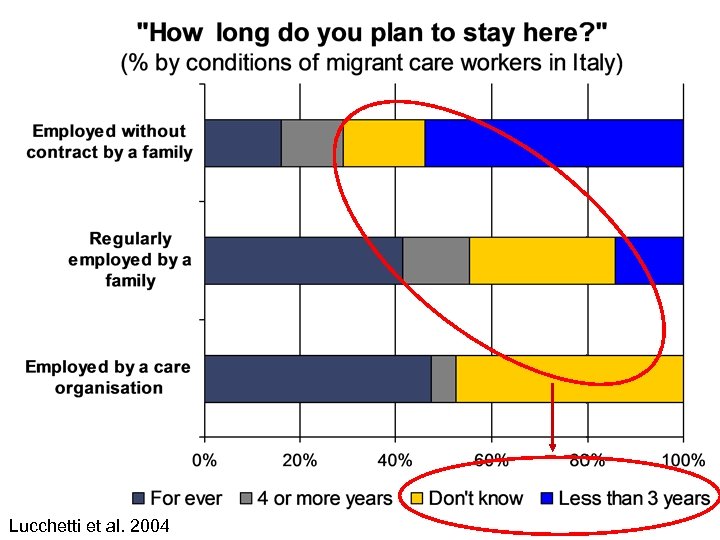 Lucchetti et al. 2004
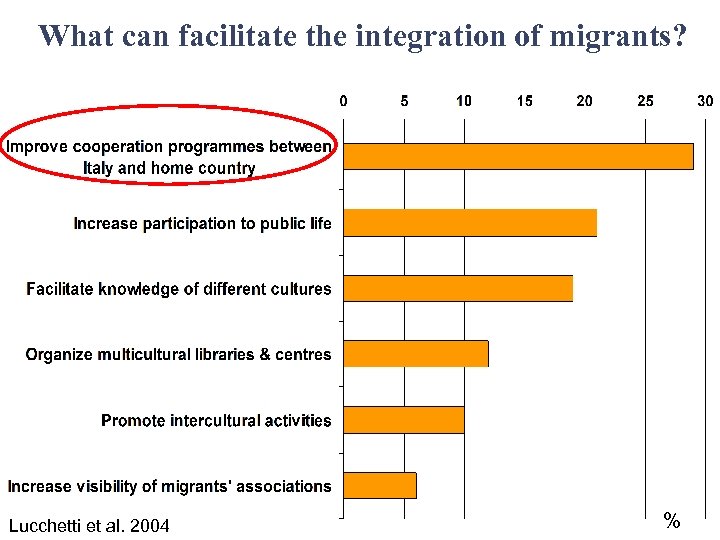 What can facilitate the integration of migrants? Lucchetti et al. 2004 %
 Care drain risks in migrants’ home countries • Migrant women’s left behind children: well-off but socially deprived, missing maternal support & cared-for by grandmothers 39
 Care drain risks in migrants’ home countries • Migrant women’s left behind children: well-off but socially deprived, missing maternal support & cared-for by grandmothers • Mental illnesses of migrant women returning home after long years of isolated care work 40
 Care drain risks in migrants’ home countries • Migrant women’s left behind children: well-off but socially deprived, missing maternal support & cared-for by grandmothers • Mental illnesses of migrant women returning home after long years of isolated care work • educational & training costs saved by “destination” countries and borne by “sending” countries 41
 Care drain risks in migrants’ home countries • Migrant women’s left behind children: well-off but socially deprived, missing maternal support & cared-for by grandmothers • Mental illnesses of migrant women returning home after long years of isolated care work • educational & training costs saved by “destination” countries and borne by “sending” countries • sending countries are themselves becoming receiving countries of migrants from poorer/closer regions to fill the new care gaps 42
 5. Final remarks Opportunities deriving from migrant work in elder care: • tailored care: personalised response to elders and carers • delayed or lower institutionalisation rates • economic convenience: for both recipients and migrants (low housing costs, wage differentials & “black market”) as well as in terms of public resources • more “focused” home care services: centred on most severe cases.
 5. Final remarks Opportunities deriving from migrant work in elder care: • tailored care: personalised response to elders and carers • delayed or lower institutionalisation rates • economic convenience: for both recipients and migrants (low housing costs, wage differentials & “black market”) as well as in terms of public resources • more “focused” home care services: centred on most severe cases. Policy challenges: • quality of care: through qualification of migrant care workers • labour market: control of undeclared work via accreditation & care allowances • exploitation of migrant care workers: ethnic-gender overlap • “care drain” in sending countries: who provides care “there”?
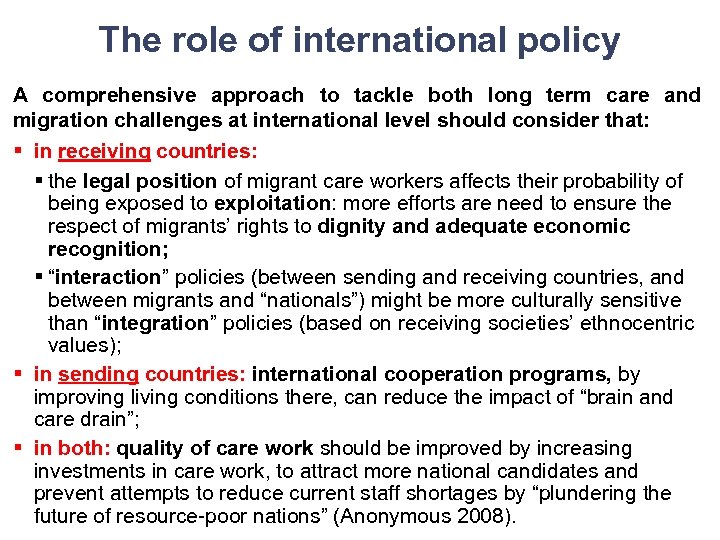 The role of international policy A comprehensive approach to tackle both long term care and migration challenges at international level should consider that: § in receiving countries: § the legal position of migrant care workers affects their probability of being exposed to exploitation: more efforts are need to ensure the respect of migrants’ rights to dignity and adequate economic recognition; § “interaction” policies (between sending and receiving countries, and between migrants and “nationals”) might be more culturally sensitive than “integration” policies (based on receiving societies’ ethnocentric values); § in sending countries: international cooperation programs, by improving living conditions there, can reduce the impact of “brain and care drain”; § in both: quality of care work should be improved by increasing investments in care work, to attract more national candidates and prevent attempts to reduce current staff shortages by “plundering the future of resource-poor nations” (Anonymous 2008).
 46 Thank you!