


 Скачать презентацию Long-Range-Forecast Training Current practices in the verification of
2464140aafc2fdcc0be42d7492f0a13f.ppt
- Количество слайдов: 25
 Long-Range-Forecast Training Current practices in the verification of seasonal forecasts in the South-East European and Caucasus Climate Outlook Forum (SEECOF) region Branko Bijelić RA VI RCC – SEEVCCC/RHMS of Serbia LRF Training, November 13 -16, 2013 Belgrade, Serbia
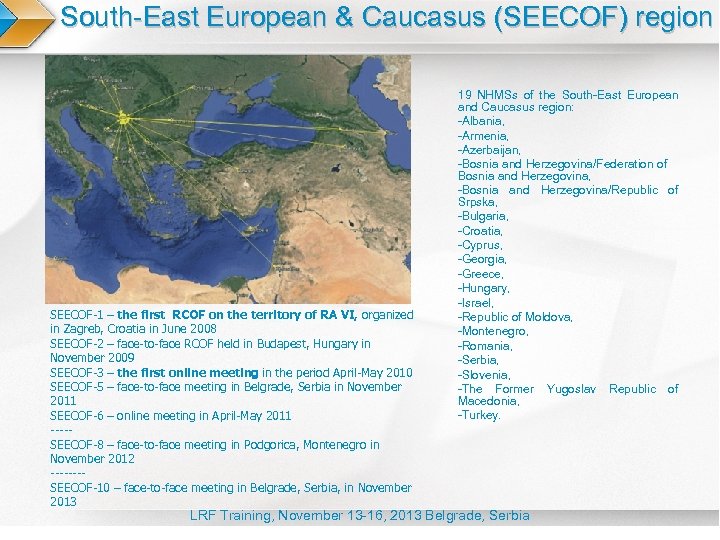 South-East European & Caucasus (SEECOF) region SEECOF-1 – the first RCOF on the territory of RA VI, organized in Zagreb, Croatia in June 2008 SEECOF-2 – face-to-face RCOF held in Budapest, Hungary in November 2009 SEECOF-3 – the first online meeting in the period April-May 2010 SEECOF-5 – face-to-face meeting in Belgrade, Serbia in November 2011 SEECOF-6 – online meeting in April-May 2011 ----SEECOF-8 – face-to-face meeting in Podgorica, Montenegro in November 2012 -------SEECOF-10 – face-to-face meeting in Belgrade, Serbia, in November 2013 19 NHMSs of the South-East European and Caucasus region: -Albania, -Armenia, -Azerbaijan, -Bosnia and Herzegovina/Federation of Bosnia and Herzegovina, -Bosnia and Herzegovina/Republic of Srpska, -Bulgaria, -Croatia, -Cyprus, -Georgia, -Greece, -Hungary, -Israel, -Republic of Moldova, -Montenegro, -Romania, -Serbia, -Slovenia, -The Former Yugoslav Republic of Macedonia, -Turkey. LRF Training, November 13 -16, 2013 Belgrade, Serbia
 Participants of the SEECOF-9 online meeting Ø Under the overall coordination of the Co-Chair of the WMO RA VI Ø Ø Working Group on Climate and Hydrology and experts from the South East European Virtual Climate Centre (SEEVCCC) the online session of SEECOF-9 was conducted during April-May 2013. Representatives from the National Meteorological and Hydrological Services of the South East Europe and Caucasus region, namely Albania, Armenia, Bosnia and Herzegovina/Federation of Bosnia and Herzegovina, Bosnia and Herzegovina/Republic of Srpska, Bulgaria, Croatia, Georgia, Greece, Israel, Republic of Moldova, Montenegro, Serbia, The Former Yugoslav Republic of Macedonia and Turkey participated in the implementation of SEECOF-9. Climate experts from the South East European Virtual Climate Change Centre (RA VI-SEEVCCC/RHMS of Serbia) and from the WMO RA VI RCC Network Node on Long-range Forecasting, namely Meteo France (France) and Roshydromet (Russian Federation), and on Climate Monitoring, namely Deutscher Wetterdienst (Germany), provided their valuable contribution to the successful implementation of SEECOF-9 by developing the relevant documents and providing scientific guidance and recommendations. LRF Training, November 13 -16, 2013 Belgrade, Serbia
 Structure of the SEECOF meetings Ø Step 1: Qualitative verification of the previous SEECOF climate outlook for summer (winter) season; Ø Step 2: Assessment of the current state of the climate, including large-scale climate patterns worldwide, and assessments of its likely evolution in the course of the next months; Ø Step 3: Building the consensus forecast for the upcoming season. LRF training, November 13 -16, 2013 Belgrade, Serbia
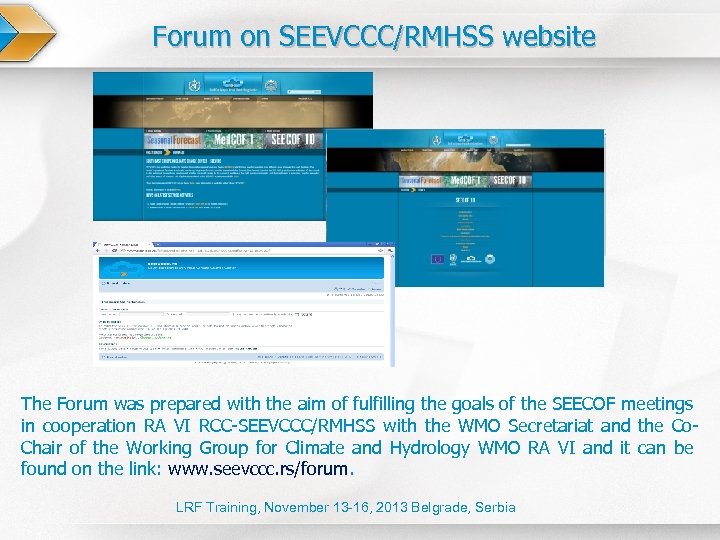 Forum on SEEVCCC/RMHSS website The Forum was prepared with the aim of fulfilling the goals of the SEECOF meetings in cooperation RA VI RCC-SEEVCCC/RMHSS with the WMO Secretariat and the Co. Chair of the Working Group for Climate and Hydrology WMO RA VI and it can be found on the link: www. seevccc. rs/forum. LRF Training, November 13 -16, 2013 Belgrade, Serbia
 STEP 1 – Qualitative verification of the SEECOF climate outlook for the previous (winter or summer) season Lively discussions took place in the Forum about the issues such as: § High impact events and § Final assessment of the correctness of the SEECOF climate outlook for the previous (winter or summer) season SEECOF-10, November 18 -19, 2013 Belgrade, Serbia
 STEP 1 – Qualitative verification of the SEECOF climate outlook for the previous season Analyses of the previous season temperature and precipitation anomalies were based on: q Operational products of the European Climate System Monitoring – ECSM (the ECSM system is a technical platform of the DWD, Lead of the WMO RA VI RCC Node on Climate Monitoring, http: //www. dwd. de/ecsm); q Climate monitoring products of the South East European Virtual Climate Change Center – SEEVCCC (Member of the WMO RA VI RCC Node on Climate Monitoring, http: //www. seevccc. rs/? p=8), and q National climate monitoring reports of the SEECOF participating countries: Armenia, Azerbaijan, Bulgaria, Bosnia and Herzegovina, Croatia, Georgia, Greece, Hungary, Israel, FYR of Macedonia, Republic of Moldova, Montenegro, Romania, Slovenia, Serbia and Turkey (documents available on http: //www. seevccc. rs/SEECOF-9/STEP%201/) LRF Training, November 13 -16, 2013 Belgrade, Serbia
 Monitoring of the results for the previous season The previous season anomalies of: § Temperature § Precipitation LRF Training, November 13 -16, 2013 Belgrade, Serbia
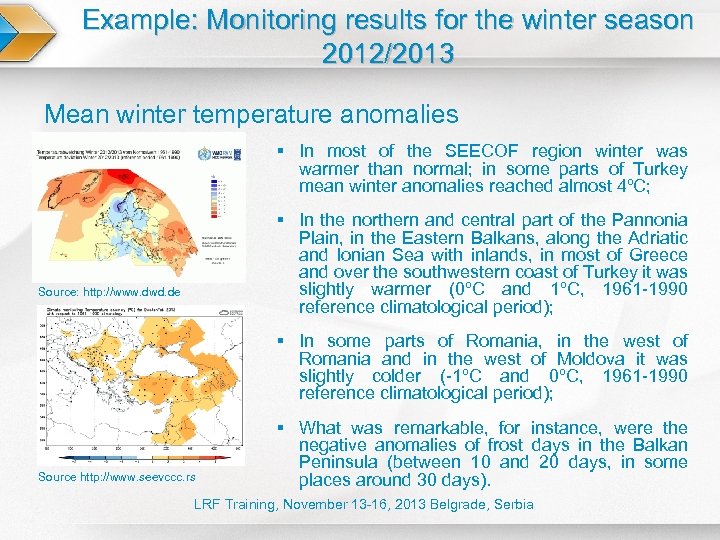 Example: Monitoring results for the winter season 2012/2013 Mean winter temperature anomalies § In most of the SEECOF region winter was warmer than normal; in some parts of Turkey mean winter anomalies reached almost 4ºC; § In the northern and central part of the Pannonia Plain, in the Eastern Balkans, along the Adriatic and Ionian Sea with inlands, in most of Greece and over the southwestern coast of Turkey it was slightly warmer (0ºC and 1ºC, 1961 -1990 reference climatological period); Source: http: //www. dwd. de § In some parts of Romania, in the west of Romania and in the west of Moldova it was slightly colder (-1ºC and 0ºC, 1961 -1990 reference climatological period); Source http: //www. seevccc. rs § What was remarkable, for instance, were the negative anomalies of frost days in the Balkan Peninsula (between 10 and 20 days, in some places around 30 days). LRF Training, November 13 -16, 2013 Belgrade, Serbia
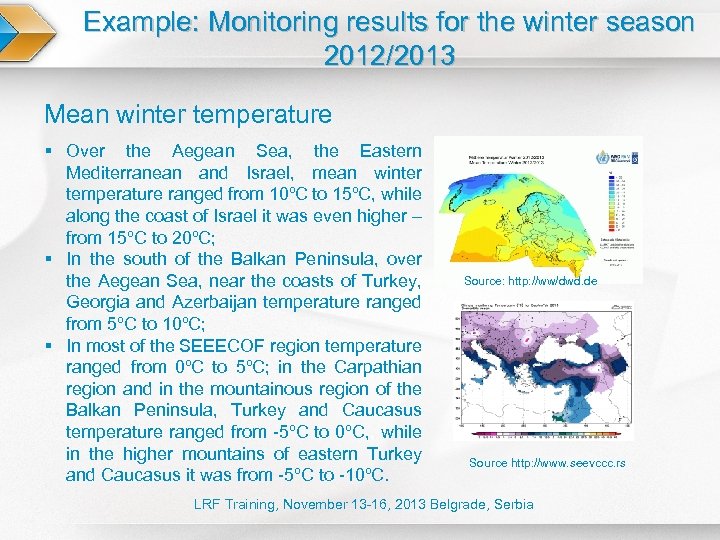 Example: Monitoring results for the winter season 2012/2013 Mean winter temperature § Over the Aegean Sea, the Eastern Mediterranean and Israel, mean winter temperature ranged from 10ºC to 15ºC, while along the coast of Israel it was even higher – from 15ºC to 20ºC; § In the south of the Balkan Peninsula, over the Aegean Sea, near the coasts of Turkey, Georgia and Azerbaijan temperature ranged from 5ºC to 10ºC; § In most of the SEEECOF region temperature ranged from 0ºC to 5ºC; in the Carpathian region and in the mountainous region of the Balkan Peninsula, Turkey and Caucasus temperature ranged from -5ºC to 0ºC, , while in the higher mountains of eastern Turkey and Caucasus it was from -5ºC to -10ºC. Source: http: //ww/dwd. de Source http: //www. seevccc. rs LRF Training, November 13 -16, 2013 Belgrade, Serbia
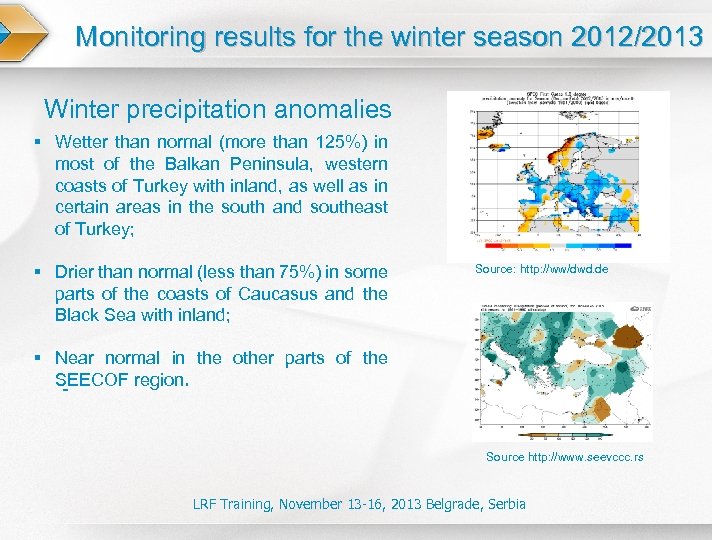 Monitoring results for the winter season 2012/2013 Winter precipitation anomalies § Wetter than normal (more than 125%) in most of the Balkan Peninsula, western coasts of Turkey with inland, as well as in certain areas in the south and southeast of Turkey; § Drier than normal (less than 75%) in some parts of the coasts of Caucasus and the Black Sea with inland; Source: http: //ww/dwd. de § Near normal in the other parts of the SEECOF region. - Source http: //www. seevccc. rs LRF Training, November 13 -16, 2013 Belgrade, Serbia
 Example: Monitoring results for the winter season 2012/2013 - High impact events - 2012/2013 - High impact events Ø On 30 December 2012 - an episode of heavy precipitation caused one fatality due to flash floods in Karditsa (Greece). Ø Heavy snowfall affected the eastern part of Turkey in January 2013. In some cities snow depth measured about 2 meters, which affected transportation very much. Ø Slide 25 Ø During the second decade of January 2013 heavy wet snow, storms and lightning caused a break in the power supply in several villages and towns in the northern part of Montenegro. Impassable roads with 1 to 2 m snow height and snow covered traffic signs along the roads protracted this situation. Ø In February 2013 in most of the Balkans, the western coast of the Aegean Sea and southwestern Caucasus it was significantly wetter than normal. The Eastern Mediterranean, Israel, parts of the northern coast of Turkey with inland a part of the Carpathian region suffered from drought. Ø Heavy precipitation was widespread, in the coastal region of the surrounding seas periodically traced with strong wind, tornados and hail, producing economic losses. Table of High Impact Events for Armenia and Azerbaijan LRF Training, November 13 -16, 2013 Belgrade, Serbia
 Sources of information for high impact events Ø National Climate Reports of the NHMSs from the SEECOF region received by the Forum; Ø Significant weather events displayed by the RA VI RCC on CM on: www. dwd. de, but also within their Monthly bulletins; Ø The European Severe Weather Database http: //www. essl. org/cgi-bin/eswd. cgi LRF Training, November 13 -16, 2013 Belgrade, Serbia (ESWD) on:
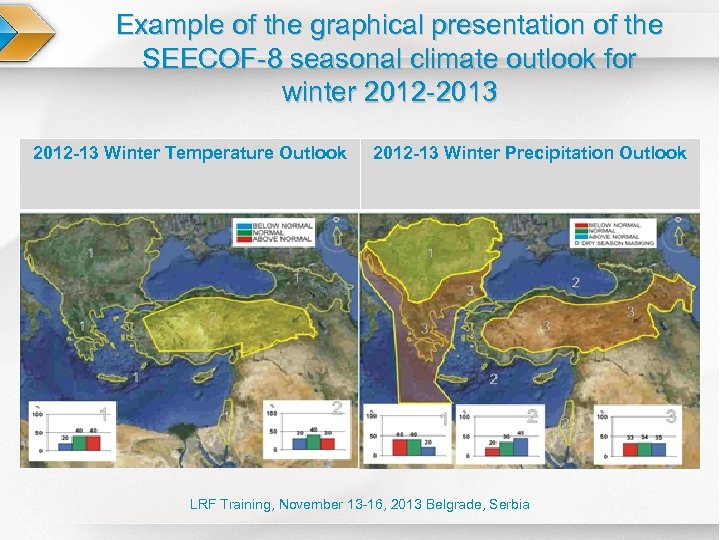 Example of the graphical presentation of the SEECOF-8 seasonal climate outlook for winter 2012 -2013 2012 -13 Winter Temperature Outlook 2012 -13 Winter Precipitation Outlook LRF Training, November 13 -16, 2013 Belgrade, Serbia
 Draft version of the Assessment of the correctness of the SEECOF-8 climate outlook for the 2012 -2013 winter season Climate outlook for the 2012 -2013 winter season temperature § Climate outlook for the 2012 -2013 winter season temperature, as outlined in the Consensus Statement, had lower uncertainties for temperature than for precipitation; § In most of the SEECOF region, the 2012 -2013 winter season temperature had above- or near- normal values, which is in accordance with the climate outlook for the winter season temperature; § In the inland of Turkey, there was higher uncertainty for the winter season temperature, but with the highest probability for the middle tercile, which was correctly predicted only in the eastern part of Turkey. The show the probabilistic Note: Consensus forecast for the tercile categories of anomalies of seasonal -mean temperature and precipitation, relative to the period 19812010. LRF Training, November 13 -16, 2013 Belgrade, Serbia
 Final assessment of the correctness of the SEECOF-8 climate outlook for the 2012 -2013 winter season Climate outlook for the 2012 -2013 winter season precipitation § In the coastal areas of the Black Sea, the eastern part of the Aegean Sea and the southeastern Mediterranean Sea, the winter season precipitation totals were above- or near-normal, which was in accordance with the climate outlook for 2012 -2013 the winter season precipitation; § The climate outlook for the 2012 -2013 winter season precipitation was incorrect in predicting near- or below-normal conditions in the Pannonia Plain, the western and central Balkan Peninsula, and the Carpathian region; § In the other parts of the SEECOF region, the probabilities for below-, near-, or above-normal conditions were approximately equal, so it is impossible to consider the verification of the climate outlook for the 2012 -2013 winter season precipitation. LRF Training, November 13 -16, 2013 Belgrade, Serbia
 Problems with the assessment of the correctness of the SEECOF Climate Outlooks for the past seasons Ø WMO referent climatological period is 1961 -1990 and all available Ø Ø Ø Climate Monitoring maps for the anomalies of the temperature on 2 m in the RCCs are in accordance with this period; In the National Climatological Reports inhomogeneous referent climatological periods are used for the assessment of the SEECOF Climate Outlook (from 1961 -1990, over 1971 -2000 to 1981 -2010) for the previous season; Some of the SEECOF participants verified the SEECOF Consensus statement in accordance with the latest period 1981 -2010 (Israel, Republic of Srpska, Bosnia & Herzegovina, Serbia, …. ) The SEECOF-8 Consensus forecast for tercile by the categories of anomalies of mean seasonal temperature and precipitation is relative to the period 1981 -2010; Low density of climatological data in some regions (example: Bosnia and Herzegovina, Caucasus region. . . ) due to the lack of the monthly means or some other reasons; Different interpretation of the High Impact Events. LRF Training, November 13 -16, 2013 Belgrade, Serbia
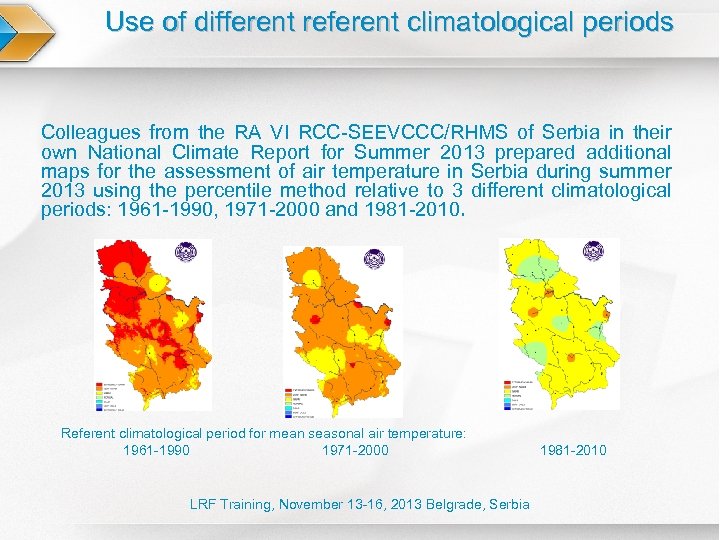 Use of different referent climatological periods Colleagues from the RA VI RCC-SEEVCCC/RHMS of Serbia in their own National Climate Report for Summer 2013 prepared additional maps for the assessment of air temperature in Serbia during summer 2013 using the percentile method relative to 3 different climatological periods: 1961 -1990, 1971 -2000 and 1981 -2010. Referent climatological period for mean seasonal air temperature: 1961 -1990 1971 -2000 1981 -2010 LRF Training, November 13 -16, 2013 Belgrade, Serbia
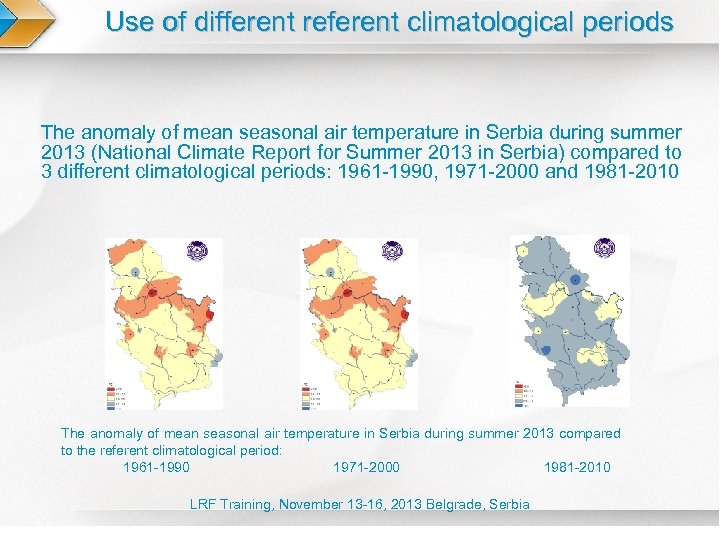 Use of different referent climatological periods The anomaly of mean seasonal air temperature in Serbia during summer 2013 (National Climate Report for Summer 2013 in Serbia) compared to 3 different climatological periods: 1961 -1990, 1971 -2000 and 1981 -2010 The anomaly of mean seasonal air temperature in Serbia during summer 2013 compared to the referent climatological period: 1961 -1990 1971 -2000 1981 -2010 LRF Training, November 13 -16, 2013 Belgrade, Serbia
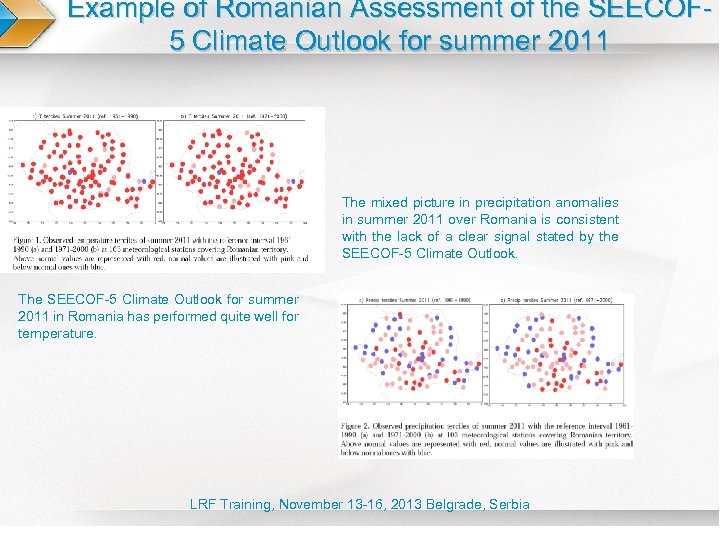 Example of Romanian Assessment of the SEECOF 5 Climate Outlook for summer 2011 The mixed picture in precipitation anomalies in summer 2011 over Romania is consistent with the lack of a clear signal stated by the SEECOF-5 Climate Outlook. The SEECOF-5 Climate Outlook for summer 2011 in Romania has performed quite well for temperature. LRF Training, November 13 -16, 2013 Belgrade, Serbia
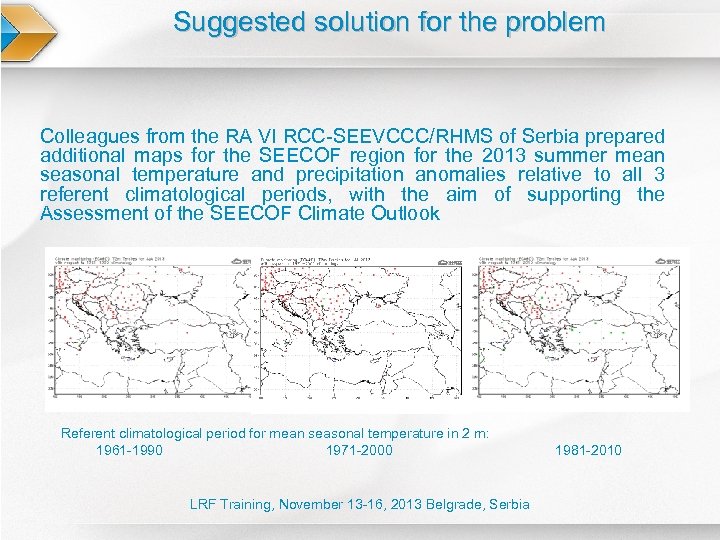 Suggested solution for the problem Colleagues from the RA VI RCC-SEEVCCC/RHMS of Serbia prepared additional maps for the SEECOF region for the 2013 summer mean seasonal temperature and precipitation anomalies relative to all 3 referent climatological periods, with the aim of supporting the Assessment of the SEECOF Climate Outlook Referent climatological period for mean seasonal temperature in 2 m: 1961 -1990 1971 -2000 1981 -2010 LRF Training, November 13 -16, 2013 Belgrade, Serbia
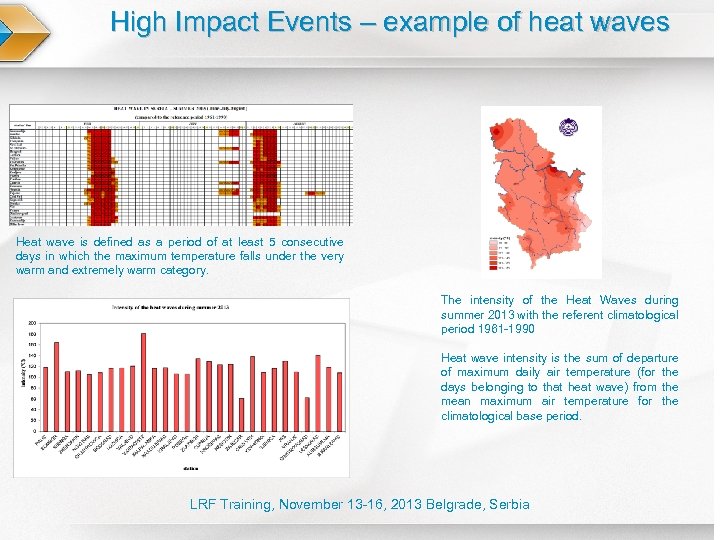 High Impact Events – example of heat waves Heat wave is defined as a period of at least 5 consecutive days in which the maximum temperature falls under the very warm and extremely warm category. The intensity of the Heat Waves during summer 2013 with the referent climatological period 1961 -1990 Heat wave intensity is the sum of departure of maximum daily air temperature (for the days belonging to that heat wave) from the mean maximum air temperature for the climatological base period. LRF Training, November 13 -16, 2013 Belgrade, Serbia
 High Impact Events – Criteria for the summer season? Ø Heat wave is defined as a period of at least 5 consecutive days in which the maximum temperature falls under the very warm and extremely warm category. Heat wave intensity is defined as the sum of departure of the maximum daily air temperature (for the days belonging to that heat wave) from the mean maximum air temperature for the referent climatological period (1981 -2010). Ø Broken absolute maximum or minimum air temperature for a specific station. Ø Total rainfall amounts during previous 1, 6, 12 hours which exceed ? ? ? mm, causing flash floods, problems in traffic, huge damages and possible causalities Ø Intensive convective activity (Cb) with hail, wind gusts and intensive precipitation, causing huge damages in agriculture, …. . Ø Drought influencing agriculture, water management, forest fires, etc. LRF Training, November 13 -16, 2013 Belgrade, Serbia
 THANK YOU FOR YOUR ATTENTION ! WWW. HIDMET. GOV. RS WWW. SEEVCCC. RS SEECOF-10, November 18 -19, 2013 Belgrade, Serbia
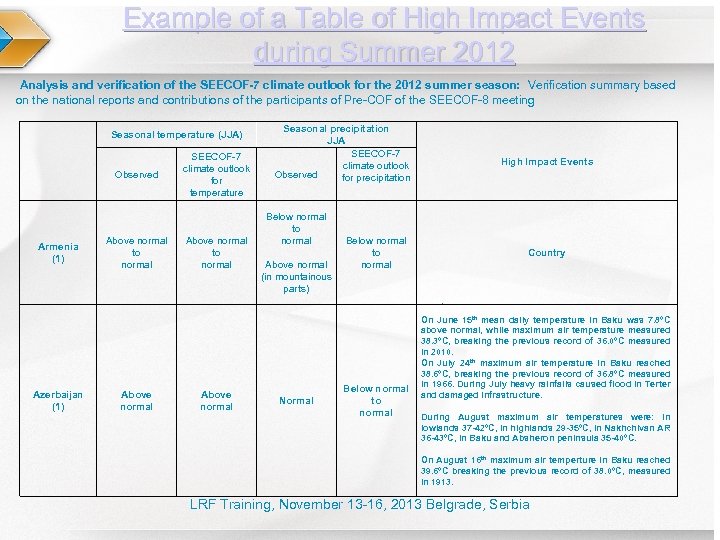 Example of a Table of High Impact Events during Summer 2012 Analysis and verification of the SEECOF-7 climate outlook for the 2012 summer season: Verification summary based on the national reports and contributions of the participants of Pre-COF of the SEECOF-8 meeting Seasonal precipitation JJA SEECOF-7 climate outlook Observed for precipitation Seasonal temperature (JJA) Observed Armenia (1) Azerbaijan (1) Above normal to normal Above normal SEECOF-7 climate outlook for temperature Above normal to normal Above normal Below normal to normal Above normal (in mountainous parts) Normal Below normal to normal High Impact Events Country . On June 15 th mean daily temperature in Baku was 7. 8°C Below normal to normal above normal, while maximum air temperature measured 38. 3°C, breaking the previous record of 36. 0°C measured in 2010. On July 24 th maximum air temperature in Baku reached 38. 6°C, breaking the previous record of 36. 8°C measured in 1966. During July heavy rainfalls caused flood in Terter and damaged infrastructure. During August maximum air temperatures were: in lowlands 37 -42°C, in highlands 29 -35°C, in Nakhchivan AR 36 -43°C, in Baku and Absheron peninsula 35 -40°C. On August 16 th maximum air temperture in Baku reached 39. 6°C breaking the previous record of 38. 0°C, measured in 1913. LRF Training, November 13 -16, 2013 Belgrade, Serbia