 Скачать презентацию London Bridge LONDON BRIDGE WAS THE FIRST BRIDGE
Тур по Лондону.ppt
- Количество слайдов: 10



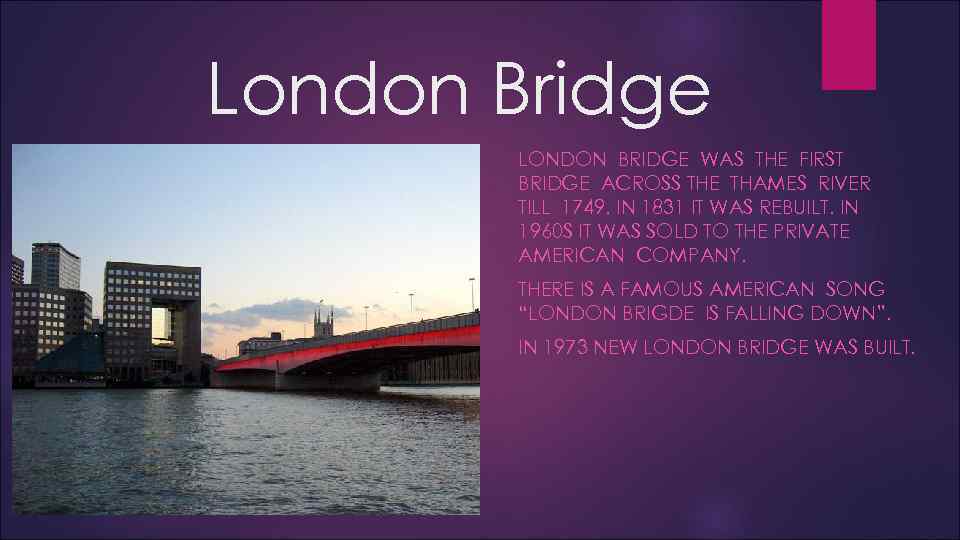
London Bridge LONDON BRIDGE WAS THE FIRST BRIDGE ACROSS THE THAMES RIVER TILL 1749. IN 1831 IT WAS REBUILT. IN 1960 S IT WAS SOLD TO THE PRIVATE AMERICAN COMPANY. THERE IS A FAMOUS AMERICAN SONG “LONDON BRIGDE IS FALLING DOWN”. IN 1973 NEW LONDON BRIDGE WAS BUILT.
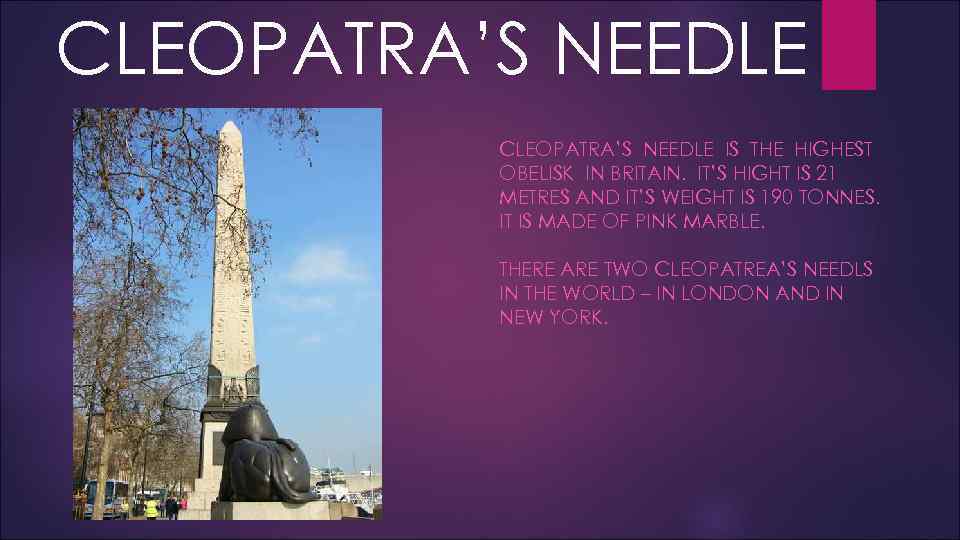
CLEOPATRA’S NEEDLE IS THE HIGHEST OBELISK IN BRITAIN. IT’S HIGHT IS 21 METRES AND IT’S WEIGHT IS 190 TONNES. IT IS MADE OF PINK MARBLE. THERE ARE TWO CLEOPATREA’S NEEDLS IN THE WORLD – IN LONDON AND IN NEW YORK.
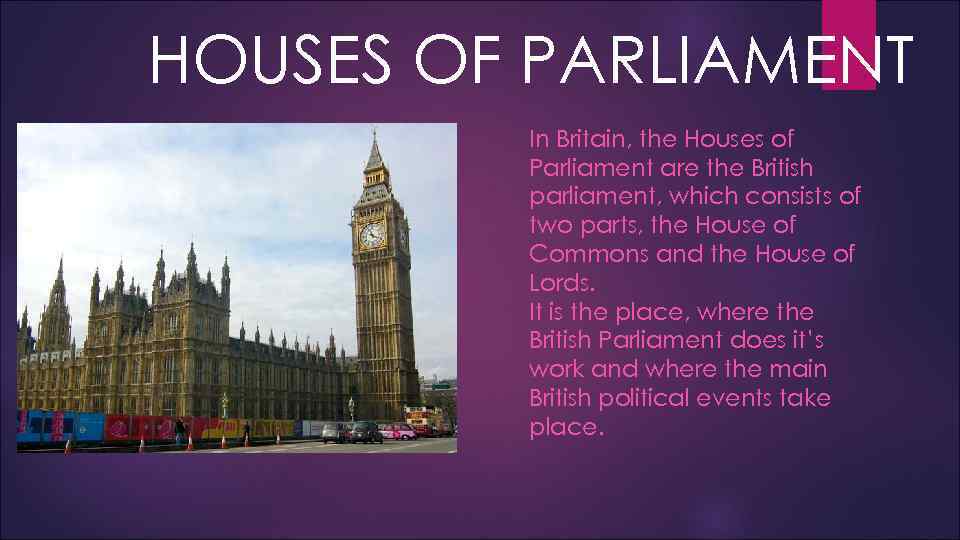
HOUSES OF PARLIAMENT In Britain, the Houses of Parliament are the British parliament, which consists of two parts, the House of Commons and the House of Lords. It is the place, where the British Parliament does it’s work and where the main British political events take place.
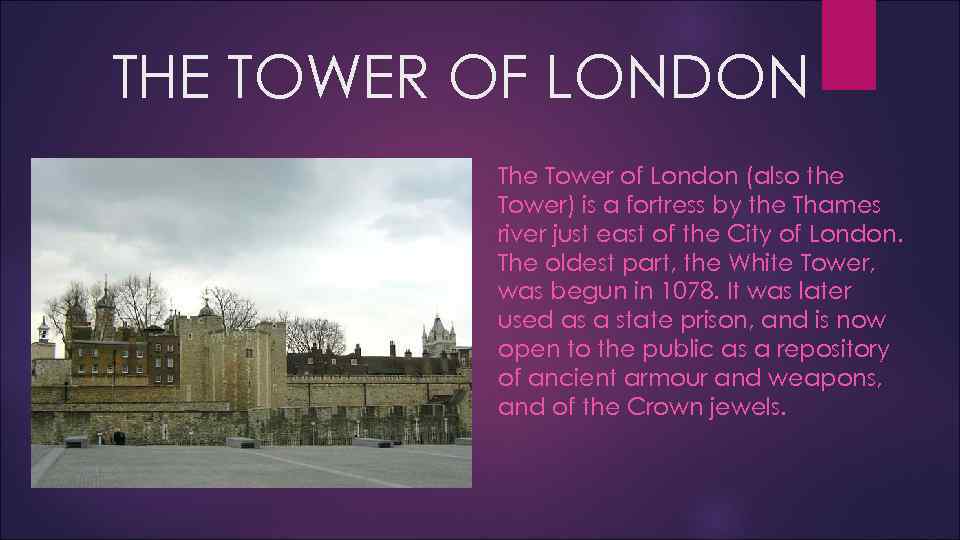
THE TOWER OF LONDON The Tower of London (also the Tower) is a fortress by the Thames river just east of the City of London. The oldest part, the White Tower, was begun in 1078. It was later used as a state prison, and is now open to the public as a repository of ancient armour and weapons, and of the Crown jewels.
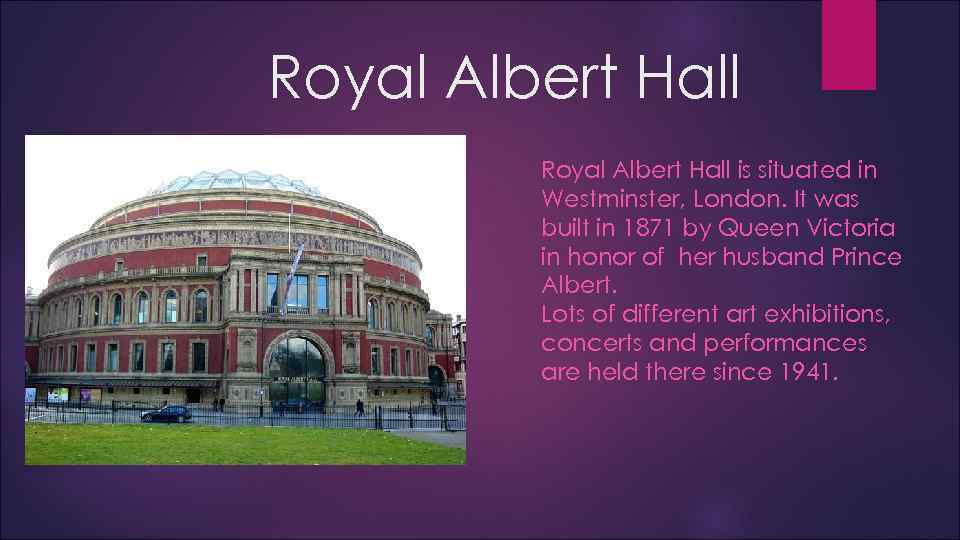
Royal Albert Hall is situated in Westminster, London. It was built in 1871 by Queen Victoria in honor of her husband Prince Albert. Lots of different art exhibitions, concerts and performances are held there since 1941.
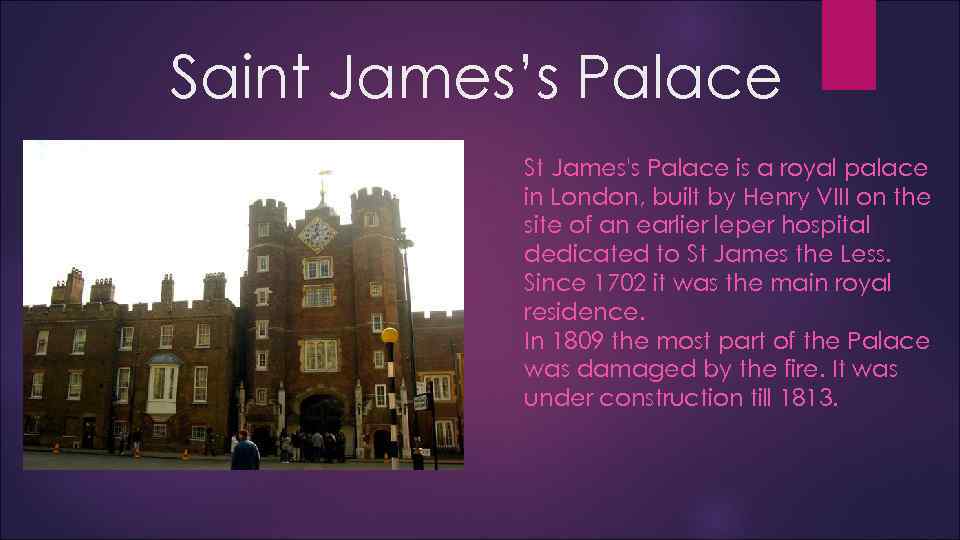
Saint James’s Palace St James's Palace is a royal palace in London, built by Henry VIII on the site of an earlier leper hospital dedicated to St James the Less. Since 1702 it was the main royal residence. In 1809 the most part of the Palace was damaged by the fire. It was under construction till 1813.
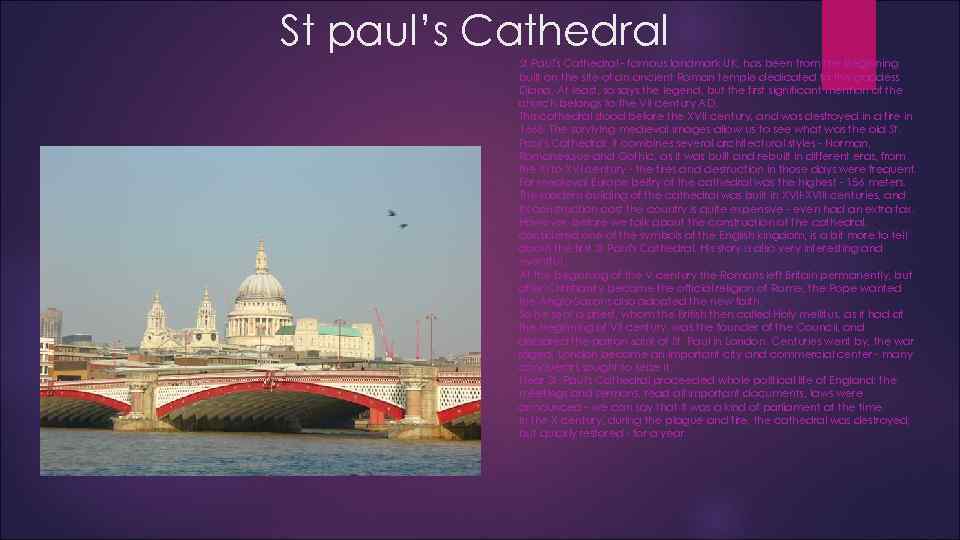
St paul’s Cathedral St Paul's Cathedral - famous landmark UK, has been from the beginning built on the site of an ancient Roman temple dedicated to the goddess Diana. At least, so says the legend, but the first significant mention of the church belongs to the VII century AD. This cathedral stood before the XVII century, and was destroyed in a fire in 1666. The surviving medieval images allow us to see what was the old St. Paul's Cathedral: it combines several architectural styles - Norman, Romanesque and Gothic, as it was built and rebuilt in different eras, from the XI to XVI century - the fires and destruction in those days were frequent. For medieval Europe belfry of the cathedral was the highest - 156 meters. The modern building of the cathedral was built in XVII-XVIII centuries, and its construction cost the country is quite expensive - even had an extra tax. However, before we talk about the construction of the cathedral, considered one of the symbols of the English kingdom, is a bit more to tell about the first St Paul's Cathedral. His story is also very interesting and eventful. At the beginning of the V century the Romans left Britain permanently, but after Christianity became the official religion of Rome, the Pope wanted the Anglo-Saxons also adopted the new faith. So he sent a priest, whom the British then called Holy mellitus, as it had at the beginning of VII century, was the founder of the Council, and declared the patron saint of St. Paul in London. Centuries went by, the war raged, London became an important city and commercial center - many conquerors sought to seize it. Near St. Paul's Cathedral proceeded whole political life of England: the meetings and sermons, read all important documents, laws were announced - we can say that it was a kind of parliament at the time. In the X century, during the plague and fire, the cathedral was destroyed, but quickly restored - for a year.

Букингемский дворец Buckingham Palace - the official London residence of the British monarch and London attractions. It is located in Westminster. Palace for official ceremonies, banquets and receptions and is a major tourist attraction. During public holidays and civil commotions about residence of the Queen is always going to a lot of people. Buckingham Palace was originally known as Buckingham House, built for the Duke of Buckingham in 1703. According to contemporaries, it was "one of the finest houses in London. " In 1761, King George III bought it for 28, 000 pounds. Buckingham House was named "Queen's House. " Over the next 75 years, architects John Nash and Edward Blore built three wings around a central courtyard. The palace was officially declared the main residence of British monarchs for accession to the throne of Queen Victoria in 1837. During her reign (late XIX early XX centuries) were made last great additions, including the present appearance of Buckingham Palace. It is sometimes called "Buck House» ( «Buck House» ). The original Georgian interior includes colorful artificial marble, blue and pink lapis. King Edward VII greatly altered it in the style of the French Belle Epoque in cream and gold. Many smaller reception rooms are furnished in the Chinese style furniture from the royal palace at Brighton and from Carlton House Palace. Garden of Buckingham Palace - the largest private garden in London, originally created by Brown and later converted William Ayton and John Nash. Large artificial lake was completed in 1828. It feeds the Serpentine River, which runs through Park. Hyde
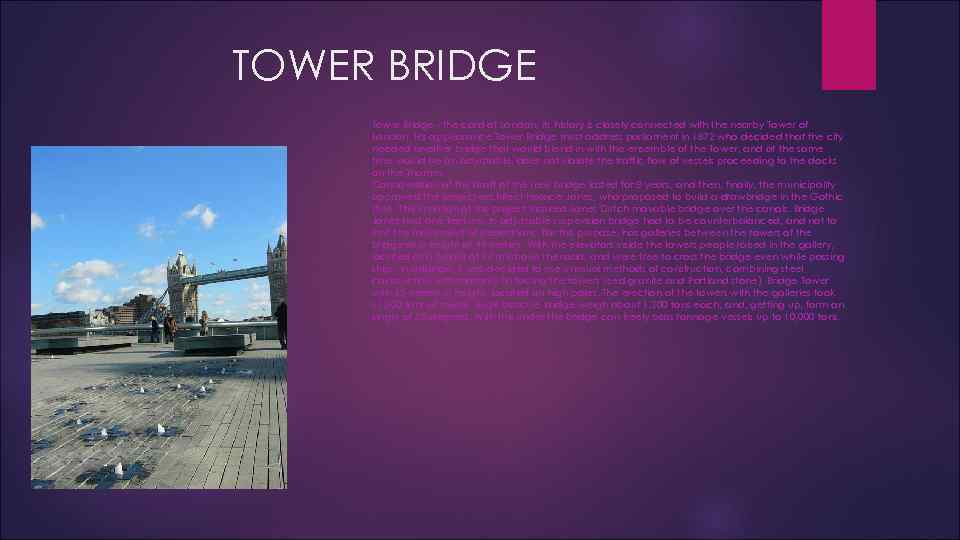
TOWER BRIDGE Tower Bridge - the card of London, its history is closely connected with the nearby Tower of London. His appearance Tower Bridge must address parliament in 1872 who decided that the city needed another bridge that would blend in with the ensemble of the Tower, and at the same time would be an adjustable, does not violate the traffic flow of vessels proceeding to the docks on the Thames. Consideration of the draft of the new bridge lasted for 8 years, and then, finally, the municipality approved the project architect Horace Jones, who proposed to build a drawbridge in the Gothic style. The creation of this project inspired Jones Dutch movable bridge over the canals. Bridge Jones had one feature: its adjustable suspension bridge had to be counterbalanced, and not to limit the movement of pedestrians. For this purpose, has galleries between the towers of the bridge at a height of 44 meters. With the elevators inside the towers people raised in the gallery, located at a height of 34 m above the road, and were free to cross the bridge even while passing ships. In addition, it was decided to use unusual methods of construction, combining steel construction with masonry (in facing the towers used granite and Portland stone). Bridge Tower with 65 meters in height, located on high poles. The erection of the towers with the galleries took 11, 000 tons of metal. Huge bascule bridge weigh about 1, 200 tons each, and, getting up, form an angle of 83 degrees. With this under the bridge can freely pass tonnage vessels up to 10, 000 tons.
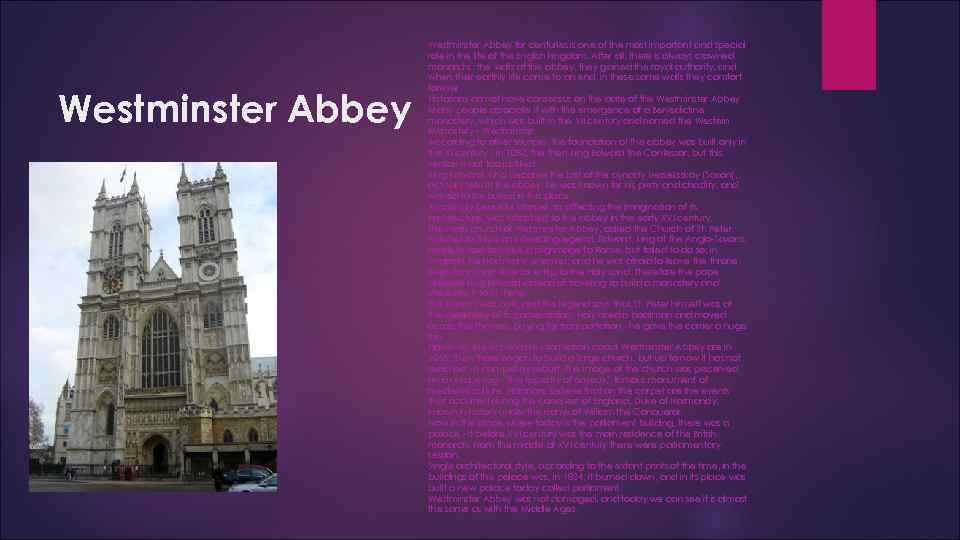
Westminster Abbey for centuries is one of the most important and special role in the life of the English kingdom. After all, there is always crowned monarchs: the walls of the abbey, they gained the royal authority, and when their earthly life came to an end, in these same walls they comfort forever. Historians do not have consensus on the date of the Westminster Abbey. Many people associate it with the emergence of a Benedictine monastery, which was built in the VII century and named the Western Monastery - Westminster. According to other sources, the foundation of the abbey was built only in the XI century - in 1052, then King Edward the Confessor, but this version is not too justified. King Edward, who became the last of the dynasty Uesseksskoy (Saxon), actually rebuilt the abbey, he was known for his piety and chastity, and wished to be buried in this place. Amazingly beautiful chapel, so affecting the imagination of its architecture, was attached to the abbey in the early XVI century. The main church of Westminster Abbey, called the Church of St. Peter. Related to this is an interesting legend. Edward, King of the Anglo-Saxons, made a vow to make a pilgrimage to Rome, but failed to do so: in England, he had many enemies, and he was afraid to leave throne, even for a short time for a trip to the Holy Land. Therefore the pope allowed King Edward instead of traveling to build a monastery and dedicate it to St. Peter. The church was built, and the legend says that St. Peter himself was at the ceremony of its consecration. Holy hired a boatman and moved across the Thames, paying for transportation - he gave the carrier a huge fish. However, the first reliable information about Westminster Abbey are in 1065: then there began to build a large church, but up to now it has not reached - it completely rebuilt. The image of the church was preserved on a unique rug - "the tapestry of Bayeux, " famous monument of medieval culture. Historians believe that on the carpet are the events that occurred during the conquest of England, Duke of Normandy, known in history under the name of William the Conqueror. Now in the place where today is the parliament building, there was a palace - it before XVI century was the main residence of the British monarch. From the middle of XVI century there were parliamentary session. Single architectural style, according to the extant prints of the time, in the buildings of the palace was, in 1834, it burned down, and in its place was built a new palace today called parliament. Westminster Abbey was not damaged, and today we can see it is almost the same as with the Middle Ages.
Скачать презентацию London Bridge LONDON BRIDGE WAS THE FIRST BRIDGE
Тур по Лондону.ppt