


 Скачать презентацию LOGO Management Communincation Principles and Practice LOGO
4364cfaa1caebf383429d50b88beefe1.ppt
- Количество слайдов: 94
 LOGO Management Communincation: Principles and Practice
 LOGO Chapter 1 Foundations of Management Communication
 LOGO Chapter 1 Foundations of Management Communication Learning objectives: l Overview the field, main schools of thought; l Introduce basic analytical tools of management communication; l Know the key ethical considerations; l Understand how to serve as a credible source.
 LOGO Chapter 1 Foundations of Management Communication Main contents: l Two schools of thought include behavioral and rhetorical schools; l Communication attaches importance for manger’s effectiveness; l Seven elements of communication (exhibit 1. 1 Sample Communication Analysis); l Perceptions on communication; l Three essential qualities of successful communication; l Qualities of effective communication; l Why business communication is unique? l Evolving communication channels? l Structure of the book and how to prepare a case. .
 LOGO Chapter 1 Foundations of Management Communication Conclusion: l Both business students and executives must develop better communication instincts; l Every successful manager, at one time or another must listen to their audiences; l Technologies serve for broader communication strategy; l Practice can ensure the effective communication.
 LOGO Chapter 2 Setting Goals
 LOGO Chapter 2 Setting Goals Learning objectives: l Defining and organizing communication tasks in a general management context; l Know clarifying goals; l Identify the important goals and urgent goals; l Understand how to contribute to a case discussion;
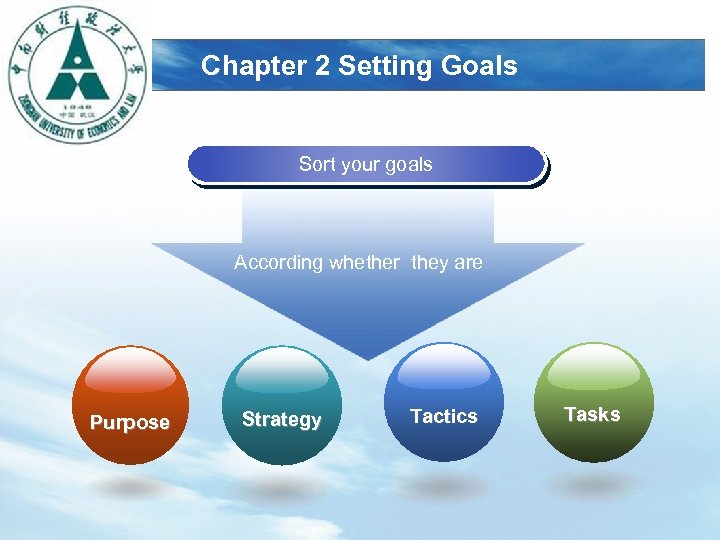 LOGO Chapter 2 Setting Goals Sort your goals According whether they are Purpose Strategy Tactics Tasks
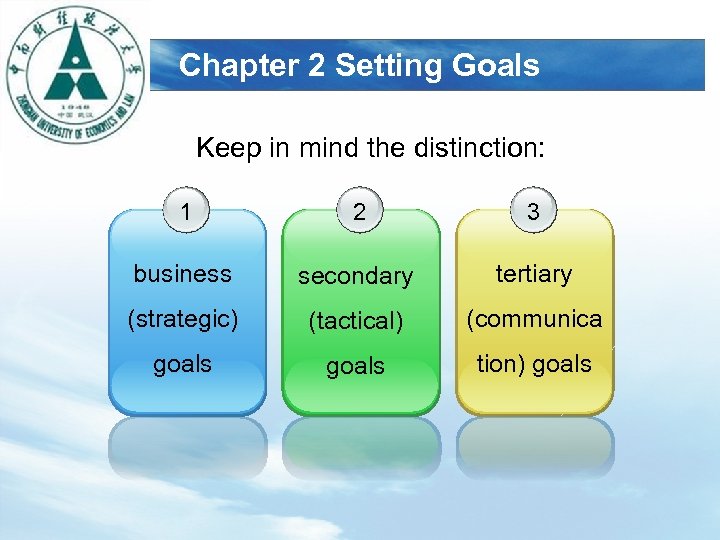 LOGO Chapter 2 Setting Goals Keep in mind the distinction: 1 2 3 business secondary tertiary (strategic) (tactical) (communica goals tion) goals
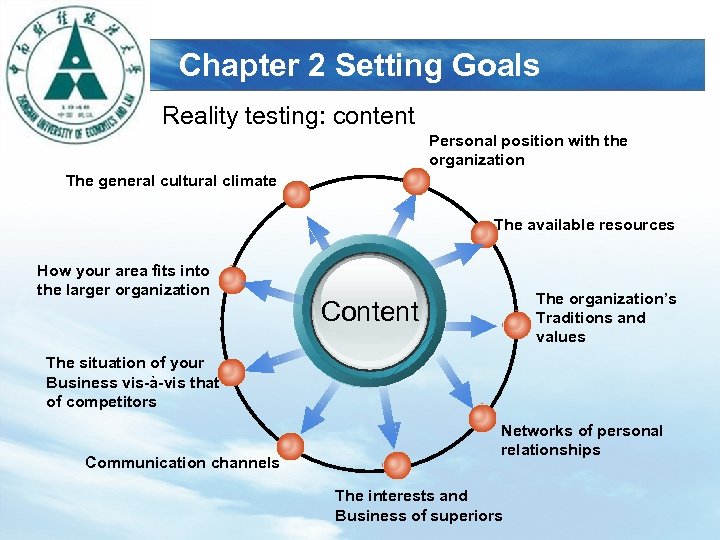 LOGO Chapter 2 Setting Goals Reality testing: content Personal position with the organization The general cultural climate The available resources How your area fits into the larger organization The organization’s Traditions and values Content The situation of your Business vis-à-vis that of competitors Communication channels Networks of personal relationships The interests and Business of superiors
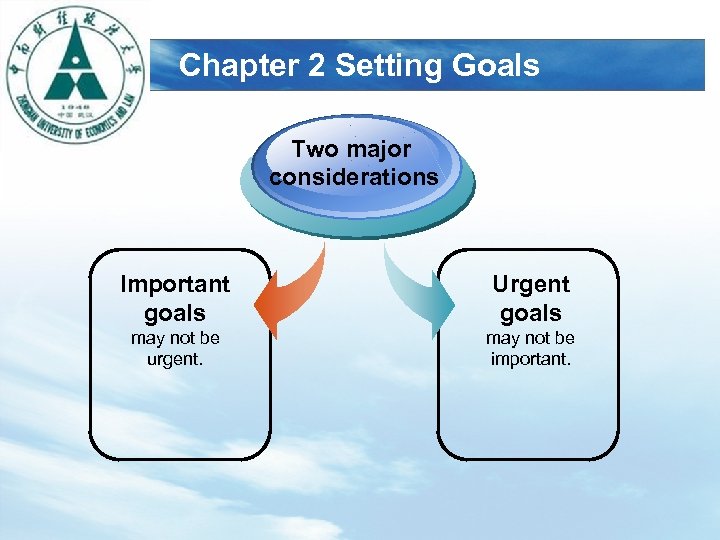 LOGO Chapter 2 Setting Goals Two major considerations Important goals Urgent goals may not be urgent. may not be important.
 LOGO Chapter 2 Setting Goals Conclusion: l Quick, accurate decisions on urgency define the successful manager; l Learn defining your business goals and deriving your key communication goals in the case;
 LOGO Chapter 2 Setting Goals Case study: Yellowtail Marine, Inc. & Study Questions: l. What are Gilcrist’s responsibilities to the company? To the employees who might resent her sudden appearance? To Boswell? l. How would you rank the issues she faces in terms of relative importance? Which are in conflict? l. What long-term goals should she set for herself? l. What should she do now? l. How should she communicate her decisions? l. What risks does Gilcrist face? What painful decisions should she make? l. Should she immediately move to make the company more marketoriented? How?
 LOGO Chapter 3 Audience Analysis
 LOGO Chapter 3 Audience Analysis Learning objectives: l Identifying, understanding, and ranking your audiences; l Understand your audience is critical;
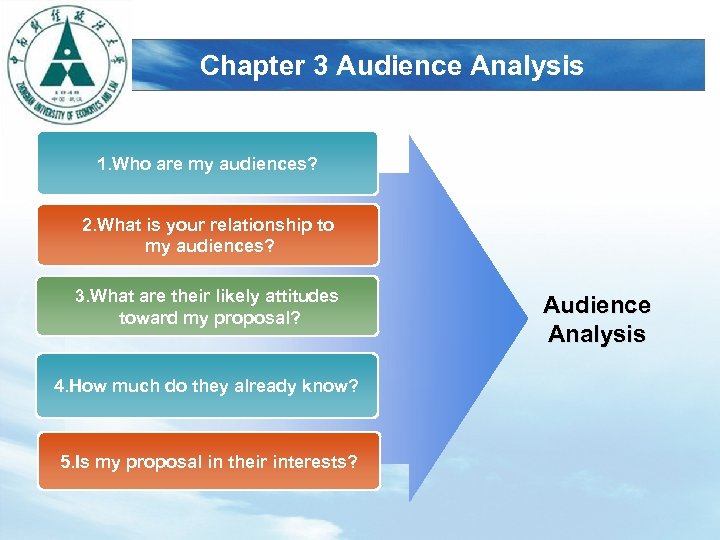 LOGO Chapter 3 Audience Analysis 1. Who are my audiences? 2. What is your relationship to my audiences? 3. What are their likely attitudes toward my proposal? 4. How much do they already know? 5. Is my proposal in their interests? Audience Analysis
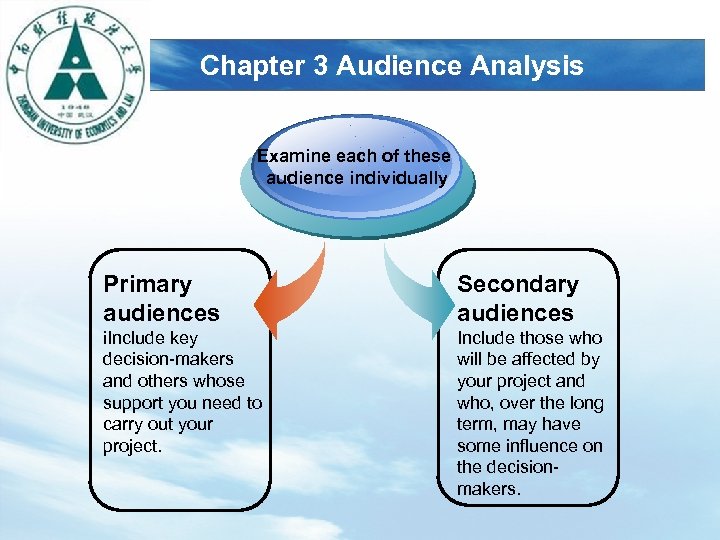 LOGO Chapter 3 Audience Analysis Examine each of these audience individually Primary audiences Secondary audiences i. Include key decision-makers and others whose support you need to carry out your project. Include those who will be affected by your project and who, over the long term, may have some influence on the decisionmakers.
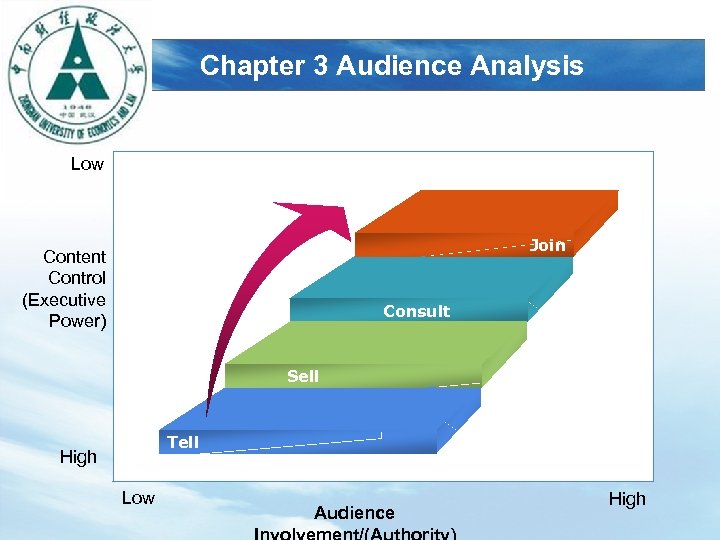 LOGO Chapter 3 Audience Analysis Low Join Content Control (Executive Power) Consult Sell Tell High Low Audience High
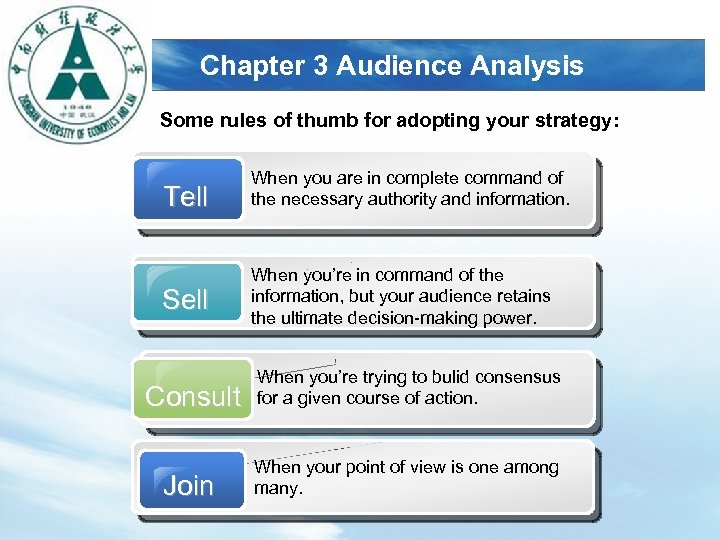 LOGO Chapter 3 Audience Analysis Some rules of thumb for adopting your strategy: Tell When you are in complete command of the necessary authority and information. Sell When you’re in command of the information, but your audience retains the ultimate decision-making power. Consult When you’re trying to bulid consensus for a given course of action. Join When your point of view is one among many.
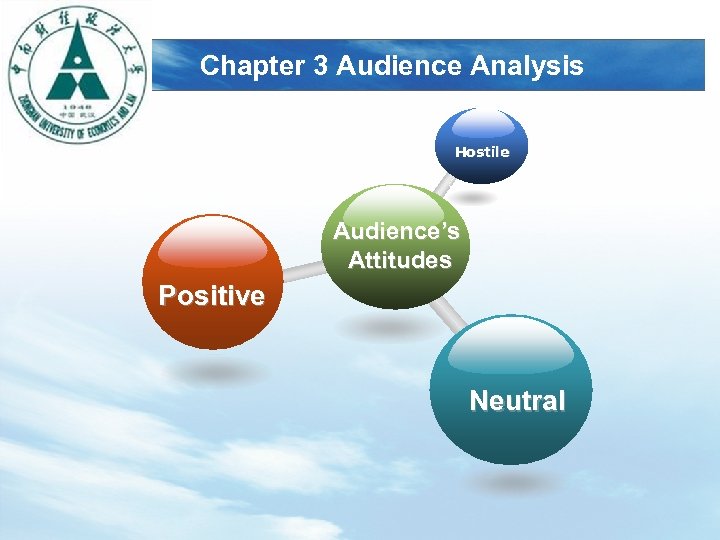 LOGO Chapter 3 Audience Analysis Hostile Audience’s Attitudes Positive Neutral
 LOGO Chapter 3 Audience Analysis Conclusion: l Sell the benefits-what the audience will gain-rather than features; l The first principle of message design: the audience need to know and believe to support you;
 LOGO Chapter 3 Audience Analysis Case study: Weymouth Steel Corporation Study Questions: l. What key audiences need to be addressed in Weymouth’s communication of good and bad news? l. Where do their interests conflict? Overlap? l. Most business communications involve good news for some audiences, bad news for others. What does this imply about how Weymouth should send its message? l. What is Weymouth doing-telling, selling, consulting, joining? l. What media should Weymouth be using to send its messages?
 LOGO Chapter 4 Point of View
 LOGO Chapter 4 Point of View Learning objectives: l Understanding competing communication motives, needs, and viewpoints; l Understanding interpersonal communication;
 LOGO Chapter 4 Point of View Main contents: l Make your point of view clear in communication; l Introduce Burke’s pentad: agent (our source), act(strategy and tactics), scene (context), agency(mostly messages), goal; l Putting your point of view into action
 LOGO Chapter 4 Point of View Conclusion: l A manager must have a point of view and understand it clearly; l Recognizing and responding constructively to others' perspectives; l A communication will be effective if is clear about its own bottom line and the driving concerns of other parties to the decision.
 LOGO Chapter 4 Point of View Case study: Smith Financial Corporation Study Questions: l. How well does Miller’s style and tone serve him in his E-mail explanations of why Lotus Notes isn’t serving the company well? How would you do it differently? l. How well does Miller communicate his goals for the future of data management at Smith Financial Corporation? l. How sensitive is Miller to the knowledge levels and concerns of hia various audiences? l. Could you suggest a communication strategy that would have served Miller better? l. What does the case suggest about the problems that can arise in clashes between various corporate cultures? l. What role does personality play in communication? How can you, as Socrates recommended, learn to “Know yourself” better?
 LOGO Chapter 5 Message: Content and Argument
 LOGO Chapter 5 Message: Content and Argument Learning objectives: l Shaping your argument that will achieve your goal; l Understand how to construct a crisp, clear, and wellsupported argument.
 LOGO Chapter 5 Message: Content and Argument Main contents: l Boil the content down to a single sentence; l Identify which points are most important to which audiences, and modulate the message to different audiences; l Introduce the two types of logical argument: deductive, inductive; l Three-part structure: given(major premise), since(minor premise), therefore(conclusion); l Demonstrating the logic that has brought you to a conclusion , arguing from cause and effect; l Take account of the “unlesses” that are in the minds of the audience; l Evidence includes: facts and figures, appeal to common knowledge, anecdotal evidence, appeal to authority; l Test your logical argument against the following criteria: assumptions, proof, inference;
 LOGO Chapter 5 Message: Content and Argument Conclusion: l Examine all the factors involved in defining and shaping the core content of your argument;
 LOGO Chapter 5 Message: Content and Argument Case study: Cuttyhunk Bank (A) Study Questions: l. How do you evaluate the message Wilson gave Brock? Brock’s E-mail? The April 25 letter? l. Did flaws in the use of content, logic, evidence, or argument lead to this problem? l. What message does Cuttyhunk Bank need to send out now? How?
 LOGO Chapter 6 Structure
 LOGO Chapter 6 Structure Learning objectives l Know the critical importance of structure in the argument process l Know how to frame a clear and persuasive structure l Know the skills of opening, building, concluding strategies in a narrative structure
 LOGO Chapter 6 Structure Main contents: l. Both deductive and inductive logic appear in all business communications. l. After identifying your evidence, organize it into an argument, and frame a clear structure. l. Selecting a persuasive structure in support of your position. l. Using the power of narrative to define your content and make most effective use of argument. l. Opening strategies should focus on how to getting attention. l. Building strategies should focus on how to holding attention. l. Concluding strategies should focus on how to letting go.
 LOGO Chapter 6 Structure Conclusion: l. Both business students and executives must understand the importance of structure in communication. l. Before communication, you need to decide how to organize your points under a few main headings that will be memorable to your audience. l. Developing an action-oriented structure with all the elements covered earlier can be included in format. l. The characteristics of good narrative are of the structural principles of effective business communication. l. Most business communications constitute a call to take some actions.
 LOGO Chapter 6 Structure Case study: Mc. Gregor's Ltd. Department Store Study Questions: l. Once Mc. Gregor has chosen his arguments, what structure will work best in this situation? One-sided of two-sided? Tell of sell? Given, since, therefore? Recommendation, rationale, implementation? Storytelling? l. What attitudes are executives and buyers likely to have toward the new discount program? Which of Mc. Gregor arguments are likely to seem most persuasive to them? Can you devise new arguments that may be more acceptable to them?
 LOGO Chapter 7 Choosing Media
 LOGO Chapter 7 Choosing Media Learning objectives: l. Overview the field, main media of business communication. l. Know the critical importance of choosing media. l. Know how to choose right media to make sure the effectiveness of messages.
 LOGO Chapter 7 Choosing Media Main contents: l. Choosing the right media will determine the effectiveness of messages. l. You are well advised to choose the most personal medium, or combination of media, capable of carrying your message. l. Modulating your media choices to your message. l. How to send a painful or bad message? l. How to deal with crisis communication? l. How to deal with factors before you sent out the urgent message?
 LOGO Chapter 7 Choosing Media Conclusion: l. Choosing the right media will determine the effectiveness of messages. l. Downward communication is impossible. l. More personal your communication medium, more likely your message will reach your audience. l. The choice of an extraordinary medium can by itself convey urgency and importance. l. People don’t want to get bad news, you can choose a proper media to convey these painful messages.
 LOGO Chapter 7 Choosing Media Case study: The Timken Company Study Questions: l. What key messages does The Timken Company need to send to its workforce? l. Does The Timken Company need to change its management of communication practices in order to achieve its goals. l. Once you’ve developed a plan of action and a strategy to communicate it, what will sell it to top management? l. What media mix should you use to convey your message?
 LOGO Chapter 8 Style and Tone
 LOGO Chapter 8 Style and Tone Learning objectives: l. Identify different styles of communication; l. Understand the difference of tones; l. Learning how to apply the tones.
 LOGO Chapter 8 Style and Tone Main contents: l. Define the style of communication; l. Identify difference between different managers under different situations; l. How different styles affects; l. Develop an ear for Tone, and Suit it to the subject and occasion; l. Avoid exclusive language; l. Avoid flattery; l. Use humor when appropriate;
 LOGO Chapter 8 Style and Tone Conclusion: l Applying considerations of style and tone to specific communication situations need to be cautious.
 LOGO Chapter 8 Style and Tone Case study: Vanrex, Inc. Study Questions: l. What is the problem at the Vanrex plant? Is it just a problem of perception or of the residents’desire for zero emissions? Are there real problems with the control of stack emissions and fugitive dust? l What steps have been taken to reduce emissions at the plant? l. What common features of technical language are exhibited by Rubin’s report? Cite some specific examples. l What differences do you note between. Rubin’s style and tone and those of Evan Lynn, the reporter for the Hayestown Clarion? Which style is likely to have greater impact on the general public? l. What steps might Vanrenx take to improve its image and community relations in Hayestown? What groups would be appropriate audiences for the company to address? What message should it communicate? What media should it use?
 LOGO Chapter 9 Giving and Receiving Feedback
 LOGO Chapter 9 Giving and Receiving Feedback Learning objectives: l. Overview the field, main points of feedback. l. Know the critical importance of listening in the communication process. l. Know feedback is an important element in the discussion of any communication effort. l. Understand how feedback actually works.
 LOGO Chapter 9 Giving and Receiving Feedback Main contents: l. Giving and receiving are essential managerial skills. l. Listening to your audiences in a business communication will help you achieve your goals. l. Several major factors inhibit feedback. l. Several key factors determine the effectiveness of managerial feedback. l. Some guidelines can improve your experiences as giver of feedback. l. When do you need feedback, how can you get it? l. Some guidelines to improve your hearing while receiving feedback. l. Evaluate feedback means evaluate your sources. l. Two quotes aptly summarize the challenges of giving and receiving useful feedback. l. Consideration of feedback leads to a more general observation implicit in the effective business communication.
 LOGO Chapter 9 Giving and Receiving Feedback Conclusion: l. Both business students and executives must understand the feedback is essential skills in communication. l. Every successful person, must listen to their audiences both downward and upward feedback. l. As a recipient of feedback, you must cultivate the habit of listening to your sources. l. Both giving and receiving feedback are among the high arts of management, and demand very special skills. l. Feedback must focus on things the recipient has the power to change.
 LOGO Chapter 9 Giving and Receiving Feedback Case study: Bailey & Wick Study Questions: l. What are the most important ways people communicate with one another in a complex high-pressured organization? l. What are the trade-offs among responsibility, legitimate self-interest, and training at Bailey & Wick? l. What are the differences between how juniors can talk to seniors and how seniors can talk to juniors? l. What institutional changes in communication practice could benefit this organization? How might they be communicated?
 LOGO Chapter 10 Managing Meetings
 LOGO Chapter 10 Managing Meetings Learning objectives: l. Overview the field, know the meeting managements procedures and key points. l. Know how to running and participating a meeting. l. Know how to prepare a meeting. l. Know how to make the meeting participation more successful. l. Know what sorts of meeting participant you typically are. l. Know how to use meeting checklist.
 LOGO Chapter 10 Managing Meetings Main contents: l. Several key questions can help focus your preparation and participation. l. Several techniques can make your meeting participation more successful. l. Going into the meeting, consider what role you will play. l. How to make your role-playing strategy? l. Most executives spend a lot of time to manage meetings-meeting checklist.
 LOGO Chapter 10 Managing Meetings Conclusion: l. Running and participating in meetings are two of the toughest managerial tasks to do well. l. Cultivate the good habit of listening on any meeting. l. A little conscious planning can make the difference between success and failure. l. Planning you role ahead of the performance can help avoid the pitfalls. l. Good managers have a general meeting strategy as well as a specific plan for each individual occasion. l. Start by defining what sort of meeting participant you typically are. l. Think for a minute about which of these categories your colleagues would put you in. l. To review the materials covered in the meeting by meeting checklist.
 LOGO Chapter 10 Managing Meetings Case study: Lincoln Park Redevelopment Project Study Questions: l. How well did Clarke prepare for this meeting? What, if anything, should she have done differently? l. How well has she used electronic communication? l What agendas did the vagarious participant bring to the meeting? l. Are there any lessons you can draw form the case about how to manage crossfunctional teams? l. What should Clarke do next? l. What general lessons have you learned form meetings you’ve participated in of led?
 LOGO Chapter 11 Communicating Changes
 LOGO Chapter 11 Communicating Change Learning objectives: l. Understand eight barriers when organization considers a change. l. Know five ways to make sure manager’s change projects have a greater chance of success. l. Identify eight steps to transforming an organization.
 LOGO Chapter 11 Communicating Change Main Contents: l. Eight barriers need to be considered when an organization announces change. l. There are five ways to make sure change projects have a greater chance of success when changing from the middle. l. There are eight steps to transforming an organization when changing from the top. l. Two major types of organizational change efforts: top-down and bottom-up. l. Prepare both foreseeable and unforeseeable consequences for any change.
 LOGO Chapter 11 Communicating Change Conclusion: l. This topic requires additional emphasis because doing a good job of communicating a change you’ve decided upon is only the first step in making it happen. Any change, whether from the bottom, the middle, or the top, will cause both foreseeable and unforeseeable consequences; be prepared for both.
 LOGO Chapter 11 Communicating Change Case study: Hammermill Paper Company Study Questions: l. How should corporate headquarters communicate the new planning procedure to the organization? Who should constitute the primary audience for communications about the planned change? Are there important secondary audiences? What role should written communications play in introducing the change? What role should oral communications play? l. Who should be the primary source for communications about planning with each audience? What role should the CEO play? What role should the “responsible office” play? In general, who should be the primaryspokesperson(s) for the change? l What are the most important changes introduced by the new planning procedure? l. What feature of the new planning procedure should be included in an initial announcement? l Given the concerns and informational needs you see as important for your target audience, what style, tone, and argumentation are appropriate in a communication explaining the planned change?
 LOGO Chapter 12 Communicating with External Audiences
 LOGO Chapter 12 Communicating with External Audiences Learning objectives: l. Understand all kinds of external audiences for business. l. Know the reason why junior manager need to be highly sensitive to press relations. l. Understand how to deal with press as a successful manager.
 LOGO Chapter 12 Communicating with External Audiences Main contents: l All kinds of external audiences for business. l Sensitive to press relations as a junior manager. l The relationship between successful manager and press.
 LOGO Chapter 12 Communicating with External Audiences Conclusion: l All these rules apply to internal and external organizational communications about situations likely to become public. Superiors will almost always appreciate savvy advice from subordinates about how to handle public relations situations, whether these are opportunities or problems.
 LOGO Chapter 12 Communicating with External Audiences Case study: Oxford Energy Study Questions: l How should Rettger prepare for his upcoming Derry presentation? l How would you analyze his probable audience? l What main topics would you suggest for Rettger’s speech? How would you organize them? l How effective is Oxford Energy’s brochure? Does it include unnecessary repetition or overly technical language? l What questions should Rettger be prepared to answer?
 LOGO Chapter 13 Diversity and Intercultural communication
 LOGO Chapter 13 Diversity and Intercultural communication Learning objectives: l Group the language according to the different culture; l Learning how the different cultures affect the negotiation style. l Aiming to be a citizen of the world.
 LOGO Chapter 13 Diversity and Intercultural communication Main contents: l Knowing the diversity of the language and culture; l Group the cultures of the whole world; l The reason why should cultures be grouped? l How the different cultures affect the management communication; l Intercultural communication practice
 LOGO Chapter 13 Diversity and Intercultural communication Conclusion: l The successful manager of the future increasingly will be required to be citizen of the world.
 LOGO Chapter 13 Diversity and Intercultural communication Case study: Reed-Watkins Pharmaceuticals Study Questions: l What internal multicultural communication issues does international Oil face? l To what degree should International Oil adapt its business and ethical practices to the realities on the ground? l What communications challenges does Schwaneger face both inside and outside the organization? l What extra support could Schwaneger provide to his field managers? l What, if anything, should Schwaneger recommend to top management? l What political pressures within the EEC should be taken into consideration in International Oil’s decision-making? l How should the company balance the convenience of electronic communications with the benefits of personal contact?
 LOGO Chapter 14 Personal and Corporate Ethics
 LOGO Chapter 14 Personal and Corporate Ethics Learning objectives: l Introduce the reason why personal and corporate ethics is so important for a successful manager. l Learn Milton Friedman and Kenneth E. Goodpaster ’ views about ethical issues. l Understand what sort of personal and corporate actions to do when considering ethic issues.
 LOGO Chapter 14 Personal and Corporate Ethics Main contents: l The core meaning of personal and corporate ethics and why it is so important for a successful manager. l Milton Friedman’s view about ethical issues l Kenneth E. Goodpaster ’ simple grid to define ethical situations. l Three major ethical frameworks----Utilitarianism, Contractarianism, Pluralism. l Ethics in action.
 LOGO Chapter 14 Personal and Corporate Ethics Conclusion: l Personal and corporate business ethics could largely be summarized by the motto: Do what’s in the best long-term interests of your shareholders--even if that won’t please Wall Street this quarter. You’ll probably be doing the best thing for yourself and for your organization.
 LOGO Chapter 14 Personal and Corporate Ethics Case study: Hal of Erhardt & Company: One Audi Senior’s Dilemma Study Questions: l What should hal say to Frank (and to others at the office)? l What are the reasons for saying it? How should he say it? l What would the consequences of any given course of action be for Hal and for others at Erhardt & Company?
 LOGO Chapter 14 Personal and Corporate Ethics Case study: Mc. Arthur Place Study Questions: l Is Carolyn’s request to cover John’s phone bills quietly unethical? l Does the case suggest that John has in fact been treated unfairly? l Should Emily’s friendship with Carolyn have any effect on her decision? l Should Emily’s consult with others before taking action? Who?
 LOGO Chapter 15 Electronic Communication
 LOGO Chapter 15 Electronic Communication Learning objectives: l Know different kinds of electronic communication. l The advantages and disadvantages of different of electronic communication.
 LOGO Chapter 15 Electronic Communication Main contents: l Telephone, networking, faxes, websites and other approaches in the development of electronic communication l The advantages and disadvantages to use these approaches.
 LOGO Chapter 15 Electronic Communication conclusion: l All these ways play an vital role to develop electronic communication l How to avoid the disadvantages of these ways is what we should consider.
 LOGO Chapter 15 Electronic Communication Case study: The E-Mail Encounter Study Questions: l How does communicating by E-mail vary from telephone conversation or talking personally? l Was the tone of the E-mails Susan sent and received inappropriate? If so, how? l What steps should Susan take next? l Evaluate John Blackwood’s and Susan Sullivan’s communications from an ethical standpoint. Was either guilty of unethical behavior. Why or why not?
 LOGO Chapter 15 Electronic Communication Case study: Unifone Communications Study Questions: l Should Leonard’s goal be to repair the relationship with World. Net? l To what extent is it his responsibility to decide corporate strategy? l What should he say in the memo? l How do point of view collide between individuals? Between corporate cultures?
 LOGO Chapter 16 Effective Writing: A Brief Manual of Style
 LOGO Chapter 16 Effective writing: A Brief Manual of Style Learning objectives: l Understand communication skills when the writer writes the paper. l Know the manual of style for an effective writing. l Know the skills of an effective writing.
 LOGO Chapter 16 Effective writing: A Brief Manual of Style Main contents: l Sentence structure. l Word choice l Punctuation and mechanics l Paragraph unity and coherence l Text formatting l A quick note on structuring job application letters
 LOGO Chapter 16 Effective writing: A Brief Manual of Style conclusion: l All these principles of good writing return to the fundamental premise of successful communication: Understand protect your audience. Make your points clearly, pitch your argument at a level the audience can understand , and don’t waste any time.
 LOGO Chapter 16 Effective writing: A Brief Manual of Style Case study: Dotsworth Press Study Questions: l How would you define the problem that has arisen between Dick Garanti and Mary Wilson? What aspects of the scene have particular bearing on the problem? l Evaluate Dick’s formal and informal appraisals od Mary so for. Has he provided clear and effective feedback? Has Mary responded appropriately to his comments and direction?
 LOGO Chapter 17 Effective Speaking: A Brief Manual of Style
 LOGO Chapter 17 Effective Speaking: A Brief Manual of Style Learning objectives: l Understand communication skills when speaker facing an audience. l Know the manual of style for an effective speaking
 LOGO Chapter 17 Effective Speaking: A Brief Manual of Style Main contents: l Preparation in making speeches. l How to make a good structure in your speech. l Six basic principles in delivering your speech. l Five general rules of using graphics effectively. l How to achieve success in group presentations. l How to handle questions and Answers in speech presentation. l Three points in personal conversational style. l Four steps before and during a job interview.
 LOGO Chapter 17 Effective Speaking: A Brief Manual of Style Conclusion: l All the discussion above suggests some ways that managers can be adapted to the special situation of a speaker facing an audience. All in all strong oral presentations require preparation, clear structure, and effective delivery.
 LOGO Chapter 17 Effective Speaking: A Brief Manual of Style Case study: ” Fair is Fair, ” Isn’t It? Study Questions: l How did the problem in this case arise? Who is responsible for the current situation? What might he or she have done differently? What should Dean Frederick do now? what should Laura Adams do now? l What argument can be made in favor of the university policies regarding employee enrollment in courses during working hours? l What argument might be made opposing these policies and their implications for Laura Adams?