



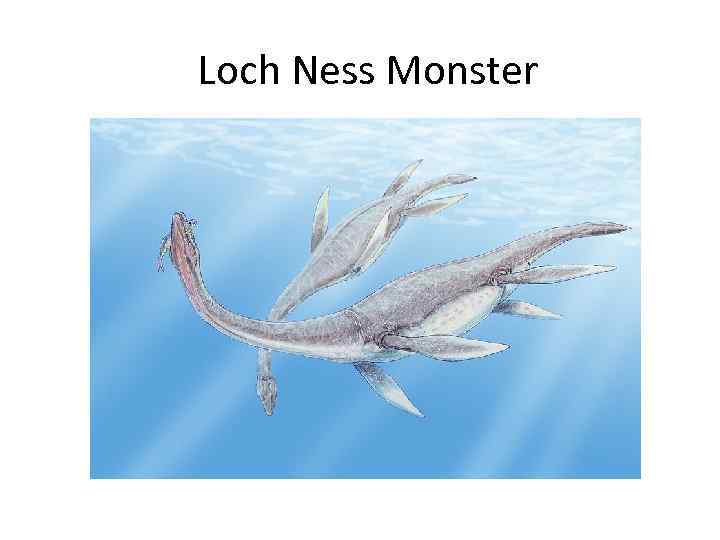
 Loch Ness Monster
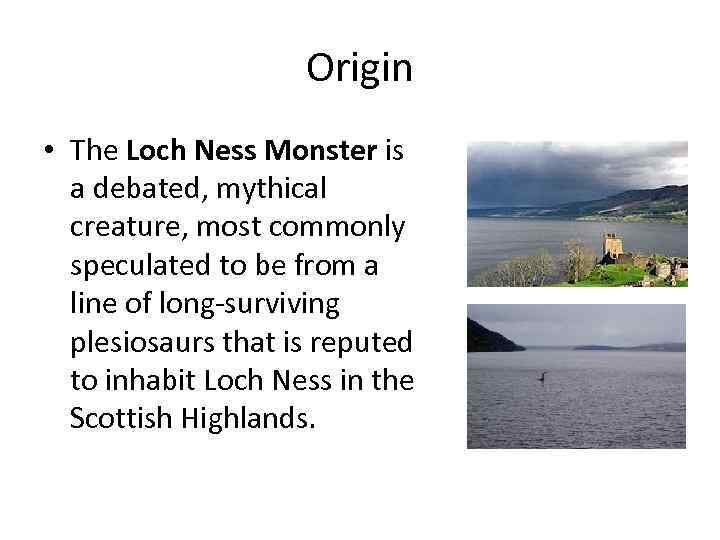 Origin • The Loch Ness Monster is a debated, mythical creature, most commonly speculated to be from a line of long-surviving plesiosaurs that is reputed to inhabit Loch Ness in the Scottish Highlands.
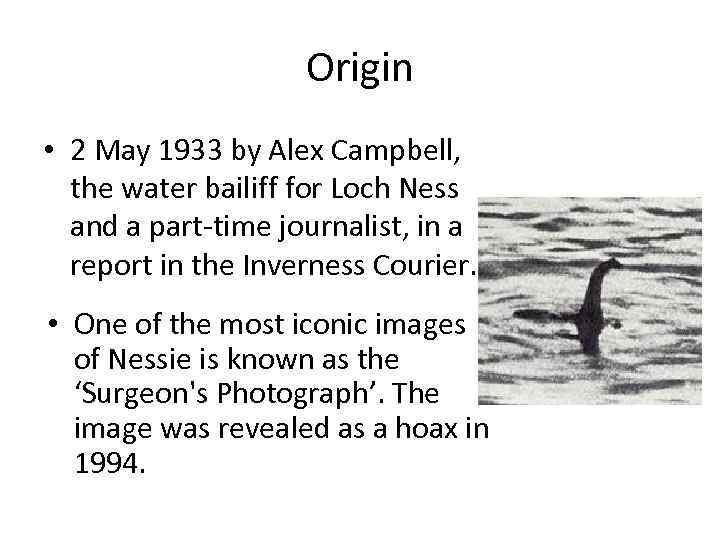 Origin • 2 May 1933 by Alex Campbell, the water bailiff for Loch Ness and a part-time journalist, in a report in the Inverness Courier. • One of the most iconic images of Nessie is known as the ‘Surgeon's Photograph’. The image was revealed as a hoax in 1994.
 Explanations A variety of explanations have been postulated over the years to account for sightings of the Loch Ness Monster. These may be categorised as: • • • misidentifications of common animals misidentifications of inanimate objects or effects reinterpretations of traditional Scottish folklore hoaxes exotic species of large animals
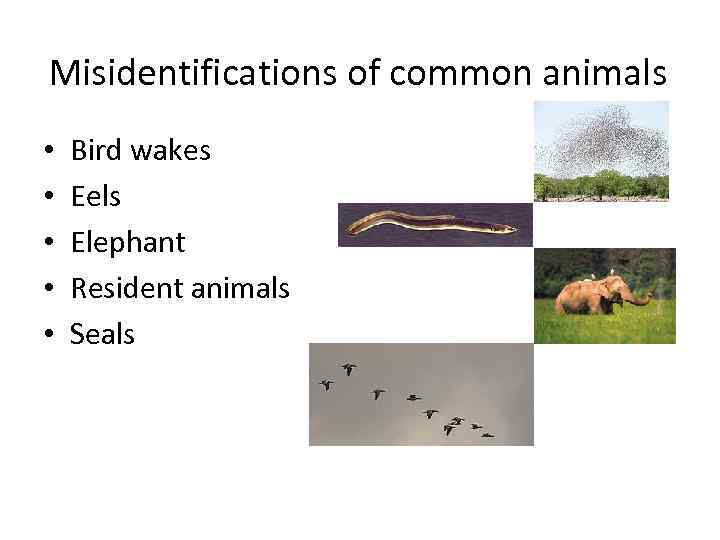 Misidentifications of common animals • • • Bird wakes Eels Elephant Resident animals Seals
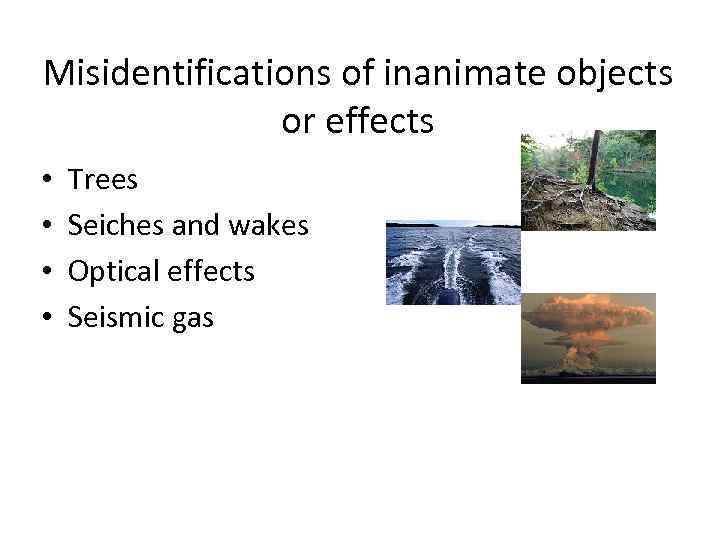 Misidentifications of inanimate objects or effects • • Trees Seiches and wakes Optical effects Seismic gas
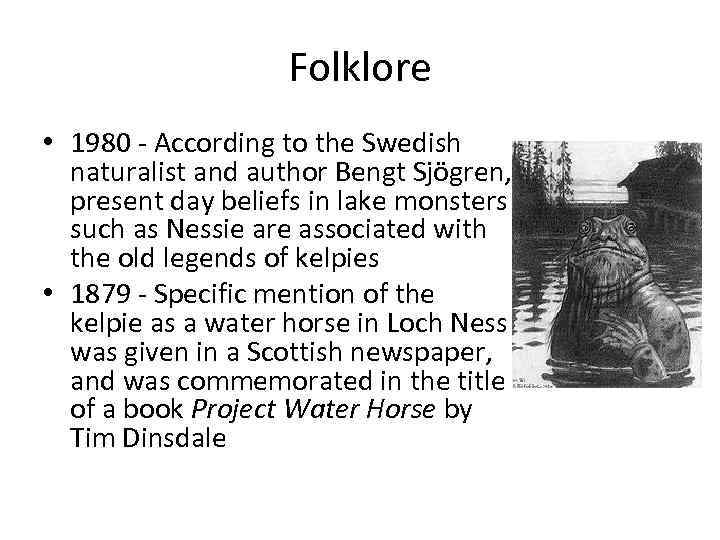 Folklore • 1980 - According to the Swedish naturalist and author Bengt Sjögren, present day beliefs in lake monsters such as Nessie are associated with the old legends of kelpies • 1879 - Specific mention of the kelpie as a water horse in Loch Ness was given in a Scottish newspaper, and was commemorated in the title of a book Project Water Horse by Tim Dinsdale
 Hoaxes • 1959 - Italian journalist Francesco Gasparini confessed to taking a sighting of a "strange fish" and expanding on it by fabricating eye witness accounts • 2003 - Gerald Mc. Sorely found a fossil supposedly belonging to Nessie when he tripped and fell into the lake. After examination, it became clear that the fossil wasn't from Loch Ness and that it had been planted there
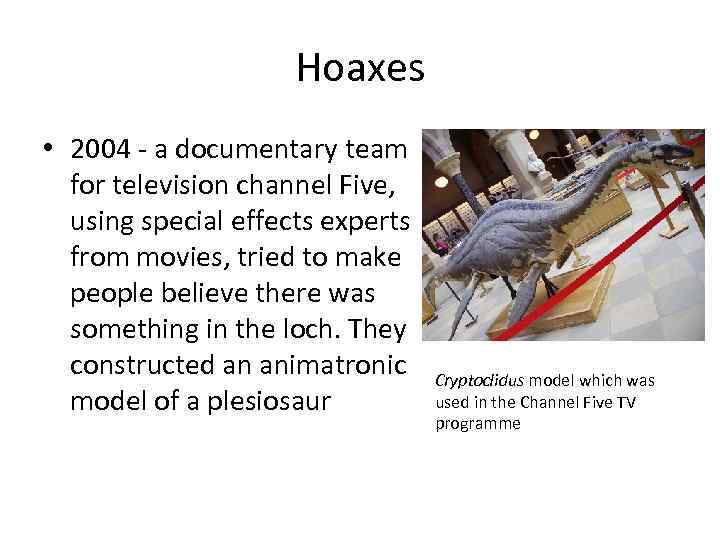 Hoaxes • 2004 - a documentary team for television channel Five, using special effects experts from movies, tried to make people believe there was something in the loch. They constructed an animatronic model of a plesiosaur Cryptoclidus model which was used in the Channel Five TV programme
 Operation Deep Scan (1987) • 1987 - Operation Deepscan, the biggest sonar exploration of Loch Ness, took place. Twentyfour boats equipped with sonar were deployed across the whole width of the lake and they simultaneously sent out acoustic waves.
 Discovery Loch Ness (1993) • 1993 Discovery Communications began to research the ecology of the loch. The study did not focus entirely on the monster, but on the loch's nematodes (of which a new species was discovered) and fish.
 Searching for the Loch Ness Monster BBC (2003) • 2003, the BBC sponsored a full search of the Loch using 600 separate sonar beams and satellite tracking. No animal of any substantial size was found whatsoever and despite high hopes, the scientists involved in the expedition admitted that this essentially proved the Loch Ness monster was only a myth.
 Th nd e. E