


 Скачать презентацию LOCATION-AWARE RESOURCE MANAGEMENT IN SMART HOME ENVIRONMENTS Sajal
af7944964ee5b529390dc82f5dcebc60.ppt
- Количество слайдов: 49
 LOCATION-AWARE RESOURCE MANAGEMENT IN SMART HOME ENVIRONMENTS Sajal K. Das, Director Center for Research in Wireless Mobility & Networking (CRe. WMa. N) Department of Computer Science and Engineering (CSE@UTA) The University of Texas at Arlington, USA E-mail: das@cse. uta. edu URL: http: //crewman. uta. edu [Funded by US National Science Foundation] CRe. WMa. N SAJAL K. DAS
 What is a Smart Environment ? • Saturated with computing and communication capabilities to make intelligent decisions in an automated, context-aware manner pervasive or ubiquitous computing vision. • Technology transparently weaved into the fabric of our daily lives technology that disappears. (Weiser 1991) • Portable devices around users networked with body LANs, PANs (personal area networks) and wireless sensors for reliable commun. • Environment that takes care of itself or users intelligent assistants provide proactive interaction with information Web. Examples: Smart home, office, mall, hotel, hospital, park, airport CRe. WMa. N SAJAL K. DAS
 CRe. WMa. N SAJAL K. DAS
 Smart/Pervasive Healthcare Ø Consider a heart attack or an accident victim Ø Desired actions § Coordinate with the ambulance, hospital, personal physician, relatives and friends, insurance, etc. § § Control the traffic for smooth ambulance pass through Prepare the ER (Emergency Room) and the ER personnel Provide vital medical records to physician Allow the physician to be involved remotely … Ø On a Timely, Automated, Transparent basis Ø PICO (Pervasive Information Community Organization) http: //www. cse. uta. edu/pico@cse M. Kumar, S. K. Das, et al. , “PICO: A Middleware Platform for Pervasive Computing, ” IEEE Pervasive Computing, Vol. 2, No. 3, July-Sept 2003. CRe. WMa. N SAJAL K. DAS
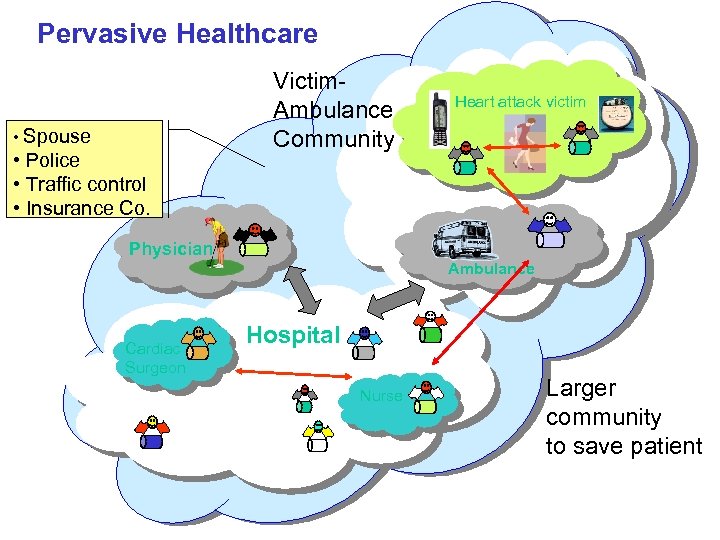 Pervasive Healthcare • Spouse • Police • Traffic control • Insurance Co. Victim. Ambulance Community Heart attack victim Physician Ambulance Cardiac Surgeon Hospital Nurse Larger community to save patient
 PICO Framework Ø Creates mission-oriented, dynamic computing communities of software agents that perform tasks on behalf of the users and devices autonomously over existing heterogeneous network infrastructures, including the Internet. Ø Provides transparent, automated services: what you want, when you want, where you want, and how you want. Ø Proposes community computing concept to provide continual, dynamic, automated and transparent services to users. CRe. WMa. N SAJAL K. DAS
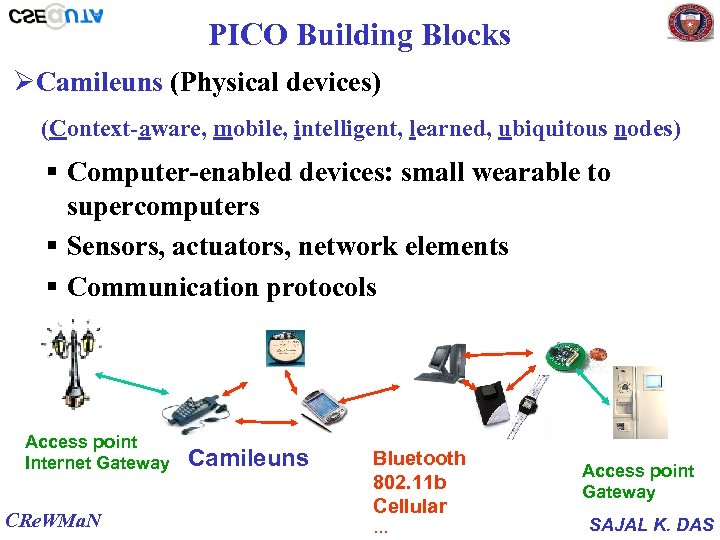 PICO Building Blocks ØCamileuns (Physical devices) (Context-aware, mobile, intelligent, learned, ubiquitous nodes) § Computer-enabled devices: small wearable to supercomputers § Sensors, actuators, network elements § Communication protocols Access point Internet Gateway CRe. WMa. N Camileuns Bluetooth 802. 11 b Cellular … Access point Gateway SAJAL K. DAS
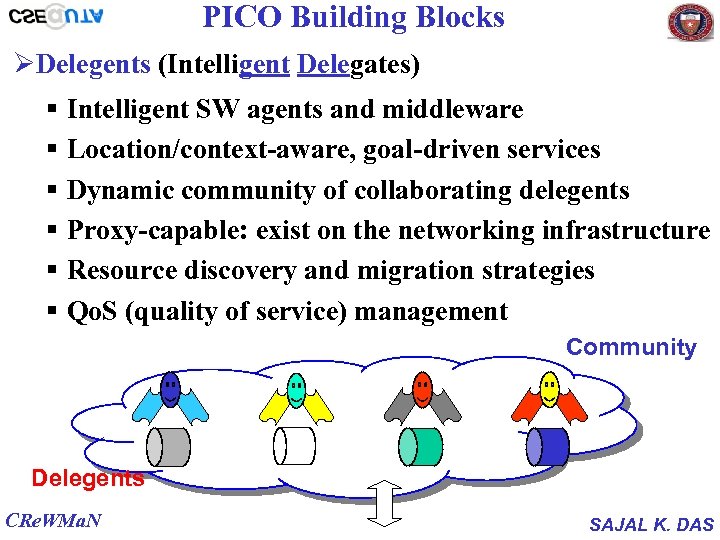 PICO Building Blocks ØDelegents (Intelligent Delegates) § § § Intelligent SW agents and middleware Location/context-aware, goal-driven services Dynamic community of collaborating delegents Proxy-capable: exist on the networking infrastructure Resource discovery and migration strategies Qo. S (quality of service) management Community Delegents CRe. WMa. N SAJAL K. DAS
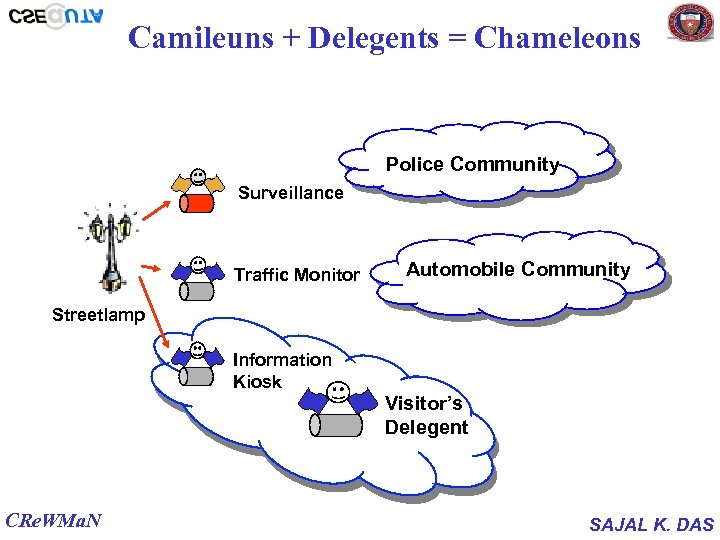 Camileuns + Delegents = Chameleons Police Community Surveillance Traffic Monitor Automobile Community Streetlamp Information Kiosk Visitor’s Delegent CRe. WMa. N SAJAL K. DAS
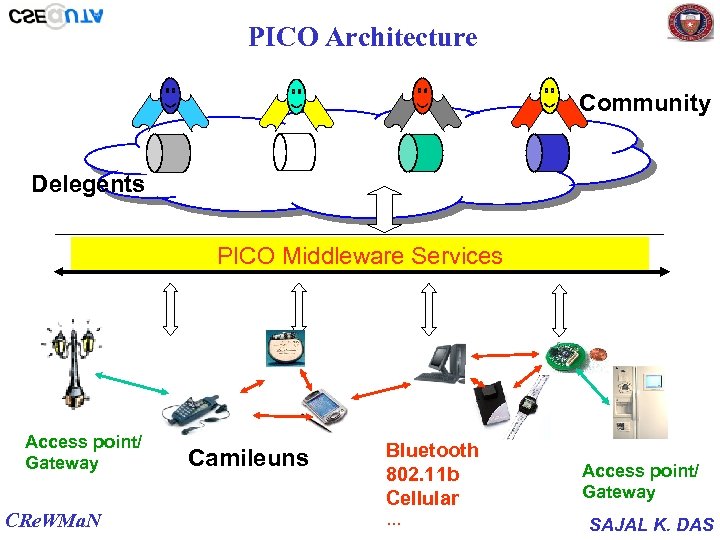 PICO Architecture Community Delegents PICO Middleware Services Access point/ Gateway CRe. WMa. N Camileuns Bluetooth 802. 11 b Cellular … Access point/ Gateway SAJAL K. DAS
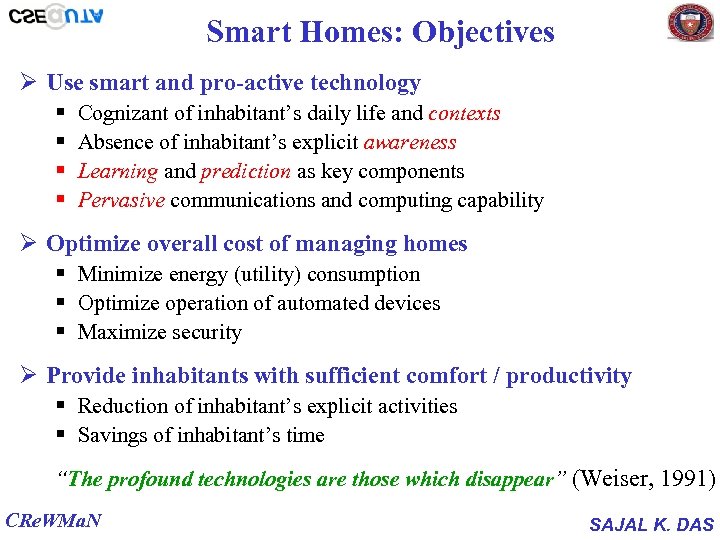 Smart Homes: Objectives Ø Use smart and pro-active technology § § Cognizant of inhabitant’s daily life and contexts Absence of inhabitant’s explicit awareness Learning and prediction as key components Pervasive communications and computing capability Ø Optimize overall cost of managing homes § Minimize energy (utility) consumption § Optimize operation of automated devices § Maximize security Ø Provide inhabitants with sufficient comfort / productivity § Reduction of inhabitant’s explicit activities § Savings of inhabitant’s time “The profound technologies are those which disappear” (Weiser, 1991) CRe. WMa. N SAJAL K. DAS
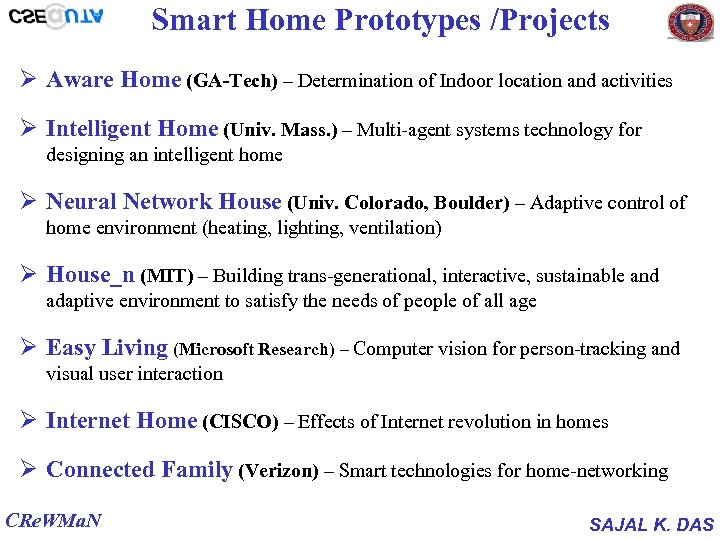 Smart Home Prototypes /Projects Ø Aware Home (GA-Tech) – Determination of Indoor location and activities Ø Intelligent Home (Univ. Mass. ) – Multi-agent systems technology for designing an intelligent home Ø Neural Network House (Univ. Colorado, Boulder) – Adaptive control of home environment (heating, lighting, ventilation) Ø House_n (MIT) – Building trans-generational, interactive, sustainable and adaptive environment to satisfy the needs of people of all age Ø Easy Living (Microsoft Research) – Computer vision for person-tracking and visual user interaction Ø Internet Home (CISCO) – Effects of Internet revolution in homes Ø Connected Family (Verizon) – Smart technologies for home-networking CRe. WMa. N SAJAL K. DAS
 MAVHome at CSE@UTA Ø Mav. Home: Managing an Adaptive Versatile Home § Unique project – focuses on the entire home § Creates an intelligent home that acts as a rational agent § Perceives the state of the home through sensors and acts on the environment through effectors (device controllers). § Optimizes goal functions: Maximize inhabitants’ comfort and productivity, Minimize house operation cost, Maximize security. § Able to reason about and adapt to its inhabitants to accurately route messages and multimedia information. http: //ranger. uta. edu/smarthome S. K. Das, et al. , “The Role of Prediction Algorithms in the Mav. Home Smart Home Architecture”, IEEE Wireless Communications, Vol. 9, No. 6, pp. 77– 84, Dec. 2002. CRe. WMa. N SAJAL K. DAS
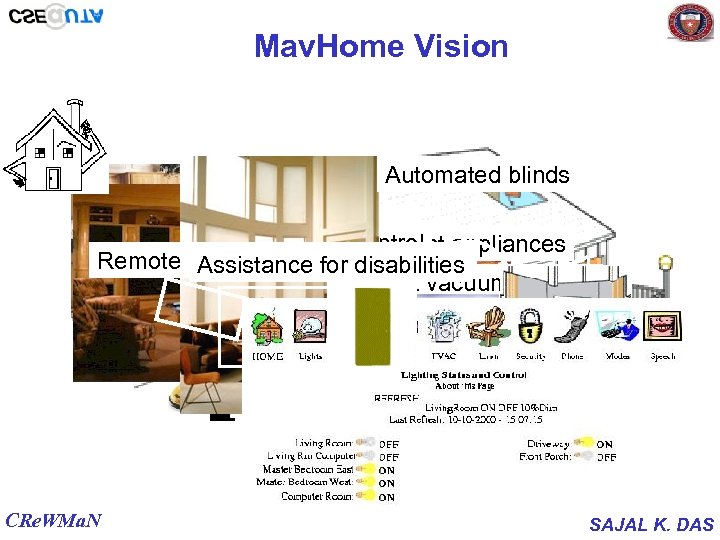 Mav. Home Vision Automated blinds Door/lock controllers, Face recognition, Surveillance system entry Climate control automated door Intelligent appliances Remote site monitoring and control Assistance for disabilities Robot vacuum cleaner Robot lawnmower Intelligent Entertainment Smart sprinklers CRe. WMa. N Lighting control SAJAL K. DAS
 Mav. Home: Bob Scenario § 6: 45 am: Mav. Home turns up heat to achieve optimal temperature for waking (learned) § 7: 00 am: Alarm rings, lights on in bed-room, coffee maker in the kitchen (prediction) § Bob steps into bathroom, turns on light: Mav. Home records this interaction (learning), displays morning news on bathroom video screen, and turns on shower (proactive) § While Bob shaves, Mav. Home senses he is 2 lbs overweight, adjusts his menu (reasoning and decision making) § When Bob finishes grooming, bathroom light turns off, kitchen light and menu/schedule display turns on, news program moves to the kitchen screen (follow-me multimedia communication) § At breakfast, Bob notices the floor is dirty, requests janitor robot to clean house (reinforcement learning) § Bob leaves for office, Mav. Home secures the house and operates lawn sprinklers despite knowing 70% predicted chance of rain (over rule) § In the afternoon, Mav. Home places grocery order (automation) § When Bob returns, grocery order has arrived and hot tub is ready (just-in-time). CRe. WMa. N SAJAL K. DAS
 MAVHome: Multi-Disciplinary Research Project Ø Ø Ø Seamless collection and aggregation (fusion) of sensory data Active databases and monitoring Profiling, learning, data mining, automated decision making Learning and Prediction of inhabitant’s location and activity Wireless, mobile, and sensor networking Pervasive computing and communications Location- and context-aware middleware services Cooperating agents – Mav. Home agent design Multimedia communication for entertainment and security Robot assistance Web monitoring and control CRe. WMa. N SAJAL K. DAS
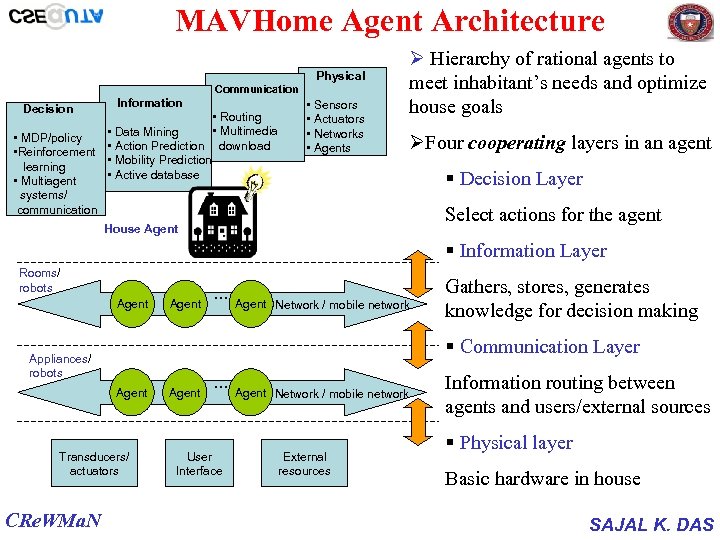 MAVHome Agent Architecture Physical Communication Decision Information • Routing • Multimedia • Data Mining • MDP/policy • Action Prediction download • Reinforcement • Mobility Prediction learning • Active database • Multiagent systems/ communication • Sensors • Actuators • Networks • Agents Ø Hierarchy of rational agents to meet inhabitant’s needs and optimize house goals ØFour cooperating layers in an agent § Decision Layer Select actions for the agent House Agent § Information Layer Rooms/ robots Agent Network / mobile network Gathers, stores, generates knowledge for decision making § Communication Layer Appliances/ robots Agent Transducers/ actuators CRe. WMa. N … Agent … User Interface Agent Network / mobile network External resources Information routing between agents and users/external sources § Physical layer Basic hardware in house SAJAL K. DAS
 Indoor Location Management Ø Location Awareness § Location (current and future) is the most important context in any smart computing paradigm Ø Why Location Tracking ? § Intelligent triggering of active databases § Efficient operation of automated devices § Guarantees accurate time-frame of service delivery § Supports aggressive teleporting and location-aware multimedia services -- seamless follow of media along inhabitant’s route § Efficient resource usage by devices -- Energy consumption only along predicted locations and routes that the inhabitant is most likely to follow CRe. WMa. N SAJAL K. DAS
 Location Representation Ø Location Information § Geometric – Location information in explicit co-ordinates § Symbolic - Topology-relative location representation Ø Blessings of Symbolic Representation § Universal applicability in location tracking § Easy processing and storage § Development of a predictive framework CRe. WMa. N SAJAL K. DAS
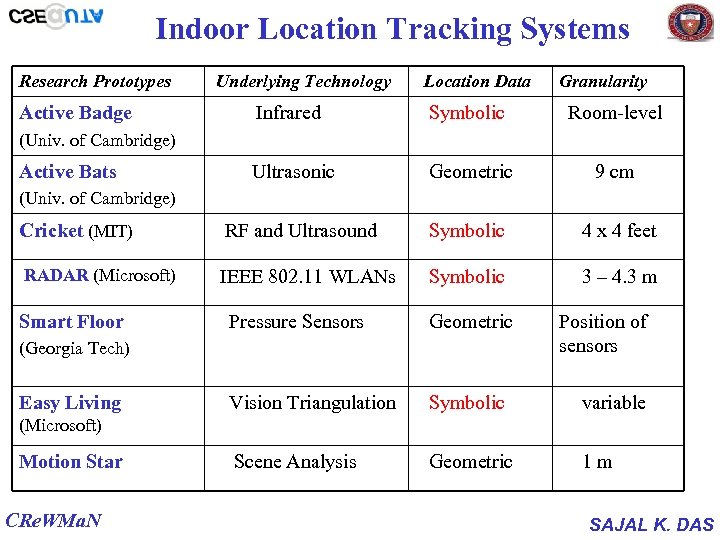 Indoor Location Tracking Systems Research Prototypes Active Badge Underlying Technology Location Data Granularity Infrared Symbolic Room-level Ultrasonic Geometric 9 cm (Univ. of Cambridge) Active Bats (Univ. of Cambridge) Cricket (MIT) RF and Ultrasound Symbolic 4 x 4 feet RADAR (Microsoft) IEEE 802. 11 WLANs Symbolic 3 – 4. 3 m Smart Floor Pressure Sensors Geometric Vision Triangulation Symbolic variable Scene Analysis Geometric 1 m (Georgia Tech) Easy Living Position of sensors (Microsoft) Motion Star CRe. WMa. N SAJAL K. DAS
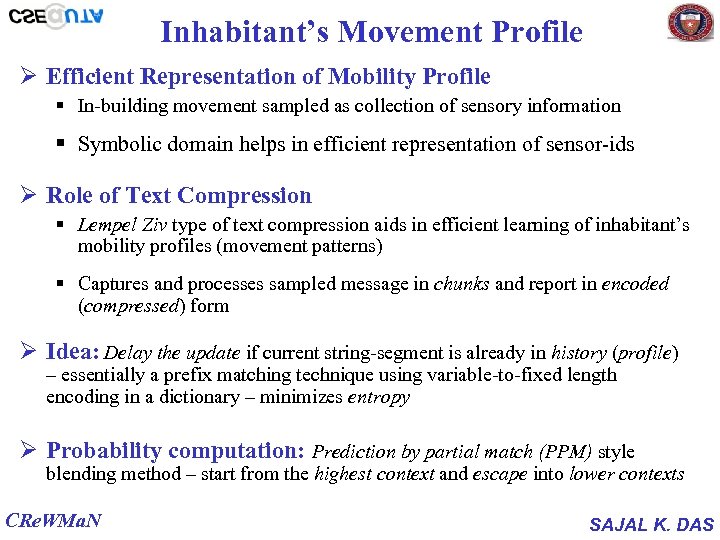 Inhabitant’s Movement Profile Ø Efficient Representation of Mobility Profile § In-building movement sampled as collection of sensory information § Symbolic domain helps in efficient representation of sensor-ids Ø Role of Text Compression § Lempel Ziv type of text compression aids in efficient learning of inhabitant’s mobility profiles (movement patterns) § Captures and processes sampled message in chunks and report in encoded (compressed) form Ø Idea: Delay the update if current string-segment is already in history (profile) – essentially a prefix matching technique using variable-to-fixed length encoding in a dictionary – minimizes entropy Ø Probability computation: Prediction by partial match (PPM) style blending method – start from the highest context and escape into lower contexts CRe. WMa. N SAJAL K. DAS
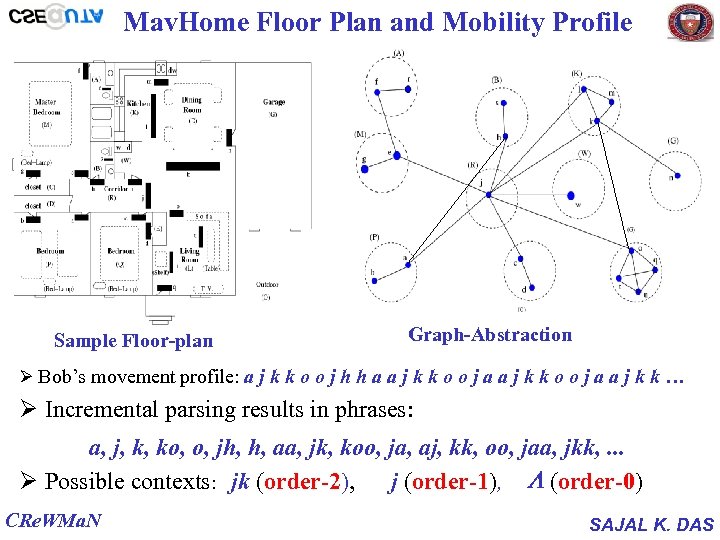 Mav. Home Floor Plan and Mobility Profile Sample Floor-plan Graph-Abstraction Ø Bob’s movement profile: a j k k o o j h h a a j k k o o j a a j k k … Ø Incremental parsing results in phrases: a, j, k, ko, o, jh, h, aa, jk, koo, ja, aj, kk, oo, jaa, jkk, . . . Ø Possible contexts: jk (order-2), j (order-1), (order-0) CRe. WMa. N SAJAL K. DAS
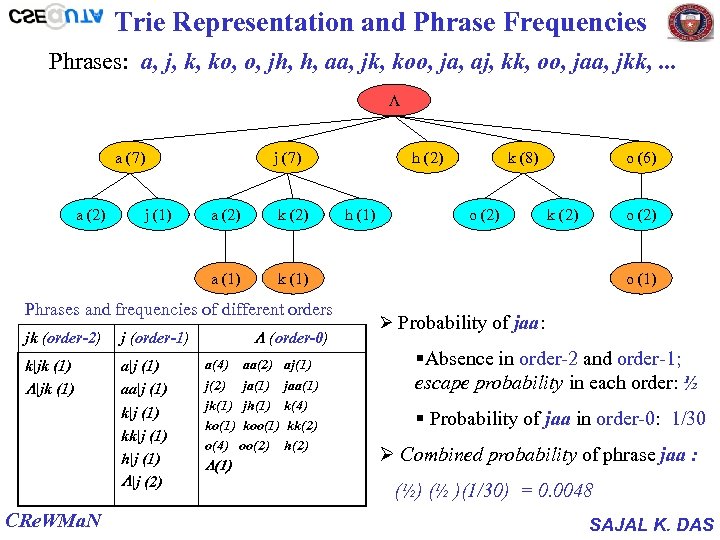 Trie Representation and Phrase Frequencies Phrases: a, j, k, ko, o, jh, h, aa, jk, koo, ja, aj, kk, oo, jaa, jkk, . . . a (7) a (2) j (1) j (7) a (2) k (2) a (1) k|jk (1) a|j (1) aa|j (1) kk|j (1) h|j (1) |j (2) (order-0) j (order-1) CRe. WMa. N a(4) aa(2) ja(1) jk(1) jh(1) koo(1) o(4) oo(2) (1) aj(1) jaa(1) k(4) kk(2) h (1) k (8) o (2) o (6) k (1) Phrases and frequencies of different orders jk (order-2) h (2) k (2) o (1) Ø Probability of jaa: §Absence in order-2 and order-1; escape probability in each order: ½ § Probability of jaa in order-0: 1/30 Ø Combined probability of phrase jaa : (½) (½ )(1/30) = 0. 0048 SAJAL K. DAS
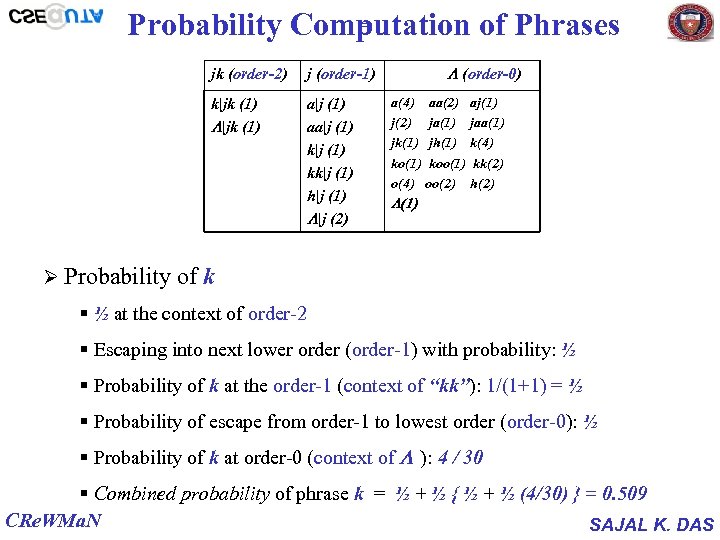 = Probability Computation of Phrases jk (order-2) k|jk (1) a|j (1) aa|j (1) kk|j (1) h|j (1) |j (2) (order-0) j (order-1) a(4) aa(2) ja(1) jk(1) jh(1) koo(1) o(4) oo(2) aj(1) jaa(1) k(4) kk(2) h(2) (1) Ø Probability of k § ½ at the context of order-2 § Escaping into next lower order (order-1) with probability: ½ § Probability of k at the order-1 (context of “kk”): 1/(1+1) = ½ § Probability of escape from order-1 to lowest order (order-0): ½ § Probability of k at order-0 (context of ): 4 / 30 § Combined probability of phrase k = ½ + ½ { ½ + ½ (4/30) } = 0. 509 CRe. WMa. N SAJAL K. DAS
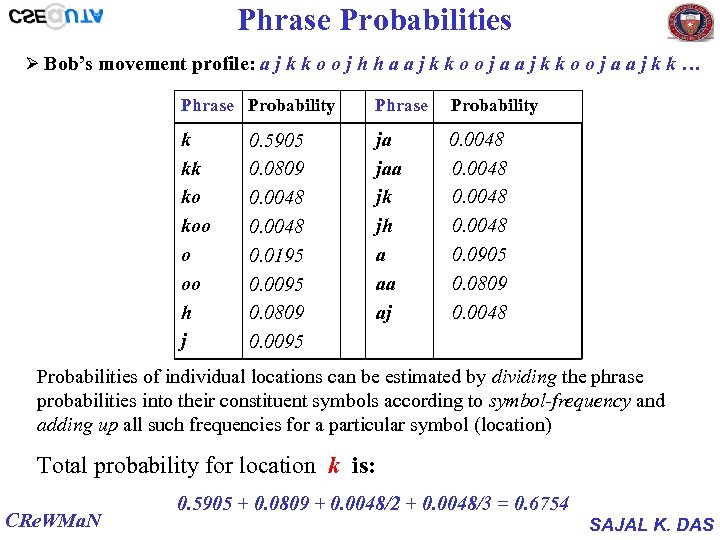 Phrase Probabilities Ø Bob’s movement profile: a j k k o o j h h a a j k k o o j a a j k k … Phrase Probability k kk ko koo o oo h j ja jaa jk jh a aa aj 0. 0048 0. 0905 0. 0809 0. 0048 0. 5905 0. 0809 0. 0048 0. 0195 0. 0095 0. 0809 0. 0095 Probabilities of individual locations can be estimated by dividing the phrase probabilities into their constituent symbols according to symbol-frequency and adding up all such frequencies for a particular symbol (location) Total probability for location k is: CRe. WMa. N 0. 5905 + 0. 0809 + 0. 0048/2 + 0. 0048/3 = 0. 6754 SAJAL K. DAS
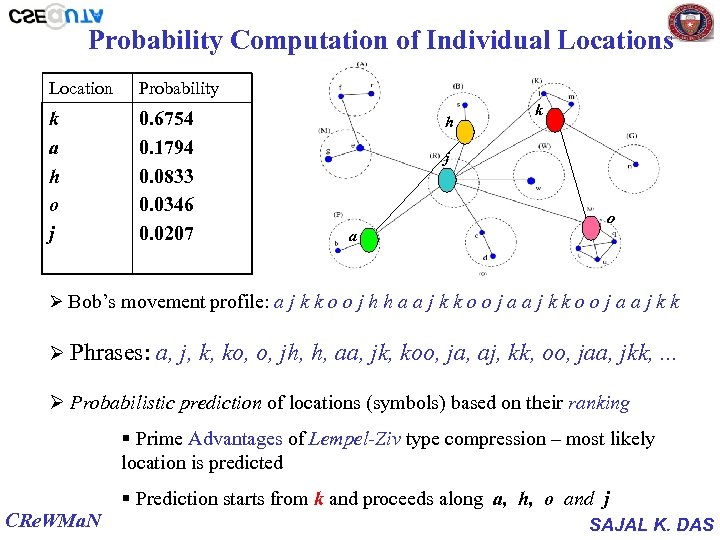 Probability Computation of Individual Locations Location Probability k a h o j 0. 6754 0. 1794 0. 0833 0. 0346 0. 0207 h k j o a Ø Bob’s movement profile: a j k k o o j h h a a j k k o o j a a j k k Ø Phrases: a, j, k, ko, o, jh, h, aa, jk, koo, ja, aj, kk, oo, jaa, jkk, . . . Ø Probabilistic prediction of locations (symbols) based on their ranking § Prime Advantages of Lempel-Ziv type compression – most likely location is predicted CRe. WMa. N § Prediction starts from k and proceeds along a, h, o and j SAJAL K. DAS
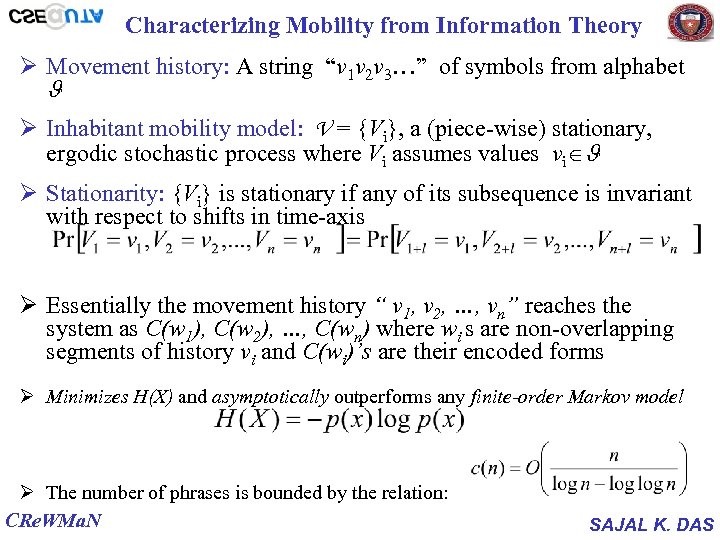 Characterizing Mobility from Information Theory Ø Movement history: A string “v 1 v 2 v 3…” of symbols from alphabet Ø Inhabitant mobility model: V = {Vi}, a (piece-wise) stationary, ergodic stochastic process where Vi assumes values vi Ø Stationarity: {Vi} is stationary if any of its subsequence is invariant with respect to shifts in time-axis Ø Essentially the movement history “ v 1, v 2, …, vn” reaches the system as C(w 1), C(w 2), …, C(wn) where wi s are non-overlapping segments of history vi and C(wi)’s are their encoded forms Ø Minimizes H(X) and asymptotically outperforms any finite-order Markov model Ø The number of phrases is bounded by the relation: CRe. WMa. N SAJAL K. DAS
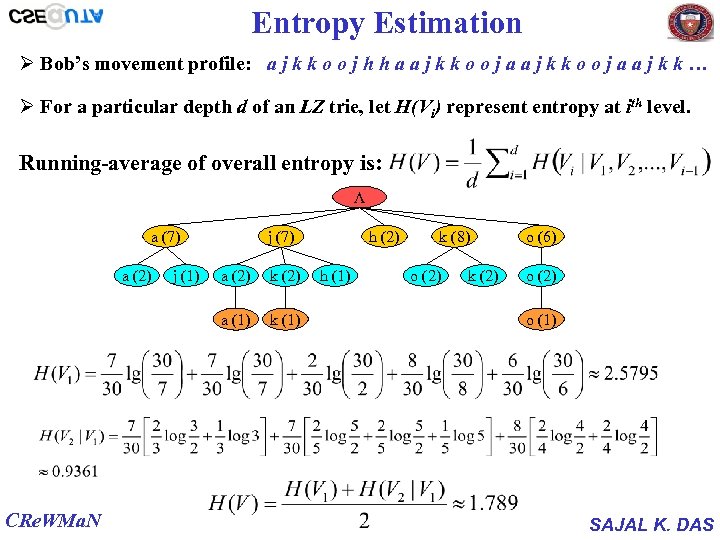 Entropy Estimation Ø Bob’s movement profile: a j k k o o j h h a a j k k o o j a a j k k … Ø For a particular depth d of an LZ trie, let H(Vi) represent entropy at ith level. Running-average of overall entropy is: a (7) a (2) k (2) a (1) CRe. WMa. N j (1) j (7) k (1) h (2) h (1) k (8) o (2) k (2) o (6) o (2) o (1) SAJAL K. DAS
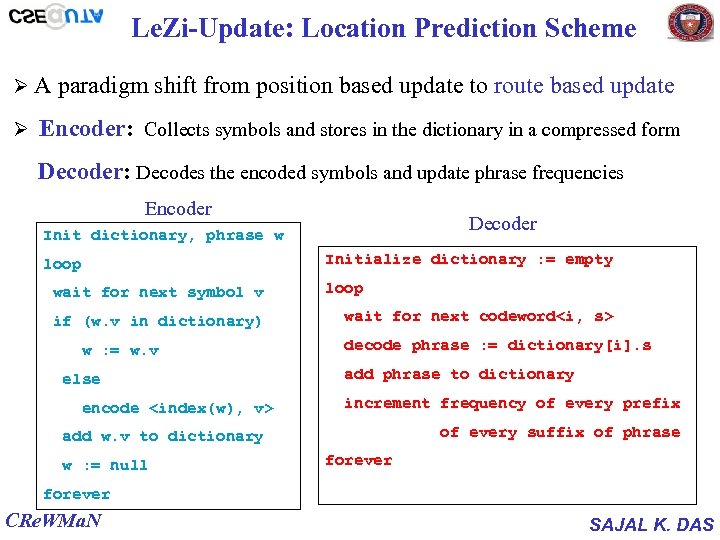 Le. Zi-Update: Location Prediction Scheme Ø A paradigm shift from position based update to route based update Ø Encoder: Collects symbols and stores in the dictionary in a compressed form Decoder: Decodes the encoded symbols and update phrase frequencies Encoder Decoder Init dictionary, phrase w Initialize dictionary : = empty loop wait for next symbol v if (w. v in dictionary) w : = w. v else encode
 Predictive Framework: Route Tracking Ø Probability of a set of route sequences depends exponentially on relative entropy between actual route-distribution and its type-class Ø Route-sequences away from actual distribution have exponentially smaller probabilities Ø Typical-Set – Set of sequences with very small relative entropy Ø Small subset of routes having a large probability mass that controls inhabitant’s movement behavior in the long run Ø Concept of Asymptotic Equipartition Property (AEP) helps capture inhabitant’s typical set of routes CRe. WMa. N SAJAL K. DAS
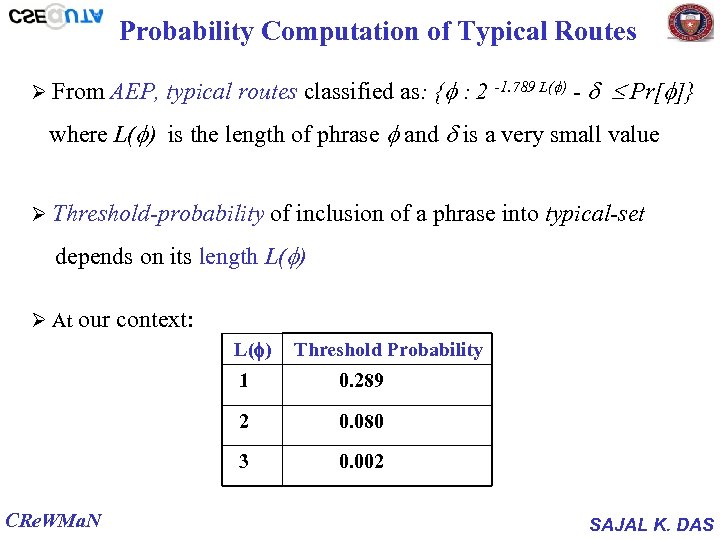 Probability Computation of Typical Routes Ø From AEP, typical routes classified as: { : 2 -1. 789 L( ) - Pr[ ]} where L( ) is the length of phrase and is a very small value Ø Threshold-probability of inclusion of a phrase into typical-set depends on its length L( ) Ø At our context: L( ) Threshold Probability 1 2 0. 080 3 CRe. WMa. N 0. 289 0. 002 SAJAL K. DAS
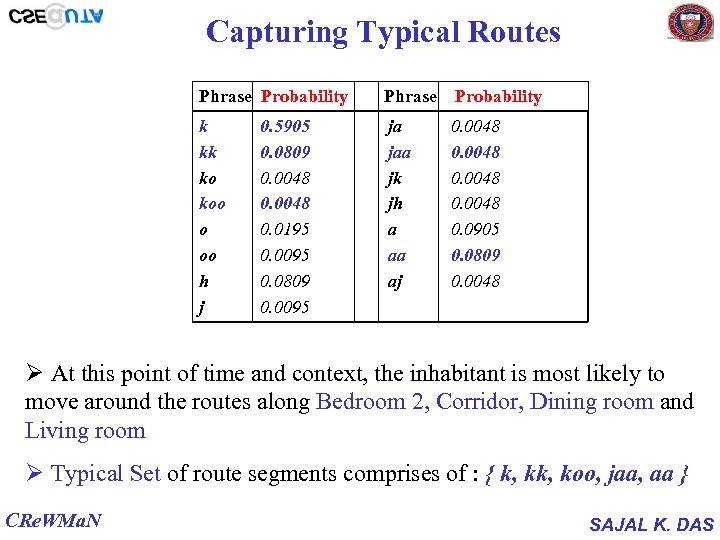 Capturing Typical Routes Phrase Probability k kk ko koo o oo h j ja jaa jk jh a aa aj 0. 0048 0. 0905 0. 0809 0. 0048 0. 5905 0. 0809 0. 0048 0. 0195 0. 0095 0. 0809 0. 0095 Ø At this point of time and context, the inhabitant is most likely to move around the routes along Bedroom 2, Corridor, Dining room and Living room Ø Typical Set of route segments comprises of : { k, koo, jaa, aa } CRe. WMa. N SAJAL K. DAS
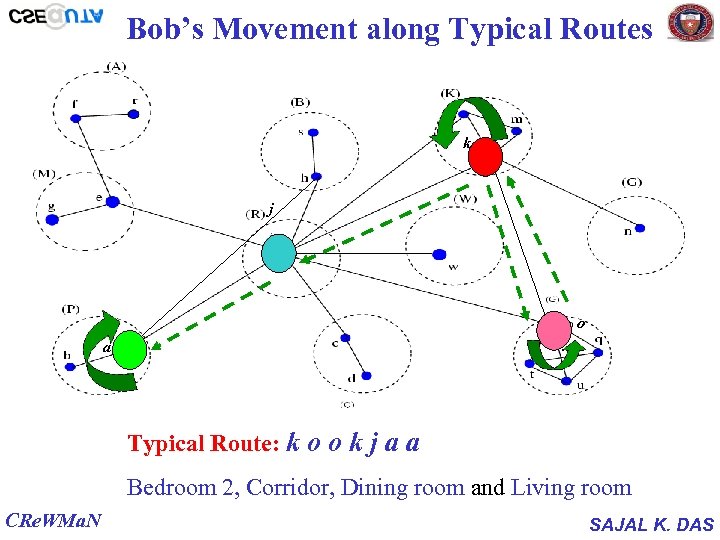 Bob’s Movement along Typical Routes k j o a Typical Route: k o o k j a a Bedroom 2, Corridor, Dining room and Living room CRe. WMa. N SAJAL K. DAS
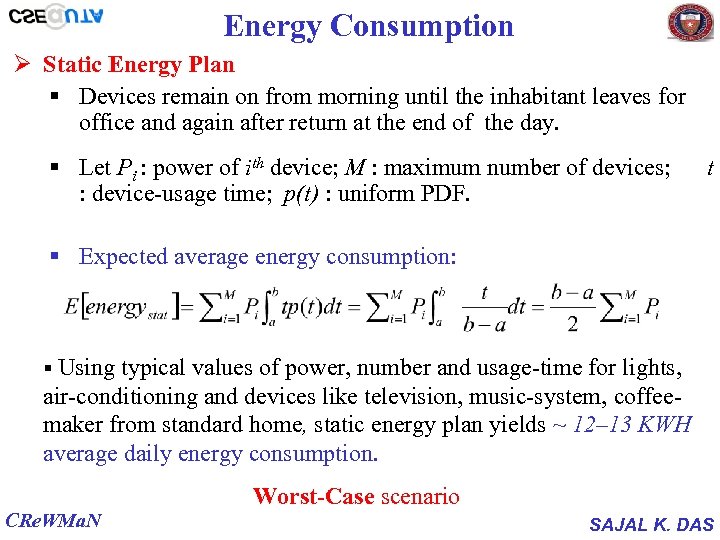 Energy Consumption Ø Static Energy Plan § Devices remain on from morning until the inhabitant leaves for office and again after return at the end of the day. § Let Pi : power of ith device; M : maximum number of devices; : device-usage time; p(t) : uniform PDF. t § Expected average energy consumption: § Using typical values of power, number and usage-time for lights, air-conditioning and devices like television, music-system, coffeemaker from standard home, static energy plan yields ~ 12– 13 KWH average daily energy consumption. CRe. WMa. N Worst-Case scenario SAJAL K. DAS
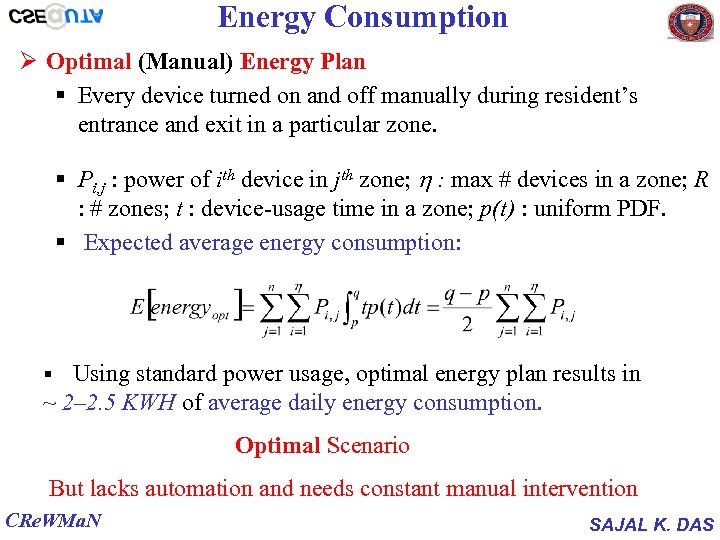 Energy Consumption Ø Optimal (Manual) Energy Plan § Every device turned on and off manually during resident’s entrance and exit in a particular zone. § Pi, j : power of ith device in jth zone; : max # devices in a zone; R : # zones; t : device-usage time in a zone; p(t) : uniform PDF. § Expected average energy consumption: § Using standard power usage, optimal energy plan results in ~ 2– 2. 5 KWH of average daily energy consumption. Optimal Scenario But lacks automation and needs constant manual intervention CRe. WMa. N SAJAL K. DAS
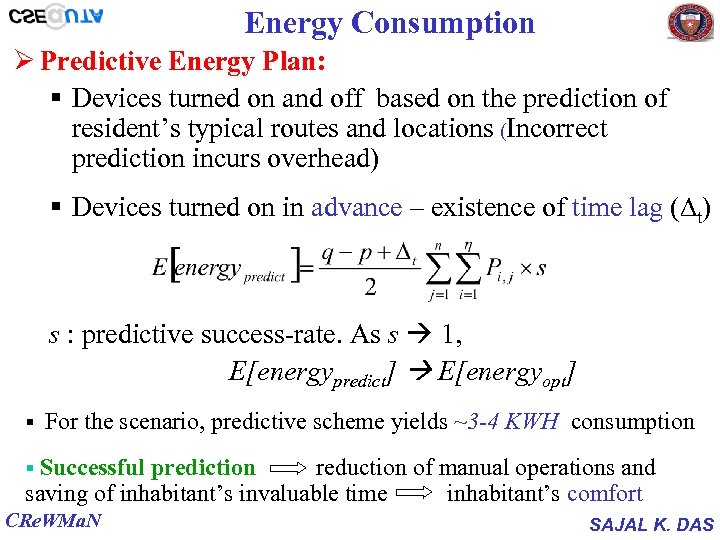 Energy Consumption Ø Predictive Energy Plan: § Devices turned on and off based on the prediction of resident’s typical routes and locations (Incorrect prediction incurs overhead) § Devices turned on in advance – existence of time lag ( t) s : predictive success-rate. As s 1, E[energypredict] E[energyopt] § For the scenario, predictive scheme yields ~3 -4 KWH consumption § Successful prediction reduction of manual operations and saving of inhabitant’s invaluable time inhabitant’s comfort CRe. WMa. N SAJAL K. DAS
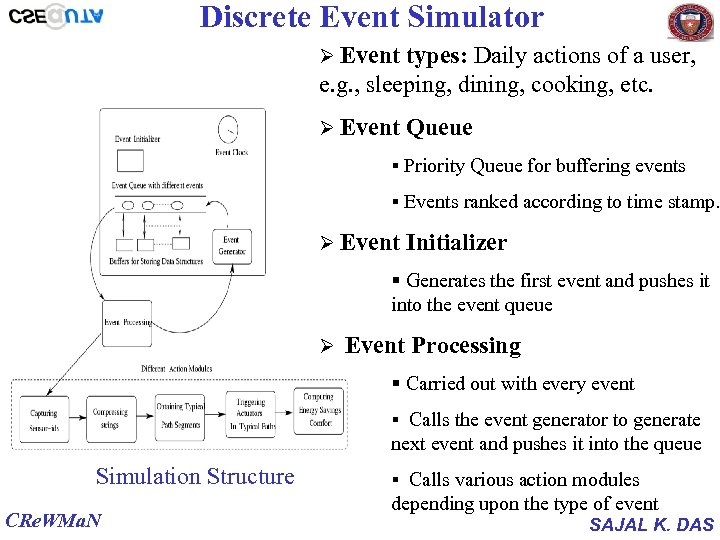 Discrete Event Simulator Ø Event types: Daily actions of a user, e. g. , sleeping, dining, cooking, etc. Ø Event Queue § Priority Queue for buffering events § Events ranked according to time stamp. Ø Event Initializer § Generates the first event and pushes it into the event queue Ø Event Processing § Carried out with every event § Calls the event generator to generate next event and pushes it into the queue Simulation Structure CRe. WMa. N § Calls various action modules depending upon the type of event SAJAL K. DAS
 Simulation: Assumptions Ø Simulation Duration: 70 days Ø Different life-styles at weekdays and weekends Ø Mobility initiated as the inhabitant wakes up in the morning and starts daily-routine Ø Inhabitant’s residence-time at every zone – uniformly distributed between a maximum and a minimum value Ø Negligible delay between sensory data acquisition and actuator activation Ø Prediction occurs while leaving every zone Ø In inhabitant’s absence, the house has minimal activity to conserve energy resources CRe. WMa. N SAJAL K. DAS
 Granularities of Prediction Ø Predicting next zone § Inhabitant’s immediate next zone / location § A coarse level movement pattern in different locations Ø Predicting typical routes / paths § Inhabitant’s typical routes along with zones § More granular indicating inhabitant’s movement patterns Ø Predicting next sensor § Every next sensor predicted from current sensor § Large number of predictions lead to system overhead Ø Predicting next device § Predict every next device the inhabitant is going to use § Details of inhabitant’s activities can be observed CRe. WMa. N SAJAL K. DAS
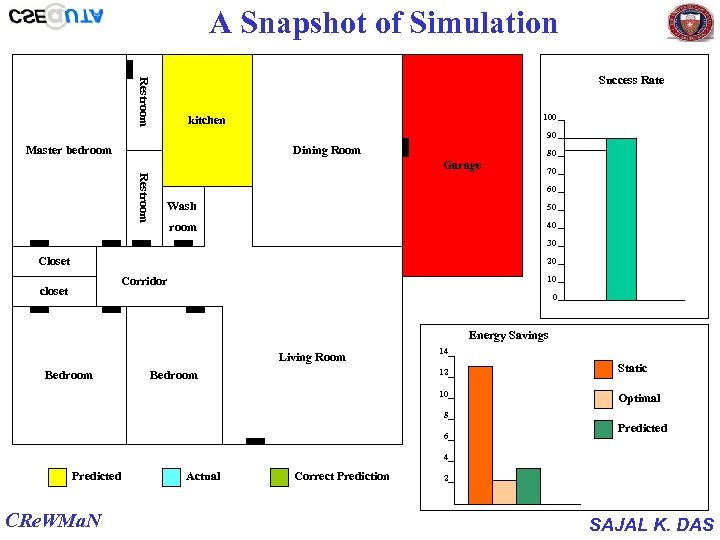 A Snapshot of Simulation Restroom Success Rate 100 kitchen 90 Master bedroom Dining Room 80 Garage Restroom 70 60 Wash 50 room 40 30 Closet 20 10 Corridor closet 0 Energy Savings Living Room 14 12 Bedroom Static 10 Bedroom Optimal 8 6 Predicted 4 Predicted CRe. WMa. N Actual Correct Prediction 2 SAJAL K. DAS
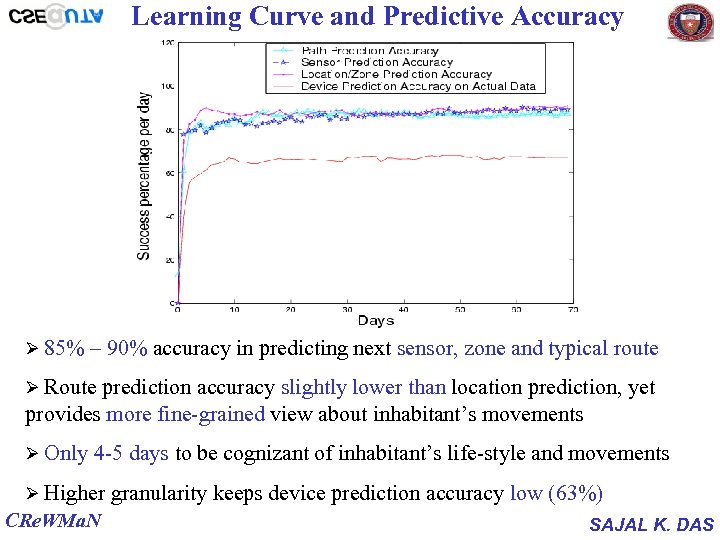 Learning Curve and Predictive Accuracy Ø 85% – 90% accuracy in predicting next sensor, zone and typical route Ø Route prediction accuracy slightly lower than location prediction, yet provides more fine-grained view about inhabitant’s movements Ø Only 4 -5 days to be cognizant of inhabitant’s life-style and movements Ø Higher granularity keeps device prediction accuracy low (63%) CRe. WMa. N SAJAL K. DAS
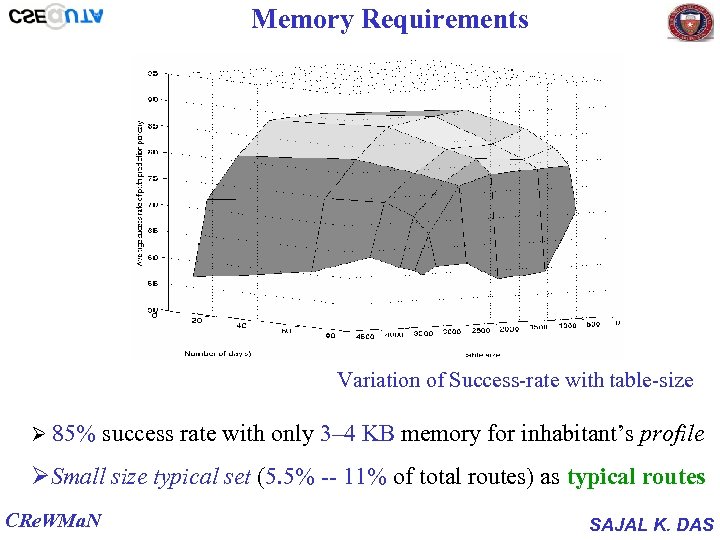 Memory Requirements Variation of Success-rate with table-size Ø 85% success rate with only 3– 4 KB memory for inhabitant’s profile ØSmall size typical set (5. 5% -- 11% of total routes) as typical routes CRe. WMa. N SAJAL K. DAS
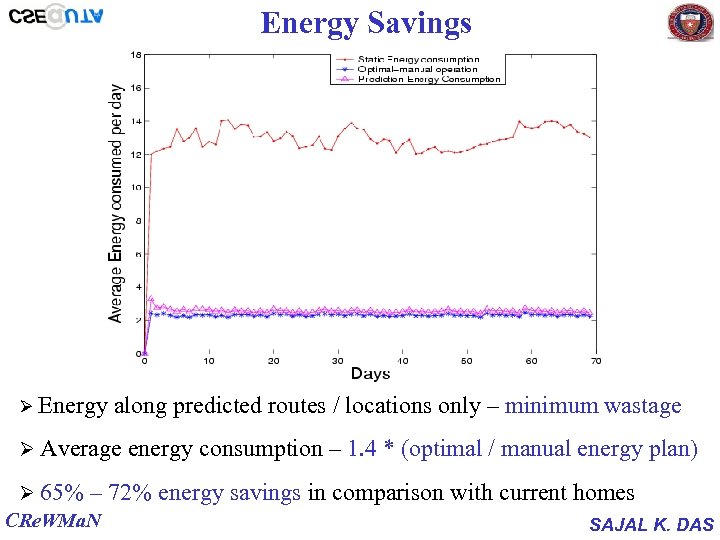 Energy Savings Reduction in Average Energy Consumption Ø Energy along predicted routes / locations only – minimum wastage Ø Average energy consumption – 1. 4 * (optimal / manual energy plan) Ø 65% – 72% energy savings in comparison with current homes CRe. WMa. N SAJAL K. DAS
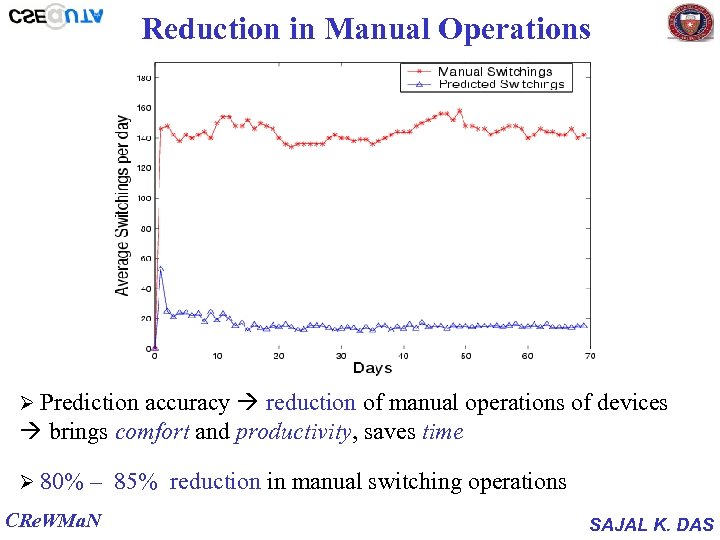 Reduction in Manual Operations Ø Prediction accuracy reduction of manual operations of devices brings comfort and productivity, saves time Ø 80% – 85% reduction in manual switching operations CRe. WMa. N SAJAL K. DAS
 Future Work Ø Route prediction and resource management in multi-inhabitant (possibly cooperative) homes Ø Design and analysis of location-aware wireless multimedia communication in smart homes Ø Integration of smart homes with wide area cellular networks (3 G wireless) for complete mobility management solution Ø Qo. S routing in resource-poor wireless and sensor networks Ø Security and privacy issues CRe. WMa. N SAJAL K. DAS
 Selected References Ø A. Roy, S. K. Das Bhaumik, A. Bhattacharya, K. Basu, D. Cook and S. K. Das, “Location Aware Resource Management in Smart Homes”, Proc. of IEEE Int’l Conf. on Pervasive Computing (Per. Com), pp. 481 -488, Mar 2003. Ø S. K. Das, D. J. Cook, A. Bhattacharya, E. Hierman, and T. Z. Lin, “The Role of Prediction Algorithms in the Mav. Home Smart Home Architecture”, IEEE Wireless Communications, Vol. 9, No. 6, pp. 77– 84, Dec. 2002. Ø A. Bhattacharya and S. K. Das, “Le. Zi-Update: An Information Theoretic Framework for Personal Mobility Tracking in PCS Networks”, ACM Journal on Wireless Networks, Vol. 8, No. 3, pp. 121 -135, Mar-May 2002. Ø A. Bhattacharya and S. K. Das, “Le. Zi-Update: An Information Theoretic Approach to Track the Mobile Users in PCS Networks”, Proc. ACM Int’l. Conference on Mobile Computing and Networking (Mobi. Com’ 99), pp. 1 -12, Aug 1999 (Best Paper Award). CRe. WMa. N SAJAL K. DAS
 Selected References Ø D. J. Cook and S. K. Das, Smart Environments: Algorithms, Protocols and Applications, John Wiley, to appear, 2004. Ø A. Bhattacharya, “A Predictive Framework for Personal Mobility Management in Wireless Infrastructure Networks”, Ph. D. Dissertation, CSE Dept, UTA (Best Ph. D Dissertation Award), May 2002. Ø A. Roy, “Location Aware Resource Optimization in Smart Homes”, MS Thesis, CSE Dept, UTA (Best MS Thesis Award), Aug 2002. Ø S. K. Das, A. Bhattacharya, A. Roy and A. Misra, “Managing Location in ‘Universal’ Location-Aware Computing”, in Handbook in Wireless Networks (Eds, B. Furht and M. Illyas), Chapter 17, CRC Press, June 2003. CRe. WMa. N SAJAL K. DAS
 Technology Forecasts (? ) • ‘ Heavier-than air flying machines are not possible’ Lord Kelvin, 1895 • ‘I think there is a world market for maybe five computers’ IBM Chairman Thomas Watson, 1943 • ‘ 640, 000 bytes of memory ought to be enough for anybody’ Bill Gates, 1981 • ‘The Internet will catastrophically collapse in 1996’ Robert Metcalfe • ‘Long before the year 2000, the entire antiquated structure of college degrees, majors and credits will be a shambles’ Alvin Toffler CRe. WMa. N SAJAL K. DAS
 Concluding Remarks “A teacher can never truly teach unless he is still learning himself. A lamp can never light another lamp unless it continues to burn its own flame. The teacher who has come to the end of his subject, who has no living traffic with his knowledge but merely repeats his lesson to his students, can only load their minds, he cannot quicken them”. Rabindranath Tagore (Nobel Laureate, 1913) CRe. WMa. N SAJAL K. DAS