 Скачать презентацию Located in downtown Boston by the Fort Point
1fea6a59d442090f86854c0ae4ef94ea.ppt
- Количество слайдов: 28



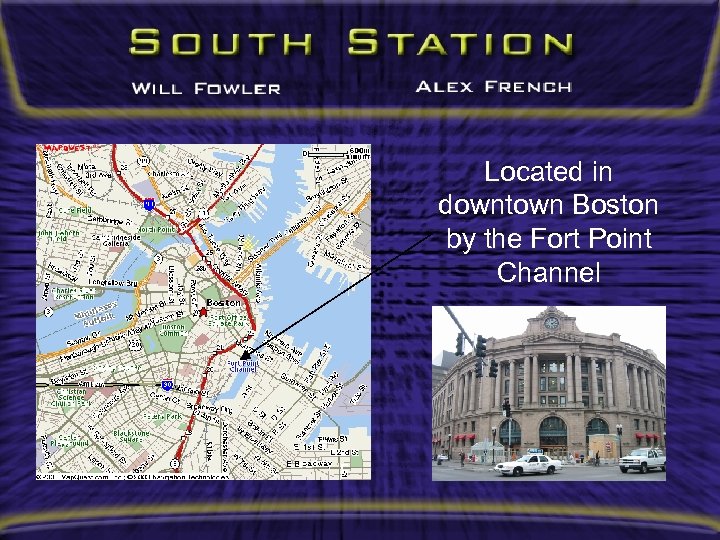
Located in downtown Boston by the Fort Point Channel
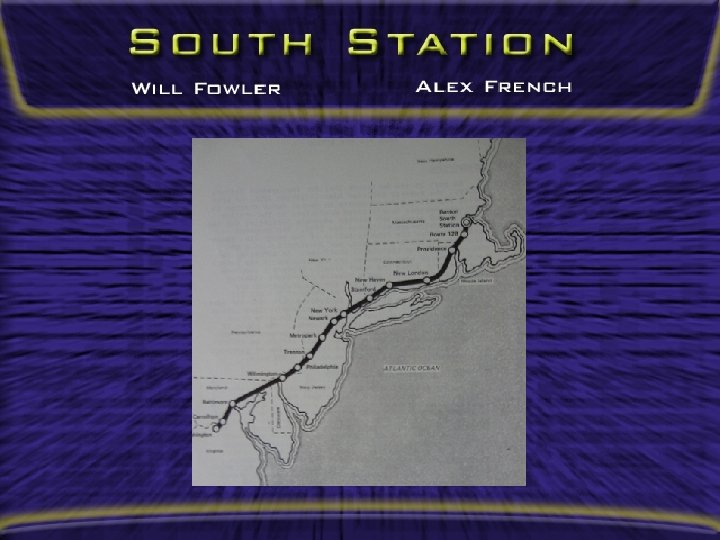
Overview • • • History of the Station Renovation of the Station (Costs) Effects of the Renovation (Benefits) Future Plans Conclusion – Beneficial Project
Sources • On Site – Mike Brennan, Codman Real Estate – South Station Air Rights Project Update (Jan. 2002) • State Transportation Library – MBTA Ridership and Service Statistics (1988, 1991, 2001) – South Station Improvement Project, Final Environmental Impact Statement (1981) – Boston South Station Revival (1989) – George Sandborne • Boston Public Library – Photo Archives • MIT – Prof. Fredrick Salvucci
History • Before South Station – Multiple Railroad Stations – Need for Centralization • Funding – 5 private companies purchased $100, 000 of stock each – $14. 5 million in public bonds at 3. 5% interest • Expenses – 35 acres of land: $9 million – City of Boston spent $2 million relocating roads and utilities – $3. 6 million to build headhouse, trainshed and support buildings
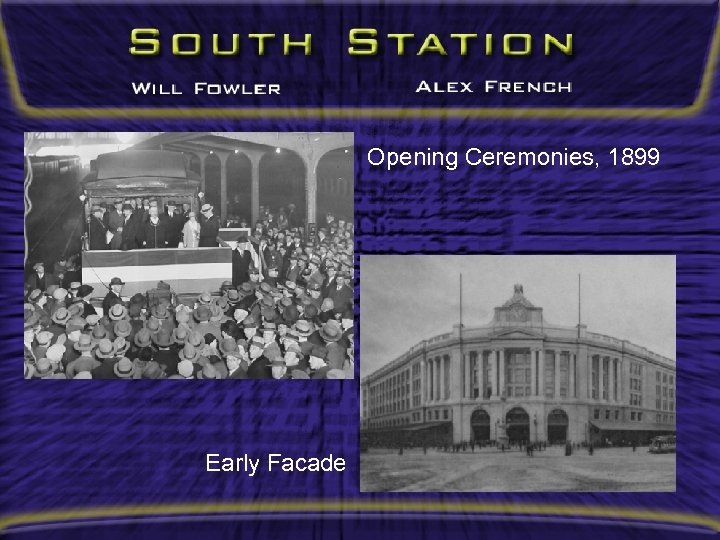
Opening Ceremonies, 1899 Early Facade
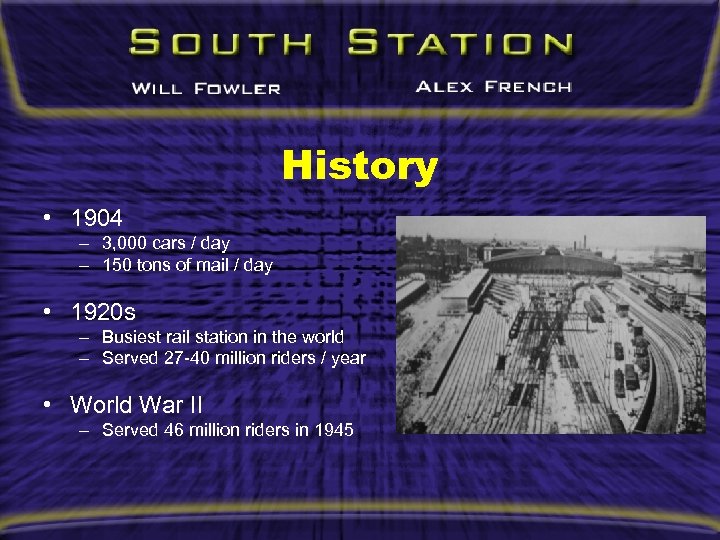
History • 1904 – 3, 000 cars / day – 150 tons of mail / day • 1920 s – Busiest rail station in the world – Served 27 -40 million riders / year • World War II – Served 46 million riders in 1945
History • Mid-Century Slump – Removal of Train Shed in 1930 – Ridership plummeted after World War II • Airplanes and automobiles • Post Office took over most of head house by 1960 • Catholic Chapel took over much remaining space • Commuter rail service reduced • Lunch counter and restaurant in head house closed.
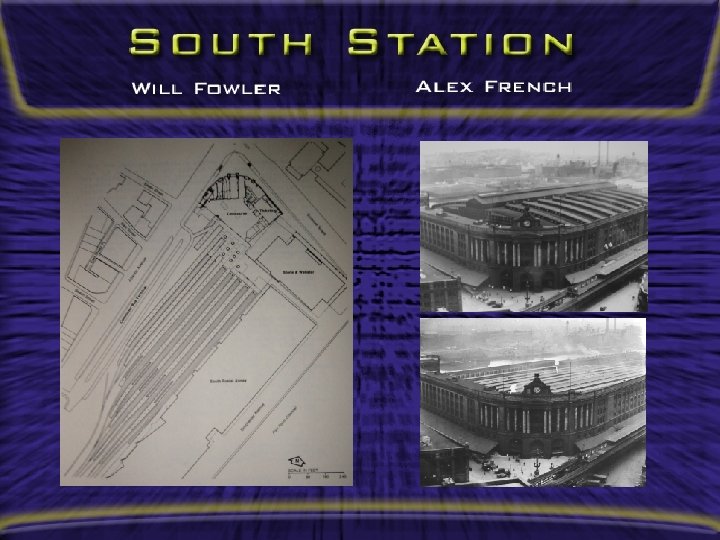
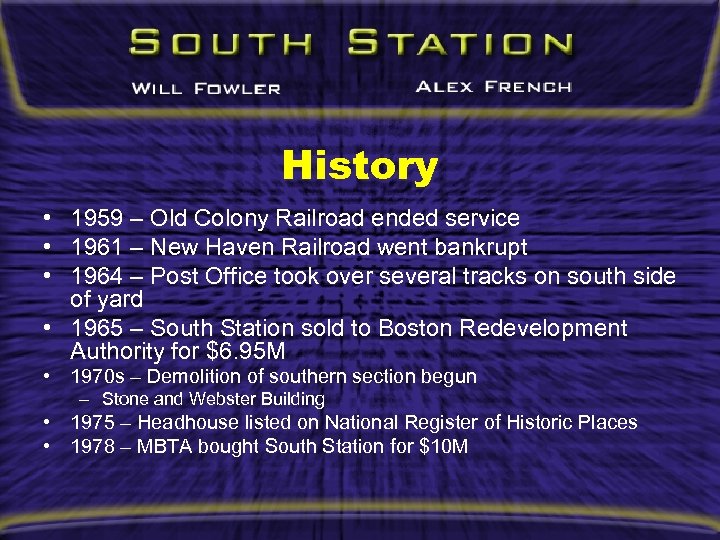
History • 1959 – Old Colony Railroad ended service • 1961 – New Haven Railroad went bankrupt • 1964 – Post Office took over several tracks on south side of yard • 1965 – South Station sold to Boston Redevelopment Authority for $6. 95 M • 1970 s – Demolition of southern section begun – Stone and Webster Building • 1975 – Headhouse listed on National Register of Historic Places • 1978 – MBTA bought South Station for $10 M
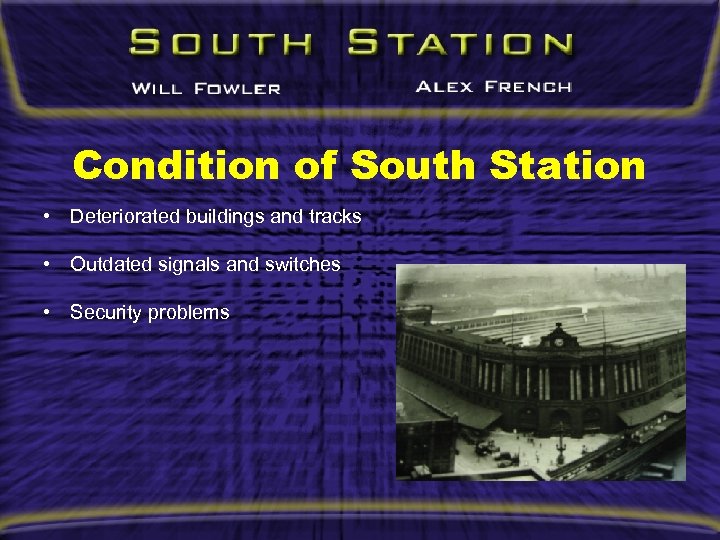
Condition of South Station • Deteriorated buildings and tracks • Outdated signals and switches • Security problems
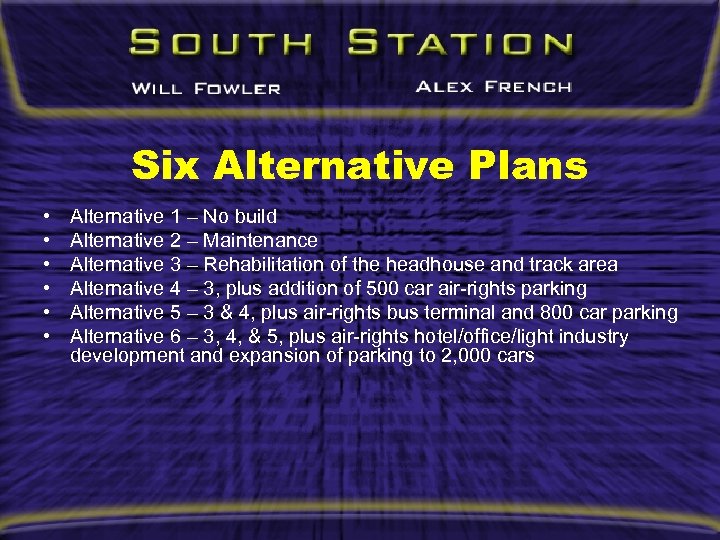
Six Alternative Plans • • • Alternative 1 – No build Alternative 2 – Maintenance Alternative 3 – Rehabilitation of the headhouse and track area Alternative 4 – 3, plus addition of 500 car air-rights parking Alternative 5 – 3 & 4, plus air-rights bus terminal and 800 car parking Alternative 6 – 3, 4, & 5, plus air-rights hotel/office/light industry development and expansion of parking to 2, 000 cars
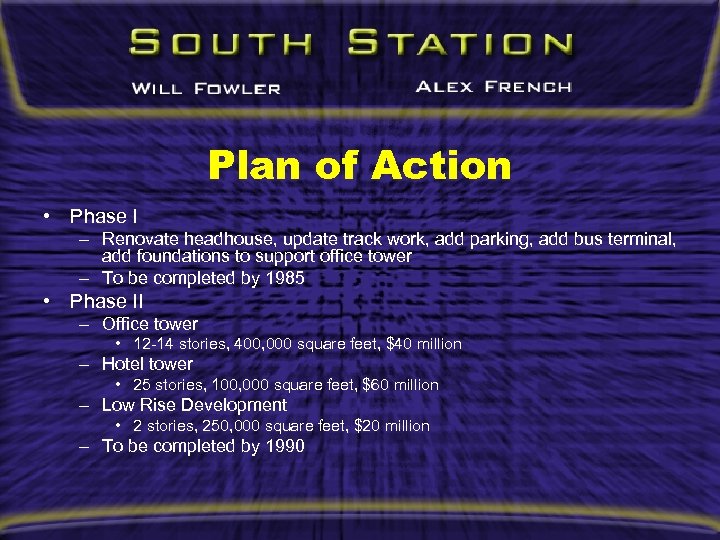
Plan of Action • Phase I – Renovate headhouse, update track work, add parking, add bus terminal, add foundations to support office tower – To be completed by 1985 • Phase II – Office tower • 12 -14 stories, 400, 000 square feet, $40 million – Hotel tower • 25 stories, 100, 000 square feet, $60 million – Low Rise Development • 2 stories, 250, 000 square feet, $20 million – To be completed by 1990
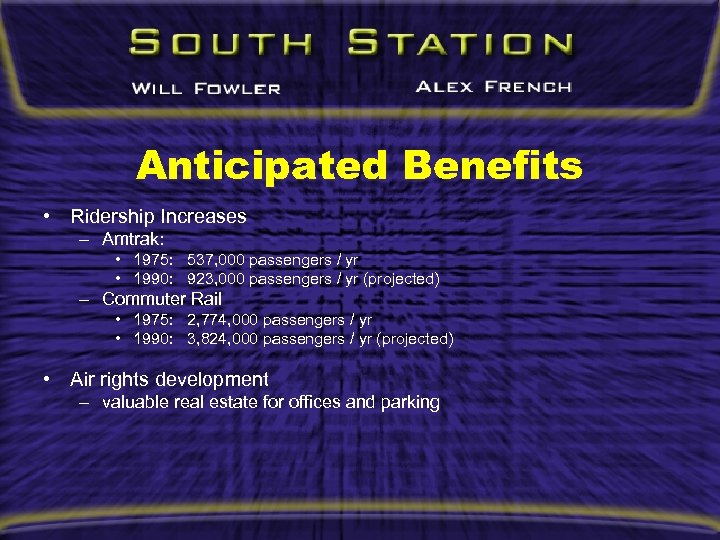
Anticipated Benefits • Ridership Increases – Amtrak: • 1975: 537, 000 passengers / yr • 1990: 923, 000 passengers / yr (projected) – Commuter Rail • 1975: 2, 774, 000 passengers / yr • 1990: 3, 824, 000 passengers / yr (projected) • Air rights development – valuable real estate for offices and parking
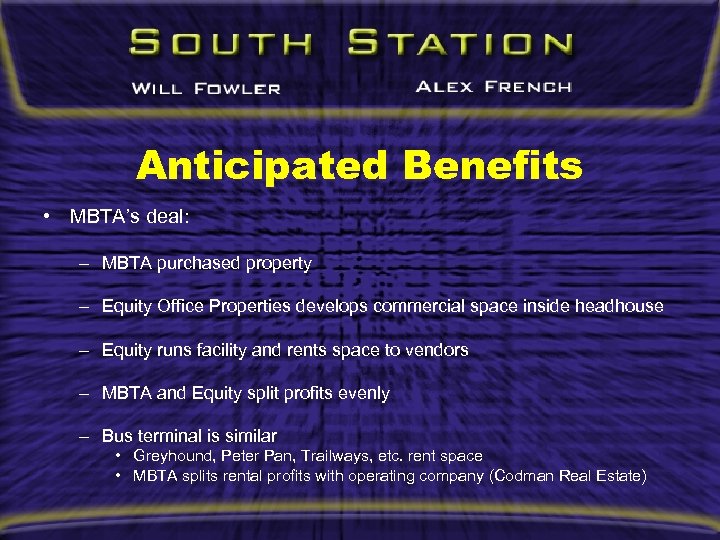
Anticipated Benefits • MBTA’s deal: – MBTA purchased property – Equity Office Properties develops commercial space inside headhouse – Equity runs facility and rents space to vendors – MBTA and Equity split profits evenly – Bus terminal is similar • Greyhound, Peter Pan, Trailways, etc. rent space • MBTA splits rental profits with operating company (Codman Real Estate)
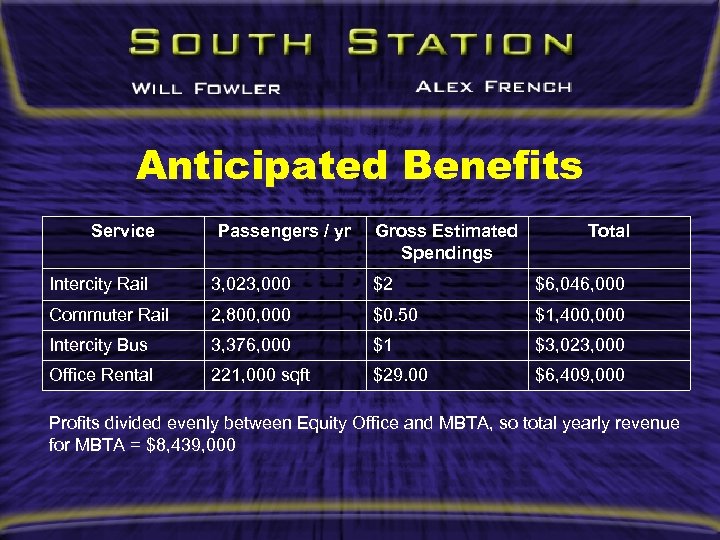
Anticipated Benefits Service Passengers / yr Gross Estimated Spendings Total Intercity Rail 3, 023, 000 $2 $6, 046, 000 Commuter Rail 2, 800, 000 $0. 50 $1, 400, 000 Intercity Bus 3, 376, 000 $1 $3, 023, 000 Office Rental 221, 000 sqft $29. 00 $6, 409, 000 Profits divided evenly between Equity Office and MBTA, so total yearly revenue for MBTA = $8, 439, 000
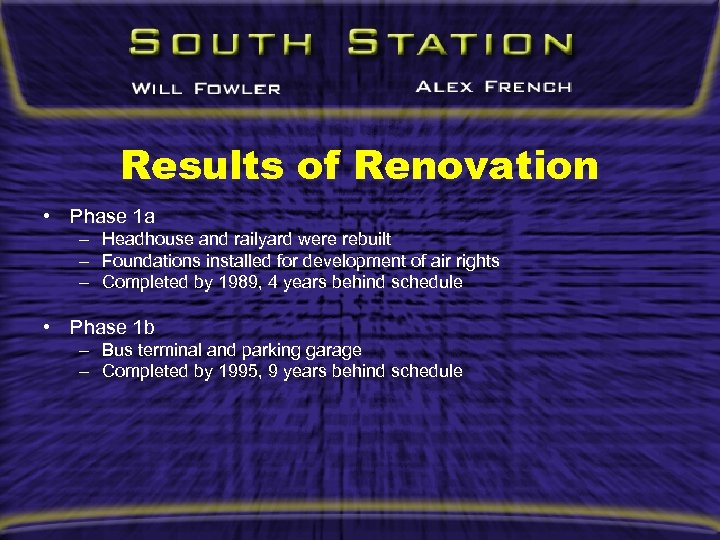
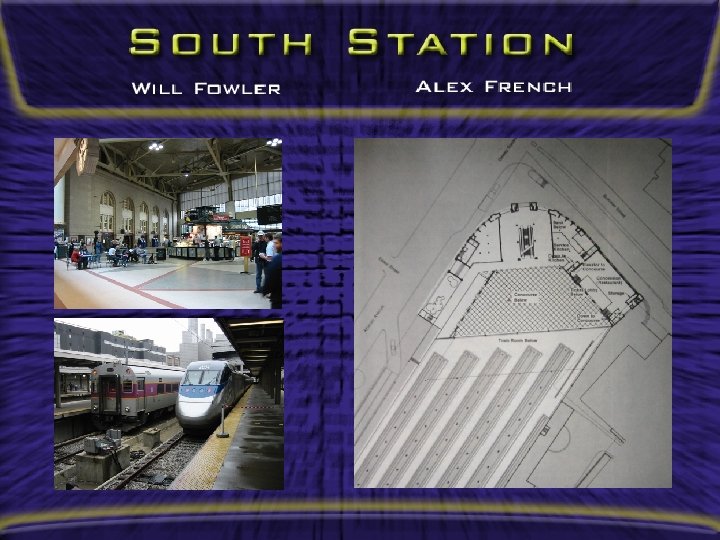
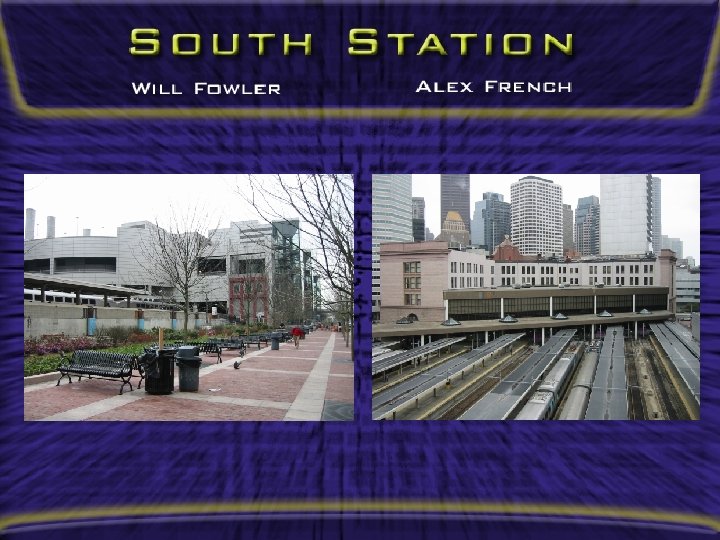
Results of Renovation • Phase 1 a – Headhouse and railyard were rebuilt – Foundations installed for development of air rights – Completed by 1989, 4 years behind schedule • Phase 1 b – Bus terminal and parking garage – Completed by 1995, 9 years behind schedule
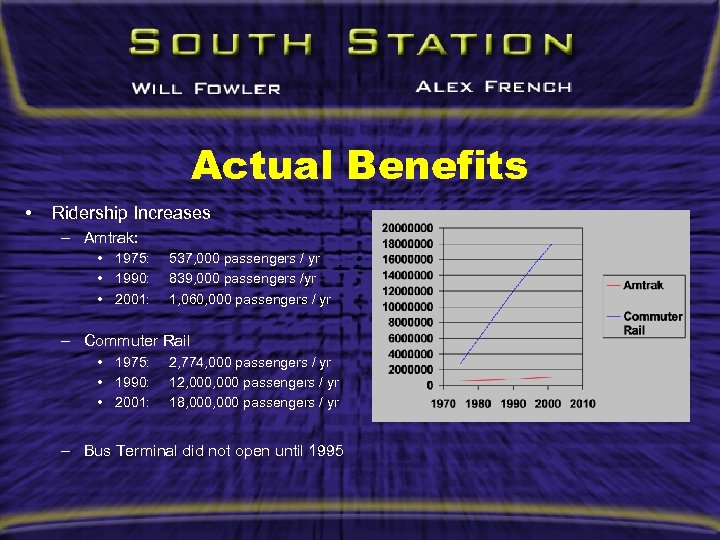
Actual Benefits • Ridership Increases – Amtrak: • 1975: • 1990: • 2001: 537, 000 passengers / yr 839, 000 passengers /yr 1, 060, 000 passengers / yr – Commuter Rail • 1975: • 1990: • 2001: 2, 774, 000 passengers / yr 12, 000 passengers / yr 18, 000 passengers / yr – Bus Terminal did not open until 1995
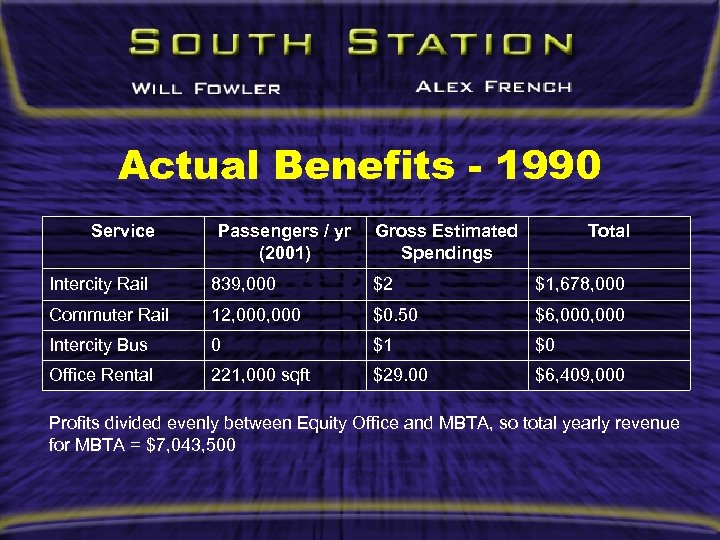
Actual Benefits - 1990 Service Passengers / yr (2001) Gross Estimated Spendings Total Intercity Rail 839, 000 $2 $1, 678, 000 Commuter Rail 12, 000 $0. 50 $6, 000 Intercity Bus 0 $1 $0 Office Rental 221, 000 sqft $29. 00 $6, 409, 000 Profits divided evenly between Equity Office and MBTA, so total yearly revenue for MBTA = $7, 043, 500
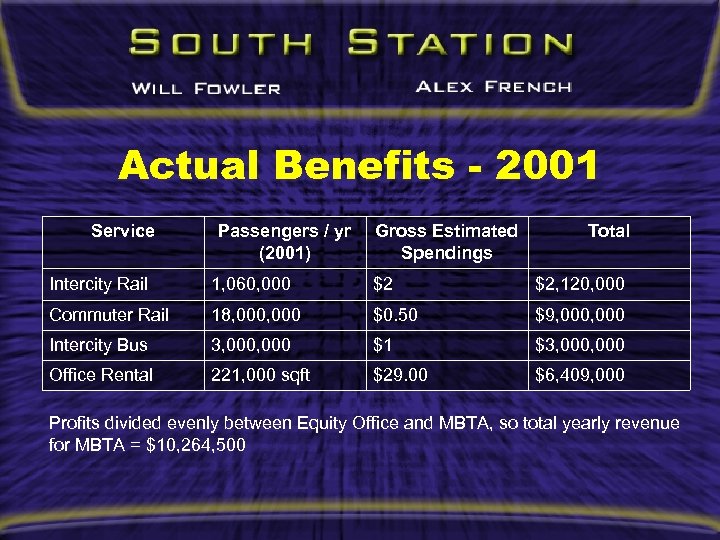
Actual Benefits - 2001 Service Passengers / yr (2001) Gross Estimated Spendings Total Intercity Rail 1, 060, 000 $2 $2, 120, 000 Commuter Rail 18, 000 $0. 50 $9, 000 Intercity Bus 3, 000 $1 $3, 000 Office Rental 221, 000 sqft $29. 00 $6, 409, 000 Profits divided evenly between Equity Office and MBTA, so total yearly revenue for MBTA = $10, 264, 500
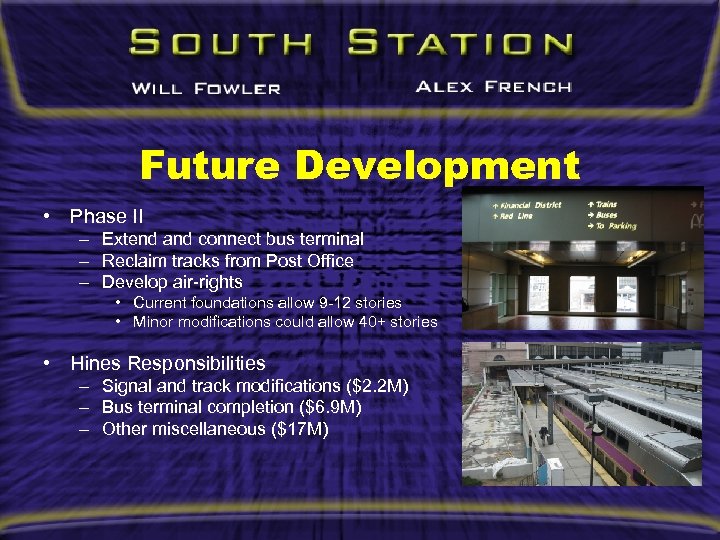
Future Development • Phase II – Extend and connect bus terminal – Reclaim tracks from Post Office – Develop air-rights • Current foundations allow 9 -12 stories • Minor modifications could allow 40+ stories • Hines Responsibilities – Signal and track modifications ($2. 2 M) – Bus terminal completion ($6. 9 M) – Other miscellaneous ($17 M)
Benefits to the City • City of Boston Linkage Payments – $11. 9 M to city • City of Boston Property Taxes – Estimated $9 M / yr • Job creation – 2, 600 short term construction jobs – 600 permanent service jobs – Office space for 6, 000 permanent office employees, ideally located in Financial District
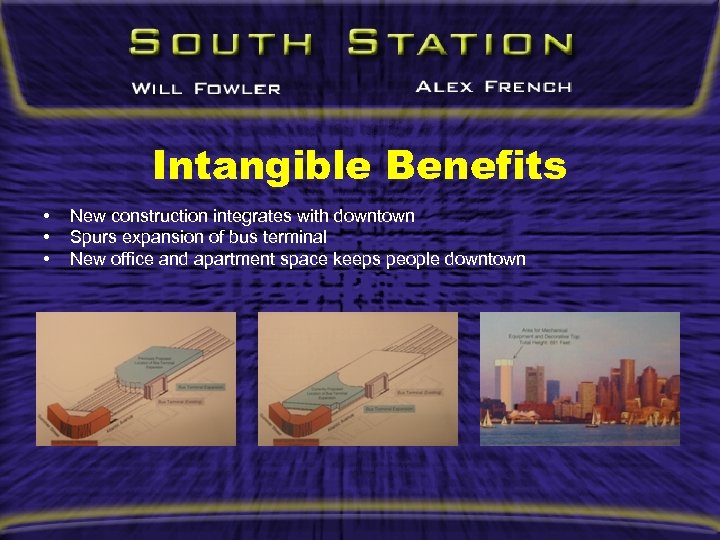
Intangible Benefits • • • New construction integrates with downtown Spurs expansion of bus terminal New office and apartment space keeps people downtown
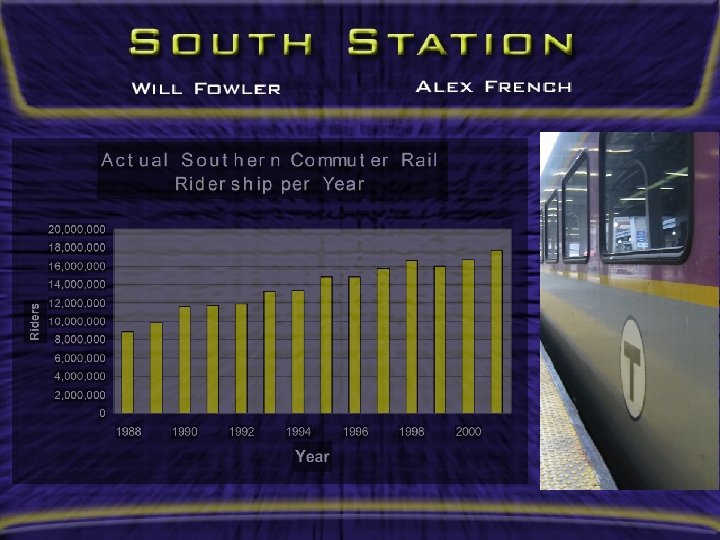
Summary • Project was beneficial • Commuter rail experienced tremendous increase in ridership • Intercity rail increased slowly • Bus terminal increases traffic through station, helps bus companies • Traffic through station makes food court profitable • Office space provides steady income
Скачать презентацию Located in downtown Boston by the Fort Point
1fea6a59d442090f86854c0ae4ef94ea.ppt