 Скачать презентацию Locarto Mobile Mapping to Promote Economic Development and
52f51328eaaacfd5f6a4ea63e581db73.ppt
- Количество слайдов: 2



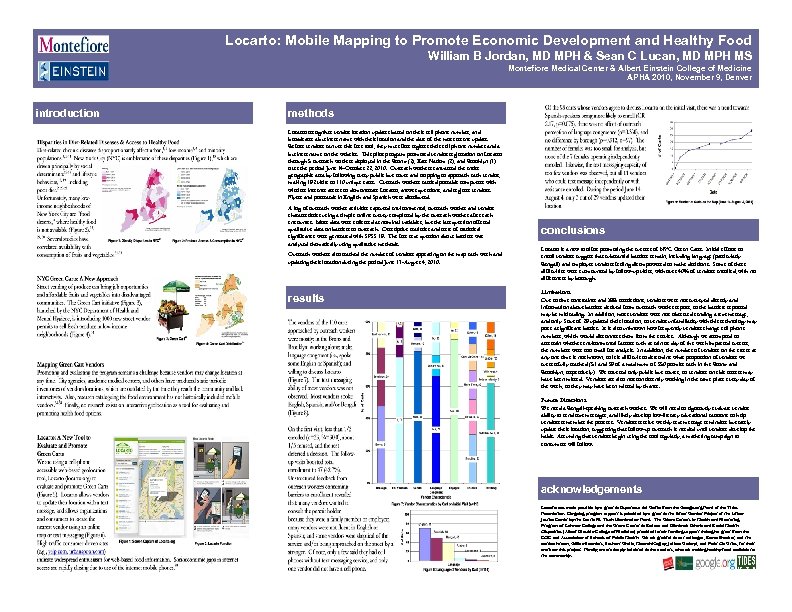
Locarto: Mobile Mapping to Promote Economic Development and Healthy Food William B Jordan, MD MPH & Sean C Lucan, MD MPH MS Montefiore Medical Center & Albert Einstein College of Medicine APHA 2010, November 9, Denver introduction methods Locarto recognizes vendor location updates based on their cell phone number, and broadcasts a business name with their location and the date of the most recent update. Before vendors can use this free tool, they must first register their cell phone number and a business name on the website. This pilot program promoted vendor registration on Locarto through 5 outreach workers deployed in the Bronx (2), East Harlem (2), and Brooklyn (1) over the period June 14 -October 22, 2010. Outreach workers canvassed the entire geographic area by following every public bus route and stopping to approach each vendor, making 192 visits to 110 unique carts. Outreach workers carried portable computers with wireless internet access to demonstrate Locarto, answer questions, and register vendors. Flyers and postcards in English and Spanish were distributed. A log of outreach worker activities captured environmental, outreach worker and vendor characteristics using a simple online survey completed by the outreach worker after each encounter. Most data were collected as nominal variables, but the last question offered qualitative data on barriers to outreach. Descriptive statistics and tests of statistical significance were generated with SPSS 19. The free text question about barriers was analyzed thematically using qualitative methods. Outreach workers also tracked the number of vendors appearing on the map each week and updating their location during the period June 17 -August 4, 2010. results conclusions Locarto is a new tool for promoting the success of NYC Green Carts. Initial efforts to enroll vendors suggest that substantial barriers remain, including language (particularly Bengali) and employee vendors feeling disempowered to make decisions. Some of these difficulties were surmounted by follow-up visits, with over 40% of vendors enrolled, with no differences by borough. Limitations Due to time constraints and IRB restrictions, vendors were not surveyed directly and information about barriers derived from outreach worker report, so the barriers reported may be misleading. In addition, most vendors were not observed sending a text message, and only 3 out of 29 updated their location, so vendor unfamiliarity with this technology may pose a significant barrier. It is also unknown how frequently vendors change cell phone numbers, which would disconnect them from the service. Although we attempted to ascertain whether environmental factors such as rain or day of the week impacted success, the numbers were too small for analysis. In addition, the number of vendors on the street at any one time is not known, so it is difficult to determine what proportion of vendors we successfully reached (51 and 39 of a maximum of 350 permits each in the Bronx and Brooklyn, respectively). We covered only public bus routes, so vendors on side streets may have been missed. Vendors are also not consistently working in the same place every day of the week, so they may have been missed by chance. Future Directions We need a Bengali-speaking outreach worker. We will need to rigorously evaluate vendor ability to send text messages, and likely develop low-literacy educational cartoons to help vendors remember the process. Vendors receive weekly text message reminders but rarely update their location, suggesting that follow-up outreach is needed until vendors develop the habit. Assuming that vendors begin using the tool regularly, a marketing campaign to consumers will follow. acknowledgements Locarto was made possible by a grant to Esperanza del Barrio from the Google. org Fund of the Tides Foundation. Ongoing program support is provided by a grant to the Street Vendor Project of the Urban Justice Center by the Laurie M. Tisch Illumination Fund. The Bronx Careers in Health and Mentoring Program of Lehman College and the Bronx Center to Reduce and Eliminate Ethnic and Racial Health Disparities (Albert Einstein College of Medicine) provided intern funding support through a grant from the CDC and Association of Schools of Public Health. We are grateful to our colleague, Renee Shanker, and the outreach team, Gillian Saunders, Sushant Bhalla, Hannah Kegley, Juliana Berenyi, and Peter De Vries, for their work on this project. Finally, we are deeply indebted to the vendors, who are making healthy food available to the community.
CONTACT William Jordan wjordan@montefiore. org REFERENCES 1. Gracey M. Child health implications of worldwide urbanization. Reviews on Environmental Health 2003; 18(1): 51 -63. 2. Miller DK, Carter ME, Sigmund RH, et al. Nutritional risk in inner-city-dwelling older black Americans. Journal of the American Geriatrics Society 1996; 44(8): 959 -62. 3. Candib LM. Obesity and diabetes in vulnerable populations: reflection on proximal and distal causes. Annals of Family Medicine 2007; 5(6): 547 -56. 4. Sharma S, Malarcher AM, Giles WH, Myers G. Racial, ethnic and socioeconomic disparities in the clustering of cardiovascular disease risk factors. Ethn Dis 2004; 14(1): 43 -8. 5. Hedley AA, Ogden CL, Johnson CL, Carroll MD, Curtin LR, Flegal KM. Prevalence of Overweight and Obesity Among US Children, Adolescents, and Adults, 1999 -2002. JAMA 2004; 291(23): 2847 -2850. 6. Bolen JC, Rhodes L, Powell-Griner EE, Bland SD, Holtzman D. State-specific prevalence of selected health behaviors, by race and ethnicity--Behavioral Risk Factor Surveillance System, 1997. MMWR CDC Surveill Summ 2000; 49(2): 1 -60. 7. Recent trends in mortality rates for four major cancers, by sex and race/ethnicity--United States, 1990 -1998. MMWR Morb Mortal Wkly Rep 2002; 51(3): 49 -53. 8. Disparities in premature deaths from heart disease--50 States and the District of Columbia, 2001. MMWR Morb Mortal Wkly Rep 2004; 53(6): 121 -5. 9. Racial/ethnic disparities in prevalence, treatment, and control of hypertension--United States, 1999 -2002. MMWR Morb Mortal Wkly Rep 2005; 54(1): 7 -9. 10. Age-specific excess deaths associated with stroke among racial/ethnic minority populations--United States, 1997. MMWR Morb Mortal Wkly Rep 2000; 49(5): 94 -7. 11. Kumanyika S. Nutrition and chronic disease prevention: priorities for US minority groups. Nutrition Reviews 2006; 64(2 Pt 2): S 9 -14. 12. NYC DOHMH. Eat Street Smart. In. New York, NY: NYC DOHMH; 2008. 13. Goranson C, Jasek J, Olson C, Greene C. The New York City Community Health Survey Atlas, 2008. In: The New York City Department of Health and Mental Hygiene; 2010. 14. NYC DOHMH. ‘Green Carts’ Will Increase Access to Healthy Foods, Improving the Health of an Estimated 75, 000 New Yorkers. Proposed Amendment to the New York City Administrative Code. In. New York, NY: NYC DOHMH; 2008. 15. Link BG, Phelan J. Social conditions as fundamental causes of disease. J Health Soc Behav 1995; Spec No: 80 -94. 16. House JS. Understanding social factors and inequalities in health: 20 th century progress and 21 st century prospects. J Health Soc Behav 2002; 43(2): 125 -42. 17. Schulz A, Northridge ME. Social determinants of health: implications for environmental health promotion. Health Educ Behav 2004; 31(4): 455 -71. 18. Mokdad AH, Marks JS, Stroup DF, Gerberding JL. Actual causes of death in the United States, 2000. JAMA 2004; 291(10): 1238 -45. 19. Mokdad AH, Marks JS, Stroup DF, Gerberding JL. Correction: actual causes of death in the United States, 2000. JAMA 2005; 293(3): 293 -4. 20. Devine CM, Wolfe WS, Frongillo EA, Jr. , Bisogni CA. Life-course events and experiences: association with fruit and vegetable consumption in 3 ethnic groups. Journal of the American Dietetic Association 1999; 99(3): 309 -14. 21. Hargreaves MK, Baquet C, Gamshadzahi A. Diet, nutritional status, and cancer risk in American blacks. Nutrition & Cancer 1989; 12(1): 1 -28. 22. Jen KLC, Brogan K, Washington OGM, Flack JM, Artinian NT. Poor nutrient intake and high obese rate in an urban African American population with hypertension. Journal of the American College of Nutrition 2007; 26(1): 57 -65. 23. Bazzano LA, Serdula MK, Liu S. Dietary intake of fruits and vegetables and risk of cardiovascular disease. Current Atherosclerosis Reports 2003; 5(6): 492 -9. 24. Liu S, Manson JE, Lee IM, et al. Fruit and vegetable intake and risk of cardiovascular disease: the Women's Health Study. Am J Clin Nutr 2000; 72(4): 922 -8. 25. Kapiszewska M. A vegetable to meat consumption ratio as a relevant factor determining cancer preventive diet. The Mediterranean versus other European countries. Forum of Nutrition 2006; 59: 130 -53. 26. Rolls BJ, Ello-Martin JA, Tohill BC. What can intervention studies tell us about the relationship between fruit and vegetable consumption and weight management? Nutrition Reviews 2004; 62(1): 1 -17. 27. He FJ, Nowson CA, Mac. Gregor GA. Fruit and vegetable consumption and stroke: meta-analysis of cohort studies. [see comment]. Lancet 2006; 367(9507): 320 -6. 28. Vainio H, Weiderpass E. Fruit and vegetables in cancer prevention. Nutrition & Cancer 2006; 54(1): 111 -42. 29. Gordon C, Ghai N, Purciel M, Talwalkar A, Goodman A. Eating Well in Harlem: How Available Is Healthy Food? In. New York: NYC DOHMH; 2007. 30. Graham R, Kaufman L, Novoa Z, Karpati A. Eating in, eating out, eating well: Access to healthy food in North and Central Brooklyn. In. New York: NYC DOHMH; 2006. 31. Morland K, Wing S, Diez Roux A. The contextual effect of the local food environment on residents' diets: the atherosclerosis risk in communities study. American Journal of Public Health 2002; 92(11): 1761 -7. 32. Creatore MI, Ross K, Gozdyra P, Glazier RH, Tynan AM, Booth GL. Chapter 8: Healthy Food and Diabetes. In: Diabetes in Toronto: Institute for Clinical Evaluative Sciences; 2007: 186 -206. 33. Rose D, Richards R. Food store access and household fruit and vegetable use among participants in the US Food Stamp Program. Public Health Nutrition 2004; 7(8): 1081 -8. 34. Morland K, Wing S, Diez Roux A. The contextual effect of the local food environment on residents' diets: the atherosclerosis risk in communities study. Am J Public Health 2002; 92(11): 1761 -7. 35. Pearce J, Hiscock R, Blakely T, Witten K. The contextual effects of neighbourhood access to supermarkets and convenience stores on individual fruit and vegetable consumption. J Epidemiol Community Health 2008; 62(3): 198 -201. 36. Pearce J, Hiscock R, Blakely T, Witten K. A national study of the association between neighbourhood access to fast-food outlets and the diet and weight of local residents. Health Place 2009; 15(1): 193 -7. 37. Franco M, Diez-Roux AV, Nettleton JA, et al. Availability of healthy foods and dietary patterns: the Multi-Ethnic Study of Atherosclerosis. Am J Clin Nutr 2009. 38. Raja S, Ma, C. , Yadav, P. Beyond Food Deserts: Measuring and Mapping Racial Disparities in Neighborhood Food Environments. Journal of Planning Education and Research 2008; 27: 469 -482. 39. Horrigan J. Wireless Internet Use. In: Pew Internet & American Life Project: Pew Research Center; 2009.
Скачать презентацию Locarto Mobile Mapping to Promote Economic Development and
52f51328eaaacfd5f6a4ea63e581db73.ppt