


 Скачать презентацию Localization Positioning 1 2018 3 16 Goals of
16a11d54be94c91353a99f8f1f2aaa21.ppt
- Количество слайдов: 37
 Localization & Positioning 1 2018/3/16
 Goals of this chapter Means for a node to determine its physical position with respect to some coordinate system (50, 27) or symbolic location (in a living room) Using the help of 2 Anchor nodes that know their position Directly adjacent nodes Over multiple hops 2018/3/16
 Outline 3 7. 1 Properties of localization and positioning procedures 7. 2 Possible approaches 7. 3 Mathematical basics for the lateration problem 7. 4 Positioning in multi-hop environments 7. 5 Positioning assisted by anchors 2018/3/16
 7. 1 Properties of localization and positioning procedures Physical position versus logical location 4 Coordinate system: position Symbolic reference: location Absolute versus relative coordinate Centralized or distributed computation Localized versus centralized computation Limitations: GPS for example, does not work indoors Scale (indoors, outdoors, global, …) 2018/3/16
 Properties of localization and positioning procedures (cont. ) Accuracy how close is an estimated position to the real position? Precision the ratio with which a given accuracy is reached 5 Costs, energy consumption, … 2018/3/16
 7. 2 Possible approaches Proximity (Tri-/Multi-) lateration and angulation The most evident form of it is to analyze pictures taken by a camera Other measurable characteristic ‘fingerprints’ of a given location can be used for scene analysis e. g. , RADAR Bounding box 6 Lateration : when distances between nodes are used Angulation: when angles between nodes are used Scene analysis A node wants to determine its position or location in the proximity of an anchor to bound the possible positions of a node 2018/3/16
 Proximity (range-free approach) Using information of a node’s neighborhood Exploit finite range of wireless communication e. g. , easy to determine location in a room with infrared (room number announcements) 7 2018/3/16
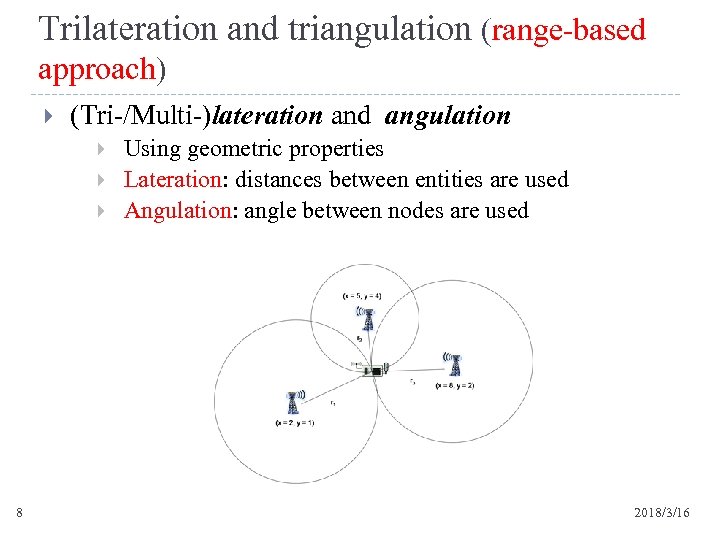 Trilateration and triangulation (range-based approach) (Tri-/Multi-)lateration and angulation 8 Using geometric properties Lateration: distances between entities are used Angulation: angle between nodes are used 2018/3/16
 Trilateration and triangulation (cont. ) Determining distances 9 To use (multi-)lateration, estimates of distances to anchor nodes are required. This ranging process ideally leverages the facilities already present on a wireless node, in particular, the radio communication device. The most important characteristics are Received Signal Strength Indicator (RSSI), Time of Arrival (To. A), and Time Difference of Arrival (TDo. A). 2018/3/16
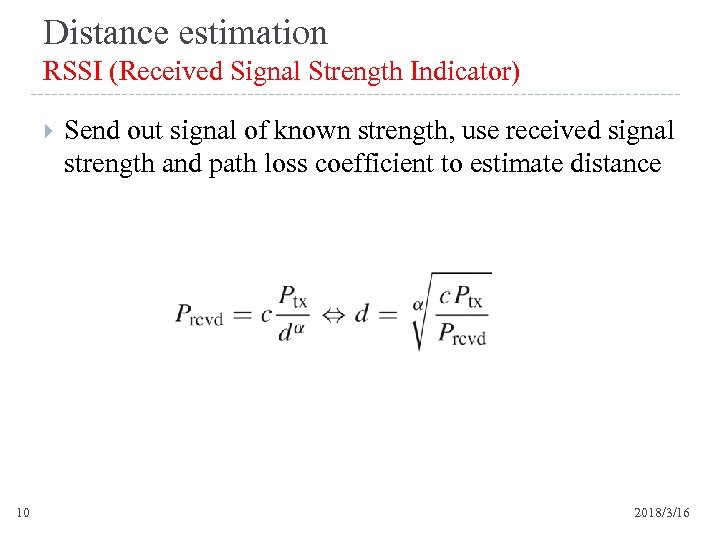 Distance estimation RSSI (Received Signal Strength Indicator) 10 Send out signal of known strength, use received signal strength and path loss coefficient to estimate distance 2018/3/16
 Distance estimation RSSI (cont. ) Problem: Highly error-prone process : 11 Caused by fast fading, mobility of the environment Solution: repeated measurement and filtering out incorrect values by statistical techniques Cheap radio transceivers are often not calibrated Same signal strength result in different RSSI Actual transmission power different from the intended power Combination with multipath fading Signal attenuation along an indirect path is higher than along a direct path Solution: No! 2018/3/16
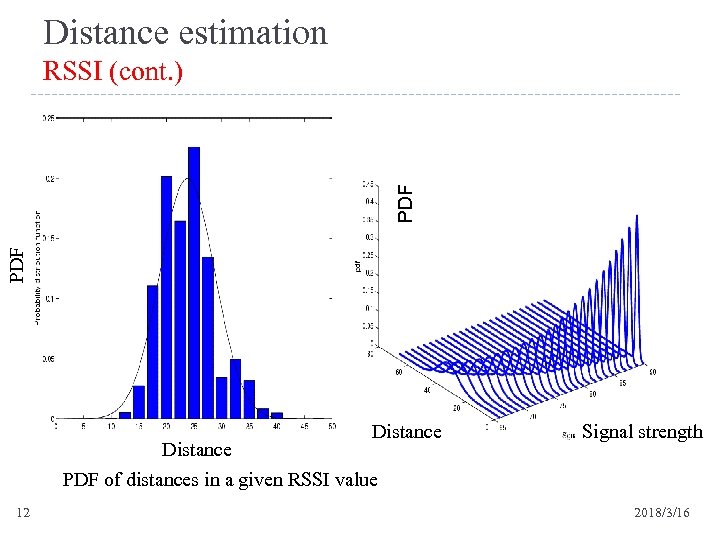 Distance estimation PDF RSSI (cont. ) Distance PDF of distances in a given RSSI value 12 Signal strength 2018/3/16
 Distance estimation To. A (Time of arrival ) Use 13 time of transmission, propagation speed Problem: Exact time synchronization Usually, sound wave is used But propagation speed of sound depends on temperature or humidity 2018/3/16
 Distance estimation TDo. A (Time Difference of Arrival ) Use two different signals with different propagation speeds 14 Compute difference between arrival times to compute distance Example: ultrasound and radio signal (Cricket System) Propagation time of radio negligible compared to ultrasound Problem: expensive/energy-intensive hardware 2018/3/16
 Scene analysis RADAR system: Comparing the received signal characteristics from multiple anchors with premeasured and stored characteristics values. 15 Radio environment has characteristic “fingerprints” The necessary off-line deployment for measuring the signal landscape cannot always be accommodated in practical systems. 2018/3/16
 Bounding Box 16 The bounding box method proposed in uses squares instead of circles as in tri-lateration to bound the possible positions of a node. For each reference node i, a bounding box is defined as a square with its center at the position of this node (xi, yi), with sides of size 2 di (where d is the estimated distance) and with coordinates (xi –di, yi–di) and (xi+di, yi+di). 2018/3/16
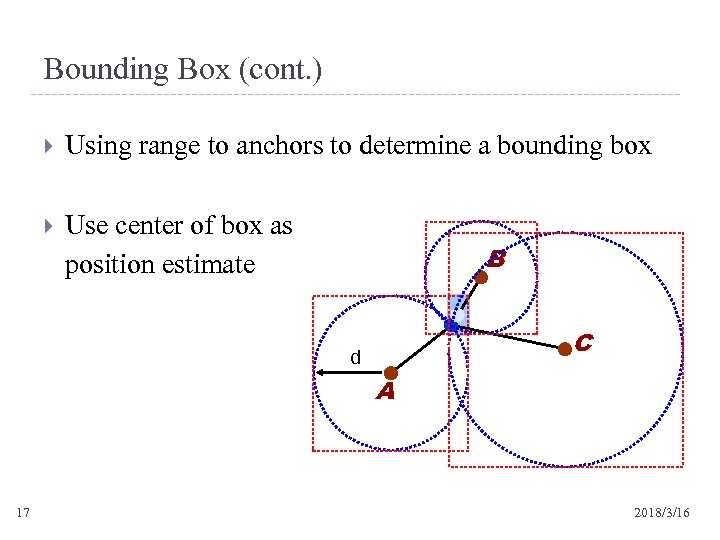 Bounding Box (cont. ) Using range to anchors to determine a bounding box Use center of box as position estimate B C d A 17 2018/3/16
 References C. Savarese, J. Rabay, and K. Langendoen. “Robust Positioning Algorithms for Distributed Ad-Hoc Wireless Sensor Networks, ” In Proceedings of the Annual USENIX Technical Conference, Monterey, CA, 2002. A. Savvides, C. -C. Han, and M. Srivastava. “Dynamic Fine-Grained Localization in Ad-Hoc Networks of Sensors, ” Proceedings of the 7 th Annual International Conference on Mobile Computing and Networking, pages 166– 179. ACM press, Rome, Italy, July 2001. 18 N. Bulusu, J. Heidemann, and D. Estrin. “GPS-Less Low Cost Outdoor Localization For Very Small Devices, ” IEEE Personal Communications Magazine, 7(5): 28– 34, 2000. S. Simic and S. Sastry, “Distributed localization in wireless ad hoc networks, ” UC Berkeley, Tech. rep. UCB/ERL M 02/26, 2002. 2018/3/16
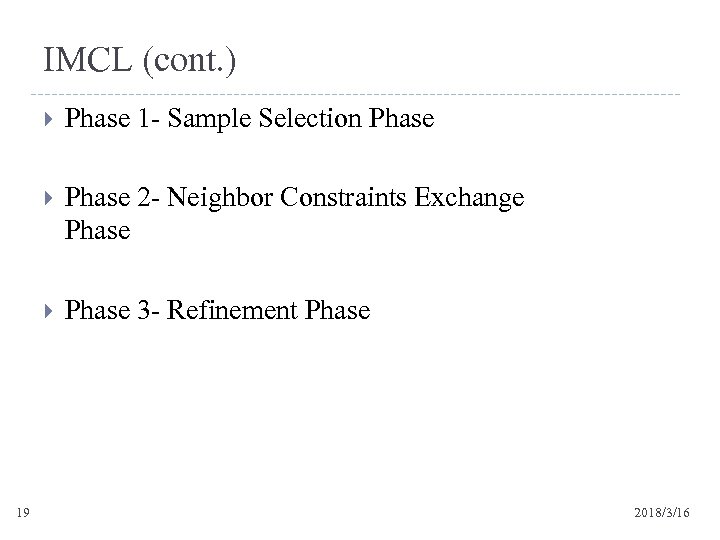 IMCL (cont. ) Phase 2 - Neighbor Constraints Exchange Phase 19 Phase 1 - Sample Selection Phase 3 - Refinement Phase 2018/3/16
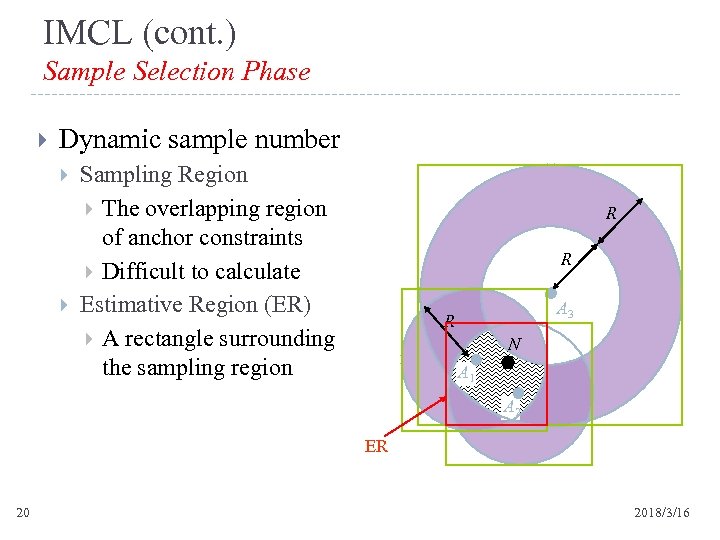 IMCL (cont. ) Sample Selection Phase Dynamic sample number Sampling Region The overlapping region of anchor constraints Difficult to calculate Estimative Region (ER) A rectangle surrounding the sampling region R R A 3 R N A 1 A 2 ER 20 2018/3/16
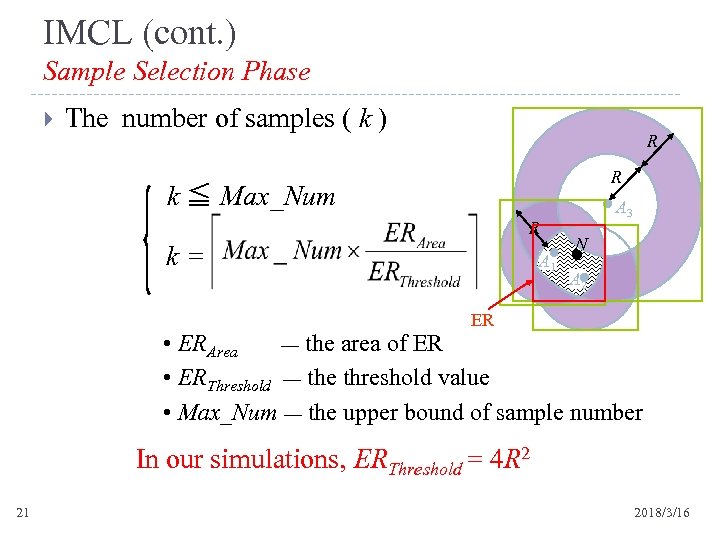 IMCL (cont. ) Sample Selection Phase The number of samples ( k ) R R k ≦ Max_Num R k= A 1 A 3 N A 2 ER • ERArea — the area of ER • ERThreshold — the threshold value • Max_Num — the upper bound of sample number In our simulations, ERThreshold = 4 R 2 21 2018/3/16
 IMCL (cont. ) Sample Selection Phase Using the prediction and filtering phase of MCL 22 Samples are randomly selected from the region extended Vmax from previous samples Filter new samples Near anchor constraints Farther anchor constraints 2018/3/16
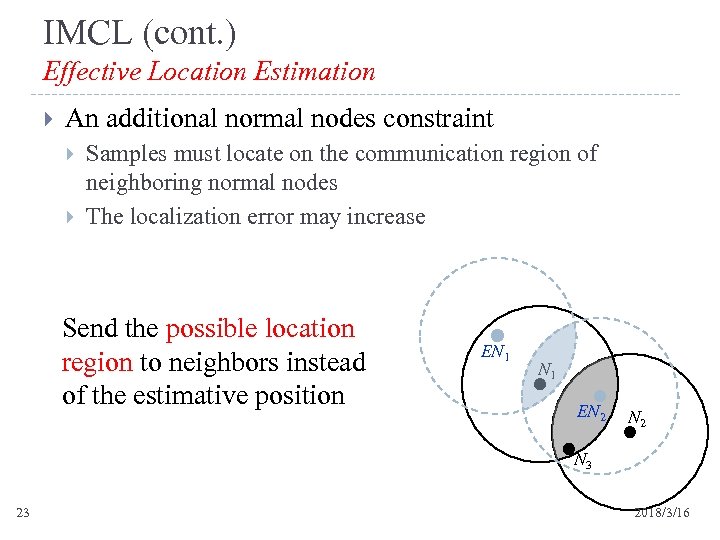 IMCL (cont. ) Effective Location Estimation An additional normal nodes constraint Samples must locate on the communication region of neighboring normal nodes The localization error may increase Send the possible location region to neighbors instead of the estimative position EN 1 EN 2 N 3 23 2018/3/16
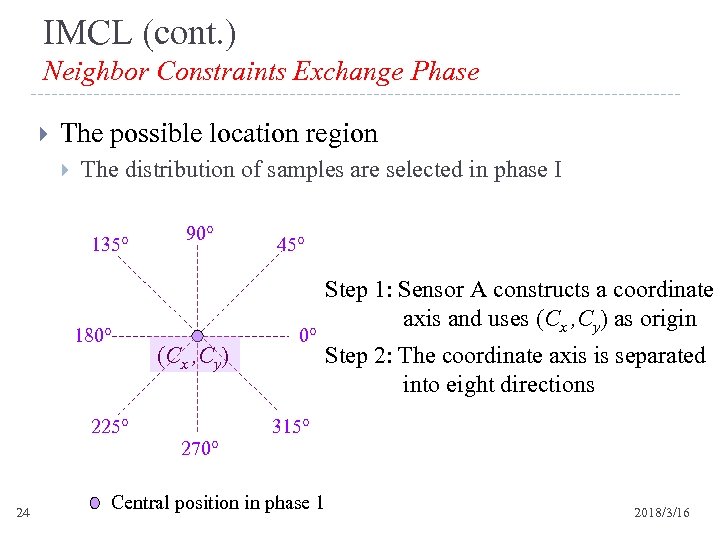 IMCL (cont. ) Neighbor Constraints Exchange Phase The possible location region The distribution of samples are selected in phase I 135° 180° 90° (Cx , Cy) 225° 45° 0° Step 1: Sensor A constructs a coordinate axis and uses (Cx , Cy) as origin Step 2: The coordinate axis is separated into eight directions 315° 270° 24 Central position in phase 1 2018/3/16
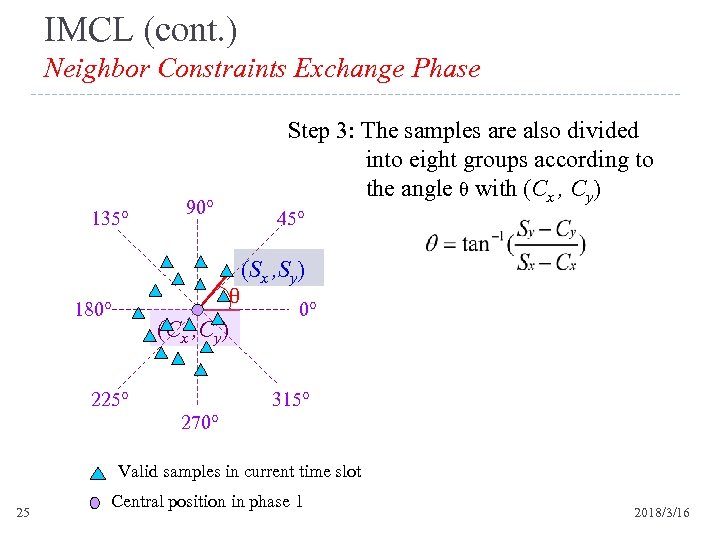 IMCL (cont. ) Neighbor Constraints Exchange Phase 135° Step 3: The samples are also divided into eight groups according to the angle θ with (Cx , Cy) 90° 45° θ 180° (Cx , Cy) 225° (Sx , Sy) 0° 315° 270° Valid samples in current time slot 25 Central position in phase 1 2018/3/16
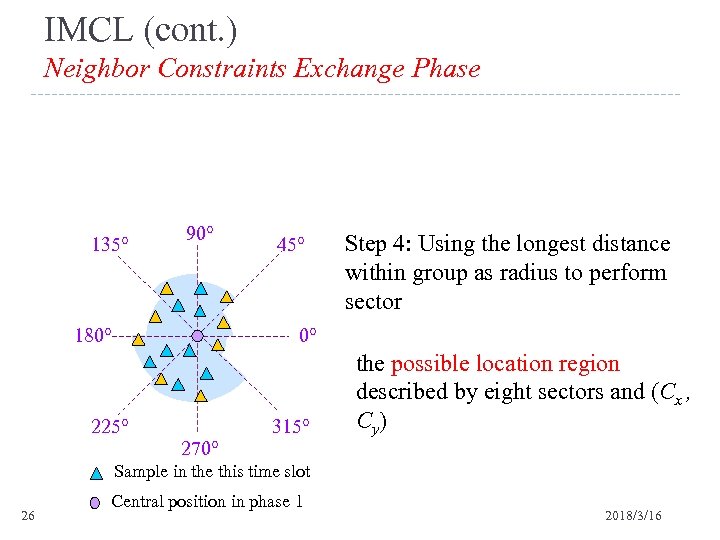 IMCL (cont. ) Neighbor Constraints Exchange Phase 135° 90° 180° 45° Step 4: Using the longest distance within group as radius to perform sector 0° 225° 315° 270° the possible location region described by eight sectors and (Cx , C y) Sample in the this time slot 26 Central position in phase 1 2018/3/16
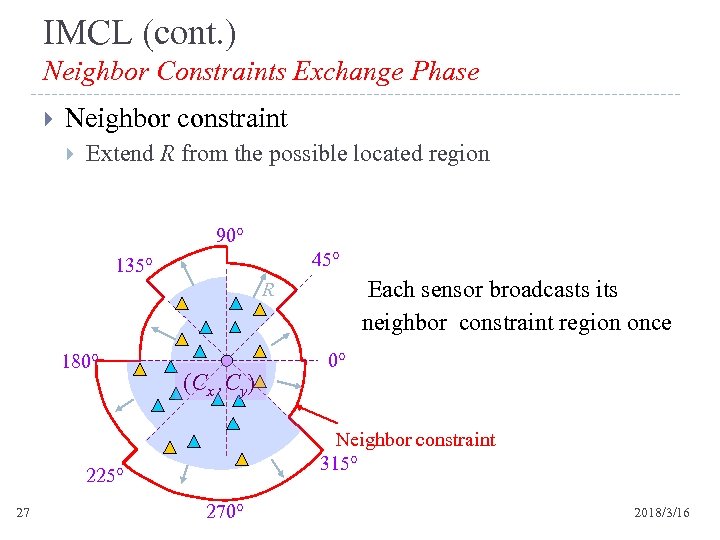 IMCL (cont. ) Neighbor Constraints Exchange Phase Neighbor constraint Extend R from the possible located region 90° 45° 135° Each sensor broadcasts its neighbor constraint region once R 180° (Cx , Cy) Neighbor constraint 315° 225° 27 0° 270° 2018/3/16
 IMCL (cont. ) Refinement Phase Samples are filtered When sample is not satisfy the constraints 28 Neighbor constraints Receive from neighboring normal nodes Moving constraint Predict the possible moving direction Normal node generates a valid sample to replace it 2018/3/16
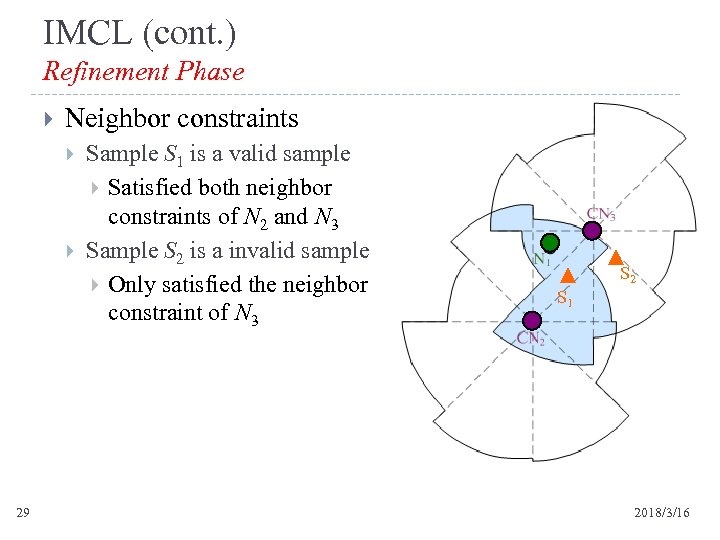 IMCL (cont. ) Refinement Phase Neighbor constraints 29 Sample S 1 is a valid sample Satisfied both neighbor constraints of N 2 and N 3 Sample S 2 is a invalid sample Only satisfied the neighbor constraint of N 3 S 2 S 1 2018/3/16
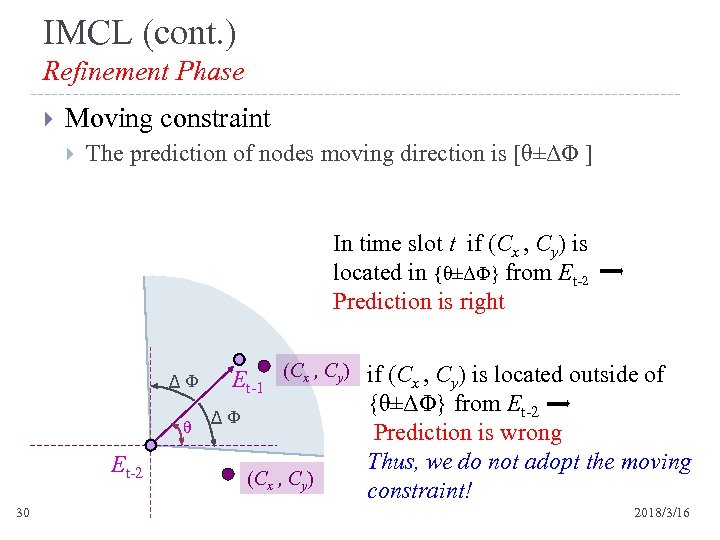 IMCL (cont. ) Refinement Phase Moving constraint The prediction of nodes moving direction is [θ±ΔΦ ] In time slot t if (Cx , Cy) is located in {θ±ΔΦ} from Et-2 Prediction is right Δ Φ θ Et-2 30 Et-1 (Cx , Cy) if (Cx , Cy) is located outside of {θ±ΔΦ} from Et-2 Δ Φ Prediction is wrong Thus, we do not adopt the moving (Cx , Cy) constraint! 2018/3/16
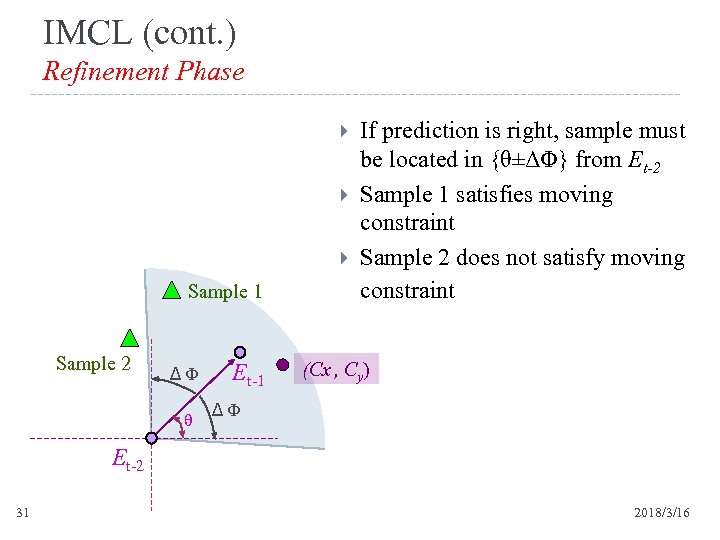 IMCL (cont. ) Refinement Phase Sample 1 Sample 2 Δ Φ θ Et-1 If prediction is right, sample must be located in {θ±ΔΦ} from Et-2 Sample 1 satisfies moving constraint Sample 2 does not satisfy moving constraint (Cx , Cy) Δ Φ Et-2 31 2018/3/16
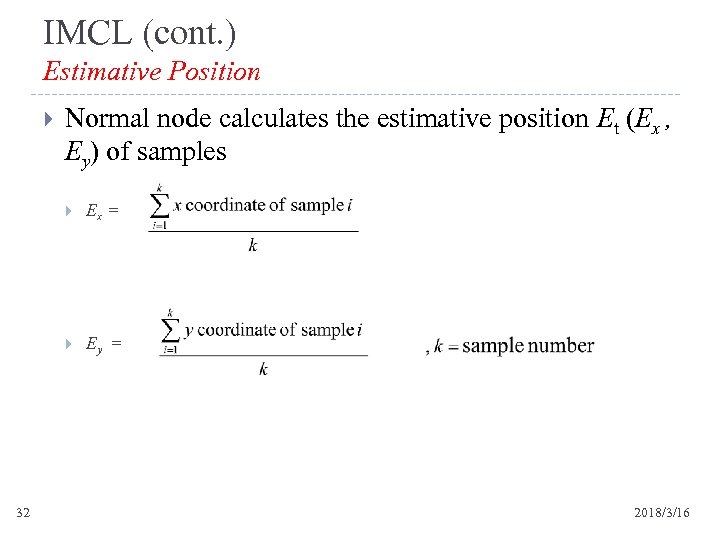 IMCL (cont. ) Estimative Position Normal node calculates the estimative position Et (Ex , Ey) of samples 32 Ex = Ey = 2018/3/16
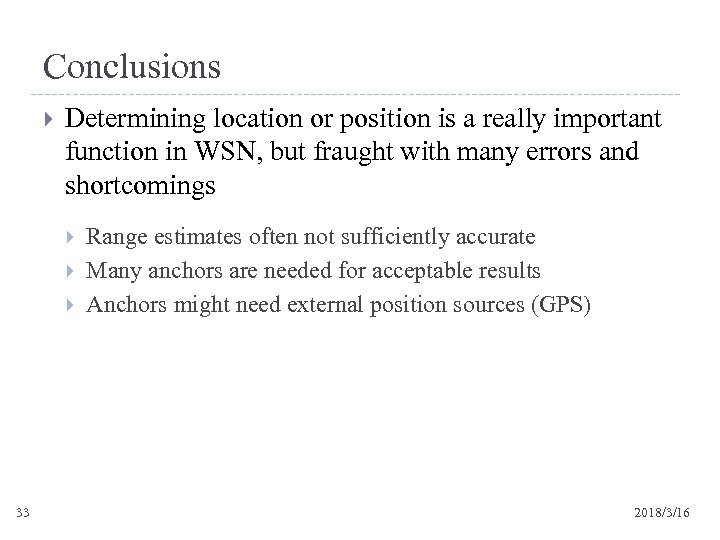 Conclusions Determining location or position is a really important function in WSN, but fraught with many errors and shortcomings 33 Range estimates often not sufficiently accurate Many anchors are needed for acceptable results Anchors might need external position sources (GPS) 2018/3/16
 References J. Hightower and G. Borriello. “Location Systems for Ubiquitous Computing, ” IEEE Computer, 34(8): 57– 66, 2001. J. Hightower and G. Borriello. “A Survey and Taxonomy of Location Systems for Ubiquitous Computing, ” Technical Report UW-CSE 01 -08 -03, University of Washington, Computer Science and Engineering, Seattle, WA, August 2001. A. Boukerche, H. Oliveira, E. Nakamura, and A. Loureiro. “Localization systems for wireless sensor networks”. IEEE Wireless Communications, December 2007. R. Want, A. Hopper, V. Fal˜ao, and J. Gibbons. The Active Badge Location System. ACM Transactions on Information Systems, 10(1): 91– 102, 1992. A. Ward, A. Jones, and A. Hopper. A New Location Technique for the Active Office. IEEE Personal Communications, 4(5): 42– 47, 1997. P. Bahl and V. N. Padmanabhan. RADAR: An In-Building RF-Based User Location and Tracking System. In Proceedings of the IEEE INFOCOM, pages 775– 784, Tel. Aviv, Israel, April 2000. N. B. Priyantha, A. Chakraborty, and H. Balakrishnan. The Cricket Location. Support System. In Proceedings of the 6 th International Conference on Mobile Computing and Networking (ACM Mobicom), Boston, MA, 2000. 34 2018/3/16
 References 35 N. Bulusu, J. Heidemann, and D. Estrin. “GPS-Less Low Cost Outdoor Localization For Very Small Devices, ” IEEE Personal Communications Magazine, 7(5): 28– 34, 2000. C. Savarese, J. Rabay, and K. Langendoen. “Robust Positioning Algorithms for Distributed Ad-Hoc Wireless Sensor Networks, ” In Proceedings of the Annual USENIX Technical Conference, Monterey, CA, 2002. A. Savvides, C. -C. Han, and M. Srivastava. “Dynamic Fine-Grained Localization in Ad-Hoc Networks of Sensors, ” Proceedings of the 7 th Annual International Conference on Mobile Computing and Networking, pages 166– 179. ACM press, Rome, Italy, July 2001. S. Simic and S. Sastry, “Distributed localization in wireless ad hoc networks, ” UC Berkeley, Tech. rep. UCB/ERL M 02/26, 2002. D. Niculescu and B. Nath. “Ad Hoc Positioning System (APS)”. In Proceedings of IEEE Globe. Com, San Antonio, AZ, November 2001. C. Savarese, J. M. Rabaey, and J. Beutel. “Locationing in Distributed Ad-Hoc Wireless Sensor Networks”. In Proceedings of the International Conference on Acoustics, Speech and Signal Processing (ICASSP 2001), Salt Lake City, Utah, May 2001. 2018/3/16
 References 36 V. Ramadurai and M. L. Sichitiu. “Localization in Wireless Sensor Networks: A Probabilistic Approach”. In Proceedings of 2003 International Conference on Wireless Networks (ICWN 2003), pages 300– 305, Las Vegas, NV, June 2003. M. L. Sichitiu and V. Ramadurai, “Localization of Wireless Sensor Networks with A Mobile Beacon, ” Proc. 1 st IEEE Int’l. Conf. Mobile Ad Hoc and Sensor Sys. , FL, Oct. 2004, pp. 174– 83. N. Bodhi Priyantha, H. Balakrishnan, E. Demaine, S. Teller, ”Mobile-Assisted Localization in Sensor Network”, IEEE INFOCOM 2005, Miami, FL, March 2005. T. He, C. Huang, B. M. Blum, J. A. Stankovic, and T. Abdelzaher. Range-Free Localization Schemes for Large Scale Sensor Networks. Proceedings of the 9 th Annual International Conference on Mobile Computing and Networking, pages 81– 95. ACM Press, 2003. F. Dellaert, D. Fox, W. Burgard, and S. Thrun, "Monte Carlo Localization for Mobile Robots", IEEE International Conference on Robotics and Automation (ICRA), 1999 L. Hu and D. Evans, "Localization for Mobile Sensor Networks, " Proc. ACM Mobi. Com, pp. 45 -47, Sept. 2004. 2018/3/16
 References 37 J. -P. Sheu, P. -C. Chen, and C. -S. Hsu, “A Distributed Localization Scheme for Wireless Sensor Networks with Improved Grid-Scan and Vector-Based Refinement, ” IEEE Trans. on Mobile Computing, vol. 7, no. 9, pp. 1110 -1123, Sept. 2008. Jang-Ping Sheu, Wei-Kai Hu, and Jen-Chiao Lin, "Distributed Localization Scheme for Mobile Sensor Networks, " IEEE Transactions on Mobile Computing Vol. 9, No. 4, pp. 516 - 526, April 2010. 2018/3/16