 Скачать презентацию Local Oscillator Generation Internal Uroš Mavrič Collaboration Meeting
1a04caaa5ea2865a92b03e7bea7512c6.ppt
- Количество слайдов: 6



Local Oscillator Generation Internal. Uroš Mavrič Collaboration Meeting Warszawa, 15. 12. 2011
Introduction and Project Objectives. > The goal is to generate a local oscillator module that will fit into a standard MTCA crate. This should reduce the number of cables and the needed space in the rack. > All the frequencies should be locked to (derived from) the 1. 3 GHz reference > The LO signals should be phase noise-matched with the processing gain due to the vector sum. > One module should feed the needed signals to a fully populated crate > The module should generate: § the LO frequency (1324, 1336 and 1354 MHz are possible, depends on the population of the boards and setting of the dividers) § the ADC clock frequencies (81, 108 MHz are possible, depends on the setting of the dividers of the boards) § the reference frequency Uros Mavric | EBPM Status | 15. 12. 2011
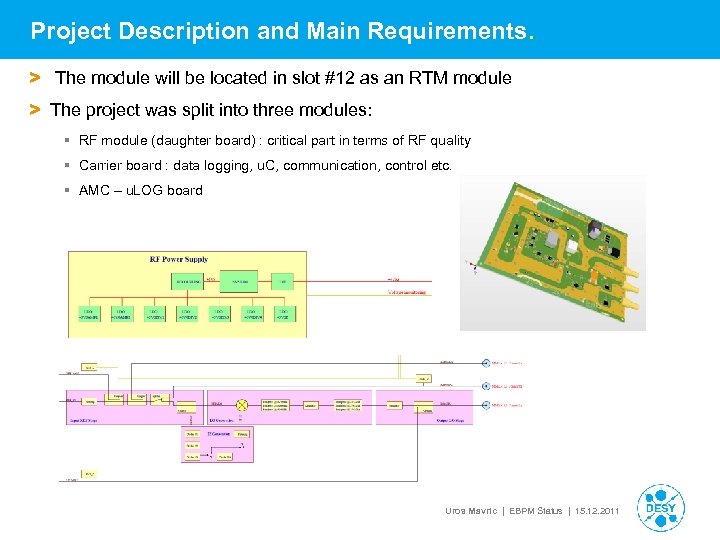
Project Description and Main Requirements. > The module will be located in slot #12 as an RTM module > The project was split into three modules: § RF module (daughter board) : critical part in terms of RF quality § Carrier board : data logging, u. C, communication, control etc. § AMC – u. LOG board Uros Mavric | EBPM Status | 15. 12. 2011
Project History. > The project started as a collaboration between I-Tech and DESY > A feasibility study of various possible approaches (architectures) was carried out app. 1 year ago > Several laboratory measurements were done usingle/dual stage LO schemes, with various types of filters etc. It was decided for the present architecture because it proved to have the best performance. > I-Tech did the design and implementation. The characterization of the board will be carried out by DESY. > In November 2011 the gerber files were sent to production. The first boards are expected by the end of January 2012. Uros Mavric | EBPM Status | 15. 12. 2011
![Critical Difficulties in the Project. > Residual phase noise [10 Hz-1 MHz] 1. 6](https://present5.com/presentation/1a04caaa5ea2865a92b03e7bea7512c6/image-5.jpg "Critical Difficulties in the Project. > Residual phase noise [10 Hz-1 MHz] 1. 6")
Critical Difficulties in the Project. > Residual phase noise [10 Hz-1 MHz] 1. 6 fs – Choice of the proper architecture > Long term : 0. 2 ps_pp, 0. 2 %_pp [0. 1 -100 s] – Fitting the Peltier elements to the small form factor > Filtering of the RF component (-80 d. Bc) – Choice of the proper filter technology > High LO Output Power +27 d. Bm – Finding the proper output amplifier > Meeting the specs inside the crate environment and radiation of the generated signal Uros Mavric | EBPM Status | 15. 12. 2011
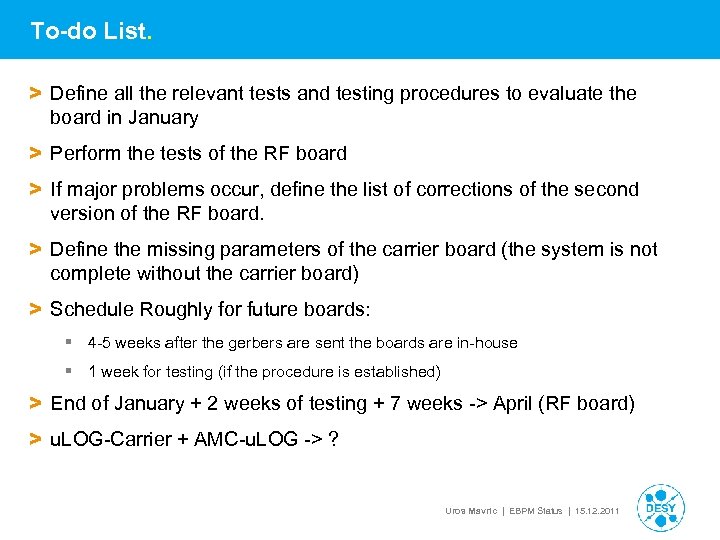
To-do List. > Define all the relevant tests and testing procedures to evaluate the board in January > Perform the tests of the RF board > If major problems occur, define the list of corrections of the second version of the RF board. > Define the missing parameters of the carrier board (the system is not complete without the carrier board) > Schedule Roughly for future boards: § 4 -5 weeks after the gerbers are sent the boards are in-house § 1 week for testing (if the procedure is established) > End of January + 2 weeks of testing + 7 weeks -> April (RF board) > u. LOG-Carrier + AMC-u. LOG -> ? Uros Mavric | EBPM Status | 15. 12. 2011
Скачать презентацию Local Oscillator Generation Internal Uroš Mavrič Collaboration Meeting
1a04caaa5ea2865a92b03e7bea7512c6.ppt