


 Скачать презентацию LOCAL GOVERNMENT MINIMUM DATASET Current collections
e3a3e3a06378a5c748e35bc494b5f2a9.ppt
- Количество слайдов: 11
 LOCAL GOVERNMENT MINIMUM DATASET
 Current collections » LGAR Surveys » Submissions to government departments » Statutory performance monitoring collections » Sector Skills Council’s data collections » 501 separate requests per annum – CLIP data flow study
 Problems with current methods » » » » Duplicated requests from different bodies Patchy coverage Lack of a uniform structure Out of date data Differing definitions between collections Comparisons across workforces problematic Comparisons with whole economy difficult Huge burden on authorities
 What is the LGMD? The Local Government Minimum Dataset (LGMD) is a framework of well-defined data items considered essential to workforce planning and national pay bargaining in local government
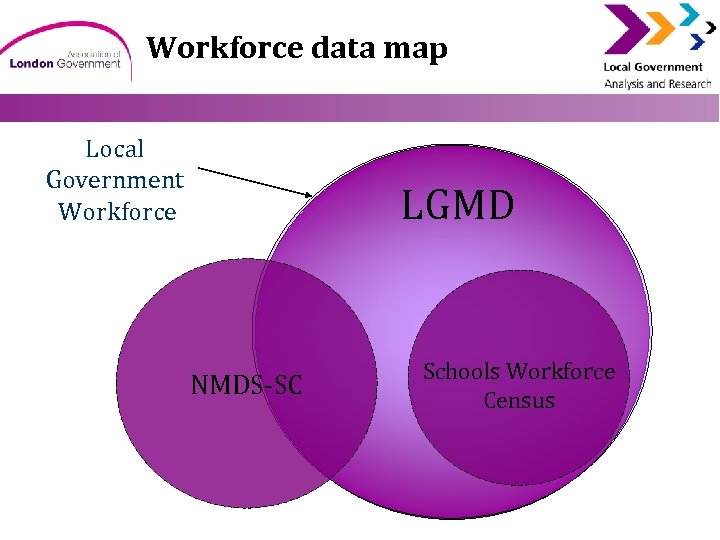 Workforce data map Local Government Workforce LGMD NMDS-SC Schools Workforce Census
 Data uses The data will: » allow Local Authorities to benchmark themselves on a local, regional and national level; » inform national needs such as pay negotiations, skills and workforce planning, diversity issues, etc; » provide central government with an overview of the local government workforce
 Advantages for Local Authorities » » Identify staff skills, needs and achievements Provide effective workforce planning Identify recruitment and retention issues Develop staff skills and competence in line with regulation and good practice » Answer data requests quickly and effectively » Enable detailed benchmarking
 Objectives 1. To provide definitive data on the local government workforce that is accepted as such by all parties. 2. To ensure a strategic, planned and coordinated approach to data sharing through a “collect once, use many times” approach. 3. To reduce data burden within local authorities through the use of the most efficient and up-to-date technologies and methodologies. 4. To introduce the infrastructure and framework required to harmonise workforce data collection across the public sector. 5. To investigate the possibilities of linking workforce data with local government performance frameworks. 6. To encourage joint working and data sharing between agencies
 Barriers and issues » Issues of design: » the development of a workable system of occupational classification » ensuring the compatibility of LGMD data with other datasets » developing the most efficient and effective methodologies » Technical issues: » establishing how the information should be collected, stored and disseminated, whilst avoiding the pitfalls of overly-ambitious and costly ICT solutions. » Issues of agreement and communication: » securing buy-in from all relevant government departments » convincing all local authorities of the advantages of the project » developing the communication and cooperation between agencies needed to succeed.
 Course of Action » Agree a framework that meets the variety of needs placed upon local government workforce data. » Ensure compatibility with other major datasets applicable to local government (e. g. the National Minimum Dataset for Social Care (NMDS-SC) and the Schools Workforce Census. ) » Develop a system of occupational classification that is compatible with SOC 2000 and the pending SOC 2010, the national classification used by the Office of National Statistics. » Establish the data framework within the culture of local authorities’ internal data systems. » Develop systems of collection that utilise the most efficient methodologies » Implement the centralised collection of the dataset within local government
 LOCAL GOVERNMENT MINIMUM DATASET For further details please contact: Ben Hickman ben. hickman@lgar. local. gov. uk 0207 664 3190 ww. lgar. local. gov. uk