


 Скачать презентацию Local Government Concept and Theoretical Overview Dr
20eb985cda735c09339beee894de8d0e.ppt
- Количество слайдов: 14
 Local Government : Concept and Theoretical Overview Dr. Salahuddin Aminuzzaman Professor, Dept. of Public Administration UNIVERSITY OF DHAKA saminuzzaman@yahoo. com 7 th March 2012 1
 l What is Local Government? Government of local area ( Area is defined by law) Government having limited control and authority over specific geographical area and can not pass or over specific geographical area and enforce laws/ rules that will affect a wider area Manned by elected representatives Enjoys legal and administrative authority Empowered to tax, regulate and enforce authority 2
 Why Local Government? l Constitutional l obligation Separation of power and counter balance l Bring government closer to community l Make democracy sustainable and grounded l Ensure effective participation l Promote local priorities l Ensure political and administrative accountability 3
 Why Local Government? Effective delivery of services l A mechanism to ensure decentralization l Encourage the process of economic growth l Promote and preserve diversity and cultural heritage l To tackle the pressure of Urbanization l 4
 Theories of LG Local government theories has primarily dealt with the nature relationship with central and local level political system. Liberal-Democratic Theory: l l l LG is needed to create these values relate to Political Education, Training in Leadership and Political Stability. LG facilitates its accountability and preserves the liberty by asserting the right of individuals to be grouped in local communities. LG also works as defense/shield against arbitrary power or centralizing power. LGs are responsive to the demands and needs of the community Centre has to survive with partnership with LG. 5
 Theories of LG Economic Theory LG as providers of packages of goods, services. LG provides widest range of choices of services based on local needs. LG ensures allocative justice and efficienct use of collective goods 6
 Theories of LG… l Elitist Theory LG is body that promotes local interest and protects state expansion and centralization. l LGs are basically pluralist and they handle secondary issues of lesser importance to national elites. l LGs are tied to national elites by network of patronage, clientelism and control over public expenditure. l 7
 Theories of LG… Consolidationist School l Twentieth century scholars on American state and local government have largely abandoned such a strong localist position. Influenced by notions of economies of scale and “burden spreading” (redistribution of resources) in urban areas, the post-World War II period has been dominated by the so-called “consolidationist” school of local government. Big is beautiful! It is economical, efficient and effective. 8
 Theories of LG… l Public Choice theory of LG l Public Choice theorist takes a strong position against the consolidationist. l This theory maintain that the model of the market place fits local government. They strongly highlighted the idea of community based mobilization of resources and decision on its allocation. l They argue that people “consume” government and its services as they want. 9
 International/ Regional experiences l Too many tiers means confusing roles and excessive administrative costs l Own resources – gives flexibility to respond to citizen’s preferences l Own resourse also enhances accountability l Involvement of civil society as watchdog l Fiscal transfers and audits/ monitoring brings good result l Linking community voice to fiscal transfers and audits (social watch and audit) enhances accountability 10
 Key Institutional Lessons l l l Three Fs: Functions, Finance, and Functionaries creates the capacity Capacity grows with responsibility Responsibility grows with managing ownresources With own-resources comes accountability Accountability is assured by citizen participation/ involvement and central audit 11
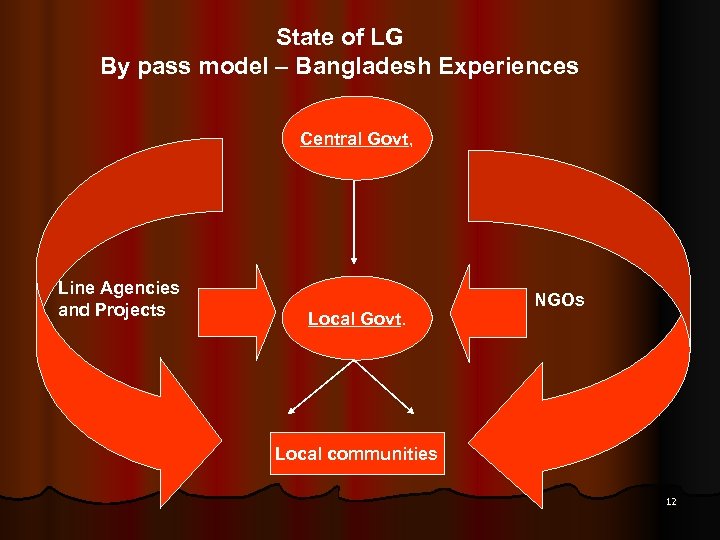 State of LG By pass model – Bangladesh Experiences Central Govt, Line Agencies and Projects Local Govt. NGOs Local communities 12
 Impact of by pass l Weak LG system/ poor image/ lack of trust l People become Centre oriented/ NGO dependent for service deliveries l Widen the scope central control / bureaucratization of development and governance l By pass model is costly and not sustainable 13
 Questions and Answer 14