


 Скачать презентацию Local Determination of Complaints The role of the
50f68d2ef21bc8766cdba3dc6d8ad928.ppt
- Количество слайдов: 11
 Local Determination of Complaints The role of the Parish Clerk
 Course Objectives • • • The process Differences to previous process Procedures followed at NWLDC The Monitoring Officer’s role Implications of a complaint The Parish/Town Clerk’s role
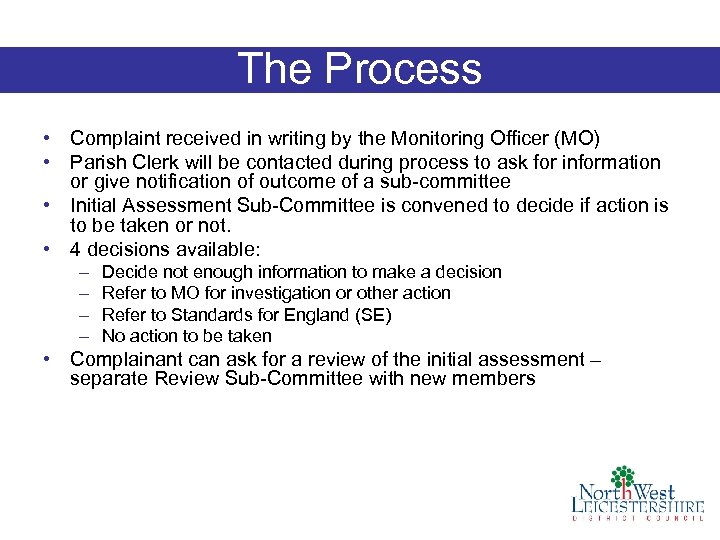 The Process • Complaint received in writing by the Monitoring Officer (MO) • Parish Clerk will be contacted during process to ask for information or give notification of outcome of a sub-committee • Initial Assessment Sub-Committee is convened to decide if action is to be taken or not. • 4 decisions available: – – Decide not enough information to make a decision Refer to MO for investigation or other action Refer to Standards for England (SE) No action to be taken • Complainant can ask for a review of the initial assessment – separate Review Sub-Committee with new members
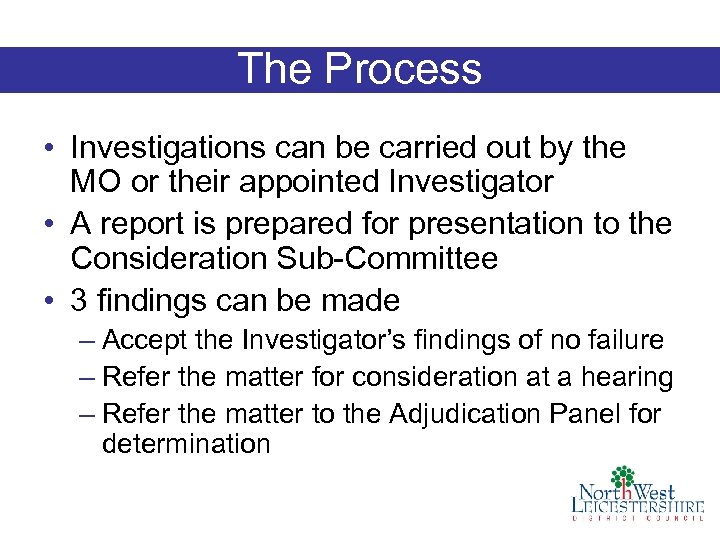 The Process • Investigations can be carried out by the MO or their appointed Investigator • A report is prepared for presentation to the Consideration Sub-Committee • 3 findings can be made – Accept the Investigator’s findings of no failure – Refer the matter for consideration at a hearing – Refer the matter to the Adjudication Panel for determination
 The Process • Pre-Hearing process: – At this point the Parish/Town Council will be notified of the matter and given the time, date and place for the hearing • Hearings Sub-Committee can make the following decisions: – No breach of the Code – Breach of the Code, no further action – Breach of the Code, sanctions to be applied
 What’s Different? • Complaints previously assessed by the SE – handled on average 295 complaints a month and referred 1 in 7 to local authorities for investigation • SE now has a regulatory role provides advice, support and guidance and also monitors performance • SE will still investigate complaints that are considered too serious or complex for the MO to handle locally.
 Procedures at NWLDC • • Regulations SE Prescribed format Decision Making Chart Policies and Procedures Booklet Exercise What decision would you come to?
 Role of the Monitoring Officer • Advisor to the Standards Committee • To administer the Local Determination of Complaints Scheme • To ensure that decisions of the authority are taken lawfully and to report to Council any that are not • Oversee the introduction and operation of the Code of Conduct • Keep and maintain the Register of Members Interests and the Register of Gifts and Hospitality
 Implications of a Complaint • Processing a complaint is very costly • No additional funding • Typical investigations costs £ 7000 if using an external investigator • In-house investigator can spend over 100 hours up until the hearing • Takes between 20 -30 hours of MO time • Actual hearing plus time of Committee Clerk = an additional 10 hours • Each complaint – possibly 4 Sub-Committee meetings • So 140 hours in total – per complaint!
 The role of the Parish/Town Clerk • Advising your Councillors on the Code of Conduct – MO support is available if you are unsure • Acting as the ‘gate-keeper’ – all member enquiries to the MO should come through you. • Mediation – try to avoid complaints – Real benefits to your community and council • Councillors are able to put their differences aside and work together to the benefit of the parish • Reputation of parish council remains intact and public confidence retained • Officer time better employed dealing with front line issues – eg prosecuting for ‘enviro-crime’ • Avoid unnecessary cost to the public purse
 The role of the Parish/Town Clerk • When notified about a complaint – you must make sure that you do not discuss/disclose any confidential information – provide any requested information to the investigator promptly • Encourage your Councillors to attend training courses on the Code, Standards and Ethics