


 Скачать презентацию Local Clinician Involvement in Clinical Information Systems Necessity
7c8eebaae15917787c897311037dabcd.ppt
- Количество слайдов: 82
 Local Clinician Involvement in Clinical Information Systems: Necessity or Luxury – A Review of International Experiences ASSIST (Harrogate, Preston) October 1 & 2, 2003 Denis Protti - University of Victoria 1
 Denis Protti - University of Victoria 2
 Questions to be discussed • Is it important to solicit meaningful physician input early and often and act upon it? • Does finding meaningful ways to engage physicians require creating an organizational climate and culture that respects the heart of medicine? – Is this the key to maintaining physician loyalty and involvement? Denis Protti - University of Victoria 3
 • Some management teams believe that ideas should be well fleshed out and ready for implementation before discussing them with physicians. – When that occurs, do physicians feel their input is actually sought? – And if they recommend changes at that point, will it be difficult for management to retreat and follow another course of action? Denis Protti - University of Victoria 4
 • How can one best square the need for centralised/standardised policy with getting local support and use? • Does the opinion of national clinical bodies matter? Denis Protti - University of Victoria 5
 Outline • The Danish Experience • The New Zealand Experience • An American Experience • The British Experience • NPf. IT – Clinicians Involved? Denis Protti - University of Victoria 6
 The challenge of being an afternoon speaker Denis Protti - University of Victoria 7
 Outline • The Danish Experience • The New Zealand Experience • An American Experience • The British Experience • NPf. IT – Clinicians Involved? Denis Protti - University of Victoria 8
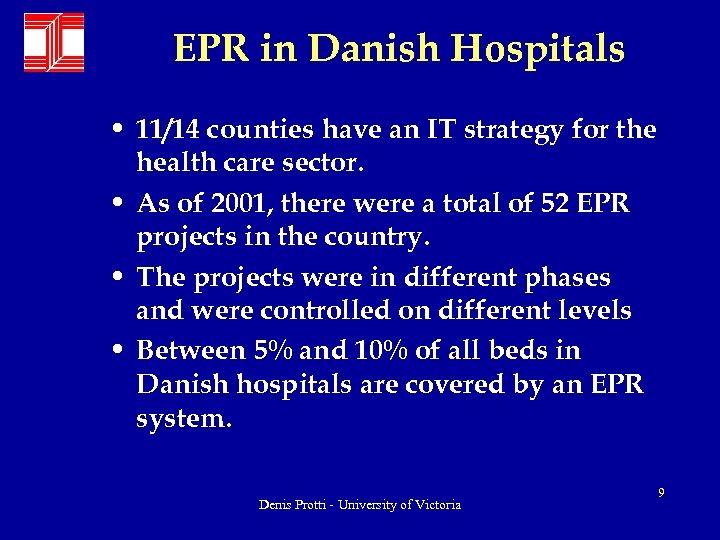 EPR in Danish Hospitals • 11/14 counties have an IT strategy for the health care sector. • As of 2001, there were a total of 52 EPR projects in the country. • The projects were in different phases and were controlled on different levels • Between 5% and 10% of all beds in Danish hospitals are covered by an EPR system. Denis Protti - University of Victoria 9
 What’s most interesting about Denmark is Med. Com Denis Protti - University of Victoria 10
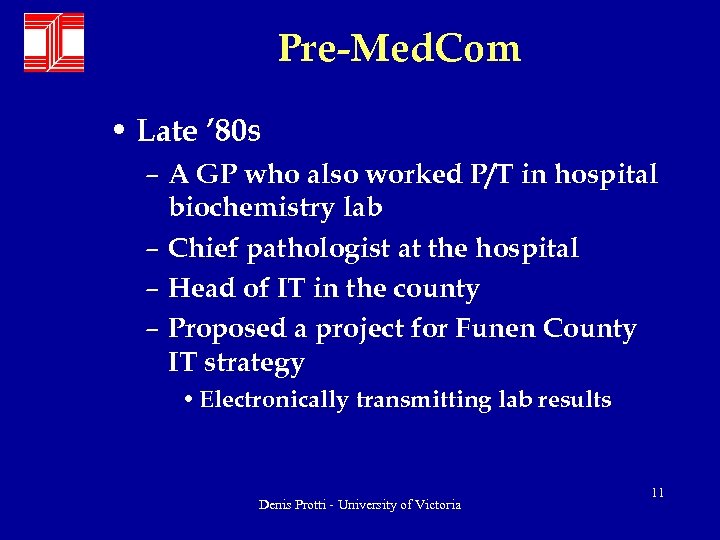 Pre-Med. Com • Late ’ 80 s – A GP who also worked P/T in hospital biochemistry lab – Chief pathologist at the hospital – Head of IT in the county – Proposed a project for Funen County IT strategy • Electronically transmitting lab results Denis Protti - University of Victoria 11
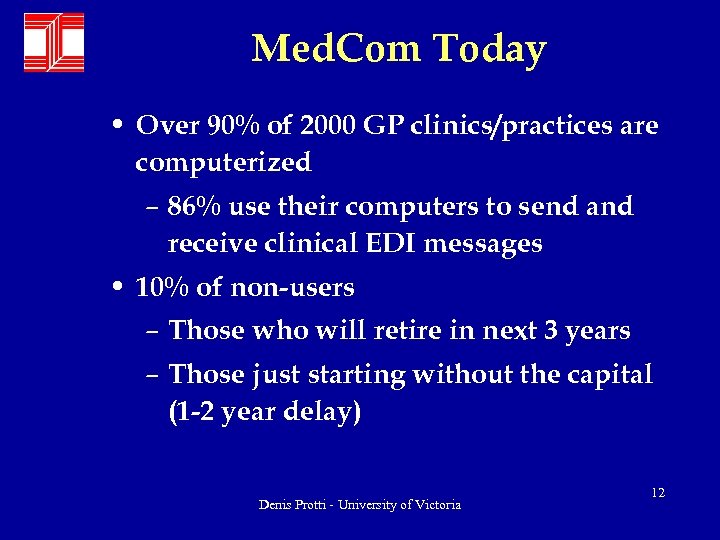 Med. Com Today • Over 90% of 2000 GP clinics/practices are computerized – 86% use their computers to send and receive clinical EDI messages • 10% of non-users – Those who will retire in next 3 years – Those just starting without the capital (1 -2 year delay) Denis Protti - University of Victoria 12
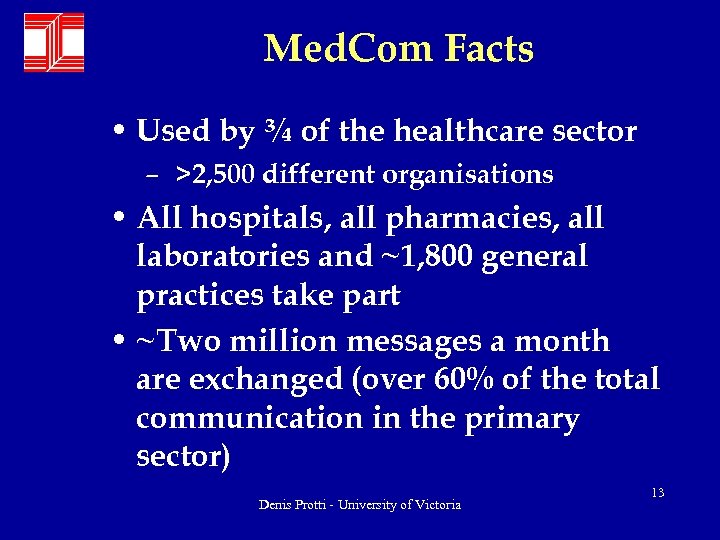 Med. Com Facts • Used by ¾ of the healthcare sector – >2, 500 different organisations • All hospitals, all pharmacies, all laboratories and ~1, 800 general practices take part • ~Two million messages a month are exchanged (over 60% of the total communication in the primary sector) Denis Protti - University of Victoria 13
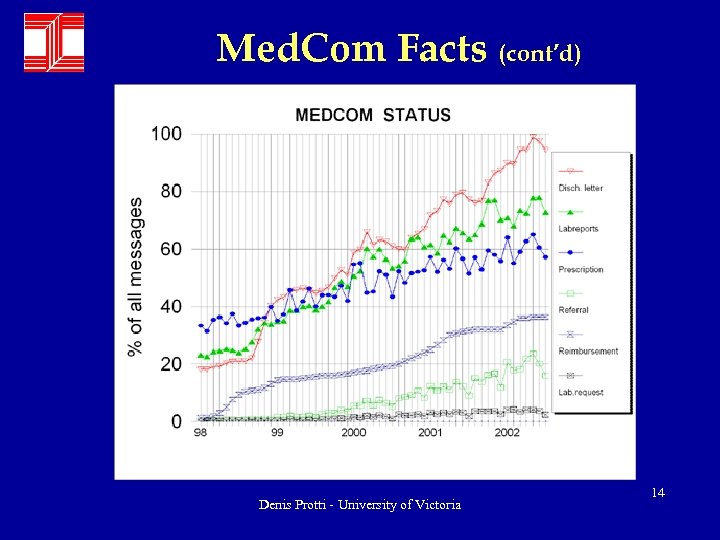 Med. Com Facts (cont’d) Denis Protti - University of Victoria 14
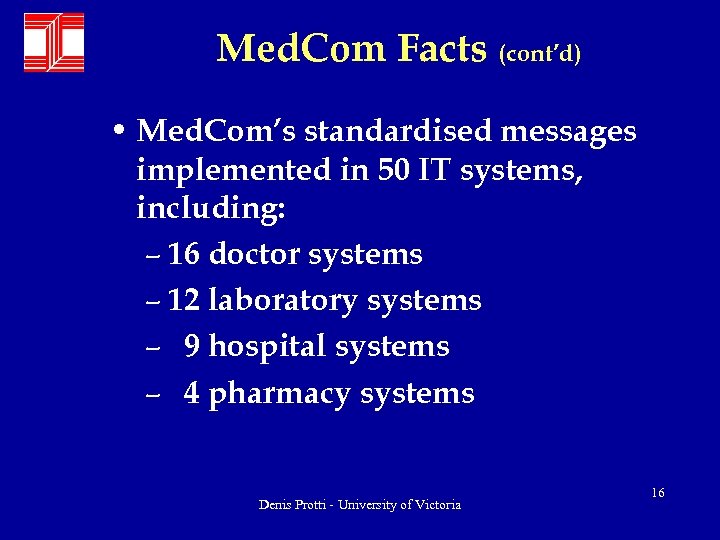 Med. Com Facts (cont’d) • Med. Com’s standardised messages implemented in 50 IT systems, including: – 16 doctor systems – 12 laboratory systems – 9 hospital systems – 4 pharmacy systems Denis Protti - University of Victoria 16
 Med. Com Facts (cont’d) • Physicians pay for their own systems • Upcoming agreement with County Association and the PLO will mandate electronic communication • Specialists use of computers range from 4090% depending on the county with their use of EDI clinical messages ranging from 1570% Denis Protti - University of Victoria 17
 Med. Com funders • 1/3 from Ministry of Health • 1/3 from County Association • 1/3 from Other Sources – Ministry of Social Services (recently) – Danish Doctors Association (early on only) – Dan NET – Danish Pharmacy Association Denis Protti - University of Victoria 18
 Seven Driving Forces 1. Communication benefits of Med. Com • • Improves dialog with hospitals use to wait 5 days for results of tests (now almost as soon as it comes off the equipment) Automatically notified when patient registered in an Emergency department Discharge summaries now arrive within 13 days (use to be 4+ weeks) – standard set by Counties Denis Protti - University of Victoria 19
 Driving Forces (cont’d) 2. Out of Office Hours (OOH) system mandated • Started 1997 • GP available from 1600 - 0800 hours (could be up to 3 GPs present) • ~30 across the country – some based at hospitals • Negotiated by PLO and County Association • GPs doctors had to learn how to use a computer if they wanted to be paid Denis Protti - University of Victoria 20
 Driving Factors (cont’d) 3. Peer influence – collegial pressure – GPs go to see each others computers 4. PLO wrote conversion software to facilitate the transfer of patient data from one GP to another 5. Access to the Internet (2 -3 times/day) – e. g. waiting times for x-rays for all clinics in Funen County – can see what procedures are done at each clinic – can decide with patient where they should go Denis Protti - University of Victoria 21
 Driving Factors (cont’d) 6. County Support – – Provides GP with a diskette of all their patients when first starting (been doing since 1992) Training done by data consultant – visit practice regularly Help desk Practioner coordinator for each specialty (psychiatry, general surgery, etc. ) • Works 2 hours/month • Coordinates wishes of GPs to hospitals and vice-versa • IT agenda moved forward through them Denis Protti - University of Victoria 22
 Driving Factors (cont’d) 7. Standards set by Med. Com – Contract signed with Counties and PLO obliging everyone to use them – Clinicians and vendors involved! – Med. Com tests and certifies vendor systems – Steering committee of paying agencies meets every 3 months to review compliance data Denis Protti - University of Victoria 23
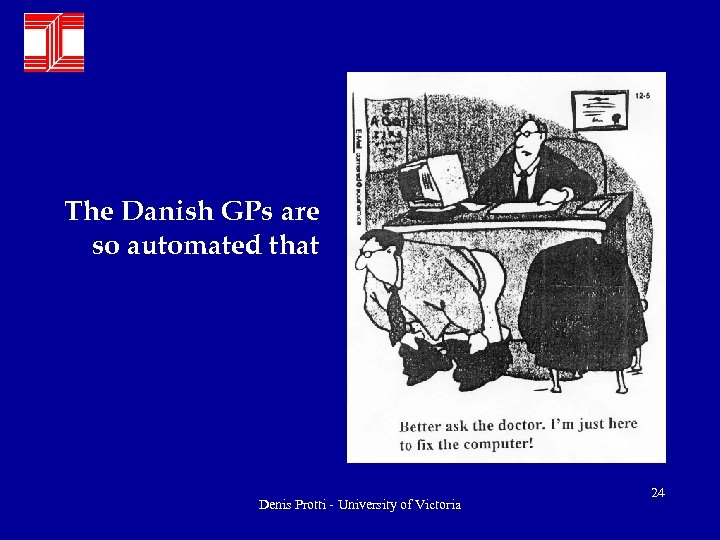 The Danish GPs are so automated that Denis Protti - University of Victoria 24
 Outline • The Danish Experience • The New Zealand Experience • An American Experience • The British Experience • NPf. IT – Clinicians Involved? Denis Protti - University of Victoria 25
 Denis Protti - University of Victoria 26
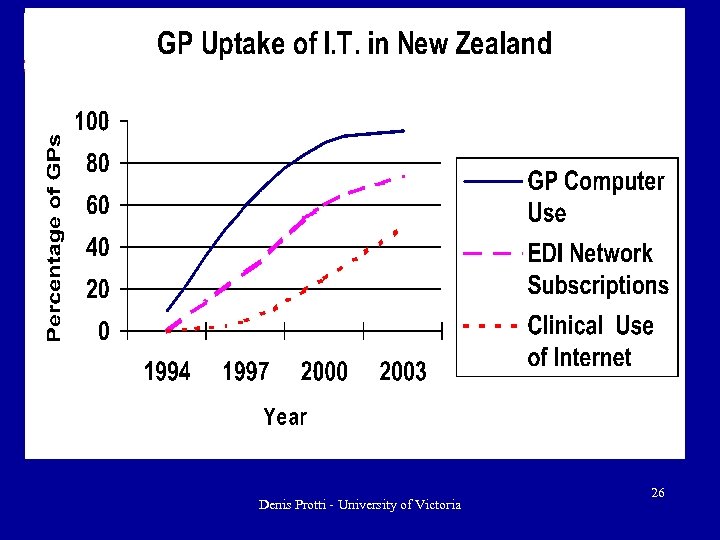
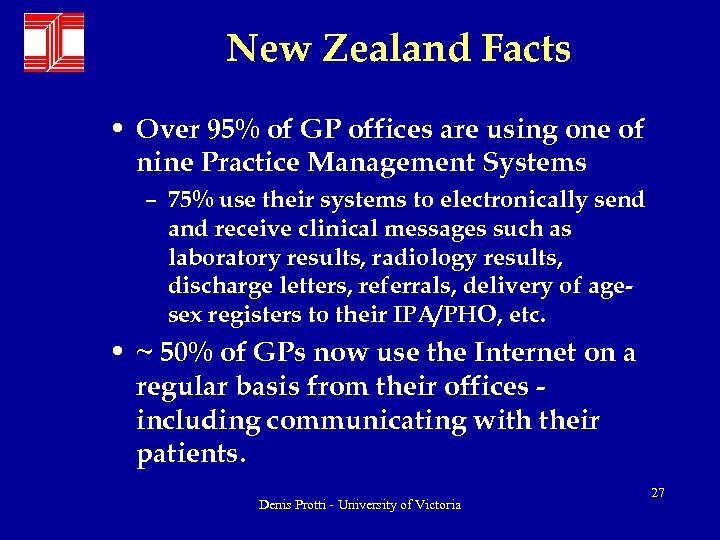 New Zealand Facts • Over 95% of GP offices are using one of nine Practice Management Systems – 75% use their systems to electronically send and receive clinical messages such as laboratory results, radiology results, discharge letters, referrals, delivery of agesex registers to their IPA/PHO, etc. • ~ 50% of GPs now use the Internet on a regular basis from their offices including communicating with their patients. Denis Protti - University of Victoria 27
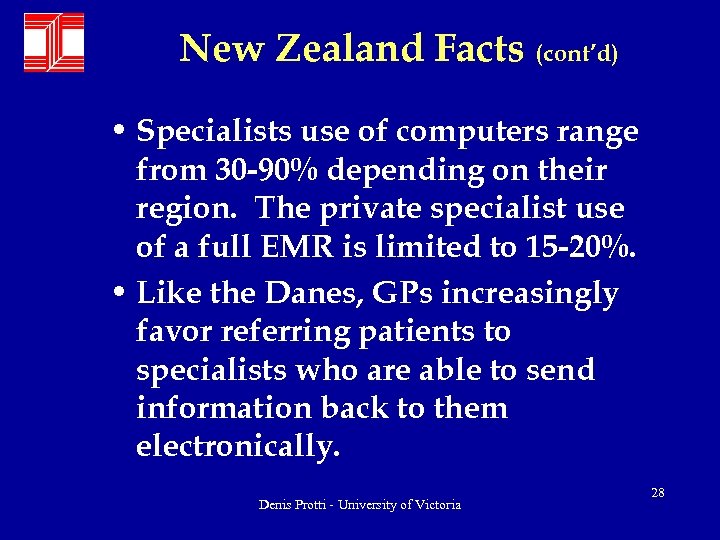 New Zealand Facts (cont’d) • Specialists use of computers range from 30 -90% depending on their region. The private specialist use of a full EMR is limited to 15 -20%. • Like the Danes, GPs increasingly favor referring patients to specialists who are able to send information back to them electronically. Denis Protti - University of Victoria 28
 AGPAL ACCREDITED 2, 200 New Zealand sites 1, 200 Australian sites 1 -800 support across Australasia Denis Protti - University of Victoria 29
 New Zealand Facts (cont’d) • Used by 75% of all healthcare sector organizations in New Zealand. – All hospitals, radiology clinics, private laboratories – ~1, 800 general practices. – > 600 specialists, physiotherapists, other allied health workers • Over 3 million messages a month are exchanged, • 95% of the communication in the primary health care sector. Denis Protti - University of Victoria 30
 Driving Forces in New Zealand • Unlike the Danish success story, Health. Link received no government funding to initiate the service and its growth and success is based entirely on the market model of “supply and demand”. Denis Protti - University of Victoria 32
 Driving Forces (cont’d) • The development of IPA’s (Independent Practitioner Associations) encouraged the uptake of information technology in primary care in New Zealand. – IPAs paid the costs for their member GPs to access the Health. Link network as part of their membership services. • Health. Link facilitated change by offering an “electronic claiming only” service for claims submission free of charge for the first 6 months. Denis Protti - University of Victoria 33
 Driving Forces (cont’d) • The past decade has also seen the emergence of the new position of “Practice Manager” within a physician general practice. • The Practice Manager has become a pivotal person to assist with the installation, management and training for any physician office system. • The Practice Manager responsibilities include financial management, IT and the human resource function in larger practices. Denis Protti - University of Victoria 34
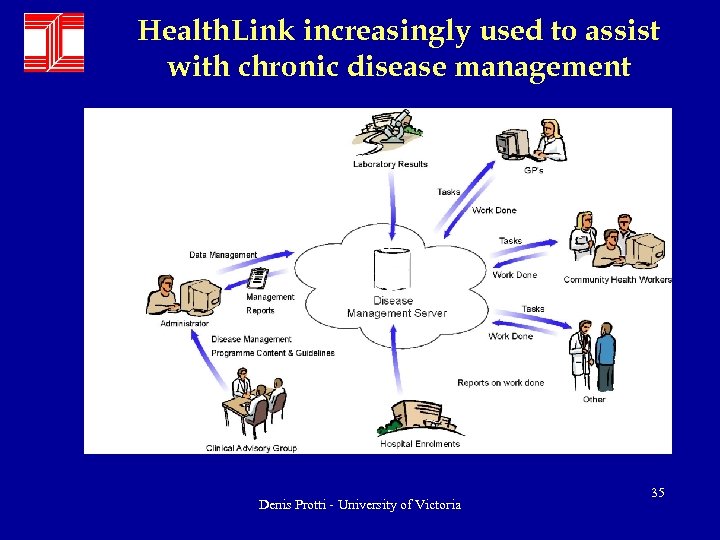 Health. Link increasingly used to assist with chronic disease management Denis Protti - University of Victoria 35
 • As a result of these applications of information technology in primary care: – Child immunization rates went from 75% to 95%. – Control of diabetes improved – for patients with Hb. A 1 c higher than 9 pre-enrolment was 34% and this was reduced to 7% postenrolment – There was an 80% reduction in wait time for statins for diabetes patients. – There was a reduction in acute admissions this was running at 9% per annum. By 2002, the growth rate was reduced to near 0%. Denis Protti - University of Victoria 36
 New Zealand’s critical success factors • A national health identifier NHI • Early adoption of HL 7 • Development and acceptance of the 1993 Privacy Act and the 1994 Health Information Privacy Code along with “practical” implementation of these • Mandatory electronic claiming for GMS (government subsidies for GP care) • Collaboration with private and public organizations • Multi-vendor co-operation and understanding of the business opportunities Denis Protti - University of Victoria 37
 NZ critical success factors (cont’d) • Healthlink’s strategy has always been to work very closely with primary care physicians – to stay close to them and to support them. • Health. Link is intricately and comprehensively tied to the GPs – “like the parmesan in the spaghetti is how one observer described it”. Denis Protti - University of Victoria 38
 An interesting aside • At one stage the New Zealand Government spent several millions of dollars on an alternative product “The Health Intranet of New Zealand”. • This failed at the point where they tried to connect the Intranet to General Practice computer systems. – The GPs were very unhappy to let government representative agents touch their computers – making the Health Intranet impossible to implement on the ground. – The government agents had no understanding of how General Practice works Denis Protti - University of Victoria 39
 NZ critical success factors (cont’d) • Health. Link employs nurses to act in liaison roles with General Practice, and so provide direct contact with the GPs. • Health. Link provides a help desk that has become the GP’s first point of contact when requesting help with their EMRs - like the Danes. • Health. Link has also stayed very close to the GP system providers – again like the Danes. Denis Protti - University of Victoria 40
 NZ critical success factors (cont’d) • • • Health. Link spend a lot of effort on demonstrator and beta testing sites. They also work closely with the physician EMR vendors to debate projects thoroughly at all stages – before during and after implementation. Many of the Health. Link initiatives were a result of demand of the primary care physicians – e. g. discharge summary from hospitals, radiology test results (DI), orders (still in progress), delivery of claiming data – i. e. responding to market needs Denis Protti - University of Victoria 41
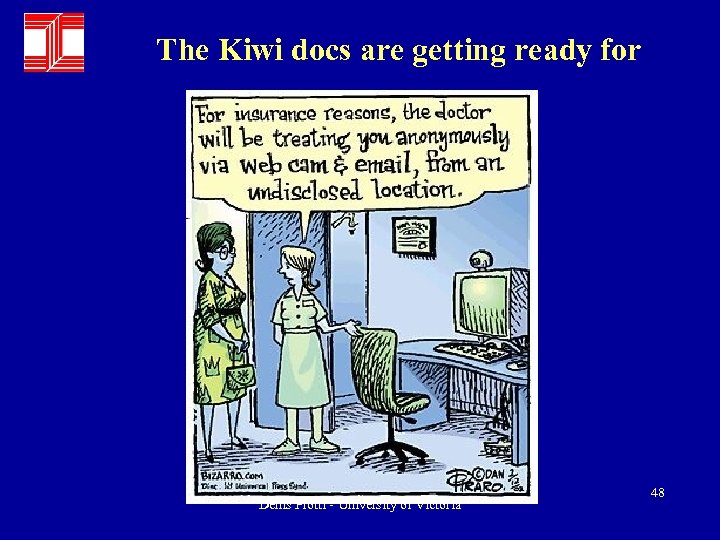 The Kiwi docs are getting ready for Denis Protti - University of Victoria 48
 Outline • The Danish Experience • The New Zealand Experience • An American Experience • The British Experience • NPf. IT – Clinicians Involved? Denis Protti - University of Victoria 49
 But first Selected observations from the American literature Denis Protti - University of Victoria 50
 • “Much research has been done in an attempt to identify the key factors that predict EPR/EHR implementation success. Over 150 factors have been identified, but only two, top management support and user involvement are consistently associated with successful implementations. ” Sittig D The Importance of Leadership in the Clinical Information System Implementation Process November 2001 http: //www/informatics-review. com/thoughts/leadership Denis Protti - University of Victoria 51
 • “Experience suggests several factors that may increase acceptance and use of clinical information systems by physicians. First, broad physician involvement in the selection and implementation of the system from the outset is essential. Systems with no real sponsorship from the medical staff are likely to fail. ” Anderson J Increasing the Acceptance of Clinical Information Systems MD Computing; Jan-Feb; 16(1): 62 -5; 1999 Denis Protti - University of Victoria 52
 • “Clinician ‘buy-in’ will require that their involvement is substantial and real. The project team must have strong clinician representation from the outset and throughout the project, including the planning, implementation, and postimplementation phases. Clinicians need to believe that the decisions they make matter. ” Krall M Achieving Clinician Use and Acceptance of the Electronic Medical Record 1998 http: //www. kaiserpermanente. org/medicine/permjournal/winter 98 pj/emr. html Denis Protti - University of Victoria 53
 • “The need for physician involvement with clinical information systems has been advocated since the first installations in the 1960’s. Even though the initial systems were rather rudimentary, the systems that were backed by strong physician leadership have been able to evolve and develop into sophisticated tools as information technology has become integrated into all facets of clinical care. ” Schneider M et al Physician Involvement in Clinical Systems—A Cost-Effective Investment HIMSS Proceedings, Session 125 2000 Denis Protti - University of Victoria 54
 • Whether or not the CPR project leader is a physician, heavy involvement of physicians is common to all awardees, as members of both the CPR project staff and governing committees. Physicians with direct roles in the CPR efforts typically continue to devote at least some of their time to clinical practice, which appears to be important to retaining credibility with the medical staff. Metzger JB et al Lessons Learned from the Davies Program 2000 http: //www. cpri-host. org/davies/nuggets. html Denis Protti - University of Victoria 56
 One Particularly Relevant American Experience • Kaiser Permanente (KP) is a not-for-profit group model HMO (Health Maintenance Organization) with headquarters in Oakland, California. • The organization is divided into regional service areas spanning the United States from Hawaii to the East Coast. • It has used a centralized organizational model for their business and information technology operations since 1997. • Kaiser has eight million members and 80, 000 care-givers across all regions (2/3 in California). Denis Protti - University of Victoria 57
 • The Kaiser Permanente Colorado Region’s CIS implementation began with 2 medical office pilot sites (80 physicians and 80, 000 members) in 1997 and was successfully completed (500 additional physicians and 250, 000 additional members) between March and October, 1998. • The region has achieved full CIS usage and has eliminated use of its paper records for all but archival purposes. Denis Protti - University of Victoria 58
 Kaiser’s research findings • 80 percent of the success of system implementations the size and complexity of KP-CIS is attributable to managing human factors. • Commitment from, and involvement of clinicians in the implementation of a project is of utmost importance. – Involvement is best achieved by soliciting active participation from both providers and staff from project initiation through project closure and beyond. • . Denis Protti - University of Victoria 59
 The KP approach • When Kaiser Permanente undertakes any project, the project leaders develop a series of Guiding Principles that provide direction during the entire project to the project team and to the larger KP community. • Once defined and accepted by executive management, these guiding principles are communicated throughout Kaiser Permanente. Denis Protti - University of Victoria 60
 The Kaiser CIS guiding principles 1. 2. 3. 4. 5. 6. The leadership and sponsors must be visible, available, and supportive throughout the project. The rationale for implementing KP-CIS must be understood across the Program. Implementation activities must focus on realistic timeframes that address system usability at the point of care. CIS must be based on acceptable clinical content. Providers and staff must believe that CIS enhances their ability to achieve superior clinical outcomes and improve provider/patient relationships. Providers and staff must be continuously involved in CIS planning, implementation, and maintenance. Regions must take the lead in implementing CIS Denis Protti - University of Victoria 61
 Kaiser guiding principles (cont’d) 7. Providers and staff must acquire the skills to effectively use CIS. Skills acquisition must accommodate individual learning styles. 8. Practicing providers and staff members must be engaged as members of the project team to ensure credibility with the staff, compatibility with the local culture and work flow, and clinical utility. 9. Honest, timely, regular, and pertinent communication to the user community is essential to adoption. 10. Providers and staff must be prepared to adapt to the changes that CIS will bring. 11. The appropriate technical and clinical support structures must be in place to ensure adoption and continued use of CIS. Denis Protti - University of Victoria 62
 Lessons to be learned from Kaiser • Unwavering executive support during the CIS implementation was a major factor in its adoption by the user community. – Implementing a CPR produces extraordinary change in nearly every facet of operations. Success would be unlikely without executive commitment to support of these changes. Denis Protti - University of Victoria 63
 Kaiser lessons (cont’d) • Identify and appoint physicianadvocates throughout the organization. – Clinical workflow change is more successful when physician advocates communicate the rewards and benefits to the user community. • It is necessary to develop formal communications for physicians who are to use this new CPR to assist them in understanding how the system will impact their work. Denis Protti - University of Victoria 65
 Kaiser lessons (cont’d) • Plan for recurrent objection themes from clinicians. – A common provider objection is the perception that they must perform clerical tasks that take time away from patients. • Clinician order entry may seem to be more labor intensive for some primary care users than for specialists. – For example, internists may have more complex patients than pediatricians. Denis Protti - University of Victoria 68
 In closing from Kaiser • Commitment from, and involvement of, end users (particularly the clinicians) in the implementation of a project was also of utmost importance. Involvement is best achieved by soliciting active participation from both providers and staff from project initiation through project closure and beyond Wolfe J Implementing a CPR to Serve Kaiser Permanente’s Eight Million Members HIMSS Proceedings, session 85 2000 Denis Protti - University of Victoria 73
 Everything in life is relative Denis Protti - University of Victoria 74
 Outline • The Danish Experience • The New Zealand Experience • An American Experience • The British Experience • NPf. IT – Clinicians Involved? Denis Protti - University of Victoria 75
 • Crucially, all of the ERDIP projects have involved clinicians and had clinicians on the local project teams. "We would not have achieved all we have without the level of clinician involvement we've had. " Philip Crouch ERDIP programme manager http: //www. nhsia. nhs. uk/text/pages/informish 6/informp 5. asp 2003 Denis Protti - University of Victoria 76
 • “The Walsall ERDIP project was managed by a small team with the support of the NSF groups. This close involvement of clinicians was important and any national programme office will require people with operational experience. It is also necessary to avoid turning larger programmes into a project management industry. ” Walsall Core National Evaluation report 5/11/2002 Denis Protti - University of Victoria 77
 Key messages for ICRS, derived from the South Staffordshire experience • The EHR is still in its early stages of evolution so that continued learning from formative and summative evaluation, co-ordinated across different communities and different suppliers, will be important. – Questions of who will be responsible for this and how it is linked to system supplier performance will need to be answered. South Staffordshire Electronic Record Development and Implementation Project: Final Evaluation Report July 2003 Denis Protti - University of Victoria 78
 • Dr John Pilling stresses not only the careful preparation necessary for such a scheme, but also the absolute need for clinician involvement throughout and constant liaison, through a committed project team, between all those involved. These are lessons that are of equal validity not just for this PACS project, but for every IT project in the healthcare field. http: //www. bjhc. co. uk/issues/v 19 -7 editorial. html Denis Protti - University of Victoria 81
 • It is not the choice of device but involvement of clinicians that counts. • I could go on, but there is no, one solution that will fit all clinical scenarios. It is imperative that clinicians are involved in all these discussions and that we do not decide what types of mobile devices will work for them. Sue Wilson Head of IM&T (acute services) Sherwood Forest Hospitals NHS Trust http: //www. e-health-media. com/news/item. cfm? ID=496 Aug 18, 2003 Denis Protti - University of Victoria 83
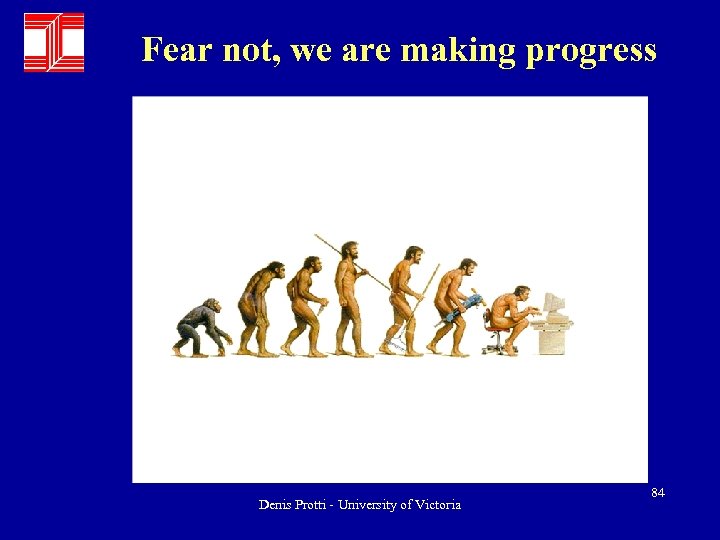 Fear not, we are making progress Denis Protti - University of Victoria 84
 Outline • The Danish Experience • The New Zealand Experience • An American Experience • The British Experience • NPf. IT – Clinicians Involved? Denis Protti - University of Victoria 86
 NPf. IT’s official position • Patient, clinician and supplier engagement is critical to the ultimate success of our solution. We: – are meeting regularly with SHA chief executives and four lead CEOs – are integrating the work of the 28 CIOs with NPf. IT – have a consensus from the Medical Royal Colleges on a core patient summary or data spine – have consulted with over 240 clinicians and NHS IT professionals in producing the initial OBS – have now got a core group of clinical representatives working in the Design Authority • We recognise that two way communication and involvement is vital. Denis Protti - University of Victoria 87
 • Professor Martin Severs from the University of Portsmouth has joined the National Programme as Director of Clinical Assurance – he will take the lead on developing and ensuring clinician involvement in the National Programme. • Professor Severs told the conference that in his first three weeks in post he had already reviewed levels of clinician involvement: – “I found there extensive levels of involvement of clinicians at all levels of the programme. ” He admitted that this finding had “quite surprised” him. E-Health Insider National Programme 'Mobilises' for Delivery 27 Mar 2003 Denis Protti - University of Victoria 88
 • “The National Programme stresses that clinicians and other NHS staff have been consulted on specifications and requirements from the outset. Most of the input into the OBS for ICRS has come from clinicians working full time in the NHS, stated Mr. Granger. ” • “Professor Peter Hutton, head of clinical engagement with the national programme, added: In two to three weeks there will be an announcement on a route in for almost everyone in the NHS to be involved. From that point on we will be taking a lot more note of individual user requirements. ” Granger Confirms Centre to Allocate LSP Contracts E-Health Insider August 14, 2003 Denis Protti - University of Victoria 89
 But … there are other views • A particular concern is limited engagement with clinicians so far. – “Lack of clinician involvement has been a consistent theme in past failures. ” – “There is a culture here that means you just can’t force solutions on clinicians, they have to be cajoled and persuaded. ” E-Health Insider April 2003 Denis Protti - University of Victoria 90
 • “Despite some early discussions, many general practitioners and consultants have not heard of the integrated care record service or the information spine. Nick Booth Sharing patient information electronically throughout the NHS BMJ, 327: 114 -115, 19 July 2003 Denis Protti - University of Victoria 91
 • “News of the National Audit Office’s involvement in reviewing the national programme was first reported in Computer Weekly this week, in a report which stated that the NAO would examine arrangements for managing high-level risks on the NPf. IT and arrangements for gaining the local commitment of clinicians. ” E-Health Insider August 22, 2003 Denis Protti - University of Victoria 92
 • Over many years, NHS informatics developments have suffered from being underutilised by their potential users…. The position of informatics should be stressed to empower decision makers to take steps to harness its capability, notably through ensuring that clinical involvement in informatics is enhanced and integral to day working, without which few health informatics systems will perform up to their promise. ” BCS Health Informatics Committee & ASSIST More Radical Steps (2003) Initiatives August 2003 Denis Protti - University of Victoria 93
 Questions to be discussed • Is it important to solicit meaningful physician input early and often and act upon it? • Does finding meaningful ways to engage physicians require creating an organizational climate and culture that respects the heart of medicine? – Is this the key to maintaining physician loyalty and involvement? Denis Protti - University of Victoria 94
 • Some management teams believe that ideas should be well fleshed out and ready for implementation before discussing them with physicians. – When that occurs, do physicians feel their input is actually sought? – And if they recommend changes at that point, will it be difficult for management to retreat and follow another course of action? Denis Protti - University of Victoria 95
 • How can one best square the need for centralised/standardised policy with getting local support and use? • Does the opinion of national clinical bodies matter? Denis Protti - University of Victoria 96
 Let the discussions begin Denis Protti - University of Victoria 97
 ICRS roll out • Phase 1 by end 2004 • Phase 2 by end 2006 • Phase 3 by end 2008 Denis Protti - University of Victoria 98
 ICRS phase 1 - 2004 • • Booking of outpatient appointments online NHS email and access to online knowledge Electronic laboratory and radiology results Some clinical communications e. g. GP referral letters Providing simple functionality and making best use of existing systems Denis Protti - University of Victoria 99
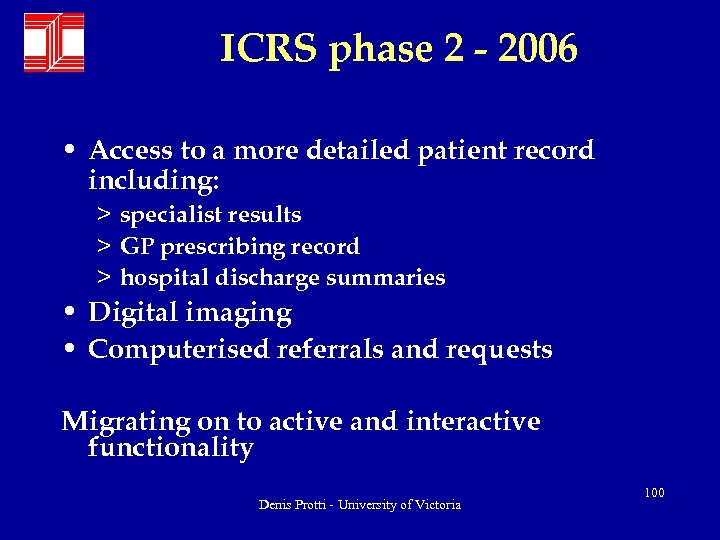 ICRS phase 2 - 2006 • Access to a more detailed patient record including: > specialist results > GP prescribing record > hospital discharge summaries • Digital imaging • Computerised referrals and requests Migrating on to active and interactive functionality Denis Protti - University of Victoria 100
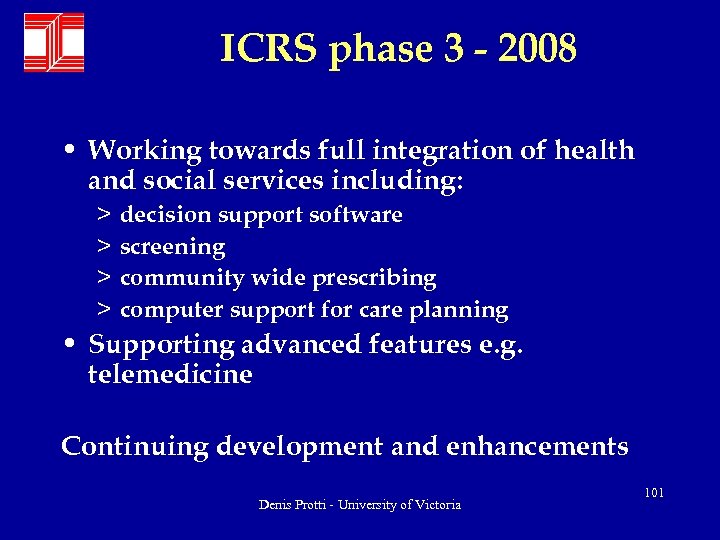 ICRS phase 3 - 2008 • Working towards full integration of health and social services including: > > decision support software screening community wide prescribing computer support for care planning • Supporting advanced features e. g. telemedicine Continuing development and enhancements Denis Protti - University of Victoria 101
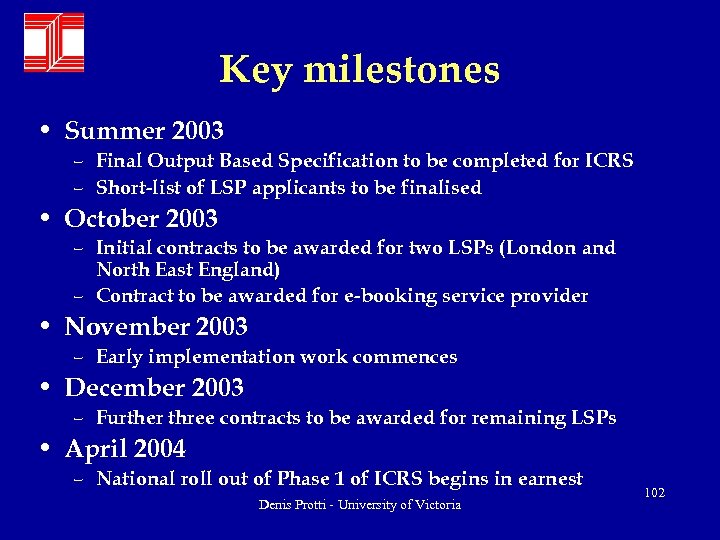 Key milestones • Summer 2003 – Final Output Based Specification to be completed for ICRS – Short-list of LSP applicants to be finalised • October 2003 – Initial contracts to be awarded for two LSPs (London and North East England) – Contract to be awarded for e-booking service provider • November 2003 – Early implementation work commences • December 2003 – Further three contracts to be awarded for remaining LSPs • April 2004 – National roll out of Phase 1 of ICRS begins in earnest Denis Protti - University of Victoria 102