 Скачать презентацию Lobbying in Asia main features from Western point
Lecture_17_Lobbying_in_Asia.pptx
- Количество слайдов: 11



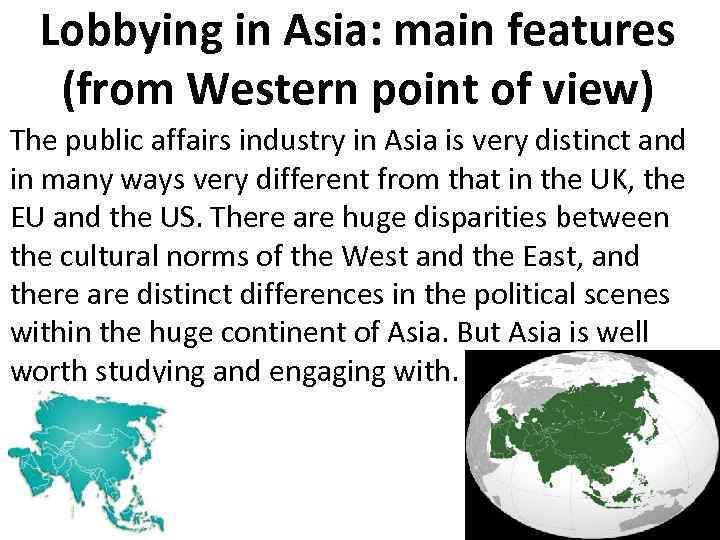
Lobbying in Asia: main features (from Western point of view) The public affairs industry in Asia is very distinct and in many ways very different from that in the UK, the EU and the US. There are huge disparities between the cultural norms of the West and the East, and there are distinct differences in the political scenes within the huge continent of Asia. But Asia is well worth studying and engaging with.
• Lobbying in Asia is a fast-growing industry – and it is worth bearing in mind that Asia is home to both the world’s largest democracy (India) – according to US point of view – and the world’s most populous state (China). Most public affairs practitioners agree that the term lobbying is not the best terminology to use in Asia. The term carries a negative connotation and is viewed with suspicion by those who would be the target of the lobbyist.
• Public affairs is practiced at national and local level throughout Asia, Asian lobbyist study lobbying in the West and adapt their knowledge to Asian context. • It is difficult to categorize a lobbyist in Asia but those who are engaged in the process of influencing government range from corporate communications directors, to public affairs managers, to chief financial officers. The phenomenon of corporate social responsibility (CSR) is very significant and a source of a great deal of business for the Western public affairs and public relations companies in the region.
• Corporate social responsibility (CSR) is the concept when organizations (firms, companies) take into consideration interests of society, taking responsibility for influence of their activity on suppliers, employers, local communities and other stake holders. • The principle of saving face also means that effective public affairs in Asia requires patience and expectation management. A polite yes can actually mean no, so expecting the unexpected, even from senior politicians and officials, is important.
• In Asia legislation is often written in terms of general principle – which means the subsequent (последующий) interpretation can be potentially difficult. • The general absence of Western style liberal democracy, plus the presence of large-scale coalition governments, also means that Western style lobbying may not be directly applicable (применимый). India, for example, has experienced a coalition composed of 18 parties.
• In Europe and the US effective lobbying can continue beyond the passing of an Act of Parliament. In the area of home affairs in the UK, for example, the courts regularly strike down laws passed by Parliament. In Asia, however, it can be a foolish move for a Western company to refer disputes with the government to the courts of that country. • The public affairs industry in Asia is itself a less transparent industry than its equivalents in Europe or North America. There is no push, demand or recognition of a need for a register of lobbying professionals - although the PR industries have adopted codes of conduct similar to those applied by their Western counterparts.
• In Asia laws are sometimes written deliberately to create a grey area the benefits of officialdom (чиновничество) can be fertile (плодородный) ground for those who control decision making processes. The scale of corruption can be eyewatering (значительный), although the crackdowns (жесткие меры) appear more frequent and the punishment more severe. In 2008 former Shanghai Communist Party chief Chen Liangyu was jailed for 18 months on graft charges (обвинения) involving £ 2. 5 billion in misappropriated funds (злоупотребления).
• The essence of decision making in Asia is also a more complex affair than in the West. The Chinese, for example, are astute (коварный) negotiators – even negotiating after the contract has been signed. The process of negotiation may look chaotic – the Chinese will jump from one issue to the next specifically to throw their counterpart off their course. The thread (нить) of an argument may appear weak, but this can be a tactic specifically designed to give the Asian negotiator the upper hand. Following a meeting if you cannot clearly report what has been agreed– and what is not agreed – then the Chinese official has scope to change the terms of the agreement at a later date.
• Trying to understand the geo-political mindset of those who you are trying to influence is vital. Thailand’s politicians are suspicious of inward investing business (particularly where it originates from China). However, they appear to be comfortable with having closer links to American business interests than they do with European corporations. Therefore, identifying where someone stands on an issue – be it Taiwan, Kashmir, or anti Tibetan independence – and making their view your view (providing it does not generate a conflict of loyalty or present other problems elsewhere) can aid your lobbying efforts and your influence.
Conclusion • Relationships are key. It is essential to invest time to develop personal relationships with decisionmakers. They will not do business with you (and you should not try to do business with them) until a relationship and a level of trust has been established. • With few exceptions (e. g. , Japan and India), many countries in Asia are either young developing democracies or not democracies at all. This means that unlike in the West, decision-making processes are often not transparent and there are rarely open opportunities for consultation or advocacy.

• Don’t expect to write letters and send position papers and get well reasoned replies clearly stating policy. It rarely happens like that. It is useful to submit your views on paper (preferably in local languages) but seek meetings for reactions rather than expect formal replies.
Скачать презентацию Lobbying in Asia main features from Western point
Lecture_17_Lobbying_in_Asia.pptx