


 Скачать презентацию LO-2 Product Data Standards Lecturer Ricardo Gonçalves
78bf48ca6345223454afcb994a9bea63.ppt
- Количество слайдов: 36
 LO-2: Product Data Standards Lecturer: Ricardo Gonçalves
 Contents • PD Standards: History and Organizations • ISO organization – Structure – TC 184/SC 4 • ISO 10303 (STEP) – Basics – Application Protocols and Modular STEP – Pros and Cons • Other Reference Standards 2
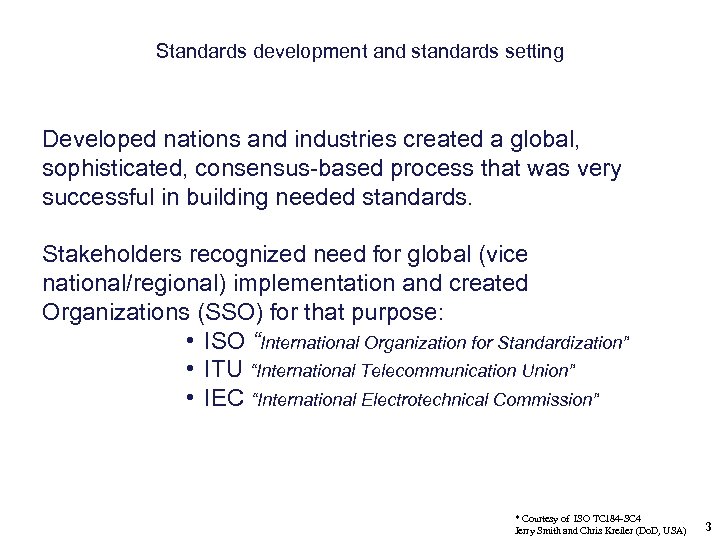 Standards development and standards setting Developed nations and industries created a global, sophisticated, consensus-based process that was very successful in building needed standards. Stakeholders recognized need for global (vice national/regional) implementation and created Organizations (SSO) for that purpose: • ISO “International Organization for Standardization” • ITU “International Telecommunication Union” • IEC “International Electrotechnical Commission” * Courtesy of ISO TC 184 -SC 4 Jerry Smith and Chris Kreiler (Do. D, USA) 3
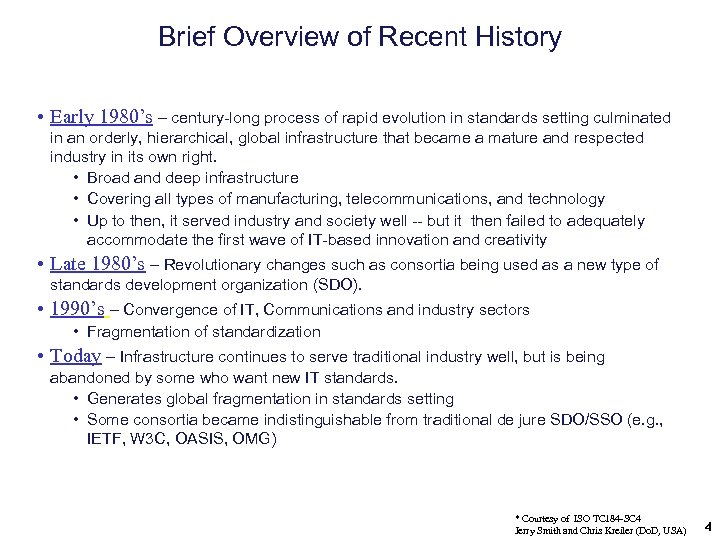 Brief Overview of Recent History • Early 1980’s – century-long process of rapid evolution in standards setting culminated in an orderly, hierarchical, global infrastructure that became a mature and respected industry in its own right. • Broad and deep infrastructure • Covering all types of manufacturing, telecommunications, and technology • Up to then, it served industry and society well -- but it then failed to adequately accommodate the first wave of IT-based innovation and creativity • Late 1980’s – Revolutionary changes such as consortia being used as a new type of standards development organization (SDO). • 1990’s – Convergence of IT, Communications and industry sectors • Fragmentation of standardization • Today – Infrastructure continues to serve traditional industry well, but is being abandoned by some who want new IT standards. • Generates global fragmentation in standards setting • Some consortia became indistinguishable from traditional de jure SDO/SSO (e. g. , IETF, W 3 C, OASIS, OMG) * Courtesy of ISO TC 184 -SC 4 Jerry Smith and Chris Kreiler (Do. D, USA) 4
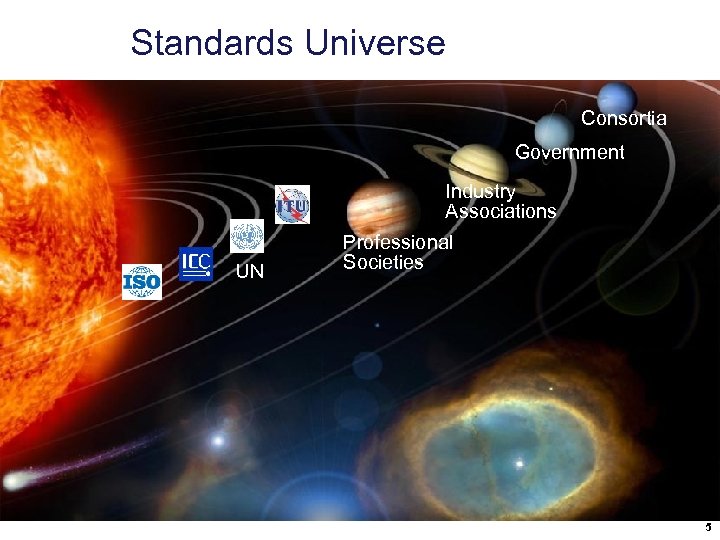 Standards Universe Consortia Government Industry Associations UN Professional Societies 5
 Organization Examples • Voluntary vs. Involuntary standards – Voluntary: consumer chooses – Involuntary: government regulation/law • Treaty vs. non-treaty organizations – Treaty: e. g. , UN, ITU, G 7, NAFTA – Non-Treaty: e. g. , ISO, IEC, IEEE • Standards setting organizations – Accredited: e. g. , ISO, IEC, BSI, DIN, CSA, JIS, ANSI, IEEE, UL, NFPA, SAE, ASTM, INCITS, CEN • Specification development organizations – Non-accredited: e. g. , IETF (internet), W 3 C, OMG, ATM Forum, Open Group, OASIS, IRDA, DAVIC, consortia * Courtesy of ISO TC 184 -SC 4 Jerry Smith and Chris Kreiler (Do. D, USA) 6
 ISO Organization International Organization for Standardization (www. iso. org)
 ISO Background • The "International Organization for Standardization" would have different abbreviations in different languages ("IOS" in English, "OIN" in French for Organisation internationale de normalisation), it was decided at the outset to use a word derived from the Greek isos, meaning "equal". Therefore, whatever the country, whatever the language, the short form of the organization's name is always ISO. • International standardization began in the electrotechnical field: the International Electrotechnical Commission (IEC) was established in 1906. Pioneering work in other fields was carried out by the International Federation of the National Standardizing Associations (ISA), which was set up in 1926. The emphasis within ISA was laid heavily on mechanical engineering. ISA's activities came to an end in 1942. • In 1946, delegates from 25 countries met in London and decided to create a new international organization, of which the object would be "to facilitate the international coordination and unification of industrial standards". The new organization, ISO, officially began operations on 23 February 1947. * Courtesy of ISO TC 184 -SC 4 Jerry Smith and Chris Kreiler (Do. D, USA) 8
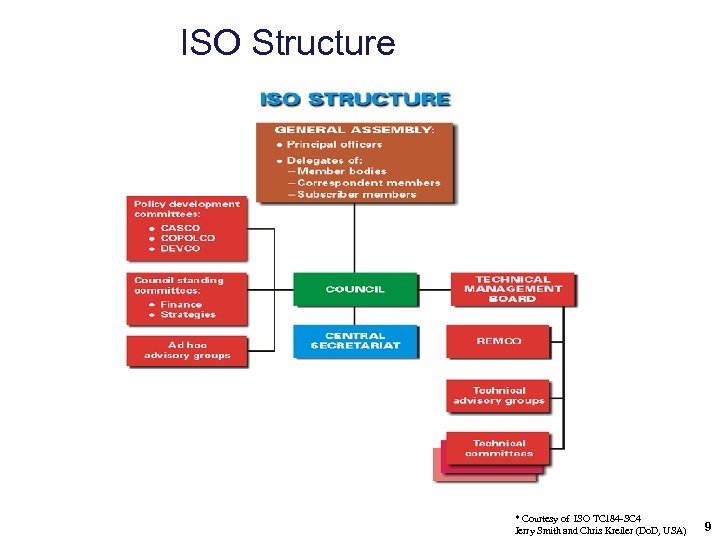 ISO Structure * Courtesy of ISO TC 184 -SC 4 Jerry Smith and Chris Kreiler (Do. D, USA) 9
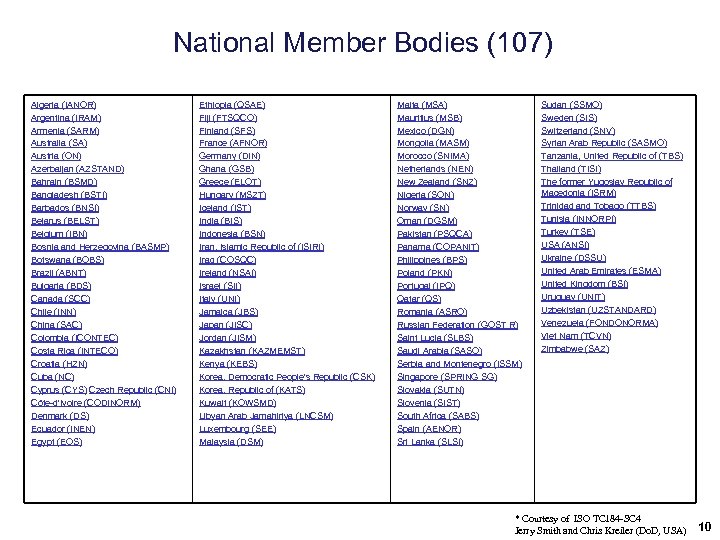 National Member Bodies (107) Algeria (IANOR) Argentina (IRAM) Armenia (SARM) Australia (SA) Austria (ON) Azerbaijan (AZSTAND) Bahrain (BSMD) Bangladesh (BSTI) Barbados (BNSI) Belarus (BELST) Belgium (IBN) Bosnia and Herzegovina (BASMP) Botswana (BOBS) Brazil (ABNT) Bulgaria (BDS) Canada (SCC) Chile (INN) China (SAC) Colombia (ICONTEC) Costa Rica (INTECO) Croatia (HZN) Cuba (NC) Cyprus (CYS) Czech Republic (CNI) Côte-d'Ivoire (CODINORM) Denmark (DS) Ecuador (INEN) Egypt (EOS) Ethiopia (QSAE) Fiji (FTSQCO) Finland (SFS) France (AFNOR) Germany (DIN) Ghana (GSB) Greece (ELOT) Hungary (MSZT) Iceland (IST) India (BIS) Indonesia (BSN) Iran, Islamic Republic of (ISIRI) Iraq (COSQC) Ireland (NSAI) Israel (SII) Italy (UNI) Jamaica (JBS) Japan (JISC) Jordan (JISM) Kazakhstan (KAZMEMST) Kenya (KEBS) Korea, Democratic People's Republic (CSK) Korea, Republic of (KATS) Kuwait (KOWSMD) Libyan Arab Jamahiriya (LNCSM) Luxembourg (SEE) Malaysia (DSM) Malta (MSA) Mauritius (MSB) Mexico (DGN) Mongolia (MASM) Morocco (SNIMA) Netherlands (NEN) New Zealand (SNZ) Nigeria (SON) Norway (SN) Oman (DGSM) Pakistan (PSQCA) Panama (COPANIT) Philippines (BPS) Poland (PKN) Portugal (IPQ) Qatar (QS) Romania (ASRO) Russian Federation (GOST R) Saint Lucia (SLBS) Saudi Arabia (SASO) Serbia and Montenegro (ISSM) Singapore (SPRING SG) Slovakia (SUTN) Slovenia (SIST) South Africa (SABS) Spain (AENOR) Sri Lanka (SLSI) Sudan (SSMO) Sweden (SIS) Switzerland (SNV) Syrian Arab Republic (SASMO) Tanzania, United Republic of (TBS) Thailand (TISI) The former Yugoslav Republic of Macedonia (ISRM) Trinidad and Tobago (TTBS) Tunisia (INNORPI) Turkey (TSE) USA (ANSI) Ukraine (DSSU) United Arab Emirates (ESMA) United Kingdom (BSI) Uruguay (UNIT) Uzbekistan (UZSTANDARD) Venezuela (FONDONORMA) Viet Nam (TCVN) Zimbabwe (SAZ) * Courtesy of ISO TC 184 -SC 4 Jerry Smith and Chris Kreiler (Do. D, USA) 10
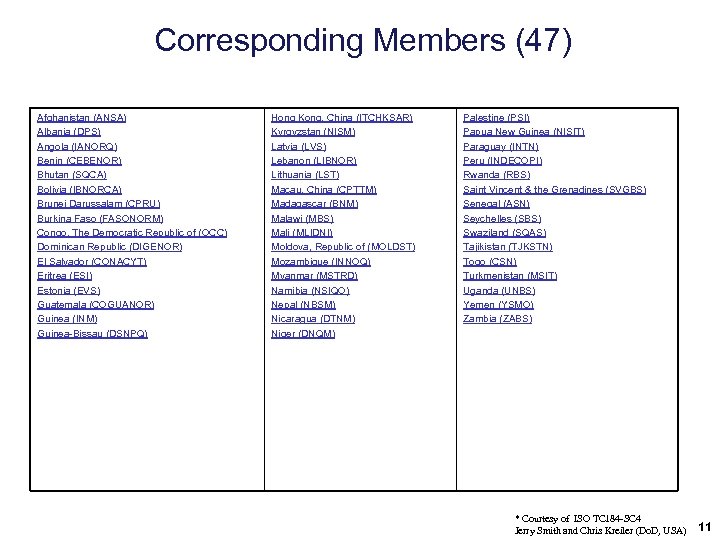 Corresponding Members (47) Afghanistan (ANSA) Albania (DPS) Angola (IANORQ) Benin (CEBENOR) Bhutan (SQCA) Bolivia (IBNORCA) Brunei Darussalam (CPRU) Burkina Faso (FASONORM) Congo, The Democratic Republic of (OCC) Dominican Republic (DIGENOR) El Salvador (CONACYT) Eritrea (ESI) Estonia (EVS) Guatemala (COGUANOR) Guinea (INM) Guinea-Bissau (DSNPQ) Hong Kong, China (ITCHKSAR) Kyrgyzstan (NISM) Latvia (LVS) Lebanon (LIBNOR) Lithuania (LST) Macau, China (CPTTM) Madagascar (BNM) Malawi (MBS) Mali (MLIDNI) Moldova, Republic of (MOLDST) Mozambique (INNOQ) Myanmar (MSTRD) Namibia (NSIQO) Nepal (NBSM) Nicaragua (DTNM) Niger (DNQM) Palestine (PSI) Papua New Guinea (NISIT) Paraguay (INTN) Peru (INDECOPI) Rwanda (RBS) Saint Vincent & the Grenadines (SVGBS) Senegal (ASN) Seychelles (SBS) Swaziland (SQAS) Tajikistan (TJKSTN) Togo (CSN) Turkmenistan (MSIT) Uganda (UNBS) Yemen (YSMO) Zambia (ZABS) * Courtesy of ISO TC 184 -SC 4 Jerry Smith and Chris Kreiler (Do. D, USA) 11
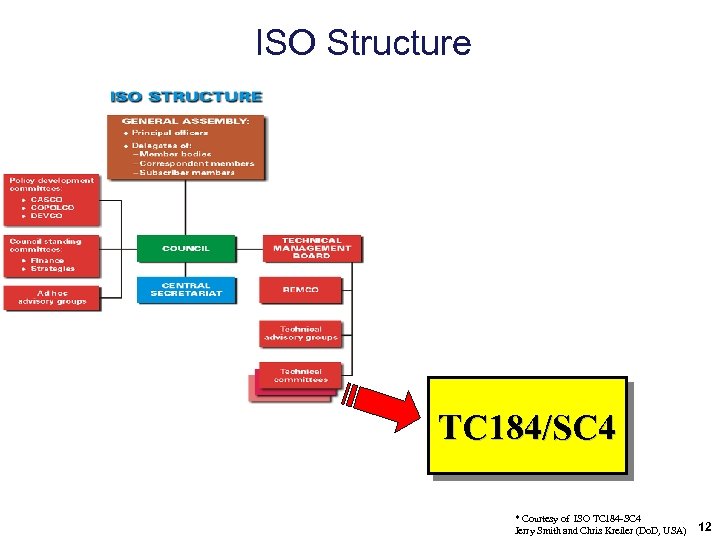 ISO Structure TC 184/SC 4 * Courtesy of ISO TC 184 -SC 4 Jerry Smith and Chris Kreiler (Do. D, USA) 12
 Technical Management Board • To report to and, when relevant, advise Council on all matters concerning the organization, coordination, strategic planning, and programming of the technical work of ISO. • To examine proposals for new fields of ISO technical activity, and to decide on all matters concerning the establishment and dissolution of technical committees. • On behalf of ISO, to keep the ISO/IEC Directives for the technical work under review, to examine and coordinate all proposals for amendments and to approve appropriate revisions. • To establish (and dissolve) Technical Advisory Groups (TAG) in order to obtain expert advice, and to appoint their members and chairmen. • To appoint registration authorities and maintenance agencies for the implementation of International Standards. • To establish (and dissolve) committees on general standardization principles and to appoint their chairmen. 13
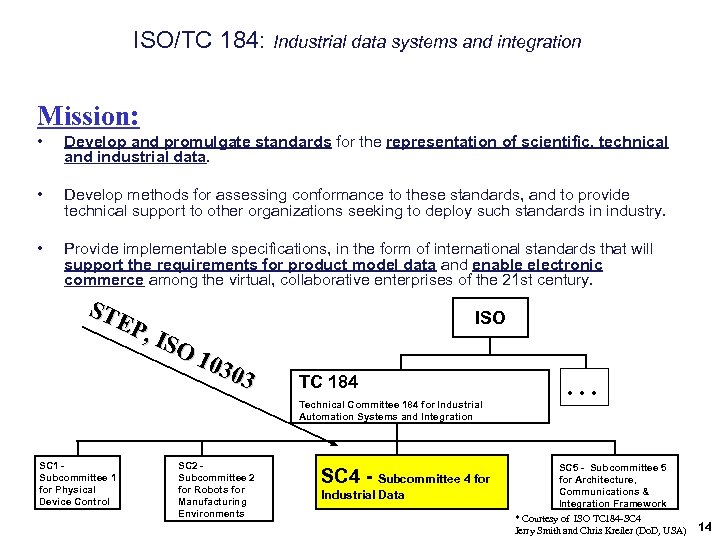 ISO/TC 184: Industrial data systems and integration Mission: • Develop and promulgate standards for the representation of scientific, technical and industrial data. • Develop methods for assessing conformance to these standards, and to provide technical support to other organizations seeking to deploy such standards in industry. • Provide implementable specifications, in the form of international standards that will support the requirements for product model data and enable electronic commerce among the virtual, collaborative enterprises of the 21 st century. ST EP , IS O 1 030 3 ISO TC 184 Technical Committee 184 for Industrial Automation Systems and Integration SC 1 - Subcommittee 1 for Physical Device Control SC 2 - Subcommittee 2 for Robots for Manufacturing Environments SC 4 - Subcommittee 4 for Industrial Data . . . SC 5 - Subcommittee 5 for Architecture, Communications & Integration Framework * Courtesy of ISO TC 184 -SC 4 Jerry Smith and Chris Kreiler (Do. D, USA) 14
 What is Industrial Data? • Long life span – 30 to 50 years • Related to large, complex products, needing configuration management • Must have component libraries for – Different views such as geometry and metadata – Different forms of lists - explicit, algorithm, class • Need a simple model of data warehousing * Courtesy of ISO TC 184 -SC 4 Jerry Smith and Chris Kreiler (Do. D, USA) 15
 Industrial Data Exchange / Sharing • Industry requires complete, accurate and timely data exchange and use – Between all the participants in a value chain – Throughout the entire life cycle – Across all business functions • The exchange/sharing of the data must use: – – Consistent models Common vocabulary Consistent reference data Information quality * Courtesy of ISO TC 184 -SC 4 Jerry Smith and Chris Kreiler (Do. D, USA) 16
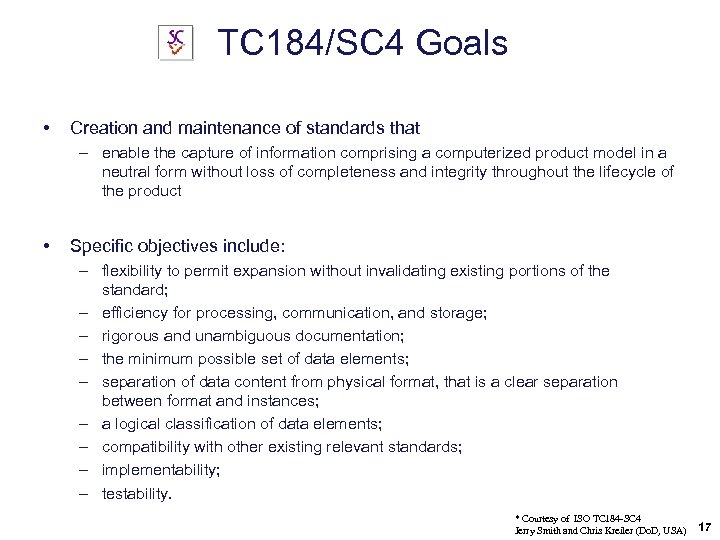 TC 184/SC 4 Goals • Creation and maintenance of standards that – enable the capture of information comprising a computerized product model in a neutral form without loss of completeness and integrity throughout the lifecycle of the product • Specific objectives include: – flexibility to permit expansion without invalidating existing portions of the standard; – efficiency for processing, communication, and storage; – rigorous and unambiguous documentation; – the minimum possible set of data elements; – separation of data content from physical format, that is a clear separation between format and instances; – a logical classification of data elements; – compatibility with other existing relevant standards; – implementability; – testability. * Courtesy of ISO TC 184 -SC 4 Jerry Smith and Chris Kreiler (Do. D, USA) 17
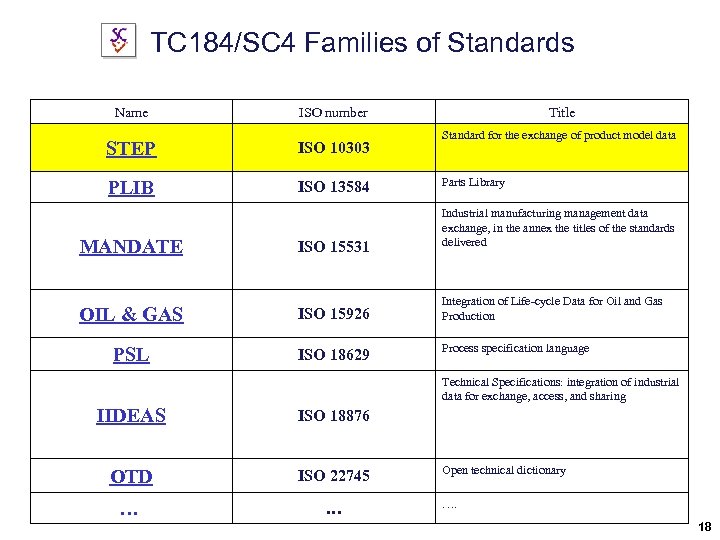 TC 184/SC 4 Families of Standards Name ISO number STEP ISO 10303 PLIB ISO 13584 MANDATE ISO 15531 OIL & GAS ISO 15926 PSL ISO 18629 Title Standard for the exchange of product model data Parts Library Industrial manufacturing management data exchange, in the annex the titles of the standards delivered Integration of Life-cycle Data for Oil and Gas Production Process specification language Technical Specifications: integration of industrial data for exchange, access, and sharing IIDEAS ISO 18876 OTD ISO 22745 … … Open technical dictionary …. 18
 ISO 10303 (STEP) Standard for the Exchange of Product data
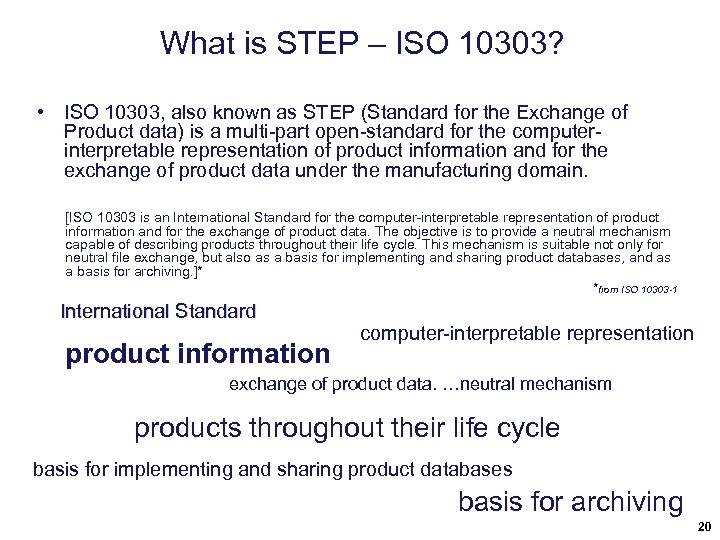 What is STEP – ISO 10303? • ISO 10303, also known as STEP (Standard for the Exchange of Product data) is a multi-part open-standard for the computerinterpretable representation of product information and for the exchange of product data under the manufacturing domain. [ISO 10303 is an International Standard for the computer-interpretable representation of product information and for the exchange of product data. The objective is to provide a neutral mechanism capable of describing products throughout their life cycle. This mechanism is suitable not only for neutral file exchange, but also as a basis for implementing and sharing product databases, and as a basis for archiving. ]* *from ISO 10303 -1 International Standard product information computer-interpretable representation exchange of product data. …neutral mechanism products throughout their life cycle basis for implementing and sharing product databases basis for archiving 20
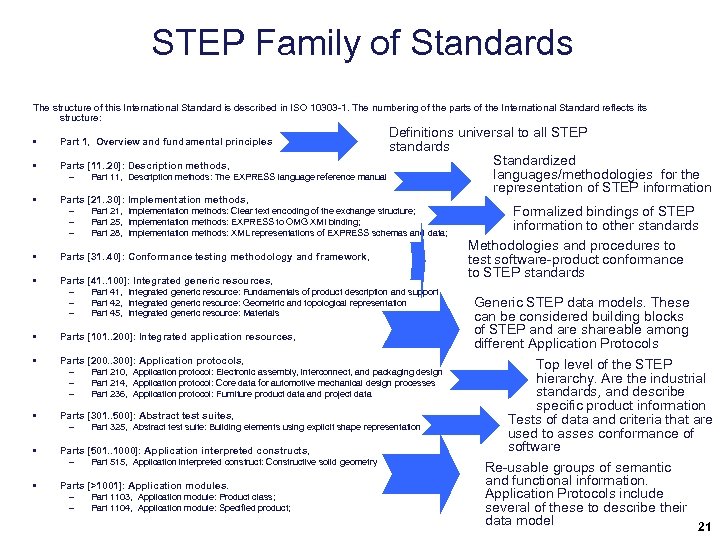 STEP Family of Standards The structure of this International Standard is described in ISO 10303 -1. The numbering of the parts of the International Standard reflects its structure: • • • Definitions universal to all STEP standards Standardized Parts [11. . 20]: Description methods, languages/methodologies for the – Part 11, Description methods: The EXPRESS language reference manual representation of STEP information Part 1, Overview and fundamental principles Parts [21. . 30]: Implementation methods, – – – • • Parts [31. . 40]: Conformance testing methodology and framework, Parts [41. . 100]: Integrated generic resources, – – – • • Parts [200. . 300]: Application protocols, Part 210, Application protocol: Electronic assembly, interconnect, and packaging design Part 214, Application protocol: Core data for automotive mechanical design processes Part 236, Application protocol: Furniture product data and project data Parts [301. . 500]: Abstract test suites, – • Part 41, Integrated generic resource: Fundamentals of product description and support Part 42, Integrated generic resource: Geometric and topological representation Part 45, Integrated generic resource: Materials Parts [101. . 200]: Integrated application resources, – – – • Part 21, Implementation methods: Clear text encoding of the exchange structure; Part 25, Implementation methods: EXPRESS to OMG XMI binding; Part 28, Implementation methods: XML representations of EXPRESS schemas and data; Part 325, Abstract test suite: Building elements using explicit shape representation Parts [501. . 1000]: Application interpreted constructs, – Part 515, Application interpreted construct: Constructive solid geometry • Parts [>1001]: Application modules. – – Part 1103, Application module: Product class; Part 1104, Application module: Specified product; Formalized bindings of STEP information to other standards Methodologies and procedures to test software-product conformance to STEP standards Generic STEP data models. These can be considered building blocks of STEP and are shareable among different Application Protocols Top level of the STEP hierarchy. Are the industrial standards, and describe specific product information Tests of data and criteria that are used to asses conformance of software Re-usable groups of semantic and functional information. Application Protocols include several of these to describe their data model 21
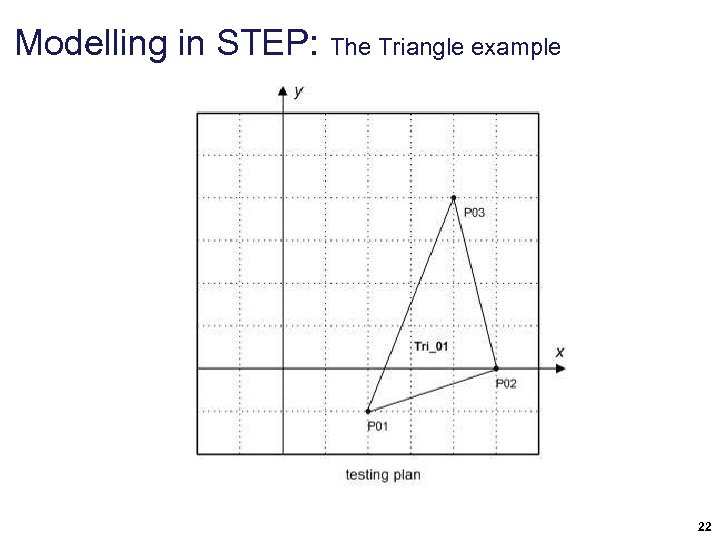 Modelling in STEP: The Triangle example 22
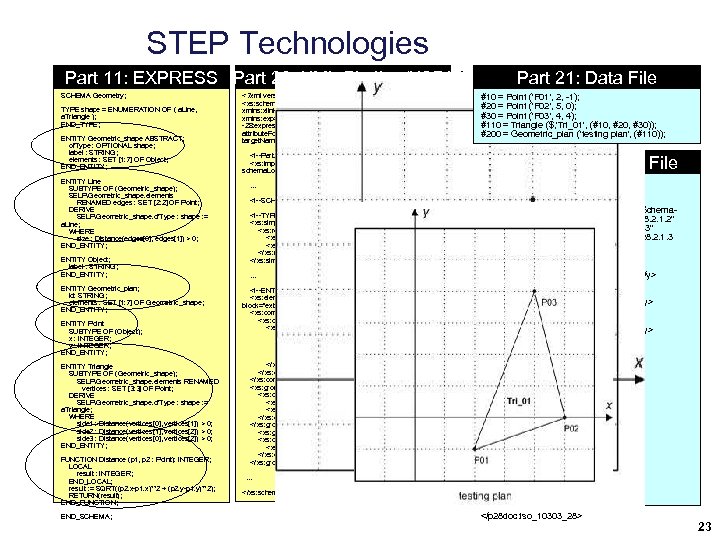 STEP Technologies Part 11: EXPRESS Part 28: XML Binding(XSD) SCHEMA Geometry; TYPE shape = ENUMERATION OF ( a. Line, a. Triangle ); END_TYPE; ENTITY Geometric_shape ABSTRACT; of. Type : OPTIONAL shape; label : STRING; elements : SET [1: ? ] OF Object; END_ENTITY; ENTITY Line SUBTYPE OF (Geometric_shape); SELFGeometric_shape. elements RENAMED edges : SET [2: 2] OF Point; DERIVE SELFGeometric_shape. of. Type : shape : = a. Line; WHERE size : Distance(edges[0], edges[1]) > 0; END_ENTITY; ENTITY Object; label : STRING; END_ENTITY; ENTITY Geometric_plan; id: STRING; elements : SET [1: ? ] OF Geometric_shape; END_ENTITY; ENTITY Point SUBTYPE OF (Object); x : INTEGER; y : INTEGER; END_ENTITY; ENTITY Triangle SUBTYPE OF (Geometric_shape); SELFGeometric_shape. elements RENAMED vertices : SET [3: 3] OF Point; DERIVE SELFGeometric_shape. of. Type : shape : = a. Triangle; WHERE side 1 : Distance(vertices[0], vertices[1]) > 0; side 2 : Distance(vertices[1], vertices[2]) > 0; side 3 : Distance(vertices[0], vertices[2]) > 0; END_ENTITY; FUNCTION Distance (p 1, p 2 : Point): INTEGER; LOCAL result : INTEGER; END_LOCAL; result : = SQRT((p 2. x-p 1. x)**2 + (p 2. y-p 1. y)**2); RETURN(result); END_FUNCTION; END_SCHEMA;
…
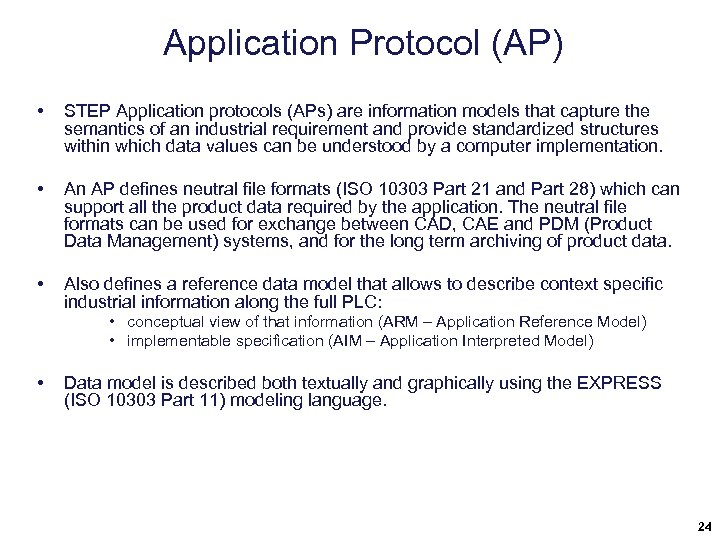 Application Protocol (AP) • STEP Application protocols (APs) are information models that capture the semantics of an industrial requirement and provide standardized structures within which data values can be understood by a computer implementation. • An AP defines neutral file formats (ISO 10303 Part 21 and Part 28) which can support all the product data required by the application. The neutral file formats can be used for exchange between CAD, CAE and PDM (Product Data Management) systems, and for the long term archiving of product data. • Also defines a reference data model that allows to describe context specific industrial information along the full PLC: • conceptual view of that information (ARM – Application Reference Model) • implementable specification (AIM – Application Interpreted Model) • Data model is described both textually and graphically using the EXPRESS (ISO 10303 Part 11) modeling language. 24
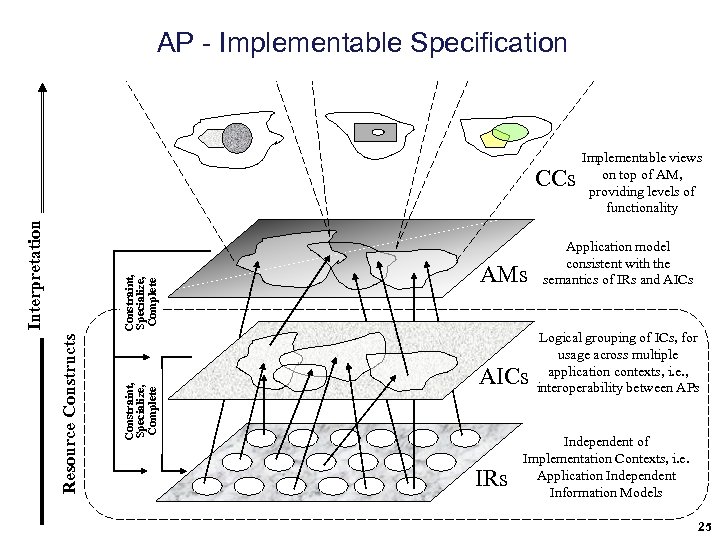 AP - Implementable Specification Constraint, Specialize, Complete Resource Constructs Constraint, Specialize, Complete Interpretation CCs Implementable views on top of AM, providing levels of functionality AMs Application model consistent with the semantics of IRs and AICs Logical grouping of ICs, for usage across multiple application contexts, i. e. , interoperability between APs IRs Independent of Implementation Contexts, i. e. Application Independent Information Models 25
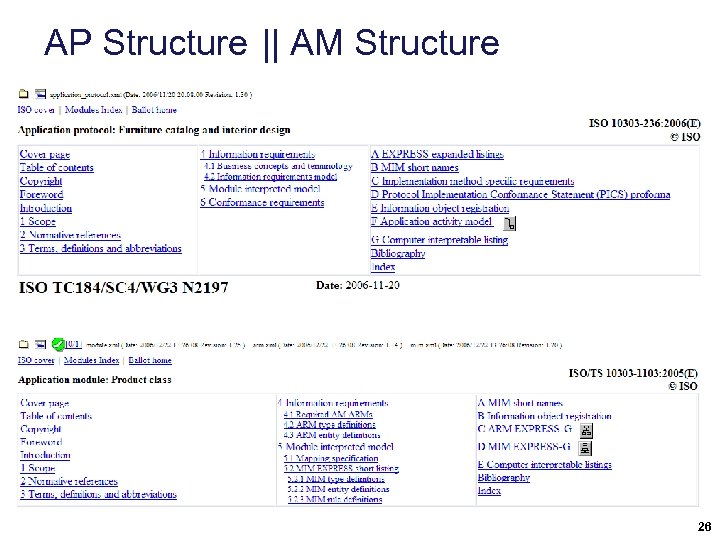 AP Structure || AM Structure 26
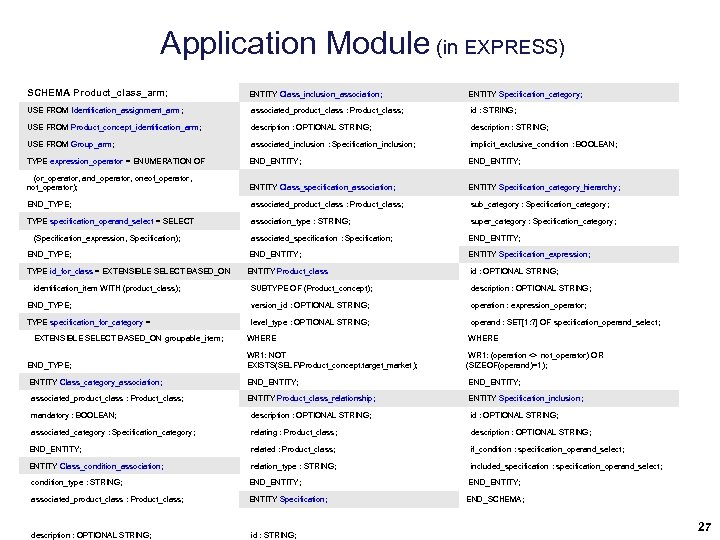 Application Module (in EXPRESS) SCHEMA Product_class_arm; ENTITY Class_inclusion_association; ENTITY Specification_category; USE FROM Identification_assignment_arm; associated_product_class : Product_class; id : STRING; USE FROM Product_concept_identification_arm ; description : OPTIONAL STRING; description : STRING; USE FROM Group_arm; associated_inclusion : Specification_inclusion; implicit_exclusive_condition : BOOLEAN; TYPE expression_operator = ENUMERATION OF END_ENTITY; (or_operator, and_operator, oneof_operator, not_operator); ENTITY Class_specification_association; ENTITY Specification_category_hierarchy; END_TYPE; associated_product_class : Product_class; sub_category : Specification_category; TYPE specification_operand_select = SELECT association_type : STRING; super_category : Specification_category; (Specification_expression, Specification); associated_specification : Specification; END_ENTITY; END_TYPE; END_ENTITY; ENTITY Specification_expression; TYPE id_for_class = EXTENSIBLE SELECT BASED_ON ENTITY Product_class id : OPTIONAL STRING; identification_item WITH (product_class); SUBTYPE OF (Product_concept); description : OPTIONAL STRING; END_TYPE; version_id : OPTIONAL STRING; operation : expression_operator; TYPE specification_for_category = level_type : OPTIONAL STRING; operand : SET[1: ? ] OF specification_operand_select; EXTENSIBLE SELECT BASED_ON groupable_item; WHERE END_TYPE; WR 1: NOT EXISTS(SELFProduct_concept. target_market ); WR 1: (operation <> not_operator) OR (SIZEOF(operand)=1); ENTITY Class_category_association; END_ENTITY; associated_product_class : Product_class; ENTITY Product_class_relationship; ENTITY Specification_inclusion; mandatory : BOOLEAN; description : OPTIONAL STRING; id : OPTIONAL STRING; associated_category : Specification_category; relating : Product_class; description : OPTIONAL STRING; END_ENTITY; related : Product_class; if_condition : specification_operand_select; ENTITY Class_condition_association; relation_type : STRING; included_specification : specification_operand_select; condition_type : STRING; END_ENTITY; associated_product_class : Product_class; ENTITY Specification; END_SCHEMA; description : OPTIONAL STRING; id : STRING; 27
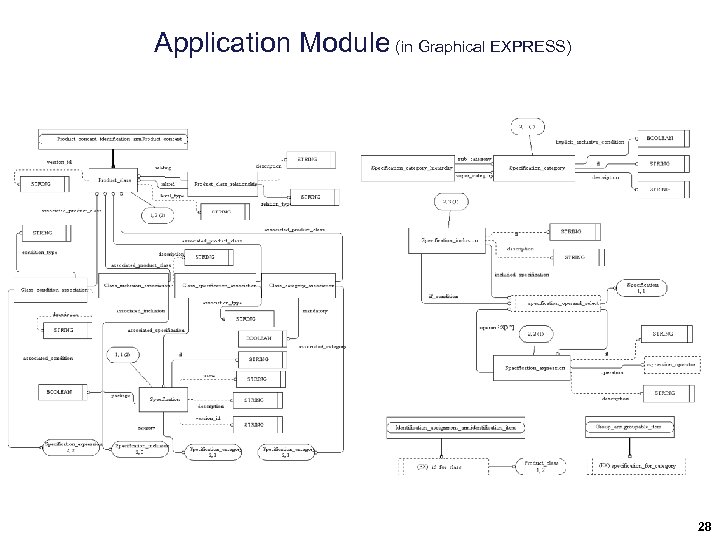 Application Module (in Graphical EXPRESS) 28
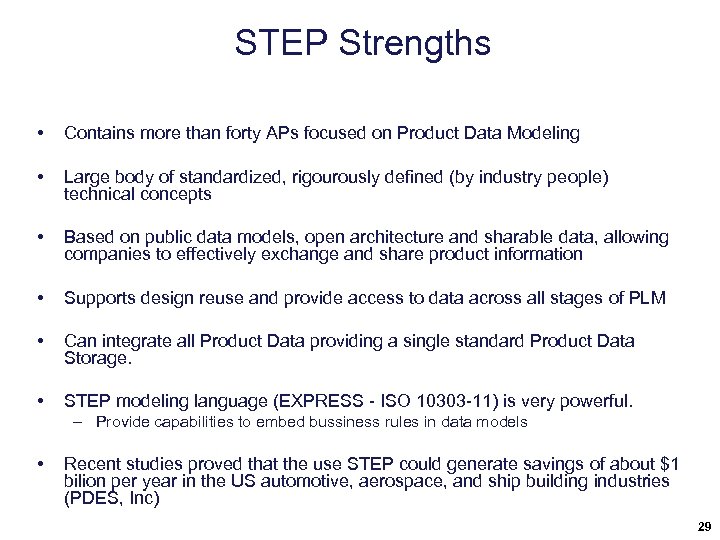 STEP Strengths • Contains more than forty APs focused on Product Data Modeling • Large body of standardized, rigourously defined (by industry people) technical concepts • Based on public data models, open architecture and sharable data, allowing companies to effectively exchange and share product information • Supports design reuse and provide access to data across all stages of PLM • Can integrate all Product Data providing a single standard Product Data Storage. • STEP modeling language (EXPRESS - ISO 10303 -11) is very powerful. – Provide capabilities to embed bussiness rules in data models • Recent studies proved that the use STEP could generate savings of about $1 bilion per year in the US automotive, aerospace, and ship building industries (PDES, Inc) 29
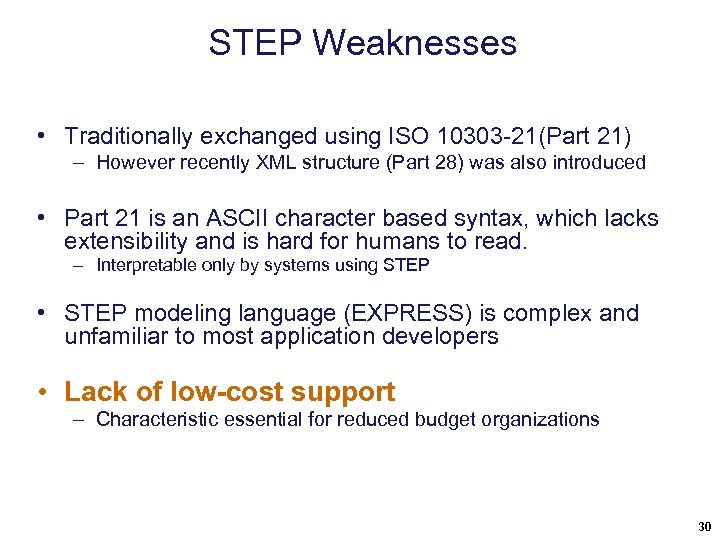 STEP Weaknesses • Traditionally exchanged using ISO 10303 -21(Part 21) – However recently XML structure (Part 28) was also introduced • Part 21 is an ASCII character based syntax, which lacks extensibility and is hard for humans to read. – Interpretable only by systems using STEP • STEP modeling language (EXPRESS) is complex and unfamiliar to most application developers • Lack of low-cost support – Characteristic essential for reduced budget organizations 30
 Other Reference Standards
 Other Reference Standards • Other communities are also developing work regarding the development of standards, methodologies, recommendations and frameworks to deal with product data: – – – OMG, W 3 C, OASIS, OAG, Etc. 32
 OMG Object Management Group OMG moves forward in establishing CORBA as the "Middleware that's Everywhere" through its worldwide standard specifications: CORBA/IIOP, Object Services, Internet Facilities and Domain Interface specifications. Established in 1989, OMG's mission is to promote theory and practice of object technology for the development of distributed computing systems. The goal is to provide a common architectural framework for object oriented applications based on widely available interface specifications. OMG is headquartered in Framingham, MA, USA and has international marketing offices in the UK, Germany, Japan, Australia, and India. Additionally, OMG sponsors the Object World series of Trade Shows and Conferences. References: • UML and XMI • MDA • … 33
 W 3 C The W 3 C was founded in 1994 to develop common protocols for the evolution of the World Wide Web. We are an international industry consortium, jointly hosted by the Massachusetts Institute of Technology Laboratory for Computer Science [MIT/LCS] in the United States; the Institut National de Recherche en Informatique et en Automatique [INRIA] in Europe; and the Keio University Shonan Fujisawa Campus in Asia. Initially, the W 3 C was established in collaboration with CERN, where the Web originated, with support from DARPA and the European Commission. We're vendor neutral, working with the global community to produce specifications and reference software that is made freely available throughout the world. References: • XML, XSD • HTML • XSL • … 34
 OASIS Organization for The Advancement of Structured Information Standards • • OASIS (Organization for the Advancement of Structured Information Standards) is a not-for-profit, international consortium that drives the development, convergence, and adoption of e-business standards. The consortium produces more Web services standards than any other organization along with standards for security, e-business, and standardization efforts in the public sector and for application-specific markets. Founded in 1993, OASIS has more than 3, 500 participants representing over 600 organizations and individual members in 100 countries. OASIS is distinguished by its transparent governance and operating procedures. Members themselves set the OASIS technical agenda, using a lightweight process expressly designed to promote industry consensus and unite disparate efforts. Completed work is ratified by open ballot. Governance is accountable and unrestricted. Officers of both the OASIS Board of Directors and Technical Advisory Board are chosen by democratic election to serve two-year terms. Consortium leadership is based on individual merit and is not tied to financial contribution, corporate standing, or special appointment. References: • eb. XML, • UDDI • … 35
 OAG Open Applications Group The Open Applications Group is a non-profit consortium focusing on best practices and process based XML content for e. Business and Application Integration. It is the largest publisher of XML based content for business software interoperability in the world. Open Applications Group, Inc. members have over 5 years of extensive experience in building this industry consensus based framework for business software application interoperability and have developed a repeatable process for quickly developing high quality business content and XML representations of that content. The OAG, a major publisher of XML-based content for business software interoperability, has published over 170 BODs focus on content, not technology; this content is the business object or process model for interoperability. References: • BODs • … 36