


 Скачать презентацию LLCs From Formation to Special Uses GET CURRENT
b467bb643e78362f920b86e0aaa69a58.ppt
- Количество слайдов: 44
 LLCs: From Formation to Special Uses GET CURRENT AND GIVE CLIENTS UP-TO-DATE ADVICE ON LLC FORMATION AN OPERATION PHILADELPHIA, PENSYLVANIA DECEMBER 7, 2010 PRESENTED BY: PHYLLIS HORN EPSTEIN ANGELA D. GIAMPOLO GARY M. MILLER
 DRAFTING THE ARTICLES OF ORGANIZATION Section 8913 of the Pennsylvania Limited Liability Company Law (PLLCL): A. Name of the LLC. Under Section 8905 of the PLLCL, must include the term “company”, “limited” or “limited liability company. ” B. Address of the registered office in Pennsylvania. C. Name and address of each of the organizers of the LLC. D. If a member’s interest in the LLC is to be evidenced by a certificate of membership interest, the certificate of organization must include a statement to that effect.
 DRAFTING THE ARTICLES OF ORGANIZATION E. If the management of the LLC is vested in a manager or managers, the certificate of organization must include a statement to that effect. F. The specified effective date of the certificate of organization, if different from the date of the filing. G. If the LLC is a restricted professional company, the certificate of organization must include a statement to that effect, including a brief description of the restricted professional service(s) to be rendered by the LLC.
 DRAFTING THE ARTICLES OF ORGANIZATION H. Any other provision that the members elect to set out in the certificate or organization for the regulation of the internal affairs of the LLC. For example: • A statement that the LLC shall have perpetual existence, to override the default rule that the LLC dissolves • A statement of the purpose of the LLC. • A statement permitting the members of the LLC to amend the certificate of organization and operating agreement in a manner provided in a subsequent change in the law. • A statement indicating that the manager or managers are authorized to take all actions prescribed in the operating agreement. • A statement rejecting the application of the default partnership governance rules described in Section 8904(a) of the PLLCL, in favor of the application of the system of governance for the LLC that follows the corporate model of the BCL.
 DRAFTING THE ARTICLES OF ORGANIZATION Under Section 8914, the LLC is deemed to be formed upon the filing of the certificate of organization with the Secretary of State, unless the certificate stipulates a later date that constitutes the effective date of formation. Modification: The certification of organization may be modified by agreement (Section 8915) or by the filing of a certificate of amendment with the Secretary of State (Section 8951).
 DRAFTING THE OPERATING AGREEMENT Flexibility: There are several different structures from which to consider in structuring an LLC in Pennsylvania Single Member LLC: This is the simplest form of the LLC, where the business will be operated in a manner similar to a sole proprietorship. • operating agreement should provide that all authority of the company is vested in the sole member Multiple Member, Member-Managed: contemplates multiple members with the management authority being vested in the members as a whole.
 DRAFTING THE OPERATING AGREEMENT Multiple Member, Manager-Managed: contemplates multiple members with the management authority being vested in a group of managers. The default rules of Section 8904(a)(2) of the PLLCL indicate that this type of LLC will be governed by the limited partnership rules under Pennsylvania law. • Members assume a role similar to passive limited partners under this model, would be consulted only with respect to fundamental transactions.
 RIGHTS AND DUTIES OF MEMBERS A. Member-Managed: Section 8943(a) of the PLLCL sets forth the duties of members of LLCs without managers. I. Section 8943(a) states that, in member-managed LLCs, every member must account to the LLC for any benefit and hold as trustee for it any profits derived by him without the consent of the other members from any transaction connected with the organization, conduct or winding up of the LLC or any use by him of its property.
 RIGHTS AND DUTIES OF MEMBERS B. Manager-Managed: Section 8943(b) of the PLLCL sets forth the duties of managers and members of LLCs with managers. I. In a manager-managed LLC, the provisions of Sections 1711 through 1717 of the Pennsylvania Business Corporations Law of 1988, as amended, are applicable to management representatives of the LLC. A written provision in the operating agreement of the LLC may increase, not decrease, the duties of representatives of the LLC to its members under those sections. PLLCL § 8943(b)(1). 1. Section 1712 of the BCL sets forth the basic standard of care for directors and officers of a corporation • Accordingly, managers of an LLC are held to this standard also.
 RIGHTS AND DUTIES ON MEMBERS Section 1713 of the BCL • permits shareholders to include in the bylaws of a corporation a provision stating that directors will not be personally liable for monetary damages for any action taken unless the director breached or failed to perform his duties and such breach or failure constitutes selfdealing, willful misconduct, or recklessness. • Note, then, that if an LLC wishes to limit the liability of its directors, it must include this type of provision in its operating agreement. Section 1714 of the BCL specifies that a director is presumed to assent to actions taken at meetings at which the director is present unless he files a written dissent with the corporation’s secretary during or immediately after the meeting.
 RIGHTS AND DUTIES ON MEMBERS Section 1715 of the BCL • provides guidelines for the exercise of a director’s powers • sets forth the baseline assumption that directors are presumed to act in the best interests of the corporation Section 1717 of the BCL • provides that only the corporation itself or shareholders acting on behalf of the corporation have standing to enforce the fiduciary duty obligations of the board of directors, committees of the board, or individual director’s • such duties may not be enforced directly by a shareholder or by any other person or group.
 RIGHTS AND DUTIES ON MEMBERS II. In a manager-managed LLC, a member who is not a manager shall have no duties to the LLC or to the other members of the LLC solely by reason of acting in his capacity as a member. PLLCL § 8943(b)(2).
 RECORDS, RETURNS, REPORTS I. Source of Requirements: Operating agreements typically contain provisions regarding the books, records, and reports of an LLC. ii. Maintenance of Financial Records: The operating agreement may provide that an LLC shall keep books and records of accounts and provide the basis for the maintenance of such accounts. iii. Maintenance of Company Records: The operating agreement may require that the LLC keep the following records.
 Maintenance of Company Records I. A list setting forth the full name and last known mailing address of each member and manager; II. A copy of the certificate of organization and all amendments thereto; III. Copies of all of the LLC’s federal, state and local income tax returns and annual financial statements; IV. Copies of the currently effective written operating agreement, and all amendments thereto, and copies of any operating agreements no longer in effect; and V. Minutes of the proceedings of the members, managers and each committee of the board of managers, if applicable. I. iv. Reports Furnished to Members
 MANAGEMENT STRUCTURE a. Default Rule – Member-Managed: Section 8941(a) of the PLLCL provides, as a general rule, that the management of the business and affairs of an LLC shall be vested in its members. i. Section 8904(a)(1) provides that if no provision is included in the LLC’s certificate of organization stating that the LLC shall be managed by managers, the provisions of Pennsylvania’s Uniform Partnership Act shall govern and the members shall be deemed to be general partners for the provisions of the UPA. However, this does not mean that members of member-managed LLCs do not have limited liability.
 MANAGEMENT STRUCTURE 1. General partners are considered to be agents of the partnership for purposes of the partnership’s business. • Unless authorized by all of the partners, general partners have no authority to • • • assign partnership property in trust for creditors dispose of the goodwill of the partnership’s business make it impossible to carry on the partnership’s business, confess a judgment, or submit a partnership claim or liability to arbitration.
 MANAGEMENT STRUCTURE b. Provision for Manager-Managed: Section 8941(b) of the PLLCL provides that an LLCs certificate of organization may provide that management of the LLC will be vested in one or more managers. i. Section 8904(a)(2) provides that if the LLC’s certificate of organization specifies that the LLC shall be managed by managers, the provisions of the UPA and Pennsylvania’s Revised Uniform Limited Partnership Act, shall govern (i) the managers shall have the authority of general partners described in the UPA (ii) the members shall be deemed to be limited partners for the purposes of the RULPA. 1. Limited partners have the right to certain information under Section 8525 of the RULPA
 PRACTICE TIP To avoid the effect of Section 8904(a)(2)(i) • Provision restricting the authority of the managers may be added to the LLC’s certificate of organization. • Note, however, that while the operating agreement can restrict internally a manager’s ability to act on behalf of the LLC, under the doctrine of apparent authority, the agreement cannot limit the LLC’s liability with respect to third parties who deal with a manager acting outside of the scope of authority set forth in the operating agreement.
 MANAGEMENT STRUCTURE c. Selection of Mangers: Under Section 8941(c) of the PLLCL, the operating agreement shall specify the manner in which managers shall be selected, and the initial managers may be named in the operating agreement. d. Qualifications and Terms of Managers: Section 8941(c) of het PLLCL also provides that members or non-members and entities may serve as managers, and that managers shall serve for one-year terms and until their successors have been elected and qualified or until their earlier death, resignation, or removal. e. Typical Management Arrangements: (1) management by several members of the LLC (2) management by a sole manager who is also a member of the LLC (3) management by several managers, often called a board of managers or directors of the LLC.
 MANAGEMENT STRUCTURE I. If management of the LLC is vested in the members of the LLC, the LLC functions similarly to a general partnership. I. If management of the LLC is vested in a single manager who is also a member of the LLC, the LLC functions similar to a limited partnership. II. If management of the LLC is vested in a board of managers, who may or may not be members of the LLC, the LLC may function similar to a limited partnership or a corporation, depending on the form of the operating agreement.
 ASSIGNMENTS OF MEMBERSHIP INTERESTS Section 8948 of the PLLCL states that the operating agreement may provide that a member cannot voluntarily dissociate from the limited liability company or assign his membership interest prior to the dissolution and winding up of the company. Also, an attempt by a member to dissociate voluntarily from the company or assign his membership interest in violation of the operating agreement shall be ineffective.
 BUY-SELL PROVISIONS In order to protect against unwanted transfers in the future, the operating agreement should provide that, upon the exit of or other specified event, the other members shall have the right to purchase the interest of the exiting member. For example, the operating agreement might include provisions triggering buyout rights (a) an offer from a third party to purchase a member’s LLC interest (b) the foreclosure by a creditor of debt secured by the member’s LLC interest
 SECURITY INTERESTS Unless otherwise set forth in the operating agreement, members may grant to creditors a security interest in their LLC interests, which security interests will be characterized as general intangibles under the Uniform Commercial Code. • An assignment of an LLC interest for the benefit of creditors will trigger the default automatic dissolution rule under Section 8971 of the PLLCL. • Protect the company’s right to future capital
 DISSOCIATION A. Voluntary Withdrawal I. No member may withdraw or resign from the LLC without the consent of members holding a majority of the shares. I. For a period of time after the formation of the LLC, no member may transfer its shares without the consent of members holding a majority of the shares, but after such period, a member may transfer its shares without such consent if the member offers such shares to the other members first, in accordance with the procedures set forth in the agreement.
 DIVISION i. The PLLCL allows for division of a Pennsylvania LLC into two or more Pennsylvania or foreign LLCs upon the approval of a plan of division by the members of the LLC and filing of the certificate of division with the Department of State. The division may occur without approval of the members if : (a) the dividing LLC has only one class of membership interests outstanding and the interests of each company are distributed pro rata (a) the dividing company survives the division and all the interests, securities and obligations of the new companies are owned solely by the surviving company, or (c) the transfer of assets effected by the division would not require the approval of the members
 DISSOLUTION Section 8971 of the PLLCL provides that an LLC dissolves upon the first to occur of the following events: (a) upon the happening of events specified in the certificate of organization (b) upon the happening of events specified in the operating agreement, (c) except as otherwise provided in the operating agreement, by the unanimous written agreement or consent of all members, (d) except as otherwise provided in the operating agreement, upon the bankruptcy, death, retirement, insanity, resignation, expulsion or dissolution of a member, unless the business is continued by a majority vote, and (e) entry of a judicial order of dissolution. Consider including in the certificate of organization provisions which • specifying that the LLC will have perpetual existence, • specifying alternative events to trigger dissolution, such as upon the vote of the members holding a majority of the interests in the LLC.
 SEMINAR OUTLINE VII. ETHICAL CONSIDERATIONS 3: 40 - 4: 40, Angela D. Giampolo A. Ethical Standards and Civil Liability B. The Role of the Attorney as Advisor in LLC Formation C. Avoiding Conflicts of Interest D. Confidentiality - Information Derived From an Earlier Representation
 ETHICAL STANDARDS AND CIVIL LIABILITY In 1987, the Supreme Court of Pennsylvania adopted the Pennsylvania Rules of Professional Conduct. Prior to adoption of the Rules, lawyers admitted to practice in Pennsylvania were governed by the Pennsylvania Code of Professional Responsibility. In adopting the Rules, the enactment Order expressly excluded from the Rules and Comments to the Rules or Comparisons to the Code.
 ETHICAL CONSIDERATIONS The Preamble to the Rules identifies three frequently conflicting roles for lawyers • lawyer is a representative of clients • an officer of the legal system • a public citizen having special responsibility for the quality of justice. There are three basic types of Rules: Mandatory Rules: use the words “shall” or “shall not. ” Permissive Rules: use the word “may. ” Aspirational Rules: use the word “should. ”
 Model Rules of Professional Conduct. Rules establish standards of conduct for lawyers • a lawyer’s violation of a Rule may be evidence of a breach of the applicable standard of conduct. • Although numerous changes have been made to the Rules • the vast majority of the amendments consist of clarifications of existing professional obligations • Comments to the Rules have been supplemented (i) to provide greater guidance, (ii) and to address common questions that were previously left unresolved.
 THE ROLE OF THE ATTORNEY AS ADVISOR IN LLC FORMATION Rule 1. 1 of the Code of Professional Conduct • “a lawyer shall provide competent representation to a client. Competent representation requires the legal knowledge, skill, thoroughness and preparation necessary for the representation. ”
 ROLE OF AN ATTORNEY Rule 2. 1 of the Code of Professional Conduct • provides “in representing a client, a lawyer should exercise independent professional judgment and render candid advice. In rendering advice, a lawyer may refer not only to law but to other considerations such as moral, economic, social and political factors, that may be relevant to the client’s situation. ”
 ROLE OF AN ATTORNEY Rule 1. 3 of the Code of Professional Conduct provides that “a lawyer shall act with reasonable diligence and promptness in representing a client. ” A lawyer should act with commitment and dedication to the interests of the client and with zeal and advocacy upon the client’s behalf. Where a client’s interest can be adversely affected by the passage of time or change of conditions, a lawyer can be held responsible. Rule 1. 4 of the Code of Professional Conduct provides that a lawyer must keep his client informed about the status of a matter and promptly comply with reasonable requests for information. Rule 1. 6 of the Code of Professional Conduct requires confidentiality of information provided to the lawyer by the client. These general requirements and rules apply to a lawyer representing an LLC as it would in any other particular circumstance.
 AVOIDING CONFLICTS OF INTEREST The basic principle • a lawyer is in a fiduciary relationship with a client. 1. Lawyer is obligated to act in the best interests of the client, and if she or he cannot do so, must withdraw from the representation. 1. Lawyer must act for the benefit of the client, even when so doing may be adverse to the lawyer’s own best interests.
 CONLFICT OF INTEREST A lawyer shall not represent a client if: • representation involves a concurrent conflict of interest. • The representation of one client will be directly adverse to another client • significant risk that the representation of one or more clients will be materially limited by the lawyer’s responsibilities to another client, a former client or a third person or by a personal interest
 CONFLICTS OF INTEREST (a), a lawyer may represent a client if: • believes will be able to provide competent and diligent representation • The representation is not prohibited by law; • The representation does not involve the assertion of a claim by one client against another client represented by the lawyer in the same litigation or other proceeding before a tribuna. L • Each affected client gives informed consent.
 CONFLICTS OF INTEREST The Rule suggests two areas of concern • taking on a new client with interests adverse to an existing client • new client with interests adverse to another client. • As firms grow larger problems are exacerbated. • Far more subtle is the conflict involved in taking on a new client whose business interests are opposed to those of an existing client.
 CONFLICTS OF INTEREST Rule 1. 7 : a lawyer may not agree to represent, or continue to represent, a client with interests adverse to her or his own. ex) If the lawyer will lose money if he or she advises the client properly Rule 1. 8 is clear about potential conflicts between lawyers and their existing clients:
 CONFLICTS A lawyer shall not enter into a business transaction with a client or knowingly acquire an ownership, possessory, security or other pecuniary interest adverse to a client unless: • transaction and terms are fair and reasonable • fully disclosed and transmitted in writing • can be reasonably understood by the client; • client is advised in writing and • The client gives informed consent in a writing signed by the client, to the essential terms of the transaction and the lawyer’s role in the transaction.
 One important point that has been implicit is that a lawyer’s disqualification affects the entire firm.
 DUTIES TO A FORMER CLIENT A lawyer retains certain duties with respect to that client. Rule 1. 9 imposes the following duties: • shall not represent another person in a related matter • person’s interests adverse to the interests of the former client unless there is consent • Cannot represent a person in substantially related matter in which a firm with which the lawyer formerly was associated had previously represented a client I. Whose interests are materially adverse to that person II. About whom the lawyer had acquired information protected by
 CONFIDENTIALITY A lawyer who has formerly represented a client in a matter or whose present or former firm has formerly represented a client in a matter shall not thereafter: • Use information relating to the representation to the disadvantage of the former client except as the Rules would permit or require with respect to a client, or when the information has become generally known • Reveal information relating to the representation except as these Rules would permit or require with respect to a client.
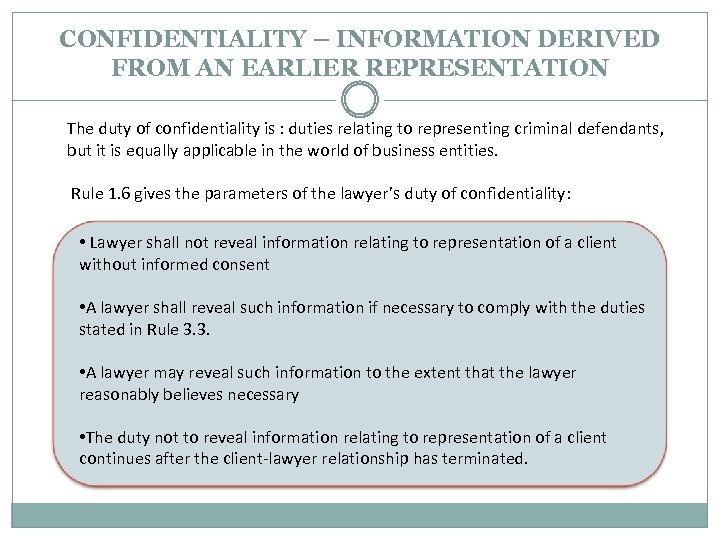 CONFIDENTIALITY – INFORMATION DERIVED FROM AN EARLIER REPRESENTATION The duty of confidentiality is : duties relating to representing criminal defendants, but it is equally applicable in the world of business entities. Rule 1. 6 gives the parameters of the lawyer’s duty of confidentiality: • Lawyer shall not reveal information relating to representation of a client without informed consent • A lawyer shall reveal such information if necessary to comply with the duties stated in Rule 3. 3. • A lawyer may reveal such information to the extent that the lawyer reasonably believes necessary • The duty not to reveal information relating to representation of a client continues after the client-lawyer relationship has terminated.
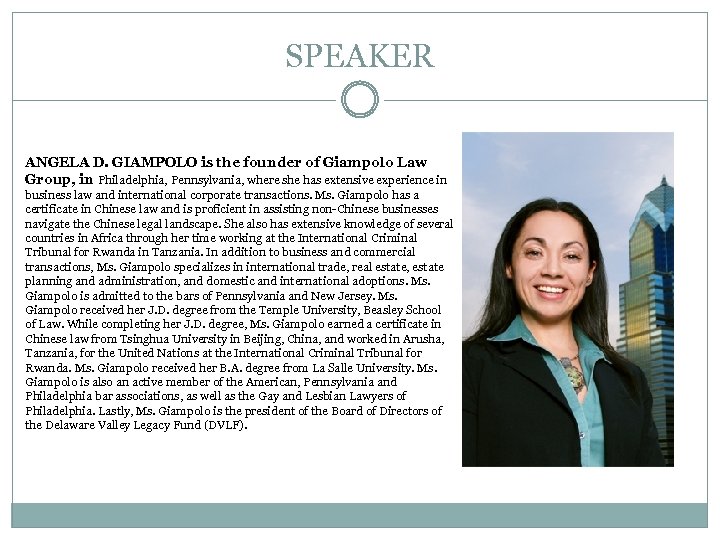 SPEAKER ANGELA D. GIAMPOLO is the founder of Giampolo Law Group, in Philadelphia, Pennsylvania, where she has extensive experience in business law and international corporate transactions. Ms. Giampolo has a certificate in Chinese law and is proficient in assisting non-Chinese businesses navigate the Chinese legal landscape. She also has extensive knowledge of several countries in Africa through her time working at the International Criminal Tribunal for Rwanda in Tanzania. In addition to business and commercial transactions, Ms. Giampolo specializes in international trade, real estate, estate planning and administration, and domestic and international adoptions. Ms. Giampolo is admitted to the bars of Pennsylvania and New Jersey. Ms. Giampolo received her J. D. degree from the Temple University, Beasley School of Law. While completing her J. D. degree, Ms. Giampolo earned a certificate in Chinese law from Tsinghua University in Beijing, China, and worked in Arusha, Tanzania, for the United Nations at the International Criminal Tribunal for Rwanda. Ms. Giampolo received her B. A. degree from La Salle University. Ms. Giampolo is also an active member of the American, Pennsylvania and Philadelphia bar associations, as well as the Gay and Lesbian Lawyers of Philadelphia. Lastly, Ms. Giampolo is the president of the Board of Directors of the Delaware Valley Legacy Fund (DVLF).