 Скачать презентацию Livorno October 7 th 2010 LEM Conferences Room
030d66e27508391a12aedb9efae4e889.ppt
- Количество слайдов: 30



Livorno, October 7 th 2010 LEM Conferences Room CONFERENCE of EU INTERREG IVC FLIPPER PROJECT Piero Sassoli – Director General Tiemme S. p. A. TIEMME: Transport Companies Merger
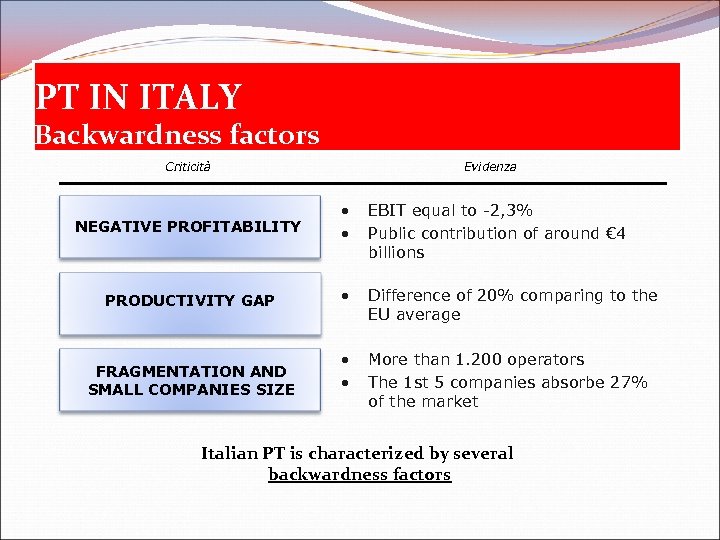
PT IN ITALY Backwardness factors Criticità Evidenza NEGATIVE PROFITABILITY • • EBIT equal to -2, 3% Public contribution of around € 4 billions PRODUCTIVITY GAP • Difference of 20% comparing to the EU average FRAGMENTATION AND SMALL COMPANIES SIZE • • More than 1. 200 operators The 1 st 5 companies absorbe 27% of the market Italian PT is characterized by several backwardness factors
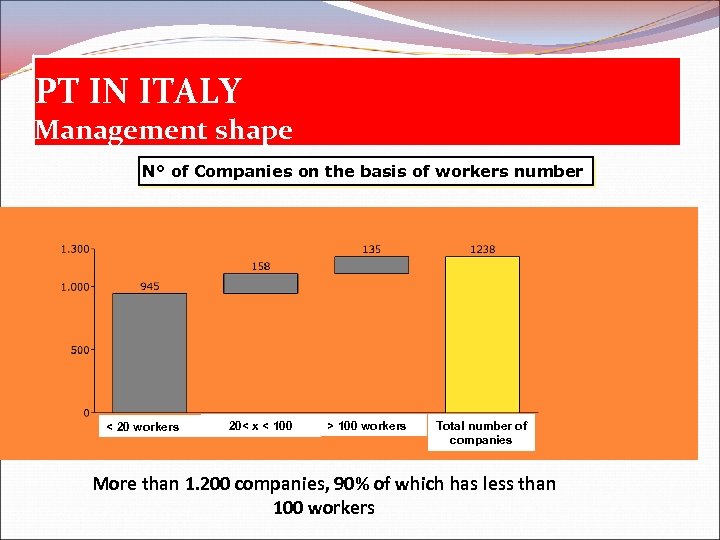
PT IN ITALY Management shape N° of Companies on the basis of workers number < 20 workers 20< x < 100 > 100 workers Total number of companies More than 1. 200 companies, 90% of which has less than 100 workers
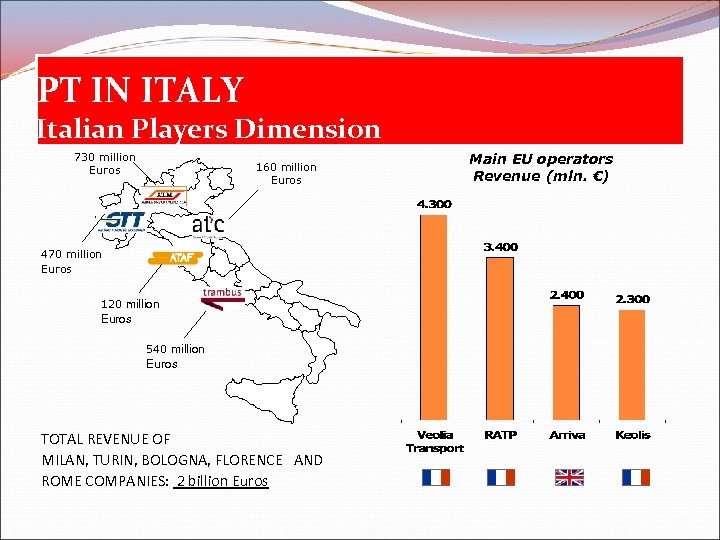
PT IN ITALY Italian Players Dimension 730 million Euros 160 million Euros 470 million Euros 120 million Euros 540 million Euros TOTAL REVENUE OF MILAN, TURIN, BOLOGNA, FLORENCE AND ROME COMPANIES: 2 billion Euros Main EU operators Revenue (mln. €)
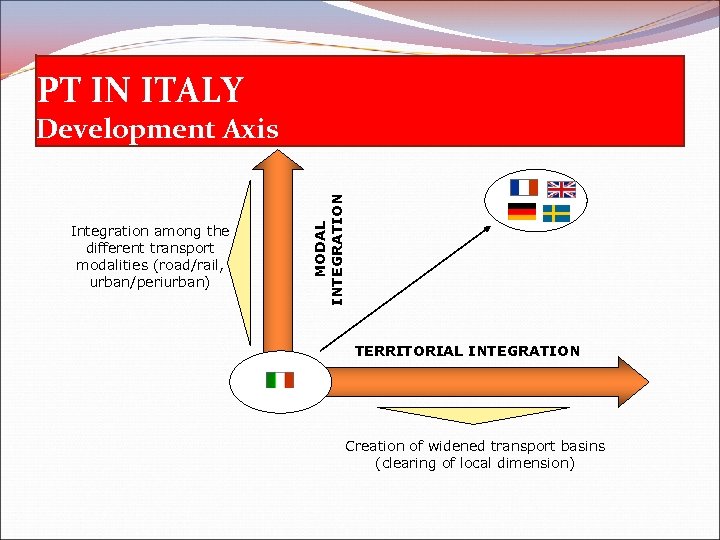
PT IN ITALY Integration among the different transport modalities (road/rail, urban/periurban) MODAL INTEGRATION Development Axis TERRITORIAL INTEGRATION Creation of widened transport basins (clearing of local dimension)
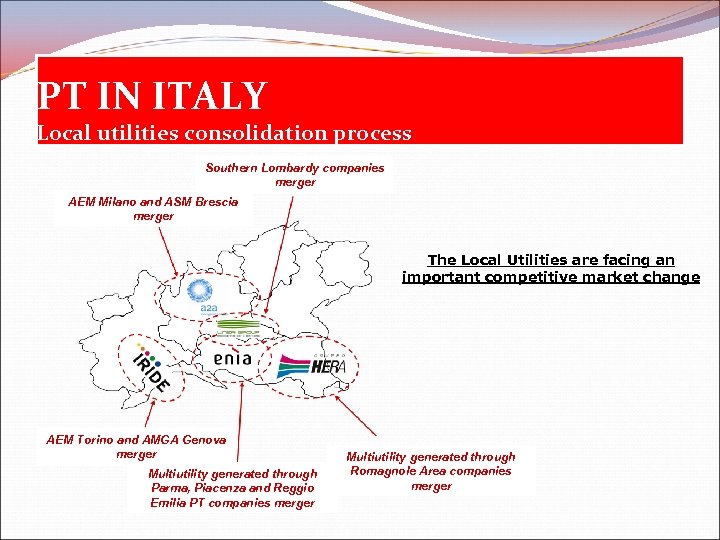
PT IN ITALY Local utilities consolidation process Southern Lombardy companies merger AEM Milano and ASM Brescia merger The Local Utilities are facing an important competitive market change AEM Torino and AMGA Genova merger Multiutility generated through Parma, Piacenza and Reggio Emilia PT companies merger Multiutility generated through Romagnole Area companies merger
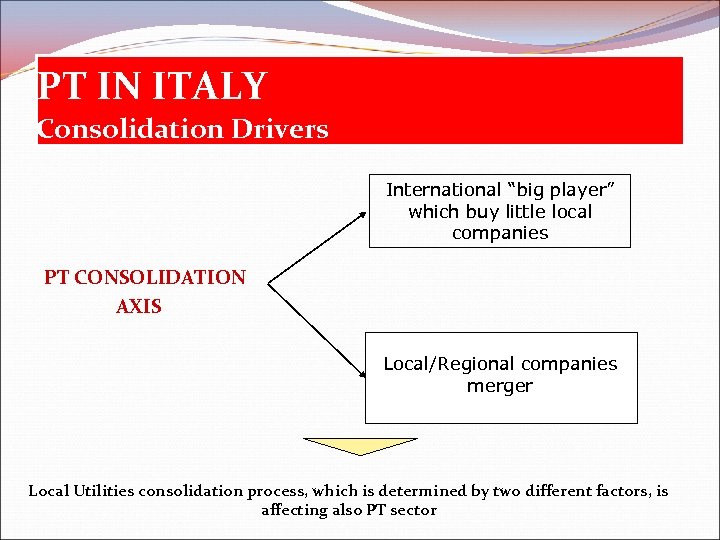
PT IN ITALY Consolidation Drivers International “big player” which buy little local companies PT CONSOLIDATION AXIS Local/Regional companies merger Local Utilities consolidation process, which is determined by two different factors, is affecting also PT sector
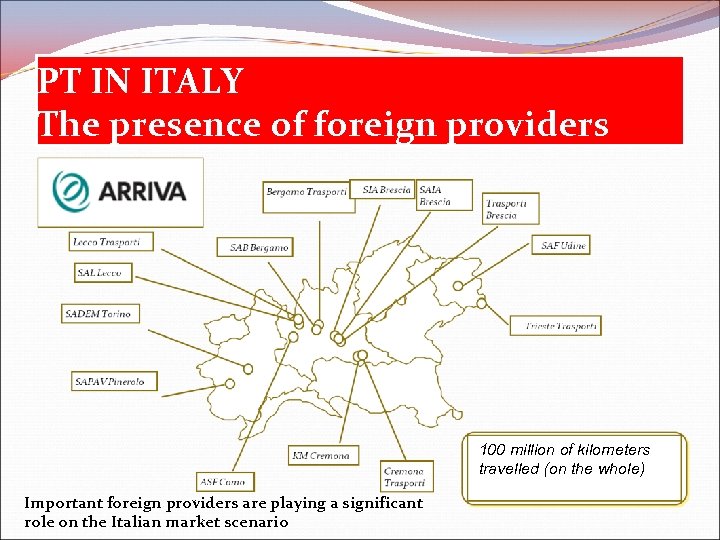
PT IN ITALY The presence of foreign providers 100 million of kilometers travelled (on the whole) Important foreign providers are playing a significant role on the Italian market scenario
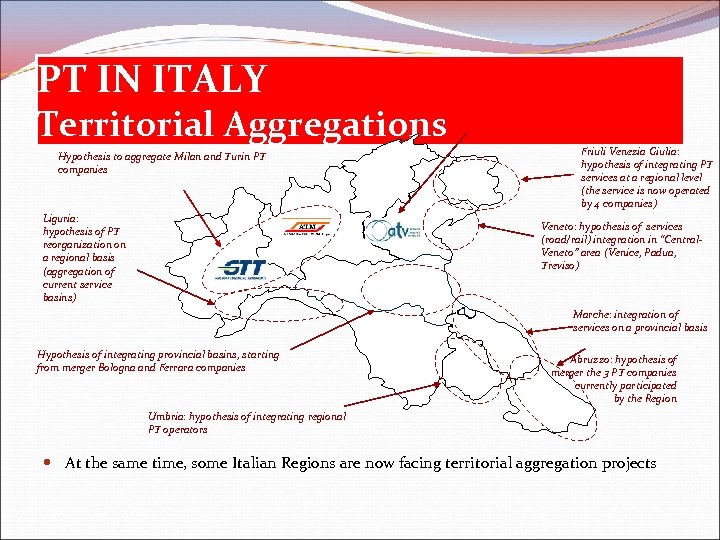
PT IN ITALY Territorial Aggregations Hypothesis to aggregate Milan and Turin PT companies Liguria: hypothesis of PT reorganization on a regional basis (aggregation of current service basins) Friuli Venezia Giulia: hypothesis of integrating PT services at a regional level (the service is now operated by 4 companies) Veneto: hypothesis of services (road/rail) integration in “Central. Veneto” area (Venice, Padua, Treviso) Marche: integration of services on a provincial basis Hypothesis of integrating provincial basins, starting from merger Bologna and Ferrara companies Abruzzo: hypothesis of merger the 3 PT companies currently participated by the Region Umbria: hypothesis of integrating regional PT operators At the same time, some Italian Regions are now facing territorial aggregation projects
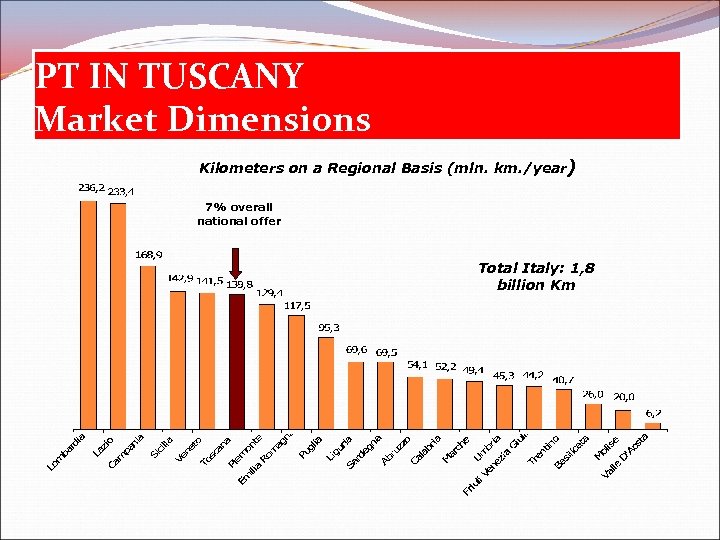
PT IN TUSCANY Market Dimensions Kilometers on a Regional Basis (mln. km. /year) 7% overall national offer Total Italy: 1, 8 billion Km
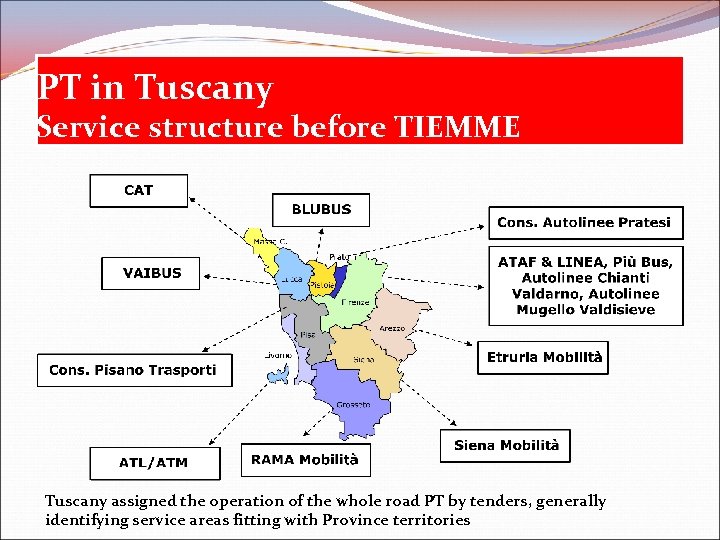
PT in Tuscany Service structure before TIEMME Tuscany assigned the operation of the whole road PT by tenders, generally identifying service areas fitting with Province territories
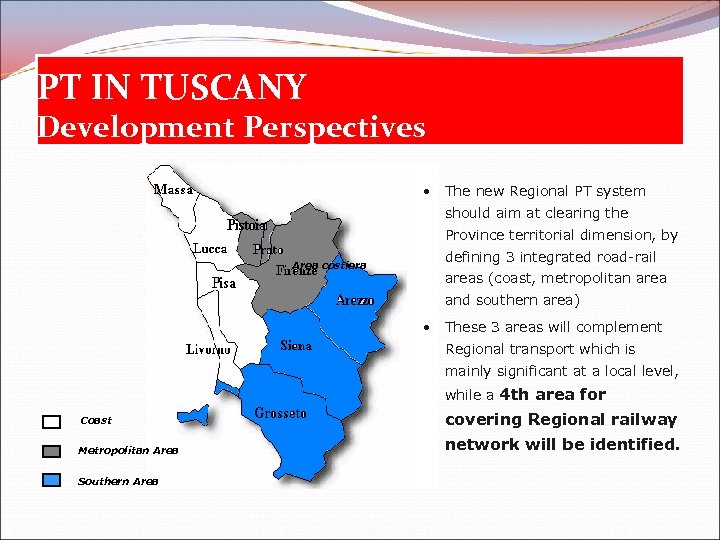
PT IN TUSCANY Development Perspectives • The new Regional PT system should aim at clearing the Province territorial dimension, by Area costiera defining 3 integrated road-rail areas (coast, metropolitan area and southern area) • These 3 areas will complement Regional transport which is mainly significant at a local level, while a 4 th area for Coast covering Regional railway Metropolitan Area network will be identified. Southern Area
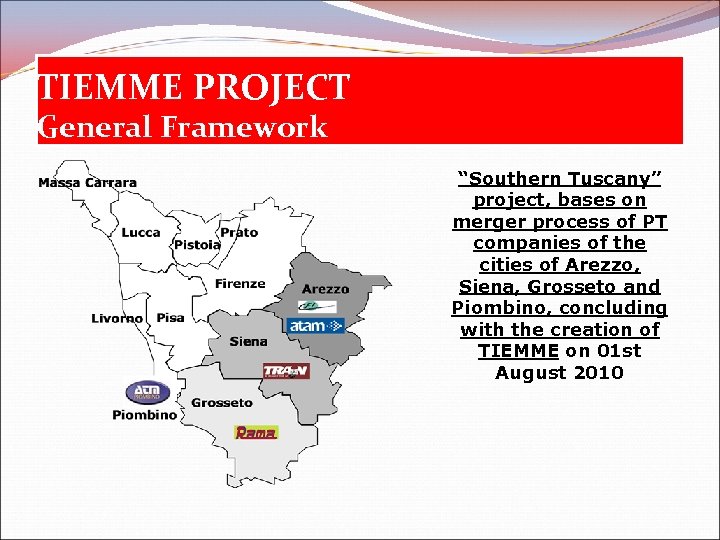
TIEMME PROJECT General Framework “Southern Tuscany” project, bases on merger process of PT companies of the cities of Arezzo, Siena, Grosseto and Piombino, concluding with the creation of TIEMME on 01 st August 2010
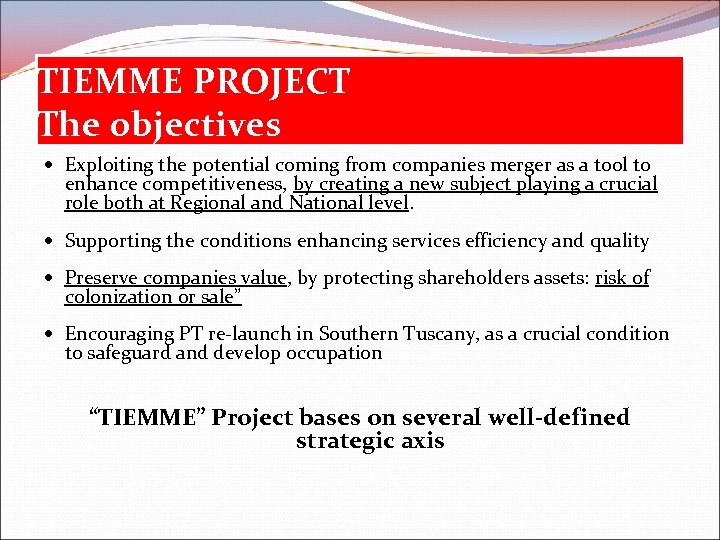
TIEMME PROJECT The objectives • Exploiting the potential coming from companies merger as a tool to enhance competitiveness, by creating a new subject playing a crucial role both at Regional and National level. • Supporting the conditions enhancing services efficiency and quality • Preserve companies value, by protecting shareholders assets: risk of colonization or sale” • Encouraging PT re-launch in Southern Tuscany, as a crucial condition to safeguard and develop occupation “TIEMME” Project bases on several well-defined strategic axis
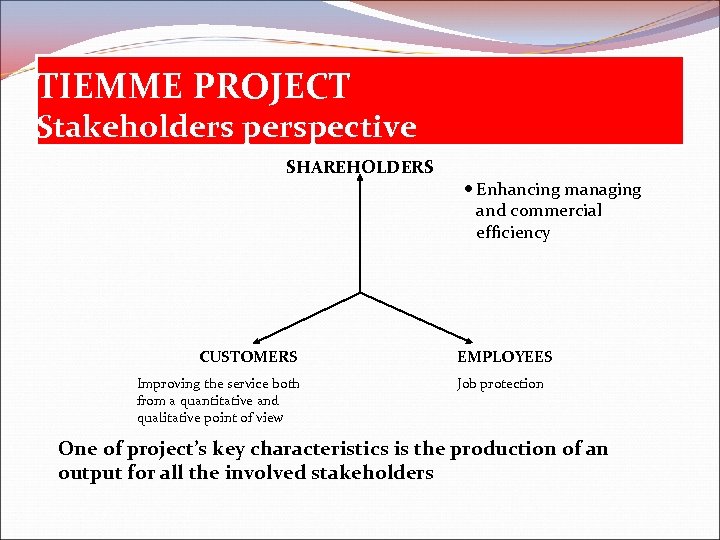
TIEMME PROJECT Stakeholders perspective SHAREHOLDERS CUSTOMERS Improving the service both from a quantitative and qualitative point of view • Enhancing managing and commercial efficiency EMPLOYEES Job protection One of project’s key characteristics is the production of an output for all the involved stakeholders
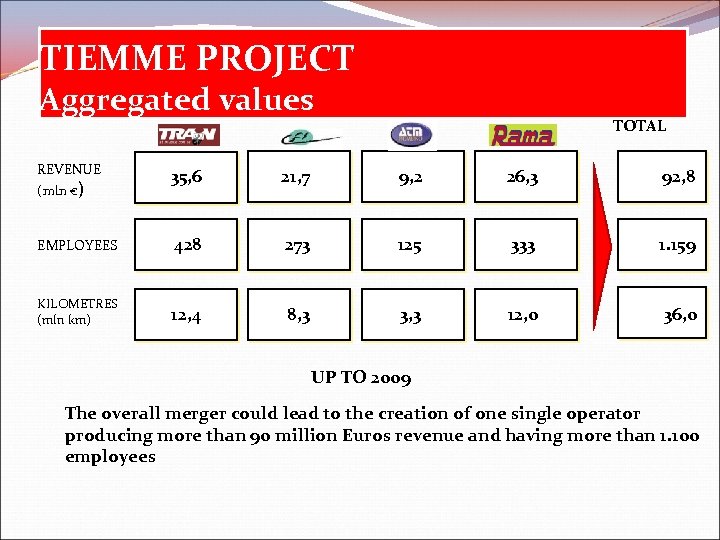
TIEMME PROJECT Aggregated values TOTAL REVENUE (mln €) 35, 6 21, 7 9, 2 26, 3 92, 8 EMPLOYEES 428 273 125 333 1. 159 KILOMETRES (mln km) 12, 4 8, 3 3, 3 12, 0 36, 0 UP TO 2009 The overall merger could lead to the creation of one single operator producing more than 90 million Euros revenue and having more than 1. 100 employees
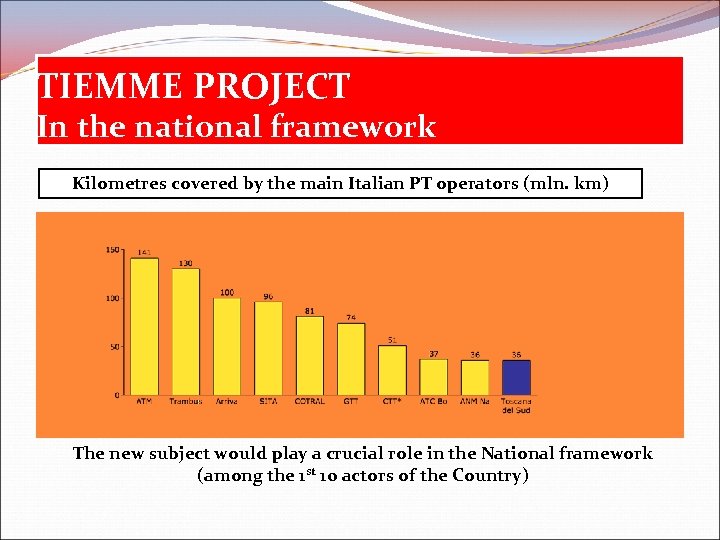
TIEMME PROJECT In the national framework Kilometres covered by the main Italian PT operators (mln. km) The new subject would play a crucial role in the National framework (among the 1 st 10 actors of the Country)
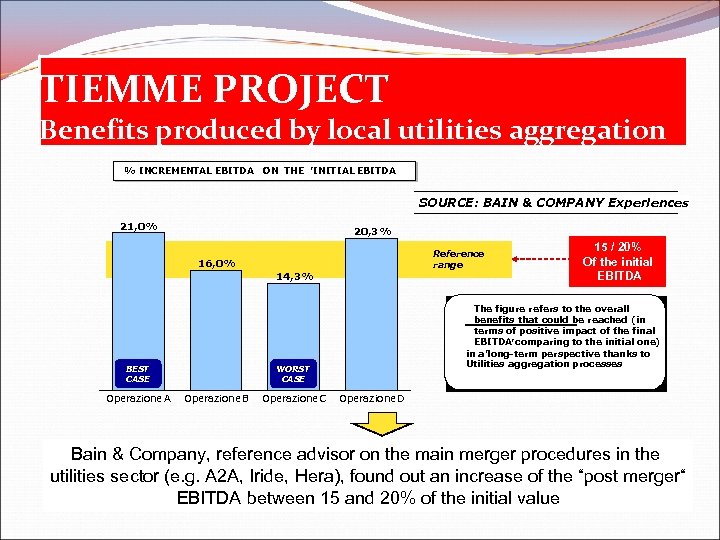
TIEMME PROJECT Benefits produced by local utilities aggregation EBITDA INCREMENTALE IN ON SULL ’EBITDA INIZIALE % INCREMENTAL EBITDA % SULL ’INITIAL INIZIALE EBITDA INCREMENTALE IN % THE ’EBITDA FONTE: ESPERIENZE BAIN & COMPANY SOURCE: BAIN & COMPANY Experiences 21, 0% 20, 3% Reference range di range riferimento 16, 0% 14, 3% BEST CASE Operazione A The figuresi riferisce ai benefici Il grafico si riferiscethebenefici Il grafico refers to ai overall benefits that could ottenibili (in COMPLESSIVAMENTEbe reached (in COMPLESSIVAMENTE ottenibili (in terms impatto positivo sull ’’EBITDA termini di impatto positivo sull the final termini di of positive impact of ’EBITDA comparing to the initial one) rispetto all ’EBITDA aggregato iniziale) rispetto all’’EBITDA aggregato iniziale) in a ’long-term perspective thanks to nell’arco di un piano pluriennale a Utilities operazioni di aggregazione seguito di aggregation processes seguito di operazioni di aggregazione nel settore delle Utilities WORST CASE Operazione B Operazione C 15 -20% 15 / 20% dell’EBITDA Of the initial iniziale EBITDA Operazione D Bain Company, reference advisor delle principali operazioni di Bainsettore delle utilites (es. di riferimentoon the main merger campoaggregazione nel & & Company, advisor A 2 A, Iride, Hera), ha riscontrato sul procedures in the un incremento utilities sector (e. g. A 2 A, Iride, Hera), found out an 15 e il 20%of the “post partenza dell’EBITDA “post aggregazione” quantificabile tra il increase del valore di merger“ EBITDA between 15 and 20% of the initial value
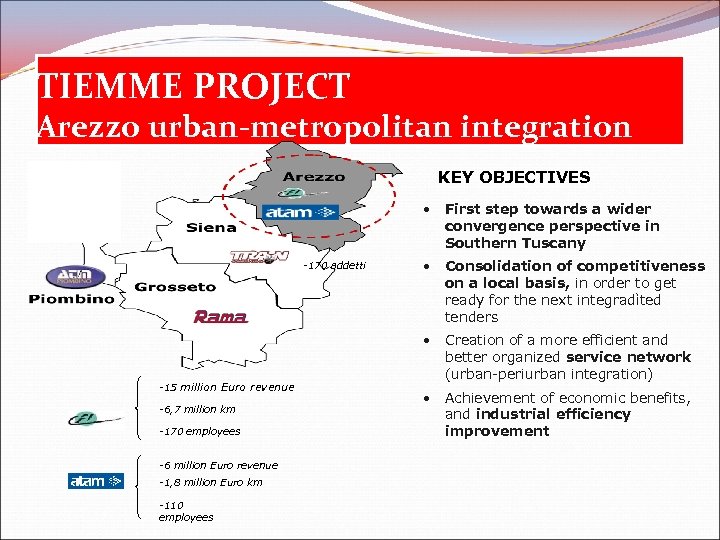
TIEMME PROJECT Arezzo urban-metropolitan integration KEY OBJECTIVES • First step towards a wider convergence perspective in Southern Tuscany -170 addetti -15 million Euro revenue -6, 7 million km -170 employees -6 million Euro revenue -1, 8 million Euro km -110 employees • Consolidation of competitiveness on a local basis, in order to get ready for the next integradìted tenders • Creation of a more efficient and better organized service network (urban-periurban integration) • Achievement of economic benefits, and industrial efficiency improvement
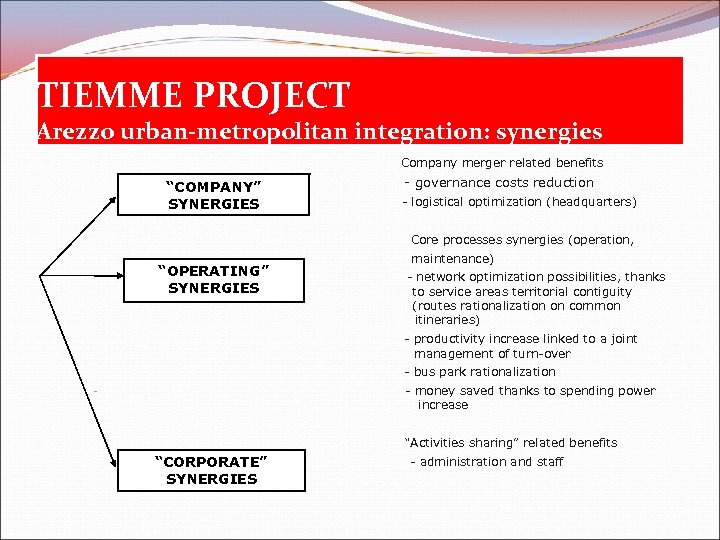
TIEMME PROJECT Arezzo urban-metropolitan integration: synergies Company merger related benefits “COMPANY” SYNERGIES - governance costs reduction - logistical optimization (headquarters) Core processes synergies (operation, “OPERATING” SYNERGIES maintenance) - network optimization possibilities, thanks to service areas territorial contiguity (routes rationalization on common itineraries) - productivity increase linked to a joint management of turn-over - bus park rationalization - money saved thanks to spending power increase - “Activities sharing” related benefits “CORPORATE” SYNERGIES - administration and staff
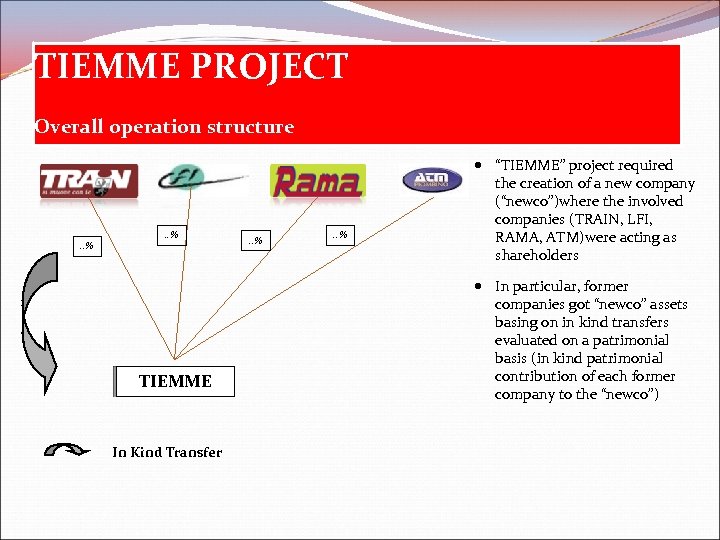
TIEMME PROJECT Overall operation structure . . % TIEMME In Kind Transfer . . % • “TIEMME” project required the creation of a new company (“newco”)where the involved companies (TRAIN, LFI, RAMA, ATM)were acting as shareholders • In particular, former companies got “newco” assets basing on in kind transfers evaluated on a patrimonial basis (in kind patrimonial contribution of each former company to the “newco”)
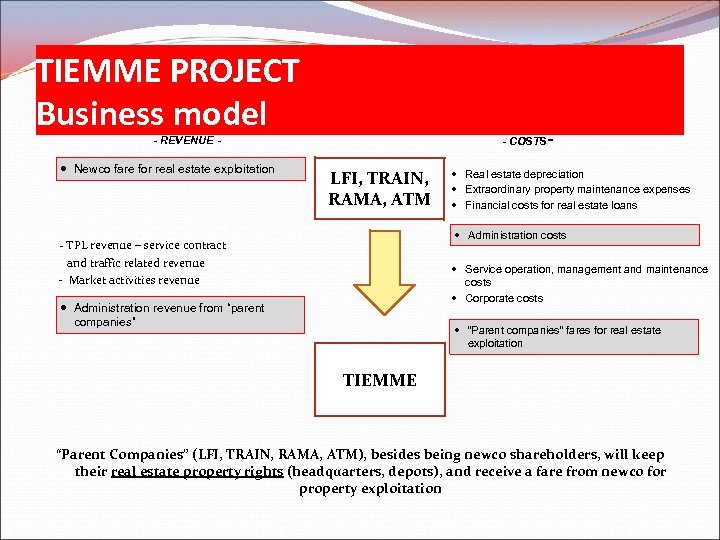
TIEMME PROJECT Business model - REVENUE - ° • Newco fare for real estate exploitation - COSTS LFI, TRAIN, RAMA, ATM - • Real estate depreciation • Extraordinary property maintenance expenses • Financial costs for real estate loans • Administration costs - TPL revenue – service contract and traffic related revenue - Market activities revenue • Service operation, management and maintenance costs • Corporate costs • Administration revenue from “parent companies” • “Parent companies” fares for real estate exploitation TIEMME “Parent Companies” (LFI, TRAIN, RAMA, ATM), besides being newco shareholders, will keep their real estate property rights (headquarters, depots), and receive a fare from newco for property exploitation
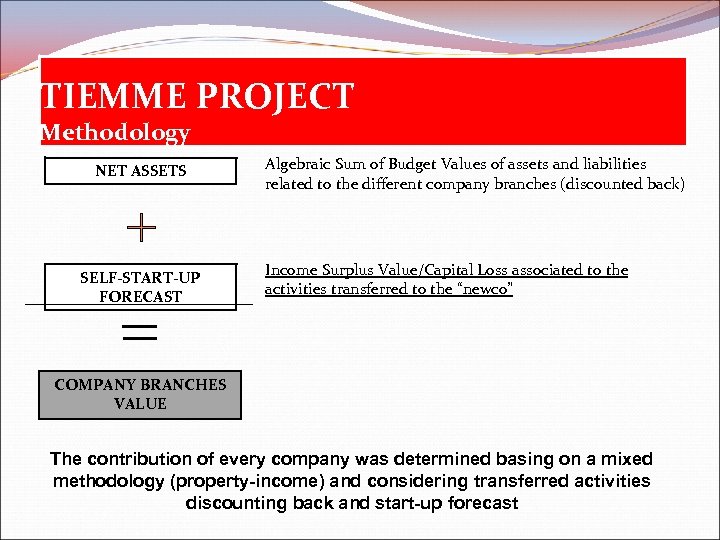
TIEMME PROJECT Methodology NET ASSETS SELF-START-UP FORECAST Algebraic Sum of Budget Values of assets and liabilities related to the different company branches (discounted back) Income Surplus Value/Capital Loss associated to the activities transferred to the “newco” COMPANY BRANCHES VALUE The contribution of every company was determined basing on a mixed methodology (property-income) and considering transferred activities discounting back and start-up forecast
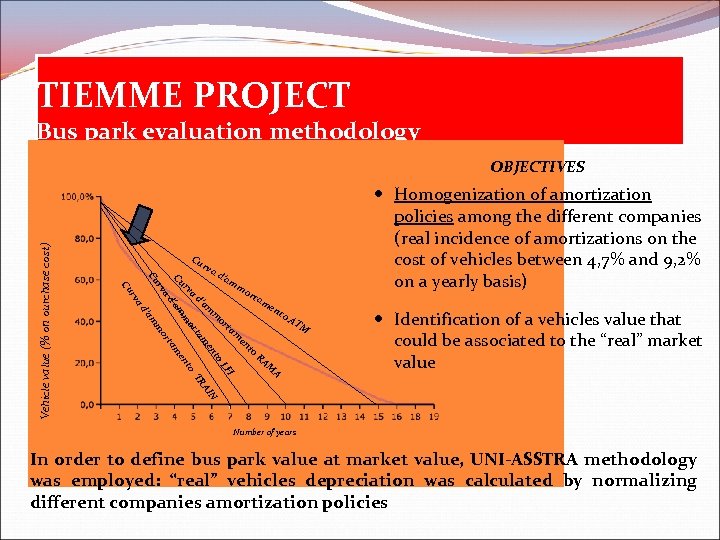
TIEMME PROJECT Bus park evaluation methodology Cu rv va r Cu a d’ va r Cu ad d’ a • Homogenization of amortization policies among the different companies (real incidence of amortizations on the cost of vehicles between 4, 7% and 9, 2% on a yearly basis) ’am mo rta m am m or ta or me nt m o. A TM en to to LF en to en m ta m or ta m m m d’a RA M I A • Identification of a vehicles value that could be associated to the “real” market value N AI TR Vehicle value (% on ourchase cost) OBJECTIVES Number of years In order to define bus park value at market value, UNI-ASSTRA methodology was employed: “real” vehicles depreciation was calculated by normalizing different companies amortization policies
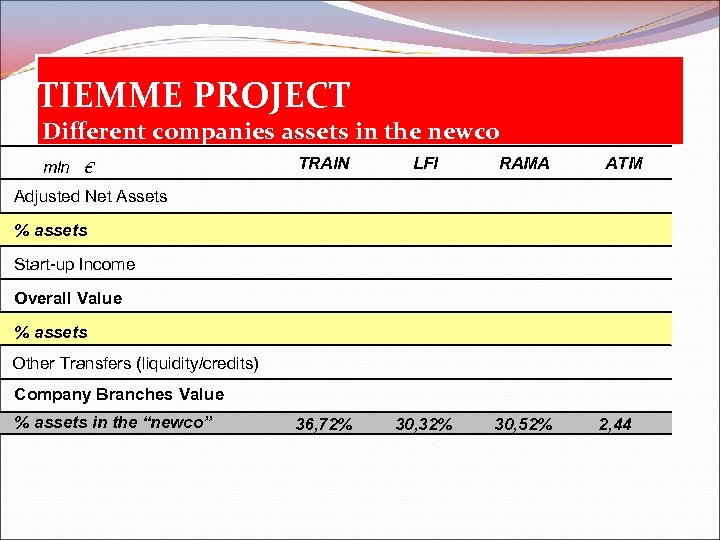
TIEMME PROJECT Different companies assets in the newco mln € TRAIN LFI RAMA 36, 72% 30, 32% 30, 52% ATM Adjusted Net Assets % assets Start-up Income Overall Value % assets Other Transfers (liquidity/credits) Company Branches Value % assets in the “newco” 2, 44
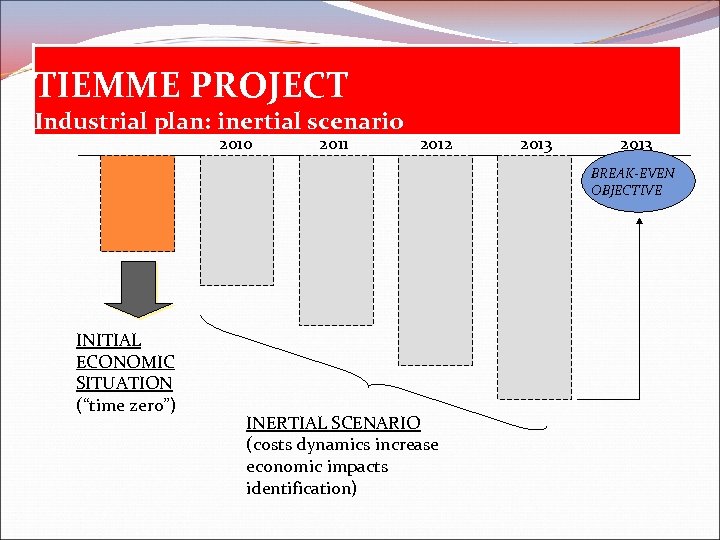
TIEMME PROJECT Industrial plan: inertial scenario 2010 2011 2012 2013 BREAK-EVEN OBJECTIVE INITIAL ECONOMIC SITUATION (“time zero”) INERTIAL SCENARIO (costs dynamics increase economic impacts identification)
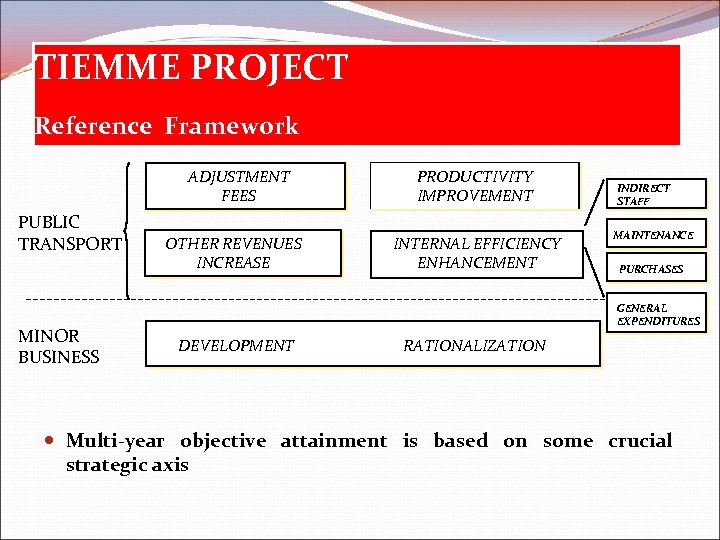
TIEMME PROJECT Reference Framework ADJUSTMENT FEES PUBLIC TRANSPORT MINOR BUSINESS OTHER REVENUES INCREASE PRODUCTIVITY IMPROVEMENT INTERNAL EFFICIENCY ENHANCEMENT INDIRECT STAFF MAINTENANCE PURCHASES GENERAL EXPENDITURES DEVELOPMENT RATIONALIZATION Multi-year objective attainment is based on some crucial strategic axis
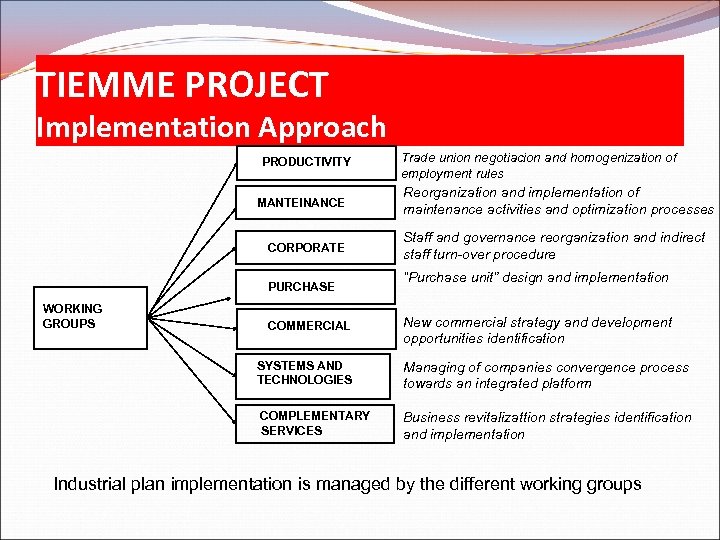
TIEMME PROJECT Implementation Approach PRODUCTIVITY MANTEINANCE CORPORATE PURCHASE WORKING GROUPS COMMERCIAL Trade union negotiacion and homogenization of employment rules Reorganization and implementation of maintenance activities and optimization processes Staff and governance reorganization and indirect staff turn-over procedure “Purchase unit” design and implementation New commercial strategy and development opportunities identification SYSTEMS AND TECHNOLOGIES Managing of companies convergence process towards an integrated platform COMPLEMENTARY SERVICES Business revitalizattion strategies identification and implementation Industrial plan implementation is managed by the different working groups
 Скачать презентацию Livorno October 7 th 2010 LEM Conferences Room
030d66e27508391a12aedb9efae4e889.ppt