


 Скачать презентацию Living with RFI at AO aka rfi snooping
97f92804cb2ba5297951b9b2ba96b417.ppt
- Количество слайдов: 24
 Living with RFI at AO (aka rfi snooping) Puerto Rican Spectrum Users Group 23 sep 10 meeting Phil Perillat Puerto Rican Spectrum Users Group Sept 23, 2010
 Talk Outline • Frequency bands covered at the Arecibo Observatory (AO) Why we want large frequency coverage • – • How RFI comes to our attention. – – • • • Hydrogen line, doppler shift, expansion of universe Users Ao monitoring of data Where is the RFI coming from? Minimizing the effect of RFI. A look at some RFI Online: http: //www. naic. edu/~phil/talks. html sept 10 PRSUG Puerto Rican Spectrum Users Group Sept 23, 2010
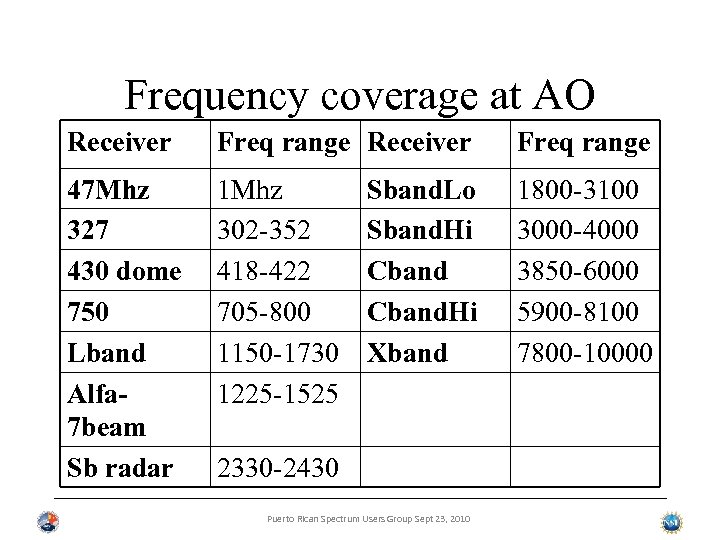 Frequency coverage at AO Receiver Freq range 47 Mhz 327 430 dome 750 Lband Alfa 7 beam Sb radar 1 Mhz 302 -352 418 -422 705 -800 1150 -1730 1225 -1525 1800 -3100 3000 -4000 3850 -6000 5900 -8100 7800 -10000 Sband. Lo Sband. Hi Cband. Hi Xband 2330 -2430 Puerto Rican Spectrum Users Group Sept 23, 2010
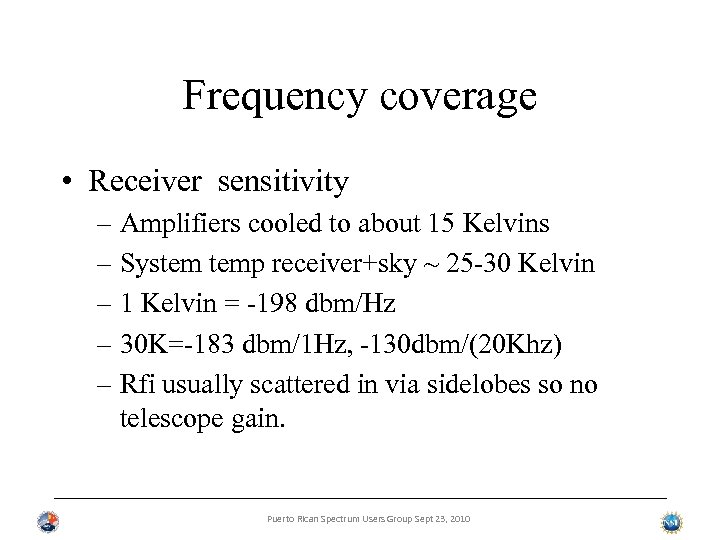 Frequency coverage • Receiver sensitivity – Amplifiers cooled to about 15 Kelvins – System temp receiver+sky ~ 25 -30 Kelvin – 1 Kelvin = -198 dbm/Hz – 30 K=-183 dbm/1 Hz, -130 dbm/(20 Khz) – Rfi usually scattered in via sidelobes so no telescope gain. Puerto Rican Spectrum Users Group Sept 23, 2010
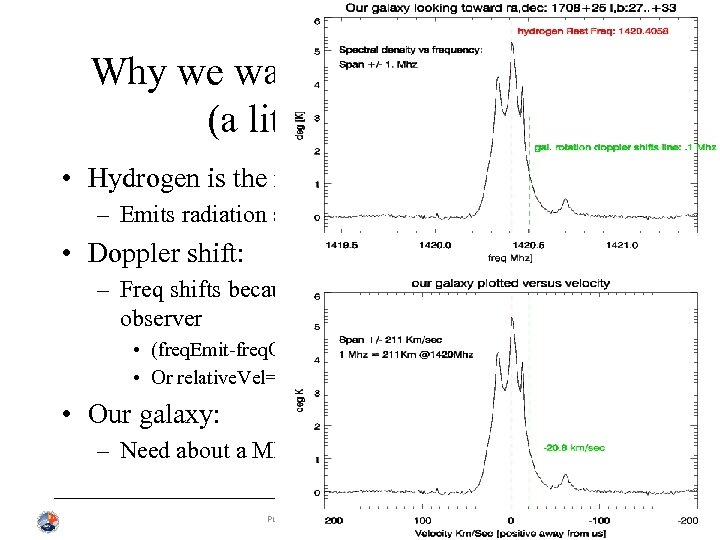 Why we want large freq coverage (a little astronomy) • Hydrogen is the most abundant element. – Emits radiation at 1420. 4058 Mhz. . • Doppler shift: – Freq shifts because of relative motion emitter and observer • (freq. Emit-freq. Obs)/freq. Emit = Relative. Velocity/C • Or relative. Vel=(freq. Dif)/freq. Emit*C • Our galaxy: – Need about a Mhz about 1420. 4 to get doppler info. Puerto Rican Spectrum Users Group Sept 23, 2010
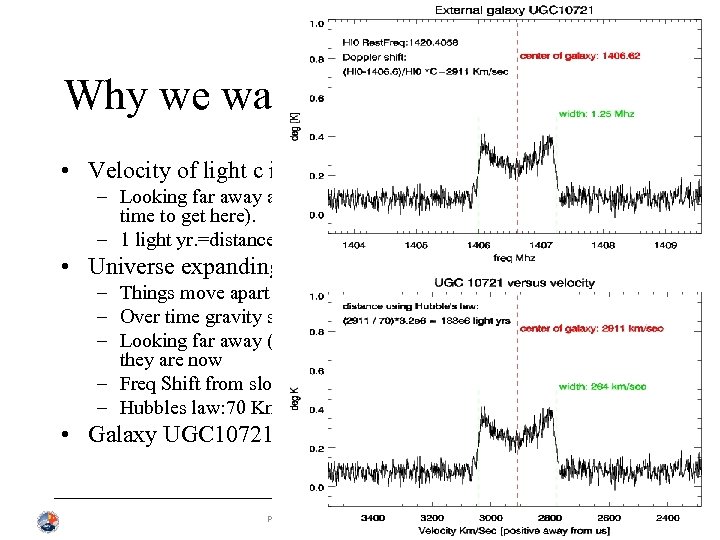 Why we want large freq coverage • Velocity of light c is finite: 300, 000 km/sec – Looking far away also looks back in time (because it takes the light time to get here). – 1 light yr. =distance light travels in 1 year=9. 5*10^12 km • Universe expanding from big bang – Things move apart at a high speed. – Over time gravity slows down the expansion. – Looking far away (back in time) things were moving faster than they are now – Freq Shift from slowdown of expansion: – Hubbles law: 70 Km/sec every 3. 2*10^6 light years • Galaxy UGC 10721 at 1406. 62 Mhz 2911 km/sec Puerto Rican Spectrum Users Group Sept 23, 2010
 Why we want large freq coverage • Example: observing galaxies at 1220 Mhz – (1420 -1220)/1420 *C velocity is 42241 Km/sec – 42242/70 * 3. 32 e 6 = 2 billion light years – Universe age : 13 billion years so looking back 2 billion years is a fraction 1/6 of the universe lifetime. • Received signals get weaker as 1/distance squared – Need long integration times and sensitive telescopes to be able to do this. • Arecibo is the most sensitive radio telescope in the world for lband observing. • Disclaimer: Observing galaxies using hydrogen is not the only interesting thing we do here… (but I’ve only got so much time for the talk…. Puerto Rican Spectrum Users Group Sept 23, 2010
 How rfi comes to our attention • • Users of the telescope see it in their data AO monitoring of telescope data for rfi Hilltop monitoring system The grapevine. . – ITU, WRC, CORF, PRSUG – google Puerto Rican Spectrum Users Group Sept 23, 2010
 Users looking at their data: • Most sensitive way, but: – Could be large time lag between users taking the data and analyzing it. – We may not use a freq range for a long time period. About 7 experiments are done daily. These may last from days to years. – So user input is good but not sufficient to cover all the bands in a timely manner. Puerto Rican Spectrum Users Group Sept 23, 2010
 Ao monitoring of telescope data • Lots of data. . – Need to automate the identification of rfi in spectra. . – Have users dump spectra fast (1 sec, 1 millisec. . ) – Compute the (rms/mean) along time axis for each freq channel. • The resulting noise is only a function of the integration time and the channel width: • Radiometer Equation: – delta. T/T=1/sqrt(channel. Bandwidth*integration. Time) Puerto Rican Spectrum Users Group Sept 23, 2010
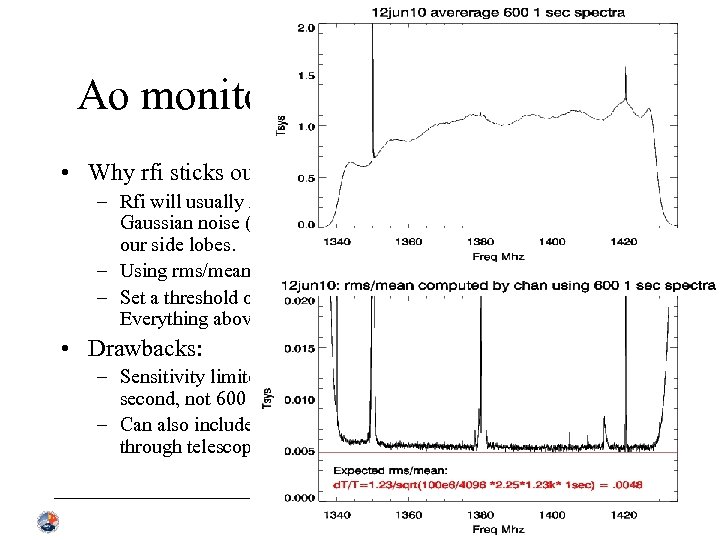 Ao monitoring of telescope data • Why rfi sticks out in rms/mean: – Rfi will usually have a time variability that is different from Gaussian noise (either inherently or because it is moving through our side lobes. – Using rms/mean gets around having to remove the band pass. – Set a threshold of 2 or 3 sigma above the expected noise level. Everything above this is called rfi. • Drawbacks: – Sensitivity limited by the single record integration (in this case 1 second, not 600 seconds). – Can also include real signals if they vary with time (eg sky drifting through telescope: (see HI, galaxy) Puerto Rican Spectrum Users Group Sept 23, 2010
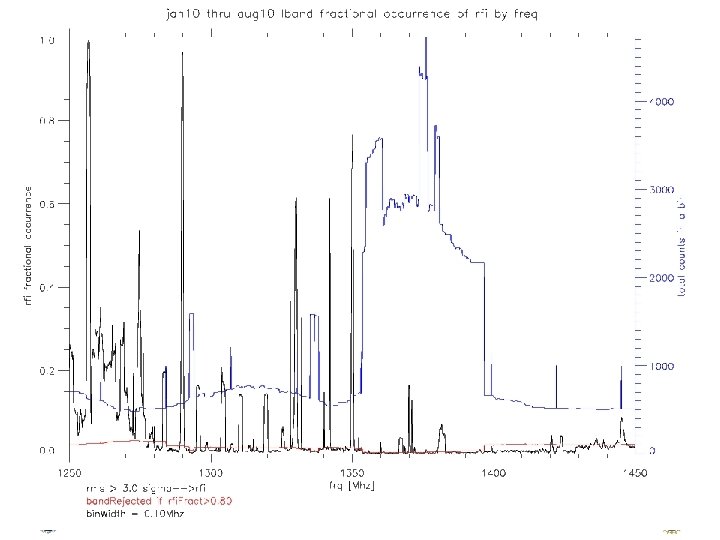 Ao monitoring of telescope data • Once a month: – process most of the data taken at arecibo computing rms/mean by channel. – For each freq range make a histogram of the fraction of time we saw rms/mean with a value 3 sigma above the expected noise value. – Call this rfi and publish it on the web: http: //www. naic. edu; /~phil/rfi/rms. html • Histogram of 1250 -1450 for 2010 jan-aug – Also have monthly plots – Punta salinas 1280 -1330 occurred only in mar 10 (we probably shifted our schedule without telling them). Puerto Rican Spectrum Users Group Sept 23, 2010
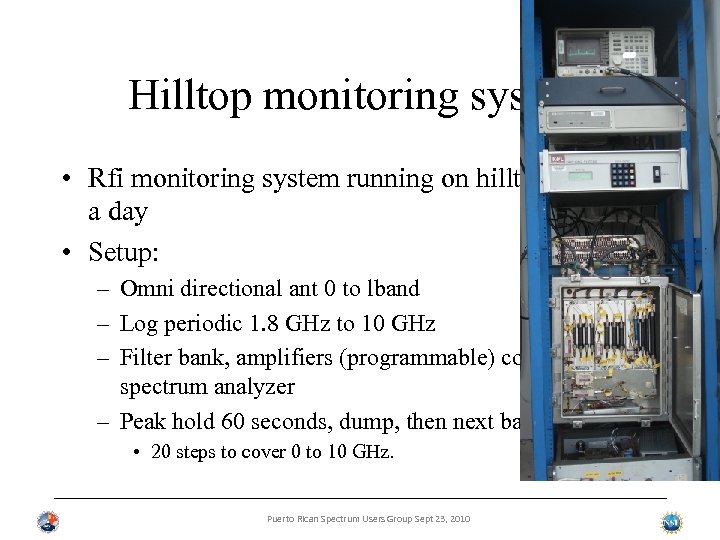 Hilltop monitoring system • Rfi monitoring system running on hilltop 24 hours a day • Setup: – Omni directional ant 0 to lband – Log periodic 1. 8 GHz to 10 GHz – Filter bank, amplifiers (programmable) connected to spectrum analyzer – Peak hold 60 seconds, dump, then next band • 20 steps to cover 0 to 10 GHz. Puerto Rican Spectrum Users Group Sept 23, 2010
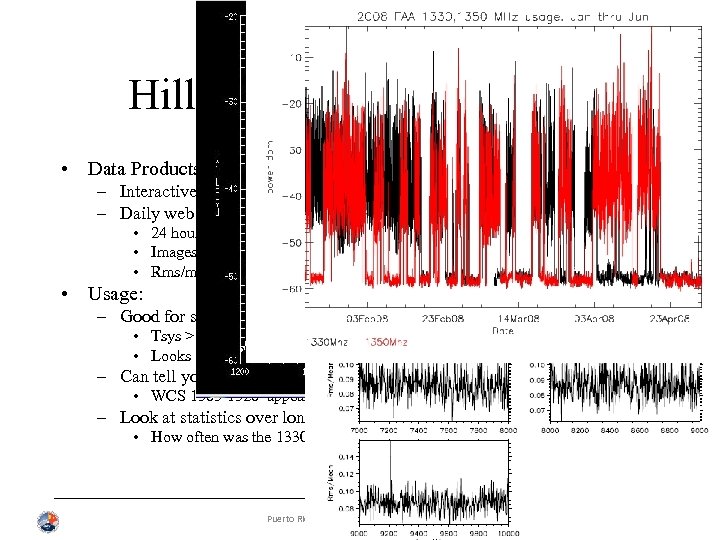 Hilltop monitoring system • Data Products: – Interactive tool to access 1 minute records. – Daily web output: • 24 hour average over each band • Images power time by frequency • Rms/mean over the day for each band • Usage: – Good for strong, wide (order 100 khz) signals. • Tsys > 1000 K, 401 channels over bandwidths 100 to 1 GHz • Looks at the horizon (hard to see satellites). – Can tell you when something started eg. . • WCS 1305 -1320 appeared 7: 30 am 23 jun 10. – Look at statistics over long periods of time. • How often was the 1330 or 1350 radar down for repair a few years ago Puerto Rican Spectrum Users Group Sept 23, 2010
 Where is the rfi coming from? • Are we generating it: – 1/distance^2 birdies originating in the dome will be strong. – Swing the azimuth arm by 360 deg. No az dependence points to birdie in the dome. – If a tone, measure it’s stability. Many of our signals are locked to a hydrogen maser. High stability (1 part 10^12 or better us). Puerto Rican Spectrum Users Group Sept 23, 2010
 Intermods, harmonics • Is the birdie entering the horn, or is it an intermod, harmonic created in our system? • – Move the first LO by delta F and see how much the birdie changes. . – Compute the harmonics, intermods for the system in use to see if it could come from a known source. – If possible select an rf filter (before 1 st mixer) that will cut down on out of band birdies. – Tv stations: 14 (471. 25) 22 (519. 25) created 430 birdie in: 2*f 1 -f 2. Placed a cavity filter in front of dewar to get rid of it (worsened Tsys by a little). Check if it is a harmonic of a known signal. – Chan 54 (711. 25) was generating a birdie at 1422. 5 from their transmitter. – Radio station 107. 3 was generating a 13 th harmonic at 1394. 9 MHz Puerto Rican Spectrum Users Group Sept 23, 2010
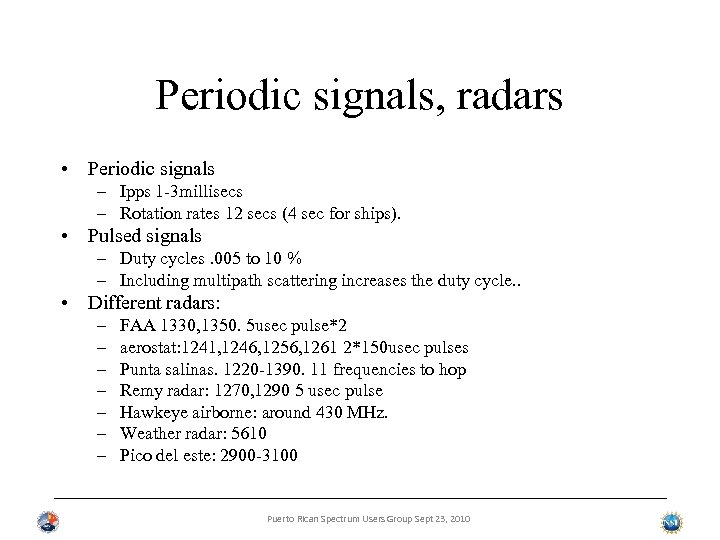 Periodic signals, radars • Periodic signals – Ipps 1 -3 millisecs – Rotation rates 12 secs (4 sec for ships). • Pulsed signals – Duty cycles. 005 to 10 % – Including multipath scattering increases the duty cycle. . • Different radars: – – – – FAA 1330, 1350. 5 usec pulse*2 aerostat: 1241, 1246, 1256, 1261 2*150 usec pulses Punta salinas. 1220 -1390. 11 frequencies to hop Remy radar: 1270, 1290 5 usec pulse Hawkeye airborne: around 430 MHz. Weather radar: 5610 Pico del este: 2900 -3100 Puerto Rican Spectrum Users Group Sept 23, 2010
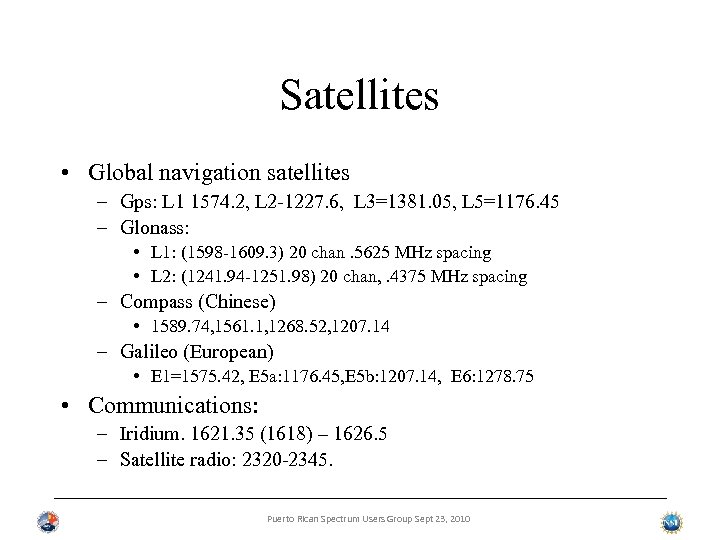 Satellites • Global navigation satellites – Gps: L 1 1574. 2, L 2 -1227. 6, L 3=1381. 05, L 5=1176. 45 – Glonass: • L 1: (1598 -1609. 3) 20 chan. 5625 MHz spacing • L 2: (1241. 94 -1251. 98) 20 chan, . 4375 MHz spacing – Compass (Chinese) • 1589. 74, 1561. 1, 1268. 52, 1207. 14 – Galileo (European) • E 1=1575. 42, E 5 a: 1176. 45, E 5 b: 1207. 14, E 6: 1278. 75 • Communications: – Iridium. 1621. 35 (1618) – 1626. 5 – Satellite radio: 2320 -2345. Puerto Rican Spectrum Users Group Sept 23, 2010
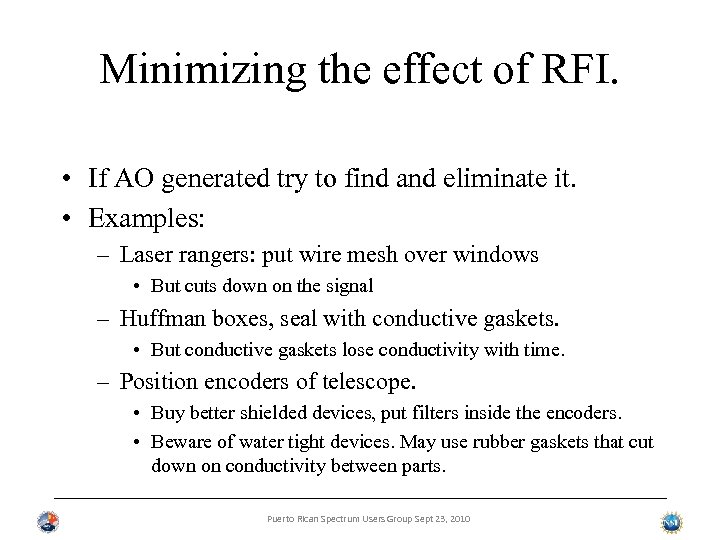 Minimizing the effect of RFI. • If AO generated try to find and eliminate it. • Examples: – Laser rangers: put wire mesh over windows • But cuts down on the signal – Huffman boxes, seal with conductive gaskets. • But conductive gaskets lose conductivity with time. – Position encoders of telescope. • Buy better shielded devices, put filters inside the encoders. • Beware of water tight devices. May use rubber gaskets that cut down on conductivity between parts. Puerto Rican Spectrum Users Group Sept 23, 2010
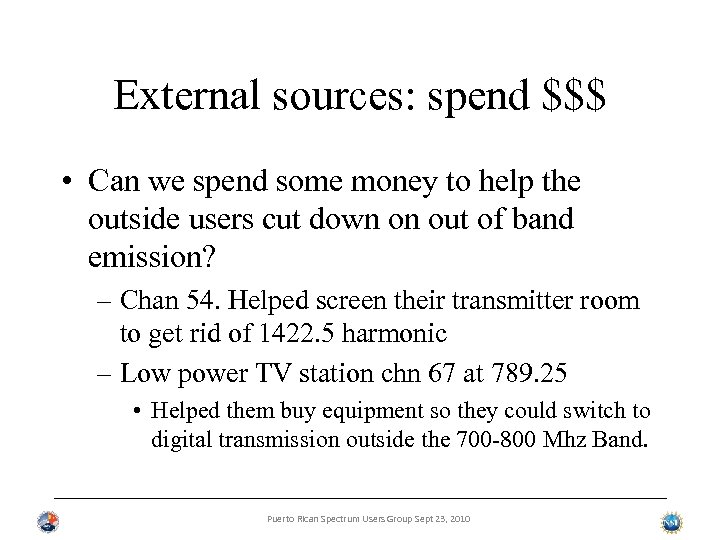 External sources: spend $$$ • Can we spend some money to help the outside users cut down on out of band emission? – Chan 54. Helped screen their transmitter room to get rid of 1422. 5 harmonic – Low power TV station chn 67 at 789. 25 • Helped them buy equipment so they could switch to digital transmission outside the 700 -800 Mhz Band. Puerto Rican Spectrum Users Group Sept 23, 2010
 Co existing with other users • See if we can time multiplex use of the band – Punta salinas moves to mode A (4 freq) when we do lband observing. When not using lband they use all of their frequencies – Punta borinquen. They try to use one of their 2 frequencies 1270, 1290 • Blank the radar in our direction to limit compression in our system: – Punta salinas and aerostat both blank their transmitters when they point at us. Puerto Rican Spectrum Users Group Sept 23, 2010
 Co existing. . • Gps L 3 at 1381. 05 – Coordinate the testing of gps l 3 and our observing schedules at lband. Shortened 4 days of testing for new svn 25 because is conflicted with AO observing • Iridium satellite. – Coordinate traffic levels with our observing schedules at OH. • FAA future upgrade – Try to blank new transmitters when they point at AO (but now 8 rather than 3 frequencies!!). Puerto Rican Spectrum Users Group Sept 23, 2010
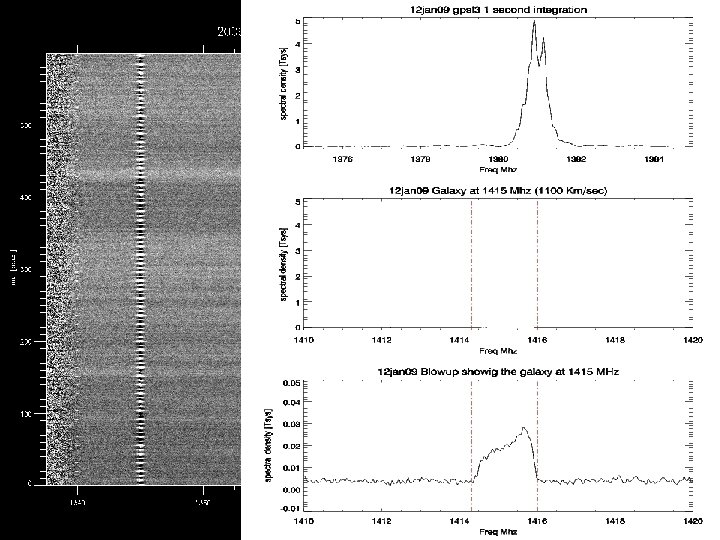 • Gps L 2 -1228, glonass L 2 -1248, compass-1268 • Faa 1330, 1350, iq images • Boriquen 1290 radar. • Punta salinas mode A Some examples of rfi • Freq vs time of power: 1220 -1395 Mhz – 1 second spectra, 21 Khz resolution • Freq vs time of power 1335 -1425 Mhz – Gps L 3 and external galaxy – 1340, 1380, 1405, 1410 generated from faa radar • GPS L 3 and external galaxy spectra – Shows difference in strength – And this is a nearby strong galaxy. Puerto Rican Spectrum Users Group Sept 23, 2010
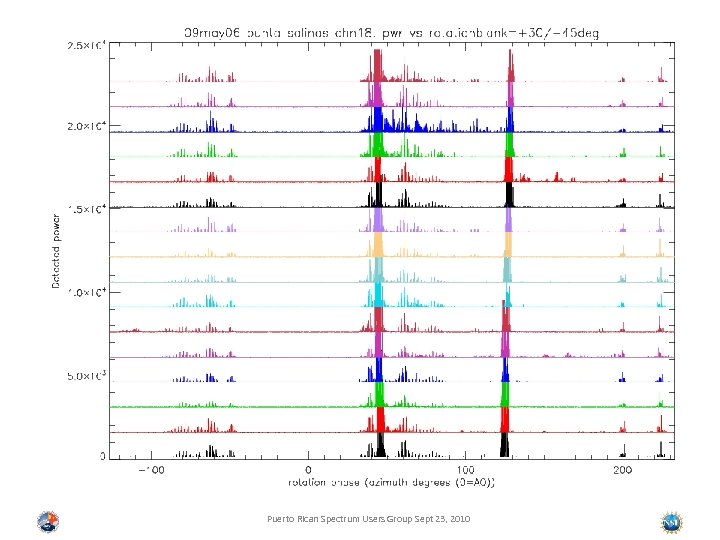 Last example of rfi • In rfi sleuthing, things never come out the way you expect them to. . Always try and duplicate the findings… • Example: punta salinas test blanking in our direction. – Online it looked like they had a gigantic sidelobe 120 degrees from pointing at us. – Offline I noticed that the line was curved… • More Info: http: //www. naic. edu/~phil/rfi • Thanks. . Puerto Rican Spectrum Users Group Sept 23, 2010