


 Скачать презентацию LIVING AND WORKING THE FUNCTION AND DESIGN OF
316a0f8c51dcb9a44233de57c68397fc.ppt
- Количество слайдов: 21
 LIVING AND WORKING: THE FUNCTION AND DESIGN OF HOUSING FOR LOWINCOME HOMEBASED WORKERS Nandini Bhaskara Rao University of Michigan Contact: nbhaskar@umich. edu
 Introduction Purpose To understand the spatial and social impacts of home-based work on the function and design of housing for low-income home-based workers.
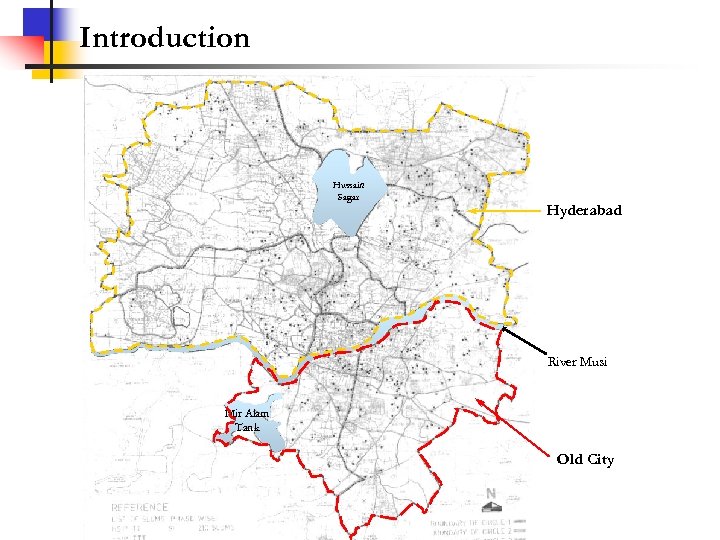 Introduction Hussain Sagar Hyderabad River Musi Mir Alam Tank Old City
 Introduction Methodology Qualitative Case Study Approach Data Sources Semi-structured Interviews with 38 Female Homeworkers n Ethnographic Field notes n Photographs n House Plans n
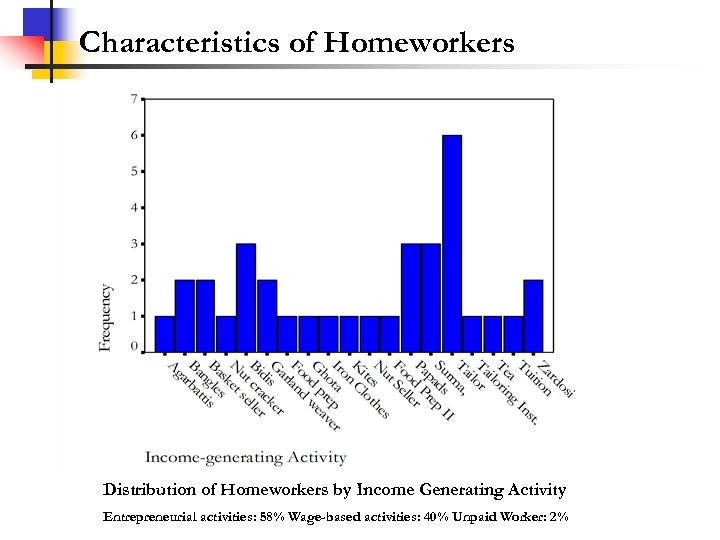 Characteristics of Homeworkers Distribution of Homeworkers by Income Generating Activity Entrepreneurial activities: 58% Wage-based activities: 40% Unpaid Worker: 2%
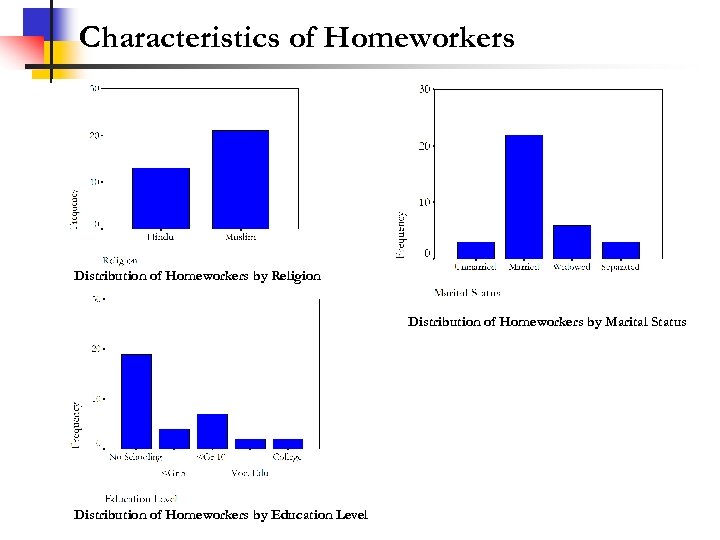 Characteristics of Homeworkers Distribution of Homeworkers by Religion Distribution of Homeworkers by Marital Status Distribution of Homeworkers by Education Level
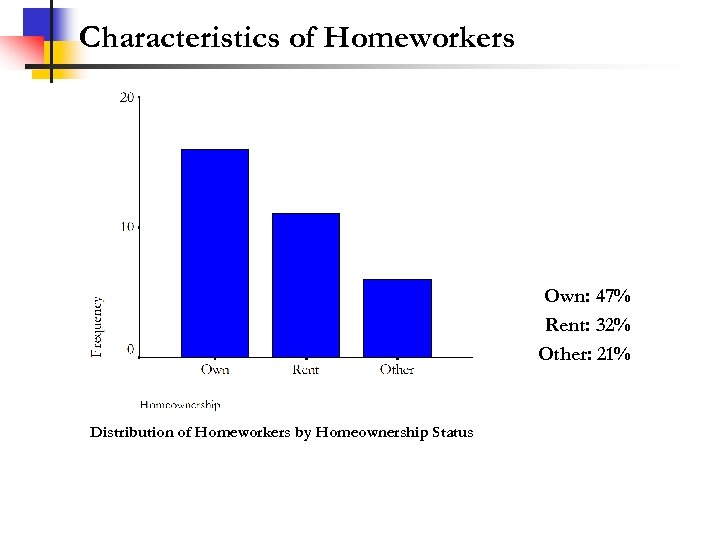 Characteristics of Homeworkers Own: 47% Rent: 32% Other: 21% Distribution of Homeworkers by Homeownership Status
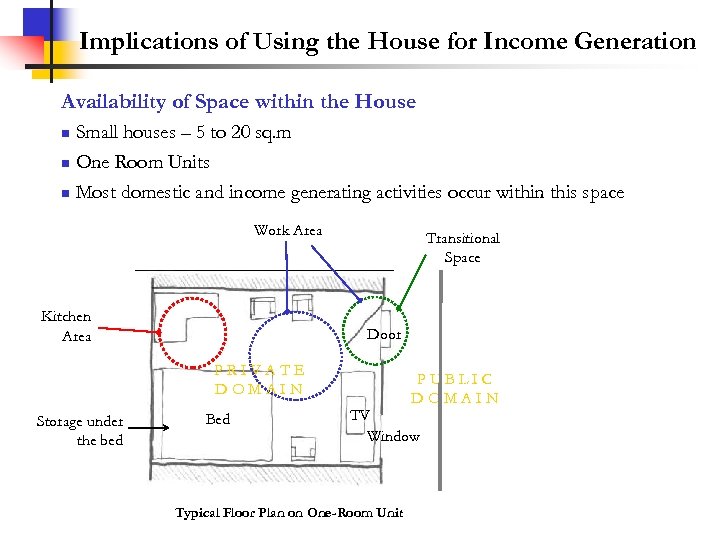 Implications of Using the House for Income Generation Availability of Space within the House Small houses – 5 to 20 sq. m n One Room Units n Most domestic and income generating activities occur within this space n Work Area Kitchen Area Transitional Space Door PRIVATE DOMAIN Storage under the bed Bed PUBLIC DOMAIN TV Window Typical Floor Plan on One-Room Unit
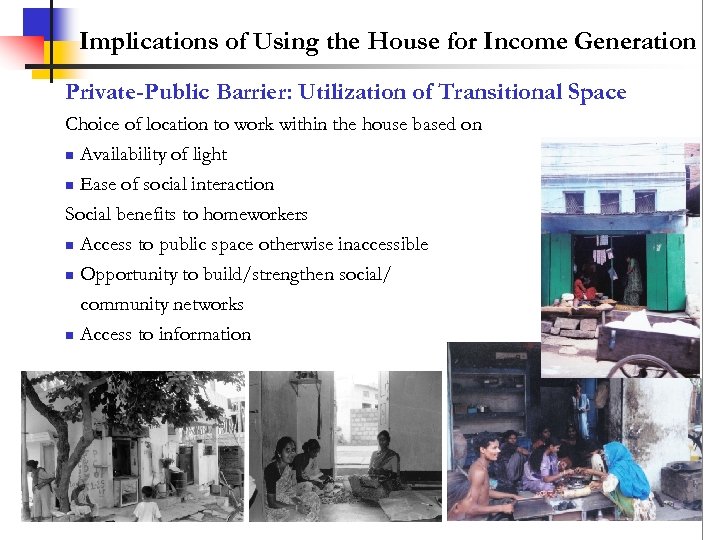 Implications of Using the House for Income Generation Private-Public Barrier: Utilization of Transitional Space Choice of location to work within the house based on n Availability of light n Ease of social interaction Social benefits to homeworkers n Access to public space otherwise inaccessible n Opportunity to build/strengthen social/ community networks n Access to information
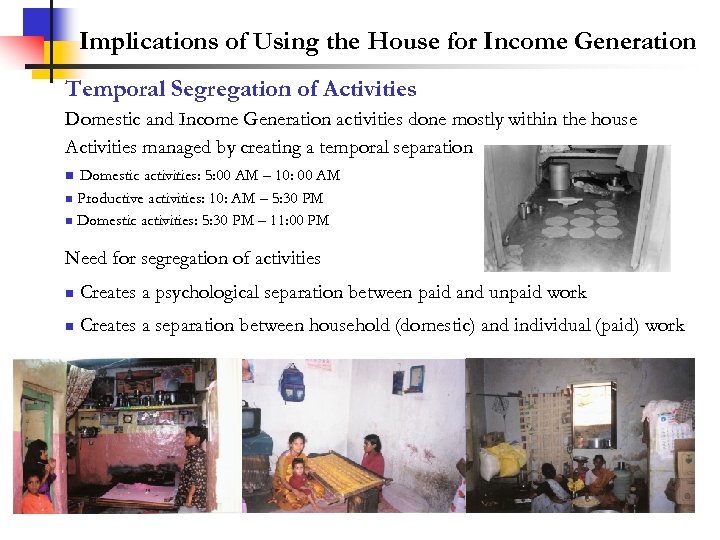 Implications of Using the House for Income Generation Temporal Segregation of Activities Domestic and Income Generation activities done mostly within the house Activities managed by creating a temporal separation Domestic activities: 5: 00 AM – 10: 00 AM n Productive activities: 10: AM – 5: 30 PM n Domestic activities: 5: 30 PM – 11: 00 PM n Need for segregation of activities n Creates a psychological separation between paid and unpaid work n Creates a separation between household (domestic) and individual (paid) work
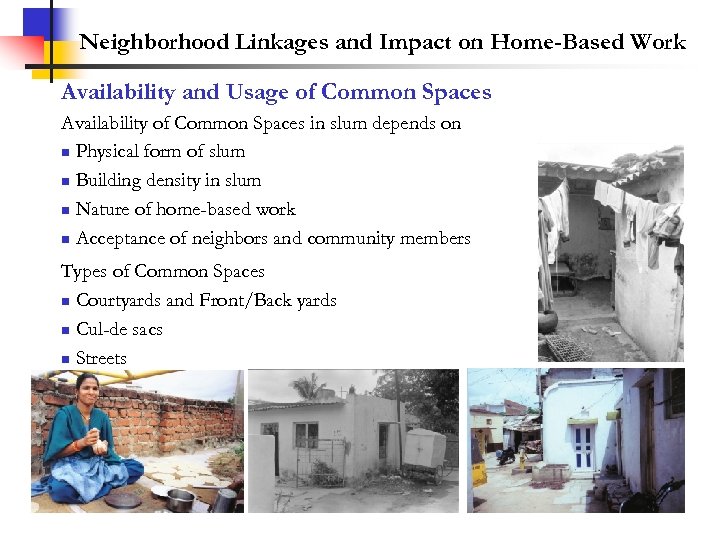 Neighborhood Linkages and Impact on Home-Based Work Availability and Usage of Common Spaces Availability of Common Spaces in slum depends on n Physical form of slum n Building density in slum n Nature of home-based work n Acceptance of neighbors and community members Types of Common Spaces n Courtyards and Front/Back yards n Cul-de sacs n Streets
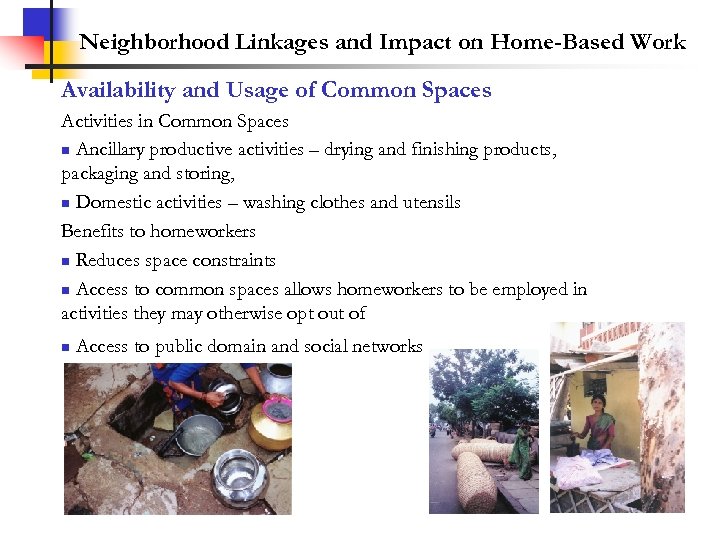 Neighborhood Linkages and Impact on Home-Based Work Availability and Usage of Common Spaces Activities in Common Spaces n Ancillary productive activities – drying and finishing products, packaging and storing, n Domestic activities – washing clothes and utensils Benefits to homeworkers n Reduces space constraints n Access to common spaces allows homeworkers to be employed in activities they may otherwise opt out of n Access to public domain and social networks
 Neighborhood Linkages and Impact on Home-Based Work Impact of Location on Availability of Semi-Public and Public Spaces Availability of semi-public and public areas in slums depends on location of slum Location and surrounding areas have an impact on n Physical size of slum n Physical size and shape of open spaces n Acceptance by neighbors and community members of usage Impact of Location on Homework n Access to Consumers/Purchasers n Access to Raw Materials
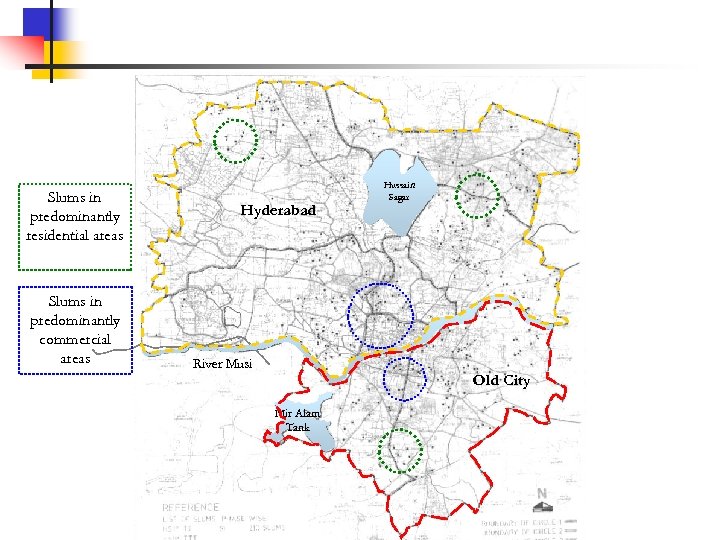 Slums in predominantly residential areas Slums in predominantly commercial areas Hyderabad River Musi Hussain Sagar Old City Mir Alam Tank
 Urban Linkages and Implications on Home-Based Workers Impact of Location on Homeownership § Availability of land § Affordability § Housing Options § Opportunity to consolidate housing § Opportunities to legalize housing Impact of Location on Availability of Employment Opportunities § Availability of employment opportunities § Choices of employment available § Access to private/government job/skill training programs § Linkages to consumers and raw materials
 Conclusions Spatial Implications of Homework n Severe space constraints Stress on space increased - For space intensive activities – food preparation, agarbatti and papad making, zardosi - In renter households - In slums in Old City - During monsoon and holiday season with more people in the house n Space constraint issues resolved by temporal segregation of activities - Creates a psychological separation between paid and unpaid work - Creates a psychological separation between individual and household work n Utilization of transitional space between private and public domains Empowers homeworkers by providing - Access to public spaces otherwise inaccessible – very important for Muslim households living in Old City - Access to some public information/knowledge - Access to social networks
 Conclusions Neighborhood Linkages and Impact on Home-Based Work § Availability and Usage of Common Spaces Empowers homeworkers by - Decreasing the stress on space within the house, but exacerbates problems during monsoon reducing productivity and therefore income. - Increases employment options, otherwise hampered by space - Increases access to public domain and social network n Ability to use common space dependent on location and religion - Muslim women in the Old City did not benefit from common spaces -- slums in the Old City have few open space -- more men in the house/community during the day -- social custom of purdah prevalent - Hindu women living in slums in residential areas of Hyderabad benefit the most from the availability and usage of common spaces
 Conclusions Urban Linkages and Impact on Home-Based Work § Impact of Geographic Location on Homeownership Rates Increased opportunities - To own a house in slums in residential areas in Hyderabad - To gain legal rights to illegally occupied land - Options for housing – more affordability to purchase Extremely low chance - To own a house in slums in commercial and residential areas in Hyderabad and the Old City - To illegally occupy land - Limited options for housing – expensive, poor quality housing
 Conclusions Urban Linkages and Impact on Home-Based Work §Impact of Geographic Location on Employment Opportunities Increased wage-based homework opportunities - For women living in slums in commercial areas in Hyderabad and the Old City - For women with skills in zardosi, bangle and bidi making Increased self-employed homework opportunities - For women in Hyderabad with linkages to training institutions
 Conclusions Planning and Policy Recommendations § When legalizing slums and consolidating housing through government programs retain and create common semi-public spaces for use of homeworkers and women § Make provisions in government programs to provide homeownership for low-income households living in slums in commercial areas § Provide more job/skill training facilities in the commercial areas of Hyderabad and the Old City
 Introduction Conceptual Framework