 Скачать презентацию Livelihoods analysis the framework Vulnerability context Shocks
4e3bec3a48ee34236089f024465455b9.ppt
- Количество слайдов: 11



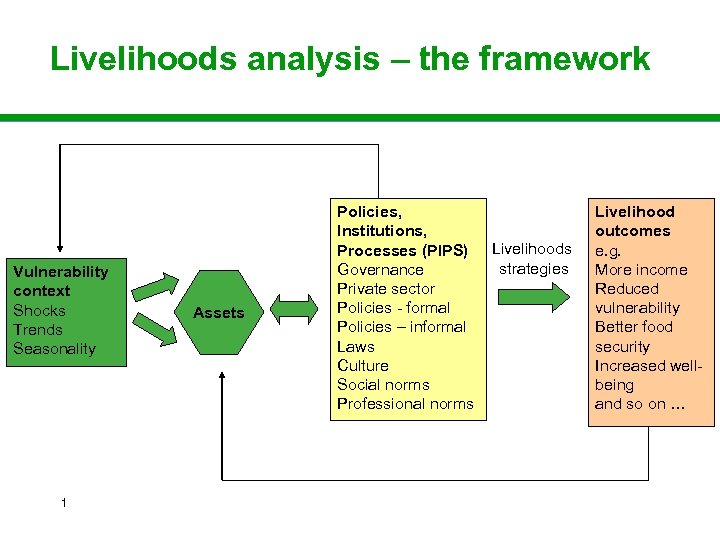
Livelihoods analysis – the framework Vulnerability context Shocks Trends Seasonality 1 Assets Policies, Institutions, Processes (PIPS) Governance Private sector Policies - formal Policies – informal Laws Culture Social norms Professional norms Livelihoods strategies Livelihood outcomes e. g. More income Reduced vulnerability Better food security Increased wellbeing and so on …
Policies, Institutions, Processes § Pastoralism is affected by a vast array of subnational, regional and international policies, rules and norms § These can be formal, but also ‘informal’ § Like many policy arenas, pastoral policy is also affected by persistent myths 2
Policy process – the importance of narratives § Policy narratives are like short stories, often with a beginning, a middle and an end § Policy change and support for one position or another is heavily influenced by how people interpret and believe narratives § Over time and with repetition, narratives are perceived as truth, as sacrosanct and not open to question § As policy narratives become dominant, fewer and fewer people look back to the original evidence from which a narrative was derived – assuming there was any evidence in the first place … 3
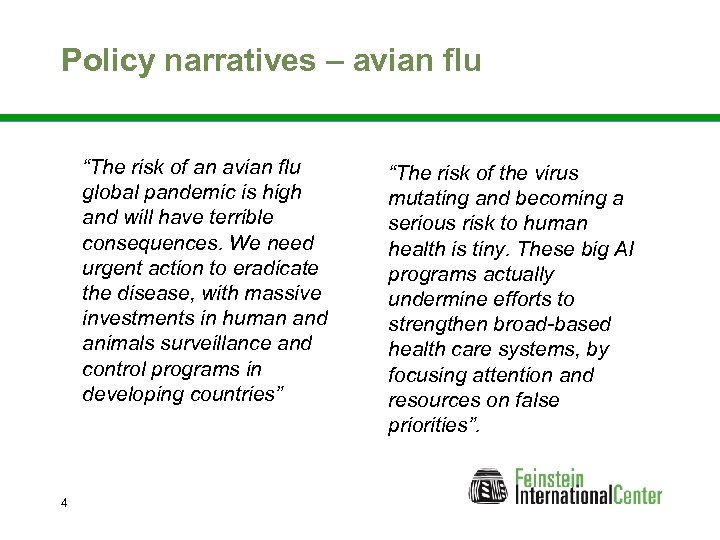
Policy narratives – avian flu “The risk of an avian flu global pandemic is high and will have terrible consequences. We need urgent action to eradicate the disease, with massive investments in human and animals surveillance and control programs in developing countries” 4 “The risk of the virus mutating and becoming a serious risk to human health is tiny. These big AI programs actually undermine efforts to strengthen broad-based health care systems, by focusing attention and resources on false priorities”.
Policy narratives - Pastoralism “Pastoralists are rich! They have all these animals compared to other people, so why do we keep being asked to give them special attention? We need to focus on poorer communities instead of these nomads and their huge herds”. 5 “Poverty in pastoral areas is complex. Even those with large herds are vulnerable because of some many risks to their livelihood. When making policy, we need to answer the question ‘Where specifically is poverty in pastoral areas? ”
Policy narratives – Pastoralism and Policy § What and where is poverty in pastoral areas? 6
Policy narratives - Pastoralism “Pastoral areas make a substantial contribution to national economies, but this economic value is not always understood or measured. Globally, the demand for animal products is growing and pastoralism is organic! If we work with them we can improve marketing and services – its a ‘win-win’ opportunity. ” 7 “These people have always resisted development. All those animals they keep damage our environment and don’t help us grow. Its about time we made them settle down, with modern agriculture. And how can we deliver services when they keep moving around? ”
Policy narratives – Pastoralism, Economic Growth and Services § The economic value of pastoralism § The Livestock Revolution § Alternative service delivery 8
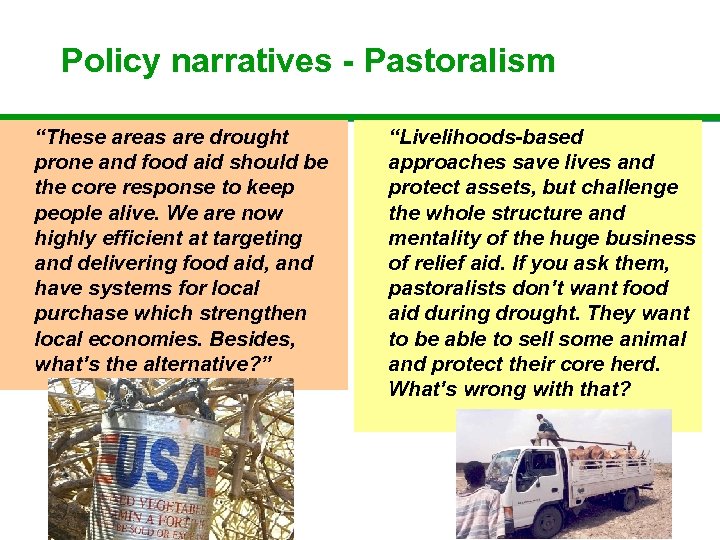
Policy narratives - Pastoralism “These areas are drought prone and food aid should be the core response to keep people alive. We are now highly efficient at targeting and delivering food aid, and have systems for local purchase which strengthen local economies. Besides, what’s the alternative? ” 9 “Livelihoods-based approaches save lives and protect assets, but challenge the whole structure and mentality of the huge business of relief aid. If you ask them, pastoralists don’t want food aid during drought. They want to be able to sell some animal and protect their core herd. What’s wrong with that?
Policy narratives – humanitarian assistance § Food aid § Livelihoods-based programming and drought cycle management § Policies and guidelines 10
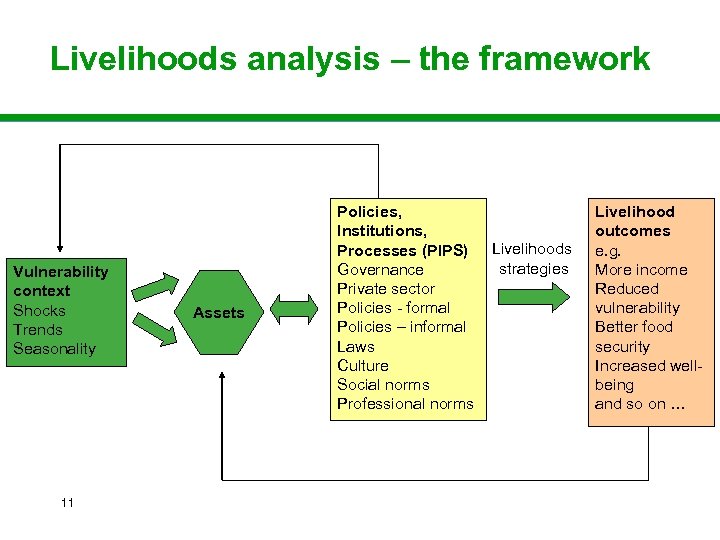
Livelihoods analysis – the framework Vulnerability context Shocks Trends Seasonality 11 Assets Policies, Institutions, Processes (PIPS) Governance Private sector Policies - formal Policies – informal Laws Culture Social norms Professional norms Livelihoods strategies Livelihood outcomes e. g. More income Reduced vulnerability Better food security Increased wellbeing and so on …
Скачать презентацию Livelihoods analysis the framework Vulnerability context Shocks
4e3bec3a48ee34236089f024465455b9.ppt