 Скачать презентацию Liudmila Glavinskaya Inhibitory relations in the mouse retinal
Final_reportPhD2014.pptx
- Количество слайдов: 16



Liudmila Glavinskaya Inhibitory relations in the mouse retinal ganglion cells Date of entrance into program: January 2014 Workplace: Istituto Italiano di Tecnologia, Genova Department: Neurotechnologies Supervisors: Dr. Luca Berdondini & Dr. Alessandro Maccione
Rational Inhibition is one of the most important mechanism for neuronal signal processing at the network level; it’s important for memory, learning and other processes Research question: What is the functional role of lateral interconnections at the network level? Suitable Model: ex-vivo mouse retina (glycinergic and gabaergic circuitries with their horizontal plane of projections) The 1 st academic year – focus is on retina In vitro Model: the cell culture (next year) Problem: Single-unit techniques lack the ability to look at the spatial/temporal dynamics in the network; Solution: the high-density micro-electrode arrays (MEAs) + pharmacology + imaging
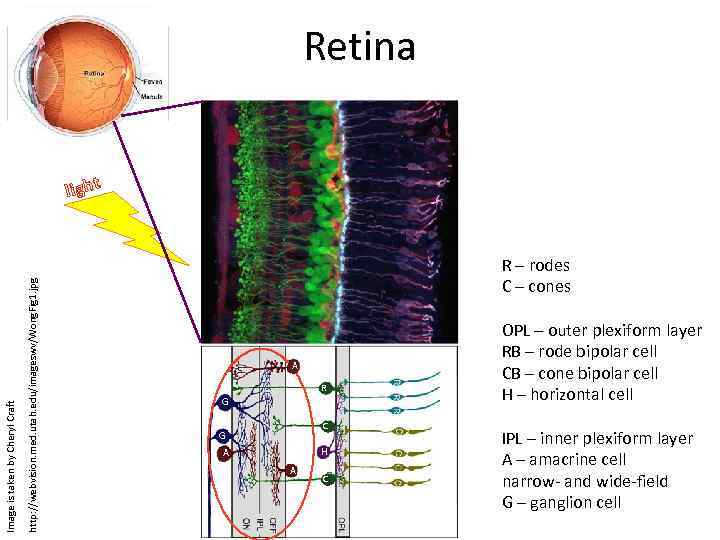
Retina http: //webvision. med. utah. edu/imageswv/Wong. Fig 1. jpg Image is taken by Cheryl Craft light R – rodes C – cones A R B G C B G H A A C B OPL – outer plexiform layer RB – rode bipolar cell CB – cone bipolar cell H – horizontal cell IPL – inner plexiform layer A – amacrine cell narrow- and wide-field G – ganglion cell
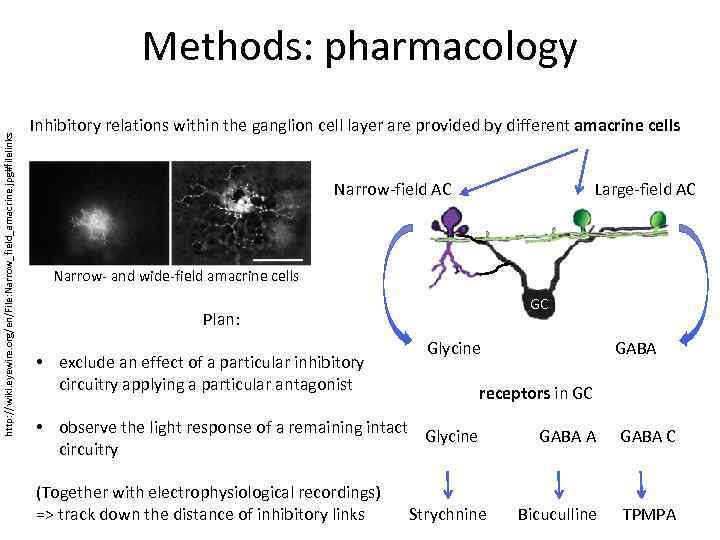
http: //wiki. eyewire. org/en/File: Narrow_field_amacrine. jpg#filelinks Methods: pharmacology Inhibitory relations within the ganglion cell layer are provided by different amacrine cells Narrow-field AC Large-field AC Narrow- and wide-field amacrine cells GC Plan: • exclude an effect of a particular inhibitory circuitry applying a particular antagonist Glycine receptors in GC • observe the light response of a remaining intact Glycine circuitry (Together with electrophysiological recordings) => track down the distance of inhibitory links GABA Strychnine GABA A GABA C Bicuculline TPMPA
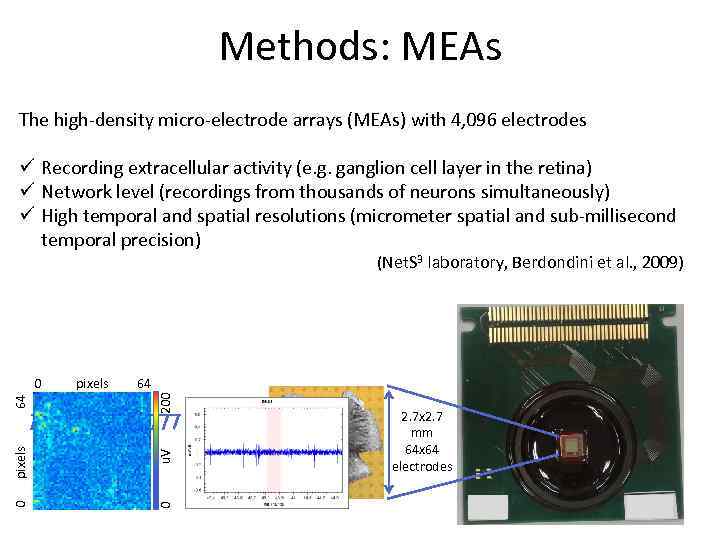
Methods: MEAs The high-density micro-electrode arrays (MEAs) with 4, 096 electrodes ü Recording extracellular activity (e. g. ganglion cell layer in the retina) ü Network level (recordings from thousands of neurons simultaneously) ü High temporal and spatial resolutions (micrometer spatial and sub-millisecond temporal precision) (Net. S 3 laboratory, Berdondini et al. , 2009) electrode 21 um 200 GC 64 u. V pixels 0 0 pixels 64 0 2. 7 x 2. 7 mm 64 x 64 electrodes
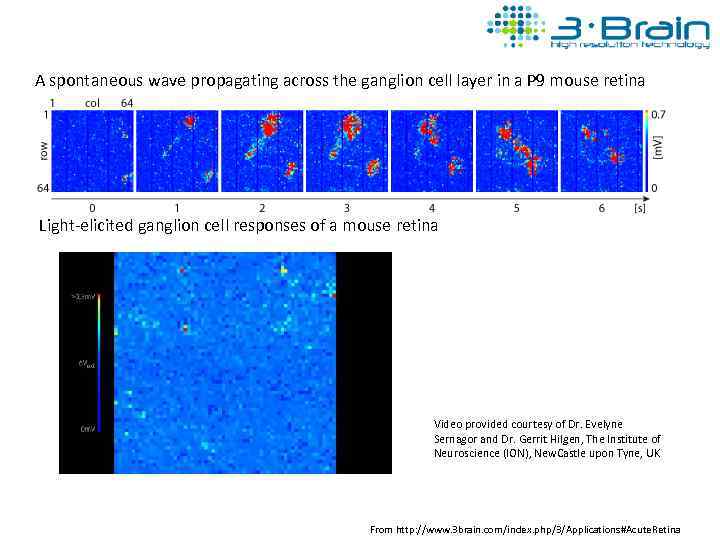
A spontaneous wave propagating across the ganglion cell layer in a P 9 mouse retina Light-elicited ganglion cell responses of a mouse retina Video provided courtesy of Dr. Evelyne Sernagor and Dr. Gerrit Hilgen, The Institute of Neuroscience (ION), New. Castle upon Tyne, UK From http: //www. 3 brain. com/index. php/3/Applications#Acute. Retina
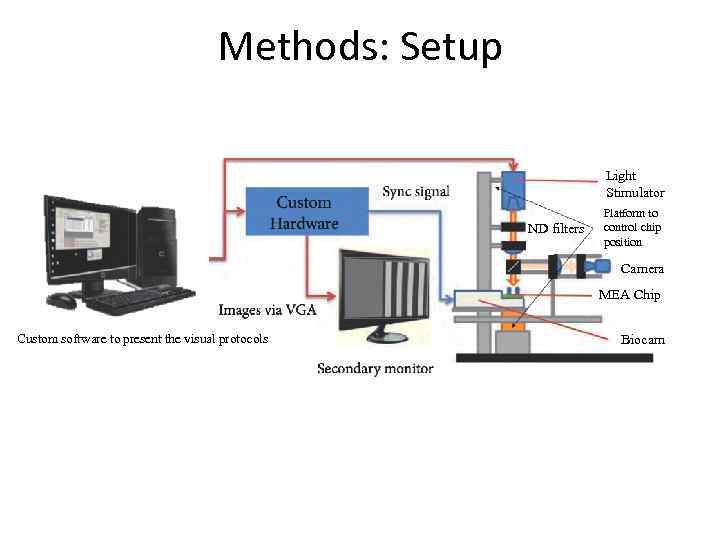
Methods: Setup Light Stimulator ND filters Platform to control chip position Camera MEA Chip Custom software to present the visual protocols Biocam
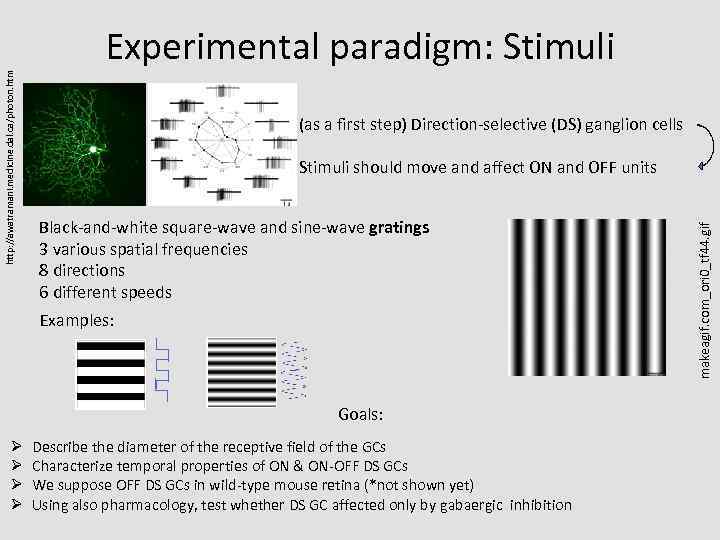
(as a first step) Direction-selective (DS) ganglion cells Stimuli should move and affect ON and OFF units Black-and-white square-wave and sine-wave gratings 3 various spatial frequencies 8 directions 6 different speeds Examples: Goals: Ø Ø Describe the diameter of the receptive field of the GCs Characterize temporal properties of ON & ON-OFF DS GCs We suppose OFF DS GCs in wild-type mouse retina (*not shown yet) Using also pharmacology, test whether DS GC affected only by gabaergic inhibition makeagif. com_ori 0_tf 44. gif http: //awatramani. medicine. dal. ca/photon. htm Experimental paradigm: Stimuli
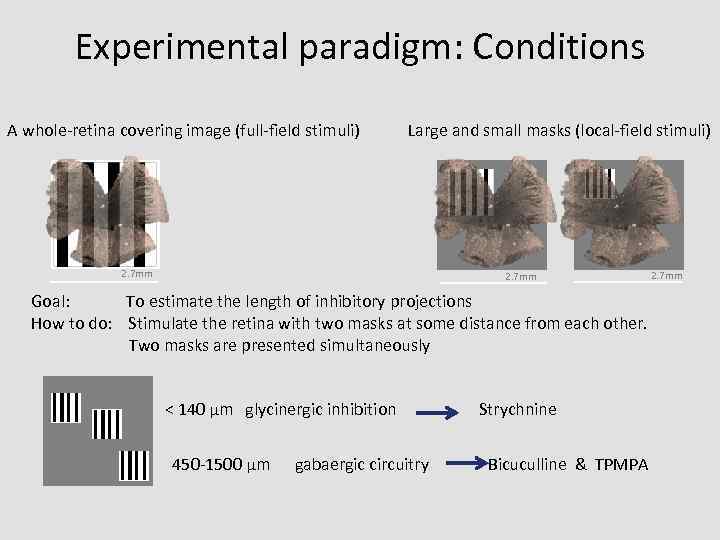
Experimental paradigm: Conditions A whole-retina covering image (full-field stimuli) Large and small masks (local-field stimuli) 2. 7 mm Goal: To estimate the length of inhibitory projections How to do: Stimulate the retina with two masks at some distance from each other. Two masks are presented simultaneously < 140 μm glycinergic inhibition 450 -1500 μm gabaergic circuitry Strychnine Bicuculline & TPMPA 2. 7 mm
Summary Rational: investigate functional role of the lateral inhibitory interconnections Model: ex-vivo mouse retina How to approach the goal: - Retinal preparation - Stimulus making - Describe GC inhibitory network using full-field & masked stimuli, & pharmacology - Retinal dissection practice - Learn how to use the experimental setup - Steps of data analysis
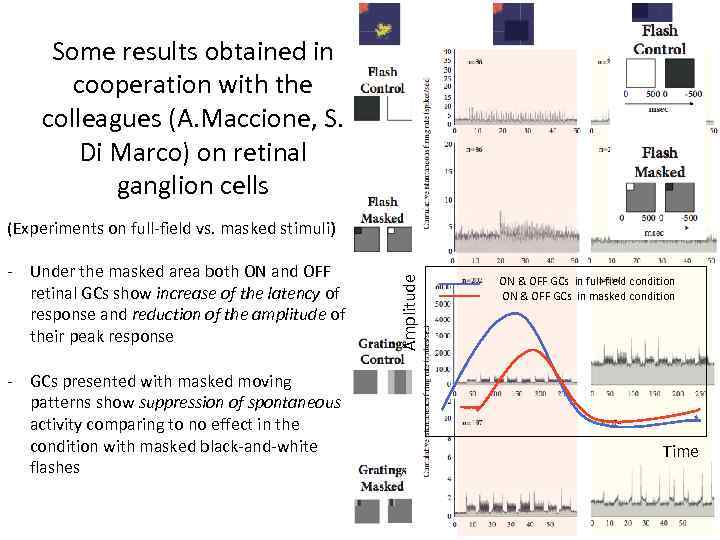
Some results obtained in cooperation with the colleagues (A. Maccione, S. Di Marco) on retinal ganglion cells - Under the masked area both ON and OFF retinal GCs show increase of the latency of response and reduction of the amplitude of their peak response - GCs presented with masked moving patterns show suppression of spontaneous activity comparing to no effect in the condition with masked black-and-white flashes Amplitude (Experiments on full-field vs. masked stimuli) ON & OFF GCs in full-field condition ON & OFF GCs in masked condition Time
Next academic year Keep running the current experiments on retinal DS GCs to investigate their temporal properties and apply masking and pharmacological agents Optimize the protocol Acquire more data and get into analysis (Brain. Wave, Matlab, Offline. Sorter and Python) Immunohistochemical fluorescence imaging (combined with electrophysiology) to for tracking down the distances between stained gabaergic and glycinergic cells Start investigating inhibition in the cell cultures using same methodology but electrical instead of light stimulation http: //www. iovs. org/content/52/3/1539/F 4. expansion. html * Maternity leave for 5 mo
Thanks for your attention! Grazie per l’attenzione! Courses attended in 2014: Drug discovery, Molecular and cellular determinants of brain development, Synaptic networks, Signal processing in neuroscience, Neuromodulation of behavioral plasticity, Neurotropic signaling, Neuroprosthesis, Psychophysiological methods; the Confocal microscopy workshop Posters: S. Di Marco, A. Maccione, L. Glavinskaya, T. Nieus, M. H. Hennig, S. Pirmoradian, G. Hilgen, E. Sernagor, L. Berdondini: A high resolution experimental platform for large-scale recording of light-evoked responses in the retinal ganglion cell layer. FENS 2014, Milan, Italy. Stefano Di Marco, Alessandro Maccione, Stefano Zordan, Liudmila Glavinskaya, Thierry Nieus, Matthias Hennig, Sahar Pirmoradian, Gerrit Hilgen, Evelyne Sernagor and Luca Berdondini (2014). “Large-scale recording of light-evoked responses in the retinal ganglion cell layer of the explanted retina: a new HD experimental platform”, Washington (USA), Society for Neuroscience, 2014.
Additional slides
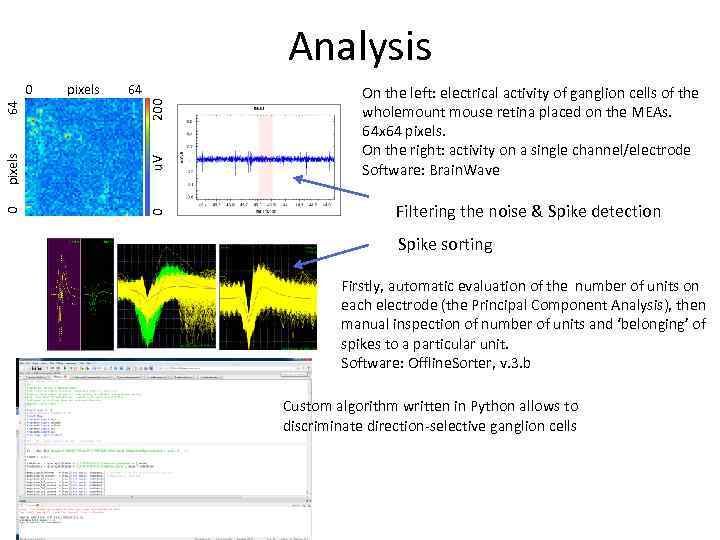
Analysis 200 0 0 u. V 64 64 pixels 0 On the left: electrical activity of ganglion cells of the wholemount mouse retina placed on the MEAs. 64 x 64 pixels. On the right: activity on a single channel/electrode Software: Brain. Wave Filtering the noise & Spike detection Spike sorting Firstly, automatic evaluation of the number of units on each electrode (the Principal Component Analysis), then manual inspection of number of units and ‘belonging’ of spikes to a particular unit. Software: Offline. Sorter, v. 3. b Custom algorithm written in Python allows to discriminate direction-selective ganglion cells
Summary on the experimental protocol Research Question: the functional role of lateral interconnections at the network level Model for the study: retinal ganglion cells, DS GCs Setup: light stimulation & recordings using MEAs Stimuli: black-and-white moving gratings Data collection, Identification of circuitry using pharmacology & masked stimuli Analysis spatial&temporal properties of inhibitory pathways using DS GCs as a model Analyzing methods: custom algorithm written in the python programming language Next steps: data interpretation (whether results meet our RQ) and testing whether similar mechanism of inhibition exists in the cell culture
Скачать презентацию Liudmila Glavinskaya Inhibitory relations in the mouse retinal
Final_reportPhD2014.pptx