 Скачать презентацию Little Pistols Bigger Scores Collected Wisdom and Lessons
be17a3d478e9a5c83d5904645ec2d459.ppt
- Количество слайдов: 57




Little Pistols Bigger Scores Collected Wisdom and Lessons Learned K 2 YWE (K 3 AU)
What’s this about? Ways modest stations can improve their scores Objective Improved Scores for Little Pistols Intended Audience Low power “grass roots” HF stations But. . . principles & tips apply almost universally K 2 YWE – PISTOLS-H 2017 p. 2
Agenda Elements of Success Preparation Q’s and Rate Strategy Station Considerations Software Operating Tips and 'Best Practices‘ After Action Conclusion A Word about SO 2 R Appendix A - Best Practices Collection Appendix B – Selected Contest Loggers Note – This presentation is modified from what is in the CTU book. (Mostly, the sequence is changed) 3 K 2 YWE – PISTOLS-H 2017 p. 3
Elements of Success Same principles apply as in most successful endeavors The Right Frame of Mind Preparation Attention to Detail Adoption of Best Practices Practice Improvement and Learning Perseverance “Which brings us to my next point” K 2 YWE – PISTOLS-H 2017 p. 4
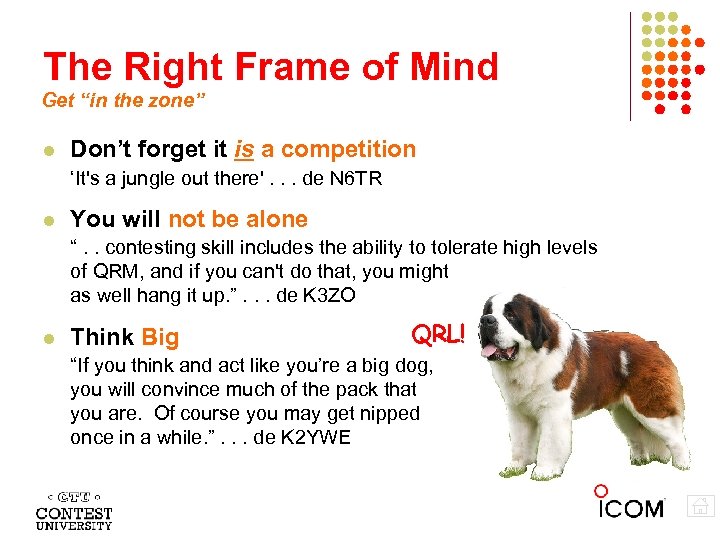
The Right Frame of Mind Get “in the zone” Don’t forget it is a competition ‘It's a jungle out there'. . . de N 6 TR You will not be alone “. . contesting skill includes the ability to tolerate high levels of QRM, and if you can't do that, you might as well hang it up. ”. . . de K 3 ZO Think Big QRL! “If you think and act like you’re a big dog, you will convince much of the pack that you are. Of course you may get nipped once in a while. ”. . . de K 2 YWE – PISTOLS-H 2017 p. 5
Preparation 'Now the general who wins a battle makes many calculations in his temple ere the battle is fought. The general who loses a battle makes but few calculations beforehand. '. . . Sun Tzu Have a strategy – write it down Provides baseline guidance Try to optimize within your constraints Modify as needed in 'battle' Reassess during the contest Expect to change the details Take big departures only if you have good reason to, like one or more of your assumptions is invalid K 2 YWE – PISTOLS-H 2017 p. 6

Preparation Get your act together before the performance Check your set-up well before the start Antennas, Hardware, Software, support files Software settings Provide enough time for fixing any problems I use my contest software every day INS Key sticks! Be well rested for the contest Listen day(s) & hours before to get a feel for Condx Have a simple means to restart software What did I call the file ? – Use consistent names K 2 YWE – PISTOLS-H 2017 p. 7
High Level Thoughts Some reasoning to frame the problem Q’s fuel the engine. Mults provide a boost Both are important More Q’s are key for higher scores Operating Time is fixed, thus Rate must go up! Rate Drivers Being Heard and Hearing others At fixed power level, this mainly means better Antennas Operating Efficiently - wasting less time Operating Practices Shack Arrangement Available QSO’s. . . K 2 YWE – PISTOLS-H 2017 p. 8
Available QSO’s Sources of QSO’s Your QSO potential is much higher if you Run Group 1 – Stations calling CQ (Runners) Group 2 – Non-Runners (callers) You hear them, most will hear you You can generate high S&P rates with them In spite of how it sounds, they are limited in number QSO’s you will never make unless you call CQ The“pool” is deeper They boost and help sustain rates Some will be Multipliers Thus. . . You must Run at least part of the time Mix of Run / S&P will vary Good conditions are favorable for Little Pistol running K 2 YWE – PISTOLS-H 2017 p. 9
Efficient Use of Time Higher rates require spending less time per QSOs Look at rate as time per QSO Time in QSO plus Time Between QSO’s Minimize Both In QSO Eliminate wasted words “Please copy my …” Avoid repetition unless conditions warrant “Maryland Mike Delta” “Thank you for …” “Dan Delta Alpha November” Fills - Give only what’s asked for “QTH? ”. . . “TX” not “ 123 B K 5 ABC JOE 81 TX” Get all fills before you pass your info K 2 YWE – PISTOLS-H 2017 p. 10
Efficient Use of Time - S&P Higher rates require spending less time per QSOs Between QSOs when S&P-ing Give your call once unless otherwise is warranted Give your whole call Partial calls often lead to an extra transmission Use K 3 ZO’s “Rule of Twice”* Timing is important Remember you’re a “Big Dog” Move on if he doesn't ID after transmitting Twice Move on if he doesn’t respond after Two calls* Use the Bandmap Save calls in the Bandmap, even if you are Unassisted *Modify “twice” as is sensible, but stick to it K 2 YWE – PISTOLS-H 2017 p. 11
Efficient Use of Time - Running Higher rates require spending less time per QSOs In QSO when Running Eliminate wasted words and avoid unnecessary repetition Fills - Ask only for what you need Don’t break your run to pull someone through Often best to ask for one piece at a time Use K 3 ZO’s “Rule of Twice”* Move on if you can’t pull him through in two tries* Speed up if callers are waiting They probably know your exchange You’ll lose impatient Ops *Modify “twice” as is sensible, but stick to it K 2 YWE – PISTOLS-H 2017 p. 12
Efficient Use of Time - Running Higher rates require spending less time per QSOs Between QSOs when Running Use only a quick ‘thanks’ (or TU) if stations are waiting They know your call. Don’t waste time on it I use a ‘progression’ as the crowd thins “Thanks” (with periodic call appended) “K 3 AU“ “K 3 AU Contest “ [CQ Message] Use a situational CQ message The busier it is, the shorter the message Occasionally expand for the RBN (on CW) Arrange keyer macros accordingly More on running in Best Practices K 2 YWE – PISTOLS-H 2017 p. 13
back to Strategy Having a game plan pays off during the contest Consider Propagation Range of prediction tools are available Temper with your own observations Allow for time-of-day considerations 'Rules of Thumb' Online resources and models What’s going on outside your area Block out expected S&P and Run times Set ground rules for changes Balance with periodic short checks for Mults K 2 YWE – PISTOLS-H 2017 p. 14
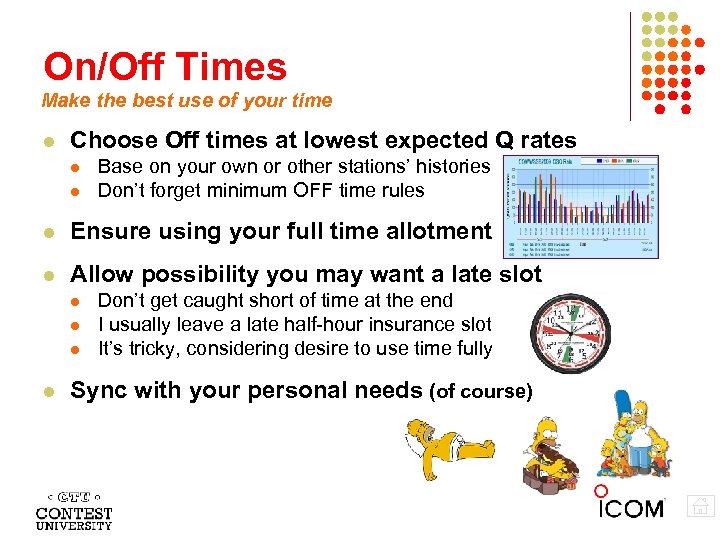
On/Off Times Make the best use of your time Choose Off times at lowest expected Q rates Base on your own or other stations’ histories Don’t forget minimum OFF time rules Ensure using your full time allotment Allow possibility you may want a late slot Don’t get caught short of time at the end I usually leave a late half-hour insurance slot It’s tricky, considering desire to use time fully Sync with your personal needs (of course) K 2 YWE – PISTOLS-H 2017 p. 15
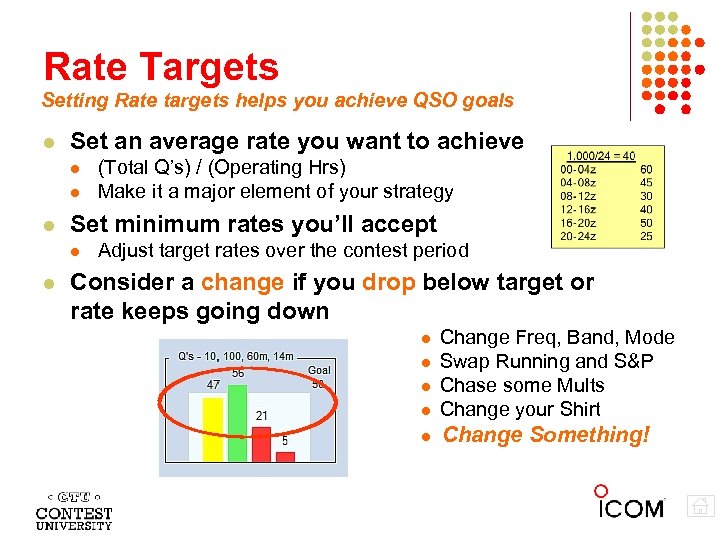
Rate Targets Setting Rate targets helps you achieve QSO goals Set an average rate you want to achieve Set minimum rates you’ll accept (Total Q’s) / (Operating Hrs) Make it a major element of your strategy Adjust target rates over the contest period Consider a change if you drop below target or rate keeps going down Change Freq, Band, Mode Swap Running and S&P Chase some Mults Change your Shirt Change Something! K 2 YWE – PISTOLS-H 2017 p. 16
Station Improvements Put method behind your madness Assess Station Strengths and Weaknesses Attack Weaknesses with biggest payoffs first Take band by band inventory based on performance history Incrementally fill in the holes Expect Antennas to rank high Don’t forget to pick 'low hanging fruit‘ Every improvement counts – they all add up Set up for Efficiency . . . Huh? K 2 YWE – PISTOLS-H 2017 p. 17
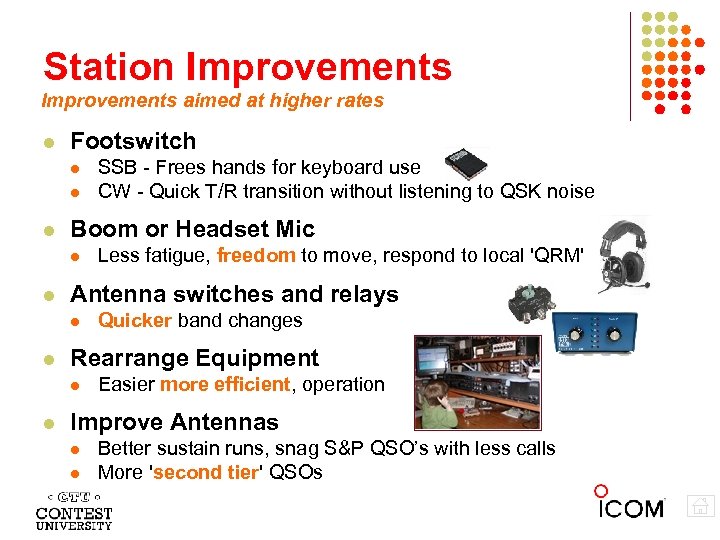
Station Improvements aimed at higher rates Footswitch Boom or Headset Mic Quicker band changes Rearrange Equipment Less fatigue, freedom to move, respond to local 'QRM' Antenna switches and relays SSB - Frees hands for keyboard use CW - Quick T/R transition without listening to QSK noise Easier more efficient, operation Improve Antennas Better sustain runs, snag S&P QSO’s with less calls More 'second tier' QSOs K 2 YWE – PISTOLS-H 2017 p. 18
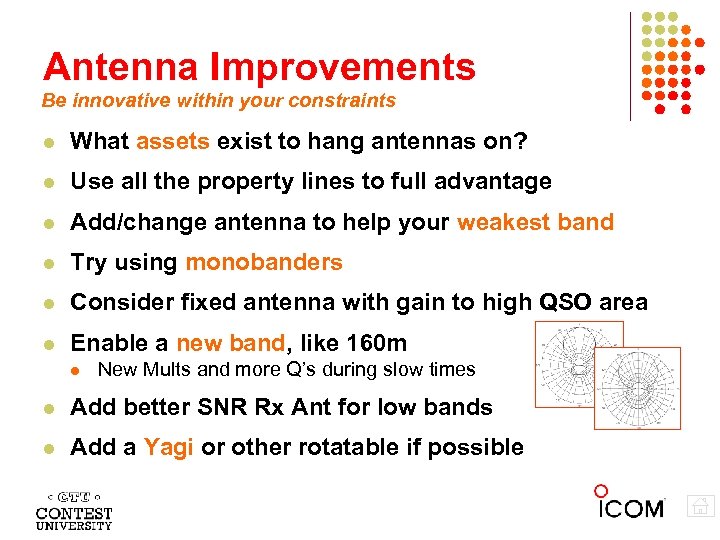
Antenna Improvements Be innovative within your constraints What assets exist to hang antennas on? Use all the property lines to full advantage Add/change antenna to help your weakest band Try using monobanders Consider fixed antenna with gain to high QSO area Enable a new band, like 160 m New Mults and more Q’s during slow times Add better SNR Rx Ant for low bands Add a Yagi or other rotatable if possible K 2 YWE – PISTOLS-H 2017 p. 19
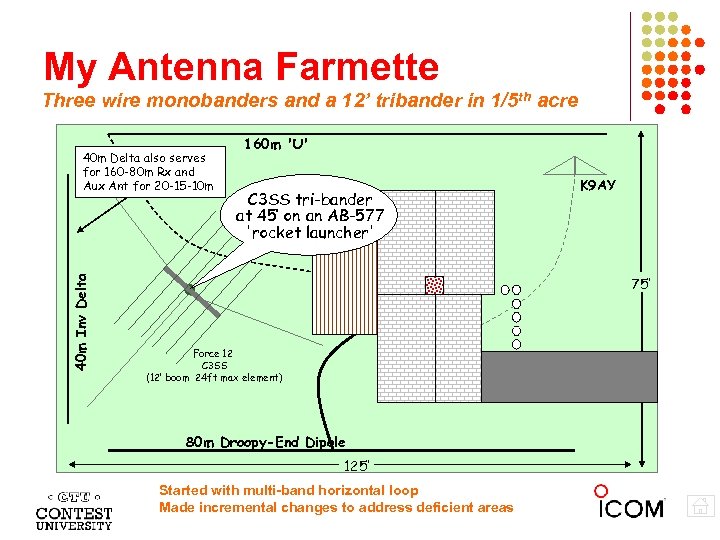
My Antenna Farmette Three wire monobanders and a 12’ tribander in 1/5 th acre 40 m Inv Delta 40 m Delta also serves for 160 -80 m Rx and Aux Ant for 20 -15 -10 m 160 m 'U' C 3 SS tri-bander at 45’ on an AB-577 'rocket launcher' K 9 AY 75’ Force 12 C 3 SS (12’ boom 24 ft max element) 80 m Droopy-End Dipole 125’ Started with multi-band horizontal loop Made incremental changes to address deficient areas K 2 YWE – PISTOLS-H 2017 p. 20
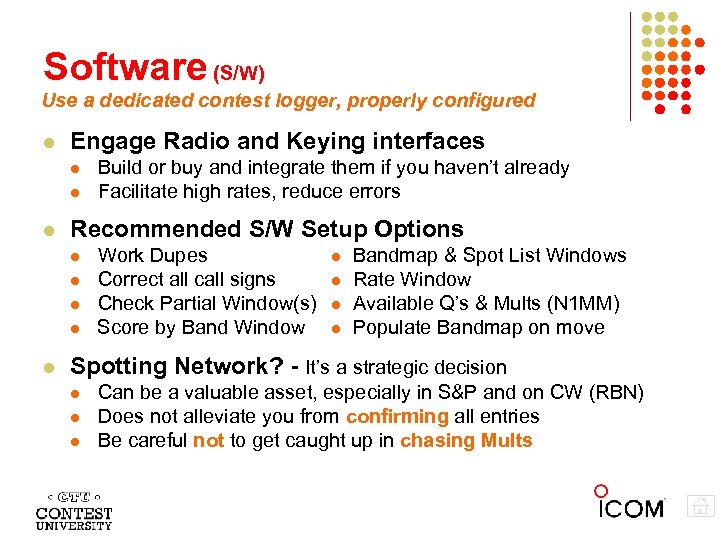
Software (S/W) Use a dedicated contest logger, properly configured Engage Radio and Keying interfaces Recommended S/W Setup Options Build or buy and integrate them if you haven’t already Facilitate high rates, reduce errors Work Dupes Correct all call signs Check Partial Window(s) Score by Band Window Bandmap & Spot List Windows Rate Window Available Q’s & Mults (N 1 MM) Populate Bandmap on move Spotting Network? - It’s a strategic decision Can be a valuable asset, especially in S&P and on CW (RBN) Does not alleviate you from confirming all entries Be careful not to get caught up in chasing Mults K 2 YWE – PISTOLS-H 2017 p. 21
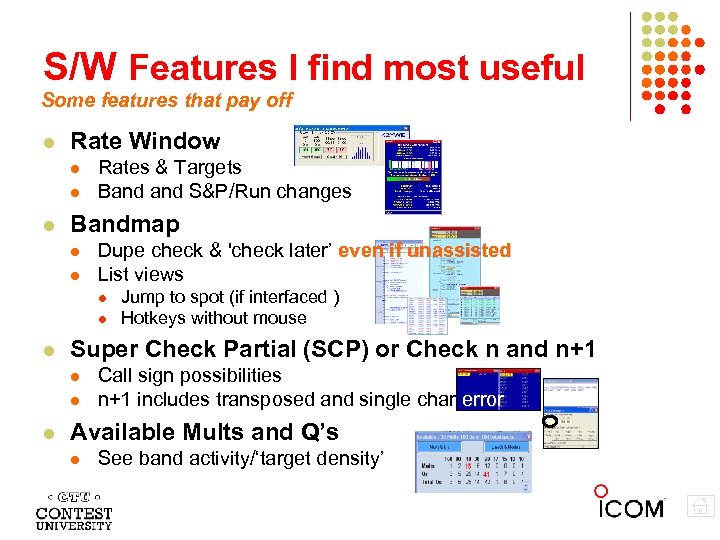
S/W Features I find most useful Some features that pay off Rate Window Rates & Targets Band S&P/Run changes Bandmap Dupe check & 'check later’ even if unassisted List views Super Check Partial (SCP) or Check n and n+1 Jump to spot (if interfaced ) Hotkeys without mouse Call sign possibilities n+1 includes transposed and single char error Available Mults and Q’s See band activity/‘target density’ K 2 YWE – PISTOLS-H 2017 p. 22
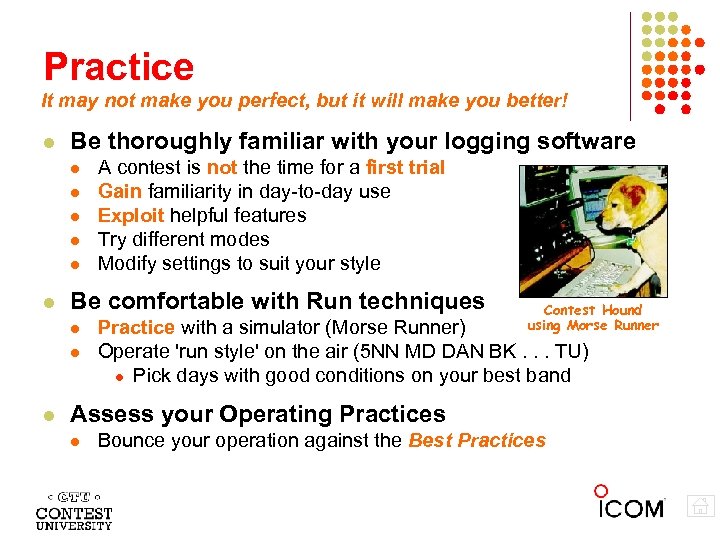
Practice It may not make you perfect, but it will make you better! Be thoroughly familiar with your logging software Be comfortable with Run techniques A contest is not the time for a first trial Gain familiarity in day-to-day use Exploit helpful features Try different modes Modify settings to suit your style Contest Hound using Morse Runner Practice with a simulator (Morse Runner) Operate 'run style' on the air (5 NN MD DAN BK. . . TU) Pick days with good conditions on your best band Assess your Operating Practices Bounce your operation against the Best Practices K 2 YWE – PISTOLS-H 2017 p. 23
Some Tips Overall Every point counts! A rule of thumb strategy There’s no such thing as 'not worthwhile' When it’s really slow, call for 'anybody' Work bands that may close first. Move with propagation Usually means 10 -15 -20 in a. m. then 40 -80 -160 later on Chase Mults when one band slows, but other hasn't yet opened Try more running when bands are open Keep an eye out for early and low-probability openings Keep multipliers in mind 'Move' Mults if you can do so efficiently Have frequency on each band set up for quick jaunt Balance effect on rate and total score when chasing Mults K 2 YWE – PISTOLS-H 2017 p. 24
Some Phone Tips Apply these basic Best Practices for starters Maintain a friendly sense of urgency in your QSOs Use conventional or unmistakable phonetics 'Duck Soup' are poor phonetics for 'D S' Use Standard (IPA) or 'Common' phonetics (countries, cities. . . ) Be mindful of SSB signal bandwidth Chattiness will slow your rate and lose you contacts Be away from strong runners not to get covered by an unheard pileup Listen to what’s on your frequency when calling split If you can hear it, you can better time your call or defer until later K 2 YWE – PISTOLS-H 2017 p. 25
Some CW Tips Apply these basic Best Practices for starters Work at being heard Try moving frequency a bit if no success calling Sometimes bandwidths are set narrow Spots put many stations on the same frequency Distinguish yourself through Speed or Weight Moderate your CQ speed by conditions & results Beware of busted RBN spots Don’t let code speed keep you from CW contests Start with the slower stations high in the band Don't worry if you need to hear the call or exchange several times Call CQ higher in the band at a speed comfortable for you When you’re ready K 2 YWE – PISTOLS-H 2017 p. 26
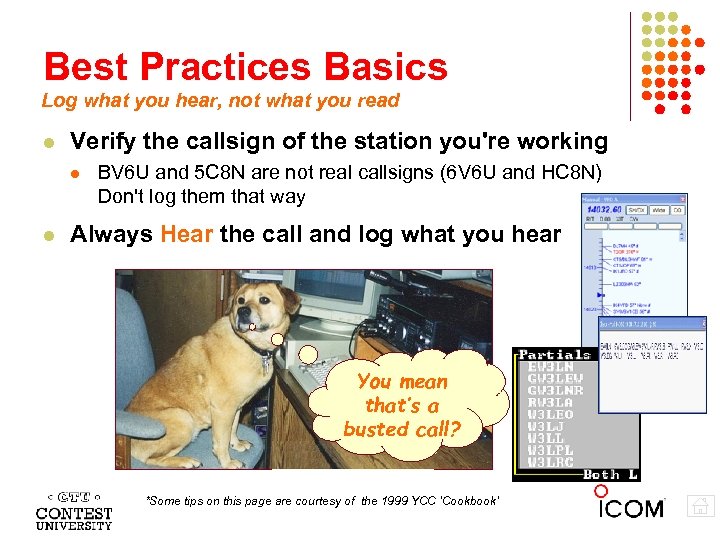
Best Practices Basics Log what you hear, not what you read Verify the callsign of the station you're working BV 6 U and 5 C 8 N are not real callsigns (6 V 6 U and HC 8 N) Don't log them that way Always Hear the call and log what you hear You mean that’s a busted call? The Master Callsign Data Base is not the Bible *Some tips on this page are courtesy of the 1999 YCC 'Cookbook' K 2 YWE – PISTOLS-H 2017 p. 27
Best Practices Basics Make the most of your available time S&P rates can be very high early in the contest Use S&P to find a spot to CQ You can maintain a high rate while searching for a clear spot It beats the alternative of establishing a frequency before the Test Be sure to try CQing late in the contest Everyone is 'fresh meat' for you. You can quickly hop from station to station with little fear of Dupes You are often safe to call first and then fill-in the call (some risk) You will be fresh meat to some that have been CQing all along Don’t waste time repeatedly calling DX that has moderate signals when the band is otherwise quiet from their area They are probably ‘opening the band’ with lots of ERP K 2 YWE – PISTOLS-H 2017 p. 28
Best Practices. . . Running Call CQ when the band is active If CONDX are good for your station Call CQ when bands are dead or worked out Use the widest IF bandwidth you can stand Always work Dupes (set software to allow it) Less chance to miss off-freq callers, especially on CW You might not be in his log and it’s usually quickest Speed up if your run is being sustained Especially in contests like SS with your call in the exchange Slow back down again appropriately K 2 YWE – PISTOLS-H 2017 p. 29
Best Practices. . . Running - continued Send out a full exchange with a partial call Send the corrected call as part of your ‘bye’ message Enable call sign correction in your software (CW) Hit SEND as soon as the call is in your head Most Ops will correct you, many without a missing a beat Fix the entry during his transmission Finish typing in the log while the exchange is sent Some programs can do this automatically after n characters Move Multipliers to other bands if you have the time Picking frequencies in advance makes it easier to jump K 2 YWE – PISTOLS-H 2017 p. 30
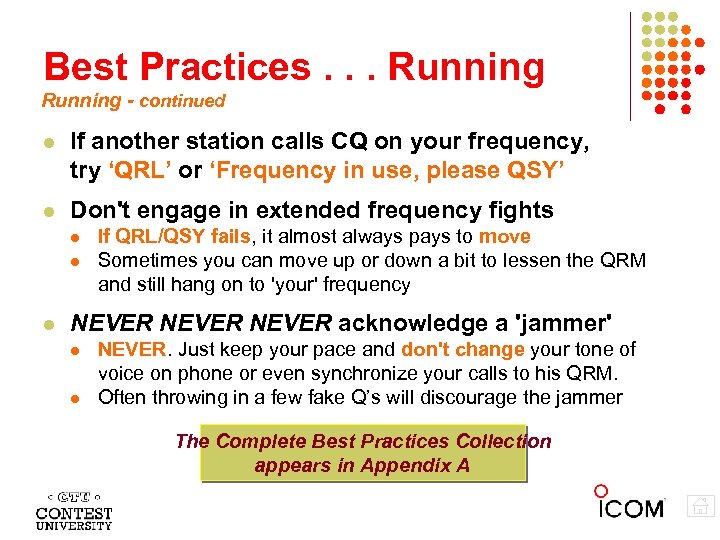
Best Practices. . . Running - continued If another station calls CQ on your frequency, try ‘QRL’ or ‘Frequency in use, please QSY’ Don't engage in extended frequency fights If QRL/QSY fails, it almost always pays to move Sometimes you can move up or down a bit to lessen the QRM and still hang on to 'your' frequency NEVER acknowledge a 'jammer' NEVER. Just keep your pace and don't change your tone of voice on phone or even synchronize your calls to his QRM. Often throwing in a few fake Q’s will discourage the jammer The Complete Best Practices Collection appears in Appendix A K 2 YWE – PISTOLS-H 2017 p. 31
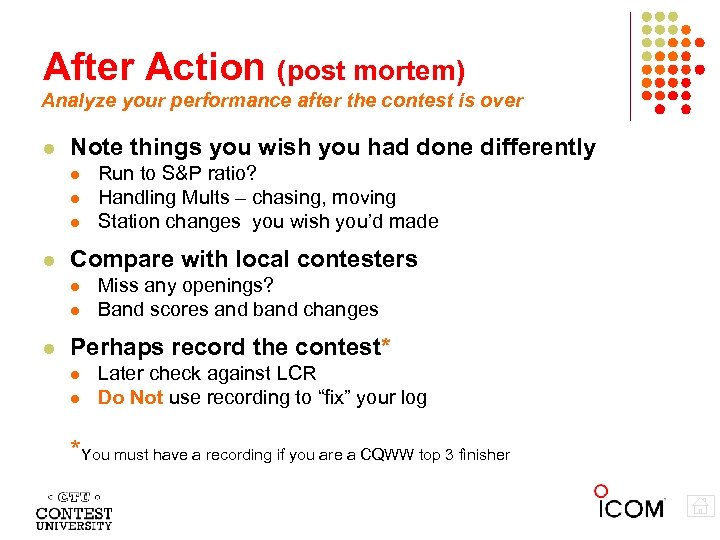
After Action (post mortem) Analyze your performance after the contest is over Note things you wish you had done differently Compare with local contesters Run to S&P ratio? Handling Mults – chasing, moving Station changes you wish you’d made Miss any openings? Band scores and band changes Perhaps record the contest* Later check against LCR Do Not use recording to “fix” your log *You must have a recording if you are a CQWW top 3 finisher K 2 YWE – PISTOLS-H 2017 p. 32
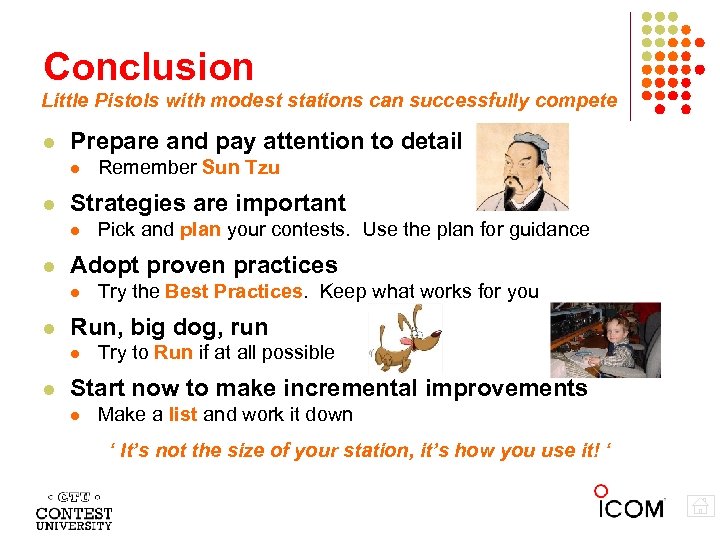
Conclusion Little Pistols with modest stations can successfully compete Prepare and pay attention to detail Strategies are important Try the Best Practices. Keep what works for you Run, big dog, run Pick and plan your contests. Use the plan for guidance Adopt proven practices Remember Sun Tzu Try to Run if at all possible Start now to make incremental improvements Make a list and work it down ‘ It’s not the size of your station, it’s how you use it! ‘ K 2 YWE – PISTOLS-H 2017 p. 33
![A Word About SO 2 R [single op 2 radio] Everyone has their own](https://present5.com/presentation/be17a3d478e9a5c83d5904645ec2d459/image-34.jpg "A Word About SO 2 R [single op 2 radio] Everyone has their own")
A Word About SO 2 R [single op 2 radio] Everyone has their own idea of an efficient SO 2 R layout. . . N 6 MJ two PCs at ZF 2 MJ (W-T) Radio A/B switch at DF 0 WA K 2 YWE An earlier two radio setup two PCs, (no audio switch rx PC) N 6 TR one computer no box (TRlog) jump to conclusion K 2 YWE – PISTOLS-H 2017 p. 34
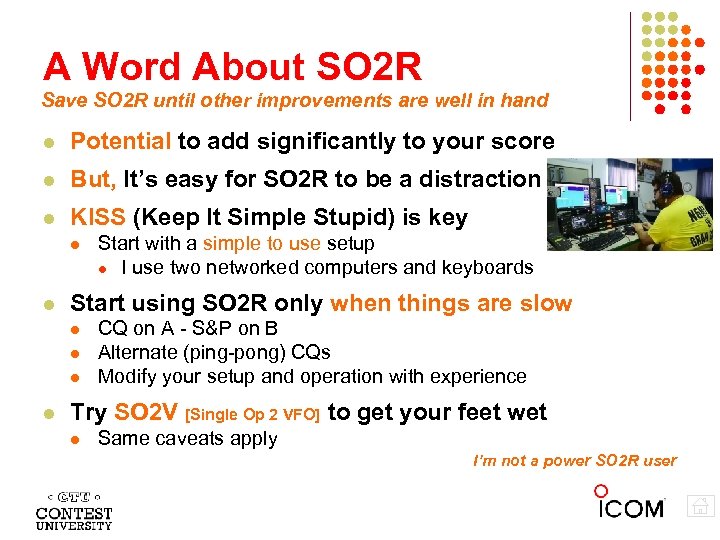
A Word About SO 2 R Save SO 2 R until other improvements are well in hand Potential to add significantly to your score But, It’s easy for SO 2 R to be a distraction KISS (Keep It Simple Stupid) is key Start using SO 2 R only when things are slow Start with a simple to use setup I use two networked computers and keyboards CQ on A - S&P on B Alternate (ping-pong) CQs Modify your setup and operation with experience Try SO 2 V [Single Op 2 VFO] to get your feet wet Same caveats apply I’m not a power SO 2 R user K 2 YWE – PISTOLS-H 2017 p. 35
Best Practices Appendix A K 2 YWE What successful competitors say works for them note: Order in the table was arranged for fit and is not necessarily logical K 2 YWE – PISTOLS-H 2017 p. 36
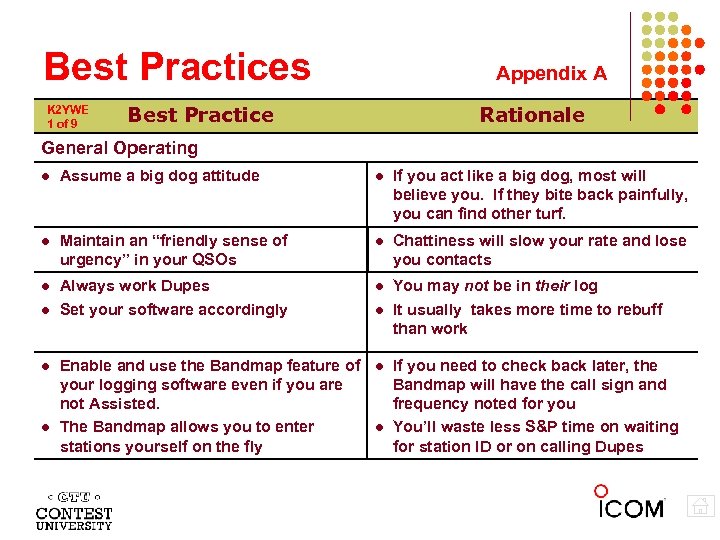
Best Practices K 2 YWE 1 of 9 Appendix A Best Practice Rationale General Operating Assume a big dog attitude If you act like a big dog, most will believe you. If they bite back painfully, you can find other turf. Maintain an “friendly sense of urgency” in your QSOs Chattiness will slow your rate and lose you contacts Always work Dupes Set your software accordingly You may not be in their log It usually takes more time to rebuff than work Enable and use the Bandmap feature of your logging software even if you are not Assisted. The Bandmap allows you to enter stations yourself on the fly If you need to check back later, the Bandmap will have the call sign and frequency noted for you You’ll waste less S&P time on waiting for station ID or on calling Dupes K 2 YWE – PISTOLS-H 2017 p. 37
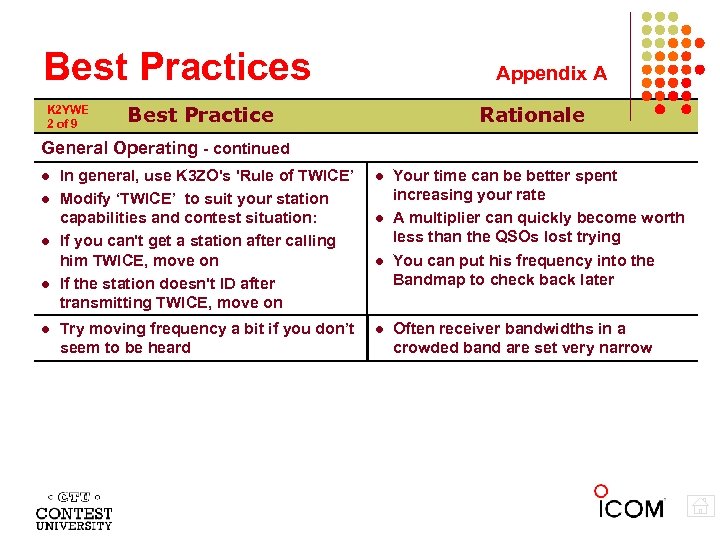
Best Practices K 2 YWE 2 of 9 Appendix A Best Practice Rationale General Operating - continued In general, use K 3 ZO's 'Rule of TWICE’ Modify ‘TWICE’ to suit your station capabilities and contest situation: If you can't get a station after calling him TWICE, move on If the station doesn't ID after transmitting TWICE, move on Try moving frequency a bit if you don’t seem to be heard Your time can be better spent increasing your rate A multiplier can quickly become worth less than the QSOs lost trying You can put his frequency into the Bandmap to check back later Often receiver bandwidths in a crowded band are set very narrow K 2 YWE – PISTOLS-H 2017 p. 38
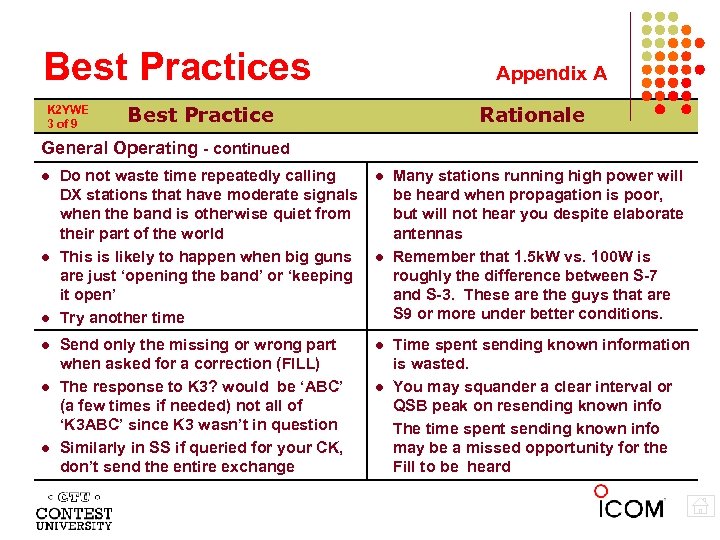
Best Practices K 2 YWE 3 of 9 Appendix A Best Practice Rationale General Operating - continued Do not waste time repeatedly calling DX stations that have moderate signals when the band is otherwise quiet from their part of the world This is likely to happen when big guns are just ‘opening the band’ or ‘keeping it open’ Try another time Send only the missing or wrong part when asked for a correction (FILL) The response to K 3? would be ‘ABC’ (a few times if needed) not all of ‘K 3 ABC’ since K 3 wasn’t in question Similarly in SS if queried for your CK, don’t send the entire exchange Many stations running high power will be heard when propagation is poor, but will not hear you despite elaborate antennas Remember that 1. 5 k. W vs. 100 W is roughly the difference between S-7 and S-3. These are the guys that are S 9 or more under better conditions. Time spent sending known information is wasted. You may squander a clear interval or QSB peak on resending known info The time spent sending known info may be a missed opportunity for the Fill to be heard K 2 YWE – PISTOLS-H 2017 p. 39
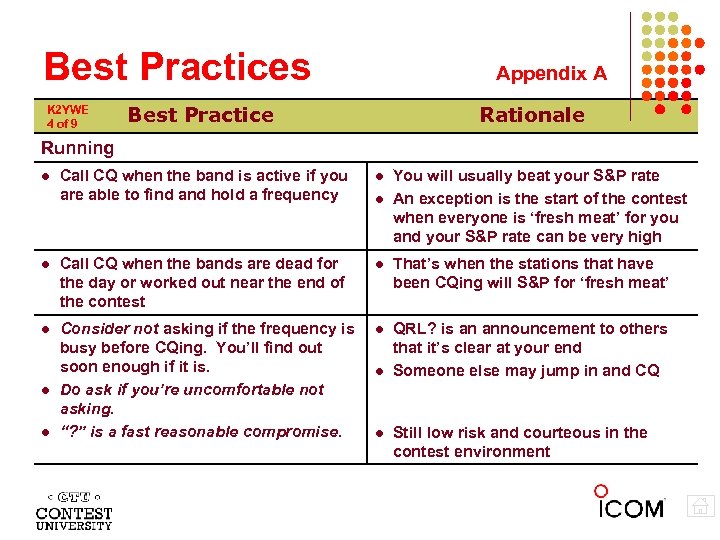
Best Practices K 2 YWE 4 of 9 Appendix A Best Practice Rationale Running Call CQ when the band is active if you are able to find and hold a frequency Call CQ when the bands are dead for the day or worked out near the end of the contest That’s when the stations that have been CQing will S&P for ‘fresh meat’ Consider not asking if the frequency is busy before CQing. You’ll find out soon enough if it is. Do ask if you’re uncomfortable not asking. “? ” is a fast reasonable compromise. QRL? is an announcement to others that it’s clear at your end Someone else may jump in and CQ You will usually beat your S&P rate An exception is the start of the contest when everyone is ‘fresh meat’ for you and your S&P rate can be very high Still low risk and courteous in the contest environment K 2 YWE – PISTOLS-H 2017 p. 40
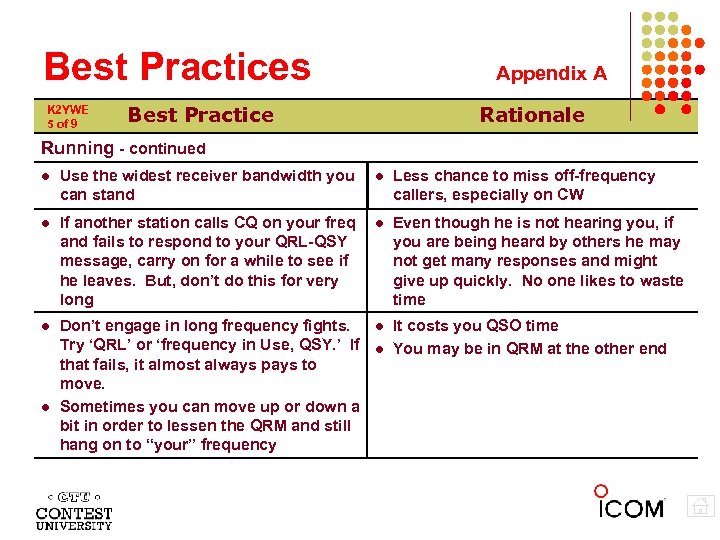
Best Practices K 2 YWE 5 of 9 Appendix A Best Practice Rationale Running - continued Use the widest receiver bandwidth you can stand Less chance to miss off-frequency callers, especially on CW If another station calls CQ on your freq and fails to respond to your QRL-QSY message, carry on for a while to see if he leaves. But, don’t do this for very long Even though he is not hearing you, if you are being heard by others he may not get many responses and might give up quickly. No one likes to waste time Don’t engage in long frequency fights. Try ‘QRL’ or ‘frequency in Use, QSY. ’ If that fails, it almost always pays to move. Sometimes you can move up or down a bit in order to lessen the QRM and still hang on to “your” frequency It costs you QSO time You may be in QRM at the other end K 2 YWE – PISTOLS-H 2017 p. 41
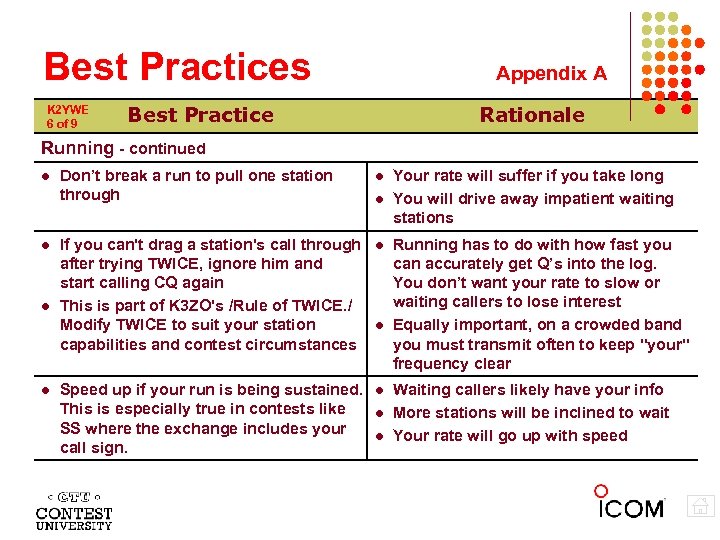
Best Practices K 2 YWE 6 of 9 Appendix A Best Practice Rationale Running - continued Don’t break a run to pull one station through If you can't drag a station's call through after trying TWICE, ignore him and start calling CQ again This is part of K 3 ZO's /Rule of TWICE. / Modify TWICE to suit your station capabilities and contest circumstances Speed up if your run is being sustained. This is especially true in contests like SS where the exchange includes your call sign. Your rate will suffer if you take long You will drive away impatient waiting stations Running has to do with how fast you can accurately get Q’s into the log. You don’t want your rate to slow or waiting callers to lose interest Equally important, on a crowded band you must transmit often to keep "your" frequency clear Waiting callers likely have your info More stations will be inclined to wait Your rate will go up with speed K 2 YWE – PISTOLS-H 2017 p. 42
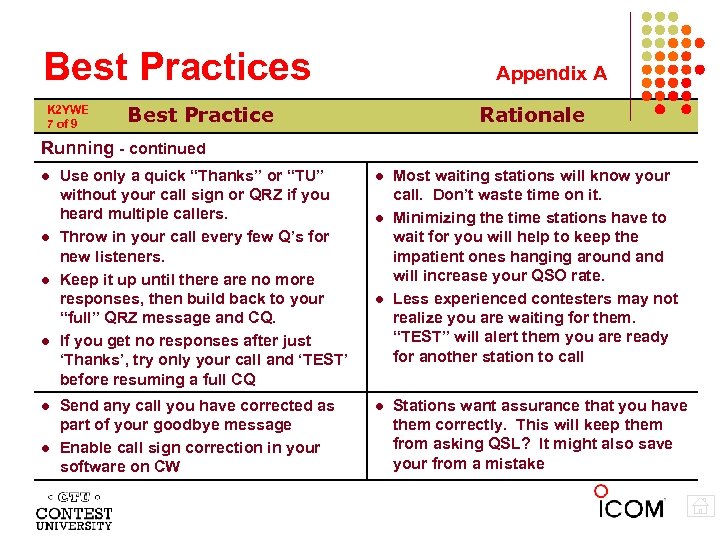
Best Practices K 2 YWE 7 of 9 Appendix A Best Practice Rationale Running - continued Use only a quick “Thanks” or “TU” without your call sign or QRZ if you heard multiple callers. Throw in your call every few Q’s for new listeners. Keep it up until there are no more responses, then build back to your “full” QRZ message and CQ. If you get no responses after just ‘Thanks’, try only your call and ‘TEST’ before resuming a full CQ Send any call you have corrected as part of your goodbye message Enable call sign correction in your software on CW Most waiting stations will know your call. Don’t waste time on it. Minimizing the time stations have to wait for you will help to keep the impatient ones hanging around and will increase your QSO rate. Less experienced contesters may not realize you are waiting for them. “TEST” will alert them you are ready for another station to call Stations want assurance that you have them correctly. This will keep them from asking QSL? It might also save your from a mistake K 2 YWE – PISTOLS-H 2017 p. 43
Best Practices K 2 YWE 8 of 9 Appendix A Best Practice Rationale Running - continued When the call sign of a responder is questionable, send a complete exchange using the questionable call Correct it during his exchange. You can use SCP to help guess incomplete calls on the first round Make sure you have it right before you let him go Maintain an “friendly sense of urgency” in your QSOs Chattiness will slow your rate and lose you contacts Move Multipliers if you have the time (a slow run) Pick frequencies in advance. Give up if you don’t connect in a short while It’s a quick way to gain band-Mults. Many Ops will go with you You probably won’t make the Q if you don’t connect quickly Nearly all contest stations will correct you on their transmission, good Ops without missing a beat It saves an extra exchange devoted only to getting the callsign right You can revert to “normal” fill-in procedures if this practice fails K 2 YWE – PISTOLS-H 2017 p. 44

Best Practices K 2 YWE 9 of 9 Appendix A Best Practice Rationale Running - continued Hit the Send key as soon as the call is in your head, and finish typing it into the log during your outgoing exchange transmission Some software can be set to do this after n callsign keystrokes (TR 4 W and N 1 MM, for example) NEVER acknowledge a ‘jammer. ’ NEVER! Just keep your pace, and don't change your tone of voice on phone or even synchronize your calls to his QRM If your fingers are like mine, they slightly lag my brain and I am still typing when the other station stops sending. This practice reduces the lag between when the other station finishes calling and when you respond, increasing your rate With no response to his jamming, he can't be sure he is even bothering you, and it isn't ‘fun’ for him if he doesn't get a reaction Got More? K 2 YWE – PISTOLS-H 2017 p. 45
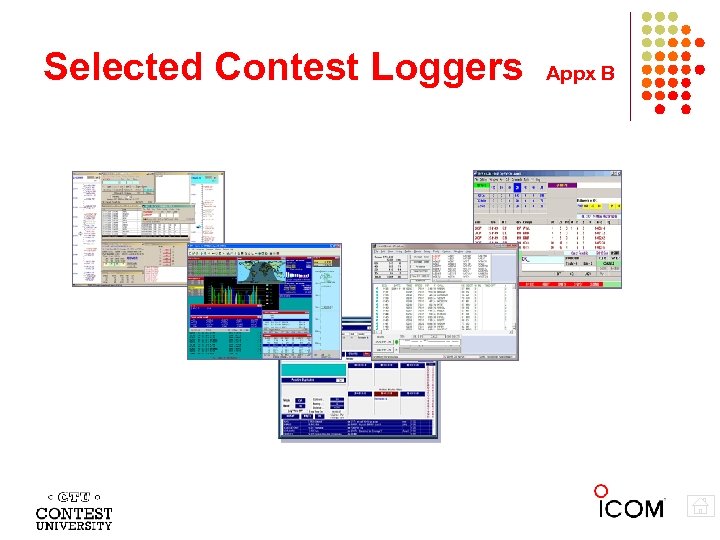
Selected Contest Loggers Appx B K 2 YWE – PISTOLS-H 2017 p. 46
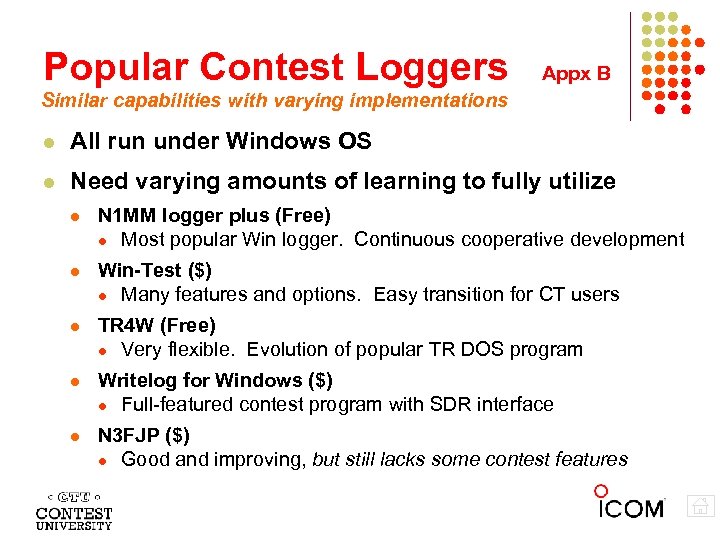
Popular Contest Loggers Appx B Similar capabilities with varying implementations All run under Windows OS Need varying amounts of learning to fully utilize N 1 MM logger plus (Free) Most popular Win logger. Continuous cooperative development Win-Test ($) Many features and options. Easy transition for CT users TR 4 W (Free) Very flexible. Evolution of popular TR DOS program Writelog for Windows ($) Full-featured contest program with SDR interface N 3 FJP ($) Good and improving, but still lacks some contest features K 2 YWE – PISTOLS-H 2017 p. 47
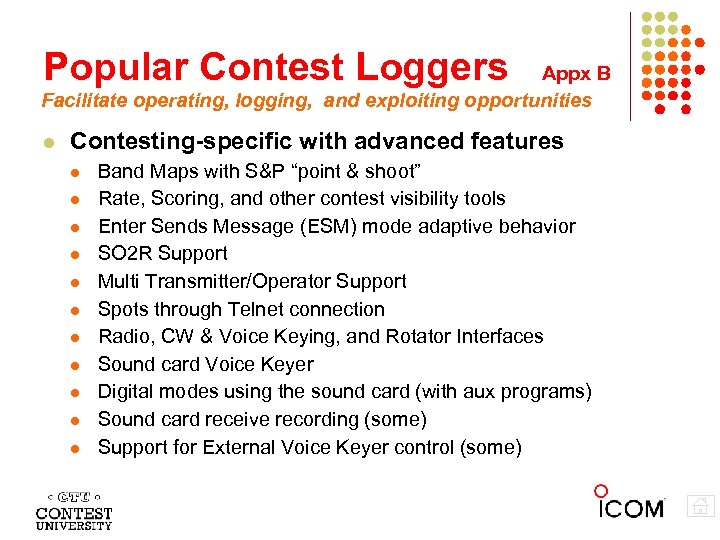
Popular Contest Loggers Appx B Facilitate operating, logging, and exploiting opportunities Contesting-specific with advanced features Band Maps with S&P “point & shoot” Rate, Scoring, and other contest visibility tools Enter Sends Message (ESM) mode adaptive behavior SO 2 R Support Multi Transmitter/Operator Support Spots through Telnet connection Radio, CW & Voice Keying, and Rotator Interfaces Sound card Voice Keyer Digital modes using the sound card (with aux programs) Sound card receive recording (some) Support for External Voice Keyer control (some) K 2 YWE – PISTOLS-H 2017 p. 48
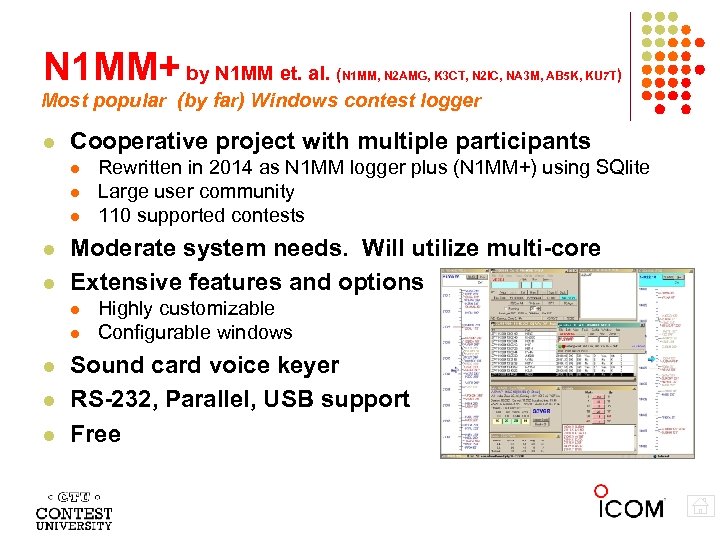
N 1 MM+ by N 1 MM et. al. ( N 1 MM, N 2 AMG, K 3 CT, N 2 IC, NA 3 M, AB 5 K, KU 7 T) Most popular (by far) Windows contest logger Cooperative project with multiple participants Moderate system needs. Will utilize multi-core Extensive features and options Rewritten in 2014 as N 1 MM logger plus (N 1 MM+) using SQlite Large user community 110 supported contests Highly customizable Configurable windows Sound card voice keyer RS-232, Parallel, USB support Free K 2 YWE – PISTOLS-H 2017 p. 49
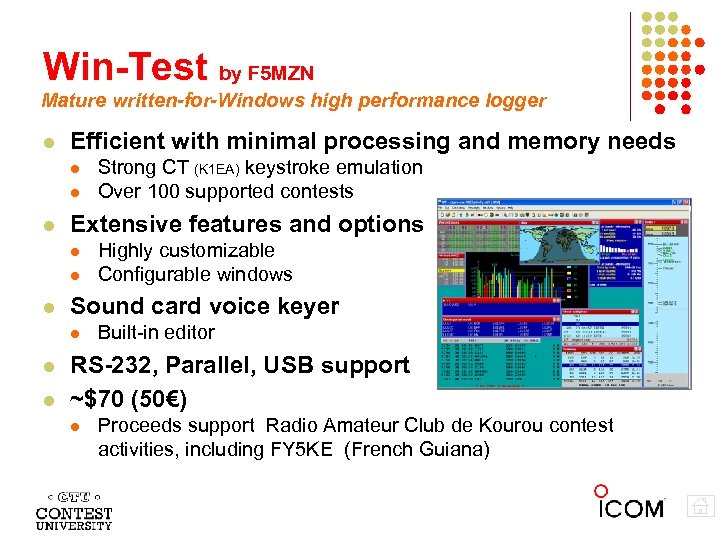
Win-Test by F 5 MZN Mature written-for-Windows high performance logger Efficient with minimal processing and memory needs Extensive features and options Highly customizable Configurable windows Sound card voice keyer Strong CT (K 1 EA) keystroke emulation Over 100 supported contests Built-in editor RS-232, Parallel, USB support ~$70 (50€) Proceeds support Radio Amateur Club de Kourou contest activities, including FY 5 KE (French Guiana) K 2 YWE – PISTOLS-H 2017 p. 50
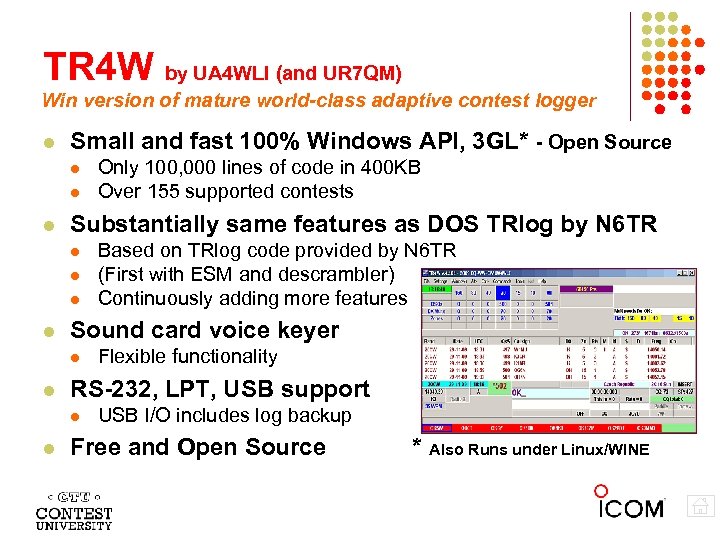
TR 4 W by UA 4 WLI (and UR 7 QM) Win version of mature world-class adaptive contest logger Small and fast 100% Windows API, 3 GL* - Open Source Substantially same features as DOS TRlog by N 6 TR Flexible functionality RS-232, LPT, USB support Based on TRlog code provided by N 6 TR (First with ESM and descrambler) Continuously adding more features Sound card voice keyer Only 100, 000 lines of code in 400 KB Over 155 supported contests USB I/O includes log backup Free and Open Source * Also Runs under Linux/WINE K 2 YWE – PISTOLS-H 2017 p. 51
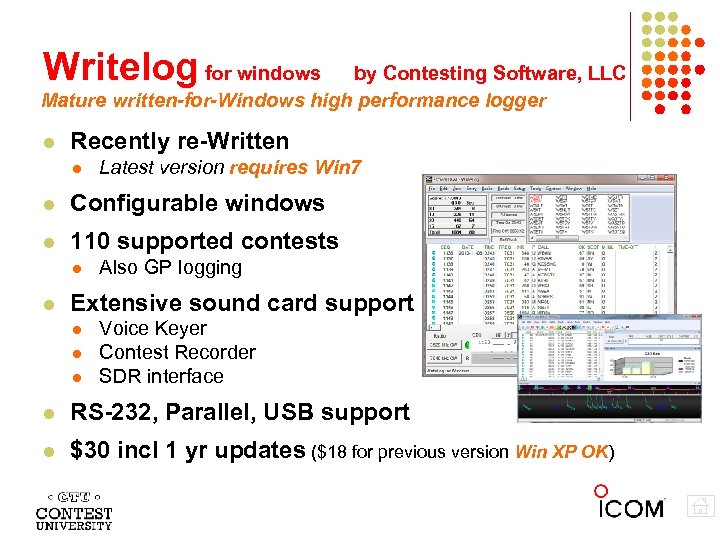
Writelog for windows by Contesting Software, LLC Mature written-for-Windows high performance logger Recently re-Written Latest version requires Win 7 Configurable windows 110 supported contests Also GP logging Extensive sound card support Voice Keyer Contest Recorder SDR interface RS-232, Parallel, USB support $30 incl 1 yr updates ($18 for previous version Win XP OK) K 2 YWE – PISTOLS-H 2017 p. 52
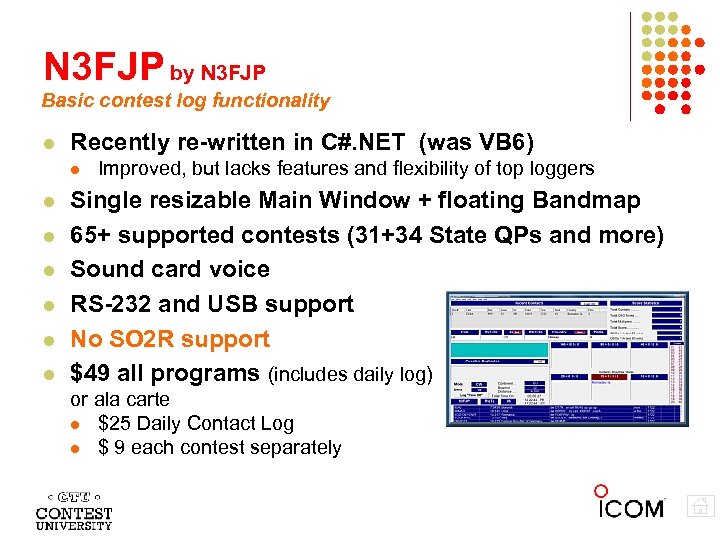
N 3 FJP by N 3 FJP Basic contest log functionality Recently re-written in C#. NET (was VB 6) Improved, but lacks features and flexibility of top loggers Single resizable Main Window + floating Bandmap 65+ supported contests (31+34 State QPs and more) Sound card voice RS-232 and USB support No SO 2 R support $49 all programs (includes daily log) or ala carte $25 Daily Contact Log $ 9 each contest separately K 2 YWE – PISTOLS-H 2017 p. 53
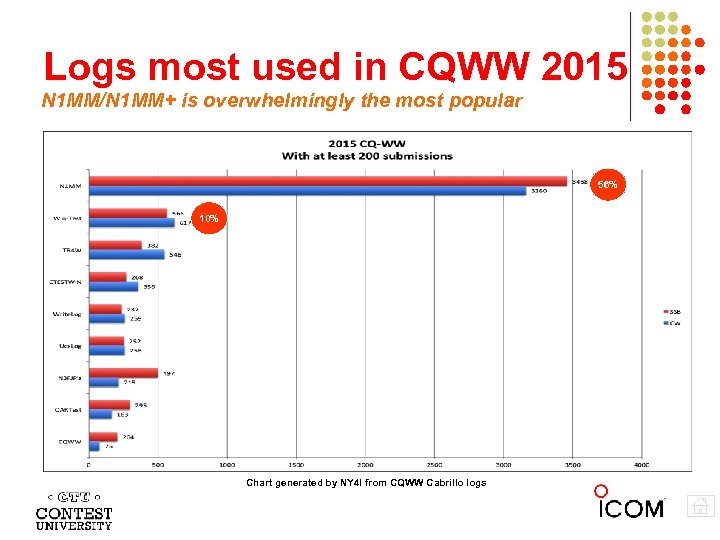
Logs most used in CQWW 2015 N 1 MM/N 1 MM+ is overwhelmingly the most popular 56% 10% Chart generated by NY 4 I from CQWW Cabrillo logs K 2 YWE – PISTOLS-H 2017 p. 54
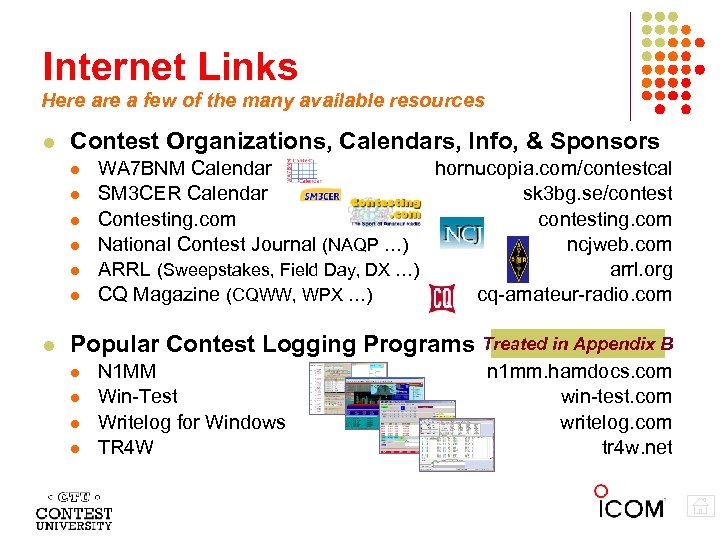
Internet Links Here a few of the many available resources Contest Organizations, Calendars, Info, & Sponsors WA 7 BNM Calendar hornucopia. com/contestcal SM 3 CER Calendar sk 3 bg. se/contest Contesting. com contesting. com National Contest Journal (NAQP …) ncjweb. com ARRL (Sweepstakes, Field Day, DX …) arrl. org CQ Magazine (CQWW, WPX …) cq-amateur-radio. com Popular Contest Logging Programs Treated in Appendix B N 1 MM Win-Test Writelog for Windows TR 4 W n 1 mm. hamdocs. com win-test. com writelog. com tr 4 w. net K 2 YWE – PISTOLS-H 2017 p. 55
Odds ‘n ends K 2 YWE – PISTOLS-H 2017 p. 56
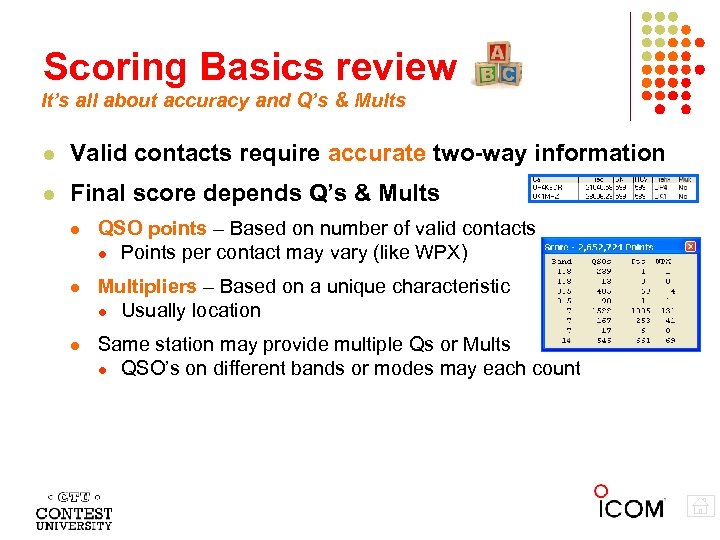
Scoring Basics review It’s all about accuracy and Q’s & Mults Valid contacts require accurate two-way information Final score depends Q’s & Mults QSO points – Based on number of valid contacts Points per contact may vary (like WPX) Multipliers – Based on a unique characteristic Usually location Same station may provide multiple Qs or Mults QSO’s on different bands or modes may each count K 2 YWE – PISTOLS-H 2017 p. 57
Скачать презентацию Little Pistols Bigger Scores Collected Wisdom and Lessons
be17a3d478e9a5c83d5904645ec2d459.ppt