 Скачать презентацию LITIGATING THE PUBLIC ENTITY STATE COURT CASE AN
cc1f05cc68d7aba78a2a00cf48979ea5.ppt
- Количество слайдов: 110



LITIGATING THE PUBLIC ENTITY STATE COURT CASE AN OVERVIEW FROM LAUNCH TO SPLASHDOWN Presented by: Eric A. Gale, Esq. Brian M. Affrunti, Esq. Burke, Williams & Sorensen, LLP 2440 West El Camino Real, Suite 620 Mountain View, CA 94040 650. 327. 2672 Moderated by: Jack Blyskal, CSAC-EIA Chief Claims Officer Materials Prepared by: Hans A. Gillinger, Esq. Brian M. Affrunti, Esq. Eric A. Gale, Esq.
Introduction • Some cases must be tried, but most are not. • 95% of civil cases settle. • Plaintiffs’ counsel know they earn more settling cases than trying them. 2
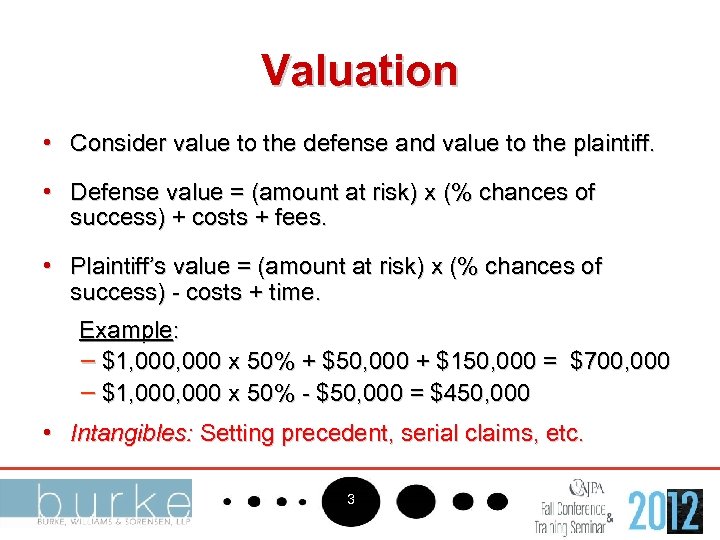
Valuation • Consider value to the defense and value to the plaintiff. • Defense value = (amount at risk) x (% chances of success) + costs + fees. • Plaintiff’s value = (amount at risk) x (% chances of success) - costs + time. Example: − $1, 000 x 50% + $50, 000 + $150, 000 = $700, 000 − $1, 000 x 50% - $50, 000 = $450, 000 • Intangibles: Setting precedent, serial claims, etc. 3
1. Determine Amount of Risk • Contractual damages (policy). • Defense attorney’s fees. • Plaintiff’s fees (such as in § 1983 and ERISA cases). • General damages. • Punitive damages. 4
2. Chances of Success • Legal research on key issues. • Strength of witnesses. • Strength of judge (willingness to grant SJ/Motion to Strike punitive damages; jury instructions). • Risk aversion. – Highest for plaintiff on contract issue. – Highest for defense on extra-contractual issues. 5
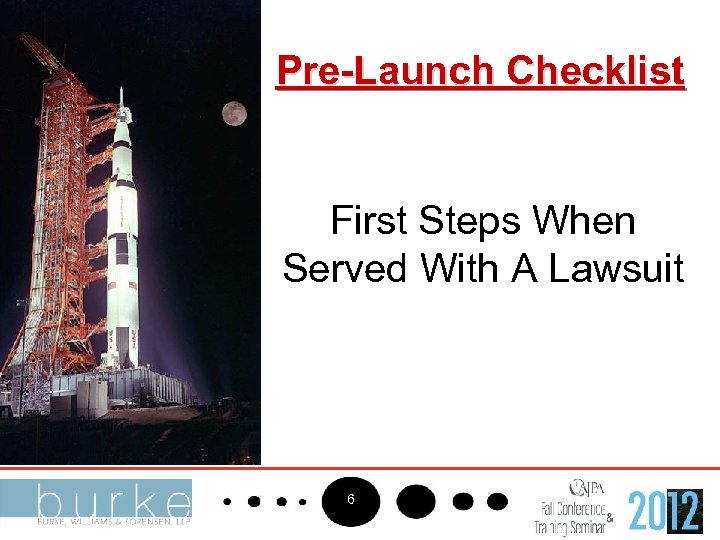
Pre-Launch Checklist First Steps When Served With A Lawsuit 6
Issue a Litigation Hold to City Staff • Adverse evidentiary inferences. The trier of fact may consider a party’s willful suppression of evidence in determining what inferences to draw from the evidence or facts. (Evid. Code § 413; see also BAJI No. 2. 03. ) • Discovery sanctions. Monetary, contempt, issue, evidence, and terminating. (Code Civ. Proc. § 2023; Cedars-Sinai Medical Center v. Superior Court (1998) 18 Cal. 4 th 1, 12; see Williams v. Russ (2008) 167 Cal. App. 4 th 1215 (terminating sanctions). ) 7
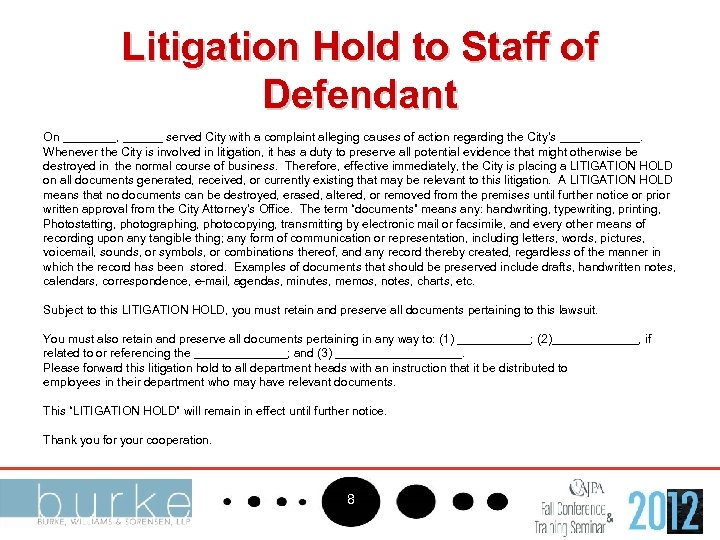
Litigation Hold to Staff of Defendant On ____, ______ served City with a complaint alleging causes of action regarding the City’s ______. Whenever the City is involved in litigation, it has a duty to preserve all potential evidence that might otherwise be destroyed in the normal course of business. Therefore, effective immediately, the City is placing a LITIGATION HOLD on all documents generated, received, or currently existing that may be relevant to this litigation. A LITIGATION HOLD means that no documents can be destroyed, erased, altered, or removed from the premises until further notice or prior written approval from the City Attorney's Office. The term “documents” means any: handwriting, typewriting, printing, Photostatting, photographing, photocopying, transmitting by electronic mail or facsimile, and every other means of recording upon any tangible thing; any form of communication or representation, including letters, words, pictures, voicemail, sounds, or symbols, or combinations thereof, and any record thereby created, regardless of the manner in which the record has been stored. Examples of documents that should be preserved include drafts, handwritten notes, calendars, correspondence, e-mail, agendas, minutes, memos, notes, charts, etc. Subject to this LITIGATION HOLD, you must retain and preserve all documents pertaining to this lawsuit. You must also retain and preserve all documents pertaining in any way to: (1) ______; (2)_______, if related to or referencing the _______; and (3) __________. Please forward this litigation hold to all department heads with an instruction that it be distributed to employees in their department who may have relevant documents. This “LITIGATION HOLD” will remain in effect until further notice. Thank you for your cooperation. 8
Summons & Complaint • Civil litigation matters are initiated by the filing and service of the summons and complaint. • A “summons” is a form of court process that functions to notify defendants that a lawsuit is pending against them and of defendant’s right to defend the action. • In suits against public agencies, service of the summons and complaint may be made by delivering to “the clerk, secretary, president, presiding officer or other head of its governing body. ” 9
Service of Process • This is the phrase used to describe a defendant being served with a complaint or petition, which notifies the defendant that a case has been filed against them. • 3 methods of proper service: • Personal • By Mail (check rules) • By Publication (need permission) • If the defendant is properly served and fails to “appear” within 30 days, the case can proceed by default. 10
Check Method of Service Personal service required. The summons and complaint/petition must be served on the “clerk, secretary, president, presiding officer, or other head of [the] governing body. ” (Code Civ. Proc. ¶ 416. 50. ) 11
Strategy Considerations – Service of Summons • Permitting defense counsel to accept service is usually good for defendants. • Refusing to accept service of summons may be appropriate. – Avoids running up plaintiff’s costs for which defendant may later be liable – There is no way to prevent service of summons 12 – Where defendant is a foreign national, living abroad – Where there is any issue as to the court’s jurisdiction – Where three-year statute for service of summons has already run
Responding to Summons • The court will enter a default judgment against the defendant that fails to timely respond to a summons; response required within 30 days in most cases • Defendants are subject to shorter periods within which to timely file a response, including: – Unlawful detainer proceedings (5 days) – “Reverse Validation Actions” challenging official action by a public agency (10 days) 13
Service By Mail With Acknowledgment • Often, plaintiffs will attempt service of the summons and complaint by mail accompanied with a request to acknowledge receipt thereof; if defendant signs and returns the acknowledgment within twenty days, no further service is necessary • Defendant is held liable for cost of additional service if it refuses to acknowledge receipt. • Acknowledgment usually benefits defendants because the responsive pleading is due within thirty days of execution of the acknowledgement 14
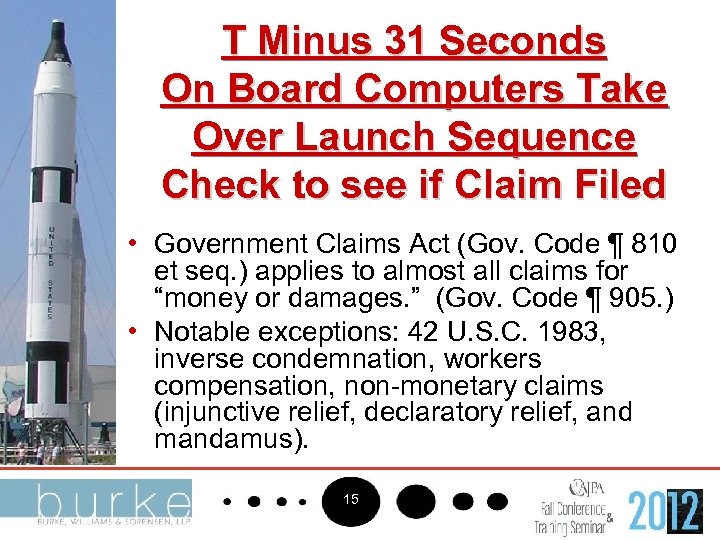
T Minus 31 Seconds On Board Computers Take Over Launch Sequence Check to see if Claim Filed • Government Claims Act (Gov. Code ¶ 810 et seq. ) applies to almost all claims for “money or damages. ” (Gov. Code ¶ 905. ) • Notable exceptions: 42 U. S. C. 1983, inverse condemnation, workers compensation, non-monetary claims (injunctive relief, declaratory relief, and mandamus). 15
Key Features of Government Claims Act Authorizing Statute Requirement: Public Entity Liability is abolished except as provided by statute, and effectively abolishes all common law or judicially declared forms of liability for public agencies, except as provided by state or federal constitution (Govt. Code § 815(a)) - To state a cause of action against a California public entity, every fact essential to the existence of statutory liability must be pled with particularity, including the existence of a statutory duty (Searcy v. Hemet Unified Sch. Dist. , 177 Cal. App. 3 d 792 (1986) 16
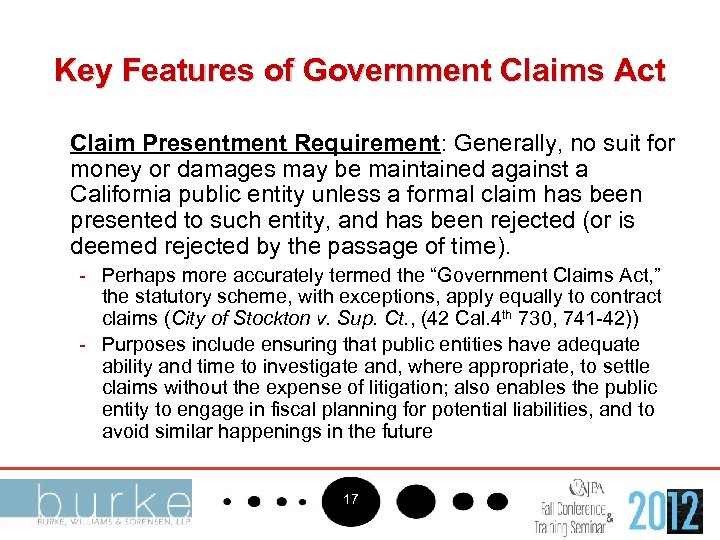
Key Features of Government Claims Act Claim Presentment Requirement: Generally, no suit for money or damages may be maintained against a California public entity unless a formal claim has been presented to such entity, and has been rejected (or is deemed rejected by the passage of time). - Perhaps more accurately termed the “Government Claims Act, ” the statutory scheme, with exceptions, apply equally to contract claims (City of Stockton v. Sup. Ct. , (42 Cal. 4 th 730, 741 -42)) - Purposes include ensuring that public entities have adequate ability and time to investigate and, where appropriate, to settle claims without the expense of litigation; also enables the public entity to engage in fiscal planning for potential liabilities, and to avoid similar happenings in the future 17
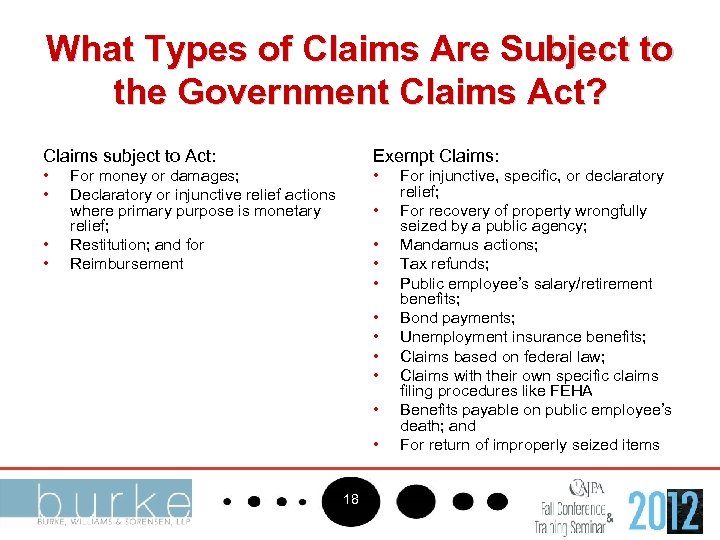
What Types of Claims Are Subject to the Government Claims Act? Claims subject to Act: Exempt Claims: • • • For money or damages; Declaratory or injunctive relief actions where primary purpose is monetary relief; Restitution; and for Reimbursement • • • 18 For injunctive, specific, or declaratory relief; For recovery of property wrongfully seized by a public agency; Mandamus actions; Tax refunds; Public employee’s salary/retirement benefits; Bond payments; Unemployment insurance benefits; Claims based on federal law; Claims with their own specific claims filing procedures like FEHA Benefits payable on public employee’s death; and For return of improperly seized items
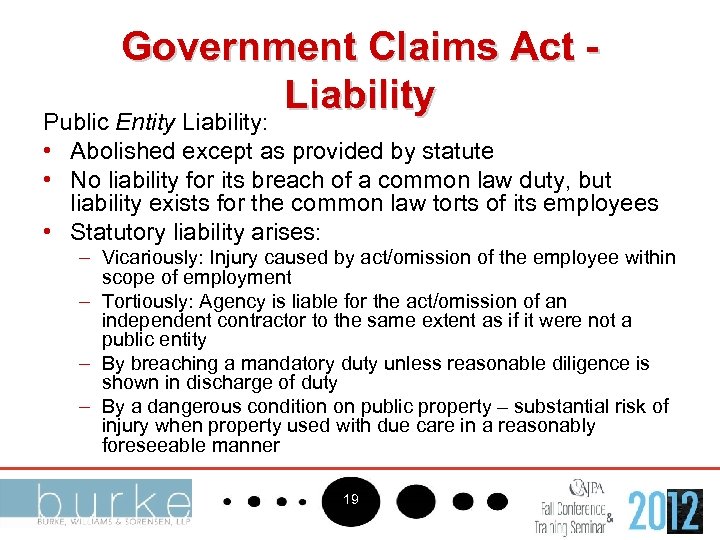
Government Claims Act Liability Public Entity Liability: • Abolished except as provided by statute • No liability for its breach of a common law duty, but liability exists for the common law torts of its employees • Statutory liability arises: – Vicariously: Injury caused by act/omission of the employee within scope of employment – Tortiously: Agency is liable for the act/omission of an independent contractor to the same extent as if it were not a public entity – By breaching a mandatory duty unless reasonable diligence is shown in discharge of duty – By a dangerous condition on public property – substantial risk of injury when property used with due care in a reasonably foreseeable manner 19
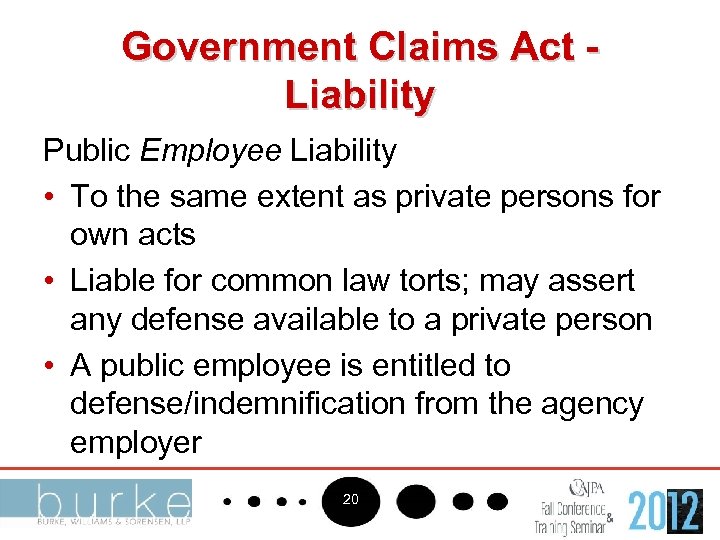
Government Claims Act Liability Public Employee Liability • To the same extent as private persons for own acts • Liable for common law torts; may assert any defense available to a private person • A public employee is entitled to defense/indemnification from the agency employer 20
Claim Presentment • Failure to comply with the claims statute bars the claim against the public entity and its employees. • Claims for personal injury, death, or for damage to personal property or crops must be presented to the governmental agency within six months of accrual of action; all other claims must be presented within one year. 21
Claim Presentment – Late Claims • Late claims must also include an “application for late filing” that must be filed with the agency within one year of accrual of claim • There are four valid reasons for a late claim under Govt. Code § 911. 6(b): 1. 2. 3. 4. Mistake, inadvertence, surprise or excusable neglect; Minority of the claimant during six month period Physical or mental incapacity; and Death of the claimant 22
T Minus 6. 6 Seconds – Engines Ignite Responding to the Complaint • Within thirty days of service of the complaint, a defendant must serve and file a responsive pleading in the form of an Answer, Demurrer, Motion to Strike, or a Petition to compel arbitration. • No matter the form of responsive pleading chosen, it must generally be filed within 30 days after service of the complaint unless extended by stipulation or court order. 23
Liftoff/Launch T Minus 0 Seconds Answers • An answer must include whatever denials or affirmative defenses are necessary to controvert the material allegations of the complaint to put the case “at issue” as to the matters alleged that the defendant doesn’t want to admit • An answer cannot be used to claim affirmative relief, which requires a complaint or cross-complaint • If the complaint is verified, defendant must verify the answer. Exception: an answer by a governmental body or officer sued in his official capacity need not be verified (CCP § 446; Trask v. Sup. Ct. (1994) 22 Cal. App. 4 th 346, 350). 24
Answers – Denials • Any material allegation in the complaint that is not effectively denied, is deemed admitted (CCP § 431. 20(a)) • An answering defendant may make a blanket denial of the whole complaint (a general denial), or may specify denial as to less than all of the complaint (a specific denial) – A general denial is not permitted if the complaint is verified 25
Other Responses • Cross-Complaints: File a case against the Plaintiff or another party about the same issue • Joinder: Makes a non-party a party in the case; anyone who has a stake in the outcome 26
Demurrer • A “demurrer” is a pleading used to test the legal sufficiency of other pleadings by raising issues of law, not fact, regarding the form or content of the opposing party’s pleading • If the defendant has not previously appeared in the action and the demurrer is the defendant’s initial pleading, the filing of a demurrer constitutes a general appearance, subjecting defendant to the court’s personal jurisdiction (CCP § 1014) 27
Demurrer As Motion/Demurrer As Pleading: • A demurrer may be the defendant’s initial pleading (CCP § 442. 10) • A demurrer is considered a “responsive pleading” to the same extent as an Answer 28 As Motion: • A demurrer is also an application for a court order like a motion • CCP § 1008(a) authorizing reconsideration of rulings on motions applies to demurrers • Civil law and motion rules (California Rules of Court 3. 1100 -3. 1370) apply generally to demurrers as well as to motions
Demurrer Limited By Pleading • A demurrer can be used only to challenge defects that appear on the face of the pleading under attack; or from matters outside the pleading that are judicially noticeable. (Blank v. Kirwan, 39 Cal. 3 d 311, 318 (1985)) • “Face of the complaint” includes matters shown in exhibits attached to the complaint and incorporated by reference; or in a superseded complaint in the same action 29
Demurrer Plus • A demurrer to a complaint (or crosscomplaint) can be filed along with a motion to strike • Less commonly, a demurrer can also be filed in conjunction with an answer – Answering and demurring at the same time only makes sense if the demurrer was taken as to some causes of action in the complaint and not others; defendant may choose to answer the remaining counts at the same time 30
Grounds For A Demurrer CCP § 430. 10 provides for the grounds for objection to a complaint or cross-complaint: • Court lacks subject matter jurisdiction; • Plaintiff lacks capacity to sue; • Nonjoinder or misjoinder of parties; • Another action is pending between the same parties for the same cause of action; • Failure to state facts sufficient to constitute a cause of action; • Failure to allege whether contract sued upon was written or oral or implied by conduct; and • Failure to attach attorney’s certificate required in certain malpractice actions 31
Failure To Raise Grounds • Most of the statutory grounds for objection are automatically waived if not raised either by demurrer or in the answer as affirmative defenses. – The failure to state facts sufficient to constitute a cause of action and the lack of subject matter jurisdiction, however, are not waived and can be raised at any time. • The failure to allege compliance with the governmental claims presentation requirements in an action against a government entity is a non-statutory ground for general demurrer (State of Cal. v. Sup. Ct. (Bodde), 32 Cal. 4 th 1234, 1239 (2004)) 32
Special Demurrers – Strategy & Tactics • Most grounds for demurrer (“uncertainty, ” “lack of capacity, ” “defect or misjoinder of parties, ” etc. ) can be raised either by demurrer or answer • Generally, the sustaining of a demurrer does not terminate the proceeding and the plaintiff is permitted to cure defects by way of an amended pleading • Why then are demurrers filed? 33
Special Demurrers – Pros v. Cons • Advantages: – Loosely pleaded claims are difficult to deny or defend; a special demurrer can obtain better clarity of pleading possibly exposing grounds for defense now, at summary judgment, or during litigation 34
Special Demurrers – Pros v. Cons • Disadvantages: – Special demurrers are rarely worth the time and money required to bring them because most often the defect can be corrected and the court will grant leave to amend. – Little is gained apart from delay. • Alternative: – Before filing a special demurrer, defendant should call plaintiff’s counsel and offer to stipulate to plaintiff amending the complaint to eliminate the defect 35
General Demurrers – Strategy & Tactics • There is no problem of waiver with general demurrers (CCP § 430. 80) and defendant can attack the complaint for “failure to state facts sufficient to constitute a cause of action” after time to demurrer including by way of motion for judgment on the pleadings or for a directed verdict • Whether to demur is a tactical consideration 36
General Demurrers – Pros v. Cons Advantages – A general demurrer makes sense in several situations: • Where plaintiff is asserting a novel cause of action; • Where it appears plaintiff cannot truthfully amend to allege omitted facts; • Where a summary judgment motion is contemplated; or • Where statute of limitations defense apparent from complaint or matters judicially noticeable 37
General Demurrers – Pros v. Cons • Disadvantages: – – – Judicial attitudes; Cost; Risk of “educating” plaintiff; Plaintiff’s complaint presumed true on appeal; Risk of creating bad law on appeal; and Risk of sanctions • Alternative: – Unless the defendant is certain that the defects in the pleadings cannot be cured by amendment, defendant should always call plaintiff’s counsel, point out the defect, and offer to stipulate to an amendment to the pleadings 38
Motions To Strike • Motions to strike can be used to reach defects or objections to pleadings that are not challengeable by demurrer. Complaints, cross-complaints, answers, and demurrers are all subject to a motion to strike (CCP § 435(a)(2)) • Can be used to attack the entire pleading, or any part thereof, even single words or phrases 39
Motions To Strike • Can be made at any time within the time allowed to respond to a pleading, which is typically 30 days from service of the complaint • Can be made in an unlimited civil case and lies either: – To strike any “irrelevant, false or improper matter inserted in any pleading; ” or – To strike any pleading or part thereof “not drawn or filed in conformity with the laws of this state, a court rule or order of court. ” (CCP § 436)) 40
Striking “Irrelevant Matters” “Irrelevant matters” include: • Allegations not essential to the claim or defense; • Allegations “neither pertinent to nor supported by an otherwise sufficient claim or defense; ” or • A demand for judgment “requesting relief not supported by the allegations of the complaint or cross-complaint. ” (CCP § 431. 10(b)) 41
Motions For Judgment On The Pleadings • A motion for judgment on the pleadings has the same function as a general demurrer but is made after the time for demurrer has expired • It has a statutory basis since 1994 - CCP § 438 • Except as provided by CCP § 438, the rules governing demurrers apply 42
Grounds For Judgment On The Pleadings A motion by defendant or cross-defendant can be made on the ground that: • The court “lacks jurisdiction of the subject of one or more of the causes of action alleged; ” or • The complaint, or any cause of action therein, “does not state facts sufficient to constitute a cause of action against that defendant. ” (CCP § 438(c)) 43
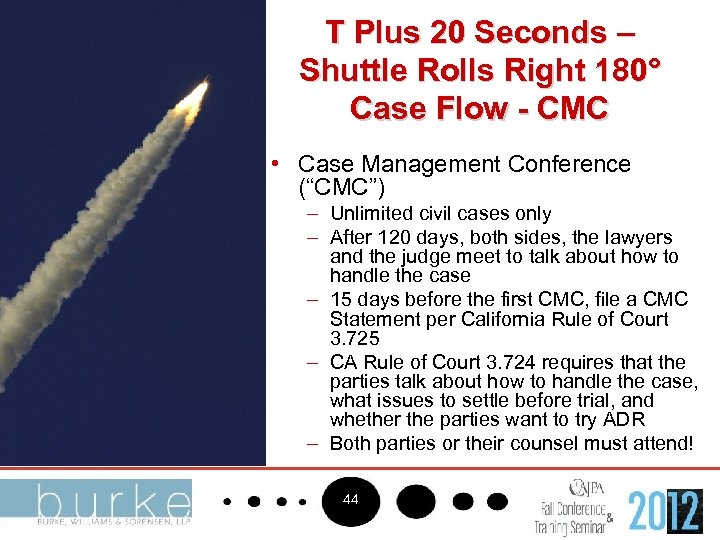
T Plus 20 Seconds – Shuttle Rolls Right 180° Case Flow - CMC • Case Management Conference (“CMC”) – Unlimited civil cases only – After 120 days, both sides, the lawyers and the judge meet to talk about how to handle the case – 15 days before the first CMC, file a CMC Statement per California Rule of Court 3. 725 – CA Rule of Court 3. 724 requires that the parties talk about how to handle the case, what issues to settle before trial, and whether the parties want to try ADR – Both parties or their counsel must attend! 44
Motions Calif. Rule of Court 3. 1112 • The papers filed in support of a motion must consist of at least the following: – a notice of hearing on the motion – the motion itself – a memorandum in support of the motion • Other papers may be filed in support of a motion, including declarations, exhibits, appendices, and other documents or pleadings. • The papers may either be filed as separate documents or combined in one or more documents if the party filing a combined pleading specifies these items separately in the caption of the combined pleading. 45
T Plus 60 Seconds – Shuttle Engines at Maximum Throttle DISCOVERY 46
Case Flow - Discovery • Building Your Case: Investigation and Discovery » Many ways to investigate your case: take photos, conduct interviews, record data » Free/low-cost information resources: internet, library, government agencies » What you gather is called “evidence” 47
Specific Forms of Discovery • Oral and written Depositions (CCP §§ 2025. 0102028. 060); • Interrogatories (CCP § 2030. 010); • Inspection, Testing and Sampling of Documents, Things, Places, or Electronically-Stored Information (ESI) (CCP § 2031. 010); • Physical and mental examinations (CCP § 2032. 010 et seq. ); • Requests for Admissions (CCP § 2033. 010 et seq. ); 48
Specific Forms of Discovery (continued) • Simultaneous Exchange of Expert Trial Witness Information (CCP § 2034. 010 et seq. ); and • Subpoenas to Nonparty Deponents (CCP § 2020. 010(a)) or Business Records Custodians (CCP § 2020. 020(b)) 49
Discovery – Problems • Discovery – If you have trouble getting others to “produce” (turn over/give you) evidence, there are several ways to get the evidence • Motion to Compel • Subpoenas 50
Discovery – Goals • Purpose of Discovery: – Preserving evidence for trial; – Providing basis for pretrial motions; – Narrowing issues for trial; – Promoting out-of-court settlements; – Avoiding surprises at trial 51
Drawbacks/Disadvantages of Discovery • Some drawbacks and disadvantages to discovery are: – Costs; – Discovery “overkill; ” – Discovery disputes; and – Discovery abuses 52
Discovery Abuses CCP § 2023. 010 et seq. sets forth a nonexclusive list of “misuses” of discovery for which sanctions may be imposed: • “Persisting, over objection, and without substantial justification, in an attempt to obtain information. . . outside the scope of permissible discovery; ” • Using a discovery method improperly; • Using a discovery method so as to cause “unwarranted annoyance, embarrassment, or oppression, or undue burden and expense; ” 53
Discovery Abuses (continued) • Failing to respond or submit to an authorized method of discovery; • “Making, without substantial justification, an unmeritorious objection to discovery; ” • “Making an evasive response to discovery; ” • “Disobeying a court order to provide discovery; ” 54

Discovery Abuses (continued) • Making or opposing a motion to compel or limit discovery unsuccessfully and “without substantial justification; ” • Failing to meet and confer by failing to make “a reasonable and good faith attempt to resolve informally any dispute concerning discovery” where so required by the particular discovery method involved. 55
Discovery Coito v. Superior Court (2010) 182 Cal. App. 4 th 758 Written or recorded witness statements that are produced by the witness or turned over to counsel are not subject to the attorney work product doctrine. Coito v. Superior Court (2012) 278 P. 3 d 860 Absolute work product protection for witness statements obtained by an interview conducted by an attorney is decided on a case-by -case basis. 56
Discovery • Holmes v. Petrovich Development Company, LLC (2011) 191 Cal. App. 4 th 1047 E-mails sent to plaintiff’s attorney by way of company e-mail are NOT protected by the attorney-client privilege, and therefore, are discoverable. 57
Do You Know How Many Pages Are In a Gigabyte of Information? • Some of the information we need to obtain from the client at the beginning of a lawsuit includes: • Document retention policy? Is it in writing? Who enforces it? • Key custodians: Who are the parties with relevant information? • What ESI sources are available? • Network servers? What sort of system of back up is used by client? What periods of time are currently available and can certain files can be selectively restored? • Email servers? What is the time frame at issue? Are there multiple servers at different locations? • Hard Drives? What is client’s policy with respect to maintaining hard drives of former employees and current employees who have received new computers? 58
California’s E-Discovery Act • Emergency legislation effective immediately – June 29, 2009 • Essentially amends CCP 2031 to include: “copying, testing, or sampling” to each section that includes the term “inspection” 59
Update Your Standard Discovery Definitions! • Defines ESI – “information that is stored in an electronic medium” CCP § 2016. 020(e). • “‘Electronic’ means relating to technology having electric, digital, magnetic, wireless, optical, electromagnetic, or similar capabilities. ” CCP § 2016. 020(d) 60
Understand the “Form” of Production • The requesting party may specify the form or forms of production for ESI. CCP § 2031. 030(a)(2); tracks FRCP 34(b)(1)(C) • If no form is specified, default is how ESI is “ordinarily maintained or in a form that is reasonably usable” CCP § 2031. 280(d)(1); tracks FRCP 34(b)(2)(E)(ii). • If form is specified, but you disagree, you must state the specific objection and the form in which you will produce. CCP § 2031. 280(c). 61
Understand the “Form” of Production • Are you producing “native” files? • Are you producing TIFF files? (Tagged Image File Format) • Are you producing PDF files? • Are you producing or receiving “load” files that provide limited metadata to sort and manage the ESI that you produce or receive? 62
Know the Limits • Party may still seek a protective order, but burden is on party objecting to demonstrate that ESI is “from a source that is not reasonably accessible because of undue burden or expense. ” CCP § 2031. 060(a) • Party may also object on grounds that information is from a source that is not reasonably accessible because of undue burden or expense. CCP § 2031. 210(d); the party opposing a motion to compel must demonstrate burden. CCP § 2031. 310(d) 63
Know the Limits (cont’d) • A party need not produce the same ESI in more than one form. CCP § 2031. 280(d)(2). • The demanding party may have to bear the costs of translating data into reasonably usable form. CCP § 2031. 280(e) (i. e. be careful what you wish for). • Court can set limits to production. CCP § 2031. 310(g). 64
Safe Harbors • “absent exceptional circumstances, the court shall not impose sanctions on a party or any attorney of a party for failure to provide ESI that has been lost, damaged, altered, or overwritten as the result of the routine, good faith operation of an electronic information system” CCP § § 2031. 060(i)(1); 2031. 300(d)(1); 2031. 310(j)(1); 2031. 320(d)(1). 65
Third Parties are Subject to ESI Requests • Adds CCP § 1985. 5 – Third parties subject to subpoenas for ESI 66
T Plus 2 Minutes – Fuel Cells Separate from Shuttle Motions for Summary Judgment • A motion for summary judgment (MSJ) asks the court to determine that the entire action has no merit and to terminate the action without the necessity of trial. • A motion for summary adjudication (MSA) asks the court to adjudicate the merits of a particular cause of action or claim for damages, including a punitive damages request. 67
MSJ/MSA The court must determine from the evidence presented that “there is no triable issue as to any material fact and that the moving party is entitled to judgment as a matter of law. . . ” (CCP § 437 c(c)) – This requirement means that summary judgment can only be granted where the essential facts are either conceded or beyond dispute. – If there is one single material fact in dispute, the motion must be denied. 68
MSJ/MSA Advantages • A successful MSJ provides an immediate judgment and avoids costs of a trial. • A successful MSA shortens the trial by eliminating claims or defenses. • Even an unsuccessful motion may focus the judge’s attention on the weaknesses of the plaintiff’s case. 69
MSJ Disadvantages • A win is always threatened by the risk of appeal • If MSJ is denied, there are several potential adverse consequences: – MSJ may alert adversary to your evidence on key issues thereby making adversary better prepared at trial to oppose your evidence – Witnesses may be impeached at trial if their testimony varies from declarations given in support of the MSJ 70
MSJ/MSA Factors For Filing • Given the downside risk, weighing the following factors is important prior to filing an MSJ: – – – – Whether the case lends itself to summary judgment; Likelihood of opposition; Costs; Timing; Probable attitude of judge hearing the MSJ; Possibility of bifurcation of trial; and Effect on settlement potential 71
MSJ/MSA – “Has No Merit” • The motion lies where one or more causes of action “has no merit. . . ” (CCP § 437 c(f)(1)) • A cause of action “has no merit” if: – Any element of the cause of action (whether or not separately pleaded) cannot be established; or – There is a complete defense to the cause of action (CCP § 437 c(f)(1)) 72
MSJ/MSA – Recent Changes • Prior to January 1, 2012, an MSA would lie only where adjudication would completely dispose of a cause of action, affirmative defense, or claim for punitive damages. • Subsequently, and provided certain conditions are met, a party may move for summary adjudication of legal issues or a claim for damages (other than punitive damages) even though such adjudication would not completely dispose of a cause of action, affirmative defense, or claim for punitive damages. (CCP § 437 c(s) 73
MSJ/MSA New Developments (continued) Before such a motion may be filed: • The parties must stipulate such a motion may be brought (CCP § 437 c(s)(2)); • The parties must each file a declaration justifying the filing of the motion (CCP § 437 c(s)(3)); and • The court must determine and issue an order “that the motion will further the interests of judicial economy, by reducing the time to be consumed in trial, or [will] significantly increase the ability of the parties to resolve the case by settlement. ” (CCP § 437 c(s)(2)) 74
MSA Advantages • At the outset of litigation, claims or defenses are often raised only to later be abandoned; as long as they remain, they must be taken seriously. An MSA can eliminate those claims that are meritless, saving the costs of discovery and perhaps spurring settlement. 75
MSA Disadvantages • Held to the same high evidentiary standard as an MSJ such that if there is any triable issue of material fact as to a claim, MSA will be denied; • An MSA challenging three causes of action is essentially three separate motions; and • Risk that eliminating opponents weakest claims may deprive defendant of ammunition at trial 76
MSA – Practical Considerations For Filing • An MSA is a lot of work; • Limiting the plaintiff’s claims at trial is not always a good idea, and defendants may want to use the plaintiff’s weak claims to cast doubt on stronger claims; and • If the court grants the MSA, the defendant builds in grounds for an appeal of any defense judgment ultimately obtained at trial. 77
MSJ/MSA Sanctions In granting summary judgment, the court may impose sanctions authorized under other statutes including: • For meritless motions, oppositions, or replies under CCP § 128. 7; • For “bad faith” declarations under CCP § 437 c(j); • Sanctions for unfounded tort actions against government or unfounded indemnity action under CCP § 1038; and • Sanctions award for prior refusal to admit facts in response to RFAs under CCP § 2033. 420. 78
T Plus 7. 7 Minutes Main Engines Throttle Down to Keep Acceleration Below 3 g’s Alternative Dispute Resolution (ADR) 79
Choosing the Mediator • Retired judge, sitting magistrate or private mediator. • Experience as a mediator. • Experience in subject matter. • Acceptance by opposing party 80
When to Propose Mediation A. When the court says so. – ENE Conference. – Compulsory ADR program. – Local Rule (before Pre-Trial Conference). 81
When to Propose Mediation B. When you say so. – Only when you are in a position of strength. • Before expert witness discovery. • After winning any significant (but not case determinative) motion. • After MSJ filed, but before plaintiff responds. 82
When to Propose Mediation C. When do you say so? – Early on in a bad case. – Early on in a stipulated value case (e. g. , ERISA). – Never within two weeks after losing any motion. 83
Convening • Consider pre-mediation telephone conversation with: – Opposing party. – Mediator. – Why? Narrow the issues to discuss. Consider asking for an agreement on liability and/or damages. – Agree on confidential vs. shared briefs • Caution: pre-mediation negotiations – creating floors and ceilings. 84
Convening: Position Paper or Mediation Brief • (Confidential) Brief should include: – – Factual history and procedural history; Information on judge, arbitrator(s) or jury pool; Factual & legal strengths of each side; What you believe the other party views as a fair outcome; – Barriers to settlement; – Prior settlement negotiations, if any; and – Other confidential information the mediator needs in order to understand the situation. 85
Convening: Defining Issues in Advance • Define the issues in advance for the mediator so the agenda will help you in the mediation process. • You can do this by and through: – Your brief; – Power. Point presentation; – One-page overview; and – Opening statement 86
Is the Mediator Asking You to Short. Circuit the Negotiation Dance? • • • “What’s your best number? ” Using “target” numbers vs. bottom lines Is “short-circuiting” good or bad? Advantages and disadvantages? Making the best use of your mediator 87
T Plus 8. 5 Minutes – Main Engines Shut Down FINAL PREPARATIONS • Serve Notices to Appear on adverse parties/witnesses – 10 days before trial • Subpoena third-party witnesses/records – Reasonable Notice – Consumer/Employment Records – 10 days before production and 5 days before service • Preparation of Witness Testimony (both lay and expert) 88
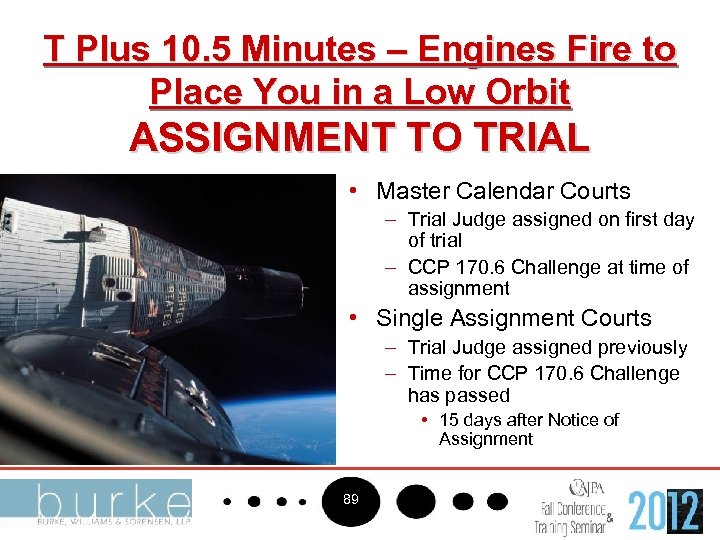
T Plus 10. 5 Minutes – Engines Fire to Place You in a Low Orbit ASSIGNMENT TO TRIAL • Master Calendar Courts – Trial Judge assigned on first day of trial – CCP 170. 6 Challenge at time of assignment • Single Assignment Courts – Trial Judge assigned previously – Time for CCP 170. 6 Challenge has passed • 15 days after Notice of Assignment 89
Pre-Trial Conference • “Housekeeping” Conference with assigned Trial Judge • Pre-trial filings – Motions in Limine – Trial Brief – Witness/Exhibit Lists – Jury Instructions and Verdict Form – Statement of Case 90
Pre-Trial Filings • Always check local rules for filing deadlines and requirements – Both vary from county to county 91
Motions in Limine • “At the outset” • Typically brought to exclude evidence before trial – To avoid having to “unring the bell” – E. G. liability insurance • Can also be brought to obtain an advance evidentiary ruling 92
Trial Brief • Required in many counties • Should be submitted in all cases – First opportunity to “argue” your case – Educate the Judge on anticipated issues 93
Witness/Exhibit Lists • Encouraged to work with opposing party(ies) to have joint lists • Exhibits can also be combined and exchanged in advance of trial – More efficient for jury trial – “Impeachment” exhibits should be withheld 94
Jury Instructions and Verdict Form • Do not rely on the adverse party(ies) to submit instructions for you. • Preparation of instructions is time consuming. – Should be done well in advance of trial – Great exercise to prepare for trial – Use CACI instructions when available – Special instructions when needed • Make sure that all argument and decisions on instructions are placed on record. 95
Re-Entry Jury Selection • Do not stipulate to smaller jury • Be prepared – first impression before jury – Voir dire questions – Familiarity with selection/seating process – Number of challenges • Unlimited challenges for cause • Peremptory challenges depends on number of “parties” and “sides” • Voir dire (“to speak the truth”) – “Argument” is not permitted but great opportunity to lay groundwork with jury • Pose questions which introduce favorable facts/law designed to uncover biases in prospective jurors • Can use hypothetical questions 96
Opening Statements • Opportunity to provide “roadmap” for your case – Develop a theme for your case – Educate the jury on what evidence will establish • Chronological • “Smoking gun” followed by chronological – Do not promise and fail to deliver! • Keep it brief depending on complexity of case – 20 minutes in most cases 97
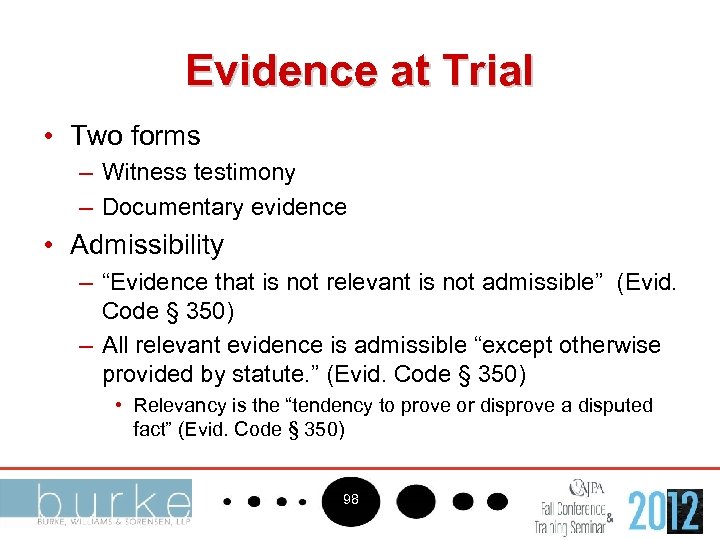
Evidence at Trial • Two forms – Witness testimony – Documentary evidence • Admissibility – “Evidence that is not relevant is not admissible” (Evid. Code § 350) – All relevant evidence is admissible “except otherwise provided by statute. ” (Evid. Code § 350) • Relevancy is the “tendency to prove or disprove a disputed fact” (Evid. Code § 350) 98
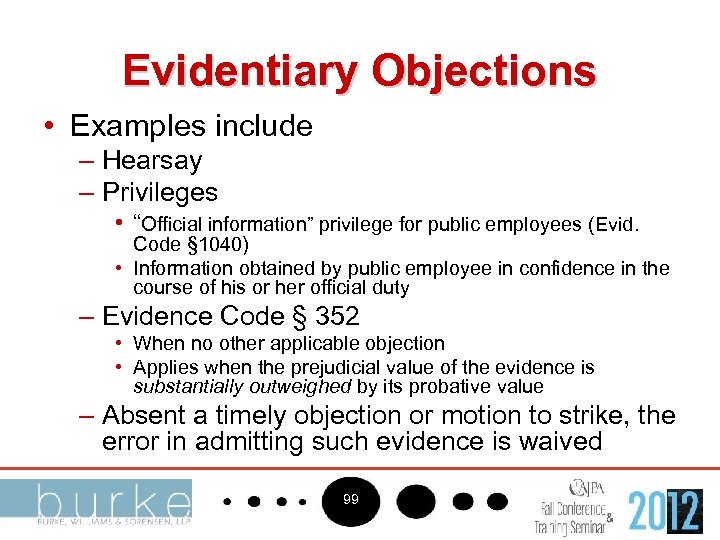
Evidentiary Objections • Examples include – Hearsay – Privileges • “Official information” privilege for public employees (Evid. Code § 1040) • Information obtained by public employee in confidence in the course of his or her official duty – Evidence Code § 352 • When no other applicable objection • Applies when the prejudicial value of the evidence is substantially outweighed by its probative value – Absent a timely objection or motion to strike, the error in admitting such evidence is waived 99
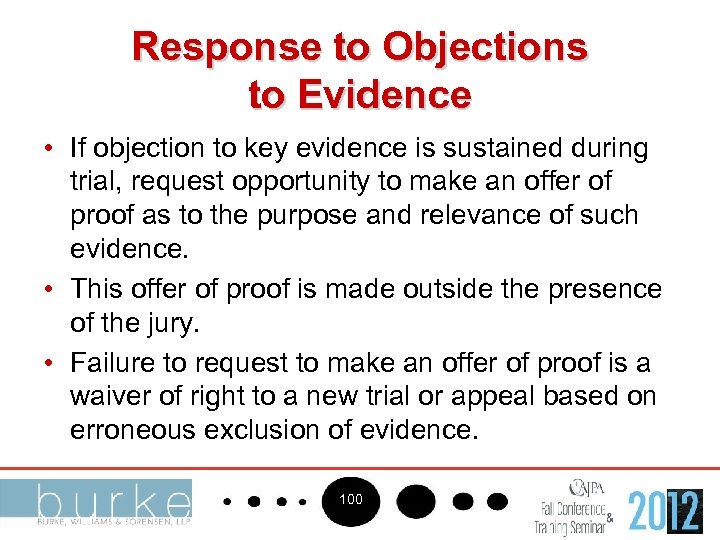
Response to Objections to Evidence • If objection to key evidence is sustained during trial, request opportunity to make an offer of proof as to the purpose and relevance of such evidence. • This offer of proof is made outside the presence of the jury. • Failure to request to make an offer of proof is a waiver of right to a new trial or appeal based on erroneous exclusion of evidence. 100
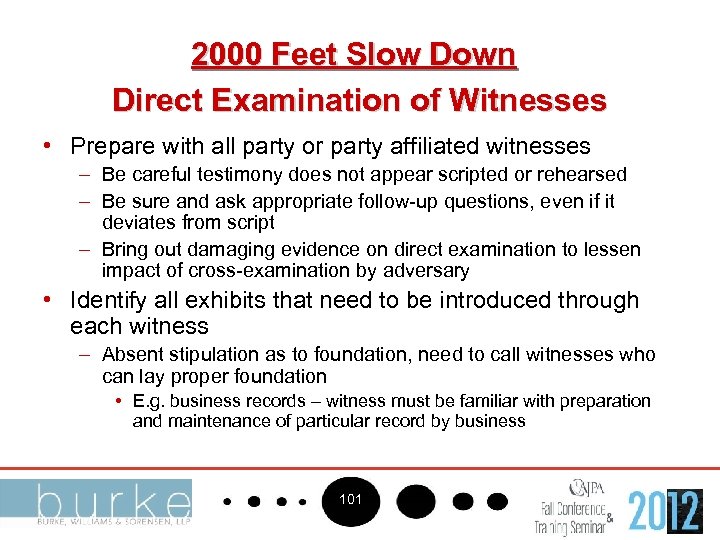
2000 Feet Slow Down Direct Examination of Witnesses • Prepare with all party or party affiliated witnesses – Be careful testimony does not appear scripted or rehearsed – Be sure and ask appropriate follow-up questions, even if it deviates from script – Bring out damaging evidence on direct examination to lessen impact of cross-examination by adversary • Identify all exhibits that need to be introduced through each witness – Absent stipulation as to foundation, need to call witnesses who can lay proper foundation • E. g. business records – witness must be familiar with preparation and maintenance of particular record by business 101
Redirect Examination of Witnesses • Opportunity to rehabilitate witness following effective cross-examination • Use cautiously – Only on key evidentiary issues following effective cross-examination – By emphasizing issues on re-direct, you are acknowledging this is an important issue for the jury when that may not be accurate – Jury may not have appreciated impact of crossexamination 102
Direct Examination of Adverse Witness • A party (usually plaintiff) can call an adverse witness during case-in-chief. (Evid. Code § 776) • From a defense standpoint, be sure your party and party affiliated witnesses are prepared. • If a notice to appear was not served on a party affiliated witness, keep him or her away from courtroom during plaintiff’s case-in-chief. 103
Cross-Examination of Witness • Limited to scope of direct testimony – Includes all inferences that can be drawn from witnesses’ direct testimony – Includes all issues related to witness’ credibility – Impeach witness with prior statements and/or testimony • This can include a deposition in another case – Try to locate transcripts of disclosed experts from prior cases where that expert testified • Inadmissible evidence (e. g. hearsay) may become admissible for purposes of impeachment • Can ask leading questions • Can introduce documentary evidence through crossexamination 104
Direct Examination of Expert Witnesses • Must qualify witness as an expert – Must have special knowledge, skill, experience, training, or education – Exercise caution in voir dire of opposing expert witness • Do not want to emphasize the experts qualifications • Better option is to bring a motion in limine at outset if there is a question of experts qualifications • Conversely, if expert is less qualified in a particular area, effective voir dire can alert the jury to this although the expert is likely to be permitted to testify in that area • Scope of admissible expert testimony – Testimony is related to subject matter that is sufficiently beyond the common experience – Must be helpful to the trier of fact • • • Can solicit opinions through direct questions or hypothetical questions Experts can opine on ultimate issue Experts can rely on inadmissible evidence if it is the type upon which experts in his or her field typically rely 105
Motions During Trial • Motion for Mistrial – Attorney or judicial misconduct • Motion for Nonsuit – – Defendants only At conclusion of plaintiff’s opening statement of case-in-chief Is essentially a demurrer to the evidence Plaintiff’s have right to reopen evidence • Motion for Directed Verdict – Plaintiffs and defendants – Only at completion of all the evidence – No right to reopen evidence but Court has discretion to allow 106
Deploy Parachute Closing Argument • • • Plaintiff goes first and last Argue the facts and apply it to the law – Renew case theme from opening statement • Catchphrase or anecdote that will resonate with the jury – Demonstrate that you delivered on your promises – Demonstrate that your opponent failed to deliver on his or her promises – Use jury instructions to educate jury – Walk jury through verdict form and indicate how and why the jury should answer each question Argue burden of proof Comment on successful impeachment of adverse witnesses – Failure to explain or deny unfavorable evidence – Willful suppression, concealment or alteration of evidence Objections to closing argument – Use when appropriate – Failure to object constitutes a waiver 107
Improper Closing Argument • Cannot appeal to the prejudice, passions or sympathy of the jury • Cannot ask the jury to place themselves in position of one party (e. g. “Golden Rule”) 108
Splashdown! (Or Landing for the Shuttle Enthusiasts) • The work is done • Judge will deliver final instructions to jury and you await verdict – Judge has discretion on timing for instructions – Many judges read preliminary instructions at time jury is sworn in and concluding instructions at conclusion of closing argument – Judge can also instruct jury in whole or in part prior to closing argument 109
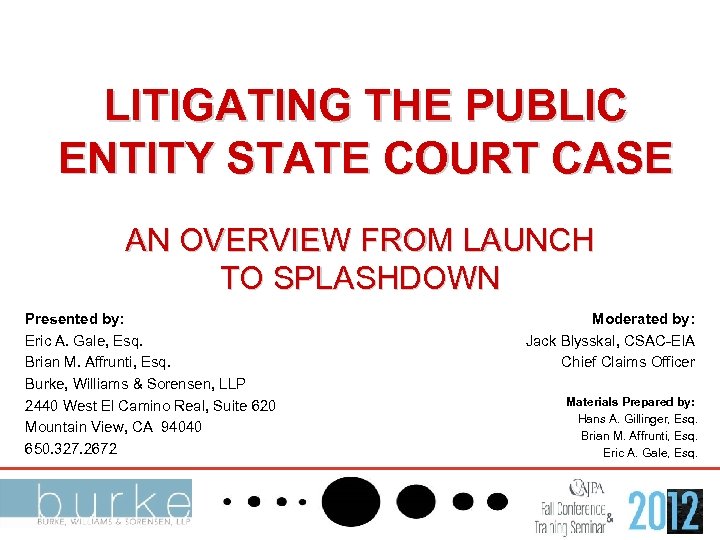
LITIGATING THE PUBLIC ENTITY STATE COURT CASE AN OVERVIEW FROM LAUNCH TO SPLASHDOWN Presented by: Eric A. Gale, Esq. Brian M. Affrunti, Esq. Burke, Williams & Sorensen, LLP 2440 West El Camino Real, Suite 620 Mountain View, CA 94040 650. 327. 2672 Moderated by: Jack Blysskal, CSAC-EIA Chief Claims Officer Materials Prepared by: Hans A. Gillinger, Esq. Brian M. Affrunti, Esq. Eric A. Gale, Esq.
Скачать презентацию LITIGATING THE PUBLIC ENTITY STATE COURT CASE AN
cc1f05cc68d7aba78a2a00cf48979ea5.ppt