 Скачать презентацию Lithuanian E-Government Assessment n December 2000 Agenda
dc527a67210f3655a9f5565141f2829e.ppt
- Количество слайдов: 60



Lithuanian E-Government Assessment n December 2000
Agenda n E-Government Strategies n What have we done in Lithuania n Assessment Action Plan
E-Government Strategies
Key Objectives n The E-Government Project will enable services to be comparable with the best services available from the private sector in terms of quality, accuracy, timeliness and user-friendliness n Government administration should provide the best possible service for citizens and companies n Simpler, faster and more flexible processes and flows
IT in Traditional Government To support the government by providing high quality, information services
IT in E-Government To conduct and support the government by providing high quality, competitive and targeted Information Services
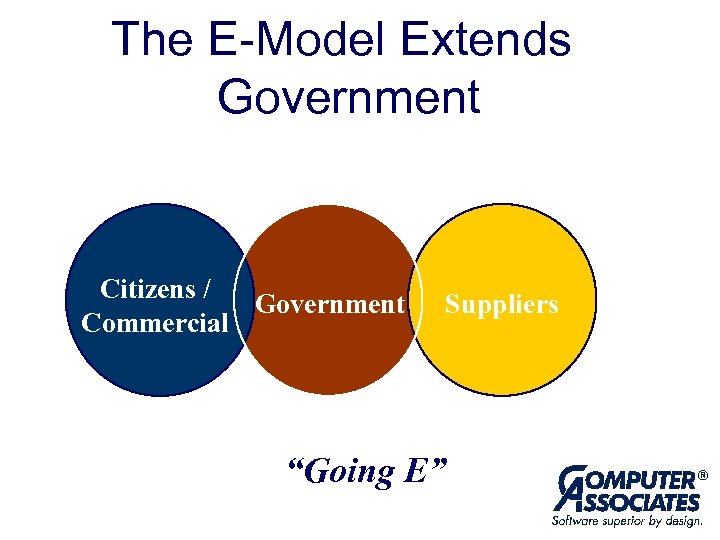
The E-Model Extends Government Citizens / Government Commercial Suppliers “Going E”
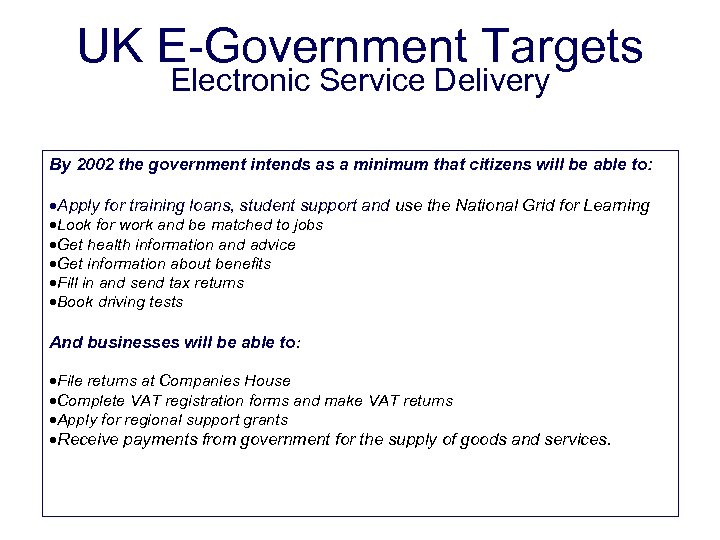
UK E-Government Targets Electronic Service Delivery By 2002 the government intends as a minimum that citizens will be able to: ·Apply for training loans, student support and use the National Grid for Learning ·Look for work and be matched to jobs ·Get health information and advice ·Get information about benefits ·Fill in and send tax returns ·Book driving tests And businesses will be able to: ·File returns at Companies House ·Complete VAT registration forms and make VAT returns ·Apply for regional support grants ·Receive payments from government for the supply of goods and services.
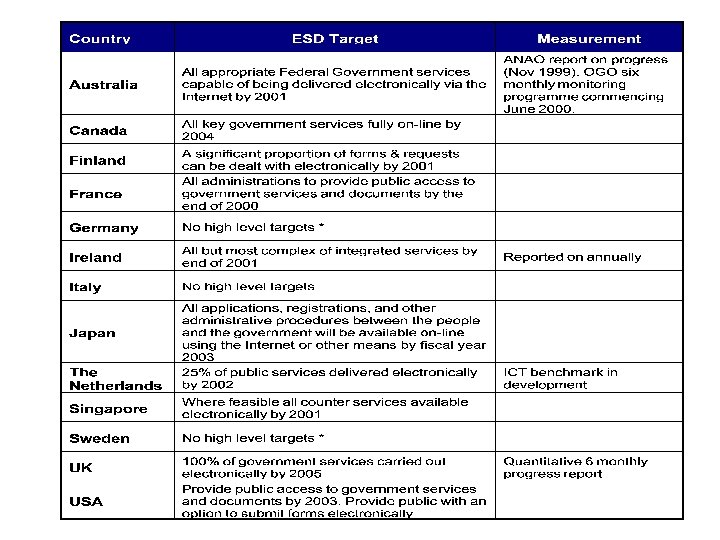
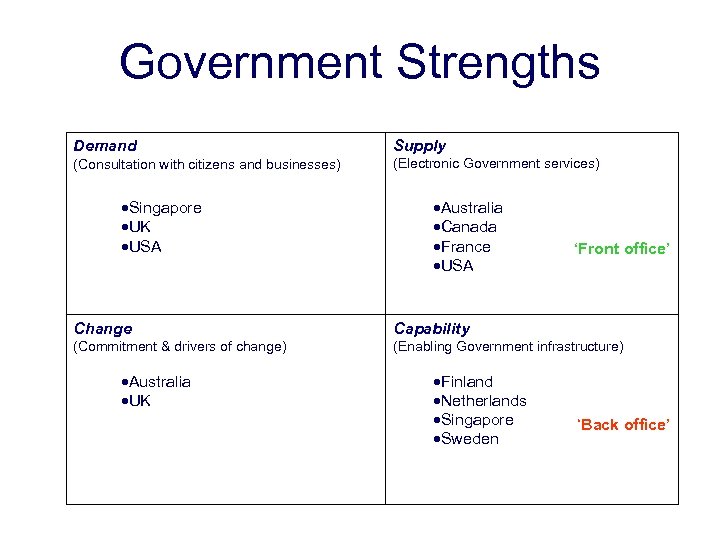
Government Strengths Demand Supply (Consultation with citizens and businesses) (Electronic Government services) ·Singapore ·UK ·USA ·Australia ·Canada ·France ·USA ‘Front office’ Change Capability (Commitment & drivers of change) (Enabling Government infrastructure) ·Australia ·UK ·Finland ·Netherlands ·Singapore ·Sweden ‘Back office’
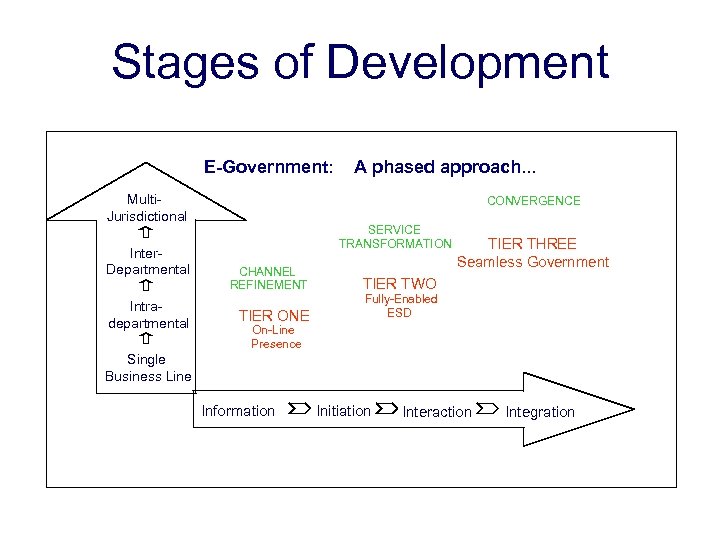
Stages of Development E-Government: Multi. Jurisdictional Inter. Departmental Intradepartmental A phased approach. . . CONVERGENCE SERVICE TRANSFORMATION CHANNEL REFINEMENT TIER ONE TIER THREE Seamless Government TIER TWO Fully-Enabled ESD On-Line Presence Single Business Line Information Initiation Interaction Integration
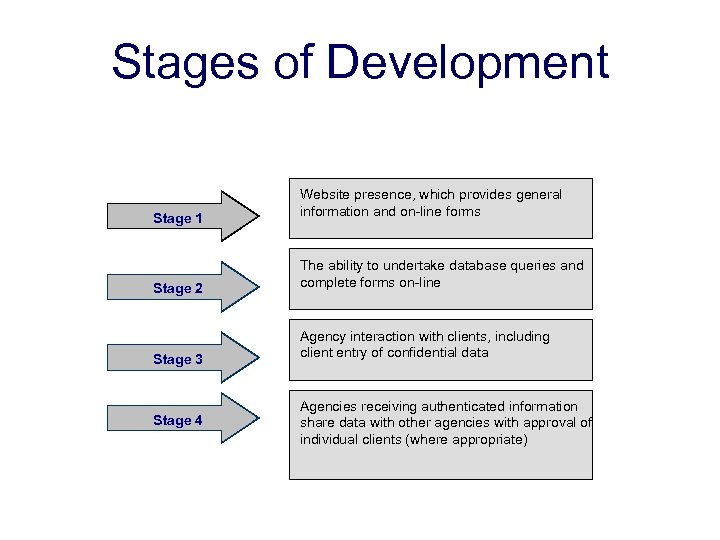
Stages of Development Stage 1 Website presence, which provides general information and on-line forms Stage 2 The ability to undertake database queries and complete forms on-line Stage 3 Agency interaction with clients, including client entry of confidential data Stage 4 Agencies receiving authenticated information share data with other agencies with approval of individual clients (where appropriate)

What have we done in Lithuania
E-Government Assessment The assessment was conducted between July and September 2000 and covered over thirty ministries and departments, state companies, twelve selected municipalities and the counties
Assessment Topics n n n IT Infrastructure Integration Security Projects Organisation
Assessment Tools
IT Infrastructure / Information Flows
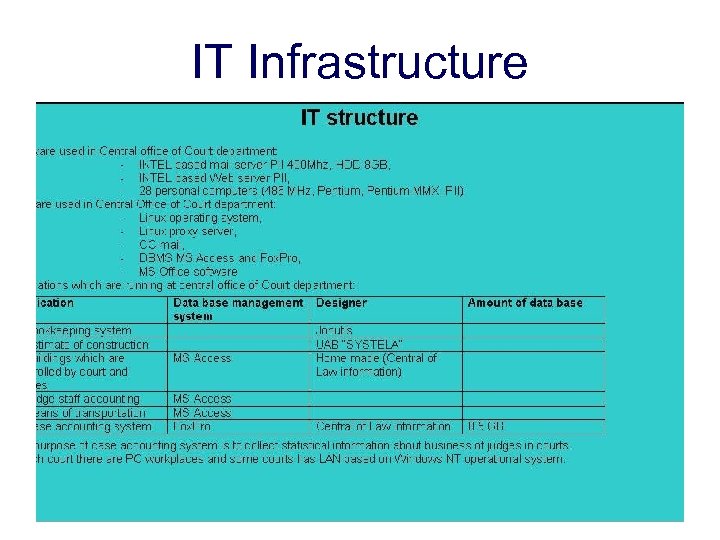
IT Infrastructure
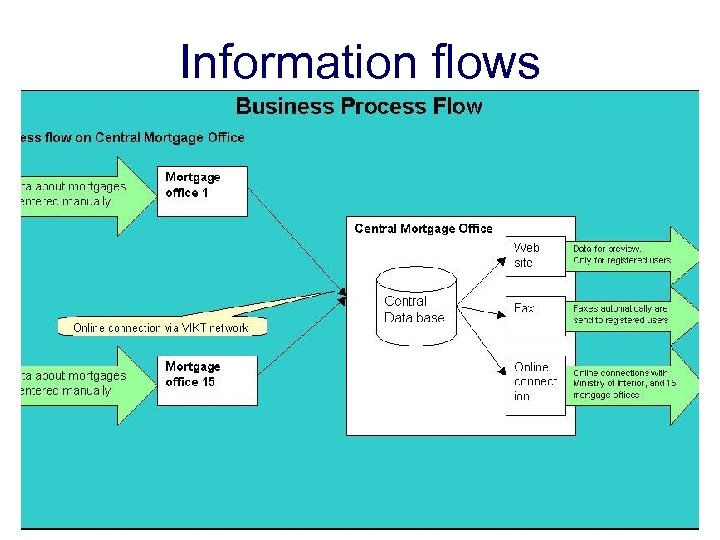
Information flows
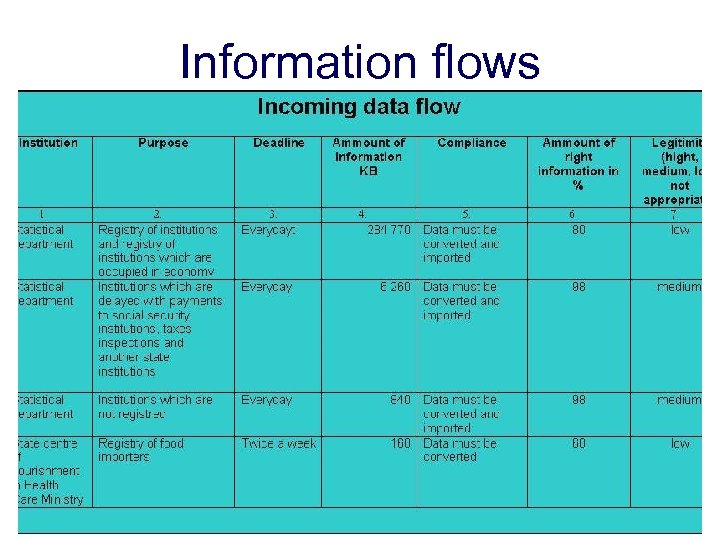
Information flows
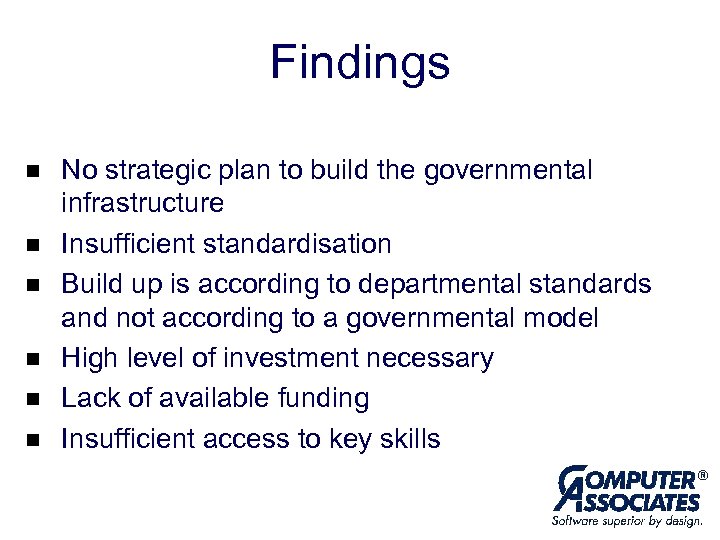
Findings n n n No strategic plan to build the governmental infrastructure Insufficient standardisation Build up is according to departmental standards and not according to a governmental model High level of investment necessary Lack of available funding Insufficient access to key skills
Integration
Approach n Information flows were analysed based on the following criteria: – Timeliness and Accuracy – Importance – Suitability – Required Level of Integration
Findings n n n No strategic plan to build the governmental Infrastructure Insufficient standardisation Build up is according to departmental standards and not according to a governmental model High level of investment necessary Lack of available funding Insufficient access to key skills
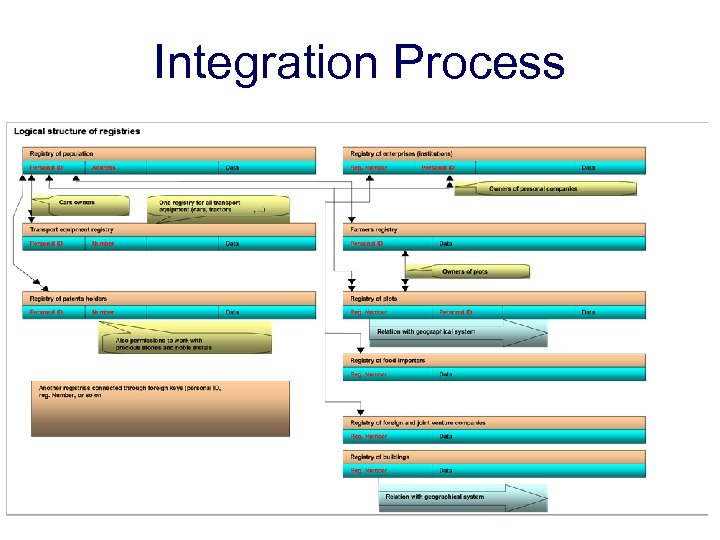
Integration Process

Security
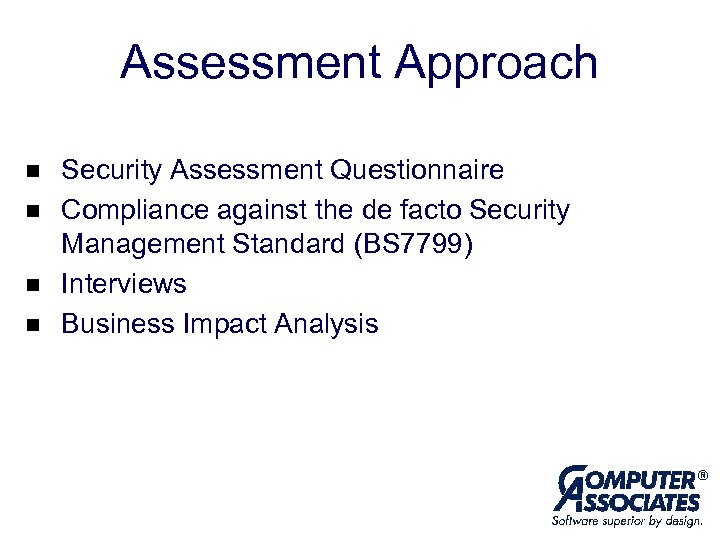
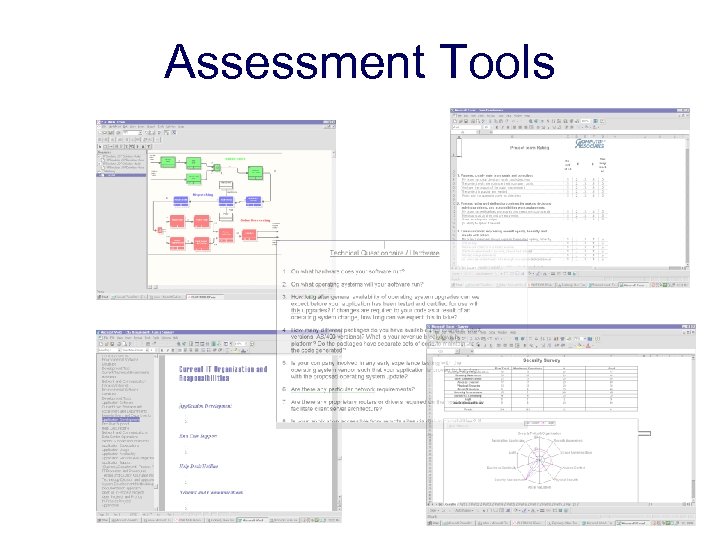
Assessment Approach n n Security Assessment Questionnaire Compliance against the de facto Security Management Standard (BS 7799) Interviews Business Impact Analysis
E-Government Drivers n n Electronic services must be conducted SAFELY Citizens need to TRUST E-Government services SECURITY IS CRITICAL FOR E-GOVERNMENT
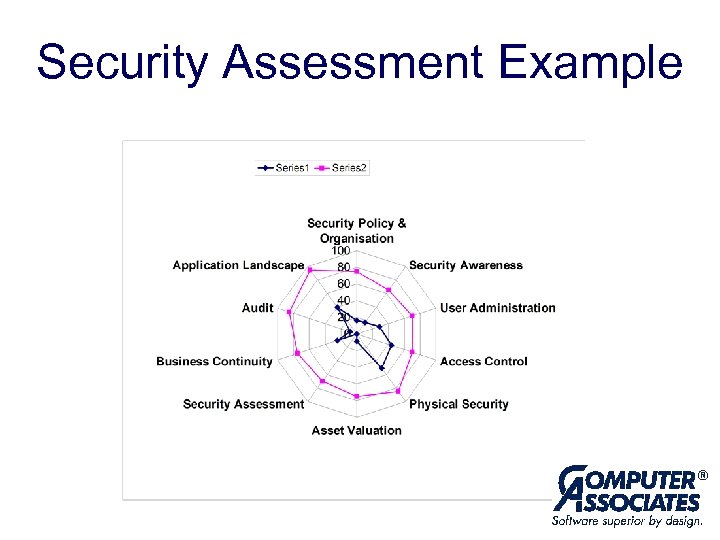
Security Assessment Example
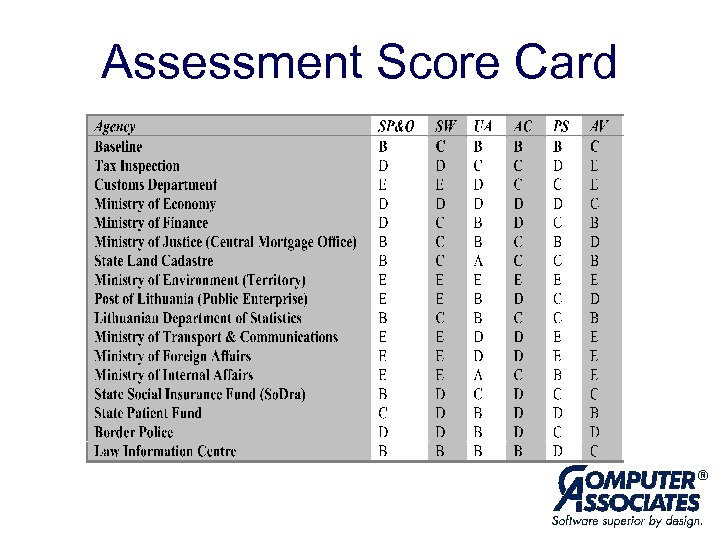
Assessment Score Card
Findings n n n Poor security across the government agencies Lack of resources and limited experience No government security standards No assignment of responsibility for security No central advisory and accreditation agency

Projects
Projects Assessment Approach n Overview of projects per department n Critical review of projects based on: – their importance for the Government of Lithuania – the business logic behind them – project management methodologies used n Review of departmental / governmental project organisation and co-ordination n Recommendations package (model) for future project planning, management and control
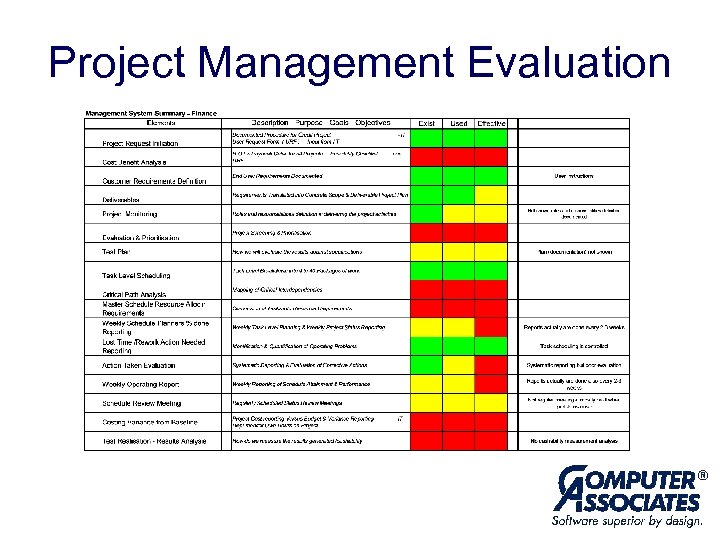
Project Management Evaluation
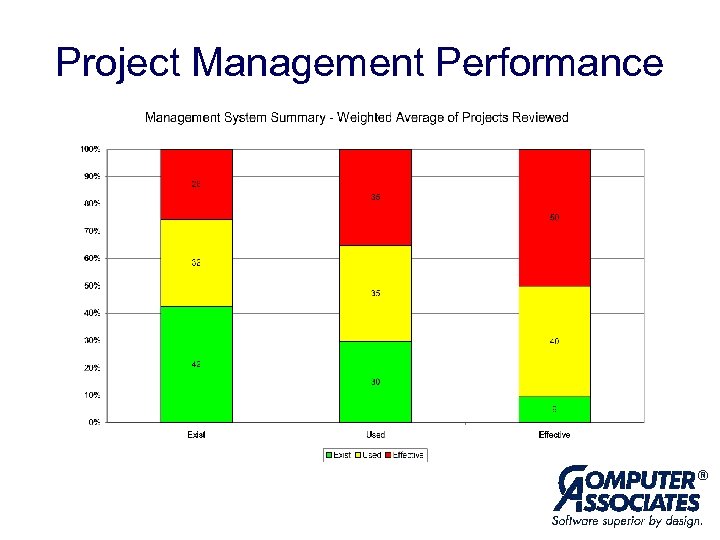
Project Management Performance
Project Management Findings n Little or no strategic planning and co-ordination of projects n Projects defined without reviewing possible synergies and overlap in areas of common need n Project evaluation, prioritisation and authorisation often focuses only on the department concerned n Very limited and often poor cost / benefit analysis
Project Management Findings (2) n Weak project management and control culture n Low levels of financial and operational project control n Task scheduling / critical interdependencies often unclear n Inadequate status and cost reporting / control n No overall milestone control methodology
Organisation
Organisation Analysis The organisation analysis was based on the following topics: – Importance of information technology to the business of an institution – Requirements for centralisation or decentralisation
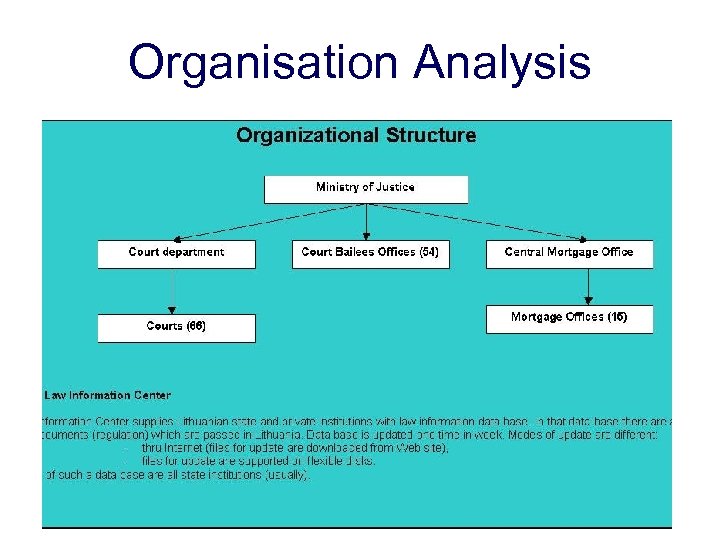
Organisation Analysis
Organisation Findings n n n Due to low salaries specialists are leaving to the private sector No or only limited pooling of key IT skills Inefficient use of departmental IT resources Project and financial planning is not linked IT departments are not consulted / involved in business decisions No central financial and project control
Organisation Findings (2) n n n Departmental interests are seen as more important than strategic governmental plans No central body for strategic IT planing Global consequences of legal and organisational decrees are not always considered
E-Government Model
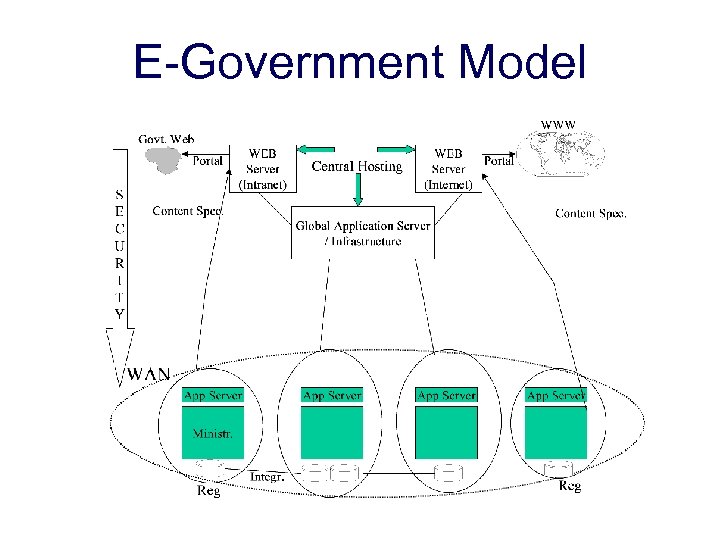
E-Government Model
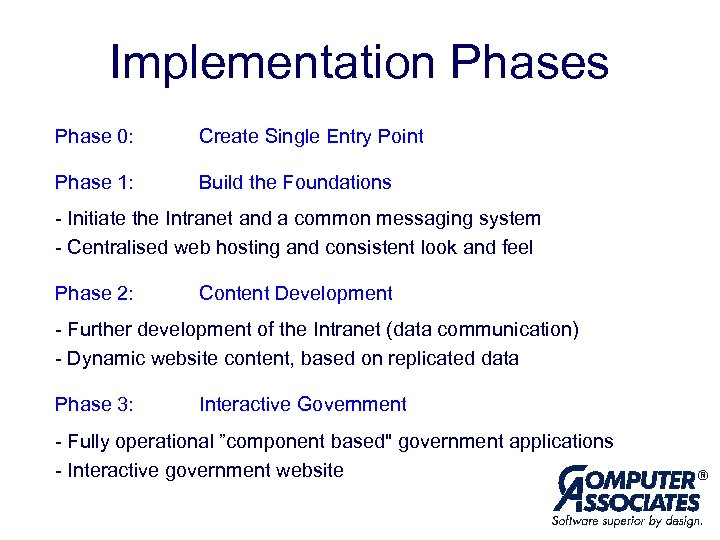
Implementation Phases Phase 0: Create Single Entry Point Phase 1: Build the Foundations - Initiate the Intranet and a common messaging system - Centralised web hosting and consistent look and feel Phase 2: Content Development - Further development of the Intranet (data communication) - Dynamic website content, based on replicated data Phase 3: Interactive Government - Fully operational ”component based" government applications - Interactive government website
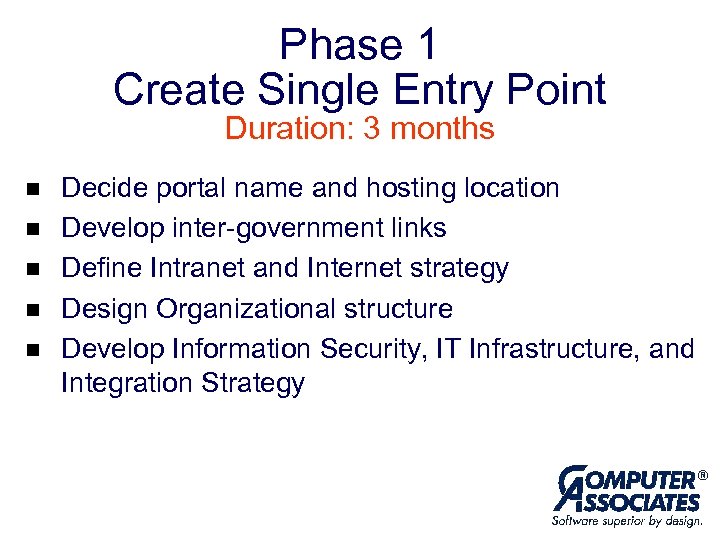
Phase 1 Create Single Entry Point Duration: 3 months n n n Decide portal name and hosting location Develop inter-government links Define Intranet and Internet strategy Design Organizational structure Develop Information Security, IT Infrastructure, and Integration Strategy
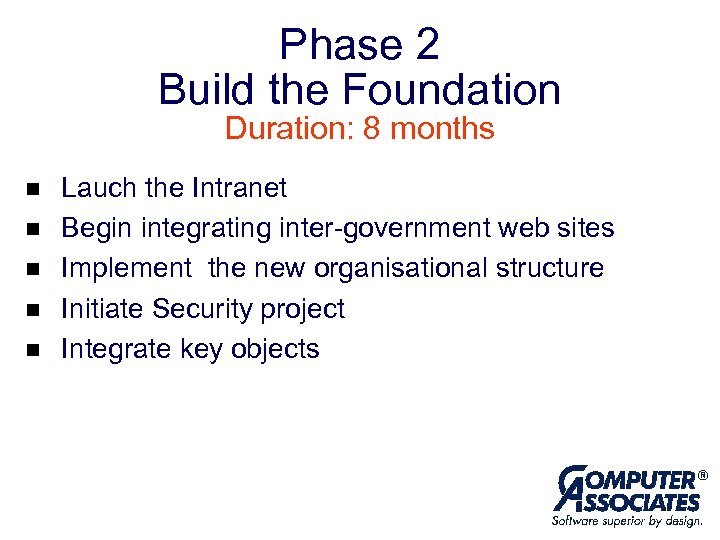
Phase 2 Build the Foundation Duration: 8 months n n n Lauch the Intranet Begin integrating inter-government web sites Implement the new organisational structure Initiate Security project Integrate key objects
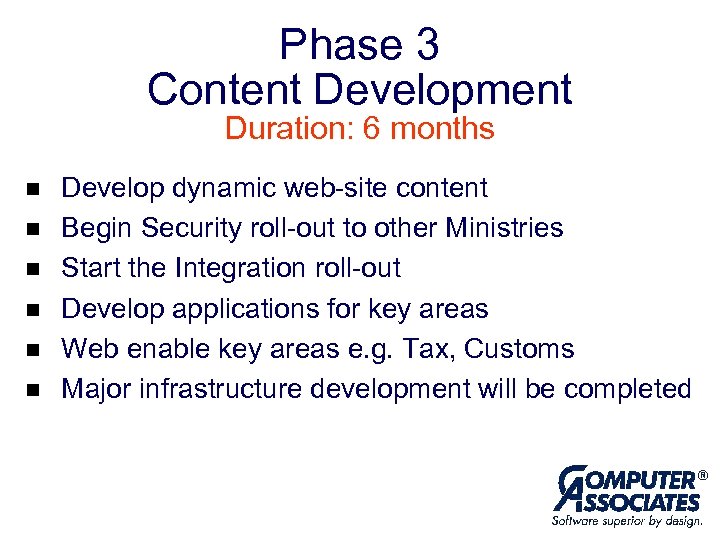
Phase 3 Content Development Duration: 6 months n n n Develop dynamic web-site content Begin Security roll-out to other Ministries Start the Integration roll-out Develop applications for key areas Web enable key areas e. g. Tax, Customs Major infrastructure development will be completed
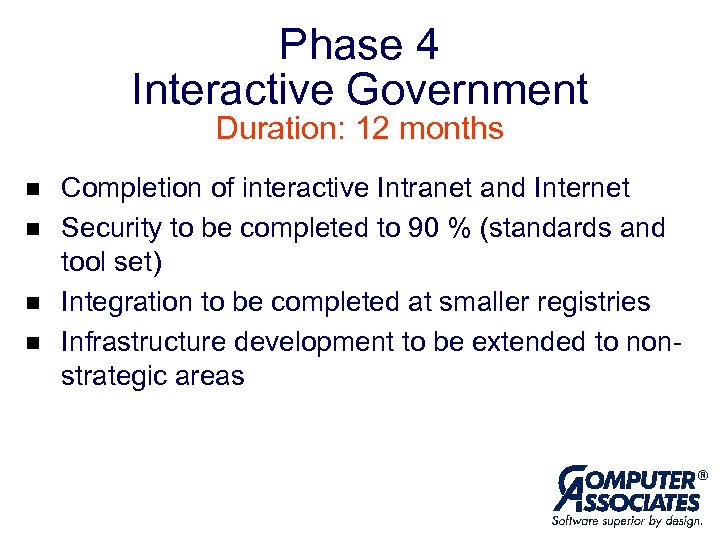
Phase 4 Interactive Government Duration: 12 months n n Completion of interactive Intranet and Internet Security to be completed to 90 % (standards and tool set) Integration to be completed at smaller registries Infrastructure development to be extended to nonstrategic areas

Action Plan for Lithuania
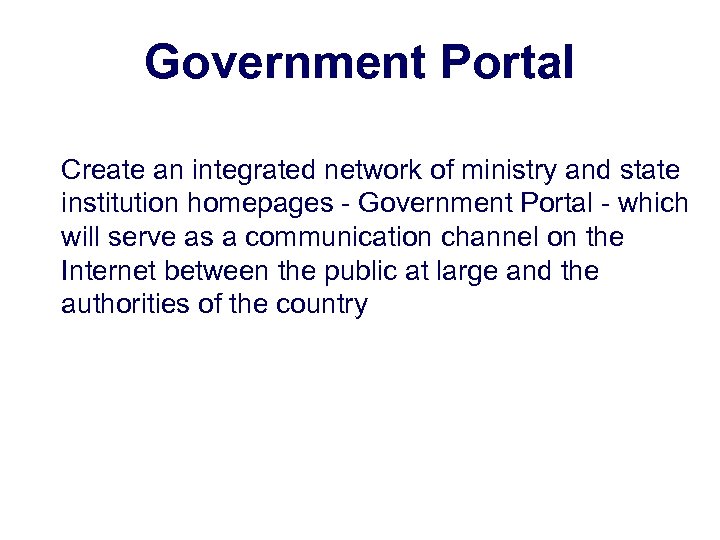
Government Portal Create an integrated network of ministry and state institution homepages - Government Portal - which will serve as a communication channel on the Internet between the public at large and the authorities of the country
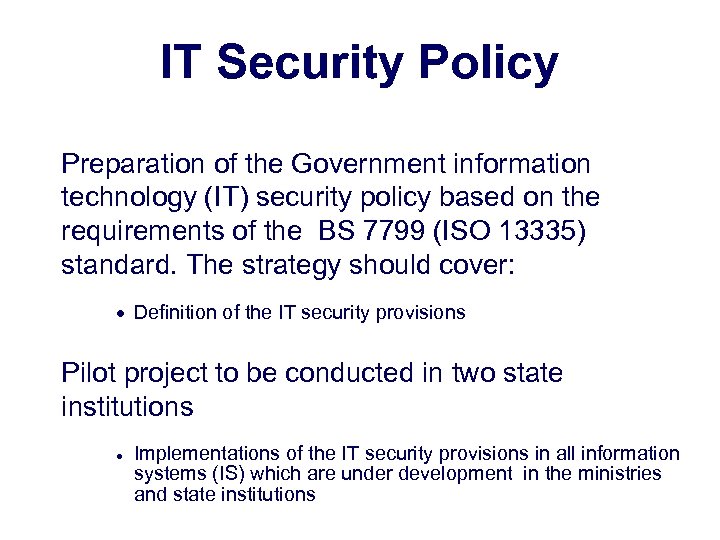
IT Security Policy Preparation of the Government information technology (IT) security policy based on the requirements of the BS 7799 (ISO 13335) standard. The strategy should cover: · Definition of the IT security provisions Pilot project to be conducted in two state institutions l Implementations of the IT security provisions in all information systems (IS) which are under development in the ministries and state institutions
IT Management Strategy Striving to save state resources it is essential to ensure more efficient use of available IT resources at the ministries and state institutions
E-Government Development Establish a post meant for a high level political official responsible for the coordination of activities related to Government prioritis with respect to the development of the Information Society Accountablility is to the Prime Minister Assign the IT Department to organize development and supervision of the E-Government project
Management of IT Projects Introduce additional measures for the effective management of the IT projects conducted in the minstries and state institutions
Introduction of IT Standards Create and introduce common requirements (standards) for the development of the IT infrastructure in the ministries and state institutions
Implementation of IT Project Methodology Create and introduce an IT project development and management methodology to be used by the ministries and state institutions
Audit of IT Projects Perform auditing of the IT projects being developed in the ministries and state institutions (technological, financial, legal)
Implementation of IT Integration Strategy In order to avoid data duplication and ensure its reliability, it is necessary to implement provisions for basic state registry integration and centralisation
Questions ?
Скачать презентацию Lithuanian E-Government Assessment n December 2000 Agenda
dc527a67210f3655a9f5565141f2829e.ppt