 Скачать презентацию Lithium Batteries United Nations Transportation Regulations Bobby Smith
fe3bdcd903eb502d56cf93aa3d50e5ba.ppt
- Количество слайдов: 24



Lithium Batteries United Nations Transportation Regulations Bobby Smith

2 Lithium battery transport regulations ¢ Lithium batteries are considered potentially hazardous ¢ Should they leak, vent, explode or take fire during transport, they may pose a risk to safety => their transport is regulated ¢ Transport regulations tell § § § How to design batteries How to test batteries before 1 st shipment Which type of packaging to use How to label the packaging Which paperwork to fill
3 All Lithium batteries are concerned ¢ ¢ ¢ Primary and rechargeable Whatever their size Bare cells and complete battery packs New or depleted Transported in bulk or packed within a device The one who ships is the one responsible for the compliance with the regulations
4 The regulation game ¢ A United Nations Sub-Committee of experts on the transportation of dangerous goods defines the rules ¢ Official bodies in charge of specific transport modes or with specific national competence (IATA/ICAO, IMO, ADR, US-DOT) apply the rules to their fields ¢ The Battery Industry may try to lobby… but must comply with the adopted rules
5 What the UN Committee keeps updating ¢ A document about the transport philosophy and general rules: Model Regulations (Rev. 15) (General Rules + Specific Provisions) ¢ A document detailing how to test the Li batteries: Manual of Tests and Criteria (Rev. 4) ¢ May be amended following transport incidents, and/ or proposals made by administrations or the battery industry ¢ The bodies in charge of specific transport modes issue their own documents, …that may differ a little from the UN but they cannot contradict !
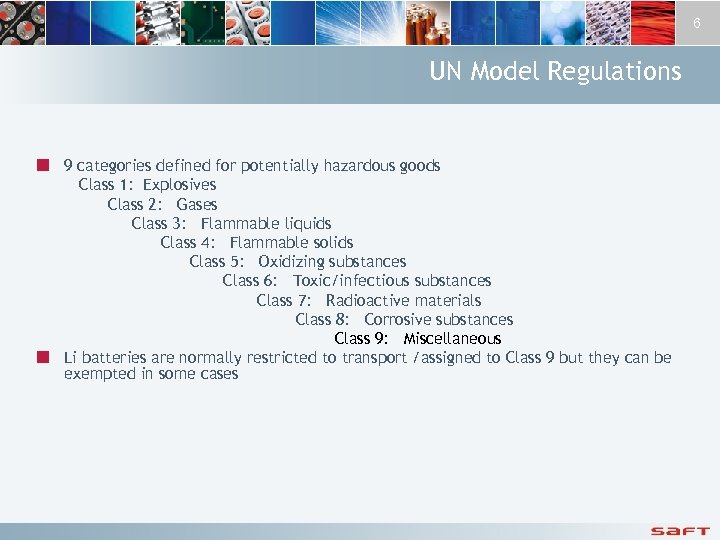
6 UN Model Regulations ¢ 9 categories defined for potentially hazardous goods Class 1: Explosives Class 2: Gases Class 3: Flammable liquids Class 4: Flammable solids Class 5: Oxidizing substances Class 6: Toxic/infectious substances Class 7: Radioactive materials Class 8: Corrosive substances Class 9: Miscellaneous ¢ Li batteries are normally restricted to transport /assigned to Class 9 but they can be exempted in some cases
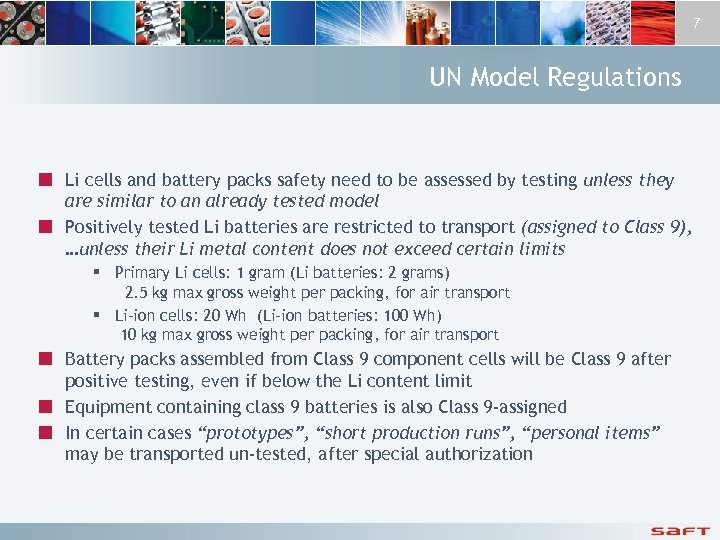
7 UN Model Regulations ¢ Li cells and battery packs safety need to be assessed by testing unless they are similar to an already tested model ¢ Positively tested Li batteries are restricted to transport (assigned to Class 9), …unless their Li metal content does not exceed certain limits § Primary Li cells: 1 gram (Li batteries: 2 grams) 2. 5 kg max gross weight per packing, for air transport § Li-ion cells: 20 Wh (Li-ion batteries: 100 Wh) 10 kg max gross weight per packing, for air transport ¢ Battery packs assembled from Class 9 component cells will be Class 9 after positive testing, even if below the Li content limit ¢ Equipment containing class 9 batteries is also Class 9 -assigned ¢ In certain cases “prototypes”, “short production runs”, “personal items” may be transported un-tested, after special authorization
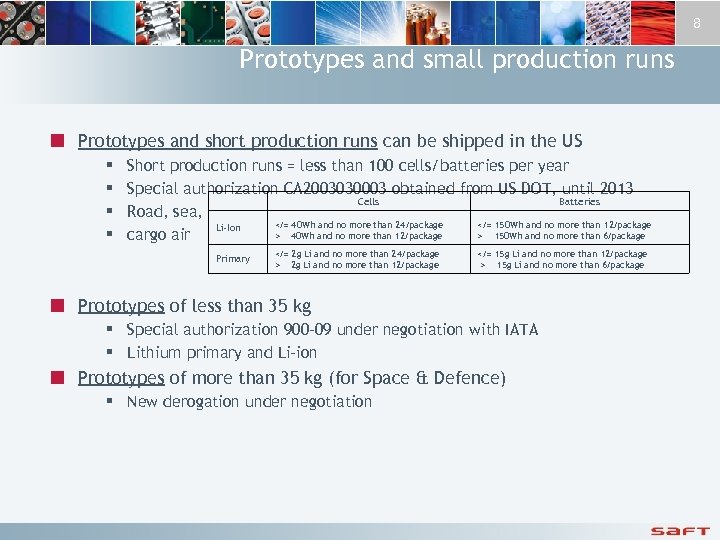
8 Prototypes and small production runs ¢ Prototypes and short production runs can be shipped in the US § § Short production runs = less than 100 cells/batteries per year Special authorization CA 2003030003 obtained from US DOT, until 2013 Cells Batteries Road, sea, </= 40 Wh and no more than 24/package </= 150 Wh and no more than 12/package Li-Ion > 40 Wh and no more than 12/package > 150 Wh and no more than 6/package cargo air Primary </= 2 g Li and no more than 24/package > 2 g Li and no more than 12/package </= 15 g Li and no more than 12/package > 15 g Li and no more than 6/package ¢ Prototypes of less than 35 kg § Special authorization 900 -09 under negotiation with IATA § Lithium primary and Li-ion ¢ Prototypes of more than 35 kg (for Space & Defence) § New derogation under negotiation
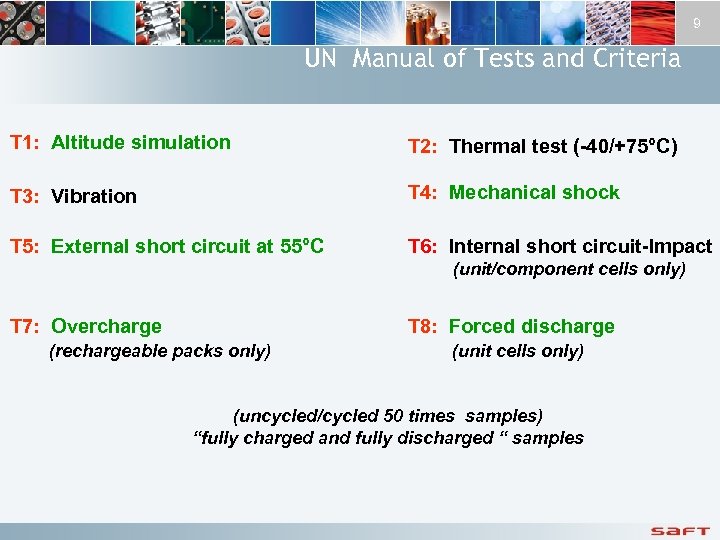
9 UN Manual of Tests and Criteria T 1: Altitude simulation T 2: Thermal test (-40/+75°C) T 3: Vibration T 4: Mechanical shock T 5: External short circuit at 55°C T 6: Internal short circuit-Impact (unit/component cells only) T 7: Overcharge T 8: Forced discharge (rechargeable packs only) (unit cells only) (uncycled/cycled 50 times samples) “fully charged and fully discharged “ samples
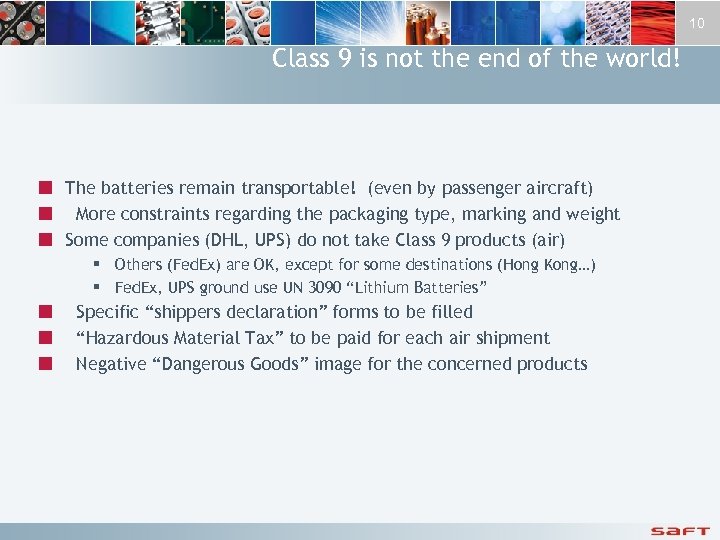
10 Class 9 is not the end of the world! ¢ The batteries remain transportable! (even by passenger aircraft) ¢ More constraints regarding the packaging type, marking and weight ¢ Some companies (DHL, UPS) do not take Class 9 products (air) § Others (Fed. Ex) are OK, except for some destinations (Hong Kong…) § Fed. Ex, UPS ground use UN 3090 “Lithium Batteries” ¢ ¢ ¢ Specific “shippers declaration” forms to be filled “Hazardous Material Tax” to be paid for each air shipment Negative “Dangerous Goods” image for the concerned products
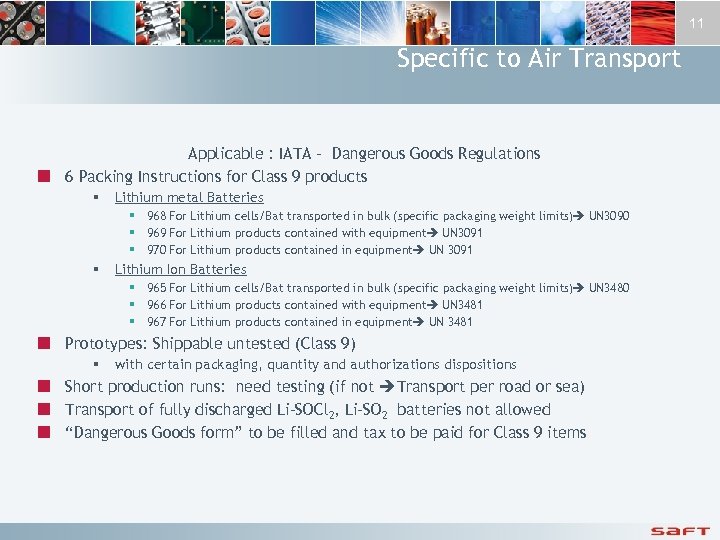
11 Specific to Air Transport Applicable : IATA - Dangerous Goods Regulations ¢ 6 Packing Instructions for Class 9 products § Lithium metal Batteries § 968 For Lithium cells/Bat transported in bulk (specific packaging weight limits) UN 3090 § 969 For Lithium products contained with equipment UN 3091 § 970 For Lithium products contained in equipment UN 3091 § Lithium Ion Batteries § 965 For Lithium cells/Bat transported in bulk (specific packaging weight limits) UN 3480 § 966 For Lithium products contained with equipment UN 3481 § 967 For Lithium products contained in equipment UN 3481 ¢ Prototypes: Shippable untested (Class 9) § with certain packaging, quantity and authorizations dispositions ¢ Short production runs: need testing (if not Transport per road or sea) ¢ Transport of fully discharged Li-SOCl 2, Li-SO 2 batteries not allowed ¢ “Dangerous Goods form” to be filled and tax to be paid for Class 9 items
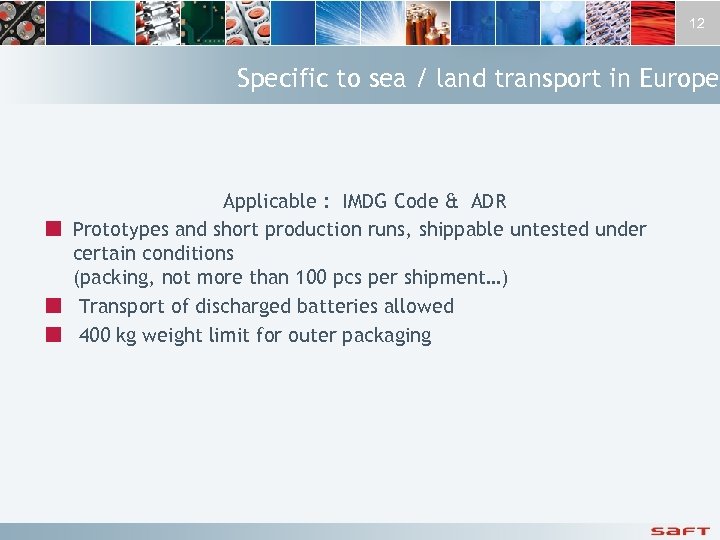
12 Specific to sea / land transport in Europe Applicable : IMDG Code & ADR ¢ Prototypes and short production runs, shippable untested under certain conditions (packing, not more than 100 pcs per shipment…) ¢ Transport of discharged batteries allowed ¢ 400 kg weight limit for outer packaging
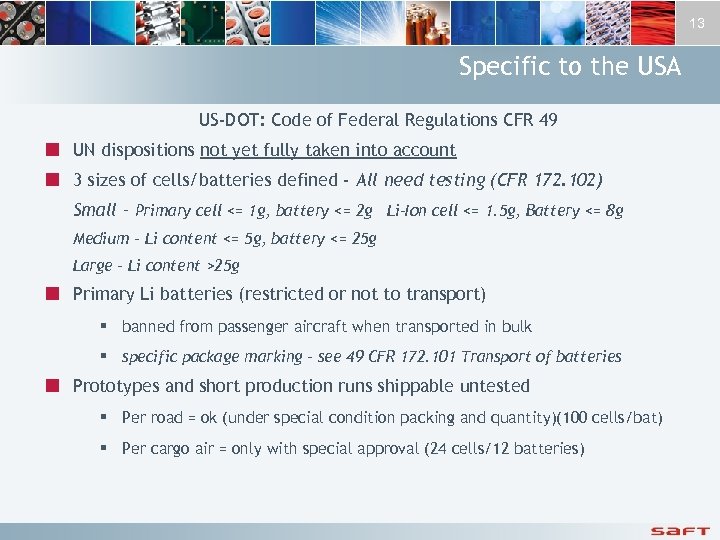
13 Specific to the USA US-DOT: Code of Federal Regulations CFR 49 ¢ UN dispositions not yet fully taken into account ¢ 3 sizes of cells/batteries defined - All need testing (CFR 172. 102) Small – Primary cell <= 1 g, battery <= 2 g Li-Ion cell <= 1. 5 g, Battery <= 8 g Medium – Li content <= 5 g, battery <= 25 g Large – Li content >25 g ¢ Primary Li batteries (restricted or not to transport) § banned from passenger aircraft when transported in bulk § specific package marking – see 49 CFR 172. 101 Transport of batteries ¢ Prototypes and short production runs shippable untested § Per road = ok (under special condition packing and quantity)(100 cells/bat) § Per cargo air = only with special approval (24 cells/12 batteries)
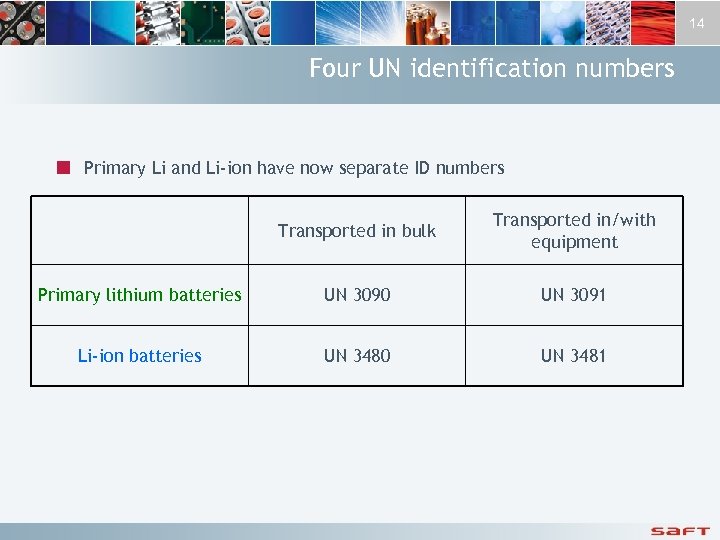
14 Four UN identification numbers ¢ Primary Li and Li-ion have now separate ID numbers Transported in bulk Transported in/with equipment Primary lithium batteries UN 3090 UN 3091 Li-ion batteries UN 3480 UN 3481
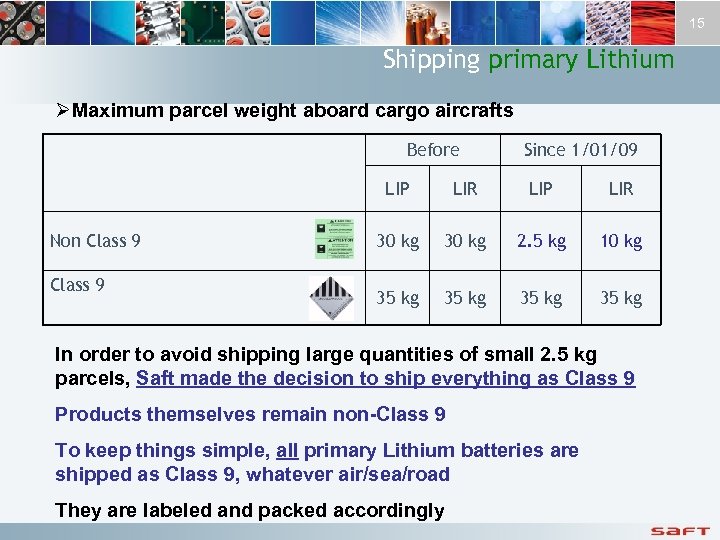
15 Shipping primary Lithium ØMaximum parcel weight aboard cargo aircrafts Before Since 1/01/09 LIP Non Class 9 LIR LIP LIR 30 kg 2. 5 kg 10 kg 35 kg In order to avoid shipping large quantities of small 2. 5 kg parcels, Saft made the decision to ship everything as Class 9 Products themselves remain non-Class 9 To keep things simple, all primary Lithium batteries are shipped as Class 9, whatever air/sea/road They are labeled and packed accordingly
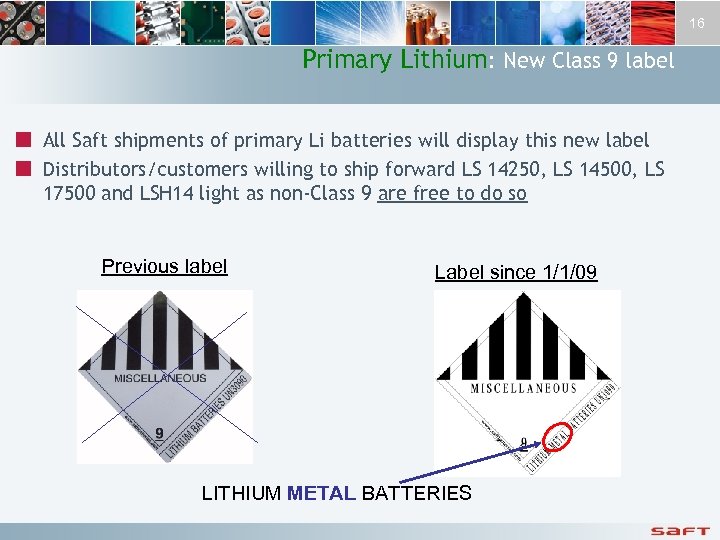
16 Primary Lithium: New Class 9 label ¢ All Saft shipments of primary Li batteries will display this new label ¢ Distributors/customers willing to ship forward LS 14250, LS 14500, LS 17500 and LSH 14 light as non-Class 9 are free to do so Previous label Label since 1/1/09 LITHIUM METAL BATTERIES
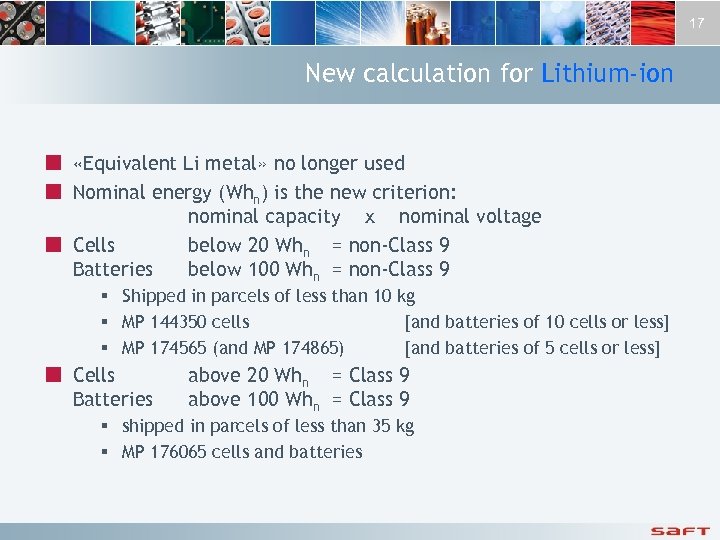
17 New calculation for Lithium-ion ¢ «Equivalent Li metal» no longer used ¢ Nominal energy (Whn) is the new criterion: nominal capacity x nominal voltage ¢ Cells below 20 Whn = non-Class 9 Batteries below 100 Whn = non-Class 9 § Shipped in parcels of less than 10 kg § MP 144350 cells [and batteries of 10 cells or less] § MP 174565 (and MP 174865) [and batteries of 5 cells or less] ¢ Cells Batteries above 20 Whn = Class 9 above 100 Whn = Class 9 § shipped in parcels of less than 35 kg § MP 176065 cells and batteries
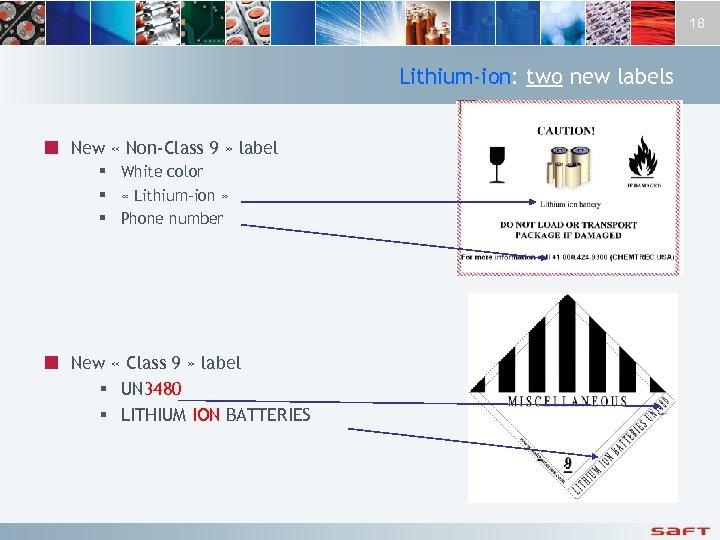
18 Lithium-ion: two new labels ¢ New « Non-Class 9 » label § White color § « Lithium-ion » § Phone number ¢ New « Class 9 » label § UN 3480 § LITHIUM ION BATTERIES
19 What to expect in the future ? ¢ Continued proliferation of devices powered by Li batteries § (> 2 billion portable Li-ion batteries made in 2008 for portable applications) ¢ More studies on the possible hazards of Li batteries ¢ Pressure to harmonize battery packing instructions and regulation discrepancies between USA and the rest of the world ¢ New efforts from the battery industry to make life easier
20 Lithium transport testing at Saft Primary Li packs: 8 samples needed expect 2 months for completion Li-ion packs: 16 samples needed (8 Cycled) expect 3 -4 months for completion Reduced Time In case of similarity with an already tested pack model
21 Lithium transport testing at Saft ¢ Test Samples ¢ Special Needs § Test Apparatus § Connectors/ Adaptors/ Etc § Fixtures/ Hardware ¢ Dimensional Limitations @ Saft Valdese § 16” diameter / length / width § Larger batteries outsourced
22 Costs ¢ Cells/ Batteries ¢ Hardware ¢ Direct And Outsource Testing
23 How Can Saft Help? Technical Expertise And Experience Support And Guidance Testing and Certification Saft Partners With You the Customer

24 Thank you for your attention! QUESTIONS?
Скачать презентацию Lithium Batteries United Nations Transportation Regulations Bobby Smith
fe3bdcd903eb502d56cf93aa3d50e5ba.ppt