


 Скачать презентацию Literature Review Khazima Tahir Muhammed Riaz La Saundra
f280e842235d0eb8248ea4bfc49ca3bb.ppt
- Количество слайдов: 175
 Literature Review Khazima Tahir Muhammed Riaz La Saundra Haynes
 Contents Literature review – What and why Searching and finding print and online sources Evaluating sources for relevance and reliability Reading critically Analyzing and synthesizing findings Writing and presenting literature review Citing sources in text and reference list / bibliography 8. Avoiding plagiarism 1. 2. 3. 4. 5. 6. 7.
 Developing Literature Review 3
 Learning Check What is Literature Review?
 Literature review - Definition A body of text that aims to review the critical points of current knowledge on a particular topic A comprehensive survey of publications in a specific field of study or related to a particular line of research Non-quantitative summary of existing published literature made by experts who select and weigh findings available from the literature A summary and interpretation of research findings reported in the literature A process and documentation of the current relevant research literature regarding a particular topic or subject of interest. 5
 Purposes of literature review Define and limit problem ◦ Develop familiarity with topic ◦ Limit research to a subtopic within larger body of knowledge Place study in historical perspective ◦ Analysis of way in which study relates to existing knowledge Avoid unintentional and unnecessary replication ◦ Awareness of prior studies so as to avoid unneeded replication ◦ Replication is reasonable if it is needed to verify prior results, investigate results that failed to be significant, or relate problem to a specific site. 6
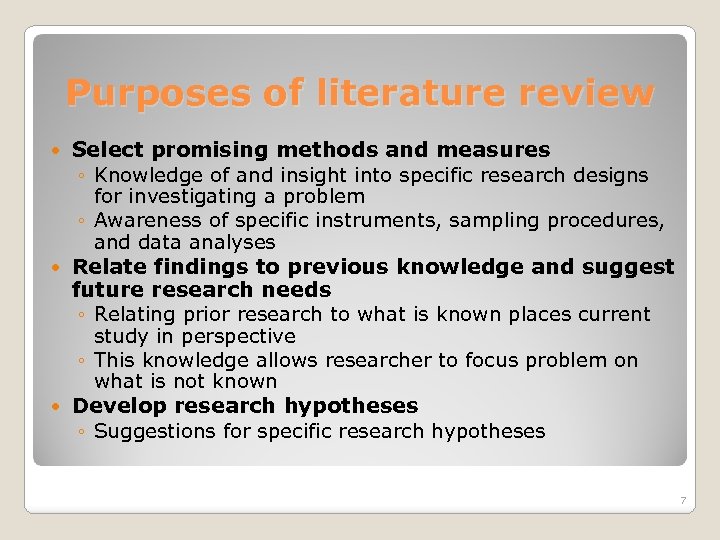 Purposes of literature review Select promising methods and measures ◦ Knowledge of and insight into specific research designs for investigating a problem ◦ Awareness of specific instruments, sampling procedures, and data analyses Relate findings to previous knowledge and suggest future research needs ◦ Relating prior research to what is known places current study in perspective ◦ This knowledge allows researcher to focus problem on what is not known Develop research hypotheses ◦ Suggestions for specific research hypotheses 7
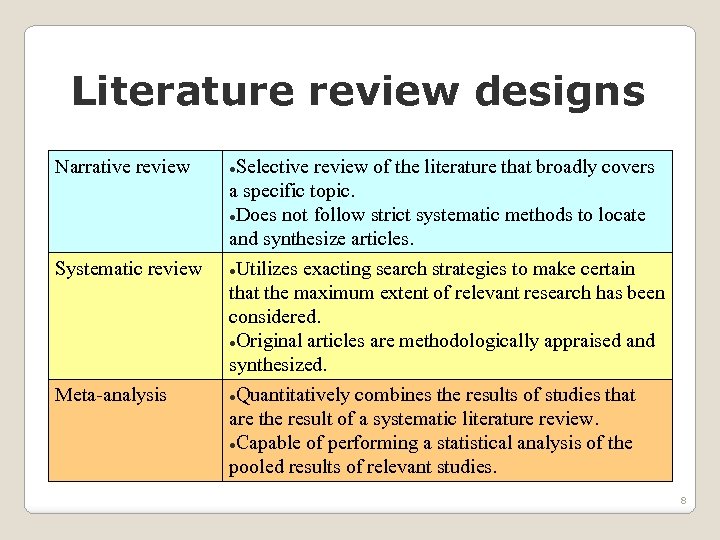 Literature review designs Narrative review Selective Systematic review of the literature that broadly covers a specific topic. Does not follow strict systematic methods to locate and synthesize articles. Utilizes exacting search strategies to make certain that the maximum extent of relevant research has been considered. Original articles are methodologically appraised and synthesized. Meta-analysis Quantitatively combines the results of studies that are the result of a systematic literature review. Capable of performing a statistical analysis of the pooled results of relevant studies. 8
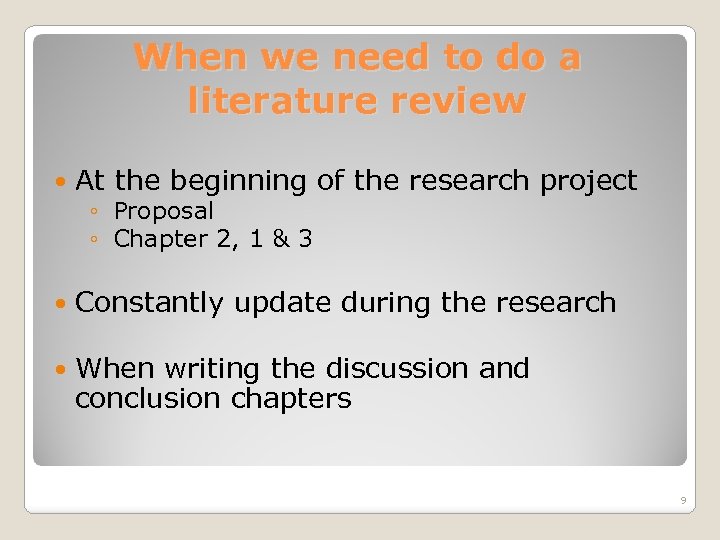 When we need to do a literature review At the beginning of the research project Constantly update during the research When writing the discussion and conclusion chapters ◦ Proposal ◦ Chapter 2, 1 & 3 9
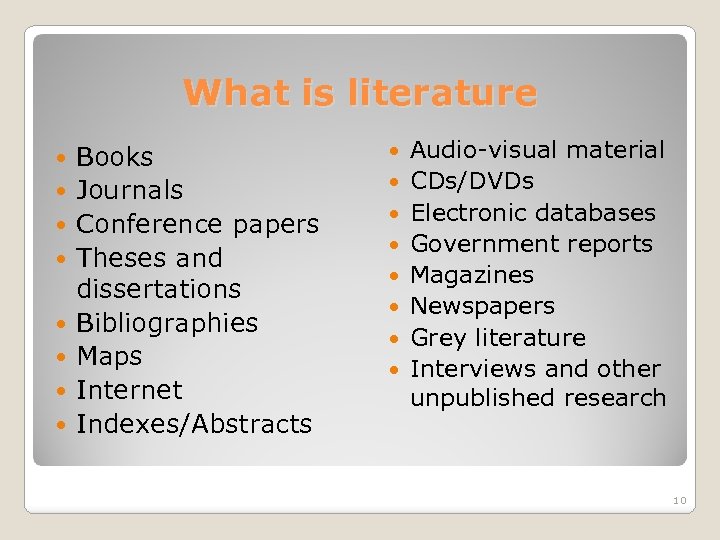 What is literature Books Journals Conference papers Theses and dissertations Bibliographies Maps Internet Indexes/Abstracts Audio-visual material CDs/DVDs Electronic databases Government reports Magazines Newspapers Grey literature Interviews and other unpublished research 10
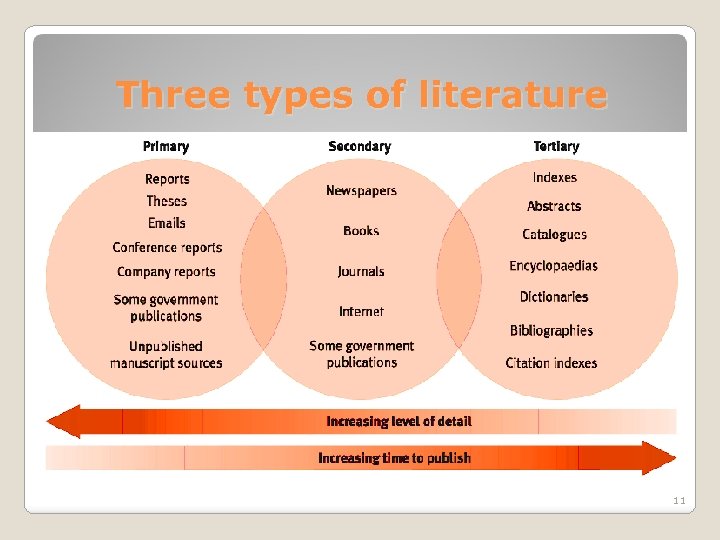 Three types of literature 11
 Activity Enlist the literature usually used in your discipline.
 Searching and Finding Information Sources 13
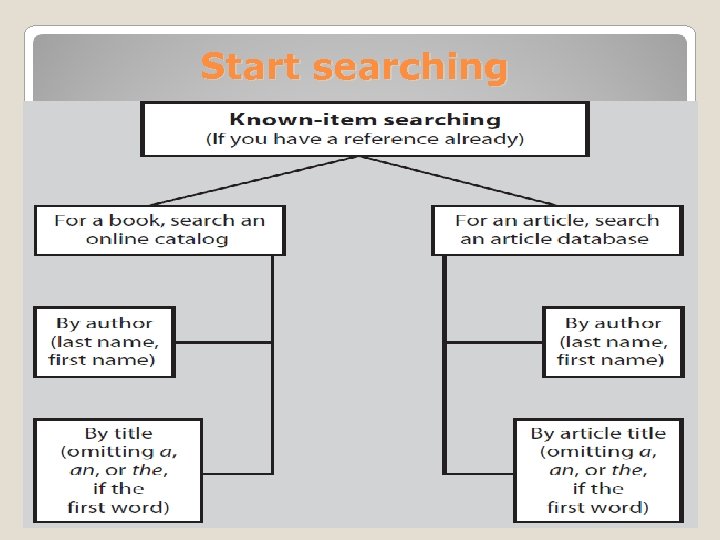 Start searching 14
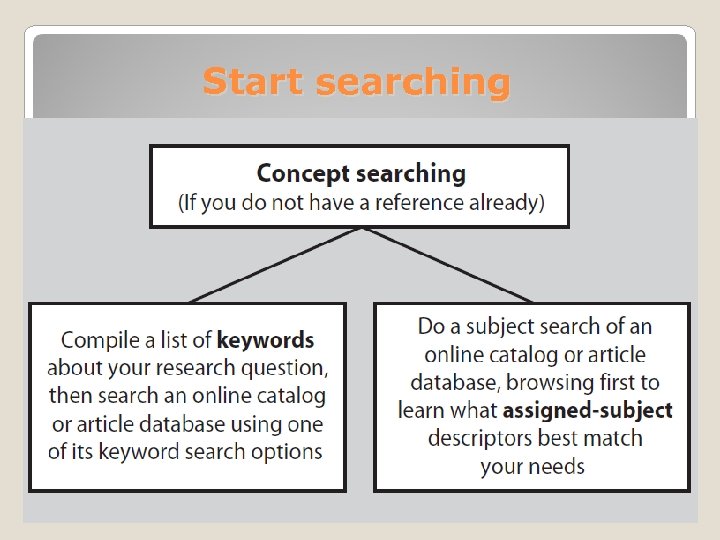 Start searching 15
 Finding information sources Formal ways ◦ University libraries ◦ Special libraries and government departments ◦ Inter-library loan Informal ways ◦ Authors ◦ Personal libraries of experts ◦ Your friends 16
 Bibliographic aids Library catalog Indexing journal Abstracting journal Bibliography Bibliographic database People ◦ Experts ◦ Librarians 17
 Online Searching Techniques Boolean Operators Phrase Searching Truncation / Wildcard Searching Proximity Searching Focusing / Limiting a Search 18
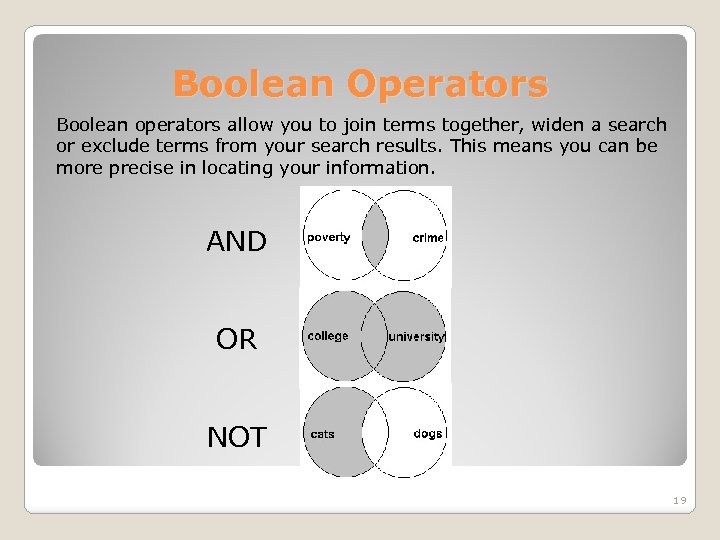 Boolean Operators Boolean operators allow you to join terms together, widen a search or exclude terms from your search results. This means you can be more precise in locating your information. AND OR NOT 19
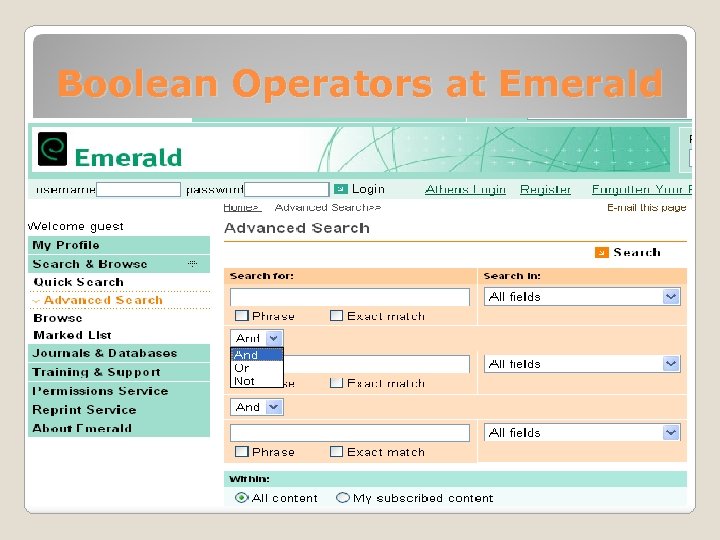 Boolean Operators at Emerald 20
 Phrase Searching It narrows your search down by searching for an exact phrase or sentence. It is particularly useful when searching for a title or a quotation. Usually quotation marks are used to connect the words together. For example “Towards a healthier Scotland” 21
 Truncation / Wildcard These search techniques retrieve information on similar words by replacing part of the word with a symbol usually a * or ? . However, different databases use different symbols, so check what is used. In truncation the end of the word is replaced. In wildcard searching, letters from inside the word are replaced. ◦ For example physiother* will retrieve physiotherapy, physiotherapeutic, physiotherapist and so on. ◦ For example wom*n will retrieve the terms woman and women. 22
 Proximity Searching It looks for documents where two or more separately matching term occurrences are within a specified distance, where distance is the number of intermediate words or characters For example ◦ Term A NEAR Term B ◦ Term A ADJ Term B 23
 Focusing / Limiting a Search There are many ways to focus your search and all search tools offer different ways of doing this. Some of the ways of limiting your search are as follows: Date Language Place Publication type Age groups Type of material e. g. you could just need to find case studies 24
 General Search Engines Google Yahoo Alta. Vista FAST Search MSN Search Lycos Excite 25
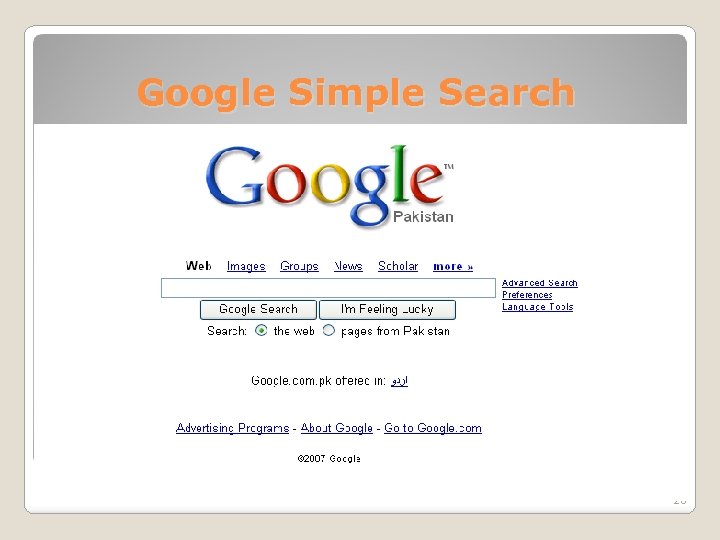 Google Simple Search 26
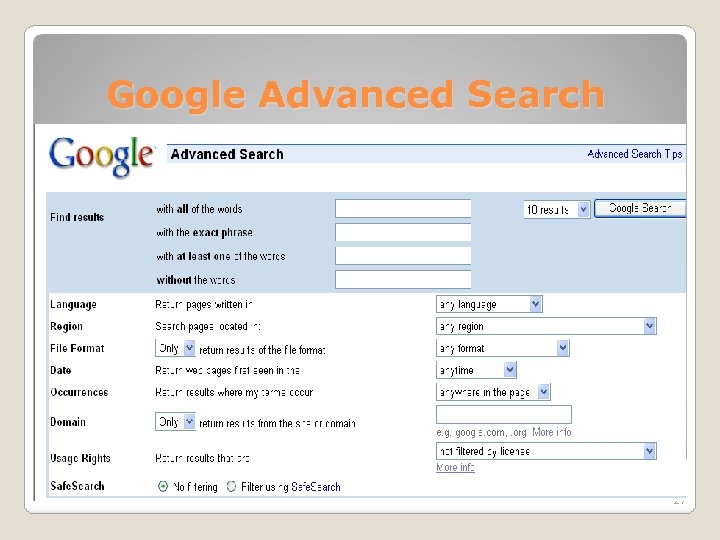 Google Advanced Search 27
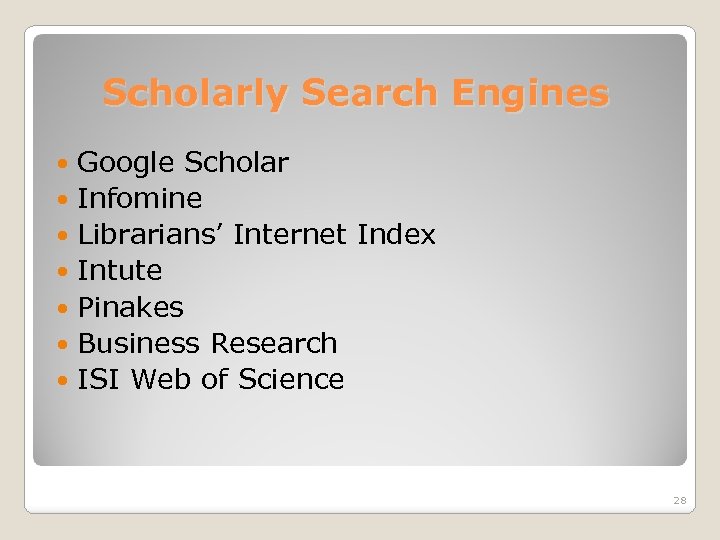 Scholarly Search Engines Google Scholar Infomine Librarians’ Internet Index Intute Pinakes Business Research ISI Web of Science 28
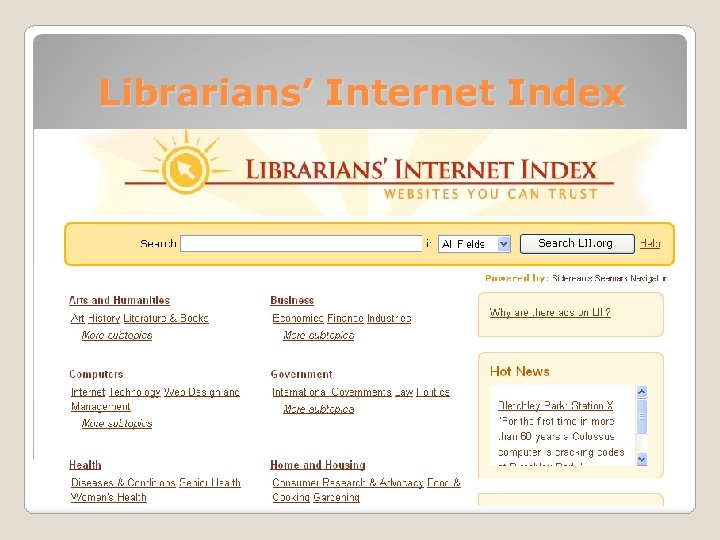 Librarians’ Internet Index 29
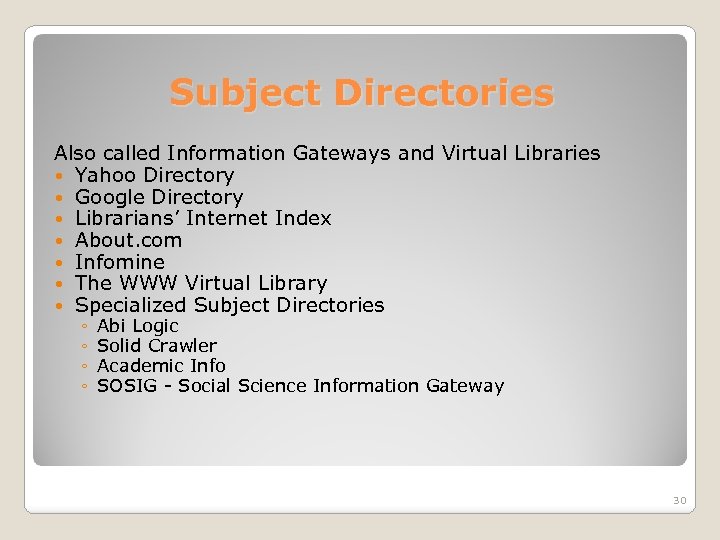 Subject Directories Also called Information Gateways and Virtual Libraries Yahoo Directory Google Directory Librarians’ Internet Index About. com Infomine The WWW Virtual Library Specialized Subject Directories ◦ ◦ Abi Logic Solid Crawler Academic Info SOSIG - Social Science Information Gateway 30
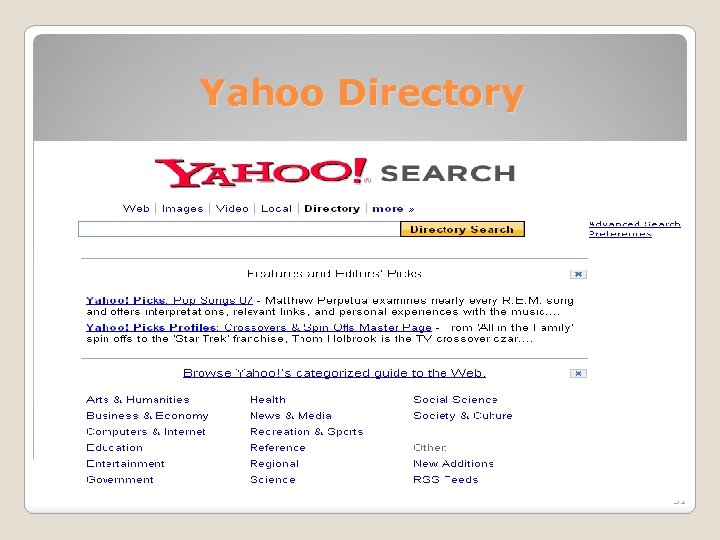 Yahoo Directory 31
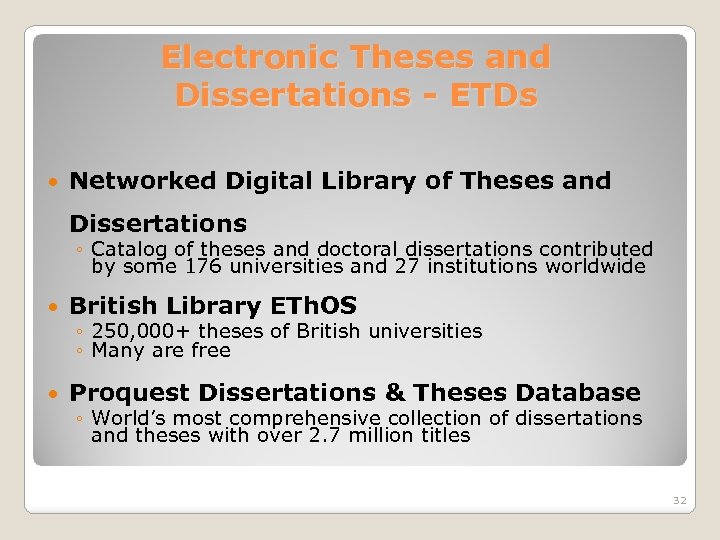 Electronic Theses and Dissertations - ETDs Networked Digital Library of Theses and Dissertations ◦ Catalog of theses and doctoral dissertations contributed by some 176 universities and 27 institutions worldwide British Library ETh. OS Proquest Dissertations & Theses Database ◦ 250, 000+ theses of British universities ◦ Many are free ◦ World’s most comprehensive collection of dissertations and theses with over 2. 7 million titles 32
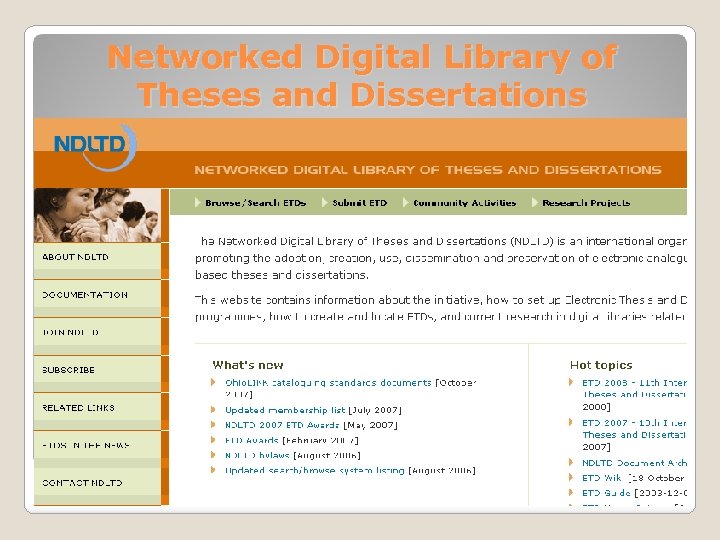 Networked Digital Library of Theses and Dissertations 33
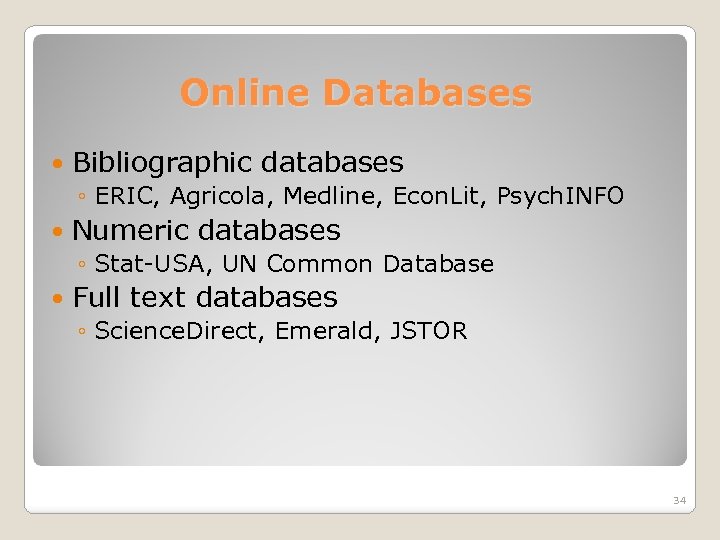 Online Databases Bibliographic databases ◦ ERIC, Agricola, Medline, Econ. Lit, Psych. INFO Numeric databases ◦ Stat-USA, UN Common Database Full text databases ◦ Science. Direct, Emerald, JSTOR 34
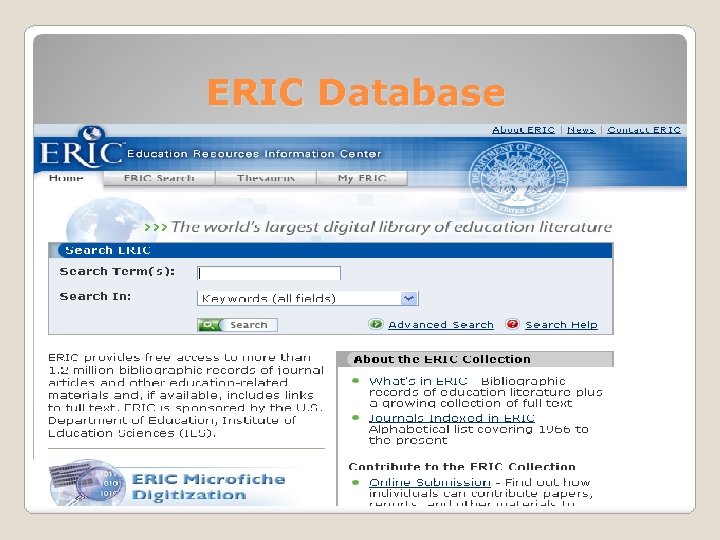 ERIC Database 35
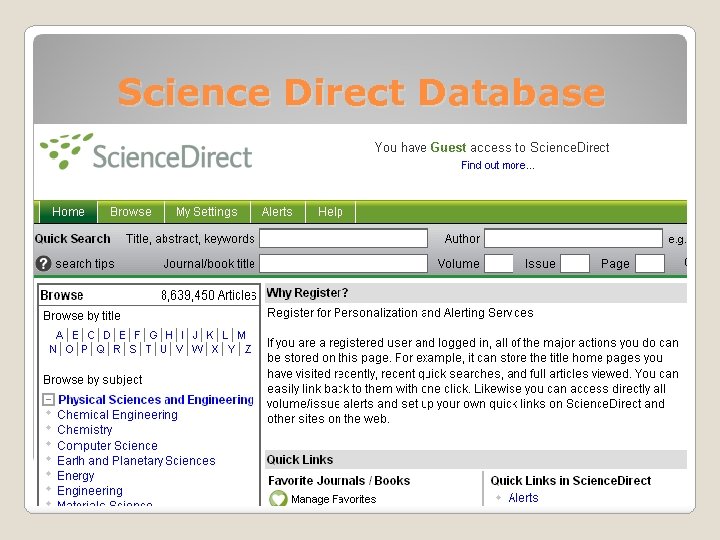 Science Direct Database 36
 Free e-books Gigapedia ◦ 300, 000+ books, the largest e-book repository The Online Books Page ◦ 35, 000+ books Project Gutenberg ◦ 30, 000+ books Internet Public Library ◦ 20, 000+ books 37
 HEC – Online Resources National Digital Library ◦ Over 30 databases with over 23, 000 journals ◦ Accessible by 250 institutions in Pakistan ◦ 50, 000 e-books ◦ Links to open access resources Pakistan Research Repository ◦ Full text of over 1800 Pakistani doctoral theses 38
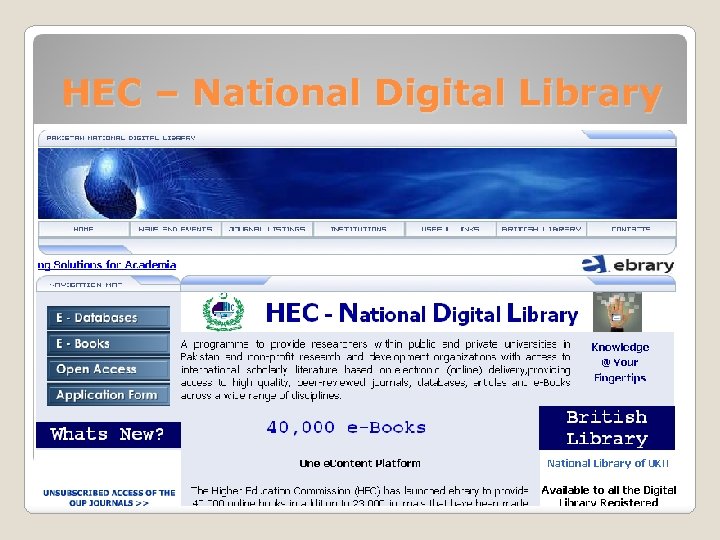 HEC – National Digital Library 39
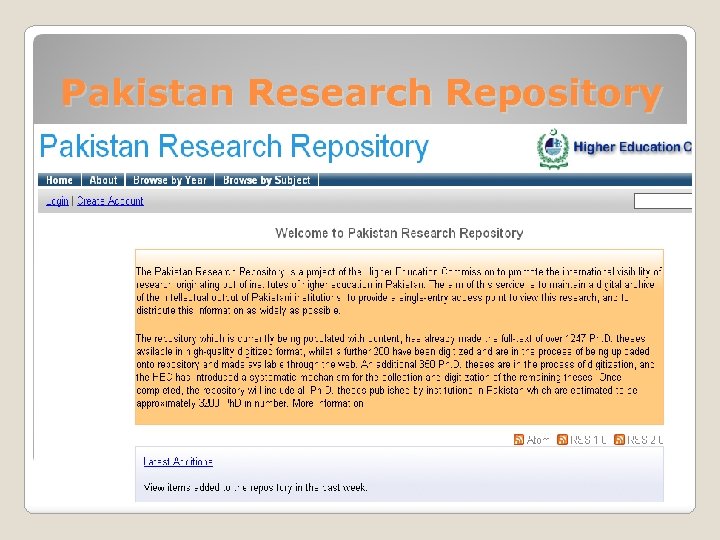 Pakistan Research Repository 40
 Library web OPACs Libdex World. Cat Library of Congress The British Library National Library of Pakistan ◦ Worldwide index of library catalogs ◦ 1. 4 billion items from 10, 000+ libraries worldwide 41
 Activity Enlist 10 keywords related to your research topic. Search these online resources and mention 10 most relevant and helpful resources of your discipline.
 Evaluating Information Sources 43
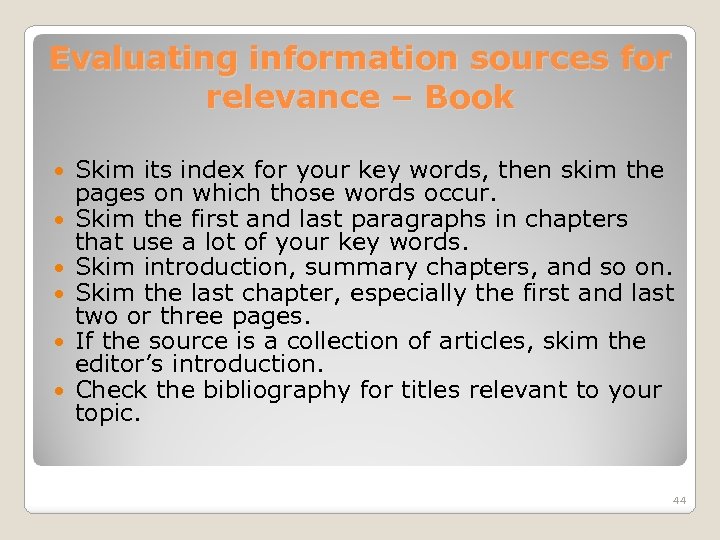 Evaluating information sources for relevance – Book Skim its index for your key words, then skim the pages on which those words occur. Skim the first and last paragraphs in chapters that use a lot of your key words. Skim introduction, summary chapters, and so on. Skim the last chapter, especially the first and last two or three pages. If the source is a collection of articles, skim the editor’s introduction. Check the bibliography for titles relevant to your topic. 44
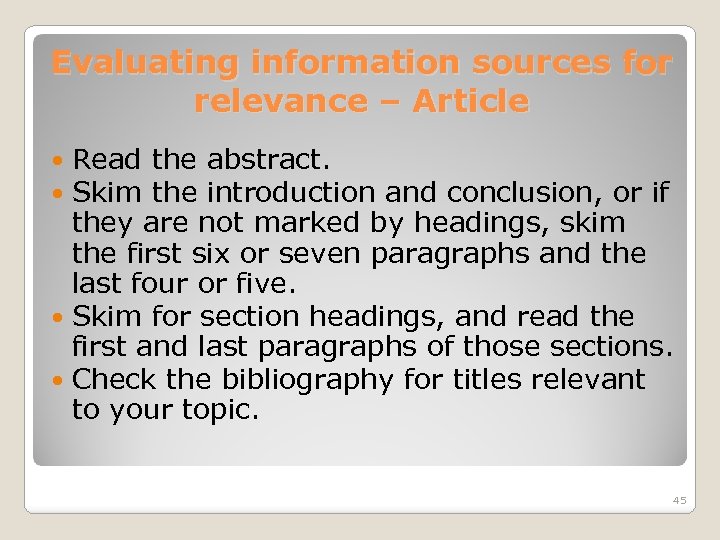 Evaluating information sources for relevance – Article Read the abstract. Skim the introduction and conclusion, or if they are not marked by headings, skim the first six or seven paragraphs and the last four or five. Skim for section headings, and read the first and last paragraphs of those sections. Check the bibliography for titles relevant to your topic. 45
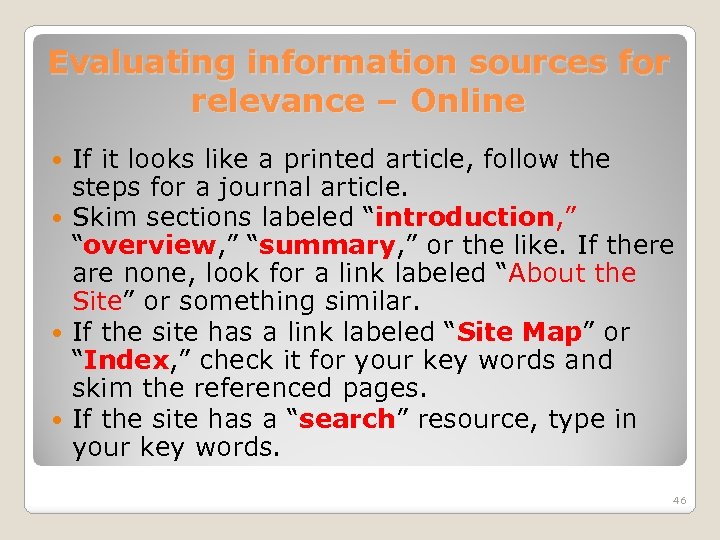 Evaluating information sources for relevance – Online If it looks like a printed article, follow the steps for a journal article. Skim sections labeled “introduction, ” “overview, ” “summary, ” or the like. If there are none, look for a link labeled “About the Site” or something similar. If the site has a link labeled “Site Map” or “Index, ” check it for your key words and skim the referenced pages. If the site has a “search” resource, type in your key words. 46
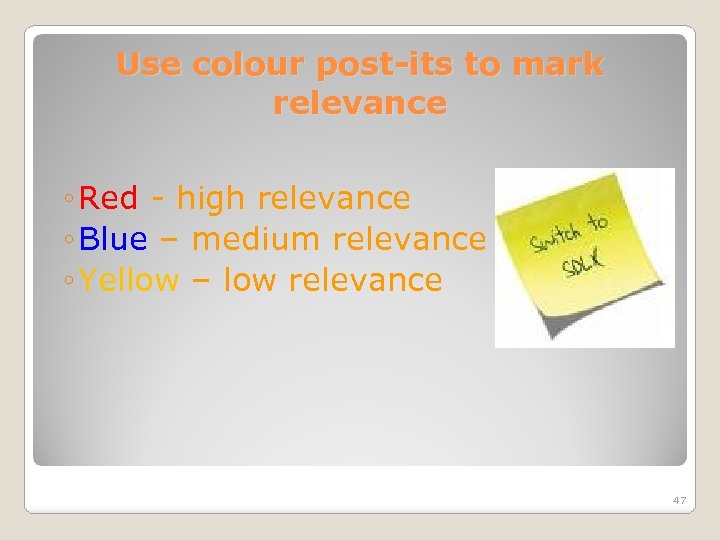 Use colour post-its to mark relevance ◦ Red - high relevance ◦ Blue – medium relevance ◦ Yellow – low relevance 47
 Evaluating information sources for reliability Audience Authority Bias Currency Scope 48
 Audience What age group/education level/political affiliation/etc. is the audience? Is this for a person with in-depth knowledge or a layperson? 49
 Authority Does the author’s name appear on the Web page? What are his/her credentials? Does the author provide contact information? 50
 Bias Is the source objective? Could the writer or the organization’s affiliation put a different spin on the information presented? What is the purpose of the source? 51
 Currency When was the work published? When was the work last updated? How old are the sources or items in the bibliography? How current is the topic? If a Web page, do the links work? 52
 Scope What does/doesn’t the work cover? Is it an in-depth study (many pages) or superficial (one page)? Are sources and statistics cited? If a site, does it offer unique info not found in any other source? 53
 Activity What was your practice for searching the literature? How would you incorporate these tips for enhancing your searching skills?
 Critical Reading 55
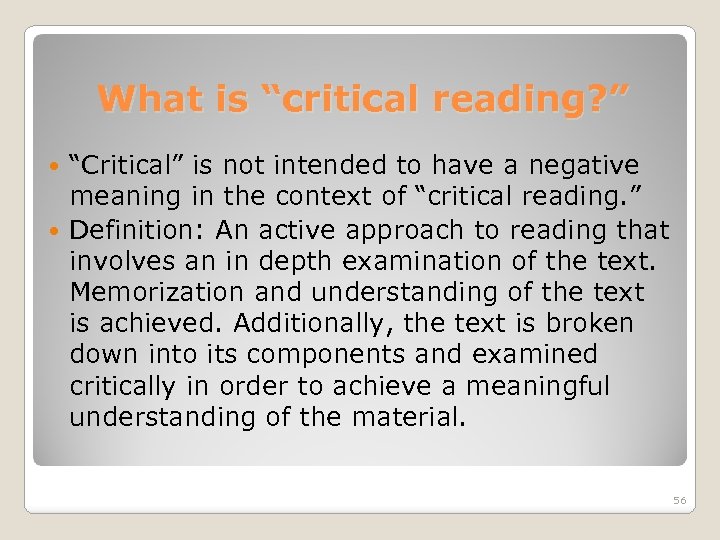 What is “critical reading? ” “Critical” is not intended to have a negative meaning in the context of “critical reading. ” Definition: An active approach to reading that involves an in depth examination of the text. Memorization and understanding of the text is achieved. Additionally, the text is broken down into its components and examined critically in order to achieve a meaningful understanding of the material. 56
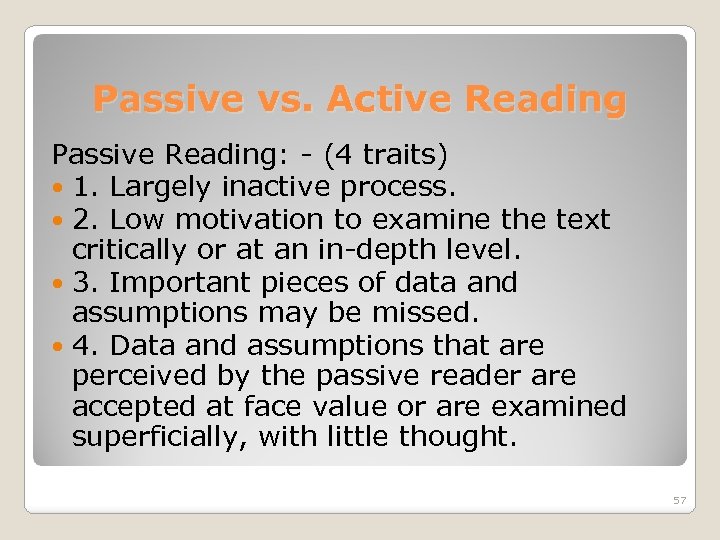 Passive vs. Active Reading Passive Reading: - (4 traits) 1. Largely inactive process. 2. Low motivation to examine the text critically or at an in-depth level. 3. Important pieces of data and assumptions may be missed. 4. Data and assumptions that are perceived by the passive reader are accepted at face value or are examined superficially, with little thought. 57
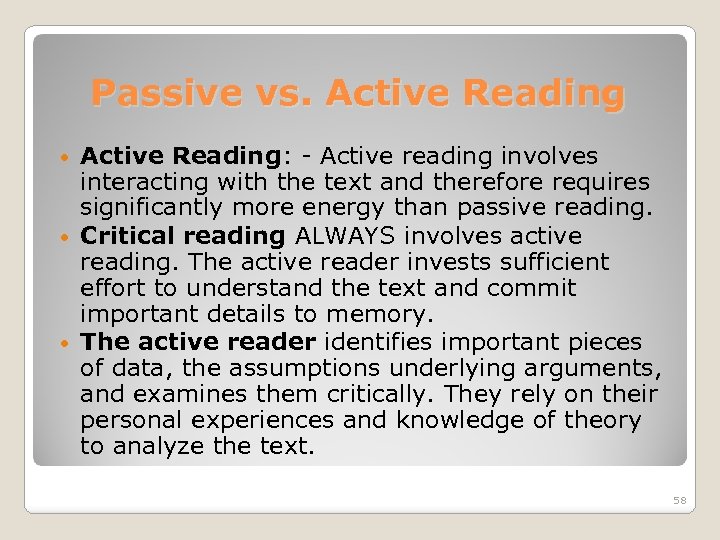 Passive vs. Active Reading: - Active reading involves interacting with the text and therefore requires significantly more energy than passive reading. • Critical reading ALWAYS involves active reading. The active reader invests sufficient effort to understand the text and commit important details to memory. • The active reader identifies important pieces of data, the assumptions underlying arguments, and examines them critically. They rely on their personal experiences and knowledge of theory to analyze the text. • 58
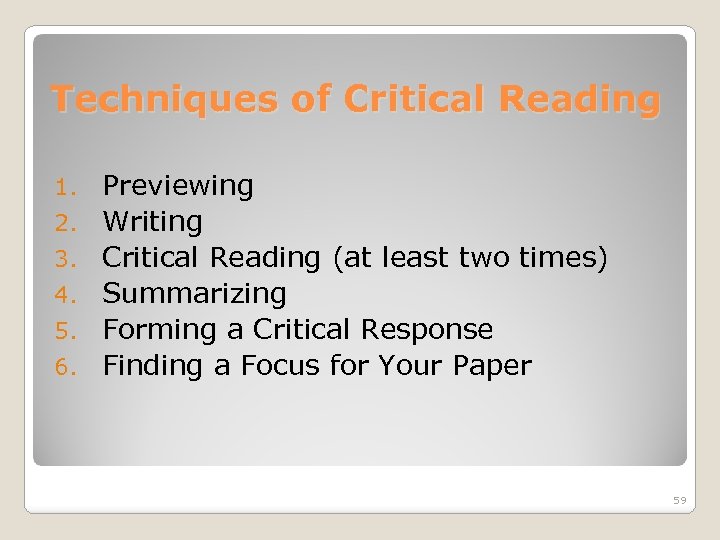 Techniques of Critical Reading 1. 2. 3. 4. 5. 6. Previewing Writing Critical Reading (at least two times) Summarizing Forming a Critical Response Finding a Focus for Your Paper 59
 Previewing Form meaningful expectations about the reading. Pace yourself – decide how much time you will dedicate to the reading. Skimming. ◦ Look for Title, Section Headings, Date ◦ Expectations about the Author (previous works) ◦ Define the important vocabulary words ◦ Brief summaries of chapters ◦ The goal is to obtain a general grasp of the text 60
 Writing 1. Writing While Reading a. Margin b. Divided Page Method c. Landmark/Footnote Method d. Reading Journal e. Online Documents 61
 Writing - Margin Mark, highlight, or underline parts of the text that you think are very important. Option 1 - Write a few words in the margin that capture the essence of your reaction. Option 2 – Write a few words that will help you to remember the passage. This is useful for learning definitions or parts of a theory. 62
 Divided Page Method On a separate piece of paper, divide your page into two columns. Label one column “text” (meaning from your reading) and the other “response” (meaning your response). Write down a part of the text you think is important in the “text” column and then write a reaction to it in the other column. 63
 Landmark/Footnote Method On a separate piece(s) of paper or in your reading journal, dedicate an adequate amount of space to an article, book, chapter, etc, you are reading. Highlight, mark, or underline a critical part in your reading. In the margin, indicate that you are going to write a footnote. For example, write a 1 or a (or whatever you want). In your reading journal, write a ‘ 1’ or ‘a’ (or whatever symbol you chose) and then write your critical response. 64
 Reading Journal In addition to the other uses described above, use the reading journal to track what you are reading and to form critical responses to articles, chapters, etc you have read in their entirety. Try to summarize the entire article, describe the main points, define key terms, and express your reactions. Remember, do NOT refer back to the text until you absolutely have to! Give your memory a workout! Force yourself to learn the material as you read and be able to write it down clearly afterwards. Also, put concepts into your own words. A general rule is 3 -5 pages of notes per 100 pages of text. 65
 Online Documents Two ways to write while reading online documents… 1) Reading Journal 2) Cut and Paste in Word Processor, then insert comments 66
 First Reading Read in an environment where you will be free from distractions. Read steadily and smoothly. Try to enjoy the work. Write notes, but do so sparingly. What works best for you? We suggest avoiding your cell phone, television, computer, and music. 67
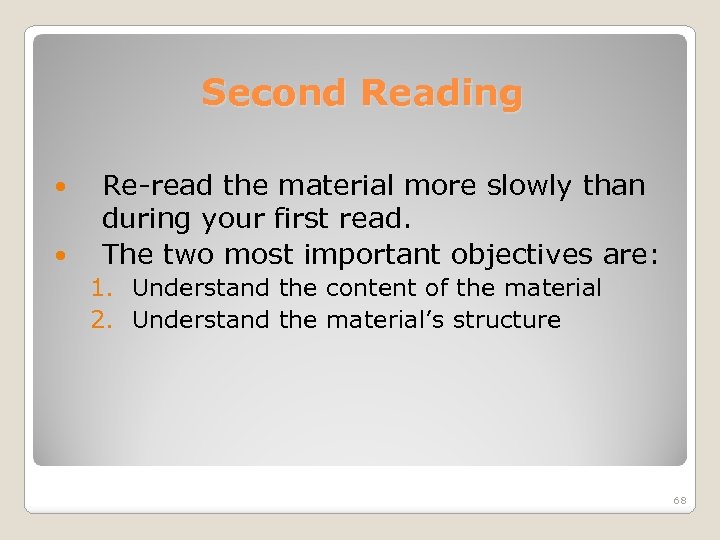 Second Reading Re-read the material more slowly than during your first read. The two most important objectives are: 1. Understand the content of the material 2. Understand the material’s structure 68
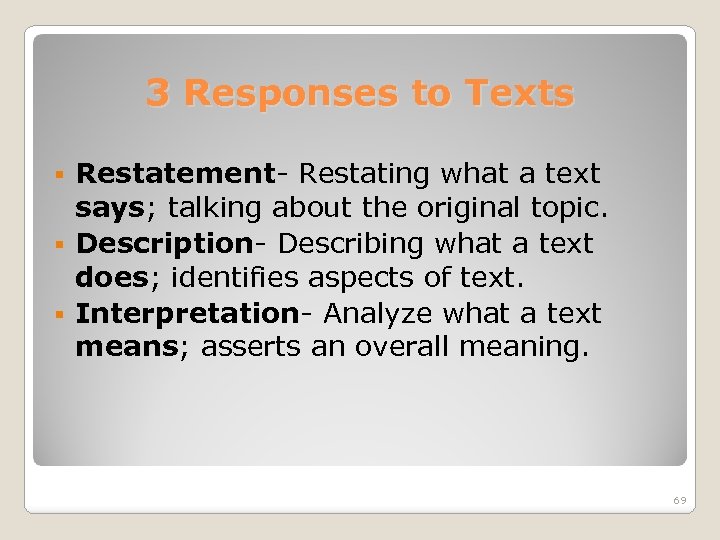 3 Responses to Texts Restatement- Restating what a text says; talking about the original topic. § Description- Describing what a text does; identifies aspects of text. § Interpretation- Analyze what a text means; asserts an overall meaning. § 69
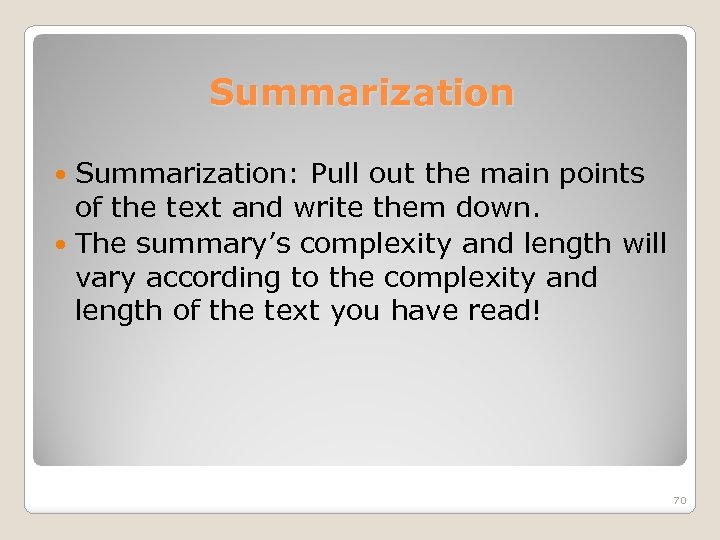 Summarization: Pull out the main points of the text and write them down. The summary’s complexity and length will vary according to the complexity and length of the text you have read! 70
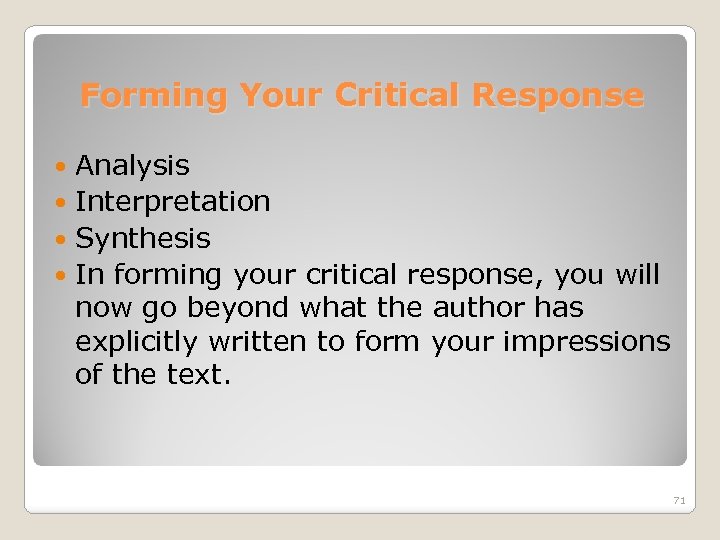 Forming Your Critical Response Analysis Interpretation Synthesis In forming your critical response, you will now go beyond what the author has explicitly written to form your impressions of the text. 71
 Analysis is the separation of something into its parts or elements, which helps to examine them more closely. To analyze reading, you can take at least these two approaches: 1) Choose a question to guide analysis. 2) Look at the author’s argument structure. 72
 Analysis (continued) Examine the argument structure. Claims: Statements that require support by evidence. Assumptions: The writer’s underlying beliefs, opinions, principles, or inferences that connect evidence to the claims. 73
 Analysis (continued) Types of evidence ◦ Facts: Verifiable evidence. ◦ Opinion: Judgments based upon facts. ◦ Expert Opinion: Judgments formed by authorities on a given subject. ◦ Appeal to Beliefs or Needs: Readers are asked to accept a claim in part because they already accept it as true WITHOUT factual evidence or because it coincides with their needs. ◦ Appeal to Emotion: A claim that is persuasive because it evokes an emotion within the reader, but may or may not rely on factual evidence. 74
 Analysis (continued) To judge the reliability of evidence, look at the following areas: ◦ Accuracy ◦ Relevance ◦ Representativeness ◦ Adequacy 75
 Analysis (continued) Logical Fallacies: Errors in reasoning. Examples: ◦ Red herring- introduction of an irrelevant issue in an argument. ◦ Non sequitur- linking two or more ideas that have no logical connection. ◦ Making broad generalizations without proven empirical evidence. 76
 Interpretation After breaking down the text into its components and examining them, ask yourself about the conclusions you can draw from this evidence. What claims does the author make? What evidence supports these claims? Can you infer anything beyond what the author has explicitly written that either strengthens or weakens the claims made by the author? 77
 Synthesis Now that you have broken down the text into its parts, analyzed them, and interpreted it all, you should make new connections with what you know. Ask yourself again: ◦ What are the main points of this text? ◦ Were my expectations for this article met? ◦ If I “read in between the lines” do I learn anything else about what the author is saying? ◦ Overall, what can I conclude from this text? 78
 Analyzing and Synthesizing Findings 79
 Read the articles Completely in each topic together Take notes in an organized manner: computer files, note cards, etc. Include all bibliographic info, especially page number when quoting! Flag like information with same color postits across articles. 80
 Summarize main purpose (research questions) methodology ◦ qualitative/quantitative ◦ subjects, controls, treatments findings relevant details 81
 Analyze varying definitions of key terms methodology used ◦ size & generalizability of subject pool ◦ innovative methodology enough evidence? findings consistent with those of similar studies? 82
 Analyze currency: lit review shows the latest work done in subject area. (last 5 years on average) Include older articles if: landmark study only evidence on a topic helps explain the evolution of the research 83
 Synthesize the Literature How does each article relate to your topic and purpose? Define your argument/thesis. Identify major trends or patterns emerging from your reading. 84
 Synthesize Reassemble your notes based on results of reading, using organizational aids such as postits, flags, etc. Revise original outline of categories Create a detailed topic outline ◦ begin with your “argument” or claim ◦ present evidence from articles researched that proves your claim Do not string together a summary of articles. The outline is topic driven. 85
 Synthesize Note landmark studies and if replicated. Note how individual studies help illustrate or advance theoretical notions. Note gaps or areas needing more research. Make sure your detailed outline follows a logical sequence of topics and subtopics. This will give your literature review the coherence it needs. 86
 Writing and Presenting Literature Review 87
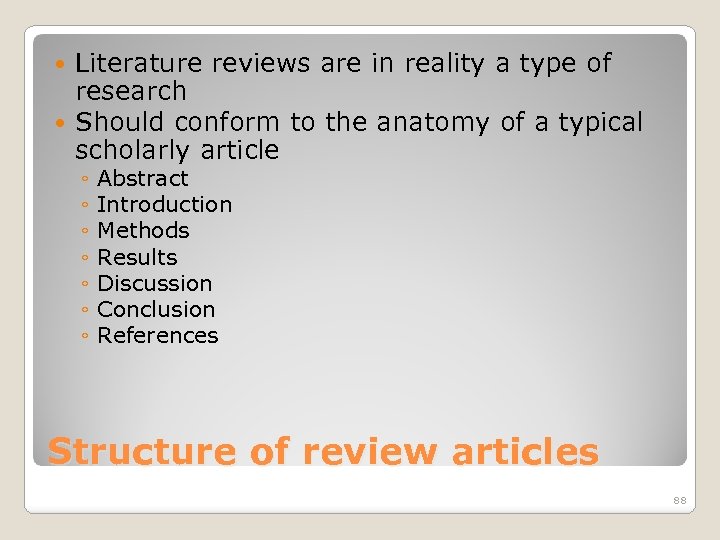 Literature reviews are in reality a type of research Should conform to the anatomy of a typical scholarly article ◦ ◦ ◦ ◦ Abstract Introduction Methods Results Discussion Conclusion References Structure of review articles 88
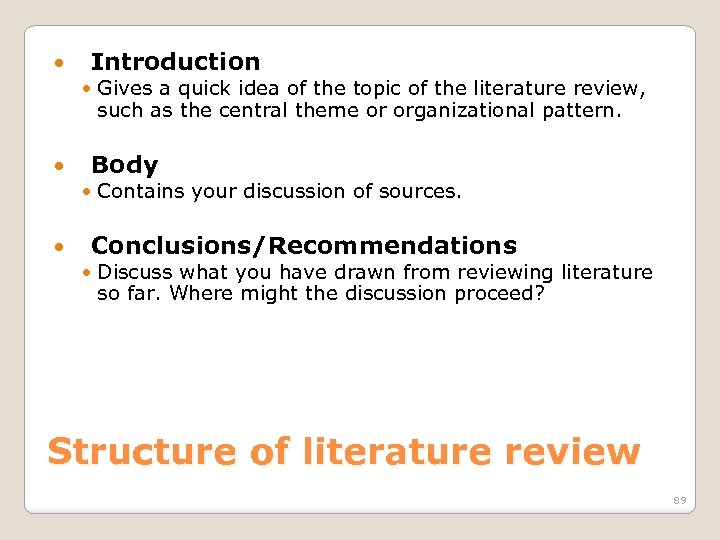 Introduction • Gives a quick idea of the topic of the literature review, such as the central theme or organizational pattern. Body • Contains your discussion of sources. Conclusions/Recommendations • Discuss what you have drawn from reviewing literature so far. Where might the discussion proceed? Structure of literature review 89
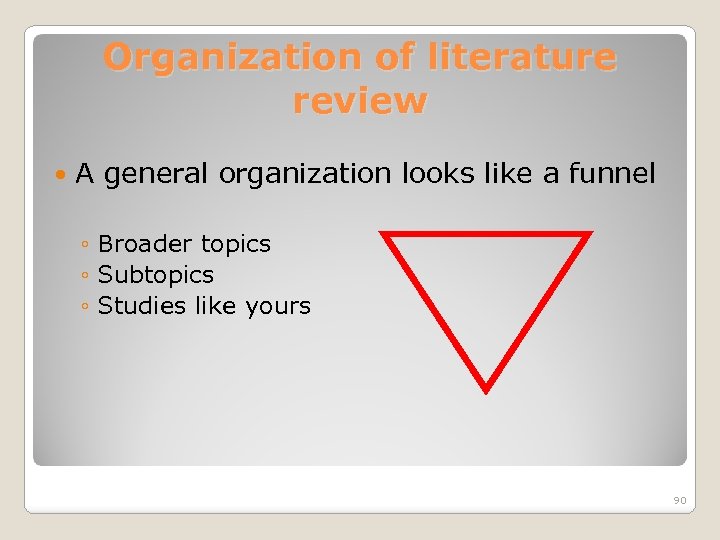 Organization of literature review A general organization looks like a funnel ◦ Broader topics ◦ Subtopics ◦ Studies like yours 90
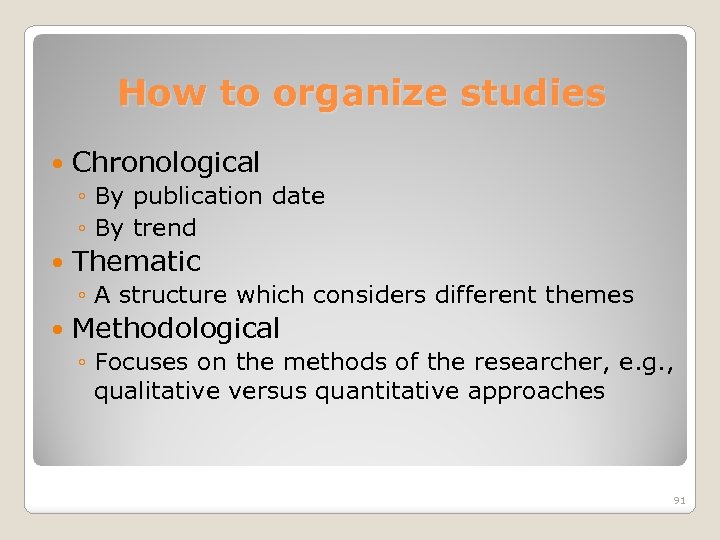 How to organize studies Chronological ◦ By publication date ◦ By trend Thematic ◦ A structure which considers different themes Methodological ◦ Focuses on the methods of the researcher, e. g. , qualitative versus quantitative approaches 91
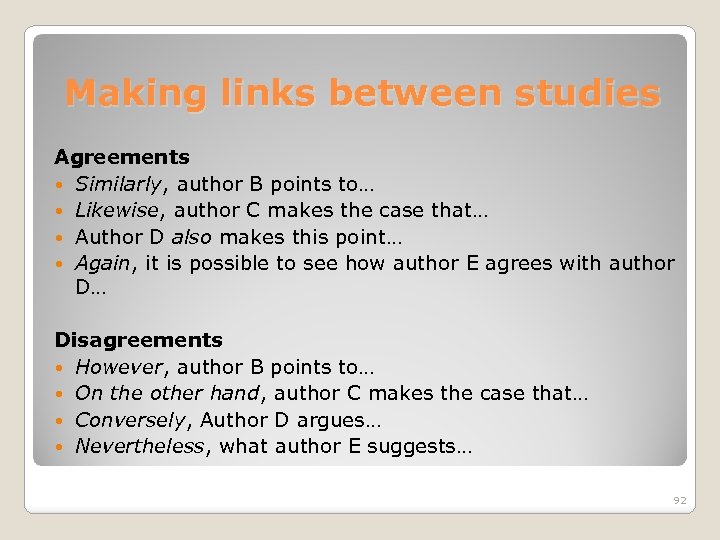 Making links between studies Agreements Similarly, author B points to… Likewise, author C makes the case that… Author D also makes this point… Again, it is possible to see how author E agrees with author D… Disagreements However, author B points to… On the other hand, author C makes the case that… Conversely, Author D argues… Nevertheless, what author E suggests… 92
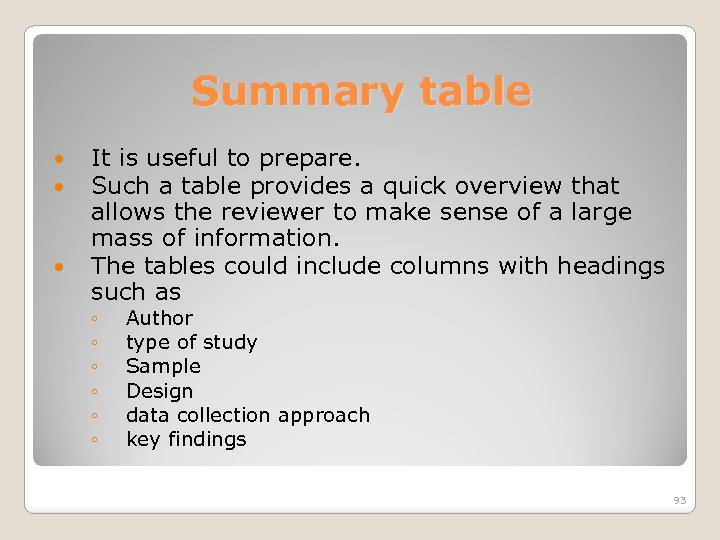 Summary table It is useful to prepare. Such a table provides a quick overview that allows the reviewer to make sense of a large mass of information. The tables could include columns with headings such as ◦ ◦ ◦ Author type of study Sample Design data collection approach key findings 93
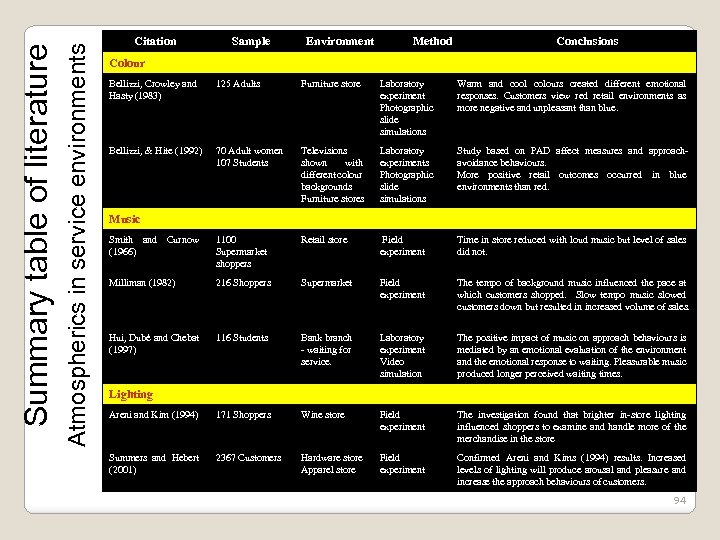 Atmospherics in service environments Summary table of literature Citation Sample Environment Method Conclusions Colour Bellizzi, Crowley and Hasty (1983) 125 Adults Furniture store Laboratory experiment Photographic slide simulations Warm and cool colours created different emotional responses. Customers view red retail environments as more negative and unpleasant than blue. Bellizzi, & Hite (1992) 70 Adult women 107 Students Televisions shown with different colour backgrounds Furniture stores Laboratory experiments Photographic slide simulations Study based on PAD affect measures and approachavoidance behaviours. More positive retail outcomes occurred in blue environments than red. Smith and Curnow (1966) 1100 Supermarket shoppers Retail store Field experiment Time in store reduced with loud music but level of sales did not. Milliman (1982) 216 Shoppers Supermarket Field experiment The tempo of background music influenced the pace at which customers shopped. Slow tempo music slowed customers down but resulted in increased volume of sales. Hui, Dubé and Chebat (1997) 116 Students Bank branch - waiting for service. Laboratory experiment Video simulation The positive impact of music on approach behaviours is mediated by an emotional evaluation of the environment and the emotional response to waiting. Pleasurable music produced longer perceived waiting times. Areni and Kim (1994) 171 Shoppers Wine store Field experiment The investigation found that brighter in-store lighting influenced shoppers to examine and handle more of the merchandise in the store Summers and Hebert (2001) 2367 Customers Hardware store Apparel store Field experiment Confirmed Areni and Kims (1994) results. Increased levels of lighting will produce arousal and pleasure and increase the approach behaviours of customers. Music Lighting 94
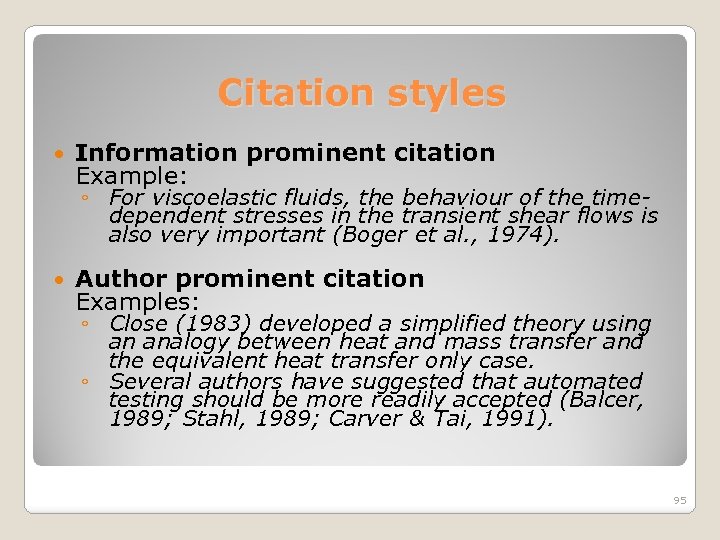 Citation styles Information prominent citation Example: ◦ For viscoelastic fluids, the behaviour of the timedependent stresses in the transient shear flows is also very important (Boger et al. , 1974). Author prominent citation Examples: ◦ Close (1983) developed a simplified theory using an analogy between heat and mass transfer and the equivalent heat transfer only case. ◦ Several authors have suggested that automated testing should be more readily accepted (Balcer, 1989; Stahl, 1989; Carver & Tai, 1991). 95
 Active or passive voice You should use, where appropriate, both active and passive voice As a general rule, use active voice unless there is good reason not to 96
 A Good Literature Review is: Focused - The topic should be narrow. You should only present ideas and only report on studies that are closely related to topic. Concise - Ideas should be presented economically. Don’t take any more space than you need to present your ideas. Logical - The flow within and among paragraphs should be a smooth, logical progression from one idea to the next Developed - Don’t leave the story half told. Integrative - Your paper should stress how the ideas in the studies are related. Focus on the big picture. What commonality do all the studies share? How are some studies different than others? Your paper should stress how all the studies reviewed contribute to your topic. Current - Your review should focus on work being done on the cutting edge of your topic. 97
 Pitfalls Vagueness due to too much or inappropriate generalizations Limited range Insufficient information Irrelevant material Omission of contrasting view Omission of recent work 98
 Common errors in reviewing literature v. Hurrying through review to get started could mean that you will miss something that will improve your research. v. Relying too heavily upon secondary sources. v. Concentrating on findings rather than methods. v. Overlooking sources other than academic journals. Don’t forget newspaper articles, magazines, blogs, etc. v. Searching too broad or too narrow of a topic. v. Inaccuracy in the compiling of bibliographic information. 99
 Activity What do you know about good literature review?
 Citing References in Your Research (APA Style)
 Some Important Terms Used in Research Work • Citation • References • Footnote
 Learning Check What is the sharp difference between Citation, References, bibliography and foot -note.
 Citation A reference or listing of the key pieces of information about a work that makes it possible to identify and locate it again.
 Reference What we quoted in the text consists of author name (Not inverted), title and pages of sources it could be as footnote, at the end of chapter or at the end of thesis.
 Bibliography In the context of academic research, a list of books or references to sources cited, for further reading, usually printed at the end of an article or in the back matter of a book includes author name (inverted), title, year, place of publication, publisher.
 Foot Note Any note used to further explain a detail outside of the main text. The term usually refers to notes at the bottom of a page OP Cited (for reference already given in list) op. cited ref No 11, H. M Deitel Ibid (for the same reference use)
 Various Style Manuals APA – American Psychological Association MLA – Modern Language Association Chicago Style – Chicago Manual of Style Turabian Style – based on Chicago Style Harvard Referencing System ASA – American Sociological Association CBE - Council of Biology Editors
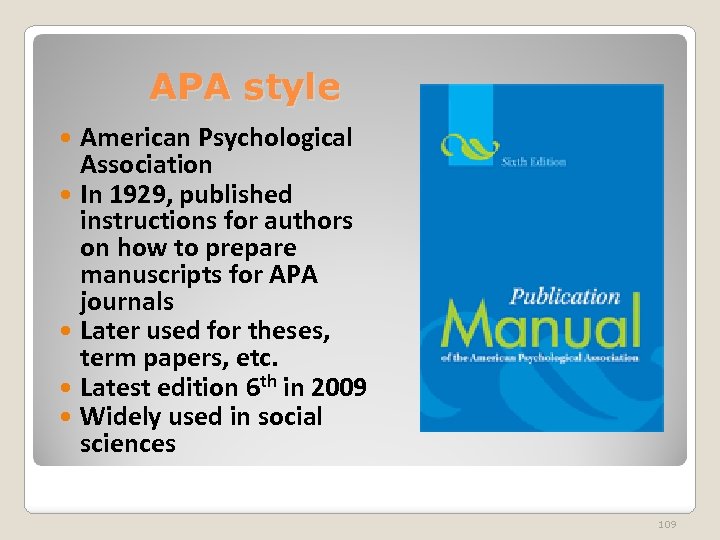 APA style American Psychological Association In 1929, published instructions for authors on how to prepare manuscripts for APA journals Later used for theses, term papers, etc. Latest edition 6 th in 2009 Widely used in social sciences 109
 Citing references – Outline Identifying and formatting citing elements Citing in text Preparing reference list / bibliography 110
 Citing Elements 111
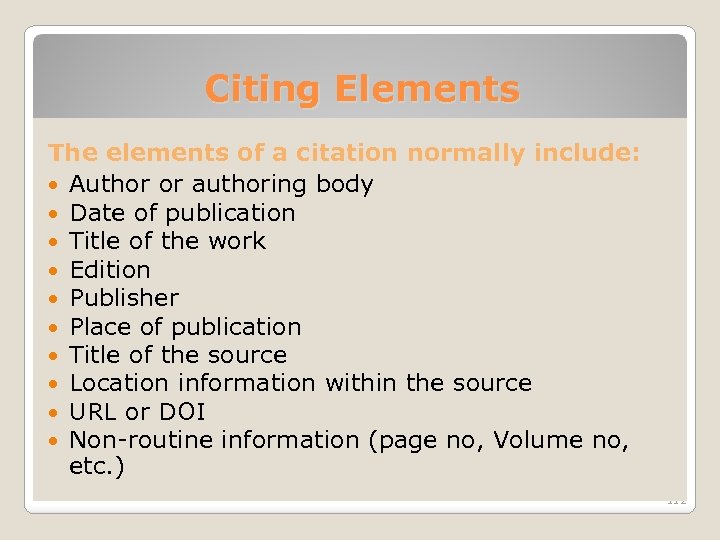 Citing Elements The elements of a citation normally include: Author or authoring body Date of publication Title of the work Edition Publisher Place of publication Title of the source Location information within the source URL or DOI Non-routine information (page no, Volume no, etc. ) 112
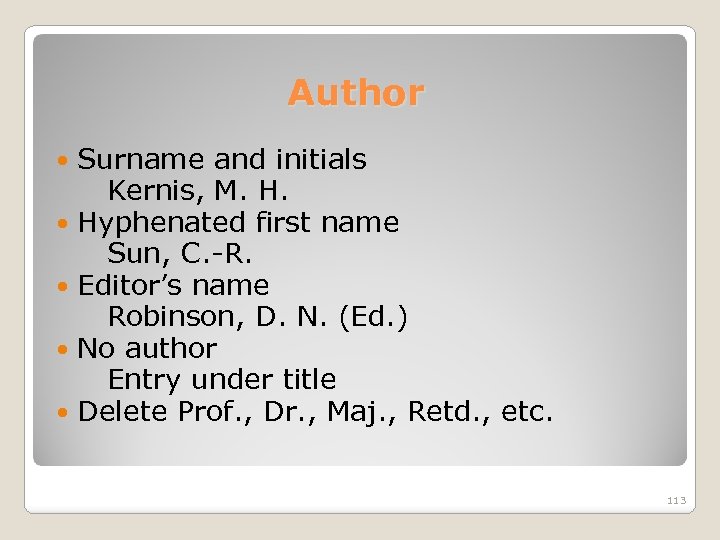 Author Surname and initials Kernis, M. H. Hyphenated first name Sun, C. -R. Editor’s name Robinson, D. N. (Ed. ) No author Entry under title Delete Prof. , Dr. , Maj. , Retd. , etc. 113
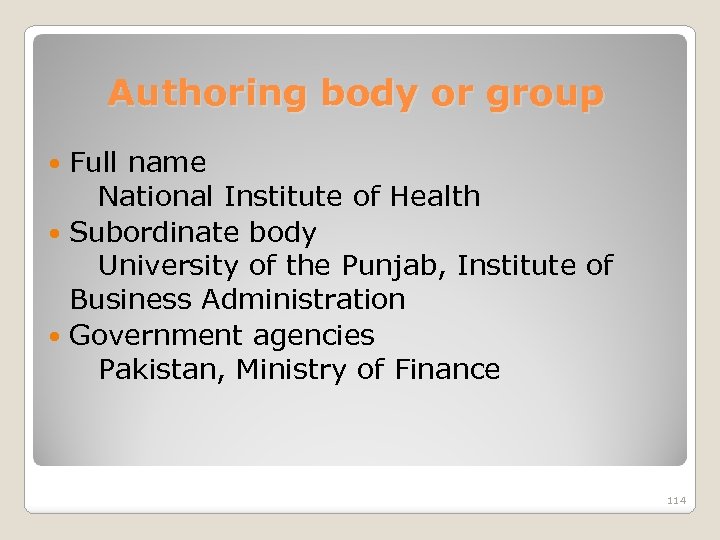 Authoring body or group Full name National Institute of Health Subordinate body University of the Punjab, Institute of Business Administration Government agencies Pakistan, Ministry of Finance 114
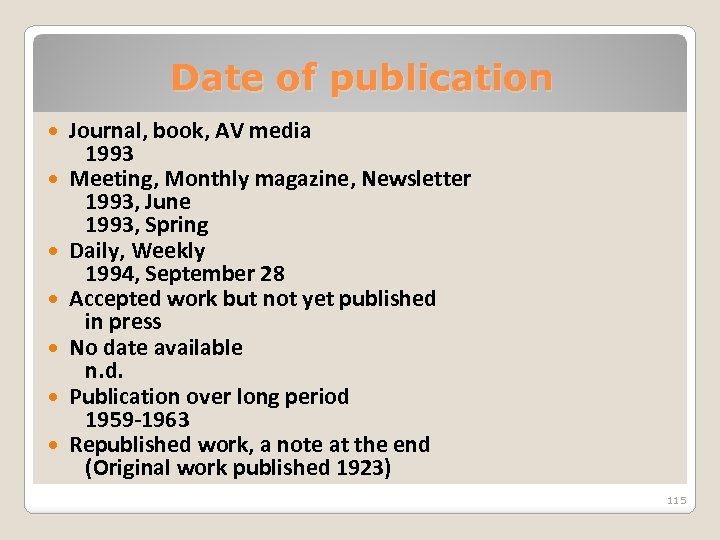 Date of publication Journal, book, AV media 1993 Meeting, Monthly magazine, Newsletter 1993, June 1993, Spring Daily, Weekly 1994, September 28 Accepted work but not yet published in press No date available n. d. Publication over long period 1959 -1963 Republished work, a note at the end (Original work published 1923) 115
 Title of the work Title of book chapter Title of journal article Title of encyclopedia article Subtitle with colon 116
 Edition you used Edition in Arabic numeral 2 nd ed. Rev. ed. 4 th rev. ed. 117
 Publisher name for non periodicals In a brief form Omit superfluous terms, such as Publishers, Publications, Co. , Inc. Sage Wiley Mc. Graw-Hill Prentice Hall Ferozsons Use only word “Author” when author and publisher is the same 118
 Place of publication Name of city If city is not well known then add state/province and/or country Jaipur, India Medford, NJ US postal service abbreviations for states (2 -digit codes) CA for California If more cities are given, use the first or the publisher’s head office if clearly mentioned 119
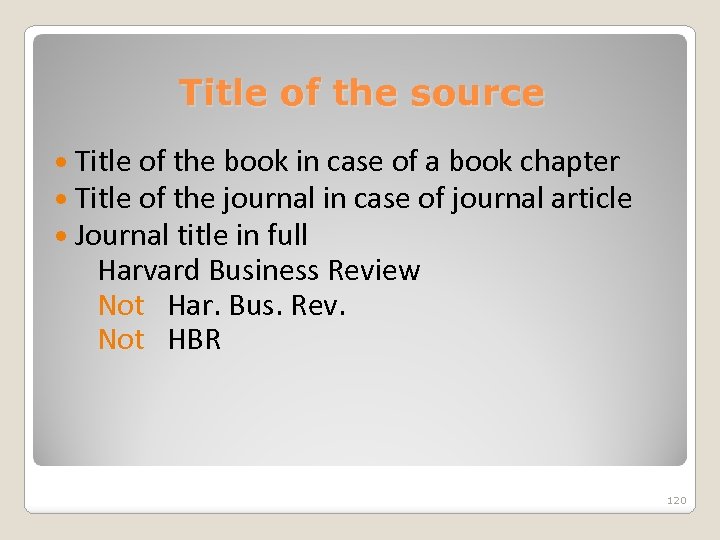 Title of the source Title of the book in case of a book chapter Title of the journal in case of journal article Journal title in full Harvard Business Review Not Har. Bus. Rev. Not HBR 120
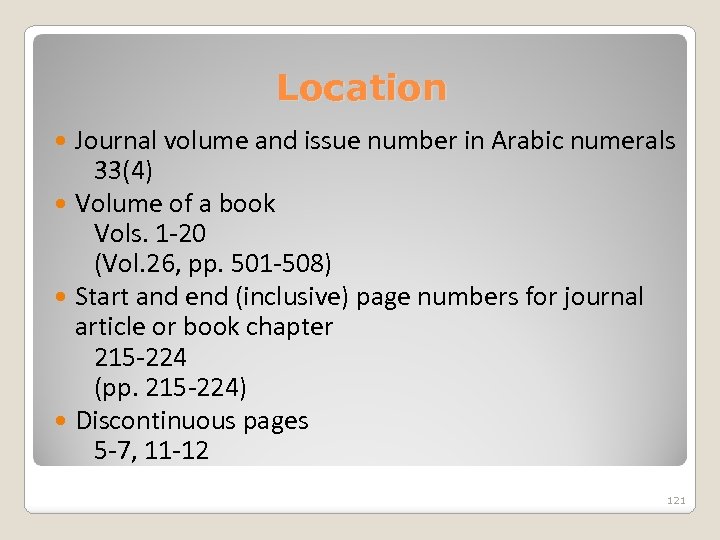 Location Journal volume and issue number in Arabic numerals 33(4) Volume of a book Vols. 1 -20 (Vol. 26, pp. 501 -508) Start and end (inclusive) page numbers for journal article or book chapter 215 -224 (pp. 215 -224) Discontinuous pages 5 -7, 11 -12 121
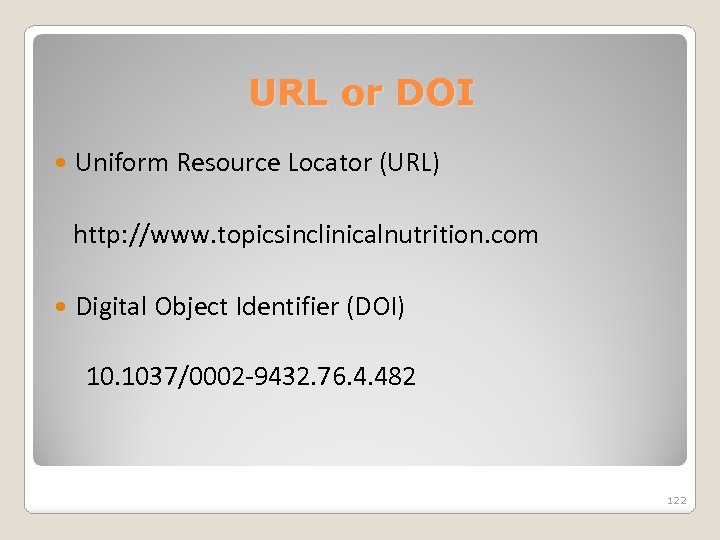 URL or DOI Uniform Resource Locator (URL) http: //www. topicsinclinicalnutrition. com Digital Object Identifier (DOI) 10. 1037/0002 -9432. 76. 4. 482 122
![Non-routine information Give nonroutine but important information in square brackets [Letter to the editor]](https://present5.com/presentation/f280e842235d0eb8248ea4bfc49ca3bb/image-123.jpg "Non-routine information Give nonroutine but important information in square brackets [Letter to the editor]") Non-routine information Give nonroutine but important information in square brackets [Letter to the editor] [Special issue] [Brochure] [Abstract] 123
Non-routine information Give nonroutine but important information in square brackets [Letter to the editor] [Special issue] [Brochure] [Abstract] 123
 Citing in text 124
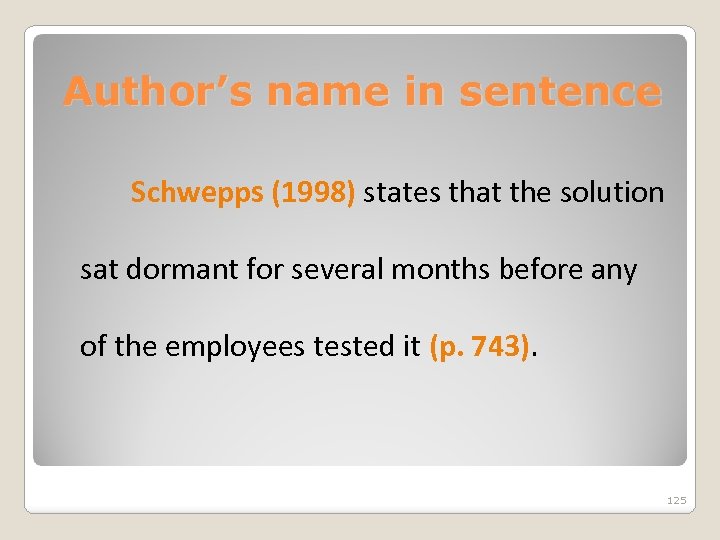 Author’s name in sentence Schwepps (1998) states that the solution sat dormant for several months before any of the employees tested it (p. 743). 125
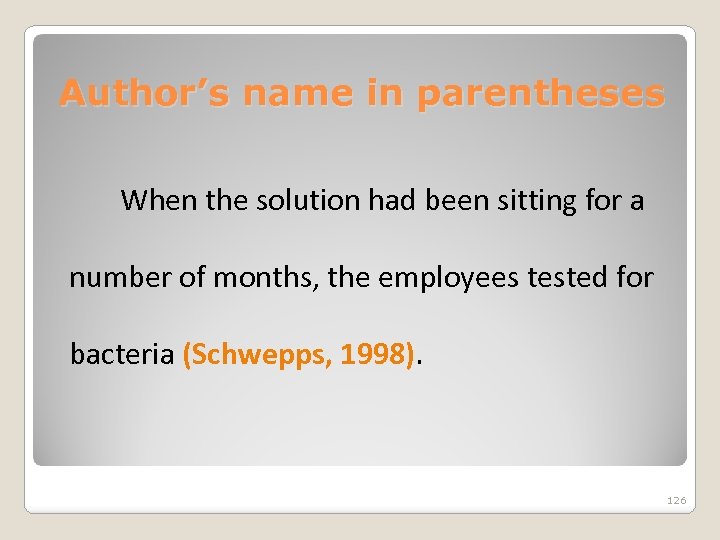 Author’s name in parentheses When the solution had been sitting for a number of months, the employees tested for bacteria (Schwepps, 1998). 126
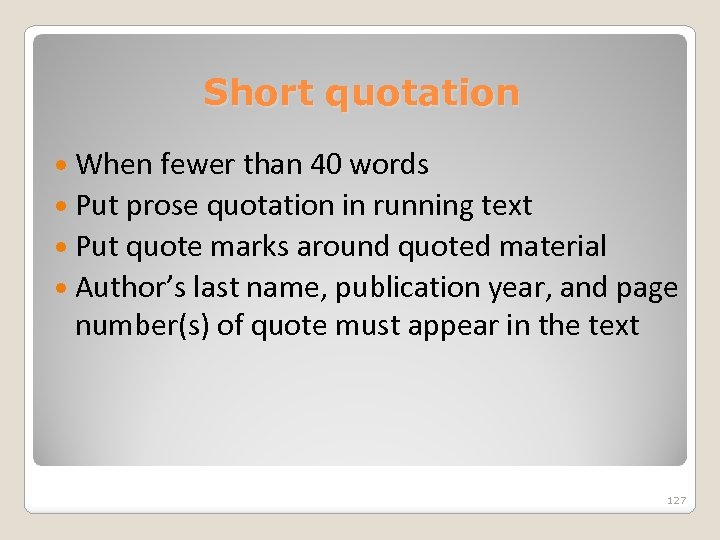 Short quotation When fewer than 40 words Put prose quotation in running text Put quote marks around quoted material Author’s last name, publication year, and page number(s) of quote must appear in the text 127
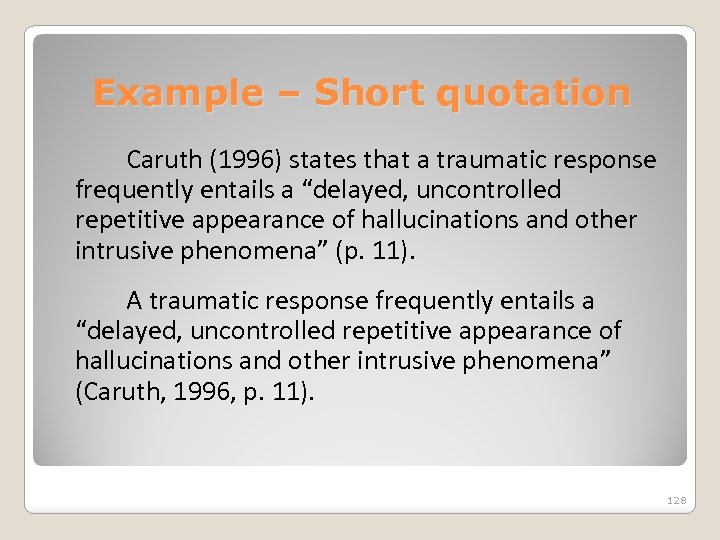 Example – Short quotation Caruth (1996) states that a traumatic response frequently entails a “delayed, uncontrolled repetitive appearance of hallucinations and other intrusive phenomena” (p. 11). A traumatic response frequently entails a “delayed, uncontrolled repetitive appearance of hallucinations and other intrusive phenomena” (Caruth, 1996, p. 11). 128
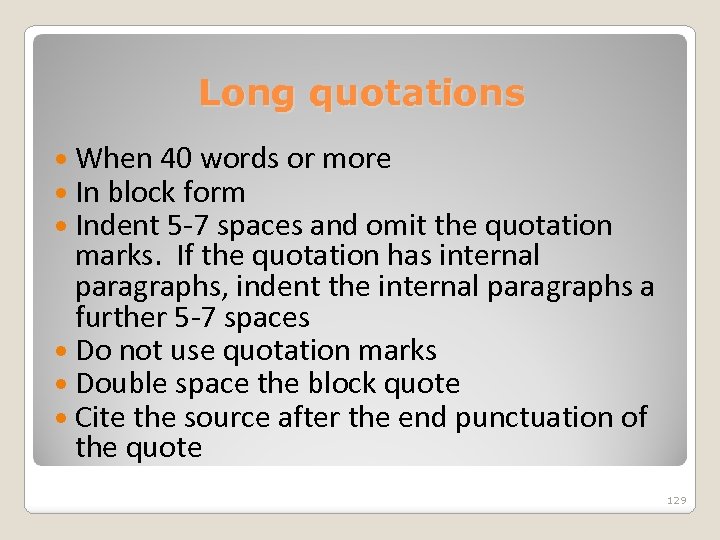 Long quotations When 40 words or more In block form Indent 5 -7 spaces and omit the quotation marks. If the quotation has internal paragraphs, indent the internal paragraphs a further 5 -7 spaces Do not use quotation marks Double space the block quote Cite the source after the end punctuation of the quote 129
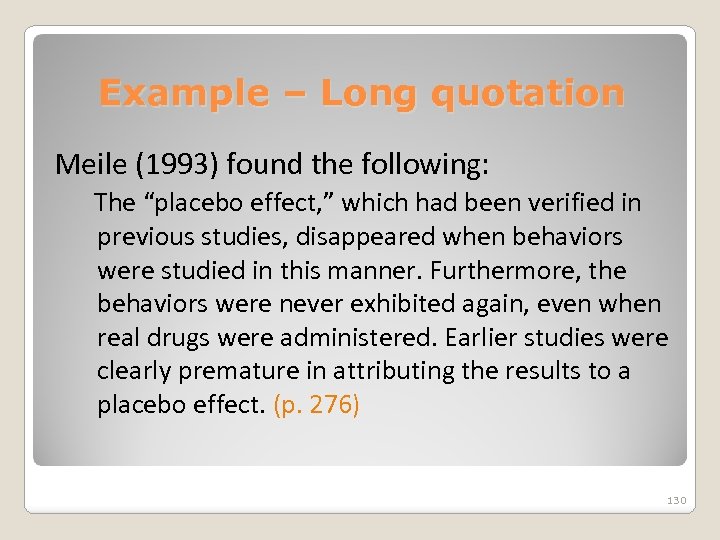 Example – Long quotation Meile (1993) found the following: The “placebo effect, ” which had been verified in previous studies, disappeared when behaviors were studied in this manner. Furthermore, the behaviors were never exhibited again, even when real drugs were administered. Earlier studies were clearly premature in attributing the results to a placebo effect. (p. 276) 130
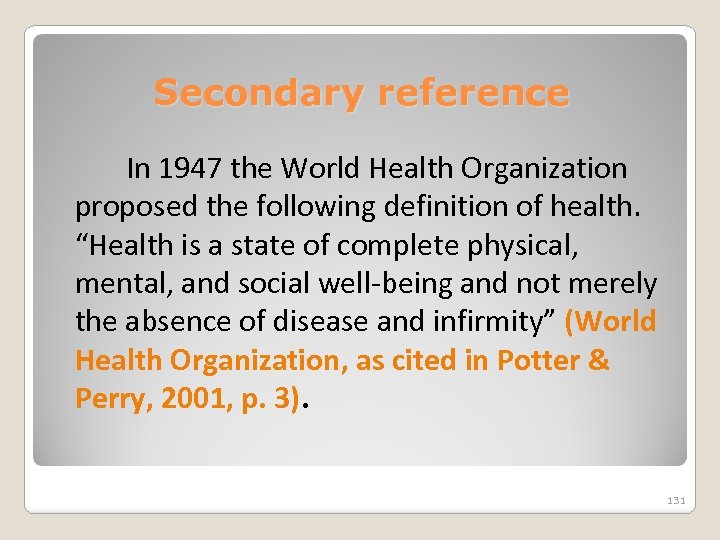 Secondary reference In 1947 the World Health Organization proposed the following definition of health. “Health is a state of complete physical, mental, and social well-being and not merely the absence of disease and infirmity” (World Health Organization, as cited in Potter & Perry, 2001, p. 3). 131
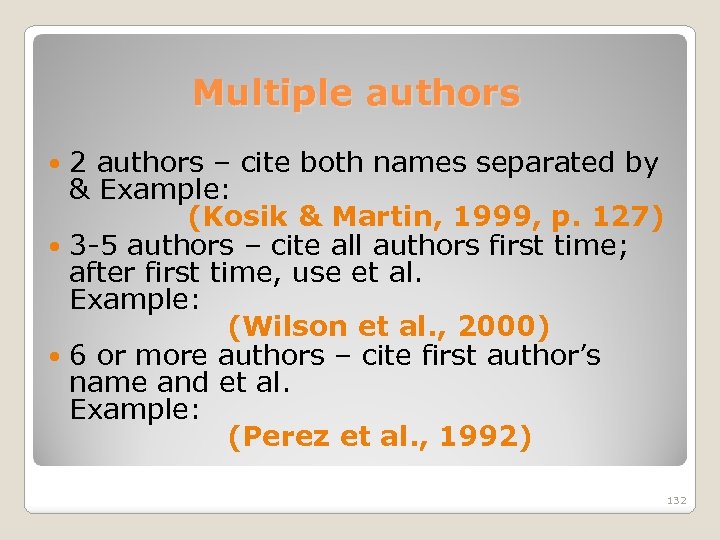 Multiple authors 2 authors – cite both names separated by & Example: (Kosik & Martin, 1999, p. 127) 3 -5 authors – cite all authors first time; after first time, use et al. Example: (Wilson et al. , 2000) 6 or more authors – cite first author’s name and et al. Example: (Perez et al. , 1992) 132
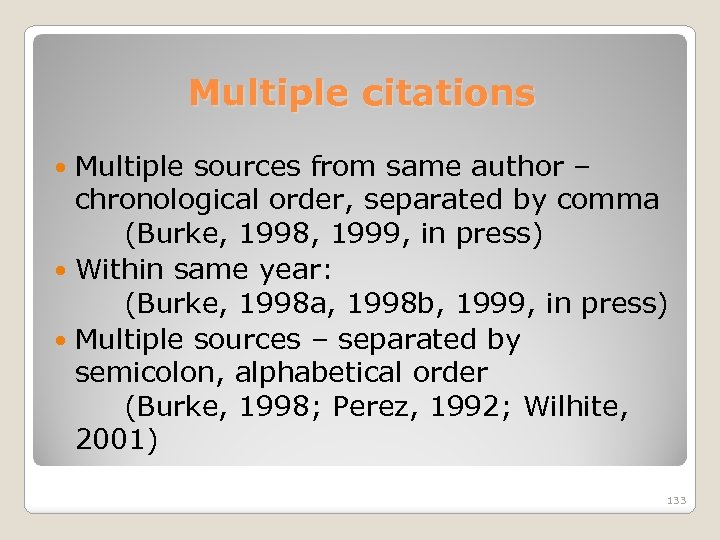 Multiple citations Multiple sources from same author – chronological order, separated by comma (Burke, 1998, 1999, in press) Within same year: (Burke, 1998 a, 1998 b, 1999, in press) Multiple sources – separated by semicolon, alphabetical order (Burke, 1998; Perez, 1992; Wilhite, 2001) 133
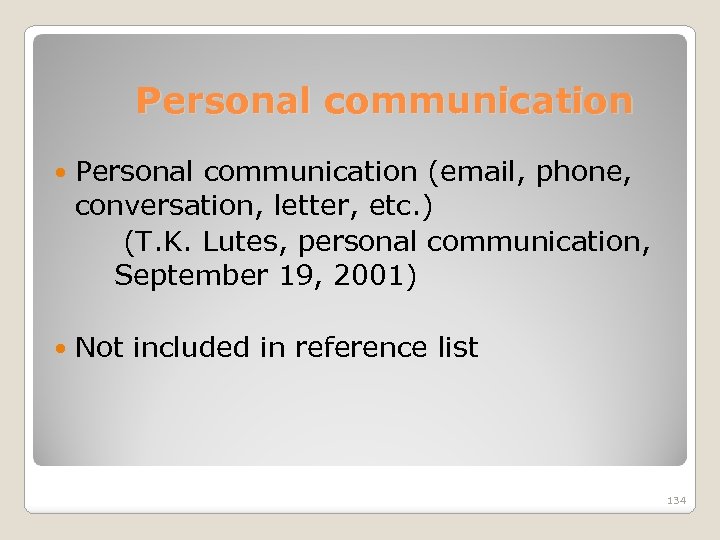 Personal communication (email, phone, conversation, letter, etc. ) (T. K. Lutes, personal communication, September 19, 2001) Not included in reference list 134
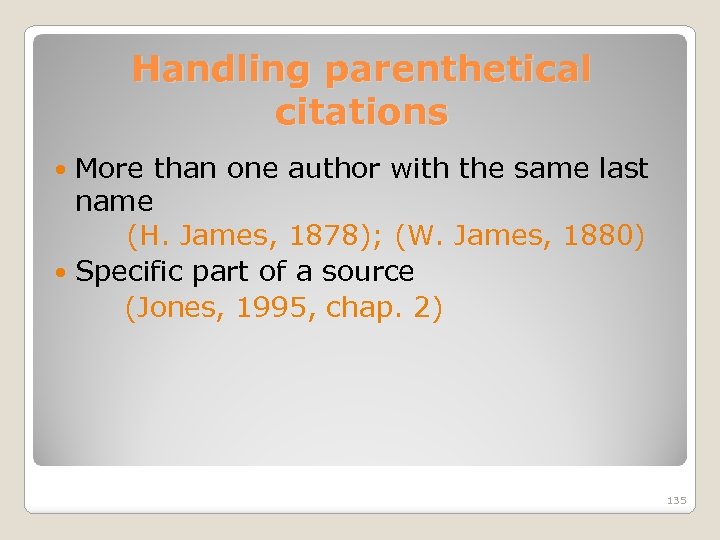 Handling parenthetical citations More than one author with the same last name (H. James, 1878); (W. James, 1880) Specific part of a source (Jones, 1995, chap. 2) 135
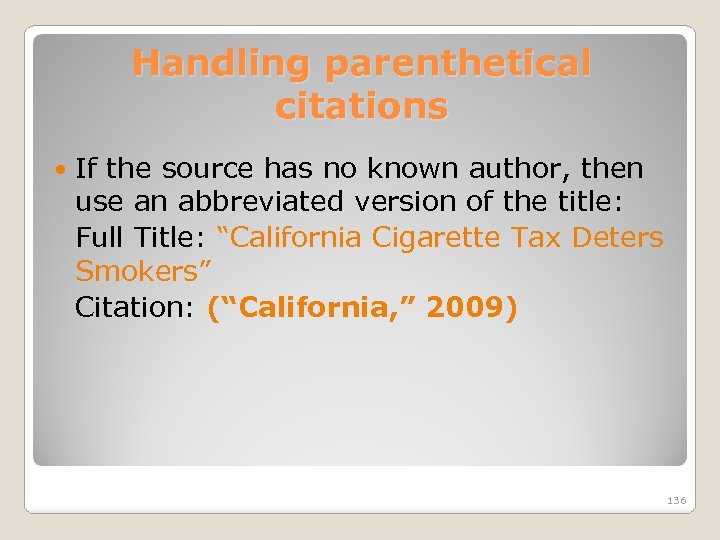 Handling parenthetical citations If the source has no known author, then use an abbreviated version of the title: Full Title: “California Cigarette Tax Deters Smokers” Citation: (“California, ” 2009) 136
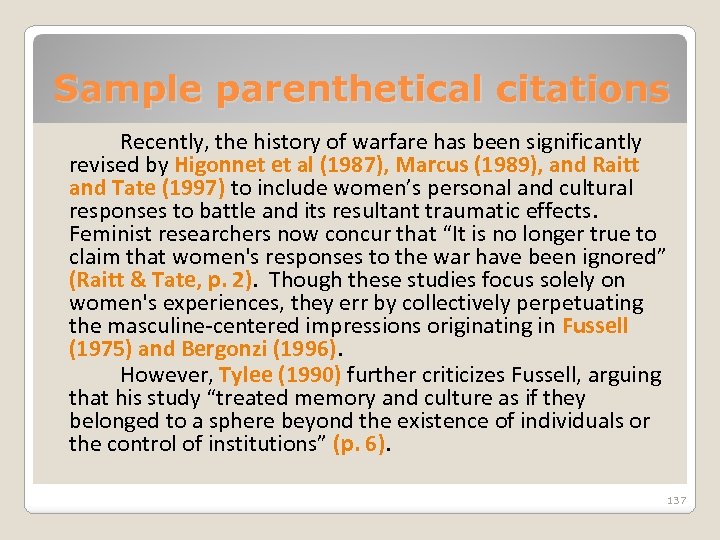 Sample parenthetical citations Recently, the history of warfare has been significantly revised by Higonnet et al (1987), Marcus (1989), and Raitt and Tate (1997) to include women’s personal and cultural responses to battle and its resultant traumatic effects. Feminist researchers now concur that “It is no longer true to claim that women's responses to the war have been ignored” (Raitt & Tate, p. 2). Though these studies focus solely on women's experiences, they err by collectively perpetuating the masculine-centered impressions originating in Fussell (1975) and Bergonzi (1996). However, Tylee (1990) further criticizes Fussell, arguing that his study “treated memory and culture as if they belonged to a sphere beyond the existence of individuals or the control of institutions” (p. 6). 137
 Reference List / Bibliography 138
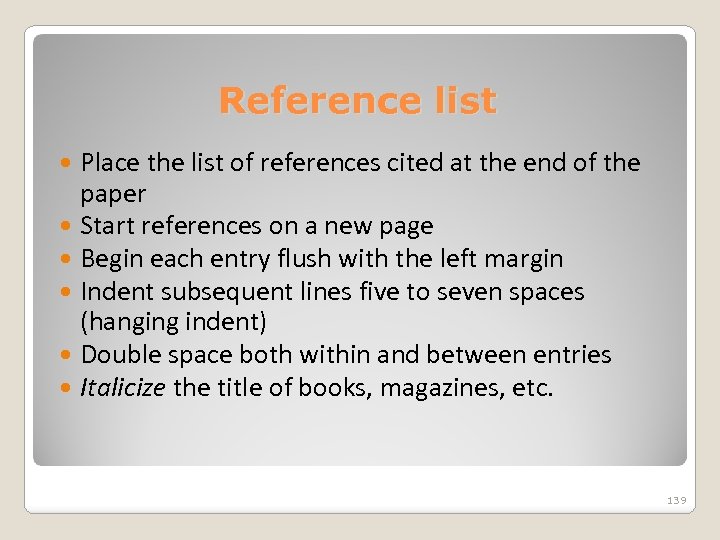 Reference list Place the list of references cited at the end of the paper Start references on a new page Begin each entry flush with the left margin Indent subsequent lines five to seven spaces (hanging indent) Double space both within and between entries Italicize the title of books, magazines, etc. 139
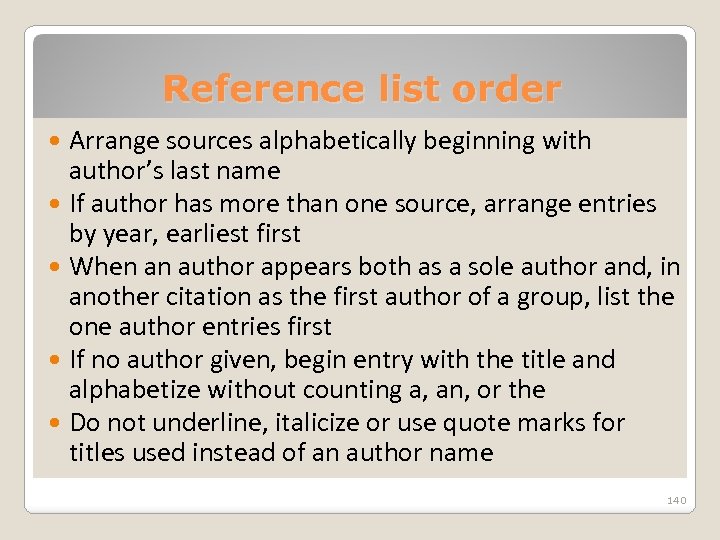 Reference list order Arrange sources alphabetically beginning with author’s last name If author has more than one source, arrange entries by year, earliest first When an author appears both as a sole author and, in another citation as the first author of a group, list the one author entries first If no author given, begin entry with the title and alphabetize without counting a, an, or the Do not underline, italicize or use quote marks for titles used instead of an author name 140
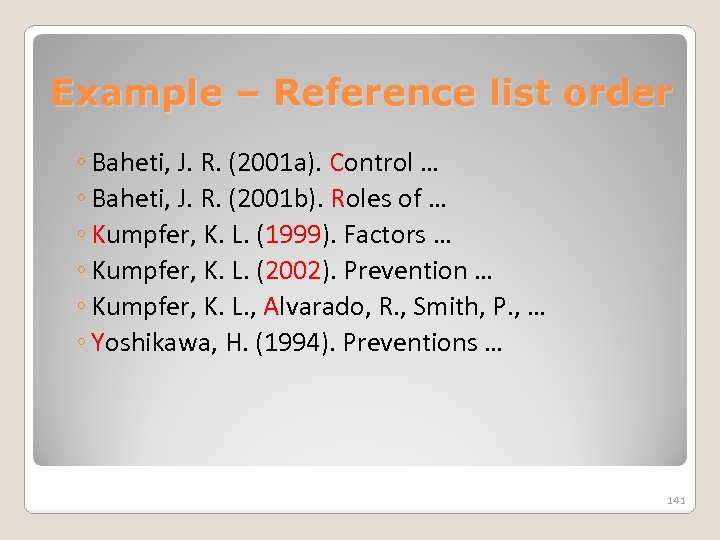 Example – Reference list order ◦ Baheti, J. R. (2001 a). Control … ◦ Baheti, J. R. (2001 b). Roles of … ◦ Kumpfer, K. L. (1999). Factors … ◦ Kumpfer, K. L. (2002). Prevention … ◦ Kumpfer, K. L. , Alvarado, R. , Smith, P. , … ◦ Yoshikawa, H. (1994). Preventions … 141
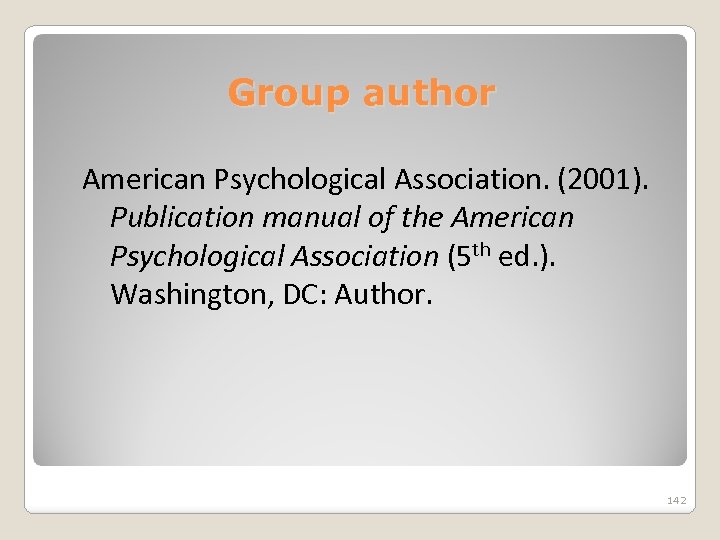 Group author American Psychological Association. (2001). Publication manual of the American Psychological Association (5 th ed. ). Washington, DC: Author. 142
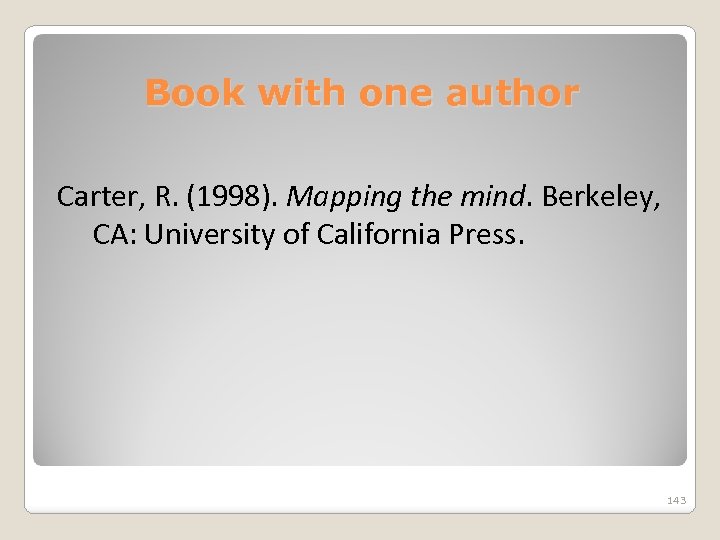 Book with one author Carter, R. (1998). Mapping the mind. Berkeley, CA: University of California Press. 143
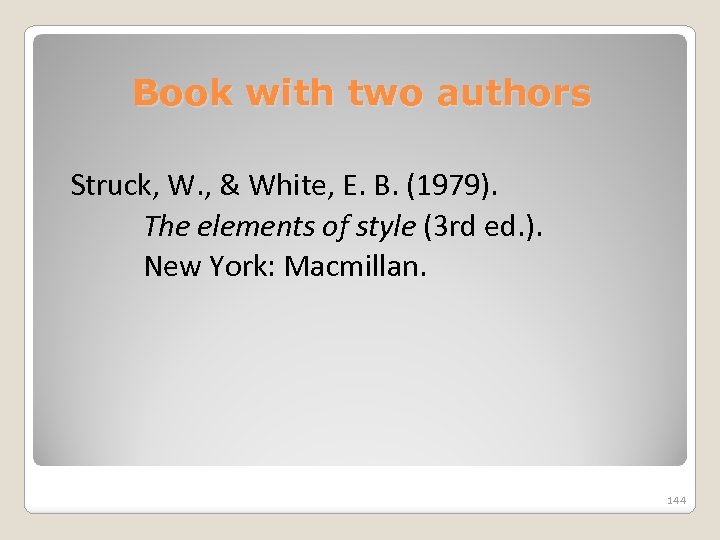 Book with two authors Struck, W. , & White, E. B. (1979). The elements of style (3 rd ed. ). New York: Macmillan. 144
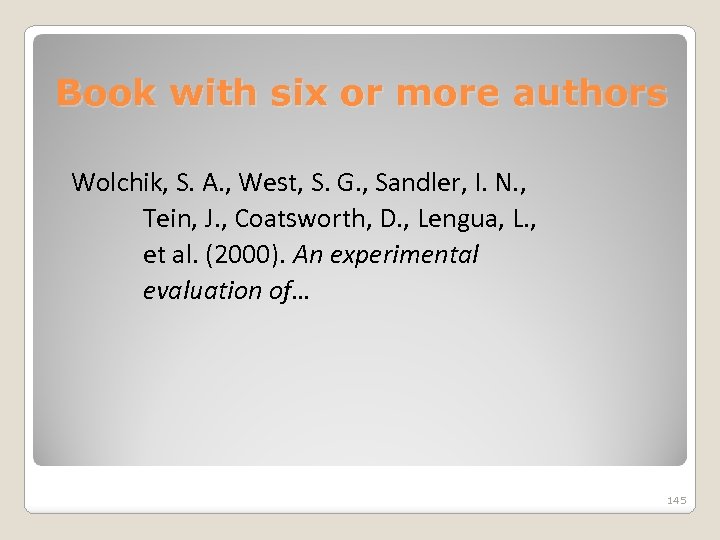 Book with six or more authors Wolchik, S. A. , West, S. G. , Sandler, I. N. , Tein, J. , Coatsworth, D. , Lengua, L. , et al. (2000). An experimental evaluation of… 145
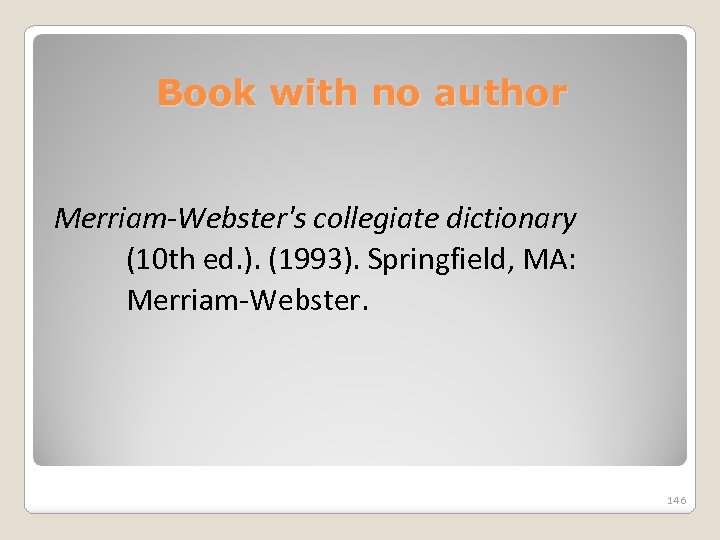 Book with no author Merriam-Webster's collegiate dictionary (10 th ed. ). (1993). Springfield, MA: Merriam-Webster. 146
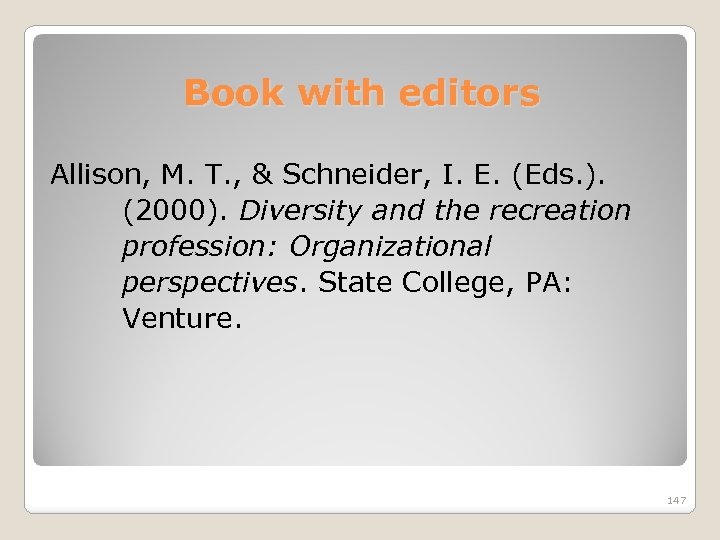 Book with editors Allison, M. T. , & Schneider, I. E. (Eds. ). (2000). Diversity and the recreation profession: Organizational perspectives. State College, PA: Venture. 147
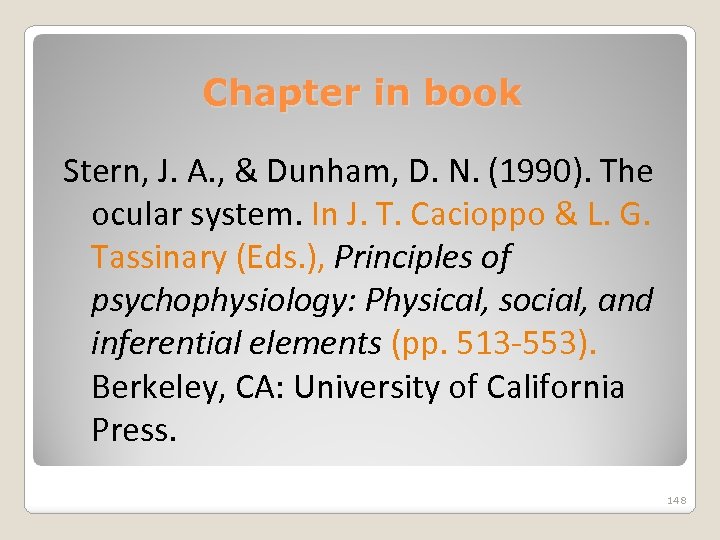 Chapter in book Stern, J. A. , & Dunham, D. N. (1990). The ocular system. In J. T. Cacioppo & L. G. Tassinary (Eds. ), Principles of psychophysiology: Physical, social, and inferential elements (pp. 513 -553). Berkeley, CA: University of California Press. 148
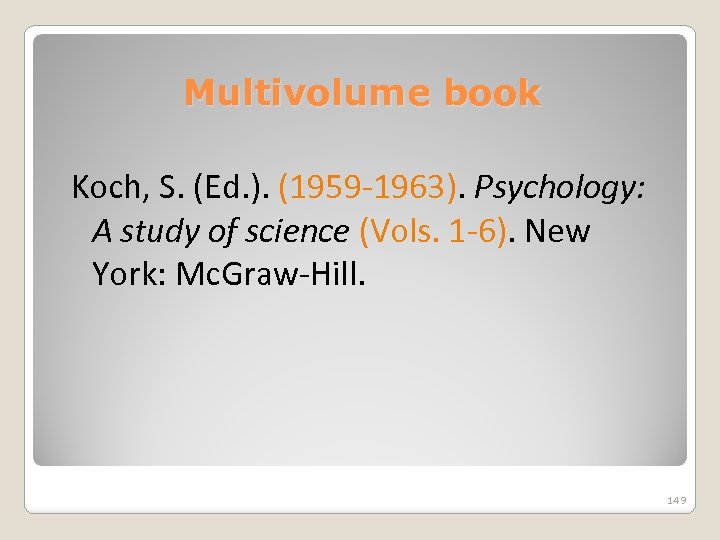 Multivolume book Koch, S. (Ed. ). (1959 -1963). Psychology: A study of science (Vols. 1 -6). New York: Mc. Graw-Hill. 149
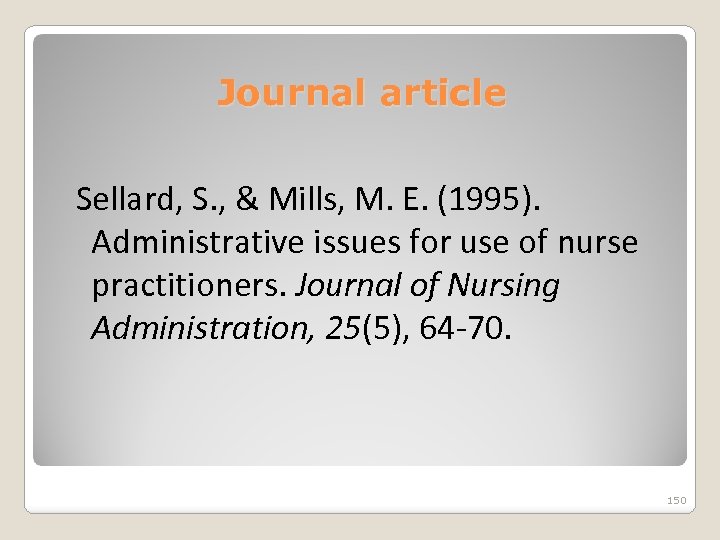 Journal article Sellard, S. , & Mills, M. E. (1995). Administrative issues for use of nurse practitioners. Journal of Nursing Administration, 25(5), 64 -70. 150
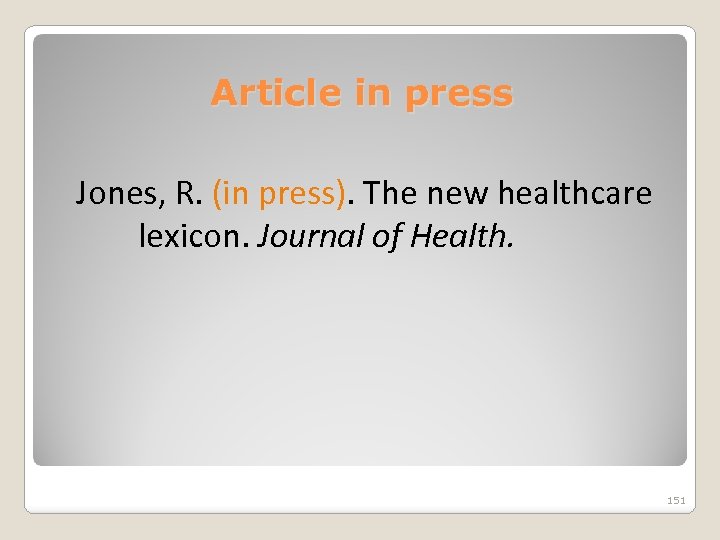 Article in press Jones, R. (in press). The new healthcare lexicon. Journal of Health. 151
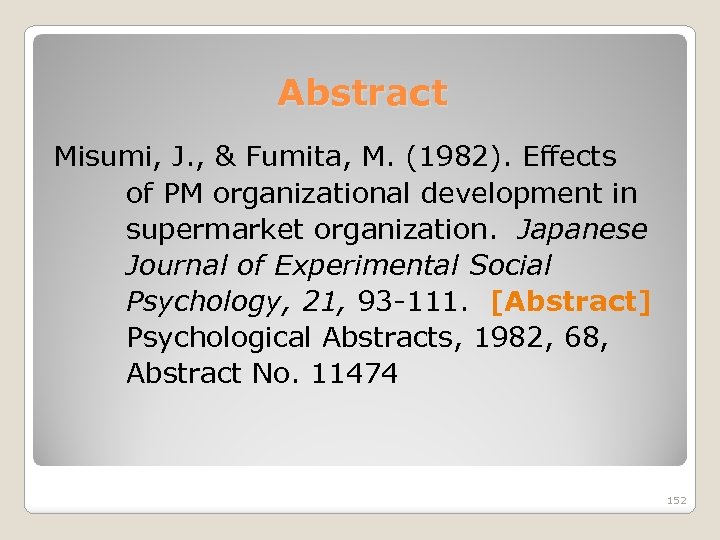 Abstract Misumi, J. , & Fumita, M. (1982). Effects of PM organizational development in supermarket organization. Japanese Journal of Experimental Social Psychology, 21, 93 -111. [Abstract] Psychological Abstracts, 1982, 68, Abstract No. 11474 152
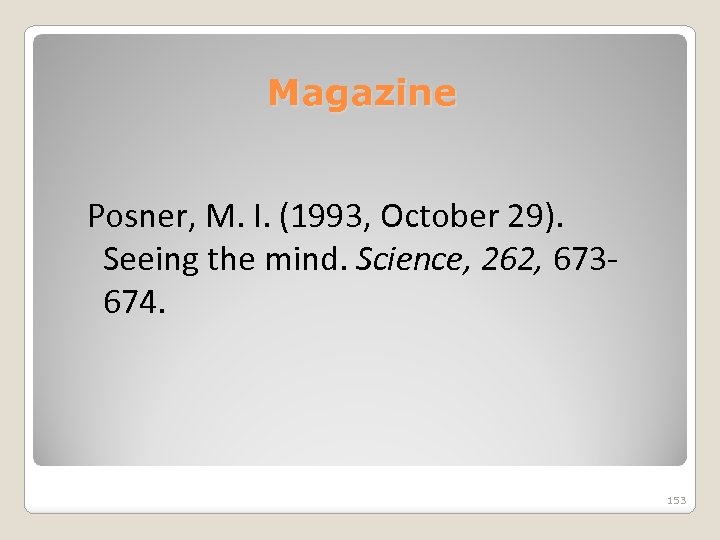 Magazine Posner, M. I. (1993, October 29). Seeing the mind. Science, 262, 673674. 153
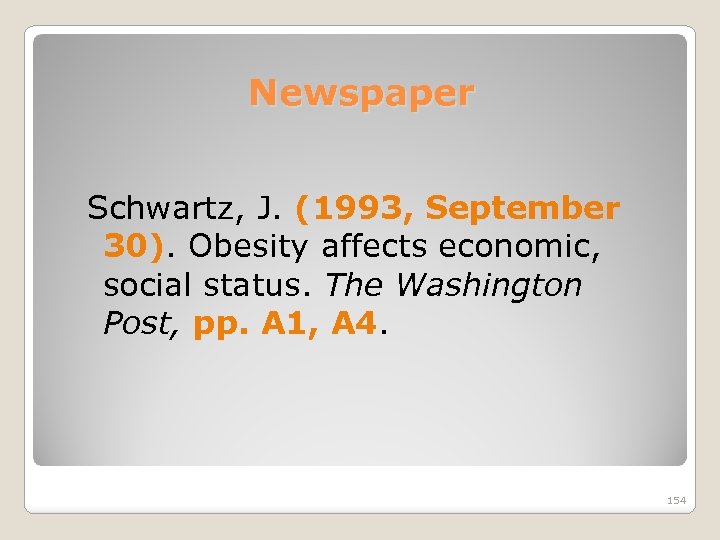 Newspaper Schwartz, J. (1993, September 30). Obesity affects economic, social status. The Washington Post, pp. A 1, A 4. 154
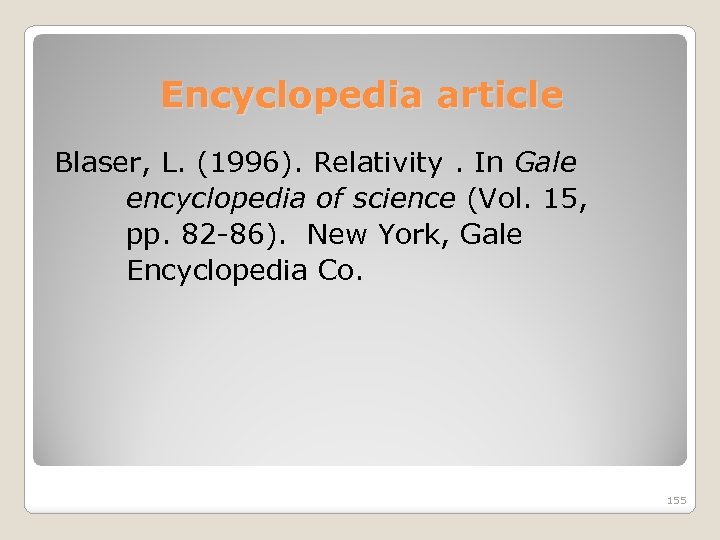 Encyclopedia article Blaser, L. (1996). Relativity. In Gale encyclopedia of science (Vol. 15, pp. 82 -86). New York, Gale Encyclopedia Co. 155
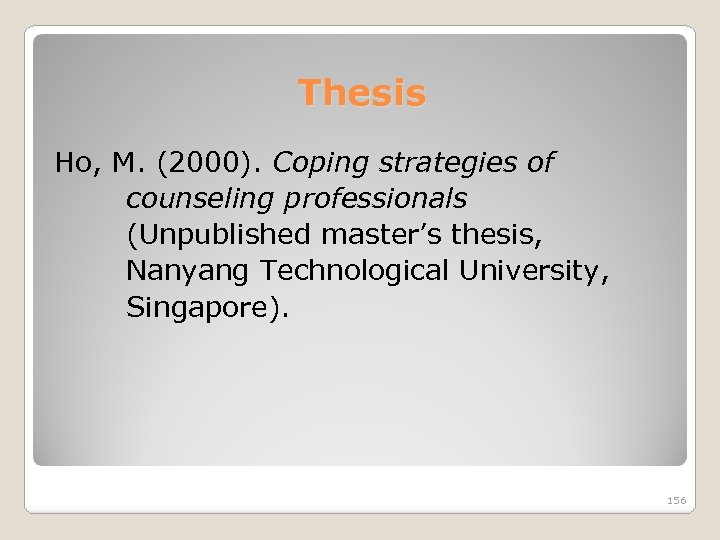 Thesis Ho, M. (2000). Coping strategies of counseling professionals (Unpublished master’s thesis, Nanyang Technological University, Singapore). 156
![Videotape National Institute on Mental Health. (1980). Drug abuse [videotape]. Bethesda: Author. 157](https://present5.com/presentation/f280e842235d0eb8248ea4bfc49ca3bb/image-157.jpg "Videotape National Institute on Mental Health. (1980). Drug abuse [videotape]. Bethesda: Author. 157") Videotape National Institute on Mental Health. (1980). Drug abuse [videotape]. Bethesda: Author. 157
Videotape National Institute on Mental Health. (1980). Drug abuse [videotape]. Bethesda: Author. 157
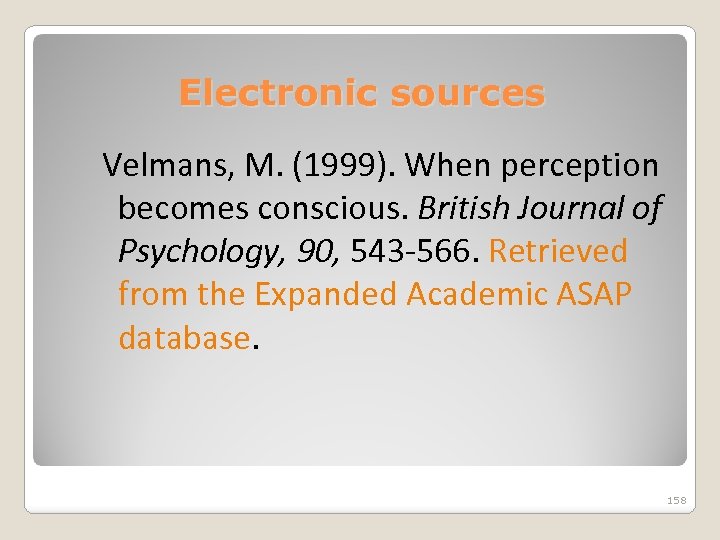 Electronic sources Velmans, M. (1999). When perception becomes conscious. British Journal of Psychology, 90, 543 -566. Retrieved from the Expanded Academic ASAP database. 158
 Web page Green, C. (2000, April 16). History & philosophy of psychology web resources. Retrieved from http: //www. yorku. ca/dept. htm 159
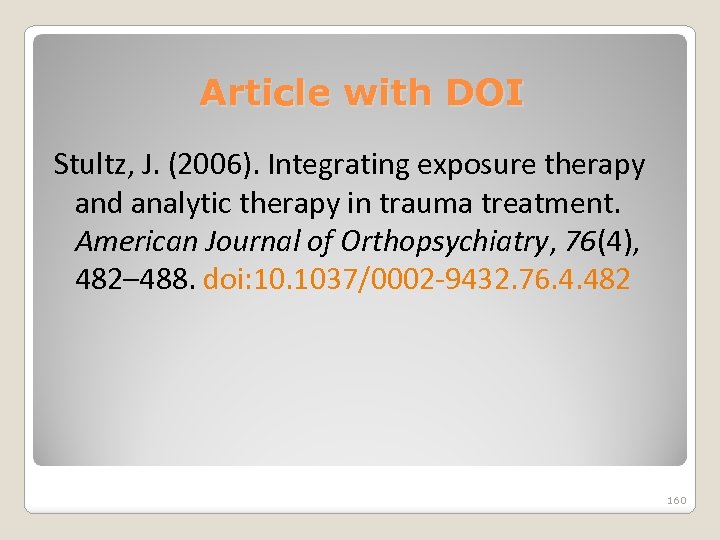 Article with DOI Stultz, J. (2006). Integrating exposure therapy and analytic therapy in trauma treatment. American Journal of Orthopsychiatry, 76(4), 482– 488. doi: 10. 1037/0002 -9432. 76. 4. 482 160
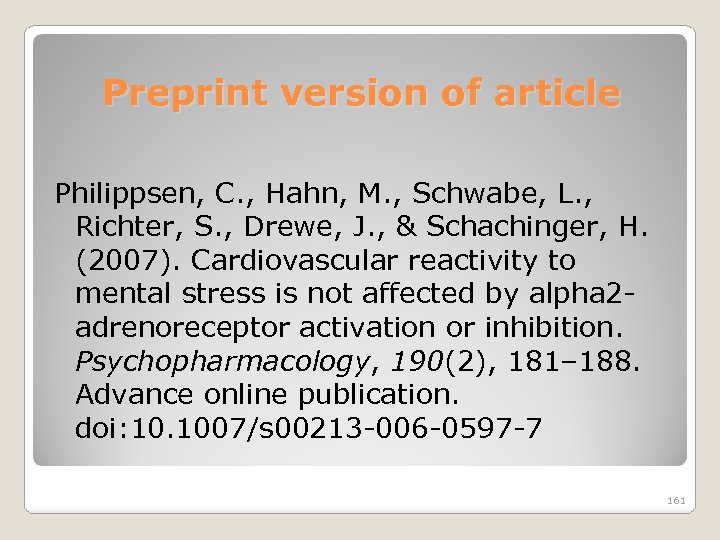 Preprint version of article Philippsen, C. , Hahn, M. , Schwabe, L. , Richter, S. , Drewe, J. , & Schachinger, H. (2007). Cardiovascular reactivity to mental stress is not affected by alpha 2 adrenoreceptor activation or inhibition. Psychopharmacology, 190(2), 181– 188. Advance online publication. doi: 10. 1007/s 00213 -006 -0597 -7 161
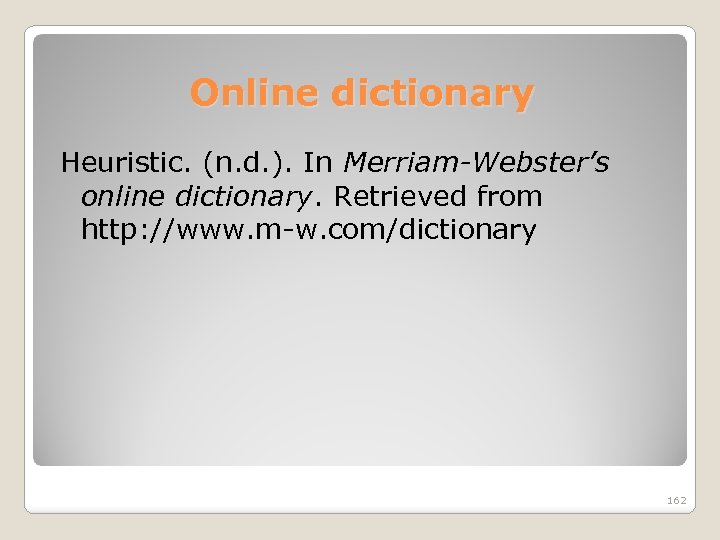 Online dictionary Heuristic. (n. d. ). In Merriam-Webster’s online dictionary. Retrieved from http: //www. m-w. com/dictionary 162
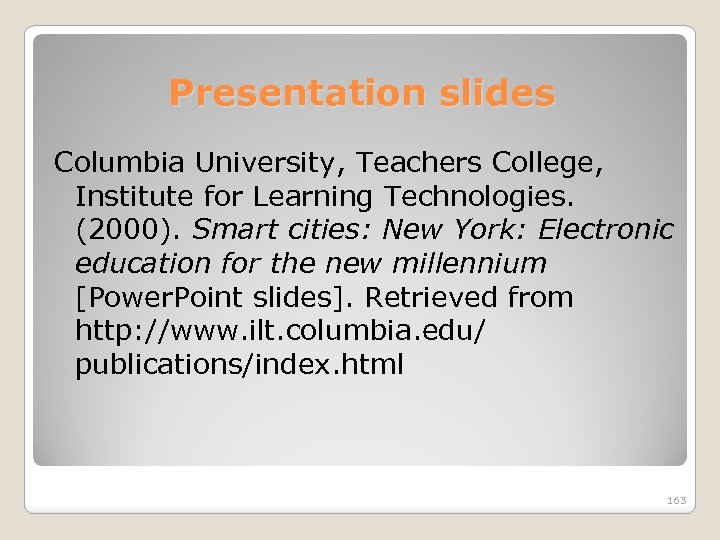 Presentation slides Columbia University, Teachers College, Institute for Learning Technologies. (2000). Smart cities: New York: Electronic education for the new millennium [Power. Point slides]. Retrieved from http: //www. ilt. columbia. edu/ publications/index. html 163
 Press release American Psychological Association. (2006, April 30). Internet use involves both pros and cons for children and adolescents [Press release]. Retrieved from http: //www. apa. org/releases/ youthwww 0406. html 164
 Message posted to an electronic mailing list Smith, S. (2006, January 5). Re: Disputed estimates of IQ [Msg 670]. Message posted to Forensic. Network electronic mailing list, archived at http: //tech. groups. yahoo. com/group/Fo rensic. Network/message/670 165
 Weblog post bfy. (2007, January 22). Re: The unfortunate prerequisites and consequences of partitioning your mind. Message posted to http: //scienceblogs. com/pharyngula/ 166
 Sample Reference List References Calvillo, D. (1999). The theoretical development of aggression. Retrieved August 21, 2002 from: http: //www. csubak. edu/~1 vega/dustin 2. html Flory, R. K. , (1969 a). Attack behavior as a function of minimum inter-food interval. Journal of the Experimental Analysis of Behavior. 12, 825 -828. Flory, R. K. , (1969 b). Attack behavior in a multiple fixed-ratio schedule of reinforcement. Psychonomic Science, 16, 383 -386. Flory, R. K. , & Everist, H. D. (1977). The effect of a response requirement on scheduleinduced aggression. Bulletin of the Psychonomic Society 9, 383 -386. Gentry, W. D. (1968). Fixed-ratio schedule-induced aggression. Journal of the Experimental Analysis of Behavior 11, 813 -817. 167
 For More Information APA Manual Website: www. apastyle. org 168
 Activity Arrange the bibliographic details provided to you according to APA.
 Avoiding Plagiarism in Research 170
 Plagiarism – Definition Taking and using the thoughts, writings, and inventions of another person as one's own Using someone’s ideas without citing or quoting; thereby, receiving credit for someone else’s intellectual effort 171
 How to avoid plagiarism Use quotes for ◦ Information that comes directly from any source ◦ Words, spoken or written, that you use directly from another person Make sure you document the source 172
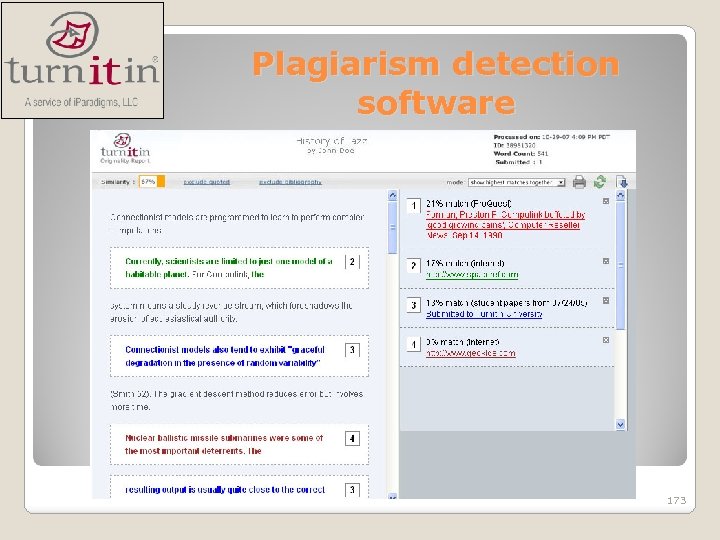 Plagiarism detection software 173
 Penalties for teachers, researchers and staff Dismissal from service Demotion to the next lower grade Warning Freezing of research grants Promotions/annual increments of the offender may be stopped University may debar the offender from sponsorship of research funding, travel grant, supervision of Ph. D. students, scholarship, fellowship or any other funded program Offender may be “Black Listed” and may NOT be eligible for employment in any academic / research organization Notification of “Black Listing” of the author may be published in the print media or may be publicized on different websites 174
 Good luck 175