 Скачать презентацию Literature and bookmarket Estonia Tauno Vahter Board member
bd2e17b5526858c7cb114a36b5d1004a.ppt
- Количество слайдов: 23




Literature and bookmarket: Estonia Tauno Vahter Board member, Estonian Publishers´ Association Board member, Estonian Literature Centre Tänapäev Publishers, editor-in-chief 21. 11. 2017
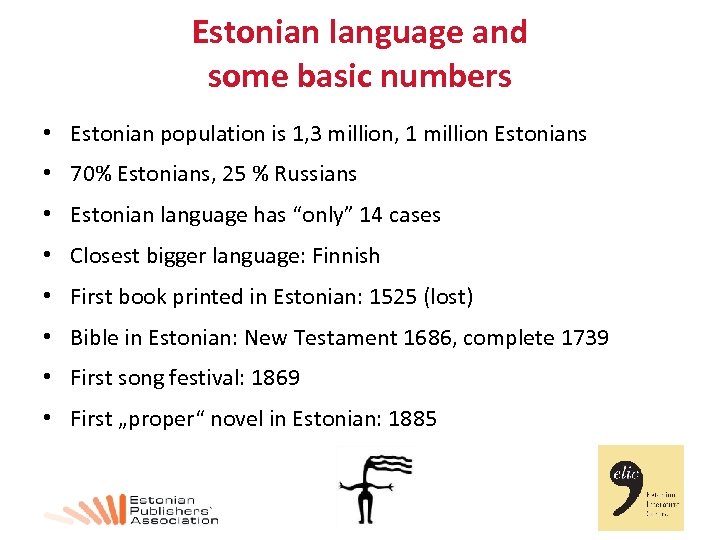
Estonian language and some basic numbers • Estonian population is 1, 3 million, 1 million Estonians • 70% Estonians, 25 % Russians • Estonian language has “only” 14 cases • Closest bigger language: Finnish • First book printed in Estonian: 1525 (lost) • Bible in Estonian: New Testament 1686, complete 1739 • First song festival: 1869 • First „proper“ novel in Estonian: 1885
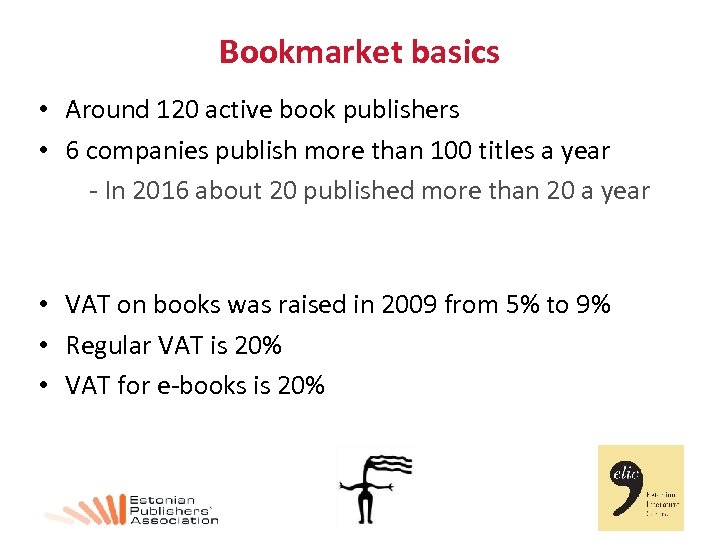
Bookmarket basics • Around 120 active book publishers • 6 companies publish more than 100 titles a year - In 2016 about 20 published more than 20 a year • VAT on books was raised in 2009 from 5% to 9% • Regular VAT is 20% • VAT for e-books is 20%
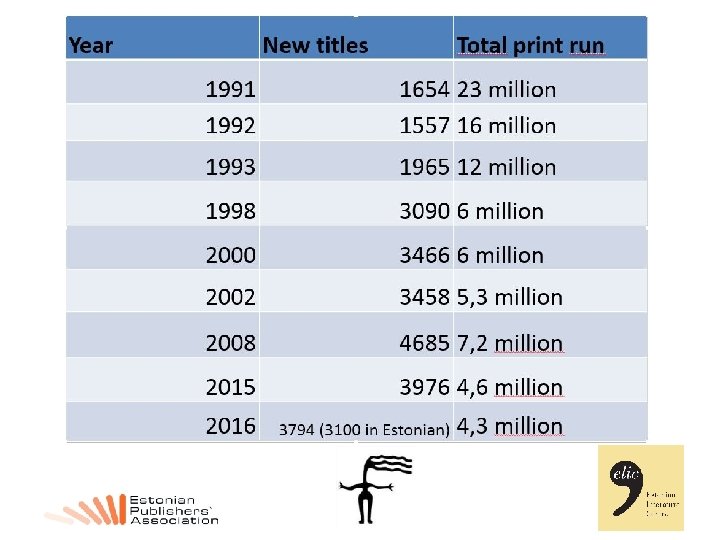
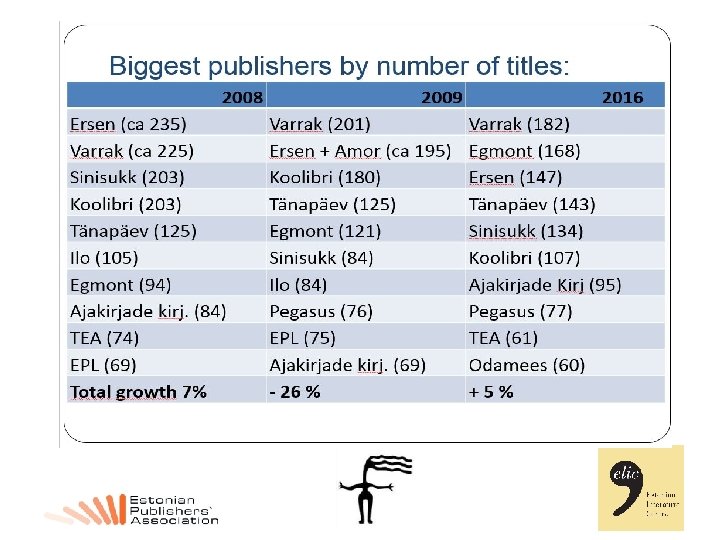
Financial data • By turnover biggest publishers are (2016 estimates): - Avita 3, 8 mln euros (3, 5 in 2008) (textbooks) - Koolibri ca 3, 6 mln (3, 5 in 2008) (mainly textbooks) - Varrak ca 3, 5 million (regular publisher, ca 30% turnover from bookclub + some retail shops) - Egmont ca 1, 5 mln (co-editions, mainly for children) - Tänapäev ca 1, 1 mln • During 2009 economic crisis sales dropped 20– 40% for different companies
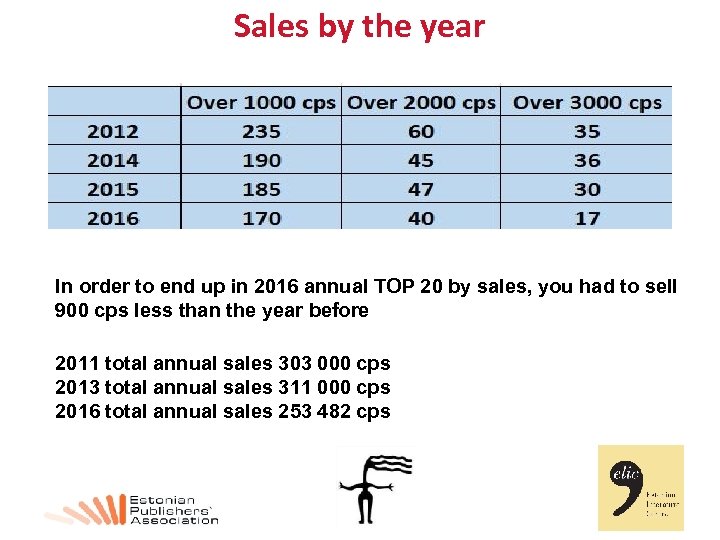
Sales by the year In order to end up in 2016 annual TOP 20 by sales, you had to sell 900 cps less than the year before 2011 total annual sales 303 000 cps 2013 total annual sales 311 000 cps 2016 total annual sales 253 482 cps
Sales channels • Most of wholesale operates through two big companies: – Apollo (15 retail shops) – Rahva Raamat (10 retail shops + supplier of most supermarkets). Market leader with ca 60% of market – No foreign companies in Estonian market now • They also own the biggest retail bookshops, which puts pressure on publishers • Both have started diagonal publishing, i. e. acting as publishers themselves (more focus on their own books, better exposure) • Their turnovers are approximately 15 million EUR • Both have lately invested heavily in new bookshops
Sales channels The total turnover of ten biggest publishers all together is ca 20 million euros. This probably makes about 50– 60 % of the whole market. As supermarket sales are growing, competition between chains is big, who gets a better deal about 15% is sold through supermarkets (and growing) internet bookstore sales generate about 7% from total
Money and print-runs • Normal first print is 800 -1000 copies. For translated fiction often less, 500– 800 copies. • Bestseller is 3000 copies, the most sold book of the year is up to 10– 12 000 cps. This is usually a book by local author. • Record print is ca 35 000 copies (biographies of an actress and a singer)
Money and print-runs • Sales of books in English is growing faster than translations. People speak several languages well. • Foreign language books ca 12– 15% • No fixed price
Government support • Cultural Endowment founded 1994, main financer of cultural projects in Estonia www. kulka. ee • 3, 5% of tobacco and alcohol tax goes to Cultural Endowment • In 2017 their budget is 28 million euros From this 12, 5% goes to literature, that is ca 3 million euros a year (application deadlines 4 times a year)
Government support • Libraries get part of the money from state and part from local municipality (% is very different in every municipality) • Depending on coalition, sometimes state wants to get out from this burden, big discussions • 1, 8 mln euros distributed between ca 600 libraries to buy new books. To some libraries it means less than 100 euros a month. • ELIC, Estonian Literature Centre www. estlit. ee • TRADUCTA, support to translations and publication of Estonian literature • http: //www. kulka. ee/programmes/traducta
E-stonia not yet into e-books • There about 10 companies operating in market, but in reality more than 90% of the e-book market is controlled by two companies: EDRK, Rahva Raamat. • E-book share from general sales is still less than 2 %. Four years ago it was 0, 5%. Growth still very slow. • 3400 titles available as e-books
E-stonia not yet into e-books • 2 years ago retail bookshops started their own e-book sales, which means heavy competition • www. edrk. ee • www. rahvaraamat. ee • Both use social DRM (watermark) and mainly epub format • Elisa subscriber service, monthly payment 9 euros. Ca 4000 monthly subscribers, 2500 titles available.
Trends in recent years • Total print runs have dropped • Average print run is 900 copies, for many even less • For translated new authors often even 500– 600 cps. Even quite famous quality fiction authors. • Quite small translated books are very expensive – print run is small – For instance – a 300 -page paperback fiction book can cost 25 euros because copyright, translation and printing costs are the same but print run is less than usual
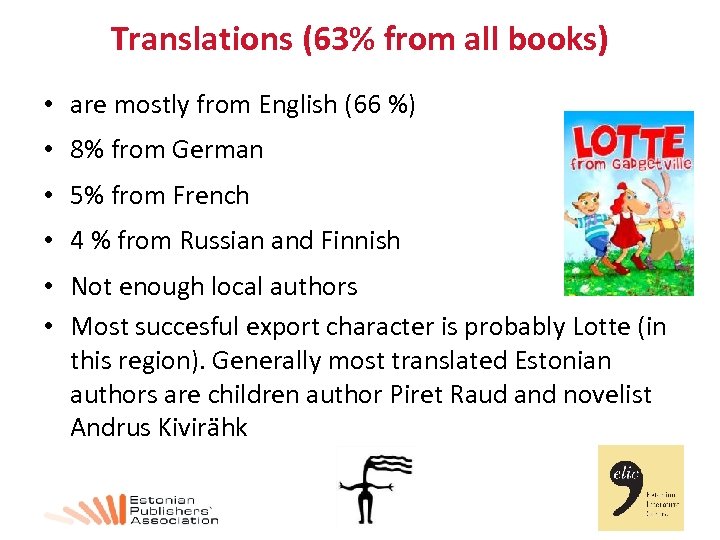
Translations (63% from all books) • are mostly from English (66 %) • 8% from German • 5% from French • 4 % from Russian and Finnish • Not enough local authors • Most succesful export character is probably Lotte (in this region). Generally most translated Estonian authors are children author Piret Raud and novelist Andrus Kivirähk
Most succesful Estonian authors abroad • Jaan Kross – “The Czars Madman”. Ca 25 languages, about an unusual German lord of the manor in early 19 th century Estonia • Andrus Kivirähk – modern humorous literature. “The Man Who Spoke Snakish”. Sold over 40 000 cps In France • Mihkel Mutt. Novels and essays often characterized with witty remarks and irony on trends in society • Indrek Hargla – “Aptechory Melchior” crime series, medieval Tallinn • Piret Raud (Children author and illustrator. ) In French, Spanish, German, Japanese, Polish, Italian, Macedonian etc • Rein Raud. Modern quality fiction
What sells in Estonia? 1. Rene Bürkland “Wise Road to Health“ (semi-esoteric), about 20 000 cps 2. Giulia Enders “The Gut” 12 000 cps 3. Riina Raudsik „Drink Sodium“ ca 7500 cps 4. Ragne Värk “Preserves” (cooking) ca 6000 5. „How to Use a Pendulum“ 6200 6. Marilyn Kerro “Reflection of faith” ca 6000 7. „Estonian animal-fairytales” ca 5000 8. Margit Härma “Vegan food“ ca 5000 Title on 20 th place sold 2800 copies Title on 30 th place sold 2000 copies
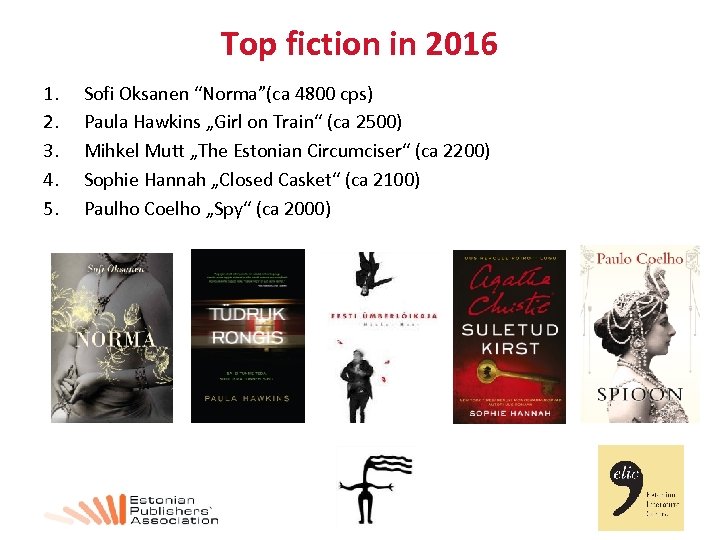
Top fiction in 2016 1. 2. 3. 4. 5. Sofi Oksanen “Norma”(ca 4800 cps) Paula Hawkins „Girl on Train“ (ca 2500) Mihkel Mutt „The Estonian Circumciser“ (ca 2200) Sophie Hannah „Closed Casket“ (ca 2100) Paulho Coelho „Spy“ (ca 2000)
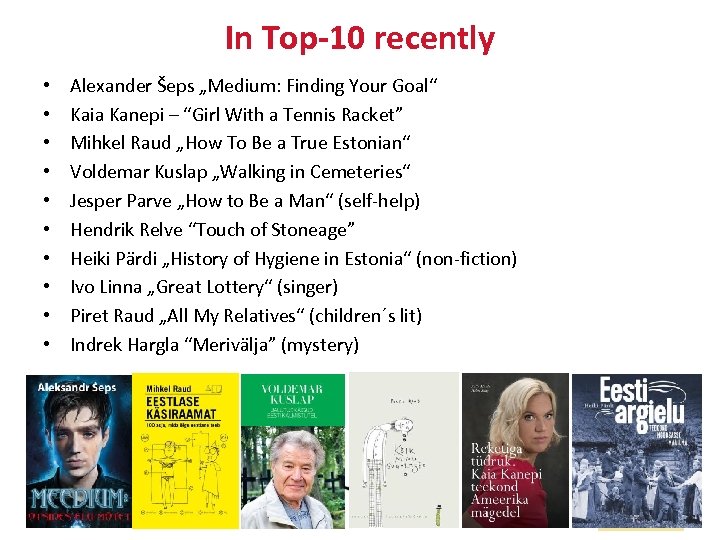
In Top-10 recently • • • Alexander Šeps „Medium: Finding Your Goal“ Kaia Kanepi – “Girl With a Tennis Racket” Mihkel Raud „How To Be a True Estonian“ Voldemar Kuslap „Walking in Cemeteries“ Jesper Parve „How to Be a Man“ (self-help) Hendrik Relve “Touch of Stoneage” Heiki Pärdi „History of Hygiene in Estonia“ (non-fiction) Ivo Linna „Great Lottery“ (singer) Piret Raud „All My Relatives“ (children´s lit) Indrek Hargla “Merivälja” (mystery)
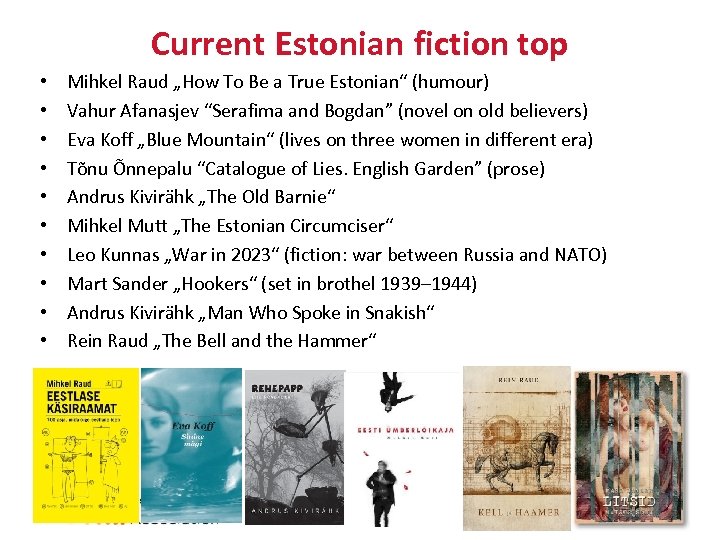
Current Estonian fiction top • • • Mihkel Raud „How To Be a True Estonian“ (humour) Vahur Afanasjev “Serafima and Bogdan” (novel on old believers) Eva Koff „Blue Mountain“ (lives on three women in different era) Tõnu Õnnepalu “Catalogue of Lies. English Garden” (prose) Andrus Kivirähk „The Old Barnie“ Mihkel Mutt „The Estonian Circumciser“ Leo Kunnas „War in 2023“ (fiction: war between Russia and NATO) Mart Sander „Hookers“ (set in brothel 1939– 1944) Andrus Kivirähk „Man Who Spoke in Snakish“ Rein Raud „The Bell and the Hammer“
THANK YOU! AITÄH!
Скачать презентацию Literature and bookmarket Estonia Tauno Vahter Board member
bd2e17b5526858c7cb114a36b5d1004a.ppt