

«Литература страны изучаемого языка и





«Литература страны изучаемого языка и проблемы перевода»
Модуль 2 Private Study № 2: from 28. 11 till 6. 12. 11 - Assessment Dates DEADLINE ---- 7. 12. 2011
PART 1. Gulliver’s Travels, “A Voyage to Brobdingnag” Read Gulliver’s Travels, “A Voyage to Brobdingnag” by J. Swift and do the tasks given in the slides below INSTRUCTIONS: Use the space provided for written-response questions. Complete sentences are not required in this section. No mark will be given for a quotation alone. A single quotation may be used more than once.
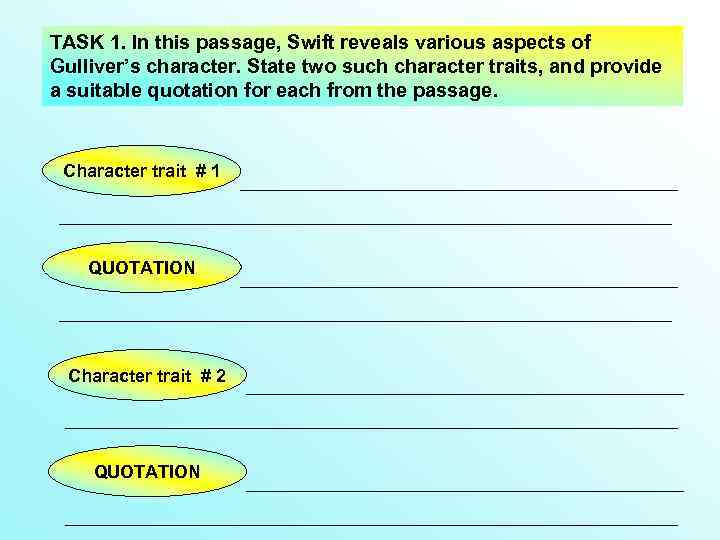
TASK 1. In this passage, Swift reveals various aspects of Gulliver’s character. State two such character traits, and provide a suitable quotation for each from the passage. Character trait # 1 QUOTATION Character trait # 2 QUOTATION
TASK 2. List three reasons why Gulliver is anxious to leave Brobdingnag. For each reason provide a suitable quotation from the passage. Reason # 1 QUOTATION
Reason # 2 QUOTATION Reason # 3 QUOTATION
PART 2. Alexander Pope TASK 1. Read The Rape of the Lock Canto III by Alexander Pope and respond to the following questions.
• Show that the passage demonstrates Pope’s description of a mock epic as “using a vast force to lift a feather. ” • With specific reference to The Rape of the Lock, discuss two targets of Pope’s ridicule.
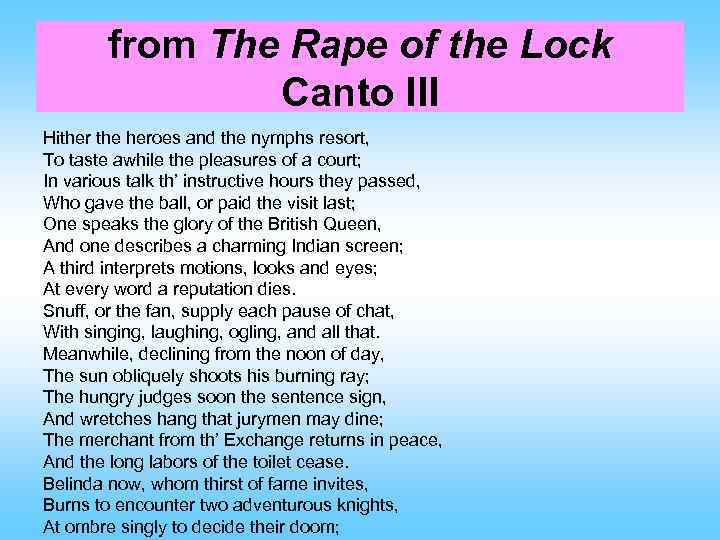
from The Rape of the Lock Canto III Hither the heroes and the nymphs resort, To taste awhile the pleasures of a court; In various talk th’ instructive hours they passed, Who gave the ball, or paid the visit last; One speaks the glory of the British Queen, And one describes a charming Indian screen; A third interprets motions, looks and eyes; At every word a reputation dies. Snuff, or the fan, supply each pause of chat, With singing, laughing, ogling, and all that. Meanwhile, declining from the noon of day, The sun obliquely shoots his burning ray; The hungry judges soon the sentence sign, And wretches hang that jurymen may dine; The merchant from th’ Exchange returns in peace, And the long labors of the toilet cease. Belinda now, whom thirst of fame invites, Burns to encounter two adventurous knights, At ombre singly to decide their doom;
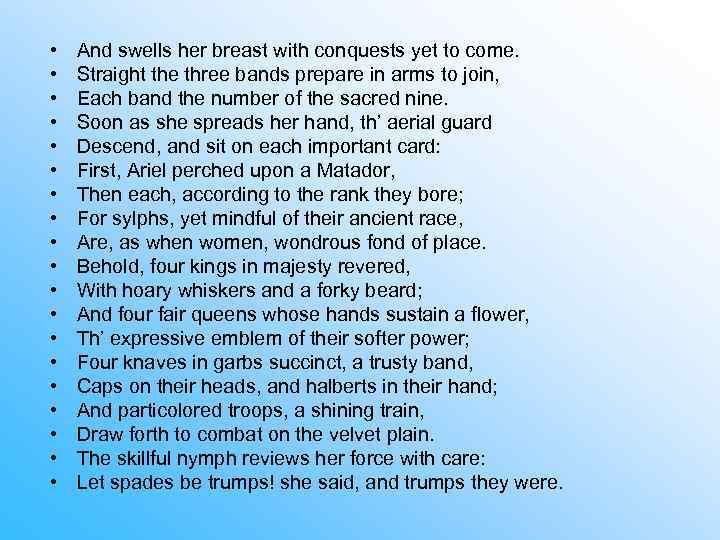
• And swells her breast with conquests yet to come. • Straight the three bands prepare in arms to join, • Each band the number of the sacred nine. • Soon as she spreads her hand, th’ aerial guard • Descend, and sit on each important card: • First, Ariel perched upon a Matador, • Then each, according to the rank they bore; • For sylphs, yet mindful of their ancient race, • Are, as when women, wondrous fond of place. • Behold, four kings in majesty revered, • With hoary whiskers and a forky beard; • And four fair queens whose hands sustain a flower, • Th’ expressive emblem of their softer power; • Four knaves in garbs succinct, a trusty band, • Caps on their heads, and halberts in their hand; • And particolored troops, a shining train, • Draw forth to combat on the velvet plain. • The skillful nymph reviews her force with care: • Let spades be trumps! she said, and trumps they were.
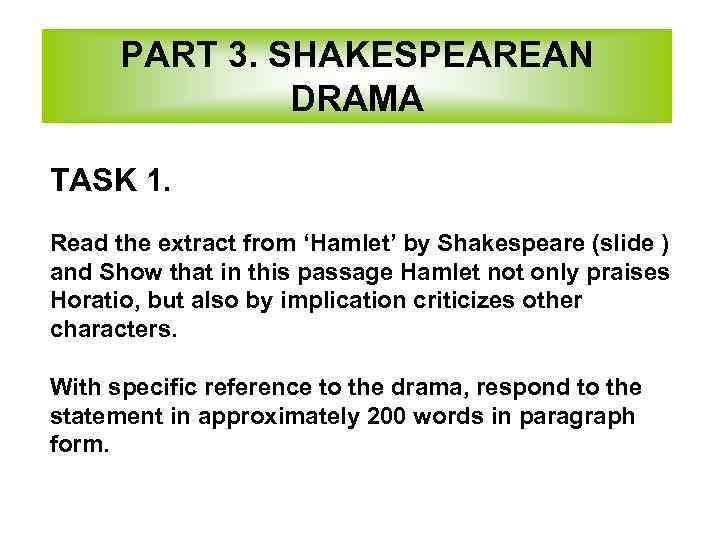
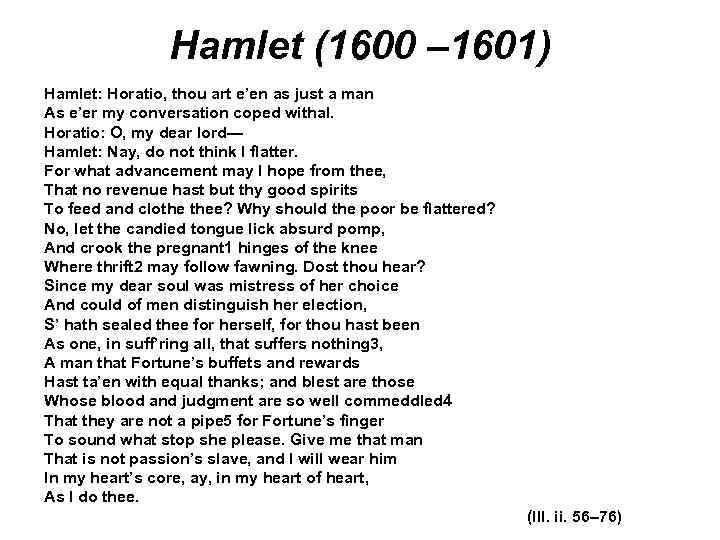
PART 3. SHAKESPEAREAN DRAMA TASK 1. Read the extract from ‘Hamlet’ by Shakespeare (slide ) and Show that in this passage Hamlet not only praises Horatio, but also by implication criticizes other characters. With specific reference to the drama, respond to the statement in approximately 200 words in paragraph form.
Hamlet (1600 – 1601) Hamlet: Horatio, thou art e’en as just a man As e’er my conversation coped withal. Horatio: O, my dear lord— Hamlet: Nay, do not think I flatter. For what advancement may I hope from thee, That no revenue hast but thy good spirits To feed and clothe thee? Why should the poor be flattered? No, let the candied tongue lick absurd pomp, And crook the pregnant 1 hinges of the knee Where thrift 2 may follow fawning. Dost thou hear? Since my dear soul was mistress of her choice And could of men distinguish her election, S’ hath sealed thee for herself, for thou hast been As one, in suff’ring all, that suffers nothing 3, A man that Fortune’s buffets and rewards Hast ta’en with equal thanks; and blest are those Whose blood and judgment are so well commeddled 4 That they are not a pipe 5 for Fortune’s finger To sound what stop she please. Give me that man That is not passion’s slave, and I will wear him In my heart’s core, ay, in my heart of heart, As I do thee. (III. ii. 56– 76)
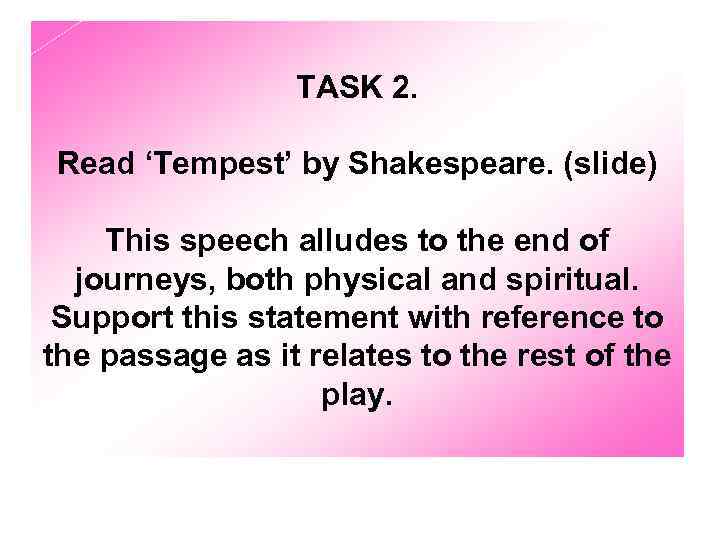
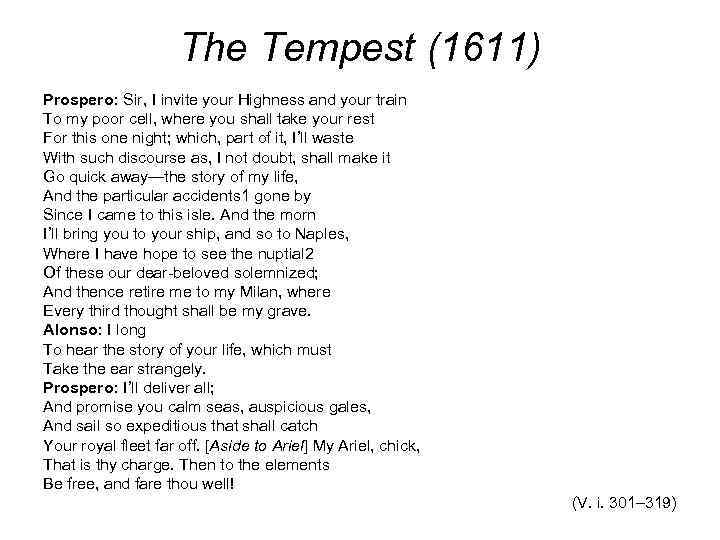
TASK 2. Read ‘Tempest’ by Shakespeare. (slide) This speech alludes to the end of journeys, both physical and spiritual. Support this statement with reference to the passage as it relates to the rest of the play.
The Tempest (1611) Prospero: Sir, I invite your Highness and your train To my poor cell, where you shall take your rest For this one night; which, part of it, I’ll waste With such discourse as, I not doubt, shall make it Go quick away—the story of my life, And the particular accidents 1 gone by Since I came to this isle. And the morn I’ll bring you to your ship, and so to Naples, Where I have hope to see the nuptial 2 Of these our dear-beloved solemnized; And thence retire me to my Milan, where Every third thought shall be my grave. Alonso: I long To hear the story of your life, which must Take the ear strangely. Prospero: I’ll deliver all; And promise you calm seas, auspicious gales, And sail so expeditious that shall catch Your royal fleet far off. [Aside to Ariel] My Ariel, chick, That is thy charge. Then to the elements Be free, and fare thou well! (V. i. 301– 319)
Part 4 • Read Paradise Lost by John Milton and show that Milton gives Satan two heroic qualities or attributes.
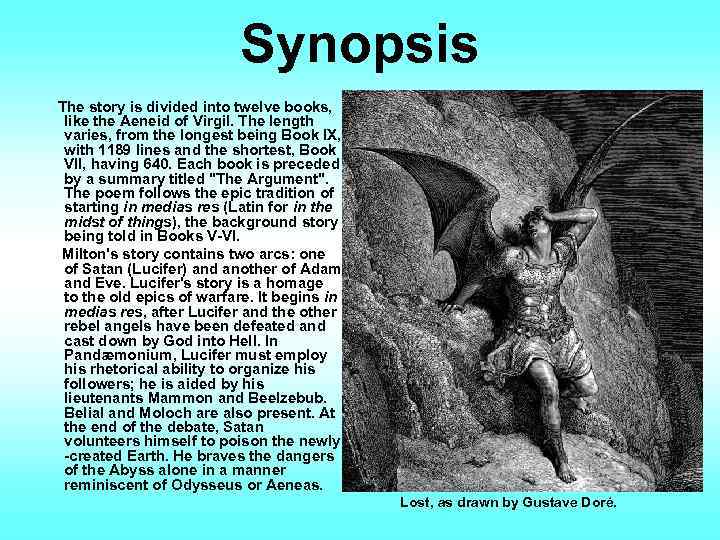
Synopsis The story is divided into twelve books, like the Aeneid of Virgil. The length varies, from the longest being Book IX, with 1189 lines and the shortest, Book VII, having 640. Each book is preceded by a summary titled "The Argument". The poem follows the epic tradition of starting in medias res (Latin for in the midst of things), the background story being told in Books V-VI. Milton's story contains two arcs: one of Satan (Lucifer) and another of Adam and Eve. Lucifer's story is a homage to the old epics of warfare. It begins in medias res, after Lucifer and the other rebel angels have been defeated and cast down by God into Hell. In Pandæmonium, Lucifer must employ his rhetorical ability to organize his followers; he is aided by his lieutenants Mammon and Beelzebub. Belial and Moloch are also present. At the end of the debate, Satan volunteers himself to poison the newly -created Earth. He braves the dangers of the Abyss alone in a manner reminiscent of Odysseus or Aeneas. Lucifer, the main protagonist of Paradise Lost, as drawn by Gustave Doré.
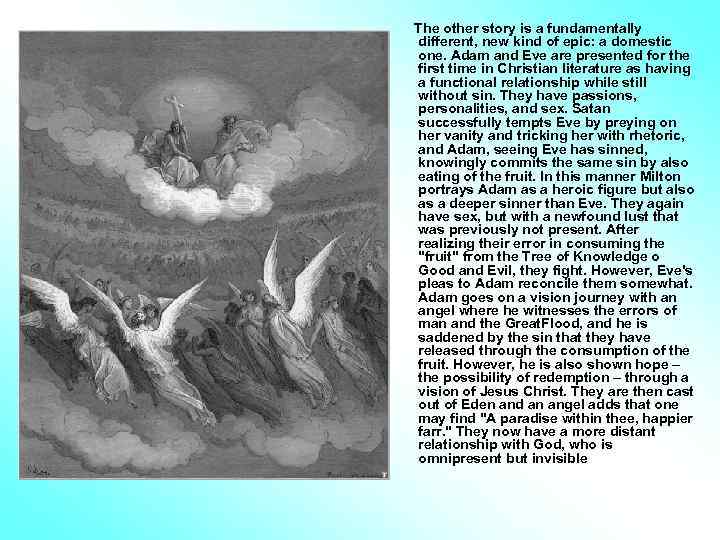
The other story is a fundamentally different, new kind of epic: a domestic one. Adam and Eve are presented for the first time in Christian literature as having a functional relationship while still without sin. They have passions, personalities, and sex. Satan successfully tempts Eve by preying on her vanity and tricking her with rhetoric, and Adam, seeing Eve has sinned, knowingly commits the same sin by also eating of the fruit. In this manner Milton portrays Adam as a heroic figure but also as a deeper sinner than Eve. They again have sex, but with a newfound lust that was previously not present. After realizing their error in consuming the "fruit" from the Tree of Knowledge o Good and Evil, they fight. However, Eve's pleas to Adam reconcile them somewhat. Adam goes on a vision journey with an angel where he witnesses the errors of man and the Great. Flood, and he is saddened by the sin that they have released through the consumption of the fruit. However, he is also shown hope – the possibility of redemption – through a vision of Jesus Christ. They are then cast out of Eden and an angel adds that one may find "A paradise within thee, happier farr. " They now have a more distant relationship with God, who is omnipresent but invisible
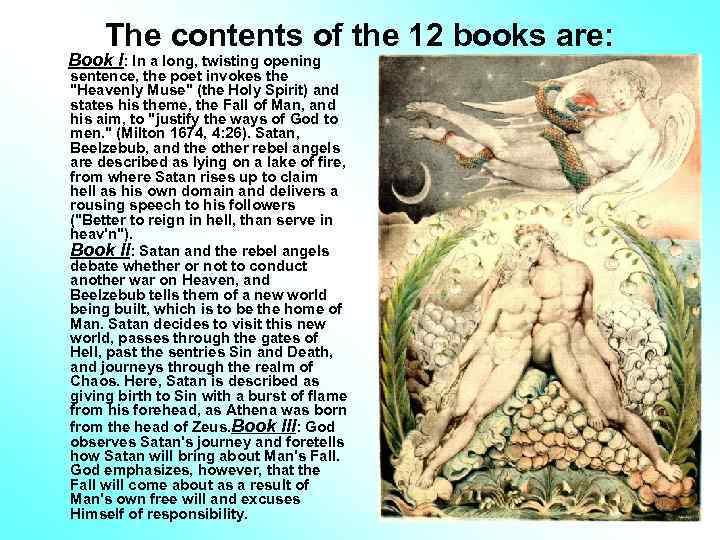
The contents of the 12 books are: Book I: In a long, twisting opening sentence, the poet invokes the "Heavenly Muse" (the Holy Spirit) and states his theme, the Fall of Man, and his aim, to "justify the ways of God to men. " (Milton 1674, 4: 26). Satan, Beelzebub, and the other rebel angels are described as lying on a lake of fire, from where Satan rises up to claim hell as his own domain and delivers a rousing speech to his followers ("Better to reign in hell, than serve in heav'n"). Book II: Satan and the rebel angels debate whether or not to conduct another war on Heaven, and Beelzebub tells them of a new world being built, which is to be the home of Man. Satan decides to visit this new world, passes through the gates of Hell, past the sentries Sin and Death, and journeys through the realm of Chaos. Here, Satan is described as giving birth to Sin with a burst of flame from his forehead, as Athena was born from the head of Zeus. Book III: God observes Satan's journey and foretells how Satan will bring about Man's Fall. God emphasizes, however, that the Fall will come about as a result of Man's own free will and excuses Himself of responsibility.
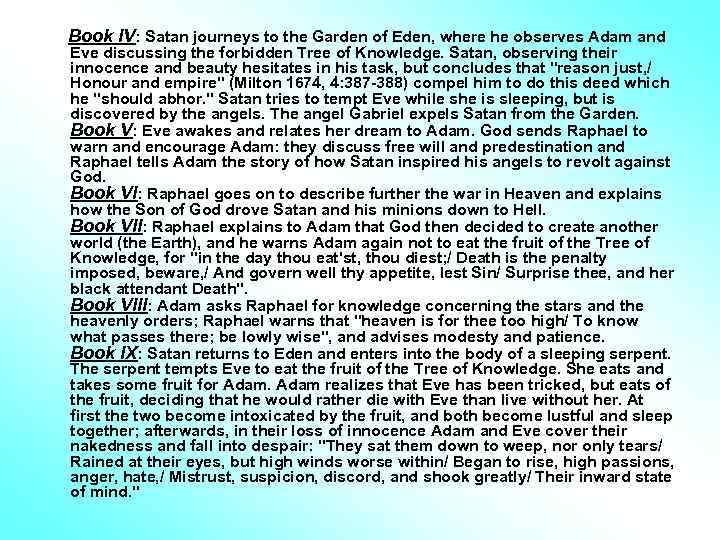
Book IV: Satan journeys to the Garden of Eden, where he observes Adam and Eve discussing the forbidden Tree of Knowledge. Satan, observing their innocence and beauty hesitates in his task, but concludes that "reason just, / Honour and empire" (Milton 1674, 4: 387 -388) compel him to do this deed which he "should abhor. " Satan tries to tempt Eve while she is sleeping, but is discovered by the angels. The angel Gabriel expels Satan from the Garden. Book V: Eve awakes and relates her dream to Adam. God sends Raphael to warn and encourage Adam: they discuss free will and predestination and Raphael tells Adam the story of how Satan inspired his angels to revolt against God. Book VI: Raphael goes on to describe further the war in Heaven and explains how the Son of God drove Satan and his minions down to Hell. Book VII: Raphael explains to Adam that God then decided to create another world (the Earth), and he warns Adam again not to eat the fruit of the Tree of Knowledge, for "in the day thou eat'st, thou diest; / Death is the penalty imposed, beware, / And govern well thy appetite, lest Sin/ Surprise thee, and her black attendant Death". Book VIII: Adam asks Raphael for knowledge concerning the stars and the heavenly orders; Raphael warns that "heaven is for thee too high/ To know what passes there; be lowly wise", and advises modesty and patience. Book IX: Satan returns to Eden and enters into the body of a sleeping serpent. The serpent tempts Eve to eat the fruit of the Tree of Knowledge. She eats and takes some fruit for Adam realizes that Eve has been tricked, but eats of the fruit, deciding that he would rather die with Eve than live without her. At first the two become intoxicated by the fruit, and both become lustful and sleep together; afterwards, in their loss of innocence Adam and Eve cover their nakedness and fall into despair: "They sat them down to weep, nor only tears/ Rained at their eyes, but high winds worse within/ Began to rise, high passions, anger, hate, / Mistrust, suspicion, discord, and shook greatly/ Their inward state of mind. "
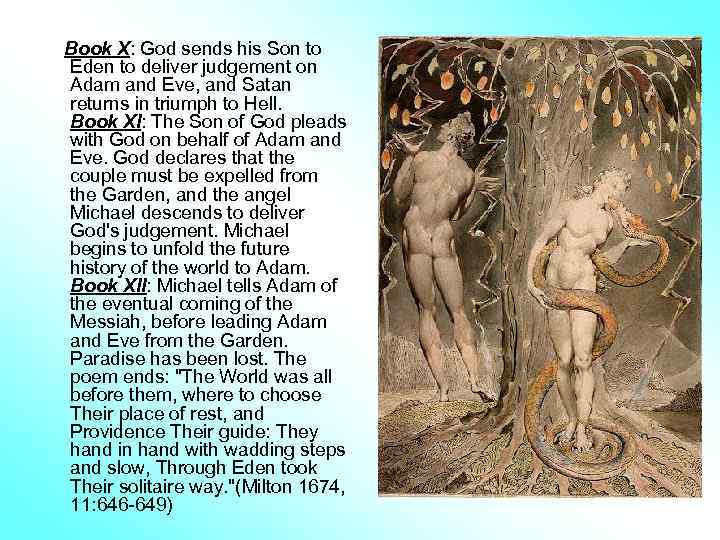
Book X: God sends his Son to Eden to deliver judgement on Adam and Eve, and Satan returns in triumph to Hell. Book XI: The Son of God pleads with God on behalf of Adam and Eve. God declares that the couple must be expelled from the Garden, and the angel Michael descends to deliver God's judgement. Michael begins to unfold the future history of the world to Adam. Book XII: Michael tells Adam of the eventual coming of the Messiah, before leading Adam and Eve from the Garden. Paradise has been lost. The poem ends: "The World was all before them, where to choose Their place of rest, and Providence Their guide: They hand in hand with wadding steps and slow, Through Eden took Their solitaire way. "(Milton 1674, 11: 646 -649)
Problem questions • What is the difference between the works of 17 th century and the works of the previous epoch? • What historical events may have influenced the works of 17 th century? • Why is the literature of the 17 th century considered as a literary epoch of Restoration? • Why is “Paradise Lost” the greatest work reflecting the Revolution in English literature?
Control • Saimkulova Sh. O. • E-mail: sholpan-757@inbox. ru • Contact hours: everyday, 14. 00 -16. 00 • Where: 3 -building, room 303
Self-assessment I can I know